
You do not need another Pinterest campaign type simply because it exists. You need to know whether someone who has not named your product yet can recognize it visually, click it, and reach a page that confirms the same choice.
That is the practical case for Pinterest Visual Search Ads. The query is partly an image, the ad competes during product exploration, and the landing page has to continue the comparison without introducing doubt. Here is how to decide whether the format fits your catalog, design a useful test, and connect the resulting insights to your wider search and AI visibility strategy.
Visual Search Ads change what counts as a query
A conventional search ad responds to words. A visual search placement can respond to the object, style, color, setting, or product relationship visible on the screen, while still considering keywords.
Pinterest Visual Search Ads can appear in Pinterest Search Results and Pin closeups, combining keyword relevance with Pinterest’s visual understanding of images, products, and intent. Advertisers can bid for a prominent response and send the shopper directly to their website.
This does not make keywords obsolete. It makes them one part of a richer signal. Someone may type a broad phrase, open an image that reflects the desired look, and then compare visually similar options. Your ad has to make sense in that sequence even when the shopper has not supplied an exact product name.
For the marketer, the job changes in three ways:
- The product’s appearance must communicate the quality that makes it relevant. A hidden benefit cannot do all the work at the impression stage.
- The promoted product must fit the visual idea being explored, not merely share a broad category or keyword.
- The destination page must preserve the image, variant, context, and offer that earned the click.
Pinterest reports more than 80 billion searches per month, with the vast majority described as visual and more than half as commercially oriented. Those are platform-supplied scale figures, not a forecast for your account. Commercial intent can mean researching, comparing, saving, or buying. Your test still has to determine which of those behaviors produces economic value for you.
The format is designed for lower-funnel objectives and can work with Pinterest Performance+, but “lower funnel” should not be read as “ready to purchase immediately.” The useful opportunity is to enter the decision while the shopper is narrowing the look, product, or category they want.
Decide whether the format deserves a test
The first qualification is not whether your brand has attractive images. It is whether a visible characteristic carries meaningful buying intent.
A quick fit test
Visual Search Ads are worth evaluating when most of the following are true:
- People can distinguish relevant choices through visible attributes such as form, finish, pattern, silhouette, layout, color, or use context.
- Your catalog contains products that are close enough to a shopper’s inspiration to satisfy the same need, rather than merely belonging to the same department.
- Your product pages can open on the exact item or variant represented in the ad.
- You can measure activity beyond impressions and saves, including qualified site visits and business outcomes.
- Your team can isolate a product group, creative question, or targeting question instead of changing the entire account at once.
- Your commercial model can support paid traffic while shoppers are still comparing options.
Delay the test if the catalog is frequently out of stock, the advertised visual leads to a generic category page, or the decisive benefit is almost entirely invisible and difficult to establish on the landing page. Visual reach will not repair a broken handoff.
Access is another qualification. Pinterest announced the format for beta rollout to eligible advertisers across its advertising markets. That wording does not guarantee that every account has the feature. Confirm availability in your account or with your Pinterest contact before building a launch schedule around it.
Key takeaways
- A visual query adds image-based intent; it does not eliminate keyword relevance.
- The strongest test candidates are products whose visible attributes affect the purchase decision.
- Creative, product selection, and landing-page continuity should be planned as one system.
- Beta access is a reason to run a controlled experiment, not a reason to assume a new source of profitable scale.
- Platform engagement is useful diagnostic evidence, but conversion and incremental business value should determine whether you expand the campaign.
Build the campaign around visual continuity

A good first campaign answers one commercial question. It should not attempt to prove that visual search works for every product, audience, creative style, and objective at the same time.
- Write the test claim before configuring the campaign. For example, you might test whether product-focused imagery or contextual imagery attracts visitors who are more likely to reach a product decision. Phrase the claim so the result can change what you do next.
- Select a coherent product group. Organize it around the visual decision the shopper is making, not merely your internal merchandising hierarchy. Products grouped together should solve a similar need and present a recognizable visual relationship.
- Audit product readiness. Confirm that the selected items have usable inventory, commercially acceptable economics, accurate offer information, and destination pages that represent the promoted variants.
- Prepare creative that reveals the decision-relevant attribute. A styled scene can establish context, while a clear product view can establish detail. Use variations to answer a defined question rather than producing arbitrary volume.
- Match each ad to the closest useful destination. The image, product name, variant, price, availability, and primary promise should not appear to change after the click.
- Record the baseline and decision rule. Identify the existing campaign, product group, or traffic source that will serve as the comparison. Decide which primary outcome would justify expansion and which guardrails would stop it.
The fourth and fifth steps are where many otherwise promising tests fail. An image can earn attention because of one finish, arrangement, or style, only for the destination to foreground a different variation. The visitor then has to reconstruct the connection that the ad should have preserved. That friction will often appear as weak post-click performance rather than an obvious creative error.
Use Priority Products as a business constraint
Performance+ is also gaining a feature called Priority Products, which lets advertisers emphasize selected products for seasonal launches, promotions, or category pushes while retaining automated optimization.
If the option is available in your account, use it to communicate a genuine merchandising priority. A new launch, a promotion, or a strategically important category can justify preference. Do not use it to force weak products into delivery merely because an internal team wants exposure. Product priority directs automation; it does not turn an unsuitable item into a strong response to visual intent.
Keep a written record of why each item was prioritized. That lets you separate a platform-learning problem from a business constraint later. If performance is weak, you will know whether the system chose the product freely or whether your instruction narrowed its choices.
Measure the test without mistaking activity for impact
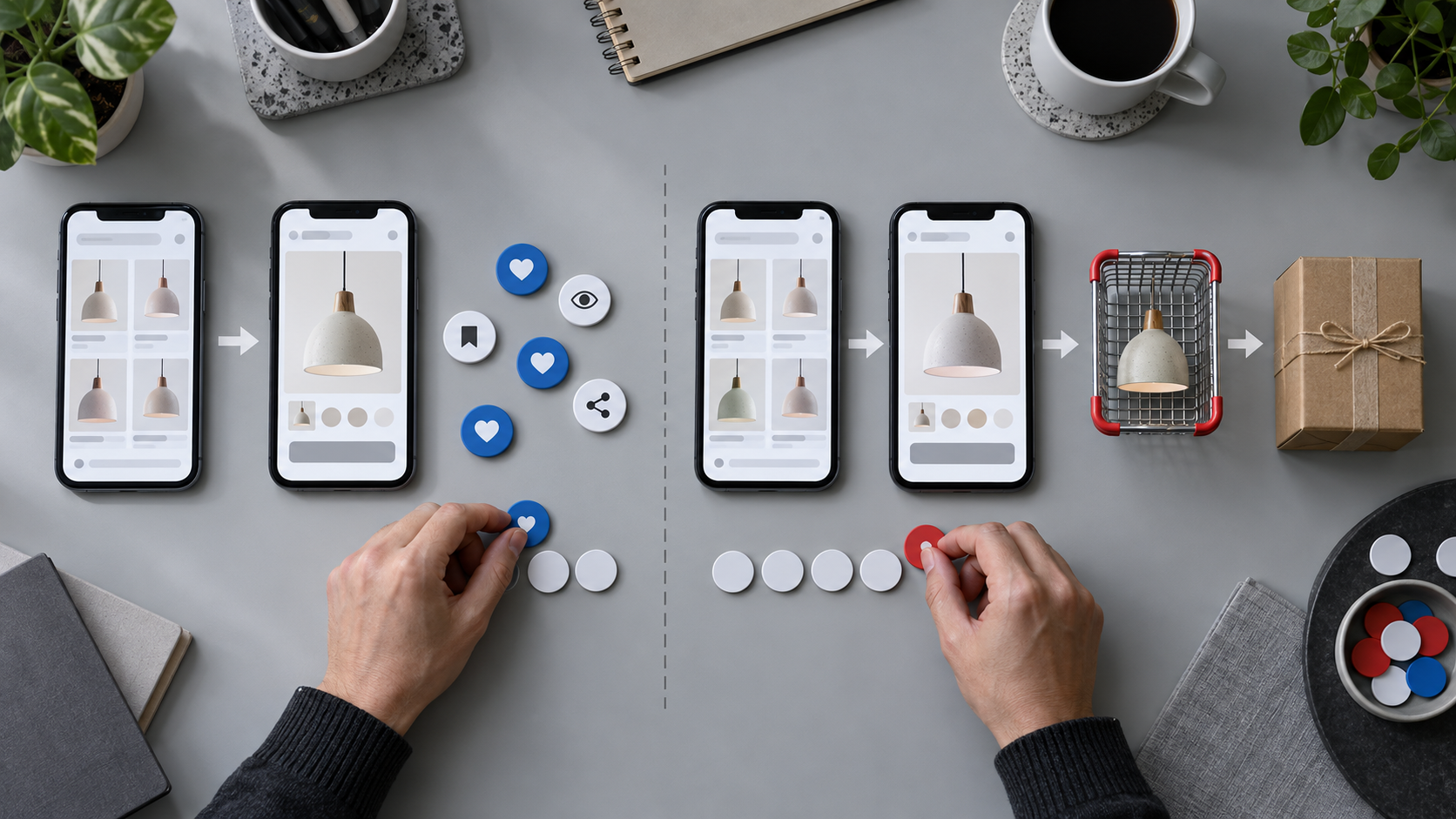
Visual discovery naturally produces intermediate behavior. People inspect, compare, and save. Those actions can explain what is happening, but they are not interchangeable with revenue.
Pinterest is introducing self-serve A/B testing for creative and targeting, including within Performance+. When that capability is available, use it to isolate one decision at a time. Compare creative in one test and targeting in another. Changing both at once may produce a winner without revealing why it won.
A practical scorecard should move from delivery to business value:
| Question | Signals to inspect | What the result should change |
|---|---|---|
| Did the campaign reach the intended product opportunity? | Delivery by planned product group and creative variation | If delivery concentrates on the wrong items, revise the product scope or priority instructions before judging the format. |
| Did the visual match create qualified interest? | Outbound clicks, landing-page arrival, product engagement, and progression toward a purchase action | If the ad earns attention but the visit ends quickly, inspect visual and offer continuity before increasing spend. |
| Did the interest produce commercial value? | Conversions, acquisition cost, revenue, and return on ad spend using consistently defined attribution | If engagement rises without acceptable business outcomes, treat the campaign as a learning result rather than a scaling result. |
| Did the campaign add value beyond activity you would have received anyway? | Incrementality evidence from a suitable holdout, geographic comparison, or other controlled method where feasible | If only platform-attributed results are available, label that limitation instead of presenting attribution as proven lift. |
Choose the primary metric before reviewing the outcome. Otherwise, a disappointing conversion test can quietly become a successful engagement test after the fact. Supporting metrics should explain the primary result, not replace it.
Keep the product scope, landing experience, and measurement definitions stable during a comparison. If a promotion, inventory change, tracking update, or site redesign occurs during the test, record it. Those events can alter the result without saying anything meaningful about visual search.
Do not borrow performance claims from adjacent Pinterest products. A result associated with an app-install objective, for example, is not evidence that Visual Search Ads will produce the same improvement for an ecommerce purchase campaign. Each format, objective, and business model needs its own baseline.
Use paid-search learning to improve broader discoverability
Visual Search Ads are not a shortcut to SEO, answer engine optimization, or generative engine optimization. They can, however, expose the visual language people use before they know the precise words for a product.
Pinterest Intelligence is designed to interpret images, products, tastes, and intent. Do not jump from that fact to the assumption that adding more keywords to image fields or Product JSON-LD will improve an ad auction. No direct relationship of that kind has been established. Keyword stuffing also makes product information less useful to people and other systems.
Instead, turn campaign learning into a disciplined content workflow:
- Record the visible attribute, use context, or product relationship represented by each meaningful creative variation.
- Compare attention with downstream behavior. A visual theme deserves broader use only when it attracts the right visitor and supports the intended business outcome.
- Reflect validated language in the appropriate page elements: clear product names, visible variant descriptions, useful category copy, concise accessibility-focused alternative text, and customer-facing answers about fit or use.
- Keep Product structured data accurate and consistent with the visible page where it applies. Mark up the real product and offer; do not treat schema as a hidden advertising copy field.
- Separate channel-specific findings from durable customer language. A concept that performs inside Pinterest may inspire a content test elsewhere, but it does not automatically predict Google rankings or inclusion in an AI-generated answer.
This is where paid visual discovery can contribute to an SEO and GEO program without overclaiming. It gives you evidence about how people recognize and compare products. Your site can then explain those products more clearly in text, imagery, page structure, and structured data. Clarity helps users and gives search and AI systems cleaner information to interpret, but it is not a guarantee of visibility.
Your first move should be small and concrete. Choose a coherent product set, identify the visible characteristic that carries buying intent, audit the Pin-to-page handoff, and write one testable commercial question. If you cannot define the comparison or measure the outcome, wait. If you can, the beta becomes a way to learn whether visual intent is profitable for your catalog rather than another placement competing for unexamined budget.
References

Leave a Reply