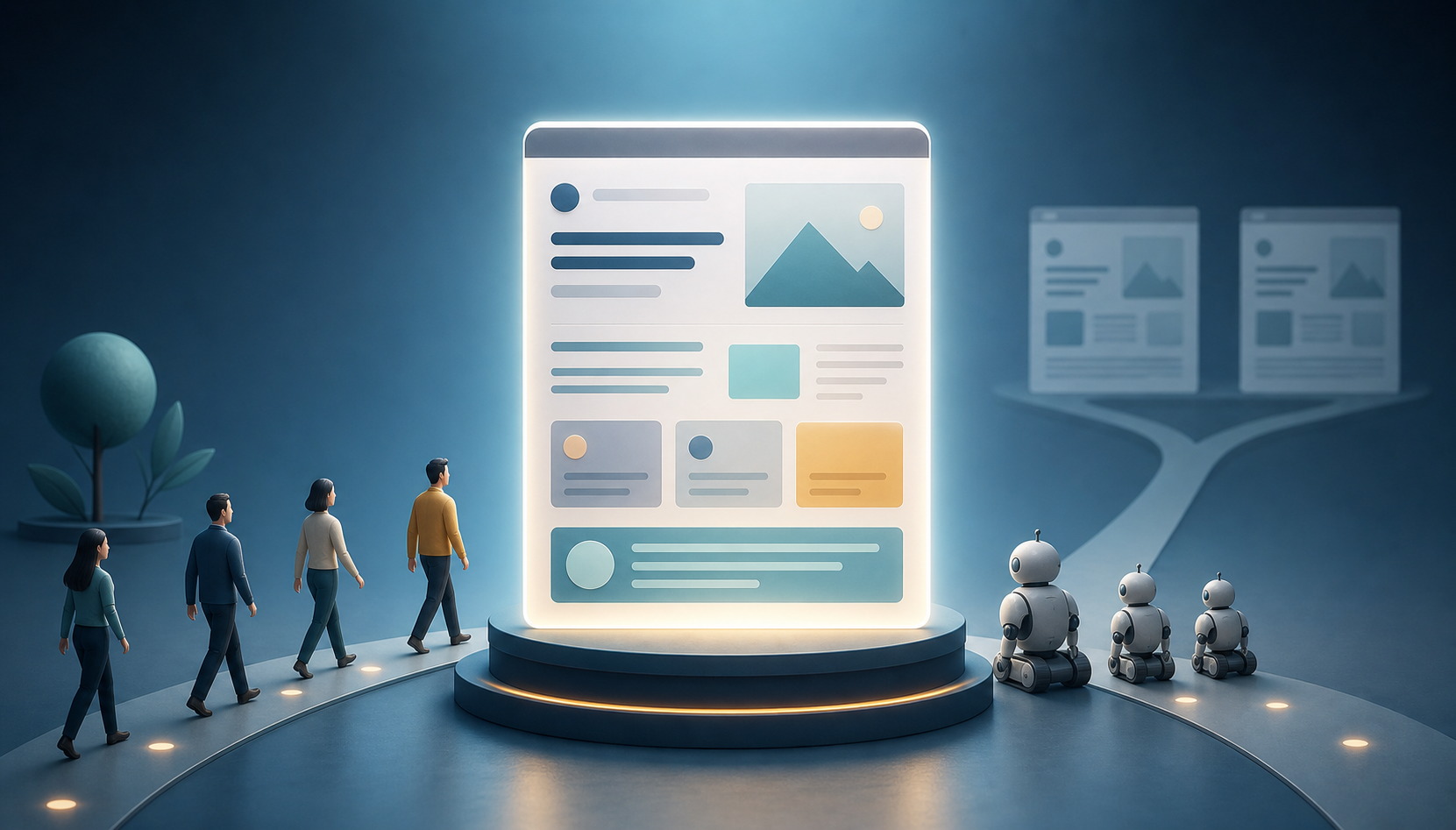
You are considering a markdown version of every page because cleaner text seems easier for an LLM to consume. The idea sounds tidy: keep the normal HTML for people, give crawlers a stripped-down .md page, and hope the machine-readable copy earns more visibility in AI answers.
Do not make that your default. A separate, bot-oriented markdown mirror adds another crawlable URL and another copy of your content without solving a demonstrated parsing problem. If its content differs from the page people see, the tactic can also cross into cloaking. Your safer and more durable approach is to make one public page clear, complete, structured, and consistent for every visitor.
Use one public page as the authoritative answer
Normal HTML is already machine-readable. Language models have long been able to read and parse ordinary web pages, so an HTML-to-markdown conversion does not automatically remove a barrier between your content and an AI system. That is why Google and Bing representatives advise against separate pages created specifically for LLMs.
The important distinction is not HTML versus markdown. It is a public resource with an independent purpose versus a shadow copy made only for crawlers.
- A normal public HTML page: This should remain your primary page. It serves users, search crawlers, and AI systems from the same maintained content.
- A downloadable markdown document people intentionally use: This can have a legitimate purpose. Its value comes from being a real user-facing resource, not from its file extension.
- A complete public documentation set authored in markdown: The format itself is not the problem. If the documents are the actual product people read, they are not merely crawler mirrors.
- A second URL containing the same copy for bots: This creates duplication and maintenance work without a clear need.
- A markdown response shown only when a crawler user agent requests the page: This is the highest-risk pattern because the server is deliberately changing what it provides according to visitor identity.
Use a simple test before creating another representation: would a person, customer, developer, or partner deliberately visit or download it? If the only answer is that an LLM might prefer it, keep working on the public page instead.
Why a bot-only markdown mirror creates avoidable risk
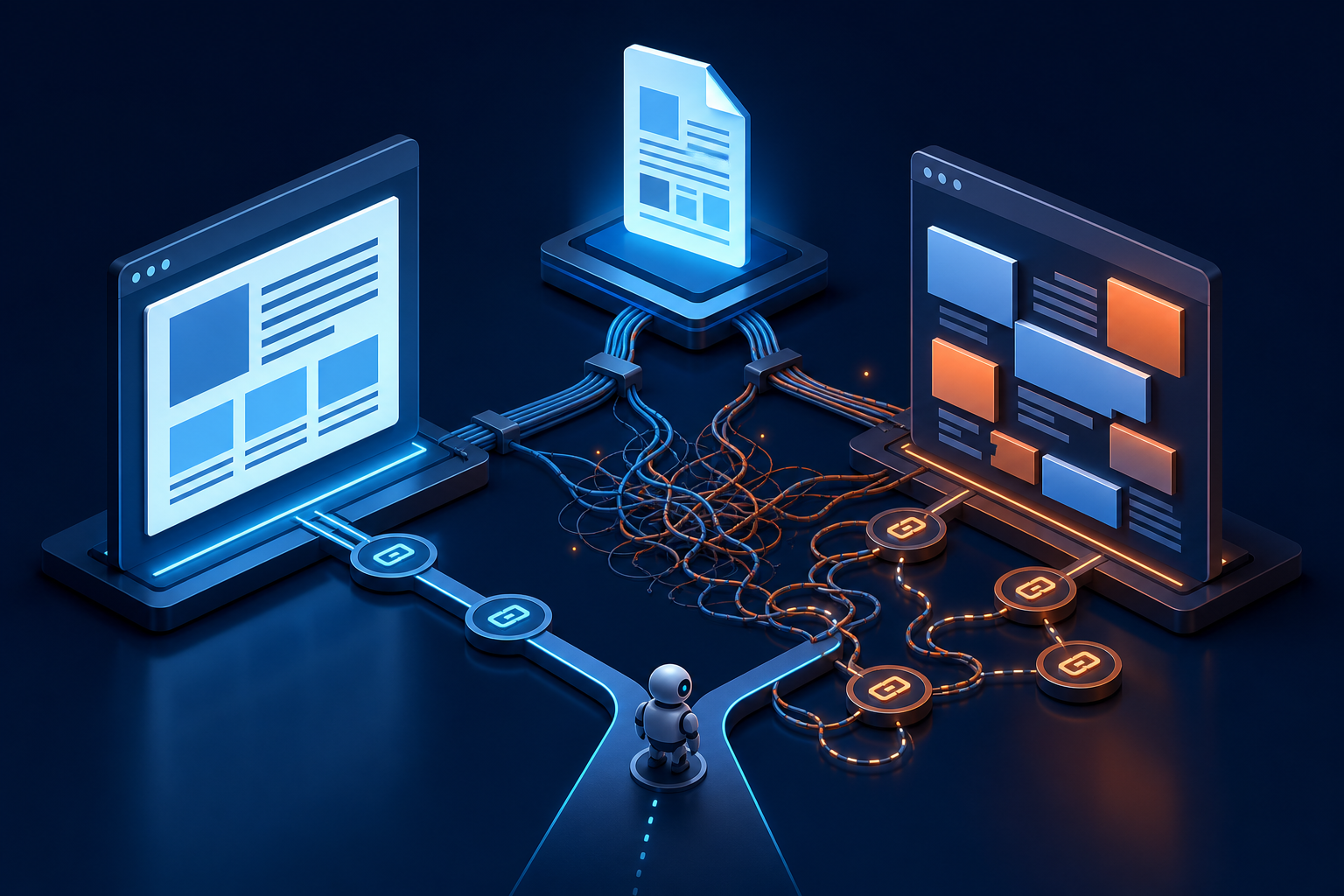
Both versions may still be crawled and compared
A second format does not necessarily replace crawling of the first. Bing has indicated that it may crawl the normal page anyway to check similarity. You can therefore create more crawl activity, not less, while giving the search engine two versions whose relationship it must interpret.
This matters even when your first markdown export is perfectly accurate. Every additional URL becomes another artifact that your publishing workflow must generate, link, update, test, and retire. The benefit is speculative; the operational burden is immediate.
The copies will eventually drift
Duplicate representations rarely fail dramatically on launch day. They fail quietly after the main template changes. A price, product name, eligibility condition, author detail, internal link, or correction is updated in HTML but not in the markdown exporter. The machine-oriented page then becomes the less reliable version of the same answer.
Human readers also provide an informal quality-control layer. They encounter broken layouts, stale claims, missing links, and confusing passages on the page your team regularly reviews. A bot-only output can remain broken because nobody uses it as a person would. Search guidance specifically warns that non-user versions are often neglected for this reason.
Material differences can become cloaking
You do not need to send byte-for-byte identical files to every client. A browser may receive styling, navigation, scripts, and interactive controls that do not belong in a plain-text representation. The problem begins when crawler detection changes the substantive page: its main claims, named entities, product details, links, availability, or overall meaning.
Serving one message to people and a different one to crawlers can be treated as cloaking and violate Google policy. Calling the alternate response markdown, JSON, an AI feed, or an optimization layer does not change that underlying relationship. If a machine is being given content a user cannot reach and verify, stop and examine why.
Make the HTML page easier to understand instead
The useful work is not converting syntax. It is reducing ambiguity in the page everyone receives. That improves the same resource for readers, conventional search systems, and AI-driven discovery without creating a parallel publishing system.
- Answer the primary question in visible page content. Do not reserve the concise explanation, definition, comparison, or conclusion for a crawler payload. A reader should be able to find the answer on the public URL.
- Give each section a descriptive heading. Headings such as Benefits or Details provide little context. State the decision, condition, or question the section resolves.
- Use lists only when the information is actually a sequence or set. Lists clarify steps, requirements, and criteria. Connected reasoning still belongs in paragraphs.
- Name entities consistently. Use the same product, organization, person, location, and feature names throughout the page. Explain abbreviations when they first appear instead of making a system infer whether two labels mean the same thing.
- Keep important qualifications beside the claim. If a condition changes an answer, do not bury it in a distant note. Clear scope is more valuable than an artificially short sentence.
- Put structured data on the public page. Bing has explicitly expressed a preference for schema embedded in pages. The markup should describe the content users can actually see rather than introduce separate claims for crawlers.
- Keep useful images. The ability of language models to process images undermines the assumption that every visual page must be converted into plain text. Use meaningful captions, labels, and alternative text where appropriate, while keeping essential facts available in the page content.
- Maintain stable internal paths to the page. Navigation and contextual links help people and crawlers reach the same authoritative resource. A hidden markdown mirror does not repair a page that is difficult to discover within your own site.
None of these changes guarantees inclusion or citation in an AI answer. They do remove self-created ambiguity. That is the right optimization target: make your meaning easier to extract without inventing a different meaning for machines.
Audit markdown and JSON endpoints already on your site

If a plugin, agency, developer, or edge rule has already produced machine-oriented versions, do not delete them blindly. First identify which URLs exist, whether anyone uses them, and whether other systems depend on them. Then consolidate the endpoints that have no independent purpose.
- Inventory every alternate route. Look for paths ending in
.mdor.json, format query parameters, alternate-link declarations, sitemap entries, CMS export features, and CDN or server rules that inspect user-agent strings. - Request the same URL in more than one way. Compare the ordinary browser response with the response produced for the crawlers your configuration recognizes. Record the status code, final URL, main text, links, headings, structured data, and robots directives.
- Identify the owner and purpose of each endpoint. A public API response, developer download, or genuinely used raw document may deserve to remain. A page created solely because someone expected LLMs to require markdown does not have the same justification.
- Compare meaning, not just word count. Check names, facts, conditions, product information, calls to action, and destination links. A shorter representation may still be equivalent; a version that changes the answer is not.
- Choose one maintained public page. Move any uniquely useful explanation into that page. Do not leave the best answer trapped inside the machine-only copy.
- Retire unjustified mirrors carefully. Remove bot-specific routing, discovery links, and generator rules. If an alternate URL has acquired legitimate links or usage, map it to the corresponding public page rather than sending every retired route to an unrelated destination.
- Clear every layer that can preserve the old behavior. Application caches, page caches, and edge caches can make a removed user-agent rule appear active after the code has changed.
- Repeat the comparison after deployment. Confirm that the normal URL now delivers the same substantive answer regardless of crawler identity. Check more than the homepage because these rules are often limited to particular templates or directories.
Create a small audit record with four fields for each alternate URL: its public purpose, its owner, the authoritative equivalent, and the action you took. That turns a vague AI-optimization experiment into a maintenance decision your content and engineering teams can revisit.
Key takeaways
- Do not create a second markdown page merely because an LLM might find it easier to read; normal HTML is already readable by language systems.
- The extension is not the issue. The issue is a duplicate or crawler-only representation with no genuine user purpose.
- Expect separate versions to increase crawling and maintenance because a search engine may still fetch the HTML page to compare them.
- If crawler detection changes substantive content, the implementation can become cloaking rather than optimization.
- Put the complete answer, clear structure, consistent entities, useful media, and accurate schema on the public page everyone can access.
- If alternate endpoints already exist, inventory and compare them before consolidating so you do not break a legitimate API, download, or linked resource.
Start with one representative page, inspect every machine-oriented variant it can produce, and remove the variant whose only purpose is supposed LLM preference. Then spend the saved maintenance effort improving the public answer. One well-structured page that people can read and correct is a stronger foundation than two versions whose differences you must continually police.
Leave a Reply