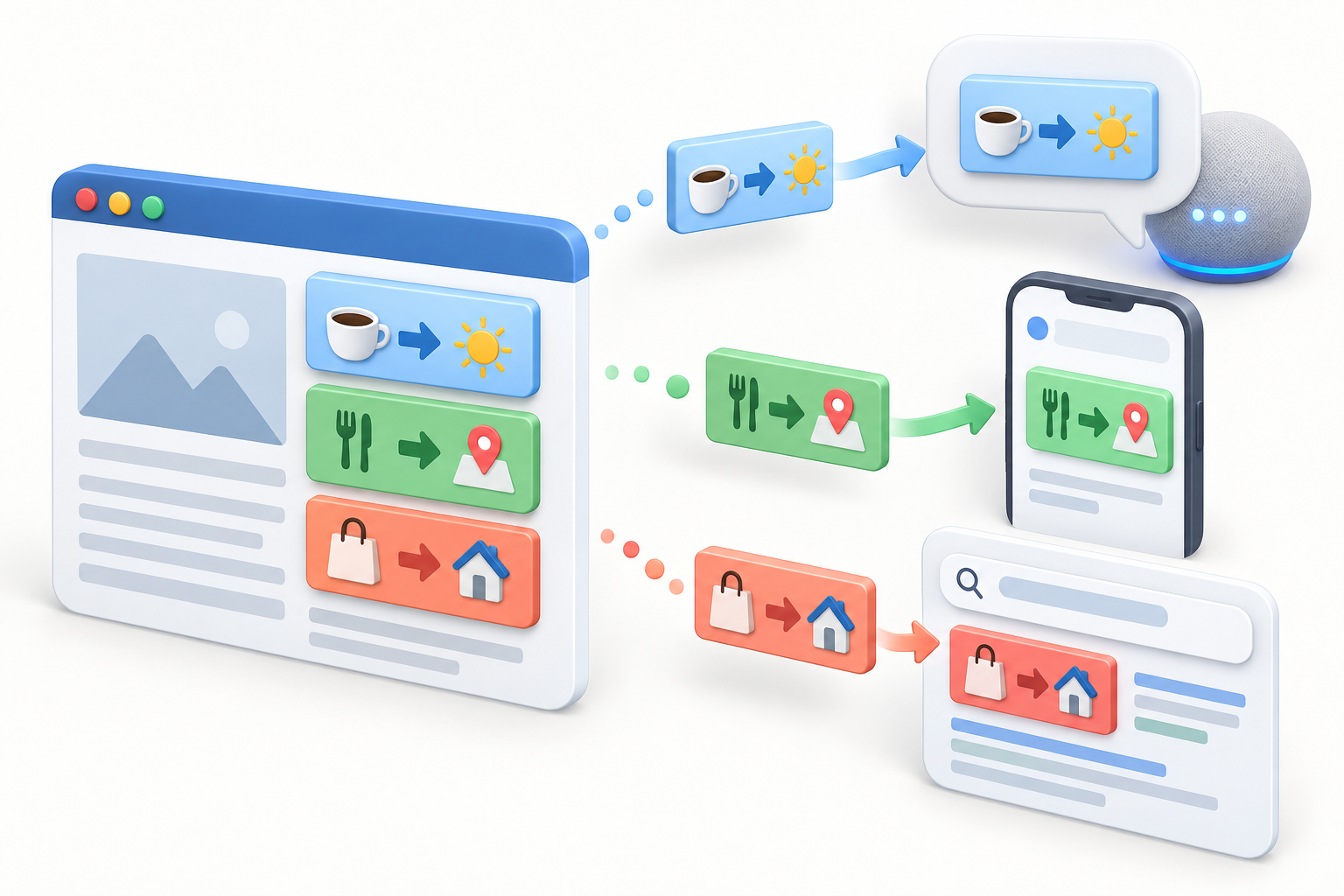
If your search strategy still revolves around winning one short keyword with one broadly written page, Google AI Mode exposes the weakness quickly. A person can begin with a general question, add their location, budget, use case, risk tolerance, and exclusions, then keep refining the decision. Your visibility depends on whether your content remains useful as that conversation branches.
The practical response is not to publish more generic copy or bolt AI language onto an existing SEO plan. You need distinctive, verifiable answers for organic discovery, suitable campaign inputs for paid eligibility, and reporting that does not pretend Google gives advertisers more placement-level visibility than it does.
What visibility in AI Mode actually requires
AI Mode is a conversational search experience. People can describe a complicated need in one prompt and narrow it through follow-up questions. Google said in October 2025 that these questions were nearly three times longer than traditional searches. That changes the unit of optimization. The keyword still matters, but so do the constraints, comparisons, exceptions, and decisions surrounding it.
The scale warrants attention without justifying panic. By May, AI Mode had surpassed 1 billion monthly users. Paid visibility is also material, although it varies by query set and test conditions. In one July SE Ranking analysis, text ads appeared in 29.45% of responses across 50,032 selected U.S. commercial keywords, with product carousels excluded. That figure is evidence of opportunity in that sample, not a universal ad frequency you should use in a forecast.
Key takeaways
- Optimize for the buyer’s decision path, not just the opening query.
- Use AI Mode’s follow-up questions to find missing answers that ordinary competitor audits overlook.
- Build pages from verified facts, first-party expertise, and explicit boundaries instead of interchangeable claims.
- Treat AI Mode, AI Max, and AI Overviews as different things. AI Mode is the customer experience; AI Max is an optimization layer inside eligible campaigns.
- Keep organic visibility, paid eligibility, and business outcomes separate in reporting. Combine them only when the data supports the connection.
That last distinction matters. A cited page, a named recommendation, and a sponsored placement are not the same outcome. They may support the same commercial journey, but they require different inputs and cannot be measured honestly as one blended AI visibility number.
Map the questions behind the query before rewriting a page

A conventional content audit tells you what competitors included. It rarely tells you what all of them omitted. If every service page repeats the same definition, benefits, and call to action, matching that pattern only makes your page another interchangeable input.
AI Mode’s follow-up questions offer a more useful gap-discovery method. Begin with the natural-language question a serious buyer would ask, then watch where the conversation goes. Repeated branches reveal the details someone needs before they can decide, including conditions, thresholds, local differences, edge cases, and tradeoffs. Those branches can become your content map rather than an indiscriminate FAQ list.
Run the query-branch audit
- Choose one commercially important page. Pick a service, product, or category page tied to a real decision. Do not begin with the entire site.
- Write the buyer’s opening question. Use a complete sentence that includes the problem and any context a genuine prospect would volunteer. A query such as “Which option fits a small team that needs approval controls but has no dedicated administrator?” is more revealing than a two-word category term.
- Record each follow-up question exactly. Preserve the wording. It shows you the terminology Google associates with the decision and the distinctions users may encounter next.
- Classify the branch. Mark whether it concerns suitability, cost, timing, location, requirements, risk, comparison, exception, proof, or next steps. This prevents ten differently phrased questions from becoming ten repetitive sections.
- Note what changes the answer. A useful answer often depends on company size, jurisdiction, product version, service area, eligibility, configuration, or another boundary. Capture that condition instead of writing a universal claim.
- Compare the branch with your page. Mark it answered, partly answered, unsupported, or absent. “Mentioned” is not the same as answered; a buyer should be able to understand the decision without decoding promotional language.
- Identify the evidence owner. Decide whether the answer belongs to a public reference, an internal record, a product owner, a practitioner, a customer-facing team, or another qualified subject-matter expert.
- Prioritize the gap. Give priority to questions that materially change the decision, align with the page’s intent, and can be answered with defensible evidence. A high-volume-sounding question with no reliable answer is not ready to publish.
Follow-up questions are signals, not automatic editorial instructions. A suggested question may be irrelevant to your offer, impossible to verify, or better answered elsewhere. Your job is to interpret the branch, determine whether it affects the buyer’s decision, and then place the answer where it belongs.
Decide whether the answer needs a section or its own page
Add a section to the existing page when the question shares the same intent and can be answered without changing the page’s audience or promise. Create a separate page when the question represents a distinct task, requires substantial evidence, serves a materially different situation, or deserves a direct landing destination of its own.
For example, an eligibility condition that determines whether someone can use a service probably belongs near the main answer. A detailed implementation workflow for people who have already chosen the service may deserve a supporting page. Link the two in the direction the buyer naturally moves.
This method is especially valuable for local pages. Google has deep context about places, businesses, and nearby entities, so a city name inserted into a generic template is a weak differentiator. Useful local content explains the actual service area, process, venue, constraints, availability, and decision rules that change with location. Only publish those details when the business can verify them.
Turn content gaps into evidence-backed answers
A plausible sentence is not necessarily a publishable fact. The fastest way to contaminate an AI visibility program is to let an unverified inference move from a generated brief into customer-facing copy. Keep a claim register while researching and drafting so every material statement has a status.
| Claim label | What it means in your workflow | Publishing action |
|---|---|---|
| OBSERVED | The detail was directly seen in the page, product, interface, record, or documented process under review. | Save enough context for an editor to reproduce the observation. |
| VERIFIED | The claim was checked against an appropriate public reference or authoritative record. | Cite the evidence and retain any scope, date, version, or jurisdiction qualifier. |
| CLIENT-SUPPLIED | The business or its subject-matter expert provided the claim. | Name the internal owner, request support where needed, and do not present it as independently verified. |
| INFERRED | The claim is a conclusion drawn from related information rather than a directly supported fact. | Label it as interpretation or replace it with a supported statement before publication. |
| UNKNOWN | The available material does not establish an answer. | Turn the gap into a precise question for the responsible expert. Do not let a writing model fill it. |
This separation is not bureaucratic overhead. It allows public facts, internal evidence, and expert judgment to contribute without being mistaken for one another. A documented workflow built around these labels also prevents unsupported claims about experience, volume, outcomes, prices, or performance from slipping into a page because they sound reasonable.
When a claim could affect someone’s legal rights, financial decision, safety, or regulatory exposure, route it to a qualified professional before publication. The downside is not merely a weak citation. An incorrect threshold or eligibility rule can cause a reader to make the wrong decision.
Write the answer before the marketing copy
Each prioritized branch should become an answer-first brief. Start with the direct response a buyer needs, then supply the conditions and evidence that make it trustworthy. A usable brief contains:
- the buyer’s question in natural language;
- a one- or two-sentence direct answer;
- the conditions that would change that answer;
- the supporting facts and their claim labels;
- any unresolved question for a subject-matter expert;
- the accuracy, legal, or version risk that needs review;
- the intended location: existing section, new page, comparison page, or supporting resource;
- the prompts you will use to retest visibility after publication.
The resulting page should help a person distinguish between options. Include the thresholds, limitations, tradeoffs, and next step when the evidence supports them. Replace claims such as “tailored solutions” or “leading service” with information only the business is well placed to provide: how qualification works, what the process includes, where exceptions arise, which input the customer must supply, and when a different option is a better fit.
Use structured data as a representation layer, not an evidence generator. Markup can express the entities and information present on a page, but it cannot turn a generic assertion into first-party expertise or resolve an unsupported claim. The visible answer and its evidence come first; the schema should accurately reflect them.
Prepare paid campaigns without confusing AI Mode and AI Max
AI Mode is the search experience a customer uses. AI Max is a collection of targeting and creative features applied to an existing Search campaign. It can expand matching through broad match and keywordless technology, use information from keywords, creative, and URLs, and adapt copy or destinations through text customization and Final URL Expansion. It is an optimization layer, not a separate campaign type.
There is also no separate AI Mode campaign or placement switch. Turning on AI Max does not select AI Mode inventory. This distinction protects you from a common reporting error: attributing every performance change after an AI Max launch to AI Mode placements.
Know which campaign routes are eligible
Google’s original May 2025 announcement identified Performance Max, Shopping, and Search campaigns using broad match, including AI Max for Search, as eligible for AI Mode ad testing. At Google Marketing Live 2026, Google recommended AI Max for Search, AI Max for Shopping, and Performance Max for access to newer AI-powered formats; AI Max for Shopping was documented as a beta.
A smaller experiment also allowed Search campaigns using exact and phrase match to serve text ads when an AI Mode user expressed clear, direct intent. Treat that as a limited test, not proof that conventional matching reaches every AI Mode format.
| Format | How it appears | Status in the cited announcement |
|---|---|---|
| Existing text and Shopping ads | Eligible ads can appear within AI Mode responses. | Testing |
| Conversational Discovery ads | Gemini tailors creative to the user’s expressed need. | Testing |
| Highlighted Answers | Sponsored businesses appear within recommendation lists with an AI-generated explanation alongside advertiser creative. | Testing |
| Direct Offers | Relevant promotions can appear during shopping conversations. | Pilot |
Testing and pilot status matters. A format described by Google may not be available in every account or country, and an eligible campaign is not guaranteed to appear. Confirm what your account actually exposes before building a media plan around a named format.
Improve the inputs Google may use
In conversational placements, your ad may sit inside a larger generated presentation. Google can use the user’s question, advertiser inputs, and landing-page context to decide what fits. Your work therefore extends beyond writing a compact headline.
- Align the destination with the detailed need. A generic homepage is a poor continuation when the prompt includes a specific use case, constraint, or product requirement.
- Keep product and offer information accurate. Do not rely on generated context to repair stale availability, unclear terms, or contradictory landing-page copy.
- Make differentiators verifiable. The same first-party facts that strengthen organic content give the paid system clearer material to work with.
- Review URL expansion deliberately. If the setting is active, make sure eligible destinations are current, appropriate, and able to convert the intent they may receive.
- Document campaign changes. Record when AI Max, matching, creative, feeds, destinations, budgets, or conversion settings change. Avoid treating a period with several simultaneous changes as a clean AI Mode test.
- Check the generated context when visible. Your approved creative may be only one part of the presentation. Watch for a mismatch between the reason Google gives, the promise in the ad, and the page a person reaches.
Do not broaden matching solely to claim AI Mode participation. First decide whether the campaign has dependable conversion measurement, suitable landing pages, accurate business data, and enough control for the risk you are accepting. Eligibility is an input to the decision, not the business case by itself.
Measure visibility without inventing AI Mode attribution

Google currently gives advertisers limited ability to isolate and measure ads within AI Mode. That constraint should shape your dashboard and the language you use with stakeholders. If the interface does not identify the placement, label the result unknown rather than assigning it to AI Mode because a campaign was eligible.
Build a controlled query set
Maintain a compact set of commercially meaningful prompts for each priority topic. Include the opening buyer question, a local or operational constraint, a comparison, an exception, and a late-stage next-step query. Run the same set repeatedly so you can notice changes in answer coverage instead of collecting unrelated screenshots.
For each observation, record:
- the exact prompt and follow-up path;
- the market, device context, and date of the check;
- whether your brand or page appeared;
- whether it appeared as a cited resource, named option, direct link, or sponsored result;
- the claim or passage used to represent the business;
- the destination page;
- any inaccurate, outdated, or missing context;
- the next content or campaign action, if the observation is reproducible and material.
Call this an observation log, not a ranking report. Conversational answers can vary with wording and follow-up context, so a single appearance is not a permanent position. The log becomes useful when the same gaps or representations recur across your controlled query set.
Keep three layers of reporting separate
- Answer visibility: Are your pages and brand present for the questions that matter, and are they represented accurately?
- Paid readiness and delivery: Are campaigns eligible, are advertiser inputs sound, and what delivery can the available Google Ads reporting actually verify?
- Business outcomes: What qualified visits, leads, sales, revenue, or other approved conversion signals reached the business?
Use these layers to make bounded decisions. If an important branch is repeatedly unanswered and your page lacks the information, you have a content gap. If the brand appears for the wrong use case, clarify its fit and exclusions. If an eligible campaign improves after several settings changed, report the campaign-level change but do not call it AI Mode return on ad spend without placement-level evidence. If traffic arrives but fails to progress, inspect the promise-to-page match before expanding reach.
Start with one high-value page and one natural-language buyer question. Map its branches, resolve the most consequential unknown with the right expert, publish the direct answer, and retest the same path. Once the organic evidence is sound, evaluate paid eligibility as a separate decision. That small operating loop will teach you more than a sitewide rewrite built on assumptions.
References
- Search Engine Land — What Google AI Mode follow-up questions reveal about your content
- Search Engine Land — Google AI Mode ads: Everything you need to know