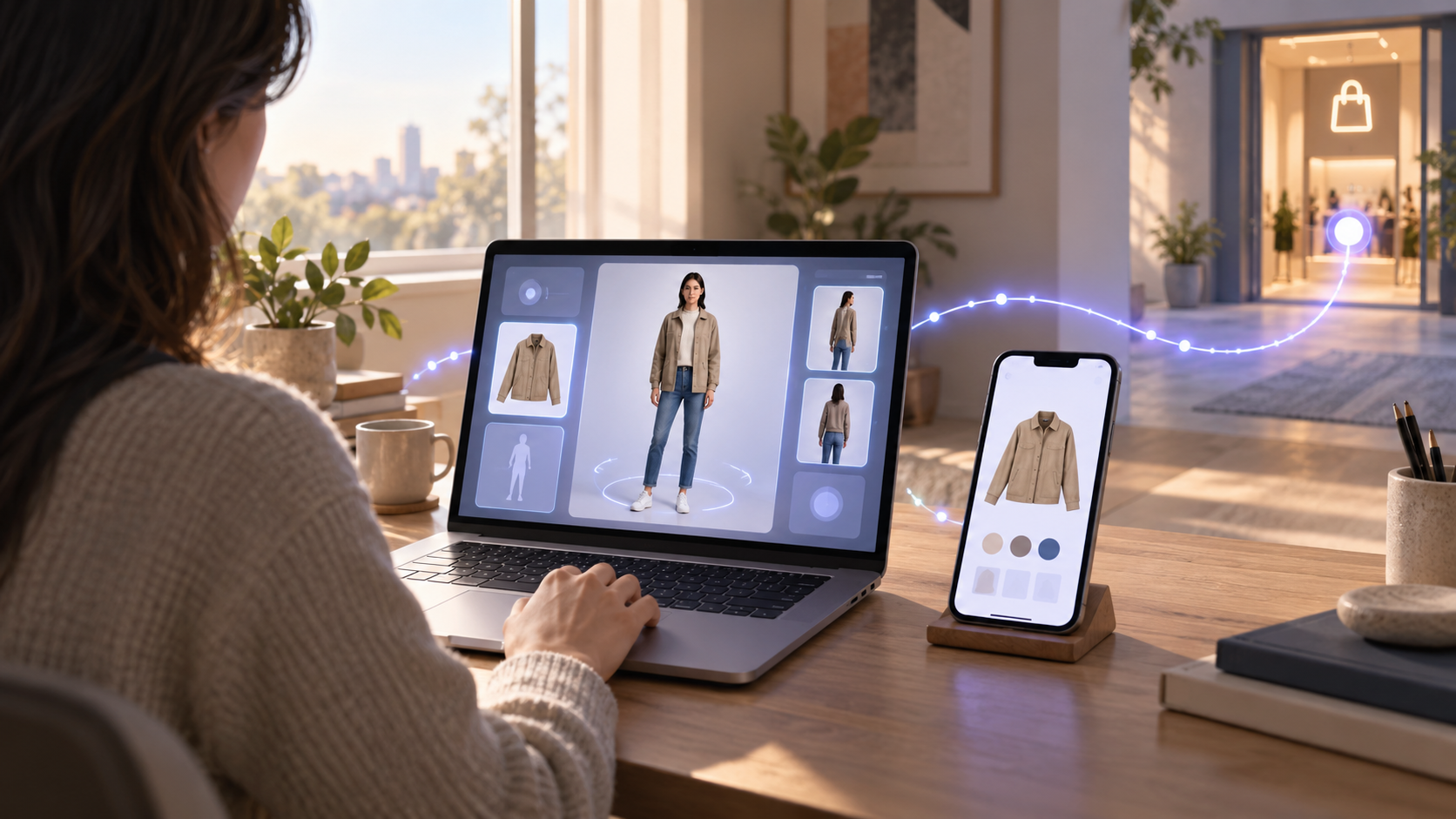
You may be asking a deceptively simple question: what should your ecommerce team change now that a shopper can preview a product inside ChatGPT? The answer isn’t to add AI shopping phrases to every page. Virtual try-on moves part of product evaluation upstream, before the shopper reaches your store.
Your job is to make each product understandable during discovery, visually recognizable during evaluation, and easy to buy when the shopper finally reaches the product page. That requires coordinated work across imagery, catalog data, structured data, fit guidance, landing-page UX, and measurement.
Virtual try-on changes where product evaluation happens
On eligible clothing and accessory listings, ChatGPT can display a Try on button that lets a shopper take or upload a selfie. ChatGPT Images then generates a visualization of that person wearing the item. A product doesn’t have to originate in a ChatGPT recommendation: the shopper can also upload an image or screenshot of something found elsewhere and request a virtual try-on.
That creates a shopping path that may look like this:
- The shopper describes the clothing or accessory they want.
- ChatGPT surfaces products that appear relevant.
- The shopper visualizes a candidate product on their own image.
- They compare it with other possibilities.
- They save promising items or visit a merchant to inspect the offer and buy.
Product discovery and visual evaluation can therefore happen within the same conversation. ChatGPT also lets shoppers save products to Favorites, organize them into Library folders, and return to them on mobile or the web. A recommendation is no longer necessarily followed by an immediate click. The shopper may build a shortlist first and arrive at your store later with a narrower set of questions.
For an ecommerce SEO or GEO team, that changes the optimization target. You need to support three decisions:
- Recognition: Can the product be distinguished from superficially similar items?
- Evaluation: Can the shopper understand its color, cut, pattern, material, and available variations?
- Completion: Can your product page resolve size, price, availability, delivery, and return questions without introducing contradictions?
This doesn’t make the product page less important. It gives the page a more demanding role. The visitor may already like the apparent look; the merchant must now establish exactly what is being sold and reduce the remaining purchase risk.
The screenshot workflow matters just as much as native product discovery. A shopper may encounter your item in search, on a marketplace, in a social post, or on another page before bringing its image into ChatGPT. Your visual assets need to remain recognizable when separated from their original context.
Build a coherent product record, not an AI optimization gimmick
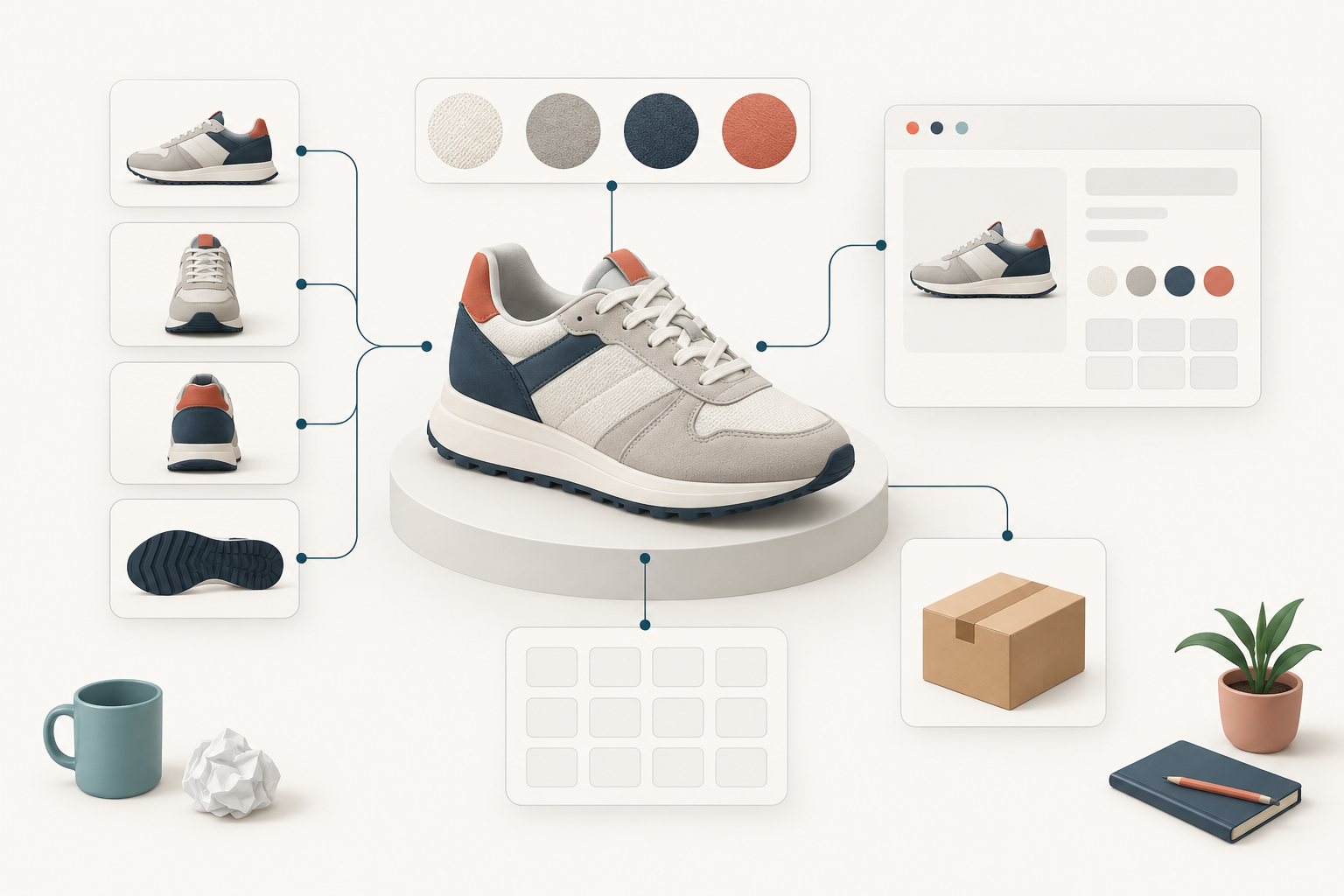
There is no established Try on optimization formula, required image dimension, or special schema property that guarantees eligibility. Treat promises of guaranteed inclusion through a single field with skepticism. The practical goal is coherence across the product image, visible copy, variation selector, commerce feed, and structured data.
Use images that still make sense outside the product page
Start with the main image because it is the most likely visual shorthand for the product. It should make the item easy to identify without forcing a system or shopper to infer which object is for sale.
- Show the complete garment or accessory clearly in at least one image.
- Keep the product visually distinct from props, backgrounds, and neighboring items.
- Use the correct image for each color or pattern variation.
- Provide additional views when the front image hides important construction, shape, fastening, or pattern details.
- Keep image treatment consistent enough that a shopper can recognize the same item across a listing, a screenshot, and the product page.
- Avoid putting essential product facts only inside image text. Those facts also belong in visible HTML.
- Write useful alternative text for accessibility and page comprehension, but don’t claim that alt text controls a virtual try-on rendering.
Run a simple crop test. View the product image without its title, price, or surrounding page. Ask whether a person could identify the item type, dominant color, pattern, and intended variation. If the answer depends on the missing copy, the image is doing too little. If several products compete for attention, it is doing too much.
Don’t replace accurate catalog photography with speculative AI composites merely to appear AI-ready. A visualization system needs a dependable representation of the product. Your controlled assets should establish ground truth, while the generated try-on remains a separate, personalized interpretation.
Make attributes explicit and consistent
Product copy should identify the attributes that distinguish the item. A poetic collection name may support branding, but it shouldn’t carry the entire descriptive burden. Pair it with plain product language that states what the shopper is looking at.
- Use a stable product name, brand, and product type.
- Name the actual color as well as any branded color name.
- Describe the material or fabric without making unsupported performance claims.
- State the silhouette, length, pattern, closure, and other decision-relevant features when they apply.
- Map every displayed image to the correct selectable variation.
- Keep price, currency, availability, and condition aligned wherever those fields appear.
- Use valid product identifiers consistently. Never invent an SKU, GTIN, or other identifier to fill an empty field.
- Provide measurements and size information in accessible page content rather than relying on an image alone.
Structured data should mirror that visible record. Product and Offer JSON-LD can express product and commercial facts in a machine-readable form, but markup is not a substitute for accurate page content and isn’t evidence of virtual try-on eligibility. If the page shows one price while the Offer markup publishes another, the problem isn’t a missing AI tactic; it is a conflicting product record.
Check variation handling closely. The selected color, image, SKU, availability, price, and structured data should refer to the same offer. If your implementation updates some of those fields dynamically, verify the rendered state rather than reviewing only the page template or source code. A technically valid block of JSON-LD can still describe the wrong variant.
Audit the complete product path
Use this sequence on representative clothing and accessory templates:
- Open a live product and select each meaningful variation.
- Compare the selected option with the main image, gallery, visible name, price, stock state, and product identifier.
- Inspect the rendered Product and Offer data for the same variation.
- Check the size guide, measurements, material details, delivery information, and return policy.
- Capture the main product image as a shopper might encounter it elsewhere and verify that the product remains recognizable.
- Resolve contradictions before adding more copy or markup. Consistency is the prerequisite, not the finishing touch.
This audit is useful beyond ChatGPT. It removes ambiguity from the catalog record that your own customers, feeds, analytics, search systems, and other shopping interfaces must interpret.
Separate appearance visualization from fit, then strengthen the handoff

The most important boundary is also the easiest one to blur: virtual try-on is a visualization, not a fitting room. The generated result may not represent the shopper or product exactly and doesn’t guarantee size or fit. Merchant measurements, product details, and return policies remain part of the buying decision.
Think of the preview and product page as answering different questions:
| Shopper question | Best answer surface | What the answer must communicate |
|---|---|---|
| How might this style look on me? | Virtual try-on visualization | A directional visual impression, not a promise of exact appearance or fit |
| Which size should I order? | Merchant size guide and measurements | Clear measurement definitions, units, garment dimensions, and relevant sizing notes |
| What exactly am I buying? | Product page and variation selector | The selected color, material, construction, images, price, and availability |
| What happens if it isn’t right? | Delivery and return information | Applicable conditions, timing, process, and customer costs |
Your size guidance needs enough context to be usable. Distinguish body measurements from garment measurements. Name the measurement points and units. Explain relevant stretch, cut, or layering considerations without pretending they can predict an individual’s fit. If sizing differs by product line or market, put the correct guide on the affected product rather than sending everyone to a generic chart.
The landing page should preserve continuity with what the shopper evaluated. The same variation should be easy to recognize, and the page should expose the remaining decision information without making the visitor hunt for it.
- Keep the product name and selected variation visible near the main image.
- Show current price and availability for that variation.
- Place the size selector close to the relevant size guide.
- Make material and care information easy to scan.
- Present delivery and return terms before the shopper commits to checkout.
- Explain unavailable variations honestly rather than silently switching the selection.
- Keep mobile layouts usable because the shopping features are available on both mobile and web.
Favorites add another handoff consideration. A shopper may save an item, compare it with alternatives, and return after the original discovery session. Stable product URLs, persistent identifiers, current inventory, and clear replacement behavior matter more than a landing experience built only for an immediate click.
If you describe AI visualization on a page you control, keep the claim narrow. Plain language such as “The preview is a visual approximation; check the product measurements and return terms before ordering” sets the right expectation. Don’t call a generated image proof of fit, exact drape, precise color reproduction, or guaranteed appearance.
Measure discovery, merchant handoff, and post-purchase outcomes
Referral traffic alone will not describe the full effect. A shopper can upload a product screenshot found elsewhere, evaluate it in ChatGPT, save it, and return by another route. Some influence will therefore be invisible to your analytics or appear under a later source.
Observe visibility without treating one answer as a ranking report
Create a repeatable set of prompts based on real customer language. Include product type, material, color, occasion, style, and other attributes your catalog genuinely supports. Record whether your products appear, whether the correct variation is represented, whether the cited destination resolves correctly, and whether a Try on option is shown when relevant.
Use those checks diagnostically. They can expose ambiguous naming, weak imagery, broken destinations, and inconsistent variants. They do not establish universal market share, a permanent ranking, or the cause of a recommendation. Avoid turning a favorable answer from one session into a performance claim.
Instrument the merchant handoff
Preserve raw referrer information where your analytics and consent setup permit it, and group identifiable ChatGPT visits without overwriting the underlying source. Then evaluate the onsite sequence rather than counting sessions alone.
- Which products receive identifiable AI referral visits?
- Does the landing URL resolve to the intended product and variation?
- Do those visitors use the gallery, variation selector, or size guide?
- Where do they leave the product and checkout funnels?
- Do they add the evaluated item to the cart, or switch to another variation or product?
- Are analytics events firing consistently across mobile and desktop?
A high click count with frequent variant switching may indicate that the upstream image or product description set the wrong expectation. Strong product-page engagement with weak size selection may point to incomplete fit guidance. Treat these as diagnostic signals to investigate, not automatic proof of causation.
Connect the experiment to business outcomes
Virtual try-on is intended to help a shopper evaluate a product, so the useful outcomes sit deeper than impressions. Track completed purchases, cancellations, exchanges, returns, and available reason codes for the affected products. A generated preview that increases curiosity but creates a mismatch at delivery is not an unqualified success.
Use a controlled improvement cycle:
- Save a baseline for the selected product group, including its images, visible attributes, structured data, funnel behavior, and return outcomes.
- Fix one interpretable layer, such as variation-image mapping or measurement content.
- Repeat the same visibility checks and review the same onsite events.
- Annotate concurrent changes in price, promotion, inventory, seasonality, and delivery terms.
- Read the result as directional unless the design actually isolates the changed variable.
Don’t label every post-change sale as AI-driven revenue. Report what you can observe directly, separate identifiable referrals from inferred influence, and name the blind spots. Favorites activity inside ChatGPT and screenshot-based exploration are not merchant-side analytics events.
Key takeaways
- ChatGPT virtual try-on can combine product discovery, selfie-based visualization, comparison, and shortlisting before a merchant visit.
- A shopper can upload a product image found elsewhere, so clear and recognizable assets matter beyond native ChatGPT listings.
- There is no basis for promising eligibility from one schema field, keyword, image treatment, or feed attribute.
- Product images, visible content, variations, commerce feeds, and Product and Offer structured data should describe the same item and offer.
- Virtual try-on visualizes a possible look; merchant measurements, size guidance, product facts, and return terms must handle fit and purchase risk.
- Measure visibility, onsite behavior, purchases, and returns while acknowledging that screenshot and Favorites activity may leave no direct referral trail.
Start with a representative clothing or accessory template and follow one product from its standalone image through variant selection, JSON-LD, size guidance, return information, and analytics events. Fix every contradiction you find before scaling the audit across the catalog. That gives you a durable commerce foundation whether the next shopper discovers the product through ChatGPT, another AI interface, a conventional search result, or a saved screenshot.
References

Leave a Reply