
Your rankings may look stable while fewer people visit your site. Paid campaigns may still meet their targets while giving you less control over how each bid is made. That does not mean search marketing is disappearing. It means the interface, measurement model, and division of labor are changing.
You need a strategy that works when a search engine answers the question itself, an AI assistant summarizes several options, or an automated system decides which ad to show. The practical response is to make your expertise easier to retrieve, measure outcomes beyond clicks, and reserve human attention for decisions machines cannot make well.
Treat AI search as another interface, not a separate market
Search has changed interfaces before. Voice queries became part of ordinary search behavior rather than a completely independent discipline. AI answers are following a similar pattern: people still want to learn, compare, decide, and act, but they may complete more of that journey without opening a traditional result.
This matters because AI Overviews can change publisher traffic and searcher behavior. A lower click-through rate does not automatically mean demand has fallen. Your answer may have been consumed before the visit, or your brand may have appeared during research without receiving the final click.
Organize your strategy around the user’s task, not the surface where the query appears. For each important topic, identify what someone needs while learning, what objections arise during comparison, and what evidence supports a decision. Then make sure the same facts remain consistent across your pages, structured data, product information, business profiles, and paid landing pages.
Do not create an isolated AI content program that competes with your SEO program. Give one owner responsibility for the accuracy of each core topic, then adapt that knowledge for conventional results, answer engines, assistants, and ads.
Build pages that can be understood before they are clicked
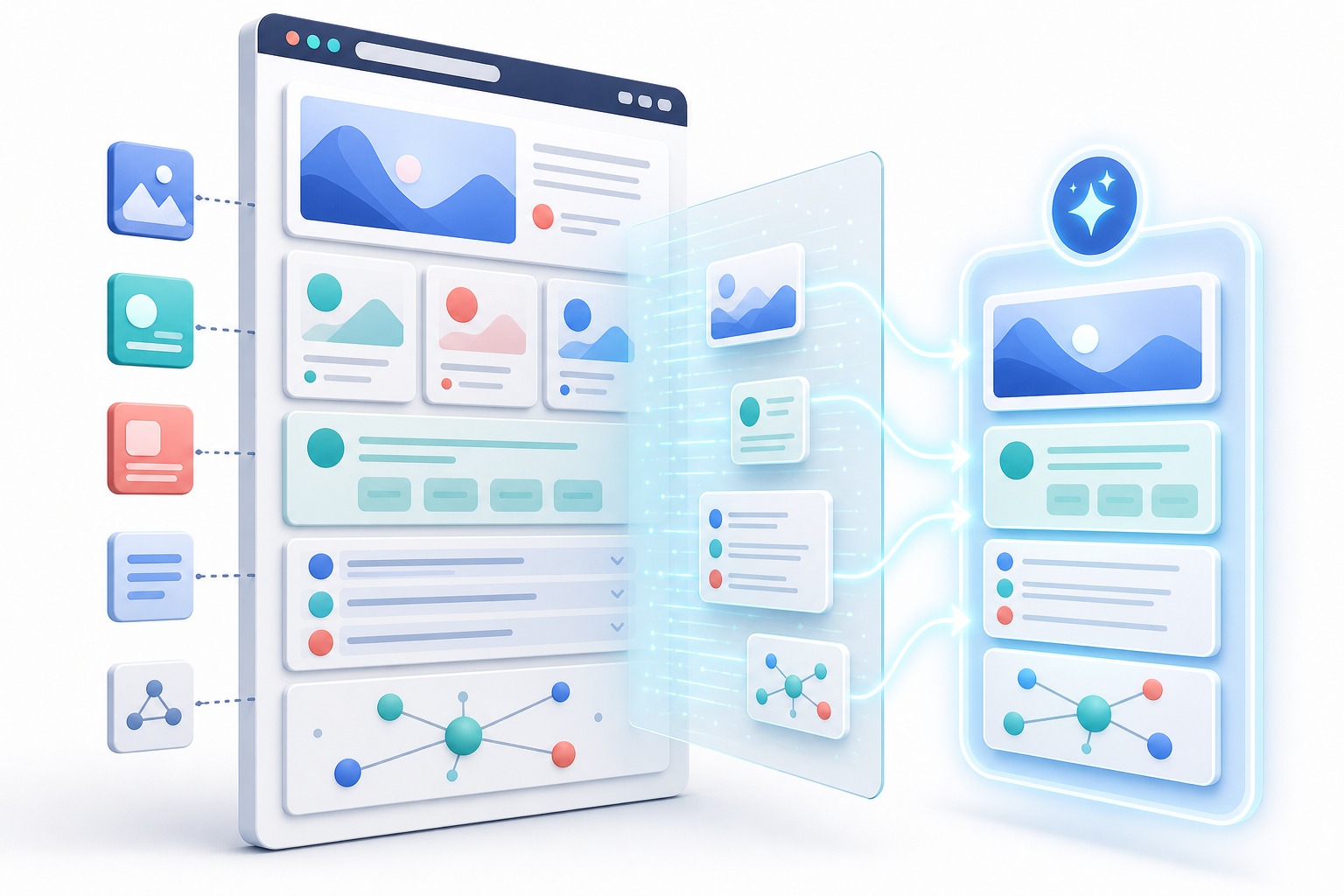
A page written only to win a blue-link click often delays the answer, repeats keywords, and hides important qualifications. That is weak service for a person and weak input for a system trying to extract a reliable response.
Make the answer easy to retrieve
State the main answer near the beginning of the relevant section. Use headings that reflect real questions or decisions. Keep definitions, requirements, exceptions, and next actions close to the claim they explain. If a reader must combine fragments from several pages to understand your position, an automated system faces the same unnecessary ambiguity.
Make the evidence easy to evaluate
Name the product, organization, method, or policy you are discussing. Show who the advice is for and when it does not apply. Support important claims with the best available evidence, and keep dates, author details, and update history visible where they affect trust. Useful specificity is more defensible than confident but generic copy.
Use technical clarity as reinforcement
Keep valuable pages crawlable, indexable, internally linked, and represented in your XML sitemap. Search Console grew from XML sitemap work into a broader way for site owners to understand search visibility, but its role is diagnostic rather than corrective: a submitted URL still needs a clear purpose and worthwhile content.
Add applicable schema markup that accurately describes what is already visible on the page. Connect entities consistently and validate the markup after publishing. Structured data is a clarity layer, not an admission ticket to an AI answer or enhanced result.
Let automation handle mechanics while people set direction
Paid search began changing fundamentally when Goto.com introduced a model in 1998 that gave clicks a direct monetary value. The work later expanded from occasional ad changes into complex campaign management, and automated bidding reduced some of the manual effort required to adjust auctions.
That history offers a useful rule for AI adoption: automate a repeatable mechanism, not the responsibility for the result. A bidding system can process auction signals faster than a person. It cannot decide whether your offer is credible, whether a promise fits the brand, or whether a technically efficient campaign is attracting the wrong customers.
Apply the same boundary to organic work. AI can cluster queries, propose outlines, reformat data, identify repeated language, and help inspect large sets of pages. A person should still approve the search intent, factual claims, distinctive point of view, examples, and publication decision. Structural assistance is valuable precisely because it frees experts to spend more time on judgment.
Before automating a task, write down its accepted input, expected output, review standard, and escalation condition. If you cannot describe what a correct result looks like, automation will increase volume without creating dependable quality.
Replace a rankings-only dashboard with an evidence chain

Search Console remains essential, but it does not provide separate, complete performance reporting for every appearance in Featured Snippets or AI Overviews. That creates a genuine blind spot. You cannot repair it by treating ordinary click data as a full record of AI visibility.
For each priority query group, record the user need, the search features present, whether your brand is visible, which page or entity appears to support that visibility, and the business outcome that follows. Use the same query groups when reviewing organic pages, AI answers, and paid campaigns. This gives you a coherent view of demand instead of three disconnected reports.
Pair platform data with first-party outcomes such as qualified enquiries, subscriptions, purchases, retained customers, or another result your organization already trusts. Add manual observations for AI surfaces that are not isolated in reporting. Label those observations clearly; they are snapshots, not precise impression counts.
When performance changes, diagnose the chain in order. Check whether demand changed, whether the results interface changed, whether your visibility changed, whether clicks shifted, and whether conversion quality moved. This prevents a traffic decline caused by an answer feature from being mistaken for a relevance problem, or a conversion problem from being blamed on rankings.
Key takeaways
- Plan around the user’s task across search results, AI answers, assistants, and ads instead of building a separate strategy for every interface.
- Publish direct answers with visible evidence, clear entities, useful qualifications, and accurate structured data.
- Use automation for repeatable mechanics, while people retain control of positioning, creative judgment, factual approval, and business tradeoffs.
- Measure visibility, engagement, and business outcomes as a chain; rankings and clicks alone no longer describe the whole journey.
- Document what good output means before scaling any AI-assisted workflow.
Start with one commercially important topic. Map its user decisions, strengthen the page that answers them, validate its technical signals, inspect how it appears across conventional and AI search, and connect that visibility to a real outcome. Once that evidence chain works, expand it topic by topic.
References
- Search Engine Land – Brad Geddes on 20 years of paid search evolution
- Search Engine Land – Vanessa Fox on the birth of Google Search Console
Leave a Reply