
Why AI Is Revolutionizing Acquisition with a Bottom-Up Approach

```json
{
  "alt": "Abstract digital illustration of vibrant neon streams converging into a funnel shape on a dark background.",
  "caption": "Experience the flow of digital energy as vibrant neon streams converge into a mystical funnel of light and color.",
  "description": "This abstract digital image features vivid neon streams in blues and pinks converging into a dynamic funnel shape, set against a deep black background. The design suggests a blend of technology and energy, invoking a sense of digital transformation. Ideal for themes related to innovation, technology, and futurism."
}
```

AI has reshaped how we think about acquisition strategy. It’s no longer about starting at the top of the funnel with broad awareness campaigns. Instead, we begin at the bottom, focusing on building understanding, credibility, and reach in the right sequence.

For the past 30 years, the industry followed a top-down model: raising awareness, gaining visibility, and then guiding potential customers through the purchase funnel. This approach made sense during the broadcast era and was somewhat effective in the search era, but today, in AI-driven environments, it’s outdated.

```json
{
  "alt": "The CapmatchOne logo with a gradient circle and bold text.",
  "caption": "Discover innovation with the CapmatchOne logo, featuring sleek typography and a modern gradient circle.",
  "description": "The CapmatchOne logo features bold, modern typography coupled with a gradient circle, symbolizing connection and innovation. The sleek design conveys a sense of progress and creativity. This image can be used for branding or promotional purposes, appealing to audiences interested in innovative solutions and forward-thinking designs."
}
```

Today’s search engines and AI-powered assistants build brand recommendations from the ground up. They need to grasp who we are before they can evaluate our credibility. Only after establishing credibility can they recommend us. If we prioritize top-down strategies, we’re essentially wasting budget on awareness without a strong foundational understanding for AI to work with.
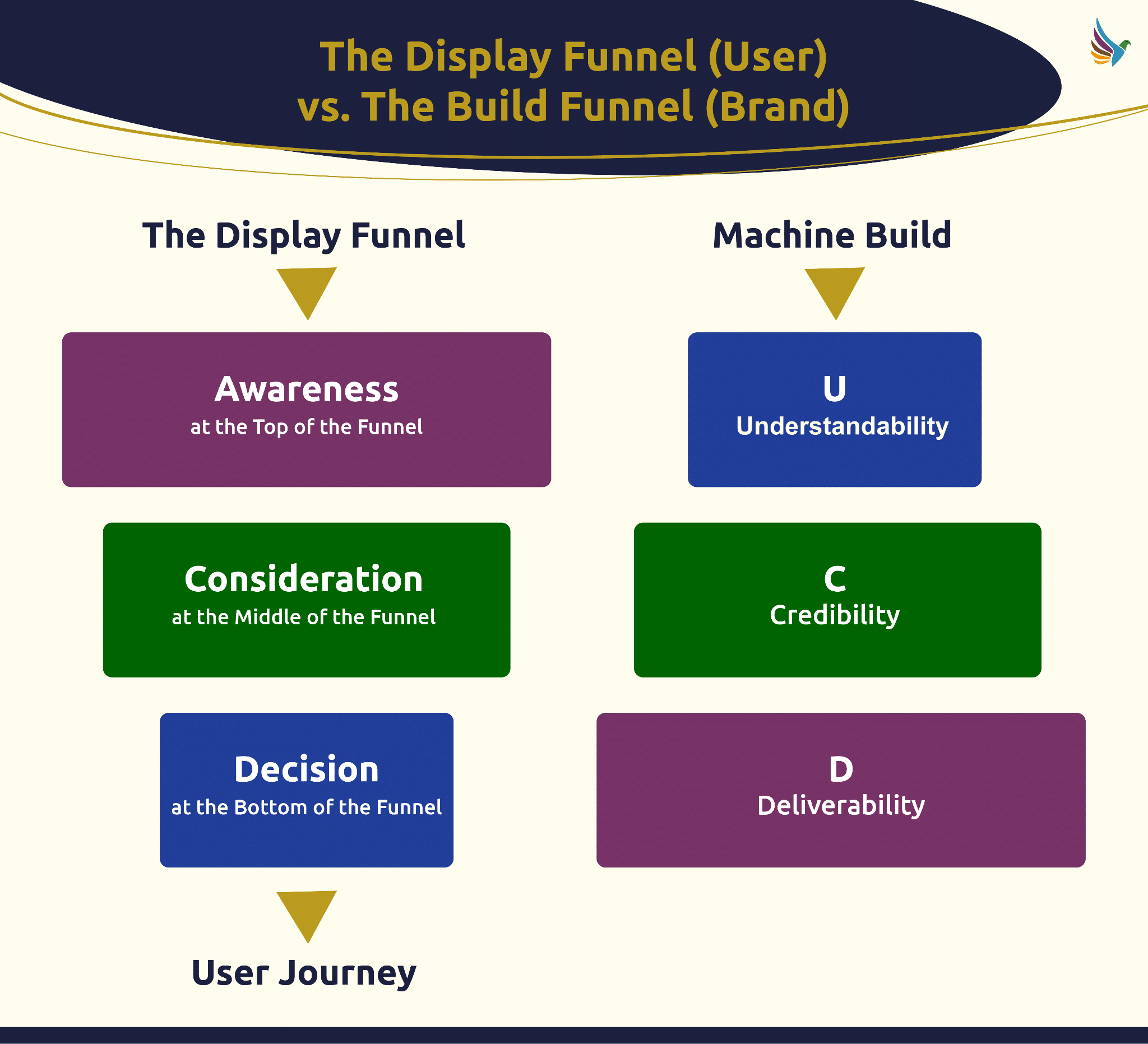
```json
{
  "alt": "Diagram comparing user display funnel with brand build funnel, showing stages like awareness, consideration, decision versus understandability, credibility, deliverability.",
  "caption": "Exploring the user journey with the display funnel and contrasting it with the brand-focused build funnel.",
  "description": "This image presents a comparative diagram of 'The Display Funnel' for users, highlighting stages such as Awareness, Consideration, and Decision, and 'The Build Funnel' for brands, featuring Understandability, Credibility, and Deliverability. The layout emphasizes the user journey and machine build paths, showing how these funnels align and differ. Keywords: user journey, display funnel, build funnel, awareness, credibility."
}
```

AI systems hold the key to successful brand recommendations — if they don’t understand our brand, or find us less credible compared to our competitors, they’ll likely recommend someone else. This AI-led shift is what I call the ultimate zero-sum game: the unseen recommendation to prospects we might not even know about.
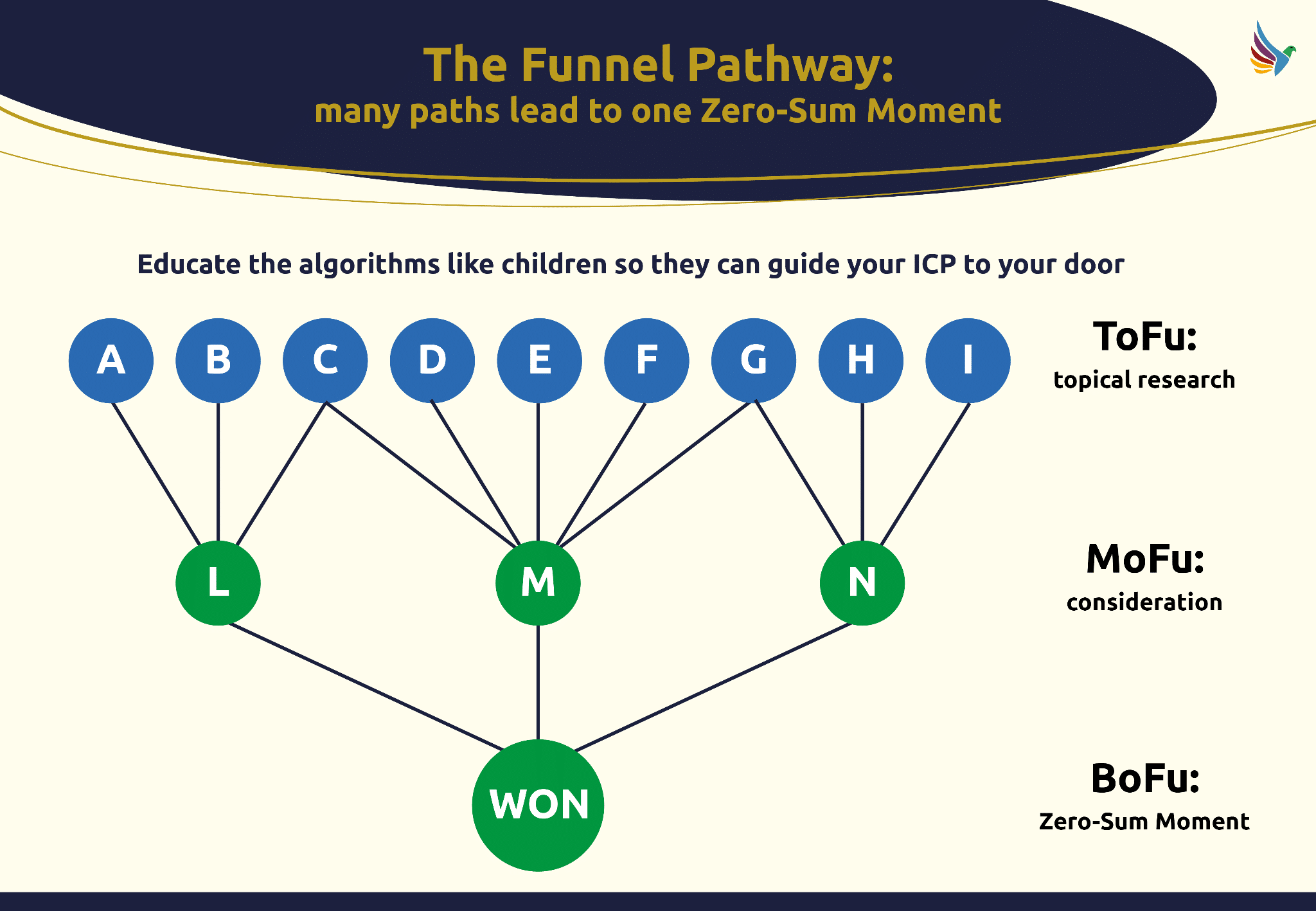
```json
{
  "alt": "Flowchart titled 'The Funnel Pathway' illustrating customer journey from research to purchase.",
  "caption": "Discover the Funnel Pathway: guiding your ideal customer profile (ICP) through strategic stages, leading to a winning outcome.",
  "description": "This flowchart, titled 'The Funnel Pathway: many paths lead to one Zero-Sum Moment,' visually represents a customer's journey from ToFu (Top of Funnel) with topical research, through MoFu (Middle of Funnel) for consideration, to BoFu (Bottom of Funnel) for a Zero-Sum Moment. Nodes A to I represent initial touchpoints, L to N for interim stages, culminating in a 'WON' outcome."
}
```

The acquisition funnel hasn’t altered for users. They still journey from awareness to consideration to decision. Essentially, Elias St. Elmo Lewis’s model from 1898 still applies. All marketing models have been based on this, although channels have evolved. The mantra remains: reach first, relationship second, commitment third.
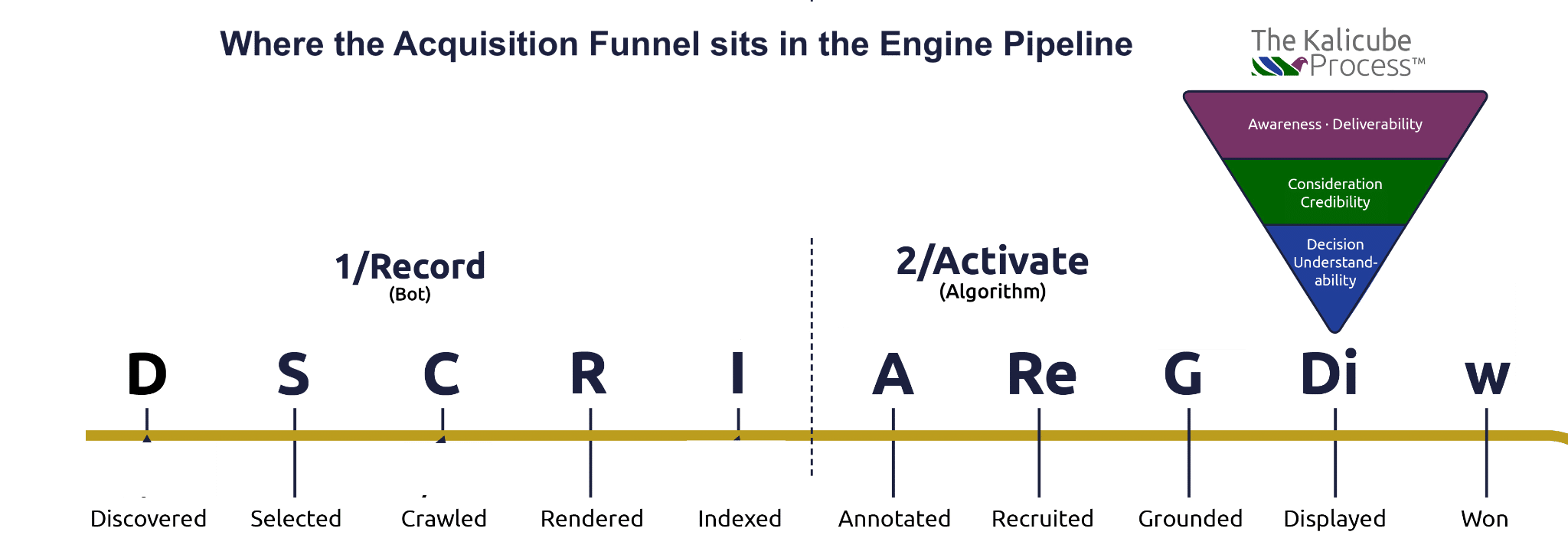
```json
{
  "alt": "Infographic showing acquisition funnel stages in search engine pipeline with a funnel diagram.",
  "caption": "Explore how the acquisition funnel integrates into the search engine pipeline through a detailed infographic, showcasing each critical stage.",
  "description": "This infographic details the stages of the acquisition funnel as it fits into the search engine pipeline. The funnel is divided into stages for awareness, consideration, and decision-making, corresponding to different phases like discovery, crawling, and indexing. The Kalicube Process logo appears at the top. Each step of the pipeline is marked with initial letters and descriptions, providing a clear pathway from discovery to winning potential customers. Keywords: acquisition funnel, search engine pipeline, Kalicube Process."
}
```

In my experience, the digital landscape changed with Google’s Knowledge Graph in 2012. It allowed machines to form independent opinions about brands, highlighting the need for brand understanding and reputation over mere awareness. Since then, my focus has centered on these aspects because AI-driven engines and agents rely on it to direct users towards credible destinations.
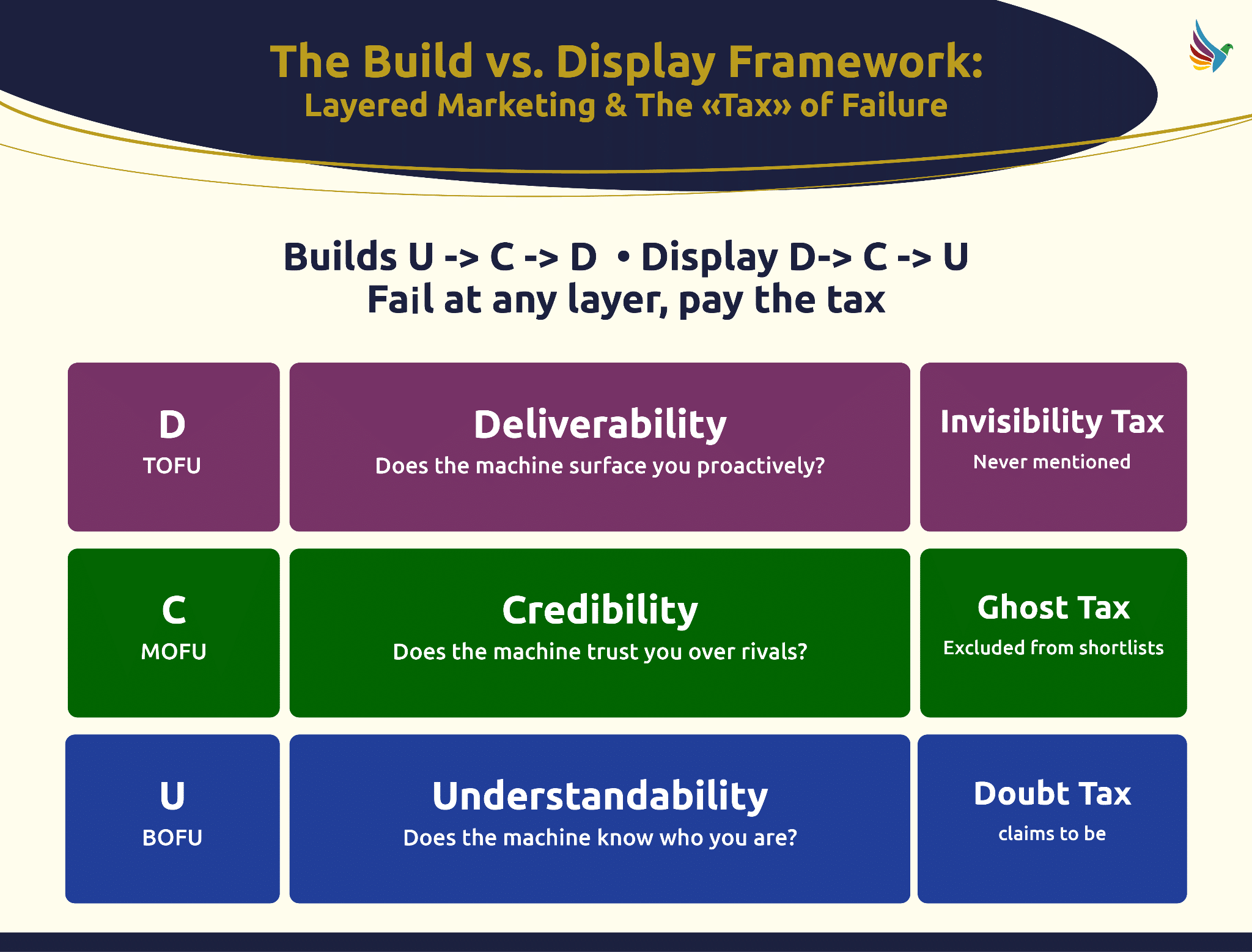
```json
{
  "alt": "Build vs. Display Framework diagram explaining layers of marketing and failure tax.",
  "caption": "Explore the Build vs. Display Framework, which outlines the layered marketing approach and associated taxes of failure at each stage.",
  "description": "This image presents the Build vs. Display Framework, focusing on layered marketing and the 'tax' of failure. It illustrates three stages: Deliverability (D), Credibility (C), and Understandability (U), each paired with potential failures: Invisibility, Ghost, and Doubt taxes. The process builds U to C to D and displays D to C to U, highlighting consequences of faltering at any level. Ideal resource for understanding strategic marketing layers."
}
```

This marks a structural shift in marketing since 1898. While the user still travels from awareness to decision, in AI engines and agents, it’s our understanding and credibility that position us at the top of their funnel, achieved by training AI to guide users to us.
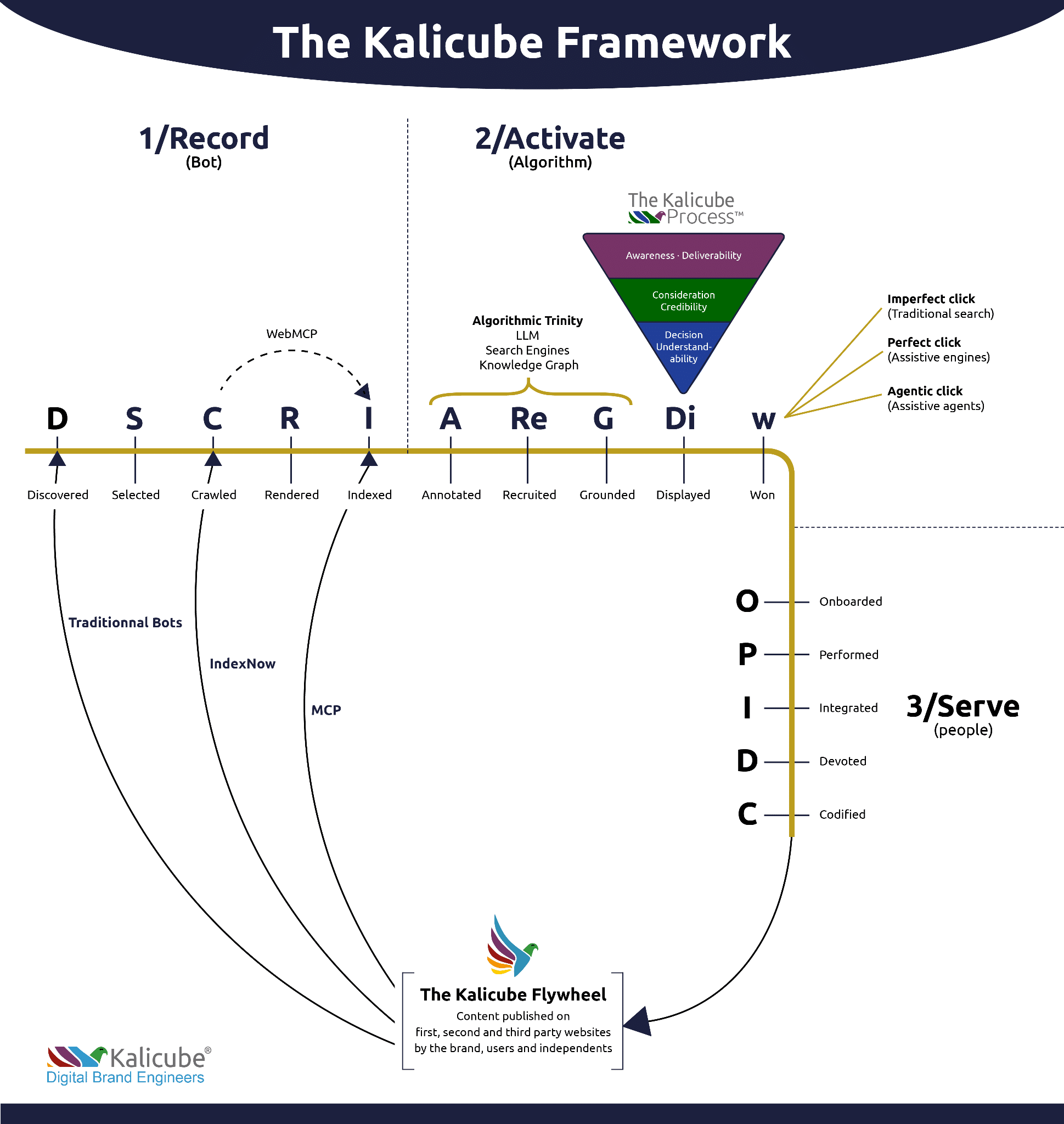
```json
{
  "alt": "The Kalicube Framework diagram illustrating SEO processes in three phases: record, activate, and serve.",
  "caption": "Explore the Kalicube Framework, a strategic guide for digital branding that outlines the process from data recording to audience engagement.",
  "description": "The Kalicube Framework visualizes the journey of digital content through three phases: Record, Activate, and Serve. Starting with discovery and indexing by bots, it progresses to algorithm activation with annotation and display. The process concludes with serving content through onboarding and performance. Key components include traditional bots, IndexNow, and the Kalicube Flywheel. Keywords: Kalicube Framework, SEO, digital branding, content indexing, algorithmic activation."
}
```

The coexistence of top-down and bottom-up strategies is real. We can still build awareness through controlled channels—paid media, broadcasts, and direct outreach. However, in the realm of organic engines, we must start from the bottom of the funnel, building a foundation for AI to guide users efficiently.

Every algorithm, AI engine, and agent operates based on entity and brand signals. Social media reach, too, hinges on brand recognition and engagement. Therefore, investing in a solid brand understanding orients us favorably within the AI framework, where roadmaps to our brand are increasingly machine-built.

This content reflects my approach to developing robust brand presences that resonate with both AI systems and human audiences.


Inspired by this post on Search Engine Land.


crushpress.ai community screenshot

FAQs

What is the bottom-up acquisition approach described in the post?

The bottom-up approach starts with building understanding and credibility at the base, and then expands reach in the right sequence, rather than starting at the top of the funnel. It emphasizes foundation before expansion.

Why do AI-powered engines need to understand your brand before recommending you?

They rely on understanding and credibility; if they don’t understand the brand or find it less credible, they will likely recommend someone else. This underscores why credibility matters in AI-driven recommendations.

Which historical model is referenced for the acquisition funnel?

The post references Elias St. Elmo Lewis’s model from 1898, and notes that the user still travels from awareness to decision. The article also mentions that channels have evolved since then.

What is the 'zero-sum game' described in the post?

It describes the unseen recommendation to prospects we might not even know about; success depends on how well we are understood and how credible we appear to AI-driven engines.

What frameworks are mentioned for building a brand in AI contexts?

The article discusses the Build vs. Display Framework and the Kalicube Framework. The Build vs. Display Framework outlines Deliverability, Credibility, and Understandability, with potential failures described as Invisibility, Ghost, and Doubt taxes.

Comments

Leave a Reply

Your email address will not be published. Required fields are marked *