As I delve into the latest updates from Google, I discovered that they’ll be retiring Dynamic Search Ads (DSA) in favor of their newer AI Max toolset. This transition will begin in September, and it’s bound to impact those using DSA, automatically created assets (ACA), and campaign-level broad match settings.
It’s fascinating to learn that Google announced AI Max for Search campaigns will exit beta, with “hundreds of thousands” of advertisers already onboard globally. I find this shift intriguing as it hints at the increasing reliance on AI-powered tools in digital advertising.
Starting September, my eligible campaigns utilizing DSA, ACA, or broad match will automatically be migrated to AI Max. This means Google will no longer support the creation of new DSA campaigns through their various platforms.
Why does this matter to us? Embracing AI Max beforehand allows us better control over campaign settings. Google mentions this change could potentially lead to an average 7% improvement in conversions or conversion value while maintaining the same efficiency.
According to Google, AI Max offers more conversions or conversion value at a similar cost per acquisition (CPA) or return on ad spend (ROAS) for non-retail sectors. It achieves this by using comprehensive features like search term matching, text customization, and URL expansion.
A Brief History: DSA has been a valuable tool for capturing traffic beyond keyword-focused campaigns, thanks to its dynamic headline generation and landing page redirection. However, changes in consumer search behavior have prompted Google to innovate further.
AI Max aims to enhance search campaigns by integrating broad real-time intent data beyond traditional landing page signals. It’s designed to adapt to the increasingly complex search landscape we navigate today.
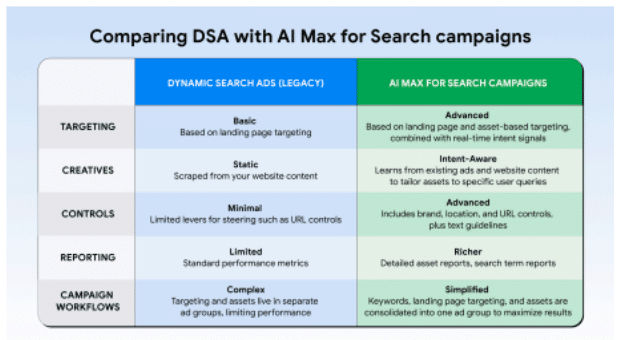
Understanding AI Max: This feature maximizes reach, personalizes ad content, and provides more control over brand, location, and text settings.
So, what should we do now? Google encourages us to make the switch before September to ensure smoother transitions and continuity in our campaigns.
Phase 1: Voluntary Upgrades is happening now. DSA users like me can leverage new tools to smoothly migrate campaign data and settings. Meanwhile, ACA and broad match users will find prompts nudging them toward AI Max.
Phase 2: Automatic Upgrades begins in September, converting dynamic ad groups in DSA campaigns to standard ones while preserving significant settings. ACA and broad match campaigns will migrate with essential features enabled by default.
The Bottom Line: Google’s move to make AI Max the standard signifies a shift towards AI-driven strategies. By acting now, I can test different settings and fine-tune results before the mandatory switch.
Inspired by this post on Search Engine Land.

Leave a Reply