
AI search sentiment seems largely positive, yet there’s a real risk that isn’t in the acronyms – it’s in the volatility of the debate.
The SEO versus GEO debate has been a significant topic in our industry for the past year. New acronyms pop up almost weekly, and the sentiment can flip rapidly, with even the most reliable voices changing their stances from time to time.
This volatility isn’t confined to the periphery. It’s evident among a small group of highly visible SEO influencers who adjust their perspectives on AI-era searches in reaction to news, platform updates, and branding pressures.
My curiosity drove me to delve into how 75 leading SEO influencers discuss AI-driven search on LinkedIn. The objective wasn’t to identify the winning acronym but to gauge consistency, sentiment, and volatility in the discourse surrounding discovery shifts.
Teaming up with Danny Goodwin from Search Engine Land, I reviewed 2,025 LinkedIn posts from these influencers, examining references to various AI-related SEO terms including GEO, AIO, AISEO, AEO, LLMO, SXO, and ASO.
Each post’s sentiment was analyzed using VADER, providing a score between -1 to +1, while volatility was measured by tracking the standard deviation of sentiment over time. The data was anonymized to safeguard individual identities while retaining relational trends.

In 2025, while industry leaders engaged passionately in debates about AI-era search terms in their LinkedIn posts, they were reluctant to integrate these new terms into their personal headlines.
Our analysis reveals that 43% of SEO thought leaders still use “SEO” in their LinkedIn headlines, compared to 21% with “AI” and a mere 3% with “GEO.”
The gap is notable, indicating a hesitation to move away from the proven SEO strategies we’ve relied on for over a decade.
Well-Structured Content Hubs: Essential for Both AI and Traditional SEO
Successful digital strategies focus on creating comprehensive, persona- and buyer-journey-led content hubs that address genuine FAQs and buying intentions. By nurturing content depth throughout all stages – from awareness to decision-making, brands can provide compounded value to users and reinforce AI search algorithms.
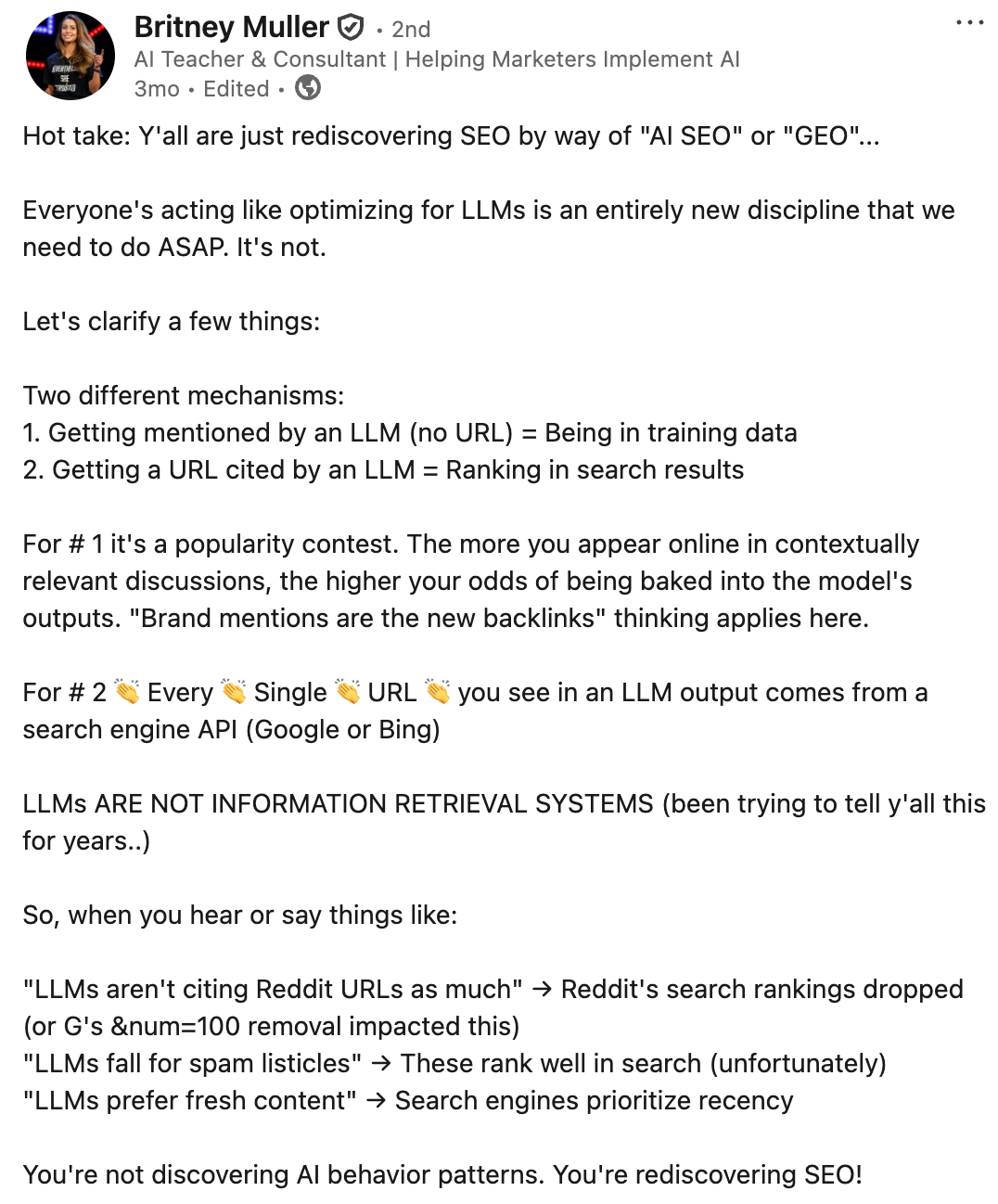
Generate Authority with Off-site Brand Trust Signals
Publishing original research and expert insights helps earn recognition from authoritative sources, which in turn boosts your brand’s trust and recognition.
- Mainstream news outlets.
- Niche-relevant publishers.
- Leading podcasters.
- Engaged Reddit communities.
Expanding these digital footprints strengthens entity recognition and reinforces brand trustworthiness.
Leveraging audience intelligence tools like SparkToro identifies which platforms, communities, and topics should be prioritized in your digital PR strategy.

For a deeper understanding, explore: The origins of SEO and its significance for GEO and AIO
New AI Terms Gain Momentum: See the Enthusiasm Rise
Though few are updating their LinkedIn headlines just yet, industry leaders’ posts reveal growing interest in three specific terms.
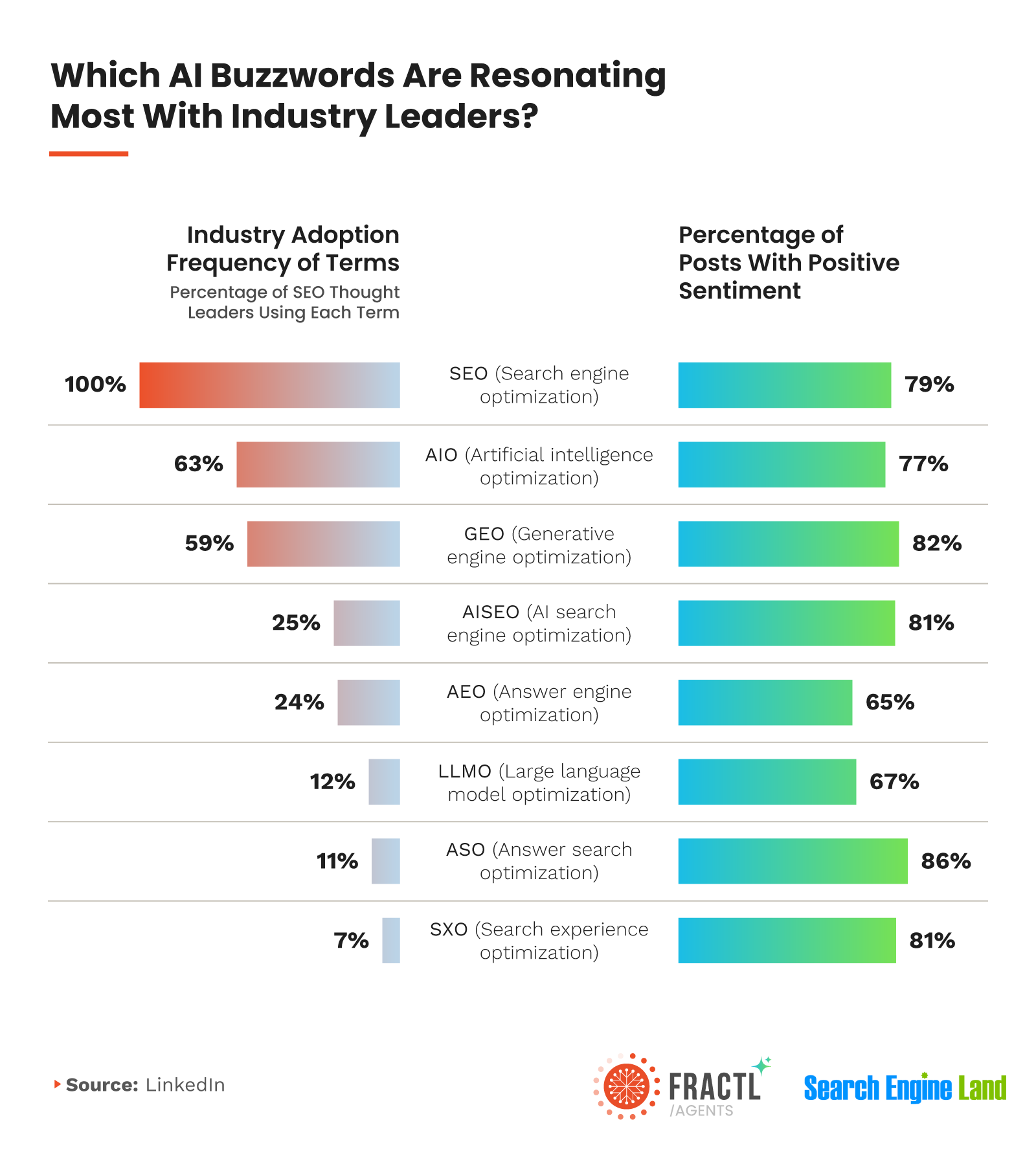
- 63% of leaders mention AIO, with 77% positivity.
- 59% mention GEO, with 82% positivity.
With over 70% of posts expressing positivity, sentiment often indicates adoption likelihood. When positivity wanes, so does usage. Yet, that’s not what’s happening here.
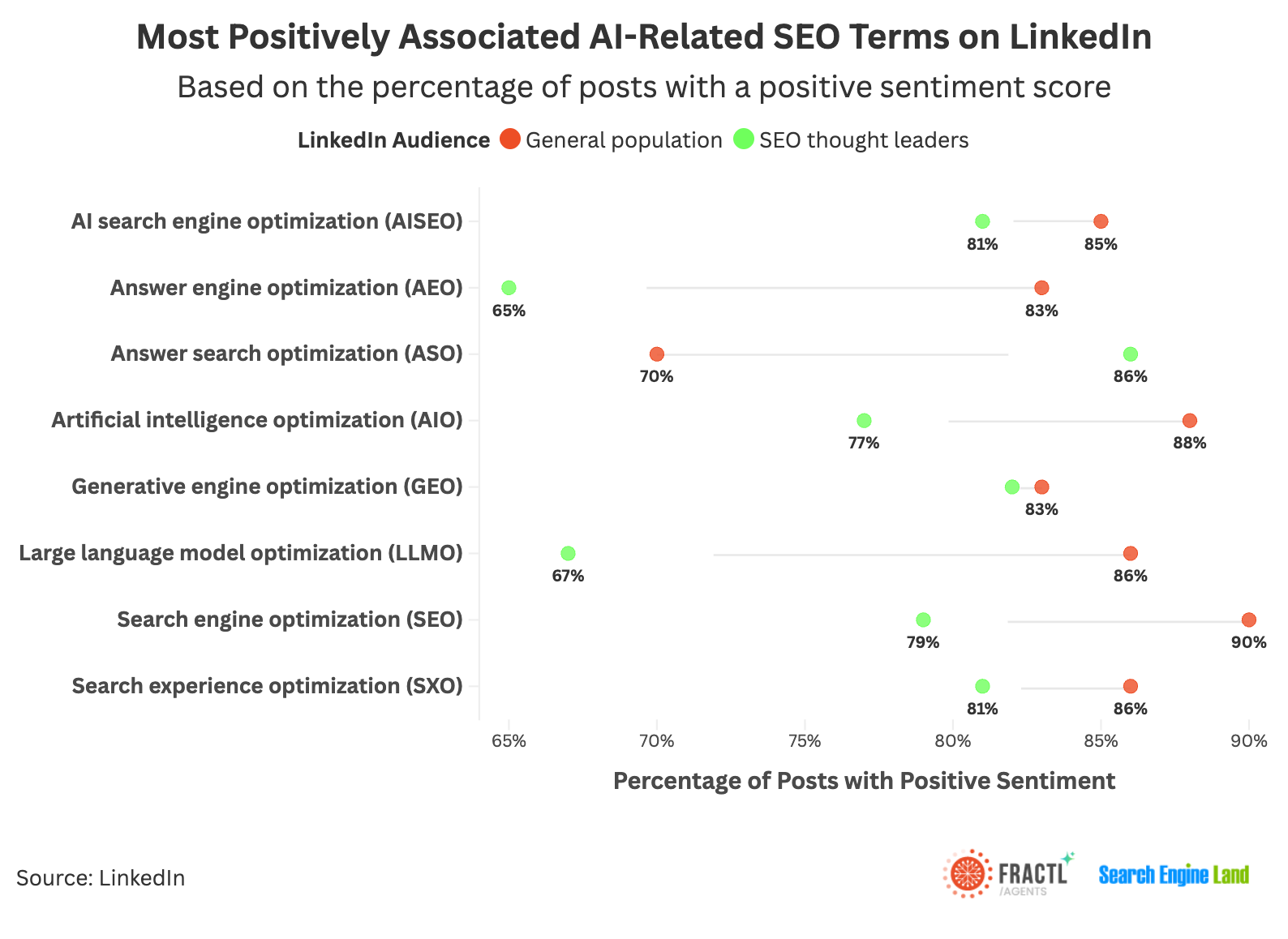
While AEO, LLMO, and AIO attract broader audiences, GEO stands out for consistent positivity, especially among SEO influencers and LinkedIn users alike.

SEO continues as the industry’s backbone, but it’s clear: we’re witnessing the alignment phase of an emerging platform.
The focus isn’t on acronyms; it’s about accurately describing brand visibility in AI-era searches.
The Real Strategy: Timely, Value-Driven Content
Brands should refrain from over-optimizing towards any singular term, strategy, or platform. Instead, develop value-focused content, repurpose it, and engage with audiences across their existing platforms.
This adaptability ensures brands endure platform shifts, avoiding pitfalls like those seen in once-dominant platforms such as Vine and Clubhouse.
Explore further: Understanding AI’s Impact on SEO
Nomenclature Volatility: A Subtle Yet Critical Indicator
Our research highlights this critical insight: less than a third of thought leaders consistently use AI-related SEO terminology with stable sentiment over the past year.
- 35% express positive sentiment toward these terms but lack consistency.
- Just over a third are consistently positive and stable.
The discourse isn’t about being right or wrong. It’s about reframing discussions as the landscape evolves, with volatility often mirroring visibility.
By evaluating sentiment against volatility, we revealed scattered positions rather than a distinct divide.
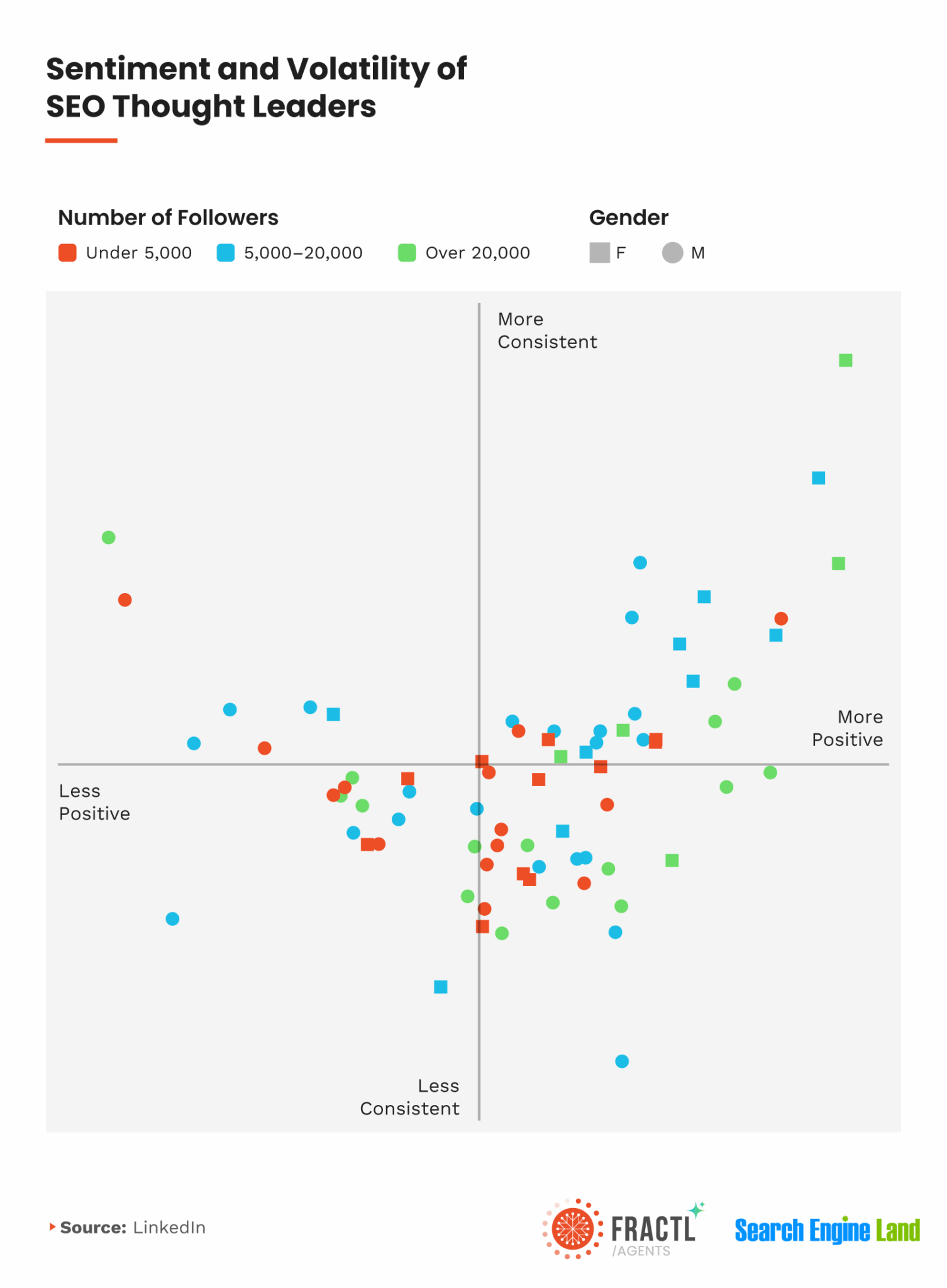

The uncomfortable truth is that the most vocal aren’t always the most dependable. The impact of their shifting narratives is vital, as their guidance influences budgets, plans, and careers.
Leaders who maintain a balanced outlook – driven by data and tempered by experience – offer a different perspective compared to those swayed by every update.
Dive deeper: Why AI Search Studies Diverge
The Key Lesson: It’s Not a Strategy Reset; It’s an Emerging Platform
Effective content marketing, digital PR, and technical SEO are the foundation for building brand visibility. AI is simply the next platform evolution, much like social media, enhancing but not replacing existing strategies.
Our analysis indicates the industry isn’t unsure about what to do. It is negotiating how to convey this rapidly evolving discovery system. This discussion is typical at this stage, but volatile shifts harm trust.
Terms like AEO, LLMO, and AIO may gain some traction, but GEO remains consistent among both practitioners and broader audiences, suggesting its potential as a stable narrative bridge as execution evolves.
Crafting a Resilient Digital Footprint: Navigating the AI Era
Market strategies shouldn’t revolve around what’s trending quarterly. Instead, focus on timeless marketing principles:
- Create content that delivers real value to your market.
- Repurpose and circulate it on platforms where your audience is active.
- Generate citations, engagement, and trust that impact search, social, and AI systems.
In today’s era, where answers are synthesized rather than ranked, the voices that resonate won’t be the ones coining the next big label, but those that remain consistent, building trust and visibility over time.
The analysis focused on the top 75 SEO thought leaders, including agency owners, directors, industry speakers, and consultants.
- Aleyda Solis
- Amanda Farley
- Amanda Natividad
- Andrew Holland
- Andrew Prince
- Andy Crestodina
- Areej AbuAli
- Barry Schwartz
- Beth Nunnington
- Brett Tabke
- Brie E. Anderson
- Britney Muller
- Bruce Clay
- Celeste Gonzalez
- Christian Hustle
- Cindy Krum
- Connor Gillivan
- Crystal Carter
- Cyrus Shepard
- Dana DiTomaso
- Danielle Stout Rohe
- Danny Ashton
- Danny Goodwin
- Darren Shaw
- Dave Davies
- Derek Perkins
- Eli Schwartz
- Eric Enge
- Fabrice Canel
- Felipe Bazon
- Garrett French
- Garrett Sussman
- Gisele Navarro
- Greg Gifford
- Ian Lurie
- James Brockbank
- James Wirth
- Jane Hunt
- Jesse McDonald
- Jordan Koene
- Joy Hawkins
- Kathryn Hawkins
- Kelsey Libert
- Kristin Tynski
- Lee Elliott
- Lidia Infante
- Lily Ray
- Loren Baker
- Marc Sirkin
- Mark Rofe
- Mark Traphagen
- Martha van Berkel
- Matt McGee
- Melissa Popp
- Michael Buckbee
- Michael King
- Michelle Robbins
- Mordy Oberstein
- Neil Patel
- Nick Eubanks
- Nick LeRoy
- Noah Learner
- Paddy Moogan
- Patrick Reinhart
- Paul Aaron Norris
- Paxton Gray
- Rand Fishkin
- Ray Grieselhuber
- Ross Hudgens
- Ross Simmonds
- Samantha Torres
- Steven J. Wilson
- Tony Wright
- Vanessa Raath
- Wil Reynolds
Inspired by this post on Search Engine Land.

Leave a Reply