
Less than two centuries ago, scientists faced ridicule for proposing handwashing could save lives. Back in the 1840s, evidence showed improved hygiene reduced mortality rates, yet without understanding the scientific mechanism, widespread acceptance stalled, resulting in preventable deaths.
Often, what we once laughed at becomes today’s truth. Conversely, following false advice leads us astray. Poor GEO advice, while not life-threatening, can cost money, jobs, and economic stability.
Earlier, I discussed the perils of unscientific SEO research and its marketing misconceptions masquerading as discoveries. This article expands on those ideas, demystifying the myths hindering AI search optimization.
Let’s debunk three prevalent GEO myths, determine their validity, and explore my recommendations.
If you’re short on time, here’s a concise summary:
- We often fall for misguided GEO and SEO advice due to ignorance, cognitive biases, and binary thinking.
- Assessment of advice can utilize the ladder of misinference—progressing from statement to fact, data, evidence, then proof.
- Increase knowledge by exploring dissenting views, aiming to understand, pausing before believing, and avoiding over-reliance on AI.
- Currently:
- You don’t need an llms.txt.
- Use schema markup even if not used immediately by AI chatbots.
- Keep content updated for relevant queries.
Let’s revisit why we fall for poor advice.
The reasons behind our susceptibility include ignorance, stupidity, and amathia (voluntary ignorance), alongside cognitive biases such as confirmation bias and simplistic black-and-white thinking.
Many of us lack knowledge or refuse to accept new ideas. Our biases, particularly confirmation bias, lead us to ignore conflicting information and scrutinize opposing theories instead.
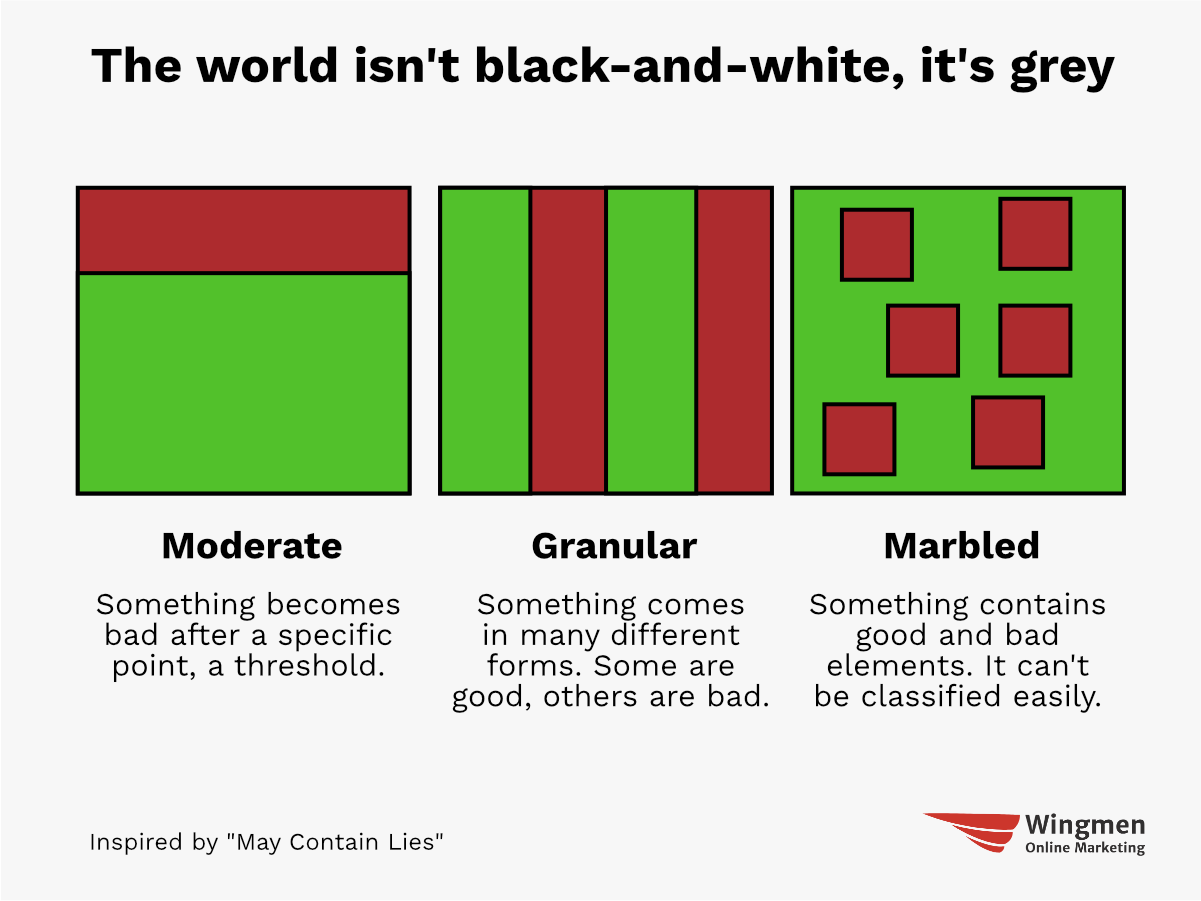
Black-and-white thinking simplifies complex issues to absolute terms, yet the world is full of gray areas, as explained in Alex Edmans’ book, “May Contain Lies.” He describes concepts as moderate, granular, or marbled.
Realizing these patterns help manage ignorance, biases, and absolutist thinking.
Let’s delve into the practical aspects of why we succumb to poor advice.
I utilize a strategy called the ladder of misinference to evaluate GEO and SEO advice, inspired by Edmans’ work, to discern truth from misleading information.
To categorize a statement as proof, it must ascend the ladder, yet many falter between evidence and proof.
Take user signals: they are said to influence rankings, evidenced by experiments, yet court documents in Google’s DOJ trial verified their significance.
Years ago, people laughed at insights shared by figures like Rand Fishkin, but these have now become accepted truths.
If I were in your shoes, I’d recommend seeking differing opinions, understanding before replying, pausing before accepting or sharing information, and avoiding AI summaries, given their summarization flaws.

To illustrate misleading examples, consider the hyped AI research lacking substance, widely shared yet devoid of real proof.
Let’s explore the most common GEO myths and discern reality from claims.
The first myth suggests the creation of an llms.txt file, touted to centralize data for AI citations. However, lacking substantial proof and grounded mostly in influencer hype, its practicality remains unverified.
If reputable companies begin supporting it, I’d review changes in crawl volume before considering its implementation.
Regarding schema markup, many argue its necessity for machine readability, but there’s no solid proof this enhances AI visibility.
For best practices, employ schema for SEO hygiene, acknowledging it may benefit AI systems in the future.
On fresh content, while there’s more empirical backing, ensure updates are genuine rather than superficial, as search engines track historical changes.
To tackle misinformation, recognize the need for critical evaluation over trusting authoritative sources or AI-generated summaries implicitly.
This reflection helps us challenge existing ideas, ensuring continual growth and awareness of the evolving digital landscape.
Inspired by this post on Search Engine Land.

Leave a Reply