
I recently stumbled upon some intriguing developments from Bing, as they are experimenting with a new ad format that closely resembles Google’s approach. This revamped ‘Sponsored results’ grouping could potentially lead to more accidental ad clicks, given how seamlessly these paid listings blend with the organic search results.
Picture this: Microsoft is testing a redesign for search ads in Bing, wherein multiple sponsored links are grouped under a single ‘Sponsored results’ label. There’s also a handy ‘Hide’ button to collapse the ad block entirely, adding a layer of user control that’s quite novel.
What’s Happening? It was Sachin Patel who first noticed this Bing test in action, sharing screenshots and a video that spotlight this new layout. Interestingly, in the current test, only the first ad in the group is marked with a label. Any subsequent ads are listed without labels beneath it. This feature allows users to click ‘Hide’ to collapse these ads and ‘Show’ to display them once more.
Understanding the Mechanism. The design clusters ad units in such a way that blurs the lines between paid and organic content. By consolidating ad labeling to just one header, it makes each ad appear more like a standard search result.

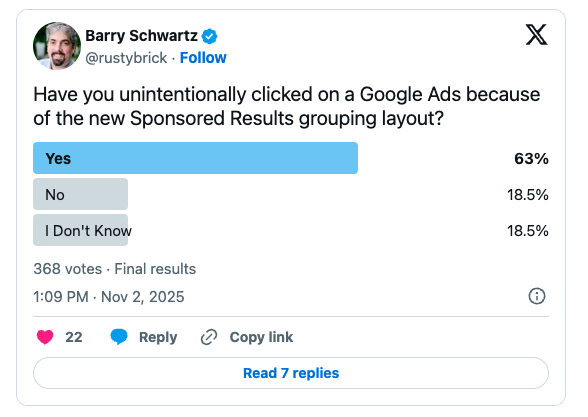
Looking Back. Google introduced a similar approach not too long ago, and it quickly drove discussions around unintended ad clicks. According to a recent poll conducted by Barry Schwartz on X, a remarkable 63% of respondents admitted to inadvertently clicking on Google Ads results due to this new grouping.
Bing following suit might indicate a broader industry trend in the labeling and display of search ads.
Why Should We Care? Bing’s new grouped ‘Sponsored results’ format could potentially raise ad visibility and enhance click-through rates by making ads blend more seamlessly with organic listings. The ‘Hide’ button introduces a refreshing control element for users, though the single-label approach may still lead to increased accidental clicks, as observed with Google’s recent redesign, potentially resulting in higher bounce rates.
Should Microsoft decide to implement this change broadly, it could significantly impact campaign performance, attribution, and spending efficiency across Bing’s search platform.
Initial Observations. This layout change was first shared by Sachin Patel, who took to X with his findings.
The Takeaway: While the experiment remains limited for now, if Bing rolls this format out extensively, it could lead to increased engagement — whether intended or accidental — and renew discussions about how clearly ads are disclosed in search results.
Inspired by this post on Search Engine Land.

Leave a Reply