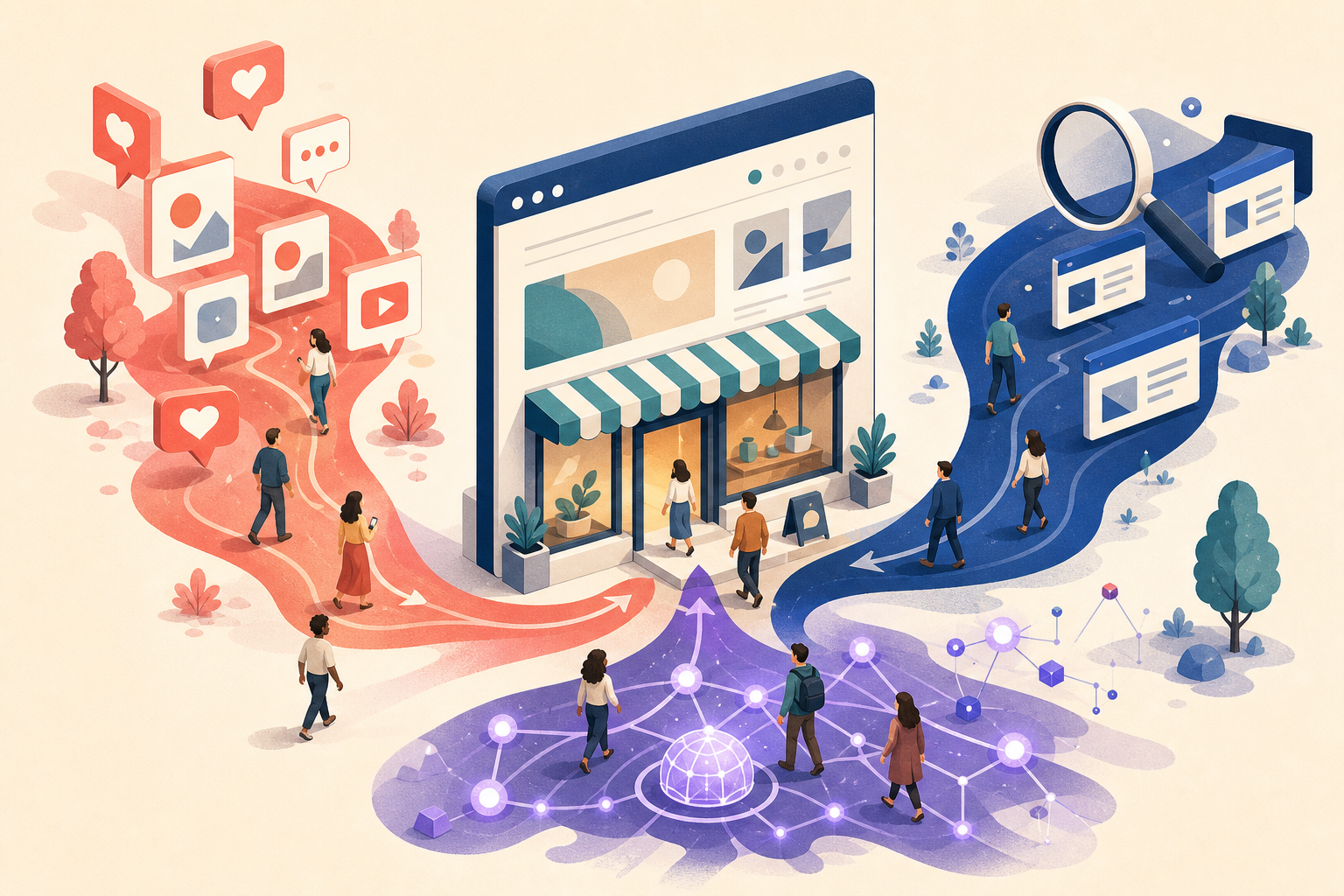
If social now sends more visitors while Google sends fewer, the wrong reaction is to replace your SEO plan with a larger social calendar. The useful move is to redesign acquisition so social creates demand, search captures intent, AI systems can understand the business, and your website turns attention into action.
For an SMB, this is mainly an ownership and measurement problem. You need to know which channel starts the journey, which page advances it, and whether your business appears when an AI answer creates a shortlist. Once those roles are visible, you can reallocate effort without betting the business on whichever channel happens to be growing fastest.
Key takeaways
- A leading traffic source is not automatically the most profitable source. Compare qualified leads and sales, not visits alone.
- Social, organic search and AI discovery should have different jobs within the same acquisition system.
- Even when social platforms or marketplaces generate enough leads, an owned website gives every channel a stable destination and a consistent set of business facts.
- Strengthen the homepage, product or service pages, and contact page before expanding into a large content program.
- Track AI referral clicks separately from AI mentions. A business can gain or lose visibility without producing a measurable visit.
- Put the next increment of time or budget into the constraint that is limiting acquisition, not automatically into the channel reporting the most traffic.
Read the shift as a portfolio signal, not an SEO obituary
Among more than 300 U.S. small businesses across 24 industries, 64% listed social media as a leading traffic driver, compared with 52% for organic search. About 40% reported losing Google traffic amid algorithm updates and AI-driven search changes. Nearly half of the larger companies within the SMB sample reported a decline.
That is a meaningful change in the acquisition mix, but it does not establish that social traffic is cheaper, more qualified or more likely to convert. The percentages describe what businesses reported as traffic drivers. They do not measure profit per channel, customer lifetime value or the role one channel played before another received credit.
The SEO-is-dead interpretation also clashes with the same businesses’ experience: 72% still considered their SEO efforts effective. Search can remain commercially useful while its share of total traffic falls. A service page that attracts fewer but highly qualified visitors may be worth more than a social post that produces a large burst of low-intent sessions.
The sample ranged from sole proprietors to companies with as many as 100 employees. That range matters. A solo operator selling through social messages has a different acquisition system from a larger SMB with multiple services, sales staff and a mature website. Use the broader numbers to identify what deserves inspection, then let your own conversions determine where money moves.
There are two expensive overreactions to avoid. The first is protecting every historical SEO activity merely because it used to work. The second is moving most acquisition resources into social because it now leads an aggregate traffic ranking. Either choice can preserve a weak tactic while ignoring the actual constraint in your funnel.
Keep a baseline for every channel that is still producing qualified demand. Make larger budget changes in reversible increments, and evaluate them against leads, orders and sales quality. Moving too much on the basis of one traffic statistic can cut off a high-intent source before you understand its contribution.
Give social, search and AI different acquisition jobs

A channel strategy becomes easier to manage when every surface has a primary job. Social media is well suited to discovery, timely distribution and visible proof that a business is active. Organic search meets people who have expressed a need through a query. AI answers can place a brand into an early shortlist, sometimes before the buyer visits any site. Your owned pages establish the facts and provide the route to an enquiry or purchase.
| Surface | Primary acquisition job | Evidence to inspect | Best handoff |
|---|---|---|---|
| Social media | Create discovery, demonstrate relevance and distribute useful material | Tagged visits, qualified enquiries, assisted conversions and the landing pages visitors choose | The page that directly continues the promise made in the social content |
| Organic search | Capture explicit demand and answer high-intent questions | Conversions by landing page, changes in qualified visits and performance by intent group | A complete product, service or decision page rather than a generic homepage |
| AI answers | Place the business in the consideration set and communicate verifiable facts | Referral sessions where a referrer is available, recurring brand mentions and competitor inclusion | The strongest page supporting the exact claim, offer or recommendation |
| Owned website | Confirm the business, reduce uncertainty and convert demand | Completed lead or purchase actions, abandonment points and the path between core pages | A clear contact, booking, enquiry or checkout action |
This division prevents a common attribution mistake. A social interaction can introduce the business, an organic result can bring the person back, and the website can receive credit for the eventual conversion. AI visibility can influence the same journey without generating a click that appears in analytics. Judging each surface only by last-click sessions hides much of that sequence.
Some businesses can operate without an owned site: 35% of businesses without websites said social channels and marketplaces generated enough leads. That can be a valid distribution choice, especially for a small operator. It is not the same as owning the customer path.
A platform can change reach, account access, page formats or reporting without preserving your preferred customer journey. An owned site gives social visitors a stable destination, gives search engines durable pages to index, and gives AI systems a consistent place to verify what the business does. If social or a marketplace already works, keep it. Add the smallest useful owned layer instead of replacing a functioning channel.
That smallest layer does not need to begin as a large blog. Start with a homepage, one strong page for each important product or service, and a contact or conversion page. Those pages can support all three discovery channels while keeping maintenance realistic for a small team.
Build the owned pages every channel can hand off to

Among businesses monitoring AI-driven traffic, 57% treated the homepage as important, 48% prioritized product or service pages, and 34% emphasized contact pages. These figures reflect business priorities, not a rule that AI systems always prefer one page type or that the homepage receives 57% of AI referrals.
The practical lesson is that AI optimization begins close to revenue. If an assistant, search result or social post introduces your business, the next page must resolve the buyer’s immediate uncertainty. A large volume of informational content cannot compensate for a vague offer, contradictory business details or a contact path that fails on mobile.
Make the homepage an unambiguous identity page
- State what the business provides, who it serves and where it operates near the beginning of the page.
- Use one consistent business name and keep core facts aligned with the rest of the site and legitimate third-party profiles.
- Replace broad claims with specific, supportable descriptions of the offer.
- Link directly to the most important product or service pages instead of making visitors decode a general navigation label.
- Include a clear next action and place essential information in readable page text, not only inside images or interactive elements.
The homepage should make the business identifiable even when a system extracts only a few sentences. That does not mean writing robotic copy. It means using complete statements, descriptive headings and consistent facts so a person or machine does not have to infer the basic proposition.
Turn product and service pages into decision pages
- Give each important offering a page with a descriptive title rather than grouping unrelated services beneath a generic label.
- Explain the audience, the problem addressed, what is included, material limitations and the next step.
- Use headings that match the questions a serious buyer asks while deciding.
- Keep the answer immediately below its heading and make it understandable without reading the entire page.
- Support credentials, outcomes and differentiators with evidence you can substantiate.
- Match the page language to the social post, search intent or AI claim sending the visitor there.
A mismatch at this handoff is easy to misdiagnose as a traffic problem. If a social post promotes one service but sends visitors to a homepage covering several unrelated offers, more reach may only produce more confusion. The closest relevant commercial page should continue the same promise and vocabulary.
Treat the contact page as part of acquisition
- State exactly what the visitor should do and what information the business needs to respond.
- Provide appropriate contact routes and keep operating area, availability or location details current when they affect eligibility.
- Test the entire action on a mobile device, including forms, buttons and confirmation messages.
- Remove fields that do not help qualify or complete the enquiry.
- Do not publish a response promise unless the business can reliably meet it.
Contact pages receive less attention than homepages, but they sit closer to the outcome you are trying to acquire. A broken form or unclear service area can make social, SEO and AI traffic appear unproductive even when discovery is working.
Add machine-readable clarity and outside corroboration
The most common AI-visibility adaptations were clear, descriptive headlines at 35%, improved readability at 26%, and technical improvements such as speed and mobile performance at 24%. Larger SMBs more often pursued external brand mentions at 33% and structured data at 30%.
Those percentages are adoption rates, not measured performance lifts. They still point to a sensible implementation order because the first changes help human visitors, search engines and AI systems at the same time: make the page’s purpose explicit, make the answer easy to read, and make the page work reliably.
Structured data comes after the visible facts are sound. If you use JSON-LD, treat it as a machine-readable restatement of the page, not a hidden place to introduce stronger marketing claims. Keep names, URLs, contact details and offering information consistent. Remove stale values, complete only fields you can support, and validate the markup after material page changes.
External brand mentions serve a different purpose. They give discovery systems evidence that does not come from the business itself. Pursue accurate mentions on legitimate third-party pages that customers already use, such as relevant organizations, partners, publishers or business profiles. Bulk placements with inconsistent details create noise rather than credible corroboration.
This work can create openings for smaller businesses because AI summaries can draw on material beyond the conventional top Google results. A business does not necessarily need to outrank every competitor for every query before it can become part of an AI-generated answer. It does need clear claims and enough reliable web evidence for those claims to be understood and checked.
Measure two kinds of AI visibility, then fund the bottleneck
AI is not yet the leading traffic source for most SMBs, but it is already entering measurement plans. Half of SMBs monitored AI referrals or mentions, rising to 70% among larger SMBs. Combining referrals and mentions into one metric, however, makes the result hard to interpret.
Separate referral traffic from answer visibility
An AI referral is a visit that can be associated with an AI service when the referring information is available. An AI mention is an appearance inside an answer, recommendation or summary. A mention may influence the buyer without producing a visit. A referral proves that someone clicked, but it does not prove that the preceding description was favorable or accurate.
- Define the outcome first. Decide which completed actions count as qualified enquiries, purchases, bookings or other meaningful conversions.
- Normalize the links you control. Tag social profile and campaign links consistently so intentional social traffic does not disappear into ambiguous reporting.
- Report by landing page as well as channel. This exposes whether discovery changed or whether a specific commercial page stopped converting.
- Maintain a fixed AI query set. Include branded questions, category or location questions, customer problems and comparison-oriented prompts that reflect real buying decisions.
- Record both presence and treatment. Note whether the business appears, which page or third-party evidence is referenced when visible, which competitors appear, and whether material facts are correct.
- Keep a change log. Record page rewrites, structured data updates and significant new mentions so later movement can be assessed without assuming that one change caused it.
A stable query set is more useful than collecting isolated screenshots. It lets you notice repeated exclusion, incorrect descriptions and competitor patterns. It also prevents one favorable answer from being mistaken for broad visibility.
Move the next unit of effort to the constraint
| What you observe | Likely constraint to investigate | Best next move |
|---|---|---|
| Social engagement is healthy, but few visitors become qualified leads | The post-to-page handoff or on-site conversion path | Send traffic to the closest relevant offer page, match its language to the social promise, and remove unnecessary steps before purchasing more reach |
| Commercial pages convert qualified visitors, but organic discovery has fallen | Search visibility or technical access rather than the offer itself | Protect the converting pages, improve their clarity and mobile performance, and strengthen relevant supporting content instead of replacing them with generic volume |
| Competitors repeatedly appear in AI answers while your business does not | Unclear business facts, weak supporting pages or insufficient third-party corroboration | Clarify the entity and offer, align JSON-LD with visible content, earn accurate external mentions, and recheck the same query set |
| Social platforms or marketplaces produce leads, but the business has no site | Ownership and verification rather than immediate lead volume | Keep the working channel and publish a minimal owned spine consisting of a homepage, offer pages and a contact path |
| Total traffic looks stable, but enquiries or sales quality has weakened | The offer, qualification or conversion experience | Inspect landing-page intent, calls to action and lead quality before shifting acquisition budget |
| AI referrals rise, but the relevant landing pages do not advance visitors | The AI-to-page handoff | Identify the claims or questions that generated the visits, then make the destination page answer them directly |
This bottleneck rule is more dependable than declaring a permanent winner among social, search and AI. If discovery is strong and conversion is weak, buying more discovery magnifies waste. If pages convert but qualified discovery is shrinking, conversion redesign alone will not restore demand. If competitors dominate AI answers, ordinary traffic reports may not reveal the visibility gap at all.
Begin with one high-value customer route: a social post to a service page, a search result to a contact page, or an AI mention to the homepage. Measure the route end to end, correct the point where it breaks, and then move to the next constraint. The traffic landscape can continue shifting without forcing you to rebuild your acquisition strategy every time a channel changes position.
Leave a Reply