
Choosing an eCommerce design agency gets risky when every proposal promises the same things: a modern storefront, better conversion, and seamless integration. Those phrases will not tell you whether the team can preserve organic visibility, model customer-specific pricing, or move a live catalog without breaking the buying path.
The useful question is not, “Which agency is best?” It is, “Which team can prove it has solved the operating problem our store actually has?” The process below turns that question into requirements, evidence, a weighted decision, and a contract you can enforce.
Define the store’s operating job before you shortlist agencies
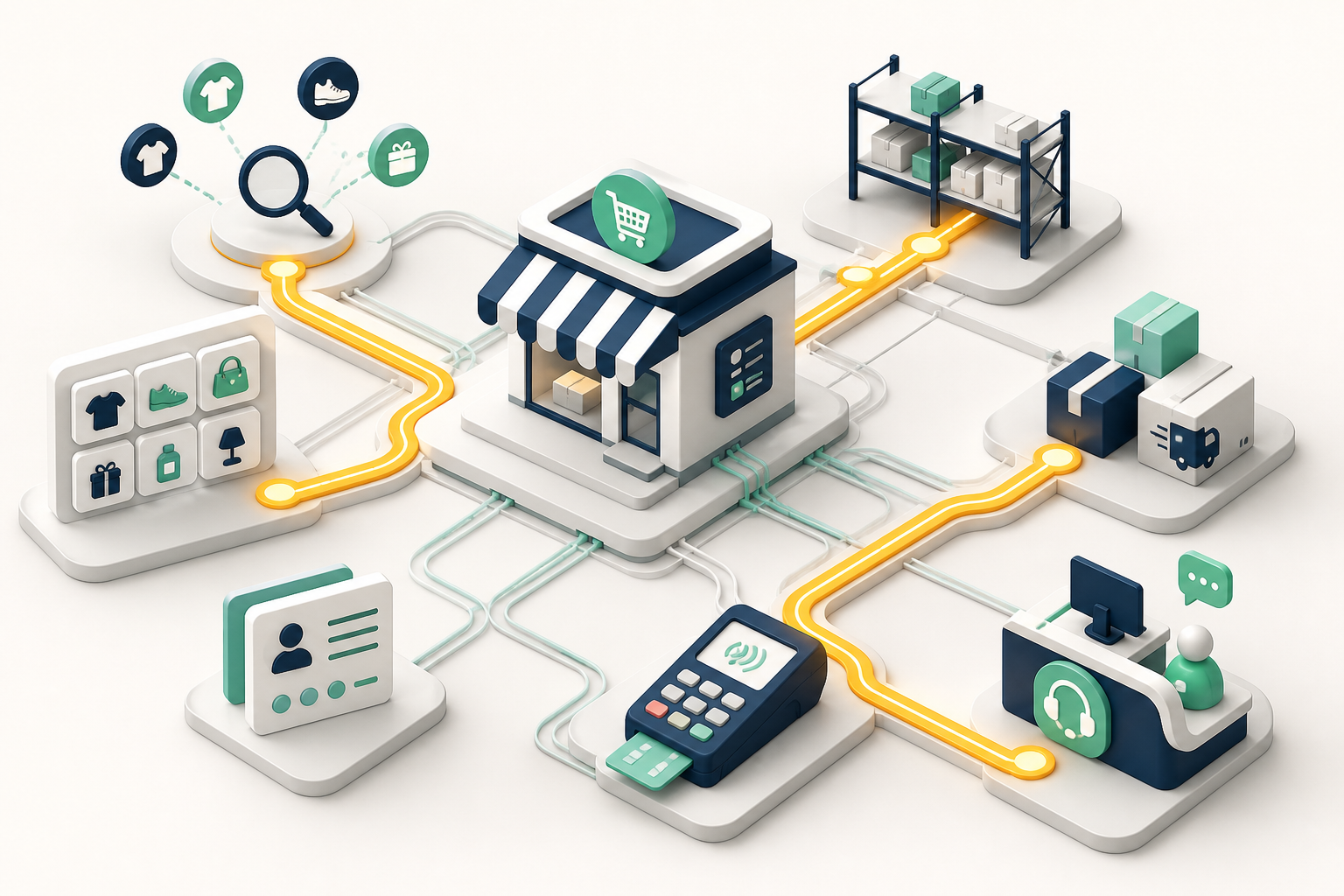
An attractive interface is only the visible layer of an eCommerce system. Underneath it sit product data, pricing rules, customer accounts, inventory, payments, fulfillment, analytics, search visibility, and the operational systems your team already uses. Your shortlist will be unreliable until you decide which of those problems the project must solve.
Start by writing one sentence that describes the commercial job, the customer, and the change you need. Use a form such as:
- For a direct-to-consumer business: “Replace our current storefront with a faster, easier product-discovery and checkout experience without losing valuable organic landing pages.”
- For a manufacturer or distributor: “Give logged-in buyers customer-specific pricing, live availability, repeat ordering, and account self-service using data from our ERP.”
- For a migration: “Move the existing catalog, customers, orders, content, and search equity to the selected platform while reducing the custom code we must maintain.”
That sentence forces an important distinction. A consumer brand may need merchandising, storytelling, acquisition landing pages, and checkout optimization. A B2B seller may need account hierarchies, approval rules, negotiated prices, payment terms, quick-order tools, and an ERP-backed buyer portal. These are not different visual styles. They are different operating models.
For manufacturers and distributors, buyer-portal capability and ERP design experience warrant separate evaluation. They were weighted at 15% and 13%, respectively, in a B2B agency assessment. That separation matters because a team can design a polished account dashboard without knowing how to make its inventory, pricing, and order status agree with the system of record.
Turn the operating job into a requirements sheet covering:
- Customer model: anonymous shoppers, account customers, dealers, distributors, procurement teams, or a mixture.
- Critical buying journeys: product discovery, quote request, purchase, approval, reorder, subscription, return, or account service.
- Catalog and commercial rules: variants, bundles, large assortments, market-specific catalogs, contract prices, volume rules, and restricted products.
- Systems and data ownership: eCommerce platform, ERP, product information system, CRM, payment service, tax service, fulfillment tools, analytics, and marketing platforms.
- Discovery requirements: existing organic landing pages, internal search, product feeds, structured data, indexation rules, redirects, and content workflows.
- Delivery constraints: launch dependencies, internal approvers, compliance needs, content readiness, available technical staff, and the support model after launch.
Label each requirement as mandatory for launch, valuable if the budget allows, or suitable for a later phase. An agency should not be able to turn an essential workflow into a surprise change request simply because it appeared deep in an unprioritized feature list.
Do not let a preferred platform reverse this sequence. Platform credentials can show that an agency knows a technology, but the platform still has to support your commercial rules and integrations. Define the job first, select the platform against that job, and then evaluate whether the agency has relevant people available to deliver it.
Ask for proof at the level of the use case
Logo walls, awards, aggregate ratings, and attractive screenshots are useful screening signals. None proves that the proposed team can handle your project. The closer the evidence is to your actual use case, the more weight it deserves.
The limits of ratings are easy to see. Among seven selected agencies in a 2026 market set, average review scores ranged only from 4.0 to 4.8 while buyer-portal capability ranged from minimal to extensive and ERP experience ranged from unreported or limited to extensive. A strong rating can support your decision, but it cannot tell you whether the agency has the capability your store needs.
Ask each candidate for an evidence pack tied to your requirements. It should include:
- A case study with the same commerce model, not merely the same industry or platform.
- A live or recorded walkthrough of the relevant workflow, including account, mobile, empty, error, and exception states where applicable.
- A clear account of what the agency actually delivered. Strategy, design, platform configuration, integration, data migration, SEO, and ongoing marketing may have been divided among several parties.
- The business or operational outcome, how it was measured, and which constraints affected it.
- The names, roles, platform credentials, and expected availability of the people proposed for your project.
- A client reference whose project involved the capability you consider most difficult or risky.
“Similar project” needs a precise meaning. Match evidence across the dimensions that create complexity: customer type, platform, catalog, pricing model, integrations, geographic reach, migration scope, and internal operating model. A fashion storefront on Shopify is not strong evidence for a distributor that needs account pricing from an ERP, even when both businesses sell online.
Audit each case study with direct questions:
- What problem existed before the project?
- Which requirements forced a custom solution, and which were handled natively by the platform?
- Which systems supplied product, price, inventory, customer, and order data?
- What failed or changed during delivery, and how did the team respond?
- Which result can be attributed to the redesign, and what else changed at the same time?
- What does the agency maintain now, and what does the client’s team own?
If an agency cannot explain how an outcome was measured, treat the work as evidence of creative quality rather than commercial impact. If it cannot identify its responsibility, do not credit it for the whole implementation. If the proposed delivery team differs from the case-study team, assess the people you will actually receive.
Use a weighted scorecard without letting averages hide deal-breakers

A scorecard prevents the most polished presentation from winning by default. For a manufacturer or distributor, the following B2B weighting provides a practical starting point. It reflects the greater delivery risk carried by portals, commercial rules, and ERP-connected experiences. It should not be copied unchanged for a direct-to-consumer brief.
| Criterion | Starting weight | Evidence worth scoring | Weak evidence |
|---|---|---|---|
| B2B specialization and platform certifications | 25% | Relevant credentials held by the assigned team plus comparable technical work | A large badge collection with no matching workflow or named delivery team |
| Average online review score | 20% | A consistent pattern across established review platforms, with comments relevant to delivery | Selected testimonials with no independent context or explanation of project scope |
| Portfolio and client success | 17% | Comparable implementations, attributable responsibilities, and measurable outcomes | Screenshots, brand names, or unverified claims without operational detail |
| Buyer portal and self-service UX | 15% | Working account dashboards, repeat ordering, approvals, quotes, and customer-specific experiences | A generic login page or mockup presented as a complete portal |
| ERP integration and operational design | 13% | Clear data ownership, interface behavior, failure handling, reconciliation, and order workflows | “We integrate with anything” without architecture or comparable implementation evidence |
| Industry experience and specialization | 10% | Understanding of the industry’s catalog, buying process, operating constraints, and terminology | Industry logos that do not connect to the requirements in your brief |
Give every agency the same evidence grades: absent, weak, acceptable, strong, or exceptional. Define what each grade means before reviewing proposals, convert the grades to a consistent numeric scale in your spreadsheet, apply the weights, and record a short justification beside every score. A score without a note will be hard to defend when stakeholders remember the presentations differently.
Keep hard gates outside the weighted total. These are conditions that cannot be averaged away, such as an unsupported required platform, missing security or compliance capability, inability to meet a fixed business dependency, an unacceptable subcontracting model, or refusal to accept essential contract terms. An agency that fails a hard gate should not win because it scored well on brand design.
Change the weights before proposals arrive if your project is not B2B manufacturing or distribution. A consumer retailer may put more emphasis on merchandising, mobile shopping, brand expression, experimentation, content, conversion, and SEO migration. A platform migration may put more emphasis on data mapping, redirects, integrations, cutover planning, and maintainability. Changing weights after seeing the candidates simply lets preference masquerade as analysis.
Turn the final pitch into a working session, then contract the details
Use one scenario to expose how the team thinks
Give every finalist the same realistic scenario from your requirements sheet before the meeting. Ask the people who would do the work to walk through their response. For a B2B seller, that might be a logged-in buyer seeing an account price, discovering that requested quantity is not fully available, seeking approval, and placing an order that must reach the ERP. For a migration, it might be preserving a valuable category URL while product taxonomy, filters, and platform templates change.
Use the session to ask:
- Which part would you solve with native platform functionality, an application, configuration, or custom code, and why?
- Where is the source of truth for each piece of data, and what should the customer see when that source is unavailable?
- Which assumptions must be validated during discovery?
- How will design decisions be tested against real catalog content and exception cases?
- How will URL changes, redirects, indexation, internal links, structured data, product feeds, and analytics be handled?
- Who makes the technical decision, who performs the work, and who remains accountable when another vendor is involved?
- What is explicitly excluded from the proposal?
Good answers reveal choices, dependencies, and tradeoffs. Be wary of answers that make every integration sound routine or every requirement sound native. The purpose of the session is not to demand a complete solution before discovery. It is to see whether the team notices the hard parts and has a credible method for resolving them.
Communication also needs evidence. Ask who owns decisions, how unresolved issues are recorded, what you will see during delivery, and how scope changes are approved. Then compare those answers with the client reference. A personable salesperson is not a substitute for a delivery system.
Replace vague promises with acceptance criteria
Do not accept “custom eCommerce website,” “seamless ERP integration,” “SEO-friendly build,” or “AI-ready content” as complete deliverables. The statement of work should identify the artifact, owner, review process, dependency, and acceptance condition for each project area.
- Discovery: approved requirements, customer journeys, functional decisions, system map, data ownership, risks, and delivery plan.
- Experience design: named templates and components, responsive behavior, account states, error states, accessibility requirements, and content responsibilities.
- Platform and integration: native features, applications, custom code, interfaces, field mappings, synchronization behavior, failure handling, reconciliation, and technical documentation.
- Content and migration: catalog mapping, customer and order history, editorial content, asset handling, validation, and ownership of cleanup work.
- Search and machine-readable discovery: URL inventory, redirect map, canonical and indexation rules, internal linking, metadata ownership, XML sitemaps, product feeds, and responsibility for relevant Product and Organization structured data.
- Quality and launch: test responsibilities, supported environments, performance and accessibility measurements, analytics validation, cutover steps, backups, rollback conditions, and post-launch monitoring.
- Support: warranty boundaries, response process, maintenance ownership, documentation, training, and the transition to internal staff or another provider.
For AI search and answer-engine visibility, insist on concrete implementation language. Product facts, prices, availability, policies, brand information, and supporting content should remain accessible on stable, crawlable pages and be represented consistently in visible copy, structured data, and feeds where applicable. No agency can contractually guarantee inclusion or ranking in an AI-generated answer. “AI-ready” without named outputs and validation steps is not an acceptance criterion.
The commercial terms should also state how assumptions, dependencies, delays, and change requests affect cost and delivery. Confirm code and design ownership, application and platform fees, third-party licenses, data access, subcontractors, termination assistance, and what happens to unfinished work. For provisions affecting intellectual property, personal data, liability, indemnity, or termination rights, have qualified counsel review the actual agreement; an agency scorecard cannot resolve legal exposure.
Before signing, speak with a reference whose implementation resembles yours. Ask what changed after discovery, which responsibilities were unclear, how the agency behaved when delivery became difficult, what the client still depends on the agency to operate, and whether the team named in the sale remained involved. Those answers help you distinguish a successful launch from a maintainable commerce operation.
Key takeaways
- Select for your commerce model and operating complexity, not for the most attractive generic portfolio.
- Write critical buying journeys, systems, data ownership, discovery requirements, and exception cases before requesting proposals.
- Score proof that matches your use case. Ratings, credentials, and brand names are supporting signals, not substitutes for comparable delivery evidence.
- Use preset weights and separate pass/fail gates so a strong presentation cannot conceal a missing essential capability.
- Put the proposed delivery team through the same working scenario and listen for dependencies, failure states, and honest tradeoffs.
- Contract specific artifacts and acceptance conditions for design, integration, migration, SEO, structured data, launch, and support.
Your next move is to write the operating brief and hard gates before booking another pitch. Send the same brief to every shortlisted agency and refuse to score a claim that has no relevant evidence behind it. Once that discipline is in place, agency selection becomes a controlled business decision rather than a contest between sales presentations.
References

Leave a Reply