
Category: Opinion

  • Unlock Demand Gen’s Potential: Test Creative Impact with Uplift

    Unlock Demand Gen’s Potential: Test Creative Impact with Uplift

    I often find that platform reporting can lead me astray when trying to gauge the real impact of Demand Gen creative. To get a clear picture, conducting controlled experiments can validate if my creative work genuinely boosts conversions.

    Demand Gen campaigns shine across YouTube, Discover, and Gmail, but they also bring a challenge—what I call the “attribution illusion.” It’s frequent for me to question whether reported conversions are truly incremental or if users would have converted through search regardless.

    Google introduced asset uplift experiments in November, allowing me to measure the impact of my Demand Gen creative using an A/B split test. This feature helps replace assumptions with clearer insights into what’s truly driving results.

    Relying heavily on creative instinct or standard reporting can misdirect efforts and waste valuable resources on underperforming assets. Google’s A/B testing capabilities empower me to isolate the impact of individual assets, preventing such outcomes.

    Why attribution doesn’t equal incrementality

    For example, if someone views a Demand Gen ad on YouTube but doesn’t click, only to search for my brand later and convert, Google might still credit the Demand Gen campaign. This attribution reflects correlation more than causation.

    To measure accurately, I need to understand the scenario without showing the creative. Withholding test assets from a portion of the target audience helps establish a baseline.

    The difference in conversion rates, or any key KPI between groups exposed to the ad and those not, reveals the actual incremental lift the creative drives.

    Dig deeper: Why incrementality is the only metric that proves marketing’s real impact

    What you need before testing creative uplift

    Launching experiments without enough data for statistical significance is a common misstep. Before testing, I ensure campaigns meet necessary prerequisites to avoid inconclusive or invalid results.

    Conversion volume

    Google suggests having at least 50 conversions across test groups during the experiment for accurate lift measurement. If primary conversions fall short, I consider optimizing the test around micro-conversions like “Add to Cart.”

    Budget minimums

    Experiments require continuous, uninterrupted spending. A limited budget stopping my campaign early skews data for the control group.

    The campaign budget must be sufficient to run for at least four weeks or until statistically significant results are achieved.

    Creative isolation

    ```json
{
  "alt": "The CapmatchOne logo with a gradient circle and bold text.",
  "caption": "Discover innovation with the CapmatchOne logo, featuring sleek typography and a modern gradient circle.",
  "description": "The CapmatchOne logo features bold, modern typography coupled with a gradient circle, symbolizing connection and innovation. The sleek design conveys a sense of progress and creativity. This image can be used for branding or promotional purposes, appealing to audiences interested in innovative solutions and forward-thinking designs."
}
```

    I test one new variable at a time to determine if a specific asset drives uplift, keeping all other campaign elements unchanged.

    Dig deeper: Why Demand Gen is the most underrated campaign type in Google Ads

    How to run an asset uplift test in Google Ads

    Running a creative uplift test in Google Ads is now more streamlined. Here’s how I set up a valid experiment.

    1. Define a clear hypothesis

    Each scientific test starts with a clear hypothesis. I avoid tests without defined objectives. For example:

    • Bad hypothesis: “Let’s see if our new video works.”
    • Good hypothesis: “Adding user-generated content (UGC) to our Demand Gen asset group will drive a 10% incremental lift in ‘purchase’ conversions compared to standard static image carousels.”

    Navigate to the Experiments interface

    In my Google Ads account, I navigate to Campaigns > Experiments. I create a new experiment, selecting Asset tests provided by you for a Demand Gen campaign.

    Configure a 50/50 split

    I define a 50/50 cookie-based split to ensure both groups have equal historical data and algorithm weighting, preventing users from being in both test arms.

    My existing campaign becomes the control, and the new asset campaign serves as the treatment.

    Lock your variables

    Once started, I practice extreme discipline by not altering audiences, targeting, or making drastic bid and budget changes.

    Any changes during the test can introduce noise, affecting the statistical significance of results.

    Set the duration
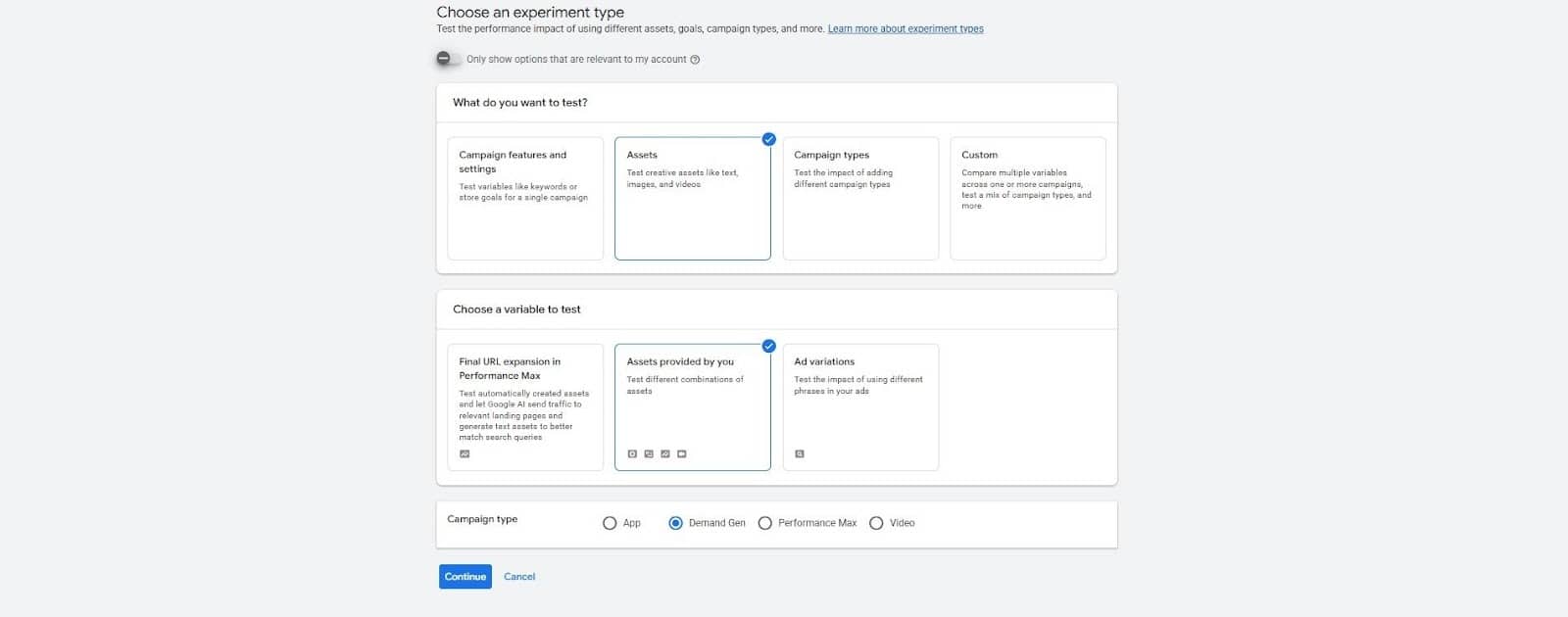
    ```json
{
  "alt": "Screenshot showing options to choose experiment type and variables to test in a digital advertising platform.",
  "caption": "Explore different experiment types and variables to optimize your digital advertising strategy with this intuitive interface.",
  "description": "This image is a screenshot of a digital advertising platform interface where users can choose experiment types such as 'Campaign features', 'Assets', 'Campaign types', and 'Custom'. Further options allow for selection of variables to test, like 'Final URL expansion', 'Assets provided by you', and 'Ad variations'. Users can select their campaign type from 'App', 'Demand Gen', 'Performance Max', or 'Video'. The interface is designed for optimizing ad performance and testing creative assets such as text, images, and videos."
}
```

    I run experiments for at least four weeks. Week 1 is a learning period, and Weeks 2 to 4 provide actionable data.

    Longer conversion cycles in B2B SaaS might require six to eight weeks.

    Dig deeper: What it takes to make demand gen work for B2B and ecommerce

    What your experiment results actually mean

    Upon completion, I review the Experiments dashboard for each arm’s performance and confidence intervals across metrics to validate my hypothesis.

    Outcome 1: Positive lift (statistically significant)

    A positive lift with 95% confidence means my creative asset adds real value. I calculate incremental cost per acquisition (iCPA) by dividing the treatment group’s ad spend by incremental conversions over the control.

    This iCPA becomes my benchmark for further scaling.

    Outcome 2: Negative lift

    Creatives may underperform, perhaps being too disruptive or skipped in ads. Pausing these assets is crucial to let data direct budget choices over personal preference.

    Outcome 3: Inconclusive result

    If results are negligible and don’t confidently attribute conversions after four weeks, I might extend the test for more data. If still inconclusive, trying a drastically different creative asset is my next step.

    Prove creative impact with incrementality testing

    Creative remains a powerful differentiator for performance. Creating high-quality video or UGC is one thing, but proving its impact with scientific rigor strengthens my creative decisions.

    Asset uplift experiments provide evidence of Demand Gen’s budget worthiness to stakeholders. When I start with a holdout test, establish a baseline, and let data guide my creative roadmap, the results speak for themselves.

    Dig deeper: The Google Ads Demand Gen playbook


    Inspired by this post on Search Engine Land.


    crushpress.ai community screenshot
  • Is Google Ads Asset Studio Truly a Game Changer?

    Is Google Ads Asset Studio Truly a Game Changer?

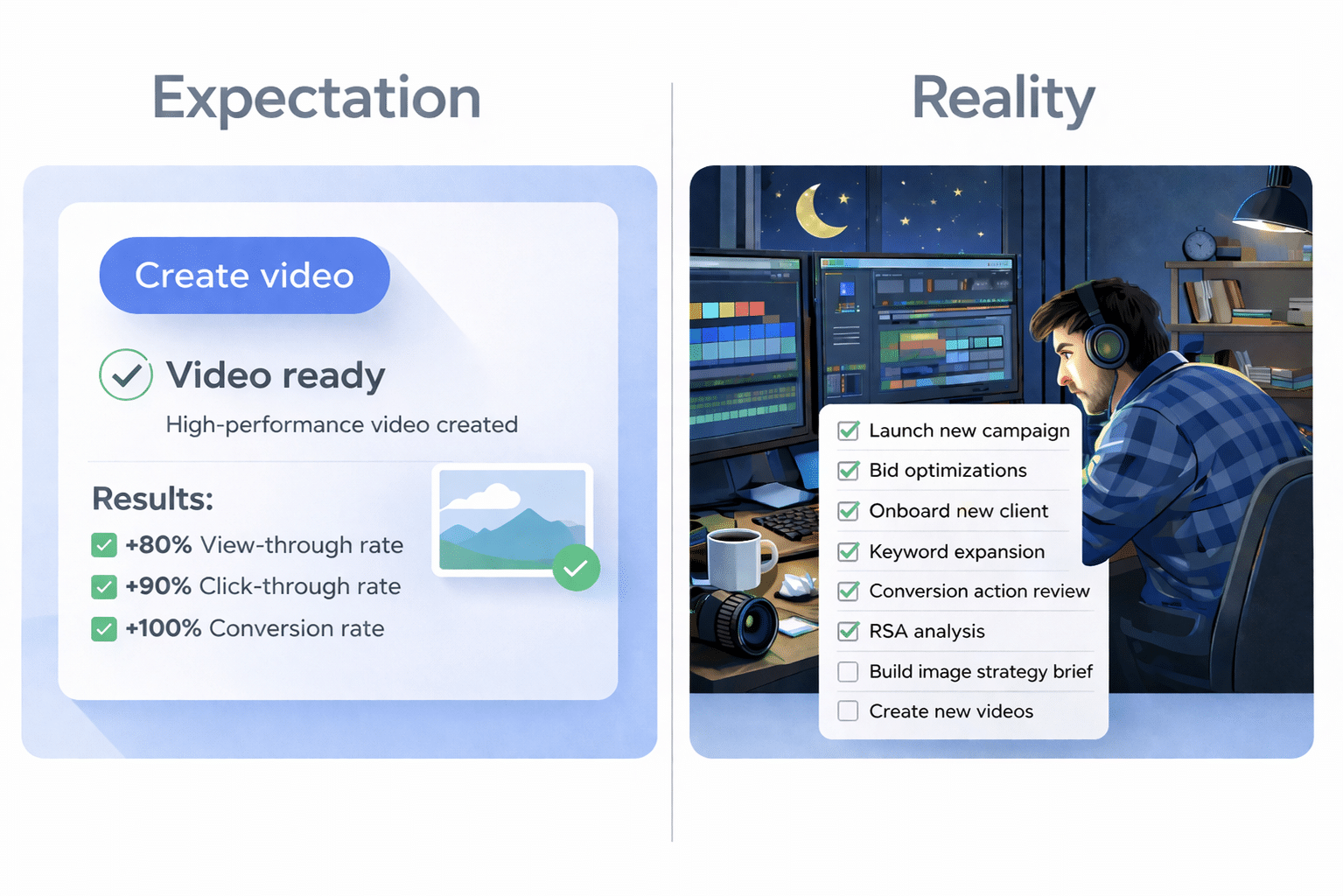
    I recently dove into Google Ads Asset Studio to see what all the hype was about. I’ve heard declarations like, “Google just ended all excuses for not running video ads!” and “It’s a total game-changer; no production budget needed!”

    The process is supposed to be simple: upload some images and get campaign-ready videos in minutes. Using Google Ads > Tools > Asset Studio, I can manage and scale images and videos effortlessly across various ad formats.

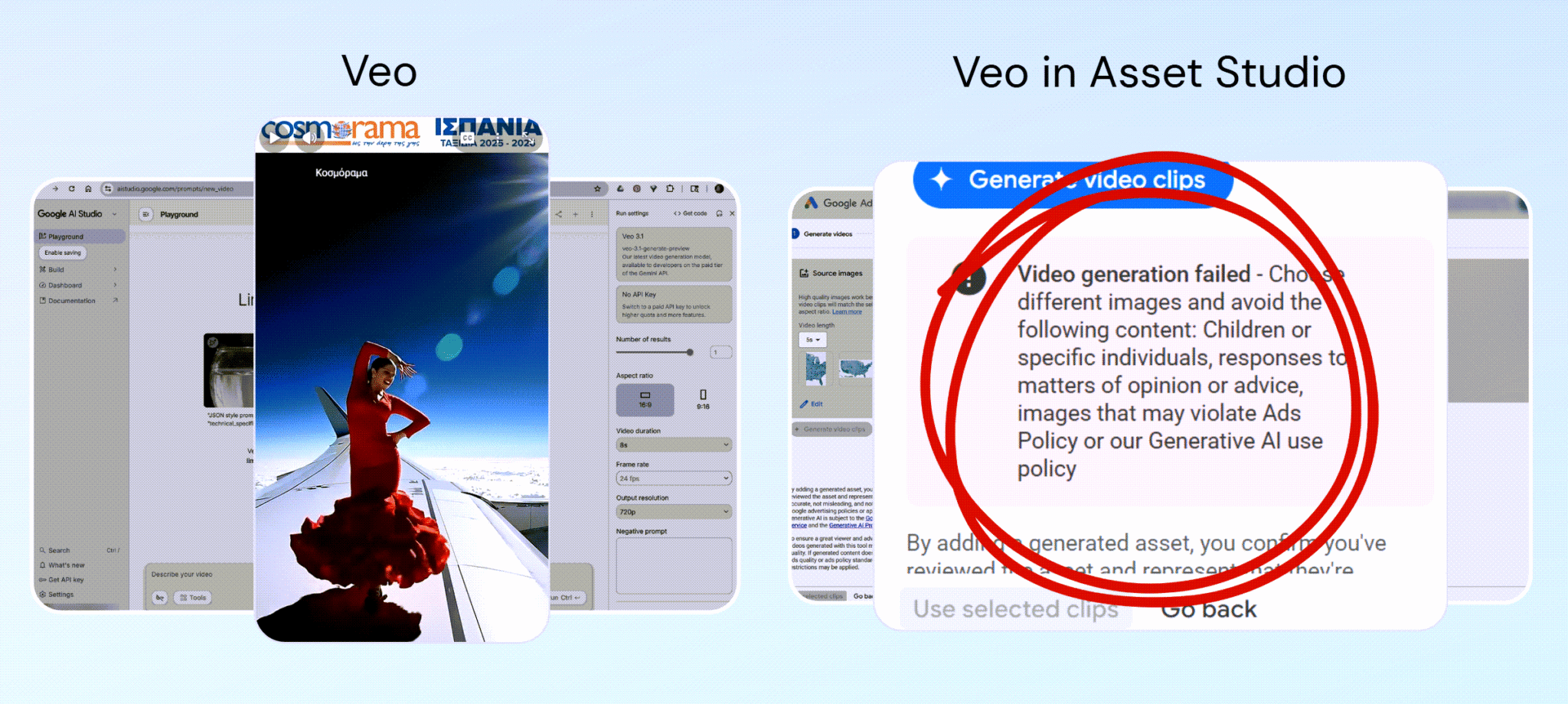
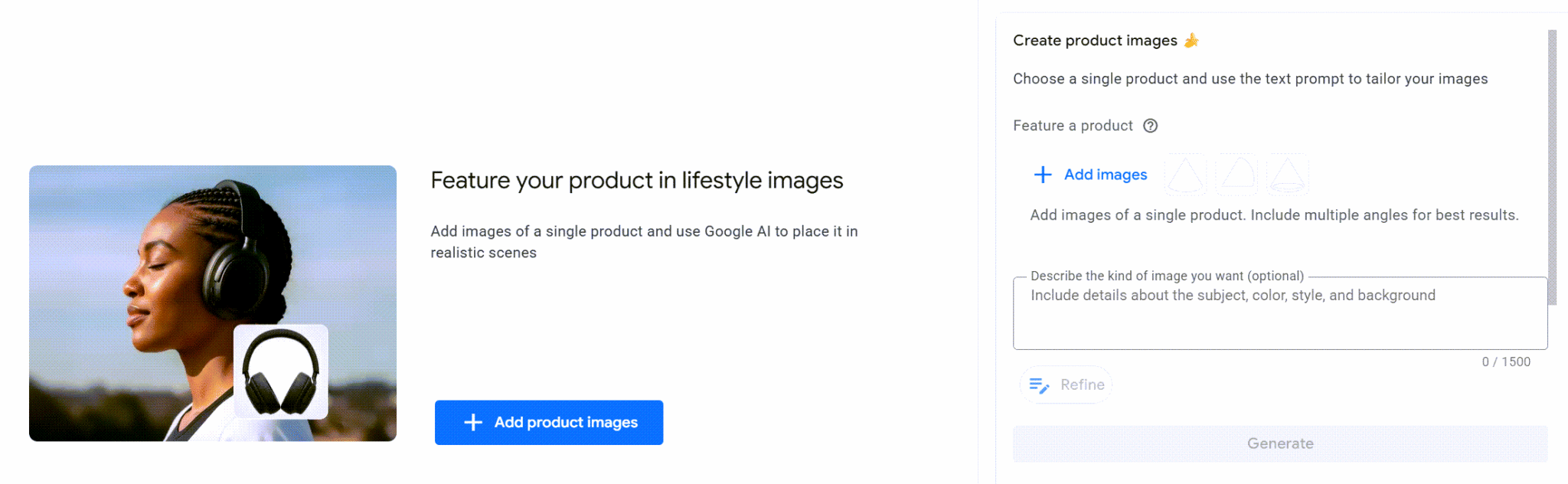
    Recent additions like Veo, Google’s AI video model, and Nano Banana Pro suggest we can transform a few product images into engaging video ads almost instantly.

    ```json
{
  "alt": "Two interfaces of a video editing platform, showing a video generation failure message.",
  "caption": "Exploring the capabilities of Veo and Veo in Asset Studio, where creativity meets technology. A video generation message highlights the intricacies of AI compliance.",
  "description": "This image showcases two user interfaces from a video editing platform, Veo and Veo in Asset Studio. The main focus is on a woman in a red dress standing on an airplane wing against a clear sky. Adjacent, a pop-up message explains video generation failures due to content issues, emphasizing restrictions on AI usage adhering to policies. The elements highlight technological features and compliance requirements within video editing tools."
}
```

    But does it really change the advertising game? Let’s explore if it’s truly worth our time.

    From the Think with Google article about AI-generated ads, such as those for Cosmorama, I tried to reverse-engineer their imaginative approach. Unfortunately, despite using Nano Banana and Veo, I encountered many limitations.

    ```json
{
  "alt": "The CapmatchOne logo with a gradient circle and bold text.",
  "caption": "Discover innovation with the CapmatchOne logo, featuring sleek typography and a modern gradient circle.",
  "description": "The CapmatchOne logo features bold, modern typography coupled with a gradient circle, symbolizing connection and innovation. The sleek design conveys a sense of progress and creativity. This image can be used for branding or promotional purposes, appealing to audiences interested in innovative solutions and forward-thinking designs."
}
```

    For instance, I found the lack of scene-level control problematic. No prompting for video scenes meant I couldn’t guide the animation’s motion or pacing.

    When generating videos, anything that resembled a human face—AI-generated or not—caused errors. This restriction limited my asset options significantly.

    ```json
{
  "alt": "Comparison image showing 'Expectation' and 'Reality' of video creation, with a checklist and a person working at multiple screens.",
  "caption": "Expectation vs Reality: Simplified video success vs. the reality of multitasking through the night.",
  "description": "This image illustrates the contrast between the 'Expectation' and 'Reality' in video production. On the left, 'Expectation' displays a straightforward checklist for creating a high-performance video, highlighting impressive results like +80% view-through rate and +100% conversion rate. On the right, 'Reality' depicts a person working late at a cluttered desk with multiple computer screens, highlighting tasks like launching new campaigns and bid optimizations. The image effectively uses color and design to convey the complexity of real-world video production."
}
```

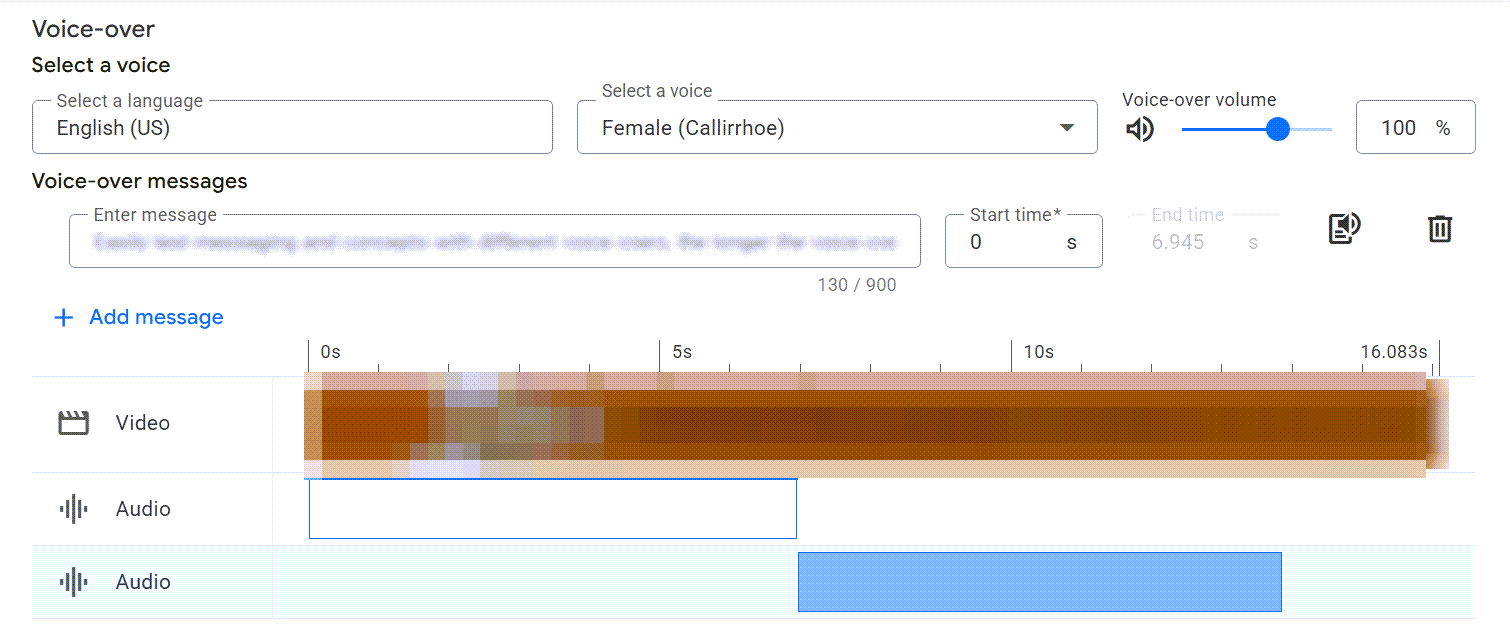
    The audio options were also very limited. Unlike Cosmorama’s videos with cinematic scores, I was stuck with a small set of preloaded audio without the ability to upload custom tracks.

    Overall, while Veo 3 introduced significant restrictions within Asset Studio, requiring a shift from expectations of advanced creative freedom.

    ```json
{
  "alt": "Golden retriever jumping to catch a red frisbee by a beach, with AI-generated content analysis overlay.",
  "caption": "A golden retriever leaps joyfully for a red frisbee at the beach, while AI analysis reveals the use of Google AI in image creation.",
  "description": "A playful golden retriever is captured mid-air as it jumps to catch a bright red frisbee at a beach, with a sunny blue sky in the background. The image is part of a visual demonstrating AI capabilities, shown by overlayed analysis indicating the content was generated with Google AI via a SynthID watermark. This inventive combination highlights technology's role in modern imagery."
}
```

    While simplifying production could be beneficial, if you were expecting full creative control, you might be disappointed.

    Thinking about whether Asset Studio truly saves time and effort, my experience suggests it’s a mixed bag. For brands previously in need of full production teams, Asset Studio might offer a faster and more cost-effective solution. However, for agencies or individuals incorporating this into existing workloads, it turns creative constraints into a newfound responsibility.

    ```json
{
  "alt": "Person wearing headphones with promotional feature for product images using AI.",
  "caption": "Immerse yourself in the sound! Use AI to feature your products in stunning lifestyle scenes effortlessly.",
  "description": "The image showcases a person wearing headphones, illustrating the promotion of an AI tool for creating product images in lifestyle settings. It suggests adding images of a single product and leveraging Google AI to place them realistically. The interface includes options to add images and describe the type of image desired. Keywords: AI, product images, lifestyle, headphones."
}
```

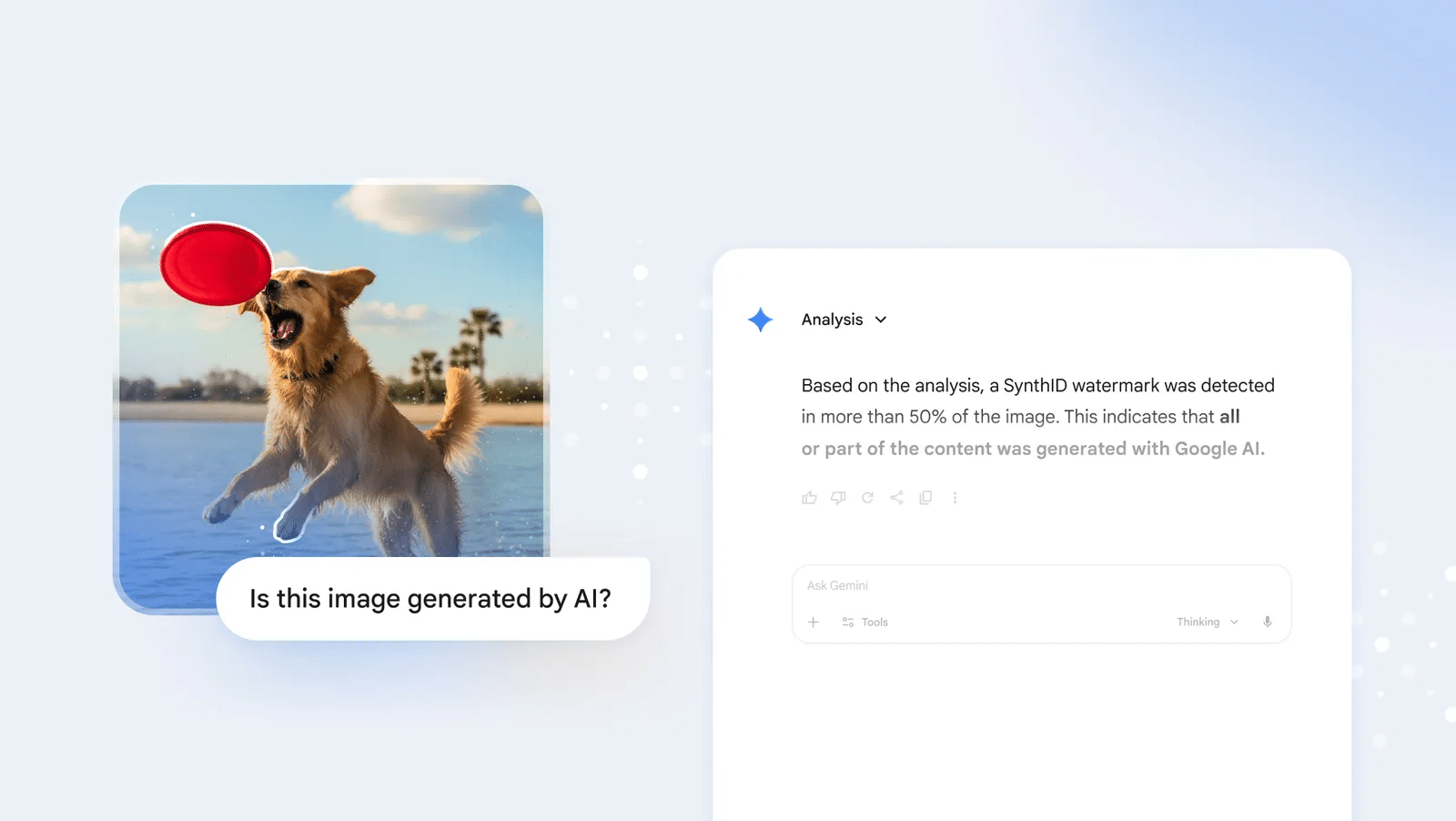
    Regarding AI ad compliance, it’s worth noting there are no current U.S. federal laws against using AI in ads. However, places like New York are setting new precedents with upcoming laws requiring disclosure of AI use.

    On the brighter side, if you use Asset Studio with ethical transparency in mind, although there’s no watermark or disclosure methods built-in, Google’s SynthID supports invisible AI tagging.

    ```json
{
  "alt": "Screenshot of voice-over editing interface with timeline and audio settings.",
  "caption": "Dive into the world of voice-over editing with this user interface, showcasing options to select language, voice type, and adjust volume, alongside a detailed timeline.",
  "description": "This image displays a screenshot of a voice-over editing interface. It includes drop-down menus for selecting language and voice for the voice-over, such as 'English (US)' and 'Female (Callirrhoe)'. The interface also features a volume adjustment slider set at 100%. Below, a timeline is visible, showing video and audio tracks with time markers. Users can enter messages and set start and end times for audio. This tool is ideal for video creators needing precise audio customization. Keywords: voice-over, editing, audio, video, interface, timeline."
}
```

    Could this tool live up to its potential without succumbing to ‘AI slop’? Josh Spanier from Google suggests not to worry, yet it’s essential to maintain control to avoid low-quality AI-generated ads from being published unwittingly.

    Asset Studio indeed offers a streamlined way to bring product images to life, optimized for product integrity through tools like Nano Banana 2.

    Features like quick trimming and leveraging simple templates show promise in turning around high-performing, concise ad creatives, even doubling CTR compared to previous client efforts.

    In conclusion, while Asset Studio isn’t a complete game-changer, it provides tools that democratize creative access for those lacking a full production budget. However, it’s vital to measure the outcomes in terms of conversions and sales.

    I’m running tests to see what truly holds up. Stay tuned.


    Inspired by this post on Search Engine Land.


    crushpress.ai community screenshot
  • Mastering Data Storytelling: The Three-Act Structure

    Mastering Data Storytelling: The Three-Act Structure

    How to use the three-act structure for data storytelling

    When I first analyzed my client’s website, I collected all performance data, pinpointed the successes, identified areas for improvement, and laid out my recommendations. However, transitioning this data into a compelling and trustworthy presentation required more than just numbers—it needed a narrative.

    Storytelling proved to be the key. It is not solely for entertainment but is a fundamental tool for making sense of data, making it indispensable for effectively presenting insights.

    One framework I found remarkably effective is the classic three-act structure, famously applied in everything from Aristotle’s Poetics to modern blockbusters like Star Wars.

    This three-act structure allows me to guide my client’s journey from initial insights to actionable conclusions, positioning them as the story’s hero who overcomes challenges.

    It’s similar to a narrative arc, but segregated neatly into three parts: the setup, the confrontation, and the resolution.

    Act 1 sets the stage, spotlighting the status quo and the emerging challenge—the antagonist to our protagonist, the client.

    Act 2 introduces rising action as conflicts and obstacles emerge, demanding strategies to navigate them.

    Act 3 brings the climax and resolution, depicting how the applied strategies overcome obstacles and pave the path for future success.

    ```json
{
  "alt": "The CapmatchOne logo with a gradient circle and bold text.",
  "caption": "Discover innovation with the CapmatchOne logo, featuring sleek typography and a modern gradient circle.",
  "description": "The CapmatchOne logo features bold, modern typography coupled with a gradient circle, symbolizing connection and innovation. The sleek design conveys a sense of progress and creativity. This image can be used for branding or promotional purposes, appealing to audiences interested in innovative solutions and forward-thinking designs."
}
```

    This method offers a deeper understanding of data and transforms mere analysis into a strategic journey that places the client at its heart.

    In essence, embracing the three-act structure for data storytelling fosters transparency and cooperation, aligning our goals with those of our clients for mutual success.

    Step 1 involves revisiting past strategies and successes to establish the baseline of Act 1.

    Step 2 follows suit by dissecting current challenges, mirroring the conflict escalation of Act 2.

    Finally, Step 3 proposes solutions that serve as the resolution in Act 3, captaining the client’s progression towards their goals.

    Imagine carving the path of this narrative like charting a hero’s journey. With every data set unfolds a chapter where I play the guide, bridging insights with impactful actions.

    But just as with any story, reaching our conclusion doesn’t signify the end. It marks the dawn of new strategies, fresh collaborations, and continued growth.

    This is how I not only deliver insights but foster trust and clarity in my partnerships, ensuring that both the successes and challenges of data transform into a compelling narrative.


    Inspired by this post on Search Engine Land.

    crushpress.ai community screenshot
  • Unmasking AI: Is Your Data Truly Ready?

    Unmasking AI: Is Your Data Truly Ready?

    As I look around, it seems like everyone is scrambling to harness AI’s power. However, I’m realizing that fundamental identity gaps and issues like fraud and unreliable inputs are not getting resolved, but rather they are magnified by AI models.

    AI has quickly become one of the most confidently discussed items in our modern marketing strategies. Budgets are reallocated, teams restructured, and vendors evaluated primarily by how “AI-powered” they appear. The belief is strong that once the right AI models are in place, performance metrics—such as targeting, segmentation, and conversion—will simply fall into place.

    Yet, I’ve discovered a quieter truth. While organizations aren’t necessarily struggling with using AI, they face challenges feeding it adequate data. And often, the data they are supplying AI isn’t nearly as reliable as assumed.

    This realization leads me to the uncomfortable truth about inputs. AI doesn’t produce truths; it magnifies what’s provided. If data is fragmented, outdated, or manipulated, AI doesn’t correct it—it scales it confidently.

    Marketers have invested heavily in data infrastructures, only to find that an abundance of data and signals doesn’t necessarily equate to readiness. Large volumes do not guarantee validity. For instance, customer profiles built from various identifiers don’t assure a unified identity, and AI models are not inherently designed to question these flawed inputs.

    Identity is at the core of this issue. Every AI-driven marketing effort assumes accurate identity for analysis and targeting, yet identity remains a fluctuating component in our data stacks. Consumers frequently move across devices and change profiles, making it tricky to track accurately over time. However, most systems treat a snapshot identity as a constant, and AI inherits this flawed assumption.

    Additionally, not all data issues stem from outdated sources. Some are intentionally deceptive due to evolving fraud tactics, becoming more challenging to distinguish without additional context. Fraudulent behavior can significantly distort model outputs and performance metrics, creating a feedback loop where AI unintentionally perpetuates the very issues it should mitigate.

    Traditional data strategies often focus on structure over substance, and clean data doesn’t equate to accuracy. AI demands an in-depth understanding of identity validity, activity authenticity, and risk awareness, which traditional strategies may overlook.

    The illusion of AI readiness becomes apparent when dashboards show excellent match rates and models yield seemingly precise outputs. However, metrics of identity reachability and engagement accuracy become crucial yet often disregarded questions.

    True AI readiness starts with ensuring that our data inputs are trustworthy. It focuses on verifying identity accuracy, validating meaningful activities, and acknowledging risks rather than simply accumulating data records.

    By addressing these foundational elements, organizations can suppress low-value identities, optimize outreach, and mitigate misuse before it skews results. Over time, this creates a structural advantage for AI operations, leading to more reliable predictions and efficient campaigns.

    I’ve come to understand that AI’s impact on marketing is undeniable, yet it cannot independently resolve inherent data challenges. Organizations need to prioritize and invest in understanding the integrity of their data systems.

    The real question isn’t about applying AI but assessing whether our data is worthy of AI. This deeper level of scrutiny defines true readiness and distinguishes the truly prepared from those merely rushing ahead.


    Inspired by this post on Search Engine Land.

    crushpress.ai community screenshot
  • Mastering AI: Elevate Your Funnel with Bottom-Funnel Content

    Mastering AI: Elevate Your Funnel with Bottom-Funnel Content

    Traffic from Google searches is declining, and I know it firsthand because I’ve invested years in organic strategies. Seeing this shift in real-time is unsettling but also enlightening.

    I’ve observed this change particularly in my SaaS clients. The educational, top-of-funnel (TOFU) content that once consistently drew traffic is losing steam. This isn’t due to declining quality; users simply don’t need to click anymore. AI Overviews are handling their queries.

    This led me to a crucial choice: defend the old strategy or adapt to the new landscape. I decided to adapt.

    Surprisingly, while informational content is getting fewer clicks, bottom-of-funnel (BOFU) content is not only steady but often driving more qualified leads.

    This shift signifies a new understanding of value creation through search.

    The pivot: Making BOFU the priority

    My new approach focuses 60% to 80% of my efforts on bottom- and mid-funnel content. The rest fills in gaps with TOFU topics, supporting content clusters and timely industry discussions.

    When I proposed this change to clients, I put it plainly:

    • “You can choose between traffic and leads. If leads are your goal, here’s our path, though it may mean less traffic.”

    I was transparent that traffic might dip, but conversions would likely increase. Clients saw the appeal of a qualified pipeline over mere traffic.

    Comprehensive comparison guides and listicles aimed at high-intent queries are highly effective BOFU content.

    Take, for example, a guide on the best time-tracking software for construction. I created a reusable review methodology for the client, addressing pros and cons transparently, including their product. This honesty builds trust with evaluating readers.

    The guide was factual, precise, and targeted at decision-makers in the purchasing phase, not casual browsers.

    In weeks, it became our most referenced article in LLM responses. Now a cornerstone piece, it often appears in conversion pathways, driving qualified leads.

    That single piece outperformed a dozen previous informational posts in pipeline impact because it directly answers a buyer’s question.

    Dig deeper: How to align your SEO strategy with the stages of buyer intent

    TOFU isn’t dead; it just has a new role

    Many SEOs see this as a binary choice. But I haven’t abandoned TOFU content; I’ve simply repositioned it.

    TOFU now builds topical authority, supporting the ranking of BOFU pages. It’s the structure beneath the main act. Guides and educational content should:

    • Support content clusters.
    • Establish expertise in Google’s eyes.
    • Pass link equity to BOFU pages.

    We’ve revised top-performing TOFU pieces to connect directly to clients’ products, supported by screenshots and expert insights.

    Calls to action were redesigned for context and strategically placed throughout the content, not just at the end.

    ```json
{
  "alt": "The CapmatchOne logo with a gradient circle and bold text.",
  "caption": "Discover innovation with the CapmatchOne logo, featuring sleek typography and a modern gradient circle.",
  "description": "The CapmatchOne logo features bold, modern typography coupled with a gradient circle, symbolizing connection and innovation. The sleek design conveys a sense of progress and creativity. This image can be used for branding or promotional purposes, appealing to audiences interested in innovative solutions and forward-thinking designs."
}
```

    These changes significantly increased visitor engagement with demo request pages, without altering the informational purpose.

    The key is still producing valuable TOFU content but ensuring it has a unique perspective—something fresh and insightful.

    Specificity in a sea of AI-generated content sets us apart.

    Why this strategy excels in AI-driven search

    Visitors from AI platforms arrive informed and ready to weigh options. This aligns with how AI Overviews serve search results.

    AI Overviews are more frequent for informational than commercial queries. E-commerce searches trigger them less, safeguarding BOFU content for now, though commercial coverage is growing.

    This change in behavior modifies what content performs well. As informational value diminishes with upfront answers, decision-stage content gains importance, aiding users in comparison and validation.

    That’s why BOFU content thrives; it matches users’ decision-making phase, not just their search.

    The time tracking software comparison piece is a prime example. It often appears in discussions on construction time tracking tools. While it might not always convert instantly, its impact is evident in branded searches and lead generation.

    The attribution challenge to embrace

    Here’s the dilemma: BOFU content’s true value often isn’t reflected in traditional analytics.

    When someone discovers your solution via an AI response, then proceeds via direct or branded search to convert, it often appears as direct traffic in GA4, masking SEO’s role.

    Therefore, I’ve guided clients to emphasize broader performance metrics, including:

    • Trends in brand search volume.
    • Citation frequency in LLM platforms.
    • Increases in direct traffic post-publication.
    • Conversions even with stable traffic levels.

    The ROI of BOFU and LLM-focused content exceeds dashboard insights. Relying solely on immediate click metrics misses SEO’s true value creation.

    Your playbook for transitioning to BOFU

    Here’s a practical guide to capitalizing on this shift:

    • Audit for BOFU gaps: Identify purchase-stage queries lacking coverage. These high-intent gaps offer quick opportunities.
    • Create comparison content: Use a consistent review framework, openly address pros and cons for credibility and citations.
    • Enhance leading TOFU articles: Incorporate product links, contextual CTAs, and expert testimony for dual-purpose content.
    • Set up LLM tracking in GA4: Use regex segments to track AI referrer traffic and gain insights often overlooked.
    • Refocus client metrics dialogue: Shift focus from traffic to lead quality and conversion rates, reflecting modern SEO’s impact.

    AI Overviews have reshaped informational content economics.

    This disruption opens strategic doors. BOFU content traditionally converts better, and AI highlights the need to focus on content that drives revenue rather than mere site visits.

    The opportunity for strategic realignment is here, but it won’t last indefinitely.


    Inspired by this post on Search Engine Land.

    crushpress.ai community screenshot
  • Is Your ROAS Truly Fueling Business Growth?

    Is Your ROAS Truly Fueling Business Growth?

    I’ve often marveled at high ROAS numbers during my campaigns, thinking they spell success. But, is this performance truly driving growth?

    High ROAS numbers can be misleading, often masking mere demand capture rather than creation. To accurately assess growth, I focus on incrementality and marginal ROAS to guide more effective spending strategies.

    An ecommerce company once collaborated with my PPC agency, eager to delve into the world of paid search. We crafted a robust plan that quickly led to impressive results: high conversion figures and a commendable ROAS.

    It seemed like a strategy success story at first glance. However, when I took a closer look, I noticed something crucial.

    Some conversions might have transpired naturally through direct or organic search channels, suggesting our campaigns perhaps weren’t spurring actual growth. This is a vital aspect that often remains unexamined. To gain genuine insight into performance, I examine incremental lift alongside marginal ROAS.

    The truth about ROAS

    I recall hearing about eBay’s paid search experiment. They heavily invested in brand PPC ads, only to later conduct controlled tests by pausing these ads for certain users, measuring their impact.

    Much of the conversion was absorbed by organic traffic, scarcely affecting revenue. Yet, intriguingly, eBay reactivated the branded ads. Whether this was driven by fear or wisdom, I ponder the implications.

    As automated search and multi-touchpoint customer journeys evolve, accurately attributing conversions to their channels becomes increasingly complex. Advert platforms often claim the credit, but adopting a skeptical view towards these reports is invaluable.

    I comprehend that what these platforms report as attributed return doesn’t necessarily equate to causal lift. While ROAS indicates platform-influenced revenue, it falls short in revealing how much revenue would have materialized regardless of the ads.

    With tools like Performance Max and Advantage+, platforms excel in optimizing conversion avenues, often not discovering new clientele but instead marking the costliest touchpoints in pre-determined conversion paths.

    In the absence of incrementality assessment, automation tends to amplify non-incremental signals: capturing existing demand through brand search campaigns, retargeting nearly-converting users, and creating falsely “safe” channel reports.

    Dig deeper: Paid media efficiency: How to cut waste and improve ROAS

    Incrementality tells you whether marketing created something extra

    By analyzing incrementality, I can determine how the campaign wrought changes it wouldn’t have caused otherwise, typically through comparisons of exposed groups with control groups. This reveals the actual organizational impact of the campaign.

    Recognizing this might feel uncomfortable, yet it serves as a more precise lens for budget allocations than superficial platform attributions.

    Sometimes, even a seemingly successful channel in-platform ROI might not equate to impactful incremental growth. Often, it merely realizes existing demand rather than inventing it.

    If I truly wish to ascertain if a campaign drives genuine growth, the incrementality factor must become my focal question.

    Despite being vital, incrementality only provides part of the picture. The necessity for marginal ROAS to chart subsequent steps can’t be overstated.

    Dig deeper: Why incrementality is the only metric that proves marketing’s real impact

    Marginal ROAS tells you what to do next

    An incremental channel alone doesn’t specify where the next budget investment should proceed. Understanding marginal ROAS is essential here.

    The marginal ROAS examines the revenue from an additional unit of spend, surpassing the average ROI across all expenses. Often, initial budget allocations perform well but subsequently deliver diminishing results.

    As investments continue, dollars spent towards the end become disproportionately less efficient. This principle also holds true for CPA metrics: a blended CPA might appear satisfactory while the terminal dollars spent demonstrate poor efficiency, luring advertisers beyond optimum bidding zones.

    I consider an example where an initial $10,000 budget generates $50,000 in revenue (500% ROAS). Deciding to expand, I then invest an additional $5,000, only to generate an incremental $5,000 revenue.

    • Your new average ROAS: 366% 
    • Your marginal ROAS: 100% (Essentially a $1-to-$1 trade.)

    In such instances, the final $5,000 expenditure was ineffective, despite overall acceptable “average” performance on dashboards.

    This highlights the folly of focusing solely on average ROAS. It can obscure the genuine scalability that might only be viable at lower spend levels, misleadingly disguising profitable demand capture as flawed incremental expansion.

    Informed decision-making requires peering deeper: platform ROAS aids in optimizing in-platform efforts, incrementality assesses campaign-generated value, while marginal ROAS indicates where the ensuing budgets should be directed.

    A robust ROAS can reflect true efficiency or merely illustrate a platform ensnaring already-converting demand. Hence, incrementality tests form the cornerstone of my analysis.

    My critical inquiry is not whether a channel is efficient per se, but whether subsequent dollars are sufficiently efficient. This understanding is essential for prudent scaling.

    Dig deeper: The marketing measurement flywheel: A 4-step framework for proving impact

    Options for incrementality testing

    Embarking on incrementality testing doesn’t require a flawless measurement lab. Utilizing geo tests, holdouts, audience exclusions, and controlled spending reduction can enhance understanding far beyond another month spent in attribution debates.

    • Geo-split testing: Organize markets into dual comparable geographic groups, maintaining ad runs in a “test” grouping while halting them in a “control” group. Revenue disparities between these regions unveil the genuine incremental lift of your ads.
    • Search lift tests (holdouts): Leverage platform tools to generate holdout groups, excluding a small user fraction from ad exposure. The behavioral contrasts between them and exposed groups unveil Search or YouTube campaign direct impacts.

    Furthermore, investigating remarketing, branding, awareness campaigns, or supplementary social channels can reveal additional insights.

    The real shift: From reporting performance to allocating capital

    For too long, marketing teams have restricted measurement to explaining past events. The optimal application lies in shaping future endeavors effectively.

    Incrementality helps me discern value creation within a channel, while marginal ROAS justifies additional investments. Together, they elevate marketing measurement from mere reporting to informed capital allocation.

    ROAS demonstrates credit allocation, incrementality pinpoints actual transactional changes, and marginal ROAS guides subsequent budgeting. It’s crucial to remember that incrementality differs from attribution. While attribution awards channel credit, incrementality evaluates whether this pursuit justified itself.

    Dig deeper: How to take your marketing measurement from crawl to sprint


    Inspired by this post on Search Engine Land.

    crushpress.ai community screenshot
  • Master SEO Without Using Restricted Keywords

    Master SEO Without Using Restricted Keywords

    When I’m faced with the challenge of optimizing for keywords that I can’t explicitly use, I gear up with a strategic mindset. Legal constraints, brand guidelines, or public perceptions might put certain terms off-limits, but there are effective ways to capture demand without using them directly.

    Here’s my approach to overcoming this hurdle, aligning with search behaviors, and enhancing visibility despite limitations.

    When Certain Keywords Are Off-Limits

    In the world of SEO, it’s not uncommon to hear, “We want to rank for (insert competitive term),” followed by, “Avoid using (that exact term) in content.”

    My journey began over 10 years ago, tasked with ranking for “custom koozies.” This sparked endless debates on the correct nomenclature for these drink holders. At home, we referred to them as “coolie cups,” but data revealed that most people simply called them “koozies.” However, “Koozie®” being a trademark meant we had to cleverly position ourselves at the top without relying on that term as our primary focus.

    Years later, at a marketing agency focusing on senior living, I encountered new terminology like assisted and independent living. Despite a bias against the term “nursing home” due to negative connotations, our research showed it was still widely used, presenting similar challenges to what I had faced before.

    Dig deeper: Branded search and SEO: What you need to know

    Strategies for Ranking Without Using Specific Keywords

    Even if I can’t use a keyword, by sending the correct signals through related terms and creative strategies, I can still rank effectively. Here’s how:

    1. Pull the Data and Confirm Direction

    Sometimes, showcasing data alone can shift perspectives. Sharing insights like “skilled nursing near me” having 4,400 monthly searches compared to “nursing home near me” with 27,100 searches can be eye-opening. Understanding the local search volume is crucial in determining the best strategy.

    2. Surround the Terms

    Creating contextual relevance is essential. For example, around the term “Koozies,” I include words like “beer,” “drink,” and occasions such as “bachelorette party.” These help build search engine context.

    ```json
{
  "alt": "The CapmatchOne logo with a gradient circle and bold text.",
  "caption": "Discover innovation with the CapmatchOne logo, featuring sleek typography and a modern gradient circle.",
  "description": "The CapmatchOne logo features bold, modern typography coupled with a gradient circle, symbolizing connection and innovation. The sleek design conveys a sense of progress and creativity. This image can be used for branding or promotional purposes, appealing to audiences interested in innovative solutions and forward-thinking designs."
}
```

    3. Use Synonyms and Break Down Phrases

    Utilizing synonyms or splitting phrases works well. Instead of “Koozies,” I might say “cozies” or “coolies,” and for “nursing homes,” highlighting “nursing” and “home” separately enriches content.

    4. Employ Indirect Usage

    Referring indirectly can be impactful, such as using headers like “More than a nursing home” or integrating the terms into questions or statements naturally within the content.

    5. Incorporate Unnameable Products

    Incorporating trademarked items alongside other products allowed me to use the term “Can Coolers & Koozies” even when the latter couldn’t be the focal point.

    6. Craft Creative Anchor Text

    Using the primary term in both off-site and internal links can guide search engines effectively. Controlling anchor text is key.

    7. Optimize Non-Visible Elements

    Leveraging alt text and strategically placing terms in title tags ensures that search engines get the right signals without visible usage, balancing between being search-friendly and on-brand.

    8. Add Definitions

    Adding definitions helps clarify common terms related to your offerings, boosting SEO and enhancing your site’s authority.

    Dig deeper: The shift to semantic SEO: What vectors mean for your strategy

    Your Strategy for Off-Limits Keywords

    Always consult with legal advisors regarding trademarked terms. By gathering data, crafting strategic approaches, and adjusting tactics as necessary, you can achieve SEO success even with restrictions.


    Inspired by this post on Search Engine Land.

    crushpress.ai community screenshot
  • Transform Your Website into the Ultimate AI Trust Anchor

    Transform Your Website into the Ultimate AI Trust Anchor

    I recently had an eye-opening experience when I asked ChatGPT to recommend a local business. Interestingly, the businesses it recommended all had strong online presences, and their websites were frequently cited as reliable sources.

    This taught me something crucial: AI doesn’t pull answers from nowhere. It gathers data from existing sources. Without a trustworthy, comprehensive website, I lose control over my business narrative as AI cobbles together information from various places.

    That’s why many business owners like myself are questioning the necessity of websites. If AI answers everything, why bother? But here’s the truth: my website is now more than just a marketing tool; it’s an authoritative document that AI treats seriously. The real challenge is deciding who defines my business narrative: me or others.

    Zero-Click Doesn’t Eliminate Opportunity

    I’m noticing a trend where impressions hold steady or even rise, but clicks are dropping. This might make some declare websites as obsolete, but I believe that’s a misplaced assumption.

    While clicks may decline, they don’t signify reduced importance. Instead, the nature of the click is changing, as AI Overviews often appear for informational intent.

    According to Ahrefs data, 99% of keywords triggering an AI Overview are informational, with navigational keywords at just 0.13%. Quick information seekers get their facts and move on, but those ready to make a decision will still validate this through direct interactions.

    The critical clicks—those leading to revenue through bookings, calls, or purchases—are still happening. The keywords leading to these clicks are where decisions are closest.

    Dig deeper: Your homepage matters again for SEO — here’s why

    AI Recommends, Customers Validate

    When AI suggests a local business, it’s using a pattern based on reviews, content, and location, offering a starting point but not the final word.

    Customers depend on a follow-up process that involves checking the website, reading reviews, and actually seeing what’s on offer before making a choice.

    Thus, my website becomes the crux of decision-making. While AI might open the door, it’s my website that ultimately closes it.

    ```json
{
  "alt": "Screenshot of Ahrefs' Keywords Explorer tool showing top searches in the United States.",
  "caption": "Explore the vast keyword landscape with Ahrefs' Keywords Explorer, depicting over 46 million search terms trending in the U.S. Discover insights for your content strategy.",
  "description": "This image is a screenshot from Ahrefs' Keywords Explorer, showcasing the top keyword searches in the United States. It highlights over 46 million keywords available for analysis. The tool offers various filters like trending, intent, KD, volume, growth rate, and more, providing users with detailed insights into search patterns and traffic potential. Ideal for SEO enthusiasts and digital marketers looking to enhance their content strategies."
}
```

    Boosting Website Value Through AI

    AI not only reads the content but also checks its accuracy against online profiles. If everything aligns, I’m recommended; if not, I’m left out.

    Essentially, my website acts as a foundational element for AI. I want AI pulling from my most precise, structured information, not outdated third-party content.

    Dig deeper: Why local SEO is thriving in the AI-first search era

    Your Website: Control the Narrative

    Everywhere else, opinions and algorithms control how I’m perceived. Only on my website do I dictate what’s highlighted and how my story unfolds.

    With well-organized content addressing real questions, my site provides the narrative I want AI to reflect. If not, the alternative narrative can be less favorable.

    Dig deeper: Your website still matters in the age of AI

    What to Do: A Roadmap

    Though a complete overhaul may not be necessary, intentional structure and focused content are critical. Here’s my focus area:

    Treat Your Site as the Truth Source

    I’m avoiding vague claims, opting instead for specific, factual content aligning across profiles.

    Every detail—services, hours, location—must match what’s on my Google Business Profile. As highlighted by contributor Will Scott:

    • “Disambiguation through context is critical. Consistency matters a lot.”

    Optimize for AI Readability

    AI values structured content over keywords. Proper use of schema markup and logical headings ensures better AI interpretation.

    ```json
{
  "alt": "The CapmatchOne logo with a gradient circle and bold text.",
  "caption": "Discover innovation with the CapmatchOne logo, featuring sleek typography and a modern gradient circle.",
  "description": "The CapmatchOne logo features bold, modern typography coupled with a gradient circle, symbolizing connection and innovation. The sleek design conveys a sense of progress and creativity. This image can be used for branding or promotional purposes, appealing to audiences interested in innovative solutions and forward-thinking designs."
}
```

    Short, direct sentences and clear FAQs improve the odds AI will accurately pull from my site.

    Service pages with unique, detailed descriptions increase credibility, serving exactly what AI needs.

    Write for Customer Questions

    Addressing specific customer queries—like insurance compatibility or repair duration—positions my site as the preferred AI response source.

    Unsure of customer questions? The answers are hiding in emails, reviews, and profile sections. I’m actively leveraging these insights.

    Dig deeper: How to apply ‘They Ask, You Answer’ to SEO and AI visibility

    Conducting My Own AI Audit

    I’m using AI tools like ChatGPT to simulate client inquiries about my business and recognize gaps in information and narrative.

    • Is it citing my site?
    • My Google Business Profile?
    • Outdated directories?

    This audit shows exactly where improvements are needed.

    Consequences of a Stale Website

    If my site lacks depth or is outdated, AI fills those gaps with potentially incorrect or damaging information, impacting reputation and decision-making.

    Beyond mere accuracy, a weak website means losing control over how my value and expertise are perceived and positioned.

    AI may bring me to the forefront, but it’s my site that secures trust and seals the deal with customers.

    Dig deeper: How AI is reshaping local search and what enterprises must do now


    Inspired by this post on Search Engine Land.


    crushpress.ai community screenshot
  • Revitalize Your Homepage for SEO Success with AI Insights

    Revitalize Your Homepage for SEO Success with AI Insights

    When I started my journey on the web, creating websites was pretty straightforward. We crafted sites like “filing cabinets,” centered around a grand entry known as the homepage. This was the gateway through which visitors would navigate to discover the information they were seeking.

    With the advent of SEO, everything took a turn. Each page evolved into a potential entry point, allowing visitors to land directly on the page most relevant to their needs.

    But today, as AI tools like Gemini and ChatGPT become prevalent, the dynamics are shifting once more. These tools are transforming user behaviors, often bringing them back to our homepages for their searches.

    Therefore, the homepage is regaining its significance as the cornerstone of SEO. It’s crucial to revisit robust information architecture practices to effectively capture and convert this newfound traffic.

    In the early 2000s, as search engines became the main source of site traffic, we had to adapt quickly, overlaying SEO strategies on our knowledge of web architecture. This evolution changed the navigation path, leading users directly to inner pages or blog posts and then routing them back to our desired products or services.

    While the homepage remained important, it shifted focus to branding and general keywords rather than trying to cover every possible detail. We concentrated on specific, high-converting long-tail content.

    Even so, as AI redefines the landscape, the pendulum swings back, reminding us of the value our homepage brings.

    AI tools now handle much of the research and summarization, redirecting users to our branded searches and homepages. However, without insights into these users, it becomes paramount to have a homepage ready to guide them effectively, or risk losing them to competitors.

    Past lessons steer us back to tackling these challenges head-on.

    Traditionally, every page served as a potential landing page, each designed to direct visitors along a purchasing funnel – from informational content to case studies.

    Yet, with AI providing immediate answers, the traditional click-through rate for deeper informational content is declining. Users skip straight to branded searches once convinced of our brand’s authority, arriving on our homepage ready for the next step, albeit with less direct data on their preferences and needs.

    We must resurrect our approach to information architecture, highlighting logical grouping, structural context, and a strong user path.

    Logical grouping means organizing content into distinct categories that are easy to navigate, avoiding convoluted labels.

    Structural context ensures AI tools recognize our content as authoritative by maintaining a comprehensive framework across SEO, PPC, and AI avenues.

    The 3-click rule — ensuring users find any information within three clicks — is a vital performance indicator, one AI and users appreciate alike.

    For successful AI-driven user engagement, we must balance our site’s structure for both human and AI interaction, ensuring smooth navigation and intuitive content access.

    The ALCHEMY framework provides a strategic path to designing a site that meets the needs of both audiences, starting with audience research and journey mapping.


    Inspired by this post on Search Engine Land.


    crushpress.ai community screenshot
  • How Reddit is Shaping PPC Campaigns in Unexpected Ways

    How Reddit is Shaping PPC Campaigns in Unexpected Ways

    I’ve noticed something interesting happening in the world of PPC advertising. More and more buyers are doing their homework on Reddit before they even think about clicking on ads. This detour is skewing PPC data and misleading our automation efforts.

    At over $50 per click, Reddit surprisingly outperforms every vendor organically around 67.3% of the time based on a study that covered 8,566 keywords. This insight is not restricted to just B2B SaaS; it’s a reality many industries are facing.

    If you’re in legal, finance, premium home services, or insurance sectors, these high CPCs are part of your landscape. It’s crucial to understand how these dynamics affect you.

    The SEO community has been discussing this for a while, highlighting the need to build glossaries and invest in content strategies. However, what intrigues me is how this affects the signal layer our PPC campaigns rely on.

    When someone searches a high-intent term and lands on Reddit instead of our page, they don’t just get peer opinions. Google’s algorithm takes note too, registering this as a resolved query.

    This kind of engagement feeds back into Google’s algorithm, gradually shaping the relevance of those terms, and it spells trouble for us if we’re not aware of it.

    The real complication arises when someone clicks on our ad after spending days researching on Reddit. Smart Bidding isn’t aware of this buyer journey; it sees only a $50 click and waits to see if it converts.

    ```json
{
  "alt": "The CapmatchOne logo with a gradient circle and bold text.",
  "caption": "Discover innovation with the CapmatchOne logo, featuring sleek typography and a modern gradient circle.",
  "description": "The CapmatchOne logo features bold, modern typography coupled with a gradient circle, symbolizing connection and innovation. The sleek design conveys a sense of progress and creativity. This image can be used for branding or promotional purposes, appealing to audiences interested in innovative solutions and forward-thinking designs."
}
```

    That delay might lead to misinterpreting performance and drawing back on keywords that are actually bringing in qualified buyers because the full picture wasn’t visible.

    UCaaS vendors show us how to counteract this. They didn’t outspend Reddit. They invested in content that educates and informs, giving search engines robust, relevant signals.

    On the bidding side, offline conversion tracking is essential. It shows the algorithm which leads closed and their worth, helping it comprehend that a longer, research-heavy path at a higher CPC might still be beneficial.

    By feeding the system first-party data via click IDs, Google’s findings indicate a 10% median lift in conversions. This helps align the algorithm’s understanding with what’s actually happening on the ground.

    For organic strategy, it’s about being present where these conversations take place. This could mean answering more questions directly on platforms like Reddit and evaluating your presence in these research hubs.


    Inspired by this post on Search Engine Land.


    crushpress.ai community screenshot