
I realized early on that merely reducing the cost per lead does not guarantee more signed cases for a law firm. Leads and signed cases differ in significant ways.
What stands between an ad click and a signed retainer is the intake process, speed of follow-up, and ultimately, conversion. Relying solely on cost per lead to gauge PPC success means making decisions with incomplete data.
Having managed over 1,000 ad accounts for plaintiff-side law firms, I’ve witnessed the same issues repeatedly. The ads fuel activity, but leakage occurs at various stages in turning leads to clients.
Law firms that successfully increase signed cases are those that integrate their ad data with intake performance and client retention. This requires a shift in approach to keywords, budget distribution, landing pages, and tracking.
I found most law firms approach campaigns backward, starting with generic keywords like injury attorney, yielding high-volume but low-quality traffic.
By reverse-engineering our keyword strategy from signed-case data, we can protect budgets and increase conversions. Instead of defaulting to Google’s suggestions, we analyze call transcripts and CRM records to find the actual language leading to retained clients.
Over time, I’ve become adept at identifying exact phrase-match terms potential clients use, like “truck accident lawyer near me” or “wrongful death law firm Tampa.”
It’s crucial to segment every keyword by funnel stage and intent. By allocating budget to high-intent terms and testing or excluding low-intent ones, we fine-tune our ad spend.

Integrating the search terms report into my workflow is the cornerstone of effective PPC management. This report reveals the precise phrases used before ad clicks, helping decide whether a lead is worth the cost. Continuous weekly reviews keep the campaign spend efficient.
Instead of treating Google Ads as a single entity, segmenting campaigns by funnel stage, intent, budget, and conversion objectives significantly improves ROI.
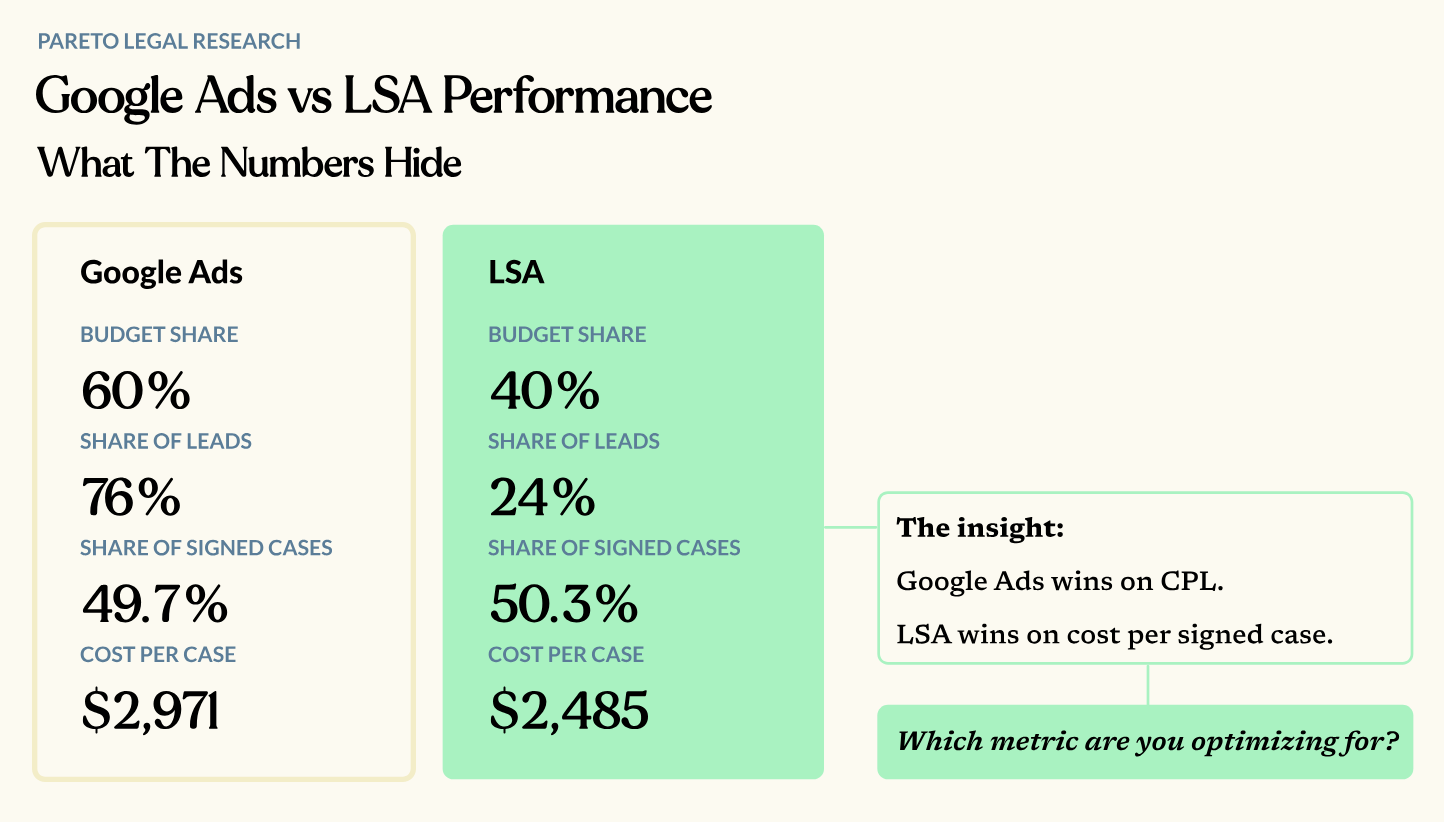
According to Pareto Legal’s report, Local Services Ads are the top-converting channel for personal injury firms. They’re pay-per-lead and don’t need a landing page setup. (I’m the CEO and co-founder of Pareto Legal.)
A simple yet effective adjustment we frequently make is refining LSA category selections to more precise case types like personal injury or motor vehicle accidents.
Mid-funnel incorporates non-brand searches and Dynamic Search Ads, evaluated on the rate of qualified leads rather than sheer volume. Too many unqualified leads can drain the budget, even if the cost seems reasonable.
Strategies involving Meta and YouTube retargeting work well post-website visitations. These should expand to cold audiences only when incremental lift is proven through accurate attribution.
Consider this simple framework to dramatically boost your PPC results. For instance, one injury firm achieved 273 signed cases from $765,000 without increasing the budget, just by restructuring Google Ads.
As I discovered, sending paid traffic to mismatched pages curbs conversion rates. While effective landing pages are crucial, they remain one of the most ignored aspects of PPC management, despite being well-known.
Your aim should be relevance: Landing pages need headlines matching search intent, transparency on settlement amounts, social proof via client reviews, and immediate contact options.
These pages should load quickly and adapt to mobile screens. Each practice area and intent deserves a unique landing page design for better results.
I improved one client’s generic page by creating intent-specific pages, adding recent reviews and results, and reducing form fields, doubling conversion rates with no extra ad spend.
A significant hurdle in law firm advertising is not the cost-per-click but the deteriorating intake process. Focus should be on post-contact processes rather than CPC.
Focus on key intake KPIs such as a 90%+ answer rate, sub-60-second response times, and a signed rate of 25%-40% of qualified leads.
Consider this: Spending $20,000 monthly at $250 per lead gets 80 leads. With optimal response and conversion, 30 cases can emerge from the same spend, vastly enhancing ROI.
Ensure marketing and intake teams share KPIs, ensuring media buyers don’t act on disparate targets.
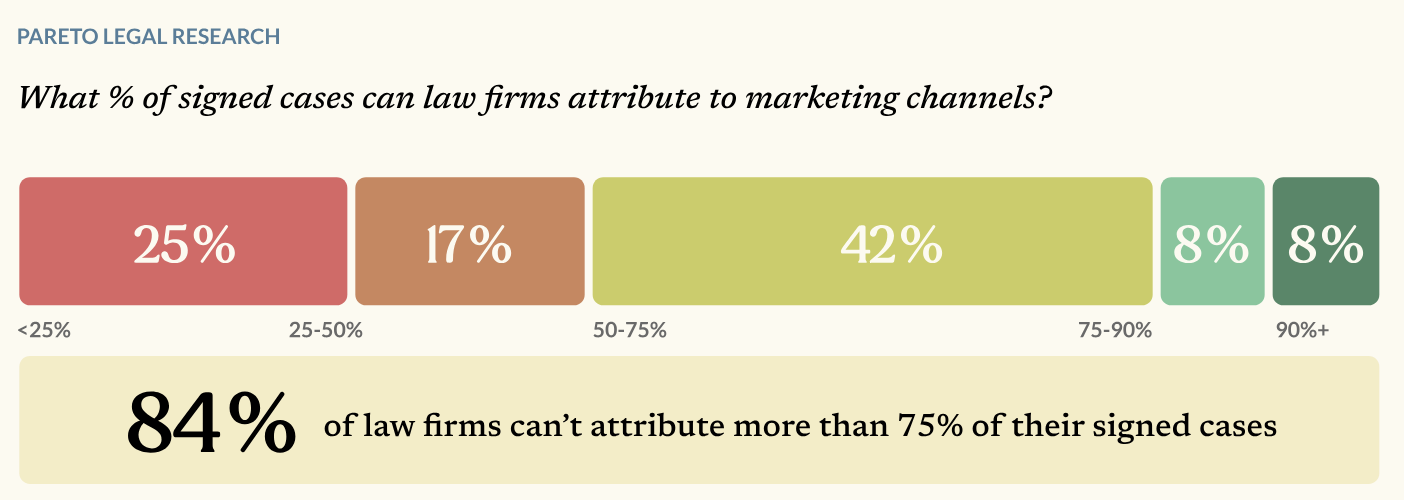
Most reporting cuts off at ad platform metrics without tapping into where the action really happens—the CRM. An integrated attribution chain from ad click to signed retainer is indispensable.
Set up your attribution system: Track traffic sources through UTMs, capture call leads, monitor web behavior with Google Analytics, and track through CRMs like Lawmatics or Clio.
The keystone metric, Marketing Efficiency Ratio (MER), evaluates the marketing ecosystem rather than viewing channels separately, crucial for budget confidence and allocation.
I recommend a streamlined dashboard with key metrics—spend, leads, qualified leads, signed cases, CPL, CPA—segmented by both channel and practice area.
Without granular reporting capability, your data might only be serving as an overview. Leveraging this tracking structure highlights effective campaigns that improve ROI sustainably.
The law firms thriving with PPC are those recognizing PPC as a comprehensive system. They apply precise keyword targeting, allocate budgets by intent, regularly scrutinize search terms, understand cost per case over cost per click, and connect ad clicks to results that matter.
Inspired by this post on Search Engine Land.

Leave a Reply