Tag: PPC Strategies

  • Win Competitor Traffic With Demand Gen Conquesting

    Win Competitor Traffic With Demand Gen Conquesting

    I have seen traditional competitor campaigns turn into expensive click traps. When someone searches for a competitor’s brand, they are often already close to buying, which means my ad can become little more than a brief detour on their way to converting somewhere else.

    That does not mean I have to give up on competitor-aware audiences. Instead of relying only on competitor brand bidding, I can use Demand Gen campaigns and negative-intent keywords to reach those buyers more efficiently, often at a lower cost.

    Demand Gen: Reaching the right audience for less

    Before I focus on negative-intent keywords, I like to look at Demand Gen because it gives me another way to reach people who may not know my brand yet but are already showing signs of interest in my market.

    For Demand Gen to work well, I need two things: strong targeting and strong creative. Within that targeting, custom audience segments and lookalike audiences are essential.

    Custom segment targeting lets me reach people who have searched for specific terms on Google or who show certain interests and purchase intentions. It is also one of the most practical ways I can get in front of users researching my competitors without paying the higher price of a search click.

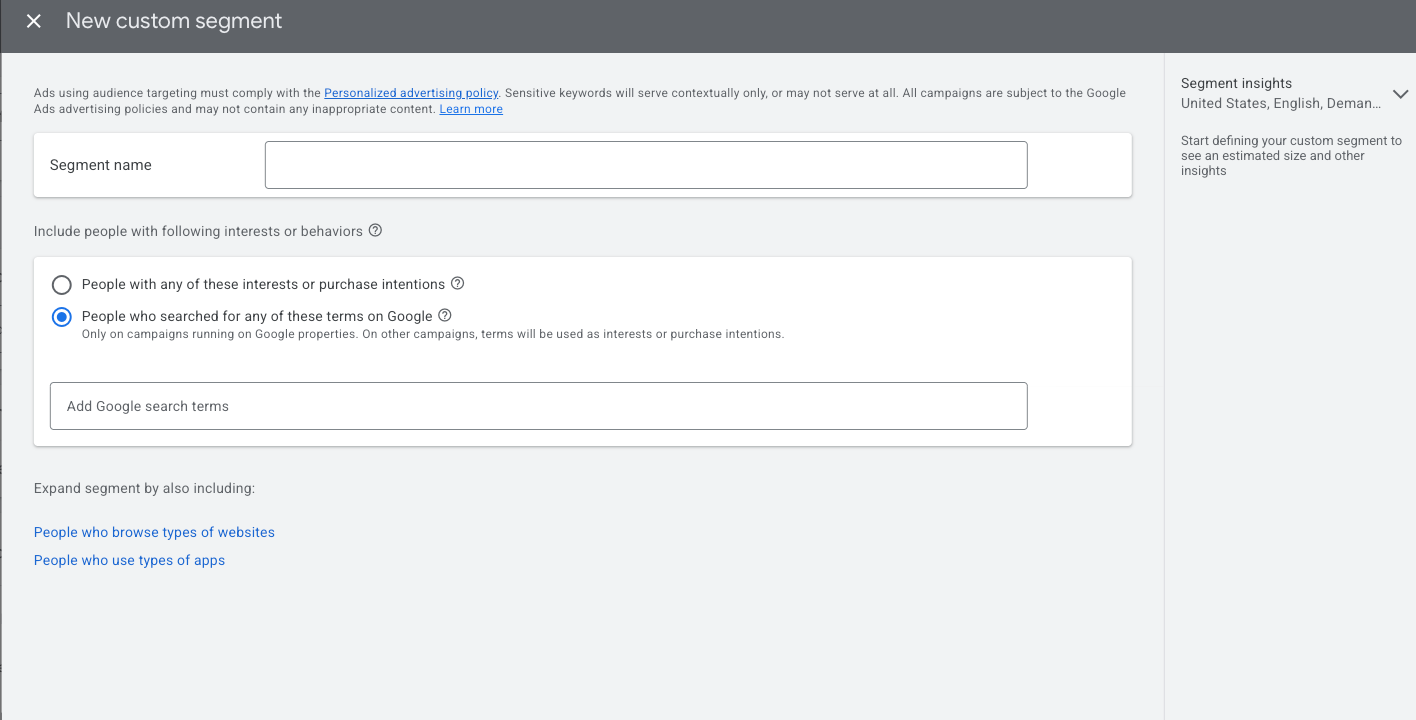
    New custom segment

    When I create a new audience inside a Demand Gen campaign, custom segments are one of the first targeting options I see, right after the audience name.

    From there, I choose the option for People who searched for any of these terms on Google and add as many relevant competitors as I can. This helps me reach a highly relevant audience across Google’s inventory at a lower cost than a traditional search network click.

    If I am not sure which competitors to include, I start by typing my main product or service into Google Ads and reviewing who appears. Those businesses are usually my primary competitors, and depending on the networks I opt into, my ads can appear across YouTube, Discover, and Gmail.

    Designing conquesting landing pages for Demand Gen

    When I use Demand Gen for conquesting, I need a landing page built specifically for that audience. I want to highlight my key differentiators, show social proof, and make it obvious why my product or service deserves consideration.

    The click is only the first step. Once someone lands on my page, the offer has to be clear, specific, and aligned with the ad they just clicked. I need to explain the value thoroughly and guide the visitor toward a call to action that matches the promise I made in the ad.


    Negative-intent conquesting: Targeting competitor weaknesses

    But Demand Gen is not always the right starting point. If I do not have strong image or video assets, I may be better off staying closer to the search network.

    Because high-quality creative tends to perform best across Demand Gen placements, search can make more sense when those assets are not available. That is where negative-intent conquesting becomes useful.
    Image

    Most advertisers understand traditional competitor search campaigns, but many overlook the people who are not simply searching for a competitor. They are searching for alternatives, comparisons, cheaper options, or signs that another company can solve the problem better.

    I often see this happen during the consideration phase. A user may search for terms like “companies like X,” “companies cheaper than X,” or, for branded products, “dupe for X.” Not every variation will have enough volume to bid on, but these searches reveal where serious comparison research is happening.

    Building campaigns around competitor pain points

    If I know a competitor has a reputation for poor customer service, I might test keywords such as “customer service complaints for [competitor].” I would keep this focused in a single ad group with closely related keyword variations.

    In the ad copy, I would focus on what makes my customer service stronger, faster, or more helpful. Because of trademark policies, I would avoid naming the competitor directly in the ad text and instead emphasize the benefit I can prove.

    Traditional competitor campaigns focus on bidding against a brand name. Negative-intent conquesting focuses on the weakness behind the search. The audience already knows the competitor, but they are actively looking for a better option.

    I can also pair this approach with a separate custom audience, which lets me reach people searching for these alternatives across Google’s networks.

    For this to work after the click, the landing page matters just as much as the keyword and ad. If my ad promises a better solution to poor service, high prices, or another competitor weakness, the landing page has to validate that claim and present a unique value proposition that directly addresses the concern.

    Target competitor audiences before the decision is made

    The biggest challenge with traditional competitor campaigns is not always the competitor. It is timing.

    When someone searches for a competitor’s brand name, they may have already narrowed their options and moved close to a decision. That is why competitor keyword campaigns can become expensive and hard to scale profitably.

    Demand Gen and negative-intent conquesting help me approach the same audience from different angles. Demand Gen lets me reach potential customers before they commit to a brand, while negative-intent conquesting reaches them when they are actively questioning their current options.

    My goal is simple: I want to reach potential customers when they are most open to considering a different choice. If I can do that with the right targeting, message, and landing page, competitor traffic becomes much easier to win without overspending on traditional brand bidding.


    Inspired by this post on Search Engine Land.


    crushpress.ai community screenshot
  • Boost Signed Cases: Law Firm PPC Strategies That Work

    Boost Signed Cases: Law Firm PPC Strategies That Work

    I realized early on that merely reducing the cost per lead does not guarantee more signed cases for a law firm. Leads and signed cases differ in significant ways.

    What stands between an ad click and a signed retainer is the intake process, speed of follow-up, and ultimately, conversion. Relying solely on cost per lead to gauge PPC success means making decisions with incomplete data.

    Having managed over 1,000 ad accounts for plaintiff-side law firms, I’ve witnessed the same issues repeatedly. The ads fuel activity, but leakage occurs at various stages in turning leads to clients.

    Law firms that successfully increase signed cases are those that integrate their ad data with intake performance and client retention. This requires a shift in approach to keywords, budget distribution, landing pages, and tracking.

    I found most law firms approach campaigns backward, starting with generic keywords like injury attorney, yielding high-volume but low-quality traffic.

    By reverse-engineering our keyword strategy from signed-case data, we can protect budgets and increase conversions. Instead of defaulting to Google’s suggestions, we analyze call transcripts and CRM records to find the actual language leading to retained clients.

    Over time, I’ve become adept at identifying exact phrase-match terms potential clients use, like “truck accident lawyer near me” or “wrongful death law firm Tampa.”

    It’s crucial to segment every keyword by funnel stage and intent. By allocating budget to high-intent terms and testing or excluding low-intent ones, we fine-tune our ad spend.

    ```json
{
  "alt": "The CapmatchOne logo with a gradient circle and bold text.",
  "caption": "Discover innovation with the CapmatchOne logo, featuring sleek typography and a modern gradient circle.",
  "description": "The CapmatchOne logo features bold, modern typography coupled with a gradient circle, symbolizing connection and innovation. The sleek design conveys a sense of progress and creativity. This image can be used for branding or promotional purposes, appealing to audiences interested in innovative solutions and forward-thinking designs."
}
```

    Integrating the search terms report into my workflow is the cornerstone of effective PPC management. This report reveals the precise phrases used before ad clicks, helping decide whether a lead is worth the cost. Continuous weekly reviews keep the campaign spend efficient.

    Instead of treating Google Ads as a single entity, segmenting campaigns by funnel stage, intent, budget, and conversion objectives significantly improves ROI.

    According to Pareto Legal’s report, Local Services Ads are the top-converting channel for personal injury firms. They’re pay-per-lead and don’t need a landing page setup. (I’m the CEO and co-founder of Pareto Legal.)

    A simple yet effective adjustment we frequently make is refining LSA category selections to more precise case types like personal injury or motor vehicle accidents.

    Mid-funnel incorporates non-brand searches and Dynamic Search Ads, evaluated on the rate of qualified leads rather than sheer volume. Too many unqualified leads can drain the budget, even if the cost seems reasonable.

    Strategies involving Meta and YouTube retargeting work well post-website visitations. These should expand to cold audiences only when incremental lift is proven through accurate attribution.

    Consider this simple framework to dramatically boost your PPC results. For instance, one injury firm achieved 273 signed cases from $765,000 without increasing the budget, just by restructuring Google Ads.

    ```json
{
  "alt": "Comparison of Google Ads and LSA performance in terms of budget share, leads, signed cases, and cost per case.",
  "caption": "Exploring the hidden metrics of Google Ads versus LSA performance, this comparison highlights differences in budget allocation, lead generation, and cost efficiency.",
  "description": "This image presents a comparative analysis between Google Ads and LSA, focusing on key metrics such as budget share, lead share, signed case share, and cost per case. Google Ads holds 60% budget share with higher leads and signed cases, but a higher cost per case of $2,971. LSA has a 40% budget share, fewer leads, but a lower cost per signed case at $2,485. Insights suggest Google Ads excels in cost per lead, while LSA is more cost-effective for signed cases."
}
```

    As I discovered, sending paid traffic to mismatched pages curbs conversion rates. While effective landing pages are crucial, they remain one of the most ignored aspects of PPC management, despite being well-known.

    Your aim should be relevance: Landing pages need headlines matching search intent, transparency on settlement amounts, social proof via client reviews, and immediate contact options.

    These pages should load quickly and adapt to mobile screens. Each practice area and intent deserves a unique landing page design for better results.

    I improved one client’s generic page by creating intent-specific pages, adding recent reviews and results, and reducing form fields, doubling conversion rates with no extra ad spend.

    A significant hurdle in law firm advertising is not the cost-per-click but the deteriorating intake process. Focus should be on post-contact processes rather than CPC.

    Focus on key intake KPIs such as a 90%+ answer rate, sub-60-second response times, and a signed rate of 25%-40% of qualified leads.

    Consider this: Spending $20,000 monthly at $250 per lead gets 80 leads. With optimal response and conversion, 30 cases can emerge from the same spend, vastly enhancing ROI.

    ```json
{
  "alt": "Bar graph showing percentages of law firms' attribution of signed cases to marketing channels with highlights on key statistics.",
  "caption": "Discover how 84% of law firms struggle to link over 75% of their cases to marketing efforts. Are these channels falling short?",
  "description": "This image, from Pareto Legal Research, displays a horizontal bar graph illustrating the percentage of signed cases that law firms can attribute to their marketing channels. The sections show 25% for less than 25%, 17% for 25-50%, 42% for 50-75%, and 8% each for both 75-90% and over 90%. A significant statistic at the bottom highlights that 84% of firms fail to attribute more than 75% of cases. Key terms: legal marketing attribution, law firm research, signed cases analysis, Pareto Legal Research."
}
```

    Ensure marketing and intake teams share KPIs, ensuring media buyers don’t act on disparate targets.

    Most reporting cuts off at ad platform metrics without tapping into where the action really happens—the CRM. An integrated attribution chain from ad click to signed retainer is indispensable.

    Set up your attribution system: Track traffic sources through UTMs, capture call leads, monitor web behavior with Google Analytics, and track through CRMs like Lawmatics or Clio.

    The keystone metric, Marketing Efficiency Ratio (MER), evaluates the marketing ecosystem rather than viewing channels separately, crucial for budget confidence and allocation.

    I recommend a streamlined dashboard with key metrics—spend, leads, qualified leads, signed cases, CPL, CPA—segmented by both channel and practice area.

    Without granular reporting capability, your data might only be serving as an overview. Leveraging this tracking structure highlights effective campaigns that improve ROI sustainably.

    The law firms thriving with PPC are those recognizing PPC as a comprehensive system. They apply precise keyword targeting, allocate budgets by intent, regularly scrutinize search terms, understand cost per case over cost per click, and connect ad clicks to results that matter.


    Inspired by this post on Search Engine Land.


    crushpress.ai community screenshot
  • Mastering PPC: Dynamic Strategies for Budget Success

    Mastering PPC: Dynamic Strategies for Budget Success

    I’ve realized that chasing the perfect PPC budget split can be a never-ending task. Fixed budget ratios often struggle to withstand real-world scenarios, which is why I’ve learned to assess funnel health and adjust spending as market dynamics evolve.

    Most PPC budget discussions revolve around balancing brand awareness with conversion-driven campaigns, but I’ve found that this is often not the ultimate goal.

    In my experience, the ideal balance is subject to constant change, influenced by our business stage, market saturation, seasonality, competitive pressures, and revenue goals.

    Yet, I’ve noticed that many teams treat funnel splits as fixed decisions—set it and forget it. While it might work today, it could be completely inappropriate in six months.

    Budget conversations often lead to debates: should we reduce brand awareness spend since it doesn’t convert directly, or are we risking future pipeline issues if we only focus on conversions?

    Both viewpoints have merit, which makes these decisions challenging for us.

    The Lower Funnel Case is Simple

    When I think about the lower funnel, Shopping, Performance Max, and high-intent Search come to mind.

    A term like “buy running shoes new york” signifies a ready-to-purchase mindset. Shopping categorically showcases the right product, while PMax exploits the conversion signals across all Google surfaces. The attributions are clear, ROAS is apparent, and this delights the CFO.

    But I understand that these campaigns only capitalize on existing demand—they don’t generate new demand. Each conversion is fed by awareness sparked elsewhere:

    • A YouTube pre-roll.
    • A friend’s endorsement.
    • A social media post.
    • Years of brand presence.

    I feel like I’m just picking fruit from a tree I didn’t plant.

    Search is unique as it serves both ends of the funnel. For instance, a query like “best running shoes for marathon training” is more informational.

    The individual is investigating rather than purchasing. With AI Max and broad match expansion, Google Ads pushes Search campaigns deeper into this space, enabling Search to straddle both ends of the funnel based on its configuration and captured queries.

    It’s something I regularly review: Is our Search spend closing existing demand, or are we engaging with prospects earlier in their journey?

    This strategy holds until it falters, often with slow warnings of decline.

    Branded search volumes may stagnate, CPCs soar for core terms, and new customer acquisition rates may plateau as retention remains stable—symptoms of a brand living off existing demand without revitalizing it.

    Lower-funnel efficiency is real, yet it counters future growth.

    Dig deeper: PPC budget planning: Aligning business goals, ad spend, and performance

    The Reseller Trap in Lower Funnel

    I’ve encountered issues quite specific to resellers and multi-brand ecommerce that don’t get enough attention.

    If I sell branded products not owned by my organization, our lower funnel might perform well short-term.

    Shopping and Search campaigns do wonders for established brands since brand owners have taken care of awareness. I’m simply reaping the demand built by major brands like Nike or Adidas.

    Yet, I lack control over that demand. If a brand cuts back on marketing, exits the market, or loses relevance, our Shopping and Search performance suffers.

    The ability to counter such shifts is hampered by the absent demand to harvest.

    This predicament requires us to prioritize two strategic imperatives, something often overlooked.

    • Own-brand expansion: Allowing us to retain control and invest in independent awareness.
    • Enhancing reseller brand: By upping upper-funnel visibility, customers will recognize our name as a destination for all brands we offer.

    Both strategies entail upper-funnel spending. Creating our brand necessitates campaigns to elevate product recognition. Building a reseller brand requires enduring efforts in Demand Gen, YouTube, and Display to ensure our brand is integral to the category, beyond individual brands. This applies beyond Google’s ecosystem.

    Ultimately, these investments will not manifest in the short-term ROAS report but will signify next year’s resilience in business.

    ```json
{
  "alt": "The CapmatchOne logo with a gradient circle and bold text.",
  "caption": "Discover innovation with the CapmatchOne logo, featuring sleek typography and a modern gradient circle.",
  "description": "The CapmatchOne logo features bold, modern typography coupled with a gradient circle, symbolizing connection and innovation. The sleek design conveys a sense of progress and creativity. This image can be used for branding or promotional purposes, appealing to audiences interested in innovative solutions and forward-thinking designs."
}
```

    Upper Funnel as Inventory Management

    I often see brand awareness spend as the uncertain, tough-to-quantify budget segment, earmarked for leftover funds. This perspective, however, is misplaced.

    Investing in the upper funnel is about creating a pool of future converters. Every Demand Gen ad impression on YouTube or Google Display isn’t a wasted effort—it’s a potential high-intent search opportunity in coming weeks, nurturing the top of the funnel for Shopping and Search endeavors to reap later.

    Google’s Demand Gen campaigns effectively highlight this throughout a single platform. I use Demand Gen to engage with audiences unfamiliar with our brand, then track Search impression shares and query volumes that surge in subsequent weeks. This lag is both tangible and trackable.

    Upper-funnel spending impacts lower-funnel effectiveness the next month, not immediately. This delay prompts cuts when budgets shrink, causing impacts six to eight weeks later rather than instantly.

    For effective demand management, I consider upper-funnel campaigns as pipeline investments. The central question isn’t “What is the ROAS on this campaign?” but rather “How much qualified demand is being generated for my Shopping and Search strategies to convert?”

    Dig deeper: Paid media efficiency: How to cut waste and improve ROAS

    Why Fixed Splits Fall Short

    Fixed rules like the 70/30 or 60/40 I often see are merely broad averages seen across different businesses and contexts. They’re decent starting points but poor long-term strategies.

    I must account for what affects the optimal split.

    • Introducing a new product entails a robust upper-funnel effort given the minimal brand awareness.
    • Even mature products in competitive fields require the same, due to shared high-intent search pools with rivals—expanding the pool is the only growth method.
    • Seasonal ventures make it essential to complete upper-funnel efforts before peaks, as urgent awareness builds are ineffective in-season.

    Conversely, when we face financial constraints or urgent revenue goals, patience for an eight-week upper-funnel maturation isn’t possible. In such cases, focusing on the lower funnel becomes necessary, accepting inevitable drawbacks while planning future awareness investments as pressures ease.

    In essence, both choices are appropriate given context. A set split disregards context entirely.

    Formulating a Dynamic Budget Split

    Rather than adhering to fixed ratios, I advocate establishing criteria that trigger budget adjustments where needed.

    Increase upper-funnel focus when:

    • Branded search remains static or declines over quarters.
    • New customer acquisition costs increase, while retention holds.
    • We’re entering new markets or launching new products.
    • Competitors significantly amplify brand presence.
    • We’re nearing peak season with ample preparation time.
    • Reselling top brands with dwindling search interest or decreased active marketing.

    Emphasize the lower funnel when:

    • Immediate revenue targets cannot wait.
    • The upper-funnel campaigns begin showing measurable awareness, indicating readiness for conversion.
    • Shopping or Search costs per acquisition fall below target, justifying scaling.
    • Demand Gen audience reach saturates, indicating repetitive reach instead of expansion.

    Within Google Ads, the necessary data for monitoring this is accessible without additional tools. Trends in branded query and impression share on non-branded terms, along with Demand Gen metrics and customer segmentation data, provide a comprehensive view of funnel health.

    Consistent review is as critical as the metrics themselves. I aim for at least monthly funnel split reviews—quarterly rounds are often too infrequent. By the time quarterly evaluations reveal declining branded queries, vital pipeline time has already been lost.

    The conversation on funnel balance isn’t typically a matter of analytics—it’s political.

    In meetings, lower-funnel spending is easy to defend thanks to visible ROAS and conversion statistics. Conversely, arguing for upper-funnel spending involves creating narratives about future campaign efficacy—a trickier sell under pressure.

    Rather than avoiding this justification, I focus on changing the evidence basis.

    • Tracking branded search volumes as predictive indicators.
    • Ploy a view integrating Demand Gen and Search conversions over time.
    • Making lag times distinct, showing evident relationships.

    Ultimately, budget allocation isn’t static but a reflection of growth strategies.

    Choosing to optimize solely for current ROAS is one decision; investing in future demand drivers another.

    For resellers, it also entails whether the business base is self-controlled or rented from brand owners with independent priorities.

    I believe the best PPC ventures strike a balance, knowing strategically when to shift focus.

    Dig deeper: How to optimize B2B PPC spend when budgets and confidence are low


    Inspired by this post on Search Engine Land.


    crushpress.ai community screenshot
  • Unlock Competitor Insights with Adthena’s ChatGPT Ad Analysis

    Unlock Competitor Insights with Adthena’s ChatGPT Ad Analysis

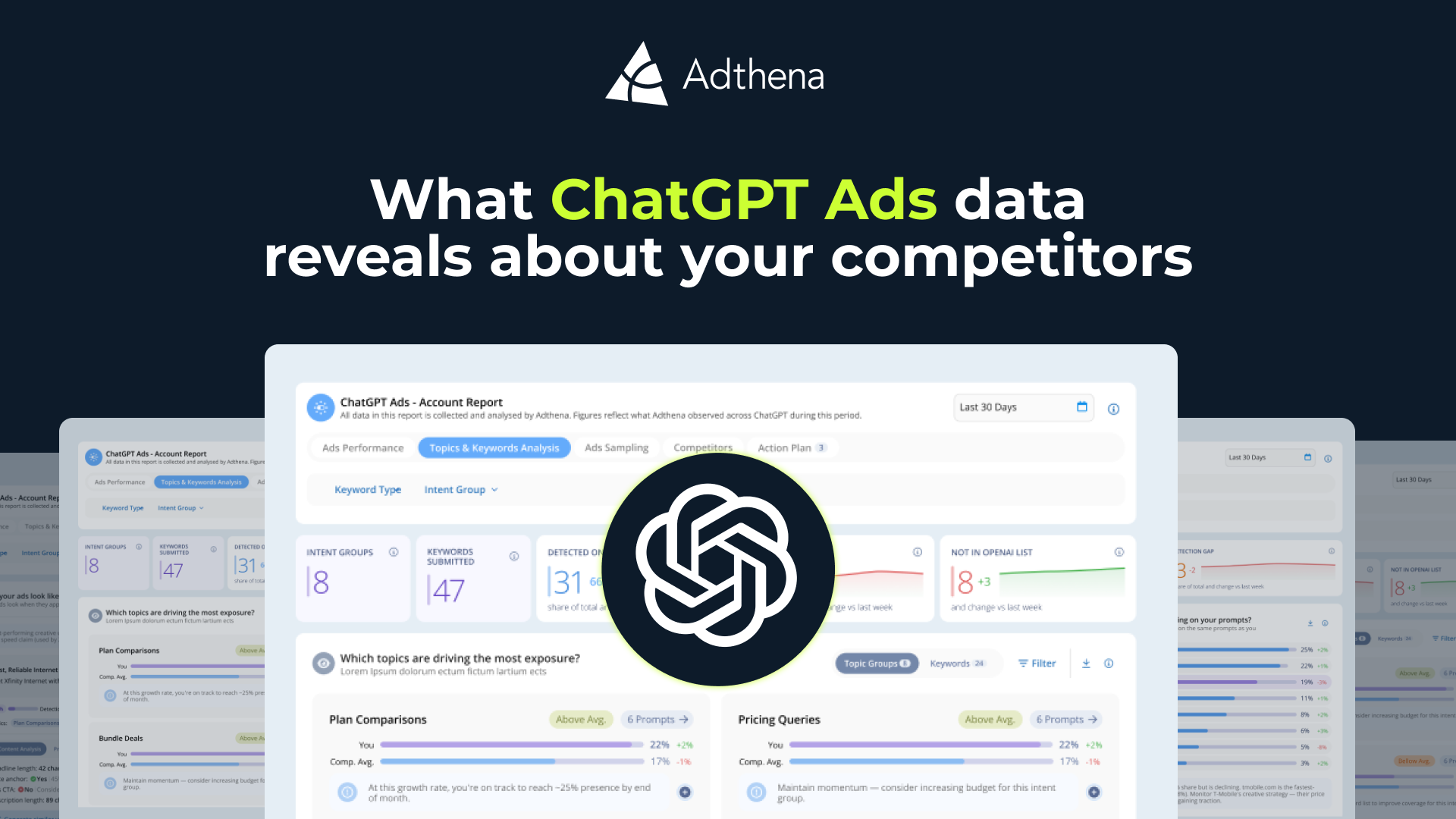
    I recently dove deep into the fascinating world of ChatGPT Ads with insights from Adthena. It turns out, the advertising space on ChatGPT is a treasure trove of competitive information that many search teams are missing out on.

    Your competitors are running stealth campaigns via ChatGPT, and the frustrating part is that it’s not immediately visible what they’re bidding on or what creative strategies they’re adopting. Unlike Google Ads, there’s no native way—yet—to get a behind-the-scenes look at this in ChatGPT.

    When OpenAI launched advertising within AI-generated responses, brands jumped on board quickly. With the Ads Manager and lowered spending thresholds, this new ad channel grew rapidly. And with plans to expand to U.K. markets soon, there’s a quickly closing window for early adopters to gain a significant advantage.

    From the start, we’ve been closely monitoring these developments, and what we’ve found is eye-opening.

    ```json
{
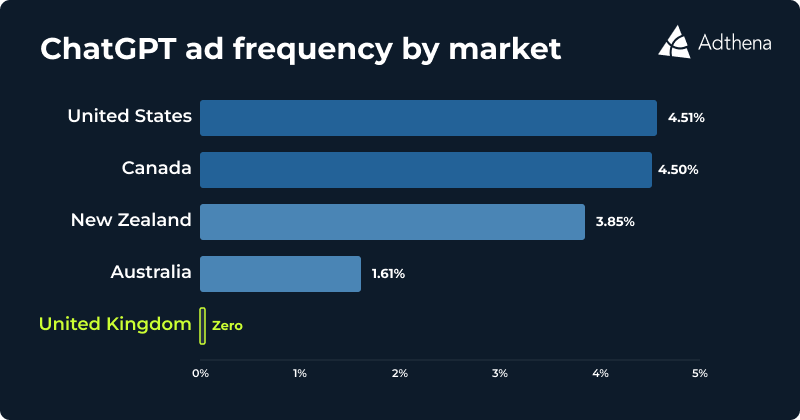
  "alt": "Bar chart showing ChatGPT ad frequency by market. U.S. at 4.51%, Canada 4.50%, New Zealand 3.85%, Australia 1.61%, U.K. Zero.",
  "caption": "Exploring ChatGPT ad presence globally: U.S. and Canada lead with over 4%, while the U.K. notes zero activity. Discover market trends in AI advertising.",
  "description": "This image is a bar chart illustrating ChatGPT ad frequency across different markets. The data shows the United States at 4.51%, Canada at 4.50%, New Zealand at 3.85%, and Australia at 1.61%. Notably, the United Kingdom registers zero ad frequency. The chart is presented on a dark blue background, emphasizing the data collected by Adthena."
}
```

    What Does the Current ChatGPT Ads Landscape Look Like?

    Our analysis spans nearly a million queries across 20 industries in five markets, telling a clear story of the current landscape.

    It’s Primarily a U.S. Channel—Other Markets are Catching Up

    In the U.S., ads are run on about 4.5% of queries. In contrast, during the same period, the U.K. had none. The U.S. dominates, accounting for 90% of ChatGPT ad placements in our dataset, with Canada and New Zealand also active and Australia at 1.6%.

    For U.K. teams, it means while the channel isn’t live yet, U.S. competitors are already fine-tuning prompts and creative strategies, placing them at a strategic advantage when the U.K. market opens.

    ```json
{
  "alt": "Bar chart showing ChatGPT ad frequency by industry, with Logistics having the highest percentage.",
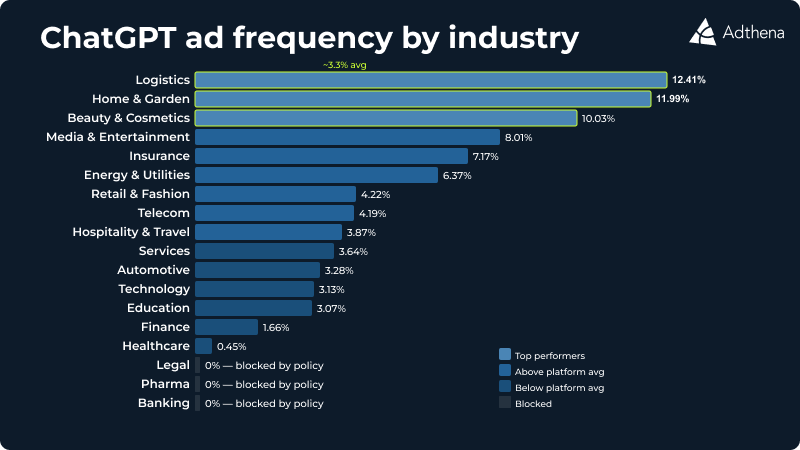
  "caption": "Explore how ChatGPT ads perform across industries, with Logistics leading the charge at 12.41% and sectors like Legal and Pharma blocked.",
  "description": "This image is a bar chart from Adthena, illustrating ChatGPT ad frequency across various industries. Logistics tops the list at 12.41%, followed by Home & Garden at 11.99%. Categories such as Legal and Pharma have 0% due to policy blocks. The chart categorizes industries into top performers, above platform average, below average, and blocked, offering insight into advertising trends."
}
```

    The Majority of Responses Contain Just One Ad

    On average, ChatGPT presents only 1.06 ad items per response in the U.S., implying a single sponsored slot per query. This level of exclusivity changes the game completely compared to multi-slot Google Ads.

    Industry Restrictions Still Apply

    Certain sectors, like Legal and Pharma, show no ad activity due to what seems to be OpenAI’s deliberate restrictions, although this could change, providing proactive teams an edge.

    Unexpected Hot Categories

    Logistics, Home & Garden, and Beauty & Cosmetics are leading in ad frequency, indicating high potential for growth in these sectors.

    ```json
{
  "alt": "Bar chart showing US market shares for retail, automotive, hospitality, media, and others.",
  "caption": "Retail and fashion dominate the US market, leading ahead in both search queries and ad presence.",
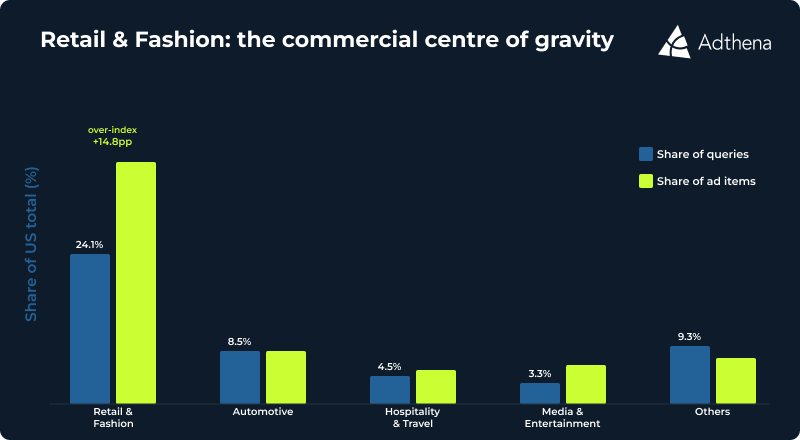
  "description": "This bar chart compares the US market shares of various industries: retail & fashion, automotive, hospitality & travel, media & entertainment, and others. Retail & fashion is the leader with 24.1% share of queries and even higher ad items share at 38.9%, showing an over-index of +14.8pp. Automotive follows with 8.5% in queries. The chart, presented by Adthena, emphasizes the commercial gravity of retail in the US market."
}
```

    Retail Leads in Ad Spend

    Retail & Fashion accounts for a vast share of U.S. ad items, indicating robust advertiser demand, far surpassing the national average. This suggests the significant investments made by retail brands in this space.

    Current Challenges in Competitive Intelligence

    Without tools like Auction Insights, understanding your competitive landscape on ChatGPT is practically impossible. You’re spending budget where you can barely track competitor activity. It’s a gap that Adthena aims to close.

    Achieving Full Market Visibility with Adthena

    Adthena’s ChatGPT Ads Intelligence offers broader insights by monitoring a plethora of prompts daily, providing a competitive overview previously unavailable.

    ```json
{
  "alt": "Ad impressions comparison chart with competitors and line graph analysis.",
  "caption": "Dynamic visualization of ad presence over time, comparing performance with top competitors.",
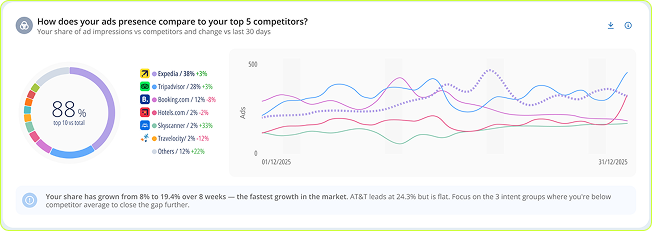
  "description": "The image displays a data chart comparing ad impressions among top competitors over 30 days. A pie chart shows a 38% share, while a line graph tracks different competitors' trends from 01/12/2025 to 31/12/2025. A note highlights the fastest growth from 8% to 19.4% in 8 weeks, advising focus on areas where competitors outperform."
}
```

    You can now see who bids on your prompts, track share of voice, and spot open prompts ripe for targeting before competitors do.

    In a new and rapidly evolving channel, being an early mover is an opportunity that shouldn’t be missed. Try ChatGPT Ads Intelligence free for 21 days and unlock the full potential of your advertising strategy.

    Beyond Just ChatGPT: Expanding Your Search Horizons

    As users move towards AI-driven searches for high-intent queries, such as product recommendations, it’s essential for search practitioners to adapt. Simply put, the game is changing.

    ```json
{
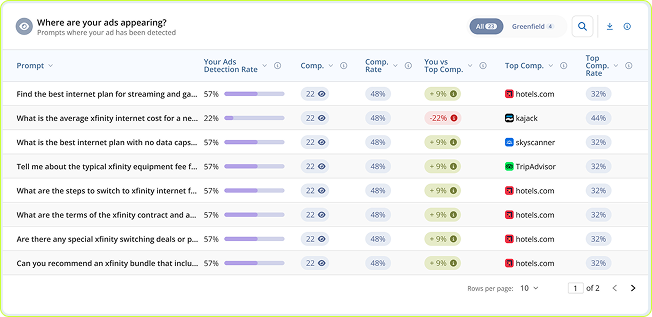
  "alt": "Chart showing ad detection rates for Xfinity-related queries with competitors' comparison and top competitor sites.",
  "caption": "Explore where your ads stand in the competitive landscape with detailed detection rates and comparisons against top competitors like hotels.com and kajack.",
  "description": "This image displays a chart analyzing ad detection rates for various Xfinity-related queries. It highlights your detection rate alongside competitors and compares it to top competitors like hotels.com. The table details 'Prompt', 'Your Ads Detection Rate', 'Comparison Rate', 'Top Competitor', and more. Ideal for advertisers seeking insights into ad performance and competitor strategy."
}
```

    If you’re attentive to ChatGPT Ads now, you’ll be hard to budge later. Our data shows a window of opportunity open now, similar to the early days of Google Ads. Capitalize on this before it closes.

    Start your free 21-day trial of Adthena’s ChatGPT Ads Intelligence today to discover what’s unfolding in the ChatGPT ad space.


    Inspired by this post on Search Engine Land.

    crushpress.ai community screenshot
  • Unleash the Power of TV Ads: Drive Search Demand Effectively

    Unleash the Power of TV Ads: Drive Search Demand Effectively

    I recently came across a fascinating insight on how TV ads don’t just create awareness, they actually spark searches. It made me realize just how crucial it is to be ready to capture this surge in interest effectively.

    Every time a high-impact TV campaign airs, viewers like us are likely to head straight to search engines like Google and YouTube to learn more about the products or brands featured. The real challenge is not in generating that interest but in being prepared to capture it when it happens.

    A great example of this is Fox Sports’ recent World Cup campaign. It highlights why SEO and PPC planning need to start way before an ad goes live to ensure we’re ready to meet the demand.

    A World Cup Ad That Created More Than Just Awareness

    DAIVID’s study ranked the most emotionally engaging World Cup ads, with Fox Sports’ “Miracle” leading the pack. This ad didn’t just create awareness; it generated a significant emotional response, prompting viewers to search for more information.

    When “Miracle” aired, it wasn’t just an advertising victory; it was a roadmap of demand generation. Fox’s search teams needed to be ready to handle the influx of interest surrounding their branded terms well before the World Cup even began.

    Throughout the ad, viewers are taken through an inspiring journey of Team USA winning the World Cup, and this prompted us to engage with various search queries like “U.S. World Cup 2026” and “Christian Pulisic.” It was amazing to see how emotional storytelling in advertising can drive such significant search activity.

    Why This Matters for Search Marketing

    Imagine the Fox ad airing; immediately, millions of us are reaching for our phones, searching for details on the U.S. World Cup team or the ad itself. The key takeaway here is the need for search campaigns to be live, optimized, and ready to meet this demand instantly.

    One study highlighted that 75% of search activity related to a TV ad happens in the first two minutes. If our search strategy isn’t aligned and prepared beforehand, we risk losing significant opportunities to competitors.

    Prepare for Four Types of Queries TV Ads Generate

    The “Miracle” ad teaches us about the various search queries it generates, categorized into branded, campaign, asset, and category queries. Each type needs its own strategic approach, and preparing for them is crucial to capturing the interest they’re meant to drive.

    Branded Queries

    After an ad airs, simple branded searches like “Fox Sports” are the most common. It’s essential to ensure we’re capturing all potential impressions by boosting budgets accordingly.

    Campaign Queries

    Campaign-specific searches arise directly from the ad content, like “Miracle ad.” Building landing pages and keyword strategies around these queries before airing can capture significant interest.

    Asset Queries

    Queries related to elements like songs or celebrities in the ad, such as “song in Fox World Cup ad,” are common. Preemptively planning for these queries ensures we don’t miss out on highly engaged and curious viewers.

    Category Queries

    Viewers might search for solutions related to the ad’s theme, like “how to watch World Cup 2026.” Addressing these queries is vital to prevent losing traffic to competitors.

    Strengthen Your Search Strategy and Creative Collaboration

    As search marketers, we should be present during the creation process to identify searchable elements, align landing pages with ad content, and prepare teams for potential viewer questions.

    A well-planned search strategy can significantly enhance a viewer’s journey from curiosity to conversion, ensuring that our hard-earned advertising dollars are not wasted.


    Inspired by this post on Search Engine Land.

    crushpress.ai community screenshot
  • Evolving PPC Skills: Transforming from Keyword Manager to System Optimizer

    Evolving PPC Skills: Transforming from Keyword Manager to System Optimizer

    I’ve noticed how AI-driven Google Ads has revolutionized the PPC landscape. My role has evolved from merely executing campaigns to designing signals and guiding the conversion system.

    In the past, PPC was all about having control – managing keywords, match types, bids, crafting ad copy, and structuring campaigns to make the algorithm follow my lead.

    Back then, proficiency in Excel and pivot tables distinguished the best ad managers. Agencies and PPC experts thrived on their execution skills. Greater control over variables meant better job execution, a strategy that worked well for PPC’s first decade.

    However, Google Marketing Live (GML) 2026 heralded a significant shift for PPC. The focus moved from tactical control to system optimization, from managing keywords to signal design, and from setting up campaigns to aligning with machine strategy.

    With AI-driven Google Ads, it’s evident that execution alone is no longer a competitive advantage. As Selin Song from Google Customer Solutions emphasized, execution has become a commodity.

    Here’s what the new skill set involves.

    ```json
{
  "alt": "Speaker in teal suit on stage with large screen displaying 'Execution is becoming a commodity'.",
  "caption": "A thought-provoking message, 'Execution is becoming a commodity,' displayed on a large screen during an engaging talk.",
  "description": "The image depicts a speaker in a teal suit presenting on stage in front of a large audience. A prominent screen behind them showcases the phrase, 'Execution is becoming a commodity.' The scene suggests a conference or seminar setting, emphasizing the importance of innovative thinking in modern industries. The stage is well-lit with a metal framework and soft background lighting, providing a professional and focused atmosphere. Keywords: execution, commodity, presentation, innovation, conference."
}
```

    I’ve learned to design inputs – the new keyword research. Knowing what inputs to provide the system helps it find the right audience on my behalf.

    With AI Max for Search, I’m using a mix of broad match, keywordless targeting, text customization, and URL expansion. This strategy surfaces queries my keyword list wouldn’t catch, leading to an average of 7% more conversions or conversion value at a similar CPA/ROAS.

    Feeding the system accurate conversion data is crucial. If conversion actions are irrelevant, the system solves the wrong problems, and that responsibility falls on me.

    In terms of product and feed data, optimizing feeds with Conversational Attributes helps display products effectively in AI-generated responses. Ensuring audience signals are precise also shapes system operation, particularly with new prospects.

    The days of relying solely on keyword lists are long gone; today’s system demands a strategic approach with the right inputs to automation.

    ```json
{
  "alt": "The CapmatchOne logo with a gradient circle and bold text.",
  "caption": "Discover innovation with the CapmatchOne logo, featuring sleek typography and a modern gradient circle.",
  "description": "The CapmatchOne logo features bold, modern typography coupled with a gradient circle, symbolizing connection and innovation. The sleek design conveys a sense of progress and creativity. This image can be used for branding or promotional purposes, appealing to audiences interested in innovative solutions and forward-thinking designs."
}
```

    Value signal architecture has replaced traditional bid management. My focus is now on providing robust signals like first-party data and accurate conversion values to Smart Bidding.

    The advent of demand-led budget pacing means I set parameters rather than control pacing. Understanding product margins, inventory, lifetime value, and cash flow guides me in providing the right signals instead of merely setting bids.

    Journey-aware bidding allows me to optimize the full conversion journey, not just the endpoint, requiring a well-instrumented conversion path connected back to the ad platform for effectiveness.

    System prompting is today’s copywriting. AI Brief powered by Gemini helps me guide AI Max using brand-specific briefs to ensure it represents the brand accurately without over-constraining creativity.

    I’ve learned to write briefs that effectively convey brand strategy, assisting AI in maintaining brand integrity in every campaign impression.

    ```json
{
  "alt": "Bar chart showing ad performance metrics with data on clicks, conversions, and missed opportunities from Nov 26 to Nov 27, 2026.",
  "caption": "Analyzing Ad Performance: Discover missed opportunities and optimize your ad strategy with insights from clicks and conversion data.",
  "description": "The image displays a bar chart highlighting ad performance metrics over two days, from November 26 to 27, 2026. It shows actual clicks, missed clicks from low bids, and missed clicks from low budgets. The chart is accompanied by a table detailing missed clicks, missed conversions, missed conversion value, and recommended actions for various ad campaigns like Holiday Campaign 2026, PMax Nike, and others. This data is crucial for refining ad strategies and optimizing budget allocations."
}
```

    Budget architecture has taken precedence over daily budget adjustments. Campaign total budgets automate the process, and interpreting auction behavior in predictive systems has become my focus.

    I rely on missed opportunity reporting to make informed decisions about budget constraints and optimize growth opportunities within the architecture I construct.

    Measurement literacy has surpassed mere Quality Score management. Feeding the system quality signals helps it make informed decisions and optimizes bidding behavior through robust data integration.

    It’s crucial now to ask business-relevant questions that the system can optimize toward meaningful outcomes. Communicating system behavior in business language is becoming a survival skill, alongside maintaining human oversight to ensure strategic alignment.

    GML 2026 confirmed we’re already in this new phase. Thriving today means understanding the system’s needs and strategically providing those inputs to achieve business objectives.


    Inspired by this post on Search Engine Land.

    crushpress.ai community screenshot
  • Spotting Early PPC Performance Signals: Your Competitive Edge

    Spotting Early PPC Performance Signals: Your Competitive Edge

    5 Early Signs of PPC Performance Declines & How to Spot Them

    Have you ever felt blindsided by a drop in your PPC performance? I’ve been there, and the key to avoiding this situation is staying ahead by tracking your competitors. Let me guide you through five signals that can appear before your performance takes a hit and what actions you should take when you notice them.

    Understand the Why Behind PPC Drops

    I’ve realized that while Google Ads reports can highlight declining PPC performance, they often fail to pinpoint the cause. In a landscape that evolves as rapidly as paid search, waiting until performance actually drops to react is simply too late. Proactive identification of the signals leading to these changes is essential to mitigate impacts before they affect your results.

    ```json
{
  "alt": "Split image showing reactive and proactive PPC monitoring. Left side shows declining metrics. Right side shows rising metrics with timely changes.",
  "caption": "Transform your PPC strategy from reactive to proactive. Witness the shift from declining to thriving metrics with timely interventions.",
  "description": "This image depicts a side-by-side comparison of reactive versus proactive PPC monitoring. On the left, a PPC manager observes decreasing metrics like CTR and CPC, labeled as 'too late'. On the right, proactive monitoring shows rising metrics with alerts such as 'competitor enters' and 'changes made in time', indicating positive growth. The scene uses vibrant graphics to illustrate the contrasting effects of different monitoring approaches. Keywords: PPC, monitoring, proactive, reactive, digital marketing."
}
```

    Key Competitor Behaviors to Watch

    Changes in your competitors’ bids on core keywords, new entrants into branded searches, or the launch of stronger offers that dominate the SERP are all factors that can alter auction dynamics. These changes often precede visible impacts by days or even weeks.

    The Importance of Competitor Monitoring

    ```json
{
  "alt": "Man analyzing graph on transparent screen with labels like SERP Takeover and Messaging Change.",
  "caption": "Delve into the art of staying ahead with competitive insights. Spot trends like bid spikes and messaging changes to act swiftly.",
  "description": "Image depicts a man in a server room interacting with a digital transparent screen displaying a graph with strategic labels such as 'SERP Takeover,' 'Bid Spike,' and 'New Competitor.' The atmosphere conveys a high-tech environment, emphasizing quick response strategies in business analytics. Keywords: competitor analysis, graph analysis, business strategy."
}
```

    By consistently monitoring competitor activity, I’ve found it provides critical context for unexpected shifts, allowing me to address issues before they become costly. Without this vigilance, areas like CPC, ad positions, and conversion rates can start slipping.

    • Cost per click: An increase due to rising auction pressure.
    • Ad positions and visibility: Diminished visibility if competitors boost their impression share or campaign coverage.
    • Conversion rate and revenue: Loss of relevance due to stronger competitor offers or CTAs.

    5 Competitor Signals You Should Never Ignore

    Every spike in CPC or drop in conversions usually indicates a competitor’s strategic move. Let’s delve into the five key signals you need to pay attention to:

    ```json
{
  "alt": "Bluepear advertisement for PPC competitor monitoring with shield and lock graphic.",
  "caption": "Unlock your potential with Bluepear! Monitor your PPC competitors with ease. Start your free trial now.",
  "description": "This image is a promotional graphic for Bluepear, featuring text promoting PPC competitor monitoring. The ad includes a shield with a lock symbol, emphasizing security and reliability. Vibrant colors and modern design enhance the message of swift and secure service, while the call to action offers a free trial for fast signup. Keywords: Bluepear, PPC, competitor monitoring, free trial, advertisement."
}
```
    SignalWhat it affectsWhat to do
    Competitor activity spikeCPC, impression shareTrack keywords & review bidding strategy
    New players in branded SERPBrand traffic, CACMonitor activity & protect brand terms
    Messaging changesCTR, conversion rateTest new offers
    Increased ad frequencyVisibility, ROIDetect pressure early
    SERP takeover (extensions, shopping)Click share, attentionExpand ad formats

    Reacting to Competitor Signals

    Upon recognizing these signals, I take proactive steps to mitigate impact. For instance, a sudden increase in competitor activity on priority keywords usually signals more aggressive bidding, driving up CPCs and reducing my campaign’s impression share.

    Steps to Take:

    • Identify key players driving auction pressure.
    • Adjust bids and strengthen branded campaigns.
    • Track competitors’ ads and implement counter strategies.

    Competitor monitoring and strategic analysis really make a difference, connecting market behavior shifts with performance changes, allowing you to act before your KPIs begin to suffer.


    Inspired by this post on Search Engine Land.

    crushpress.ai community screenshot
  • From Video Tapes to AI: My Journey Through Paid Search Evolution

    From Video Tapes to AI: My Journey Through Paid Search Evolution

    Reflecting on my journey, it all began with a simple student side hustle, not a meticulously crafted career path in the world of PPC.

    Back in 1998, as a Stanford student, I stumbled upon an opportunity to resell used Blockbuster video cassettes, prompting me to seek a way to connect with buyers. That quest introduced me to GoTo, an early search engine where I first experienced the power of paid search through keyword bidding.

    Over two decades later, I find myself recognized as a prominent voice in PPC, having journeyed from Google to founding Optmyzr, shaping the landscape of Google Ads.

    In this reflective interview, I delve into the transformation of Google Ads from its inception to the current era of automation, and I urge marketers to stay mindful as we transition from keywords to AI-driven prompts.

    Paid Search’s Humble Beginnings

    My initial ‘aha’ moment with paid search occurred before Google Ads became an advertising giant.

    GoTo revealed to me the potential of reaching audiences without an enormous budget; buying a keyword allowed me to test and refine my strategies easily, a stark contrast to traditional advertising requiring hefty budgets with less measurable results.

    This accessibility fundamentally changed the game.

    Google Ads: Pioneering Measurable Success

    Joining Google in 2002 marked a new chapter as I helped launch Google Ads in Dutch, expanding its reach as the sixth supported language.

    Back then, a significant advertiser was spending about $30,000 monthly—a figure that, while modest by today’s standards, was groundbreaking at the time.

    Google’s unique selling point wasn’t merely traffic; it provided proof through tools like Urchin (Google Analytics) and conversion tracking, offering insights into post-click activity, transforming paid search into a provably effective strategy.

    Search Engine Land’s Influence

    By 2006, when Search Engine Land emerged, paid search had already solidified its position as a serious advertising channel.

    The platform became more than just news for me; it was a community for idea exchange, learning, and connection-building that significantly impacted my career.

    It even inspired Optmyzr’s creation after connecting with my future co-founders through a published article on quality score, catalyzing a collaborative venture.

    Understanding Quality Score

    Google Ads’ quality score has always centered around relevance. Initially, it was primarily about click-through rate, ensuring ads were not only high-bid but also relevant to the user.

    This necessity for a balance between bid and quality formed the auction’s cornerstone, a balance managed by machine learning, which humans like myself initially handled, sometimes reviewing keywords to ensure relevance.

    Cyclical Nature of Search

    The evolution of paid search is undeniably cyclical. Initially, advertisers had limited data, but Google empowered them with analytics, conversion tracking, and search query reports, only for visibility to be obscured again by privacy changes.

    Products like Performance Max followed this pattern, launching with restricted features and expanding as demanded. Yet, the industry often views such ‘black box’ phenomena as novel, overlooking the pendulum swing between simplicity, control, automation, and transparency.

    The Impact of Smart Bidding

    A pivotal moment was when Smart Bidding became highly effective. It shifted advertisers’ roles and compelled tool providers like Optmyzr to redefine their contribution.

    With Google automating bidding so competently, the focus shifted from bid adjustments to offering ‘PPC insurance,’ monitoring automation, setting limits, and diagnosing system errors, a critical part of Optmyzr’s strategy.

    AI: The Next Shift

    The launch of ChatGPT marked a significant shift, propelling Google to advance its Gemini technology and prompting the industry to move beyond keyword-based advertising.

    With Google’s foundation built on keywords, we’re now seeing a shift towards interactions through prompts, conversations, and AI assistants, raising fundamental questions about whether the existing system should be overhauled or if an entirely new framework is needed.

    AI Search: More Than Just Information

    AI is transforming mere search queries into actionable tasks. People now not only seek information but also request AI tools to produce content, solve issues, and deliver solutions.

    This evolution demands advertisers understand user goals profoundly, thus enhancing opportunities to assist at crucial junctures rather than simply matching a keyword to an ad.

    Enhancing AI with Context

    One prevalent mistake is treating AI like traditional search, asking limited questions and dismissing tools based on unsatisfactory answers.

    My advice? Empower AI with true objectives. Don’t just ask for the ‘best mattress’ if your goal is health improvement; outline the broader context and let AI explore the solutions.

    The same principle applies to marketing strategies, emphasizing goal clarity whether it’s lead generation, recruitment, education, or brand growth.

    Future Opportunities for Problem Solvers

    Marketers must evolve beyond past mechanisms. If my role was solely ‘keyword manager,’ the future might seem uncertain. But focusing on customer engagement and problem-solving signifies that while tools might change, the mission remains intact.

    The future of search will favor those adept at understanding consumer needs and communicating value, adjusting to innovative discovery methods.

    Advice to My Younger Self

    Looking back, the simplest advice would have been to invest in more Google stocks.

    Beyond that, I’m content with my journey’s trajectory. My guidance? Be intentional, think systematically, and join communities offering significant insights.

    Communities like Search Engine Land, SMX, and Silicon Valley introduced worthwhile problems to solve.

    What I’m Most Proud Of

    I’m proud of becoming part of Google’s early team, contributing to digital infrastructure that defines the modern digital ecosystem.

    While Optmyzr is a significant achievement, Google’s broad impact—from Ads to Maps, and Drive—is what I regard as monumental, funding products that revolutionize access to information and daily activities.

    PPC Marketers’ Secret

    We often joke that PPC experts never confess ignorance. Instead, we say, ‘It depends.’

    Though humorously put, it’s mostly accurate.

    The intricacies of paid search abound with caveats and evolving contexts, which is why continuous learning is essential for longevity in this industry.


    Inspired by this post on Search Engine Land.

    crushpress.ai community screenshot
  • How Ignoring Data Can Derail Your PPC Success

    How Ignoring Data Can Derail Your PPC Success

    Recently, I found myself captivated by a story shared by Dean Kadi, Head of Paid Growth at One Link Media. He recounted a fascinating experience from a PPC Live podcast that really highlighted what can go wrong when you ignore performance data. It involved a client who overrode a winning ad strategy with new creatives that just didn’t deliver.

    Dean Kadi’s team had developed an exceptionally successful Meta advertising strategy for a premium woodworking brand, Rubio Monocoat, using user-generated content (UGC). Their intensive testing across creators and formats resulted in a significant ROAS improvement, proving the power of well-tested strategies.

    However, the client decided to halt all the high-performing ads in favor of new, heavily branded content. Despite the polished look, these ads didn’t blend well with the Meta platform, and it was clear that engagement and conversion would likely suffer.

    The client’s assumption was rooted in a customer survey that praised the brand’s color range, leading them to mistakenly prioritize this over proven data. This is a classic marketing pitfall where assumptions can cloud judgment and overshadow hard-earned data insights.

    The most eye-opening moment came when the client expressed a simple wish for their new strategy to be a winner. Dean explained that in paid media, success isn’t driven by preferences or hopes—it’s determined by what resonates with audiences, as clearly shown by performance data.

    When facing such situations, Dean advises agencies like us to stay calm, present evidence, and communicate risks effectively. Professionalism and clear documentation can help maintain client relationships while asserting the agency’s expertise.

    As expected, the new strategy did not perform well. Underperformance became evident with increasing costs and decreasing campaign efficiency. After eight weeks of this, the client recognized the necessity to revert to the original strategy.

    Reintroducing UGC ads quickly turned the tide, proving the original strategy’s effectiveness. Performance metrics showed immediate improvements, reinforcing the importance of data-driven decisions.

    The overarching lesson here is that data should be your guiding light in PPC campaigns. Clients sometimes need to see failures themselves before they trust data insights. Consistently providing clear, transparent reports helps rebuild trust and guide future strategies.

    Dean also pointed out that many PPC accounts still suffer from poor tracking setups. This issue is a major roadblock to optimizing performance and should be addressed urgently.

    Additionally, while AI tools can enhance efficiency, they cannot replace the need for a strong strategy. Human judgment remains crucial for evaluating AI outputs and guiding successful campaigns.

    In conclusion, successful PPC is all about balancing data, strategy, and communication. Document recommendations thoroughly, trust your expertise, and let audience data guide your actions. Remember, it’s the audiences who ultimately decide what works.


    Inspired by this post on Search Engine Land.

    crushpress.ai community screenshot