Harnessing AI: Google Transforms Lookalike Audiences

```json
{
  "alt": "Illustration of a woman using a laptop with digital profiles and graphs in the background.",
  "caption": "Navigating the digital world: A focused woman explores online connections and data through her laptop amid a vibrant, tech-inspired backdrop.",
  "description": "This illustration features a woman immersed in her laptop as digital profiles and colorful graphs surround her. The scene conveys a sense of connectivity and exploration in a digital landscape. The blending of technology themes and vibrant colors highlights the dynamic nature of online interactions and data analysis, making it ideal for topics related to technology, digital networking, and information systems."
}
```

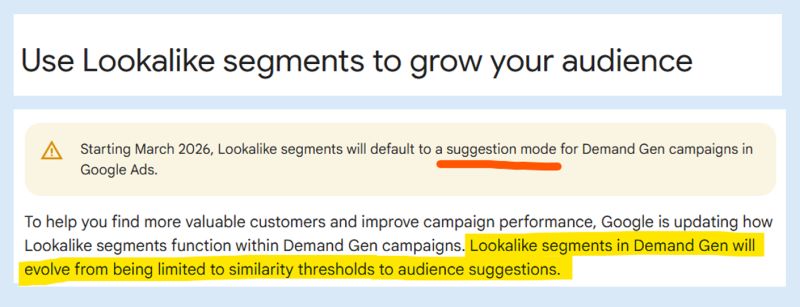
I’ve noticed some exciting changes coming to Google Demand Gen campaigns. Starting in March 2026, Lookalike audiences will no longer be the rigid framework we’re used to. Instead, they’ll serve as optimization signals, ushering in a new era of AI-driven campaign enhancements.

Google is updating its Help documentation to reflect this transformation where Lookalike segments shift from strict targeting to a more flexible, AI-enhanced recommendation model.

Understanding the Transition. Previously, I would choose a specific similarity tier (narrow, balanced, or broad) to dictate exactly who my campaigns targeted. That’s changing.

Now, Google will use these tiers as signals. The system will intelligently expand its reach beyond my chosen Lookalike lists to engage users predicted to convert.

Behind the Change. This transition turns Lookalikes from a barrier into an enabling tool. It allows Google’s automation to use intent signals to explore audience performance well beyond predefined limits.

Interaction with Optimized Targeting. The new Lookalike-as-signal approach resembles Optimized Targeting but doesn’t replace it. When they’re layered, Google mentions it could further expand my reach.

In practice, this means multiple automation signals will be at play, providing the algorithm more freedom to either reduce CPA or boost conversion rates.

Opting Out. If I prefer the traditional Lookalike approach, I can opt out via a dedicated form, preserving the old targeting behavior. Absent that, campaigns automatically switch to the new format.

Why This Matters. This update affects the control I have over ad targeting in Google Demand Gen campaigns. Lookalike audiences will now guide rather than confine targeting, significantly influencing scale, CPA, and performance.
```json
{
  "alt": "Google Ads update on Lookalike segments for Demand Gen campaigns starting March 2026.",
  "caption": "Exciting changes are coming to Google Ads in 2026! Lookalike segments will shift to a suggestion mode, enhancing your marketing strategies.",
  "description": "This image highlights an update from Google Ads regarding Lookalike segments in Demand Gen campaigns. Starting March 2026, these segments will default to a suggestion mode, moving beyond similarity thresholds to audience suggestions. This change aims to help advertisers find more valuable customers and enhance campaign performance. Key phrases such as 'Lookalike segments,' 'Demand Gen campaigns,' and 'audience suggestions' are emphasized in the text."
}
```

Additionally, it indicates an industry-wide move toward automation, similar to shifts driven by Meta Platforms. I’ll need to test thoroughly, rethink strategies, and decide whether to embrace the added reach or opt out for tighter targeting.

Industry Context. Google’s strategy echoes a broader trend toward AI-first audience expansion, aligned with similar adaptations from Meta in recent years. The advertising landscape is increasingly prioritizing machine-led optimization over detailed manual control.

The Reasoning. According to digital marketer Dario Zannoni, there are two main reasons for Google’s shift:

  • Stringent Lookalike targeting can limit scale and hinder performance in conversion-focused campaigns.
  • The complexity of maintaining high-quality similarity models makes automation a more viable option.

The Bottom Line. For performance marketers like me, this marks another step towards automation-centric strategies. Reduced control might be daunting, but similar platform changes have historically yielded performance gains. A fresh testing cycle is on the horizon as I examine the impact of expanded Lookalike signals on CPA, reach, and conversions.

Observed and Shared. Dario Zannoni initially highlighted this update on LinkedIn.

Explore Further. For more information, check out Google’s guide to using Lookalike segments to grow your audience.


Inspired by this post on Search Engine Land.


crushpress.ai community screenshot

FAQs

What is changing with Google Lookalike audiences in Demand Gen campaigns?

Starting in March 2026, Lookalike audiences in Google Demand Gen campaigns will shift from strict targeting frameworks to optimization signals. Google will use similarity tiers as signals to help expand reach toward users predicted to convert.

How did Lookalike audience targeting work before this update?

Previously, advertisers could choose a similarity tier such as narrow, balanced, or broad to define who campaigns targeted. The post says that approach is changing because those tiers will guide Google’s system rather than strictly confine targeting.

Does the Lookalike-as-signal approach replace Optimized Targeting?

No. The article explains that the new Lookalike-as-signal approach resembles Optimized Targeting but does not replace it, and Google says layering them could further expand reach.

Can advertisers keep the traditional Lookalike audience behavior?

Yes. The post says advertisers who prefer the traditional Lookalike approach can opt out via a dedicated form, while campaigns automatically switch to the new format if no opt-out is submitted.

Why does this Google Ads update matter for performance marketers?

The update changes how much control advertisers have over Demand Gen targeting. Lookalike audiences will guide rather than restrict targeting, which may influence scale, CPA, conversion rates, and the need for fresh testing.

Why is Google moving Lookalike audiences toward AI-driven signals?

The article cites two reasons from digital marketer Dario Zannoni: strict Lookalike targeting can limit scale in conversion-focused campaigns, and maintaining high-quality similarity models is complex. Automation is presented as a more viable approach for audience expansion.

Comments

Leave a Reply

Your email address will not be published. Required fields are marked *