
If you depend on organic visibility in shopping, hotels, transport or sports, Google’s €460 million Search fine gives you a reason to watch European result pages closely. It does not give you a reason to rewrite your site, declare an algorithm update or forecast a traffic windfall.
The useful question is narrower: what evidence would show that Google’s response to the Digital Markets Act is changing your actual search opportunity? You need a baseline that captures interface prominence as well as rankings, followed by disciplined comparisons when a confirmed change appears.
Two DMA findings address two different platform problems
The combined penalties total €890 million: €460 million for Google Search and €430 million for Google Play. Combining the amounts is useful when describing the enforcement action, but combining the underlying conduct will confuse your response.
| Finding | Google Search | Google Play |
|---|---|---|
| Fine | €460 million | €430 million |
| Conduct identified | Preferential treatment for Google’s own shopping, hotel, transport and sports services | Restrictions on developers communicating, promoting and concluding outside-store offers |
| Required outcome | Fair and non-discriminatory treatment of third-party services relative to Google’s own services | Technical and contractual freedom for developers to communicate, promote offers and conclude contracts inside or outside Google Play |
The European Commission required compliance within 60 days and warned of periodic penalty payments of up to 5% of Google’s total worldwide turnover if Google does not comply. That creates a concrete compliance window. It does not tell you which search design Google will choose or guarantee that every affected result page will change in the same way.
Key takeaways
- The Search decision concerns the comparative treatment and prominence of Google’s services and similar third-party services.
- The Play decision concerns app-store steering. It should not be used to explain a movement in organic search traffic.
- The 60-day requirement makes baseline collection urgent, but it is not a promised rollout schedule for a particular search interface.
- Rank position alone cannot reveal whether a search redesign has improved or reduced the click opportunity available to you.
Search self-preferencing is a presentation problem as well as a ranking problem
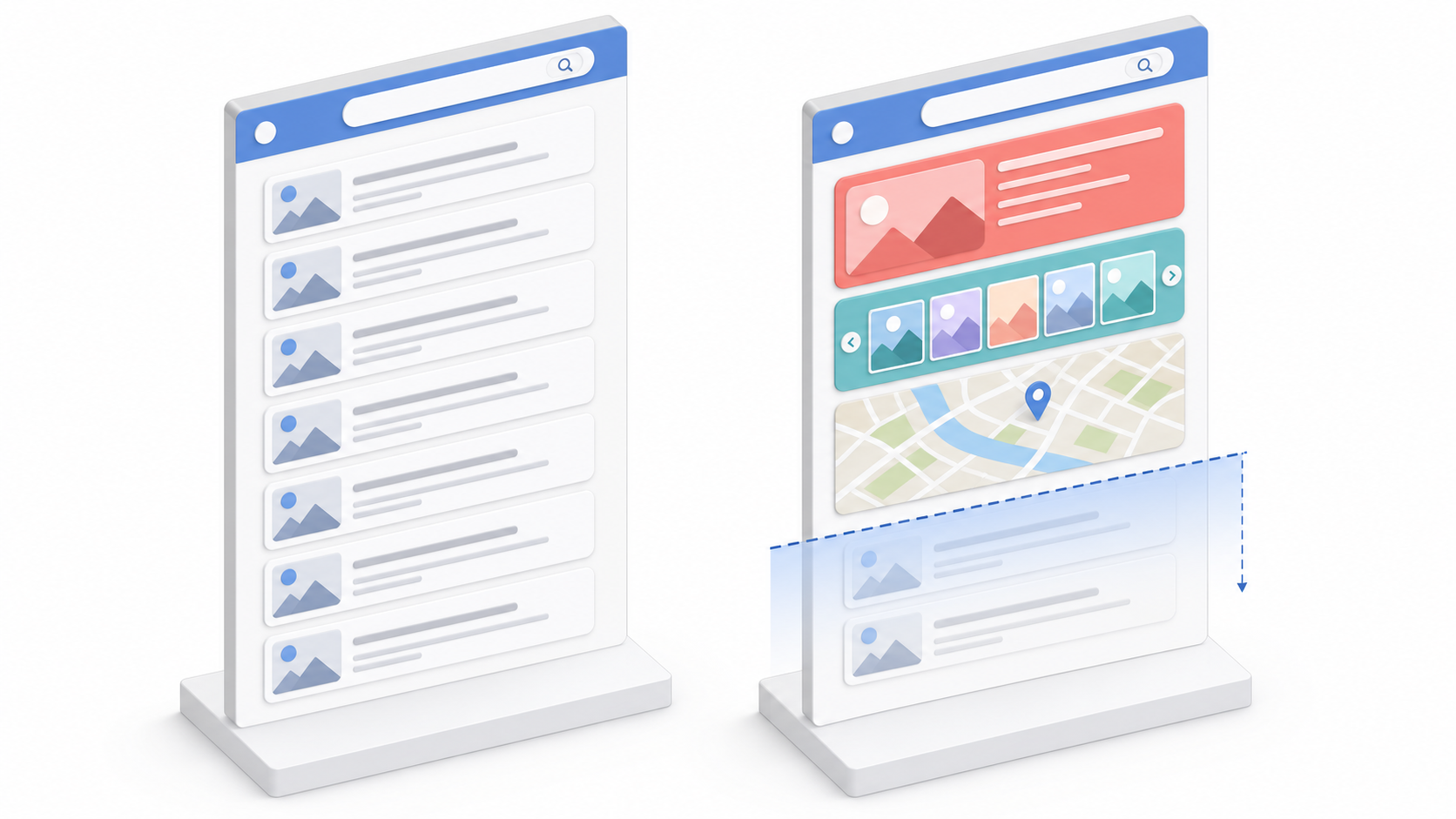
The Search finding is broader than a complaint about which blue link ranks first. Google was found to give its own services greater prominence, including placement at the top of results and the use of enhanced visuals and filters that comparable third-party services did not receive.
That distinction changes what you should measure. A third-party page can retain the same nominal organic position while losing practical visibility because a large Google-owned module occupies the area above it. The reverse can also happen: a new third-party feature or direct link can improve exposure without moving the conventional listing.
Audit the result page in layers rather than reducing it to a rank number:
- Order: Record which component appears first and what sits between the search box and your listing.
- Visual weight: Note images, expanded cards, labels, filters and other treatments that make one service more noticeable than another.
- Destination: Distinguish links that lead into a Google service from links that send the user directly to a third-party provider.
- Interaction: Test what happens after a user selects a filter, card or comparison option. The initial screen is only part of the journey.
- Parity: Compare how equivalent information from Google and third parties is presented, including whether either side receives richer controls or more prominent placement.
This is an SEO observation framework, not a legal test. A screenshot can document treatment, but it cannot by itself establish a DMA breach. If your business is considering a complaint or another legal response, preserve the evidence and have competition counsel assess it against the Commission’s decision.
Build a baseline that can survive a search redesign

Do not wait for traffic to move before documenting the current experience. By then, you may know that performance changed without knowing whether the cause was a new interface, a conventional ranking movement, demand, seasonality or something on your own site.
Create a query set around the verticals named in the finding: shopping, hotels, transport and sports. Include the commercial searches that matter to your business, then add a comparison group of queries where Google-owned vertical features are absent or less central. Keep market, language, device type and other test conditions consistent so that you are comparing like with like.
For each observation, store:
- The exact query, market, language, device type and observation time.
- A full-page capture showing the order and size of major result components.
- Which components represent Google services, third-party services or conventional organic results.
- The presence of enhanced visuals, comparison controls and filters.
- The number and location of direct links available to third-party sites.
- Your impressions, clicks, click-through rate and average organic position for the same query cohort.
- Engaged visits, conversions or other business outcomes from the affected landing pages.
Annotate the date of a confirmed interface or policy change separately from the date of the fine. This prevents a common analytical error: treating the enforcement announcement as the moment Google’s implementation necessarily reached every user.
When the interface changes, compare the affected cohort with your stable comparison queries. If rankings hold steady but click-through rate changes where Google-owned modules were altered, presentation becomes a stronger explanation. If both groups move together, investigate broader demand, technical or ranking causes before crediting the DMA response.
Change your SEO tactics only when the evidence supports the move
A regulatory order defines the result Google must achieve, not the exact search design it must ship. Google could respond through placement, visual treatment, filters, direct links, eligibility rules or some combination of those elements. Build for credible scenarios, but do not bet your roadmap on one speculative layout.
- Protect technical eligibility. Keep important pages crawlable and indexable, use accurate canonical signals, and maintain relevant structured data or feeds. These measures do not guarantee feature inclusion, but prevent avoidable technical defects from obscuring whether access has changed.
- Make comparable information explicit. If a result could be filtered by price, location, availability, category or another material attribute, represent that information consistently on the page and in supported machine-readable formats. A new third-party filter is of little value if your data cannot qualify for it.
- Strengthen the destination. A direct third-party link only helps when the landing page immediately satisfies the query. Align the page title, visible heading, primary information and conversion path with the specific search intent you are monitoring.
- Watch click paths, not just inclusion. Being displayed inside a feature is not equivalent to receiving a visit. Record whether users can reach your site directly, must pass through another Google screen or are encouraged to complete the task without leaving the result page.
- Require repeatable evidence before major edits. Do not delete useful pages, rebuild templates or change information architecture because of an isolated result-page test. Confirm that the treatment persists under controlled conditions and that it affects performance before making a costly or difficult-to-reverse change.
If third-party services begin receiving more direct links or comparable visual treatment, prioritize data accuracy, landing-page quality and measurement of the new referral paths. If no visible change appears in your sample, continue collecting evidence. Absence from your tracked queries does not prove that Google has made no changes elsewhere, while one unusual result does not prove that broad compliance has arrived.
Keep the Google Play finding out of your search diagnosis
The €430 million Google Play fine addresses a separate restriction. Google prevented app developers from freely communicating and promoting offers, and from concluding contracts with users through distribution channels of their choice, including third-party app stores. Google may receive a fee for facilitating an initial customer acquisition through Play, but the Commission found that the steering-related fee level and charging period went beyond DMA compliance.
If you operate an app, route that issue to the people responsible for distribution contracts, checkout paths, customer acquisition economics and developer communications. Keep their implementation log separate from the SEO change log. A revised external-offer flow could affect app revenue or attribution, but it is not evidence that Google Search changed how a web page ranks or appears.
Your next move is simple: capture the current European search experience for the queries that matter, preserve the underlying performance data, and wait for a confirmed implementation before changing strategy. The teams that can distinguish a ranking movement from a presentation change will be able to act while everyone else is still arguing about what the fine was supposed to do.
Leave a Reply