AI search is reshaping how SEO visibility is understood. It can often overlook high-ranking brands in buyer answers, urging us to refocus our strategies. Our mission as link builders is to optimize the sources AI systems use to retrieve and cite information.
Link building has evolved significantly over the years. Traditionally, visibility was measured by keywords, rankings, links, and click-through traffic. Although these metrics are still crucial, their influence, especially at the top of the funnel, has diminished.
There’s a seismic shift in how prospective customers resolve their issues. Today, buyers no longer compress their queries into keywords. Instead, they interact with AI systems using natural language, providing context to make informed decisions tailored to their needs.
If we ignore this change, we’re in for visibility nightmares that outdated metrics can’t explain. As link builders, our role has always been about more than just accumulating links. We must earn visibility on pages that convert.
Modern link building requires us to focus more closely on decision-making, understanding what buyers need, ensuring the information’s existence, and discerning which sources AI can trust and utilize.
That’s why our focus should shift towards citation optimization.
AI search changes the landscape of SEO visibility. Top-of-the-funnel strategies are still relevant, but they don’t yield the same impact as before. Ranking for key topics remains beneficial, as does maintaining visibility in searches and sources AI systems refer to for decision-stage prompts.
Core SEO principles such as creating useful content, fostering trusted references, establishing authority, maintaining source consistency, ensuring clarity, and building strong links still matter. However, the traditional process has weakened.
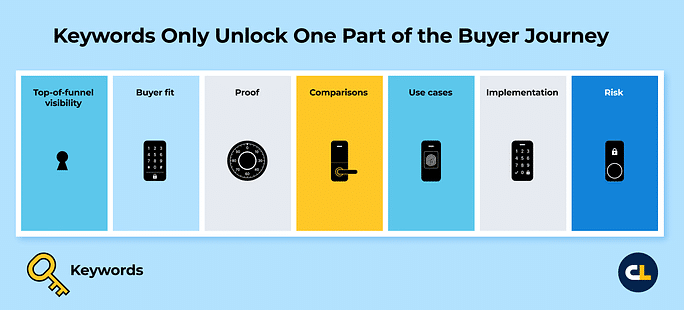
We’ve built an entire SEO model around keywords, but they were always simplified representations of real problems. People had to translate their questions, constraints, fears, or decisions into keywords to use search.
AI changes this behavior. People ask questions naturally, add context, and describe their problems, what they know, and their obstacles. Although simple, this represents a significant mental shift for SEO teams—from focusing on keyword rankings to assisting people in solving problems.
Citation optimization involves guiding AI systems to useful source material for decisions rather than simply adding another link.
AI makes visible the questions buyers once asked sales directly. We’ve observed enterprises with vast search visibility still missing in critical AI-driven buyer queries.
Massive keyword searches and site traffic don’t guarantee presence in these AI-centric answers, as more focused questions tie closely to buyer pain points and services. Competitors often appear instead.
Google’s AI Mode may not recognize some brands due to a lack of context necessary to confidently recommend them for specific buyer questions.
These aren’t traditional keyword questions. They’re deeper buyer-side queries typically surfacing during sales interactions, aiming for clarification on fit, use cases, proof points, and implementation, traditionally held in sales reps’ knowledge.
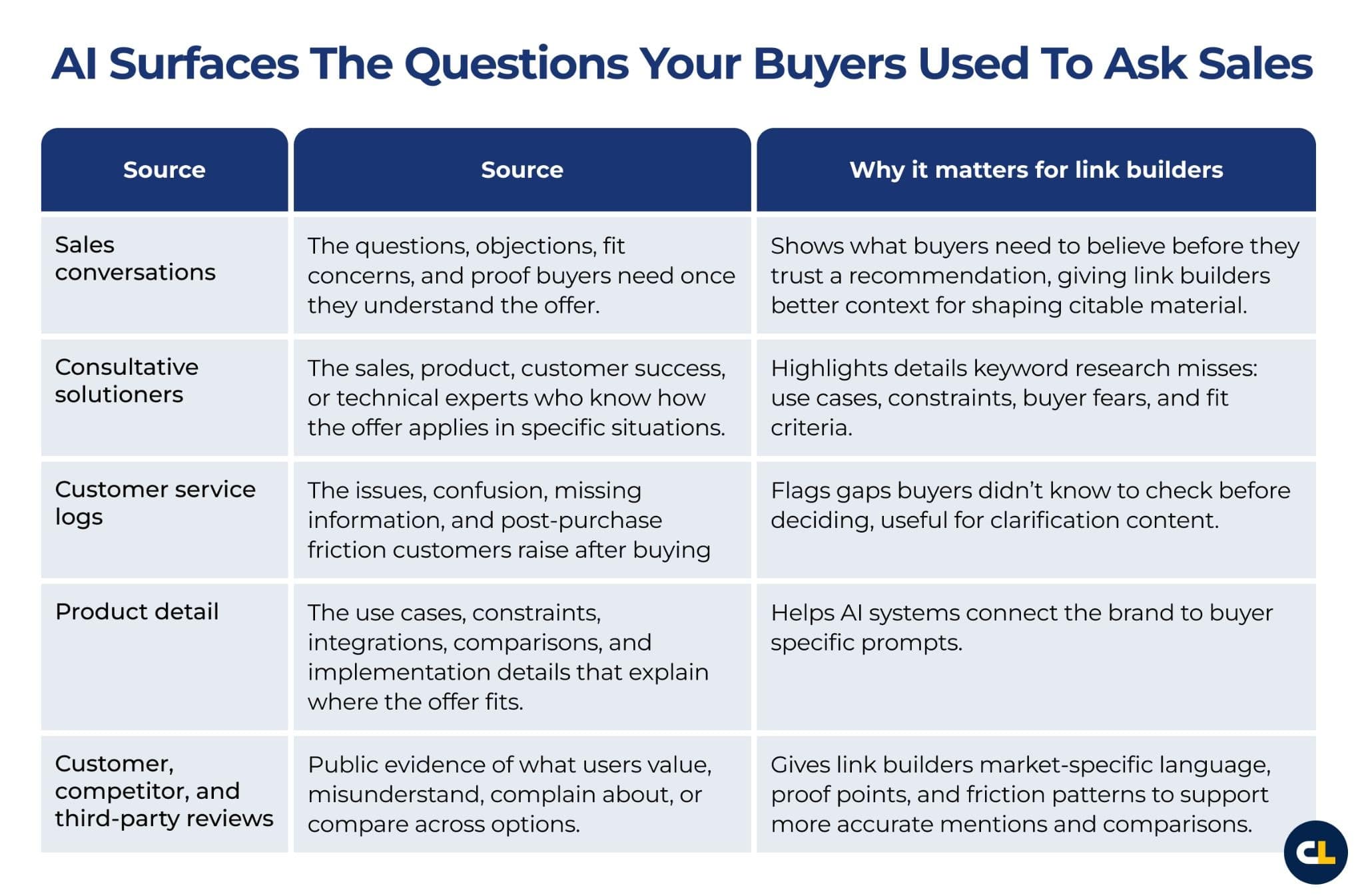
Nowadays, buyers conduct this research independently when narrowing down options, confirmed by our recent behavioral study.
As link builders, it’s our responsibility to extract this valuable information from within our organizations, posting it where AI tools are likely to source answers, not just focusing on backlinks.
This necessitates access to essential sales and implementation diagnostics insights.
When these questions arise, simply covering keywords isn’t enough. It showcases demand but doesn’t highlight necessary buyer trust elements nor uncover unasked questions (known as FLUQs) essential for decision-level information AI systems require.
AI systems need materials to answer buyer questions. Tracking BOFU prompts lets us examine these surfaces.
Direct prompt data remains inaccessible, but synthetic prompts can reflect real buyer intent, guiding insight without treating single rundowns as conclusive.
We must begin by considering what sources AI systems access when responding to buyer problems.
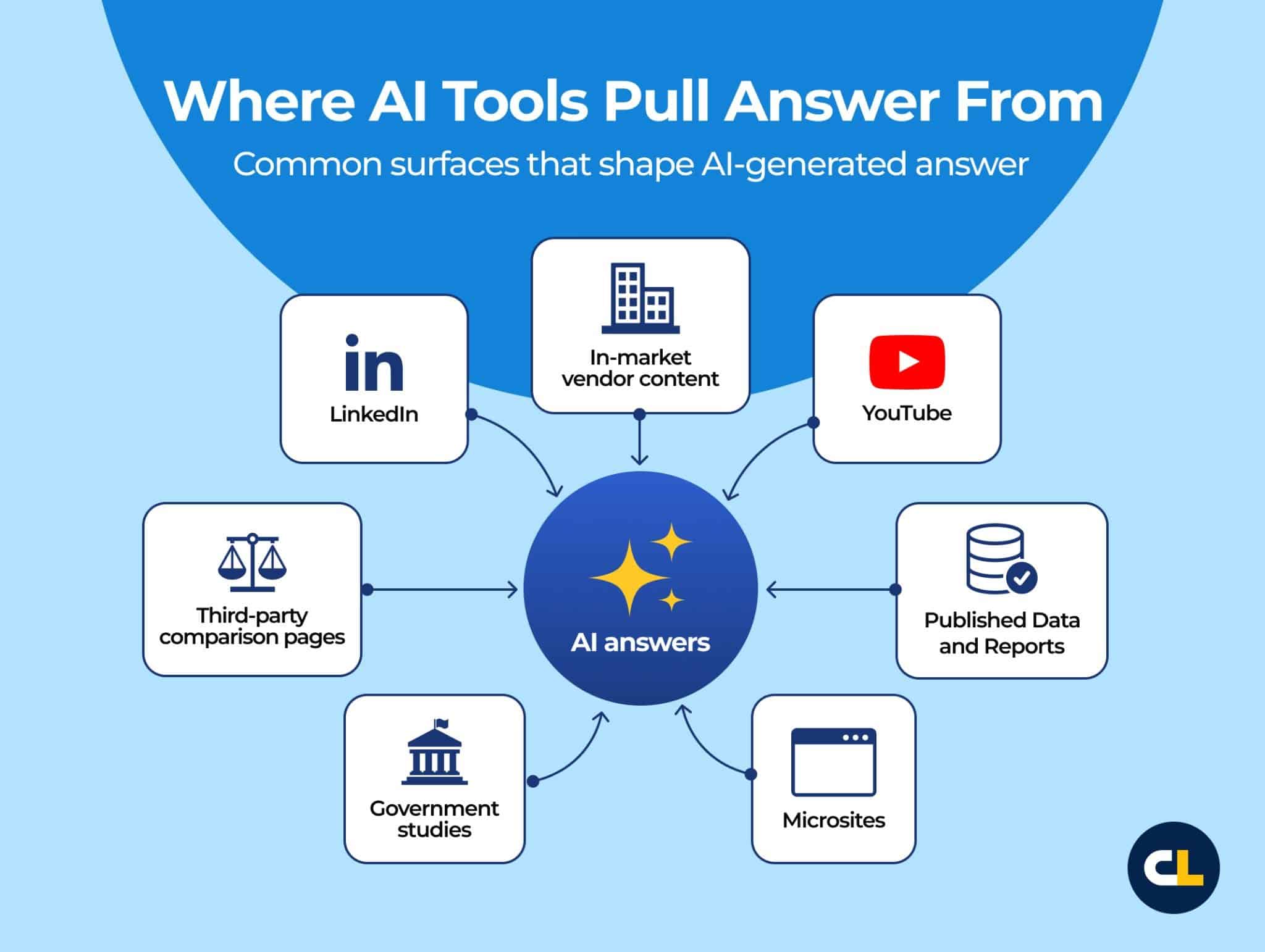
This changes link-building strategy. We assess cited pages in AI responses asking if they provide detailed, accurate answers:
- Do they explain the offer?
- Do they compare options?
- Do they outline use cases?
- Do they provide proof?
The source mix varies by prompt, industry, and intent. At the funnel’s bottom, AI tools often cite LinkedIn, YouTube, third-party comparison pages, microsites, and competitive or vendor content.
AI systems work with what they can swiftly access, requiring page content prepared for easy consumption, like tables or comparisons.
Our job is to earn not just links, but to enhance material AI systems reference, aiding their brand decisions.
Don’t over-analyze a single prompt. Track multiple prompts for recurring gaps. If a brand is visibly missing from valuable prompt categories, that gap signals an area to investigate.
Citation optimization involves identifying influential pages and websites and ensuring they properly mention your offering to boost brand visibility and accuracy within AI context.
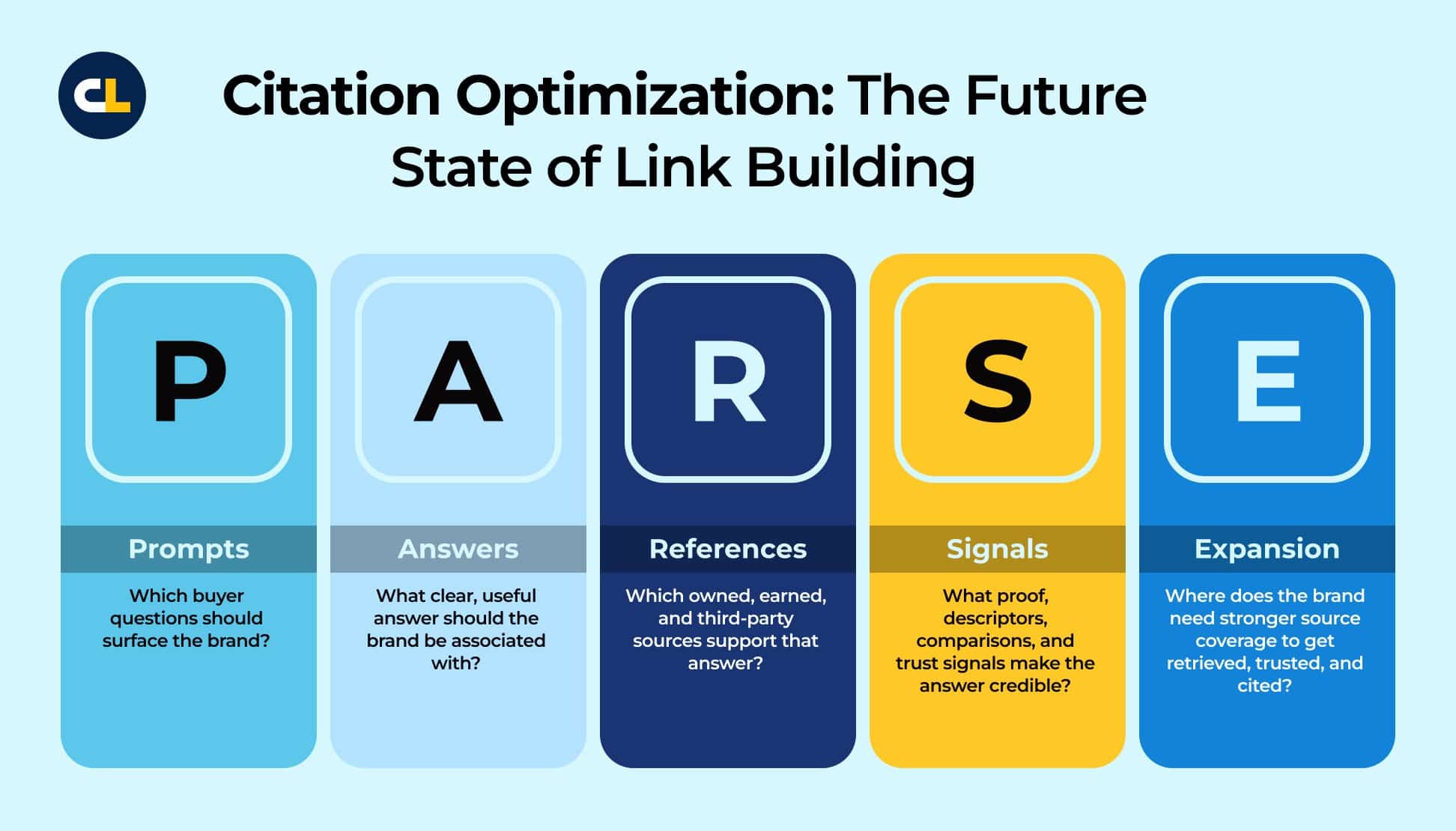
Remember PARSE: Source-led research starting points for SEOs and link builders. Track relevant unbranded prompts, identify repeatedly cited pages and domains, and review them closely.
Questions to consider:
- What sources shape the answer?
- Which pages compare options?
- Which provide a table, list, or framework AI systems can utilize?
- Which omit your brand while mentioning competitors?
- Where are you mentioned without enough context?
This approach produces a richer target list beyond mere backlinks. It’s about refining material AI might use to identify brand presence in an answer.
Incorporate your brand into cited pages, enriching existing mentions, or improving thin comparisons with clearer ones, adding tables, graphics, or explanations to create more valuable content chunks.
Links remain important but aren’t standalone solutions. You need more than anchor text; contextual material surrounding it is critical for AI understanding, forming effective citations.
Whether you’re managing link-building internally or with partners, seek more than just a backlink. Ask for comprehensive anchor context, including insights into the offer, use cases, beneficiaries, and reasons for its place in the AI-driven answer.
This marks the first step from traditional link building to the realm of citation optimization, enhancing both search and AI visibility.
Inspired by this post on Search Engine Land.

Leave a Reply