
Have you ever wondered if your Google Ads attribution window is truly representing how your customers purchase? That’s a question I faced when working with one of my clients, a direct-to-consumer (DTC) retailer in a fiercely competitive industry.
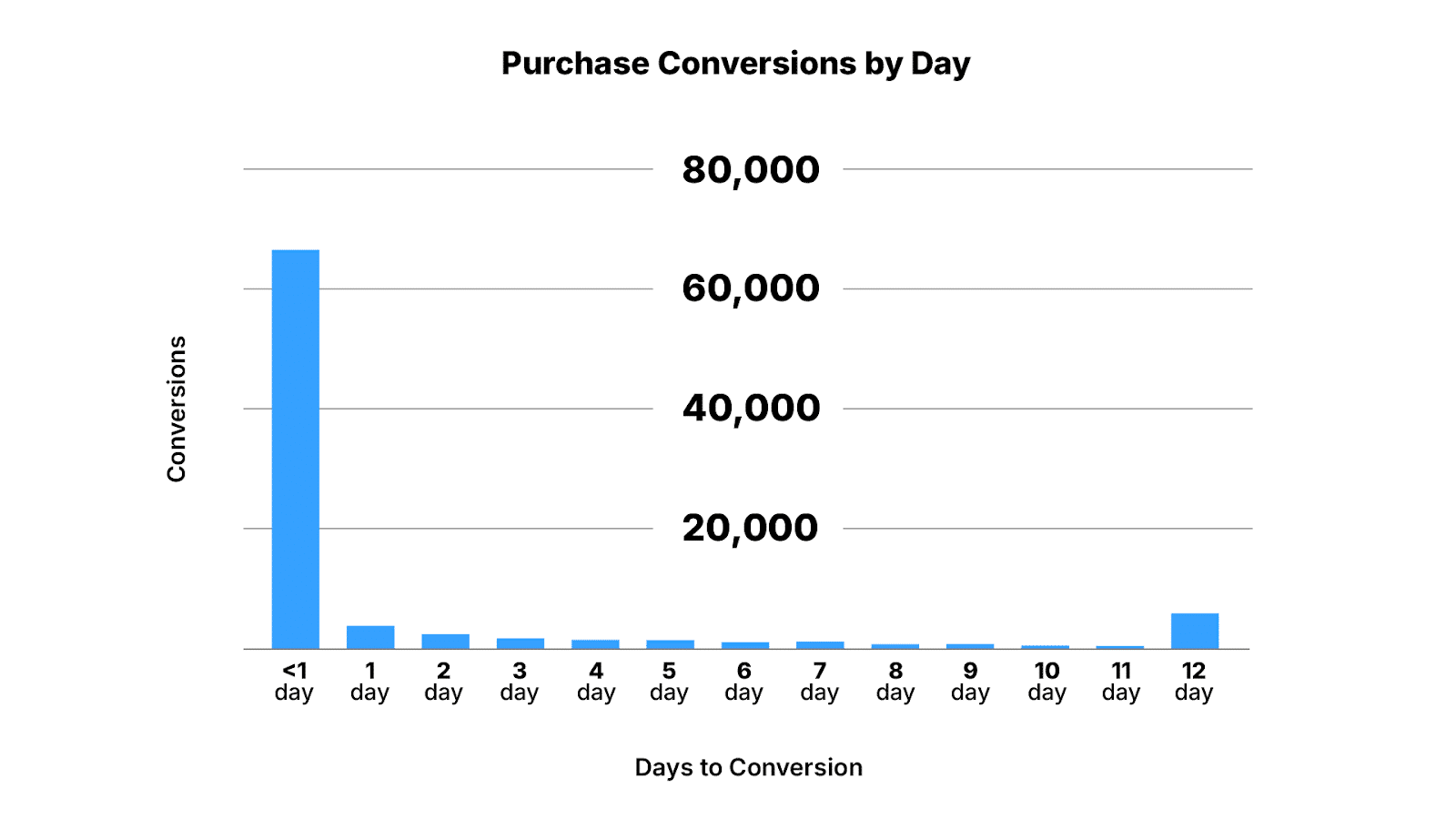
At first, we used the default 30-day click attribution window in Google Ads. But as I discovered, my client’s customers typically converted within 2.2 days. This discrepancy meant that many conversions were mistakenly credited long after the initial interaction.
I realized that to capture the genuine impact of our advertising efforts, particularly the impulse-buying behavior, we needed a shorter attribution window. So, in January, we transitioned the account from a 30-day to a 7-day click window. Here’s what we found.
Our main focus was on Meta Ads, the primary recipient of the marketing budget. With both Meta and Google Ads reporting high sales due to the initial 30-day window, it was challenging to assess where advertising dollars were best spent.
Before making any changes, I delved into the conversion path data, which revealed that customers converted on average in just 2.2 days. A sizable portion of these conversions occurred within a single day.
Rather than abruptly altering our primary conversion action, we decided to carefully test by setting up a new 7-day conversion as a secondary action. This cautious approach helped us monitor any disruptions.
The process went as follows:
- Step 1: We duplicated the primary purchase conversion, setting a 7-day click window as a secondary conversion action.
- Step 2: We monitored performance over two weeks.
- Step 3: We transitioned to primary optimization on January 12, 2026.
Let’s see what happened after we made this change. By comparing data 30 days post-switch to a previous period, we observed changes and improvements.
Results:
- Spend decreased by 6.3%.
- Conversions rose by 42.9%.
- Conversion value increased by 52.1%.
- ROAS jumped by 62.3%.
The signs were promising, but I still wanted to check the actual business impact. Examining Shopify sales data, I found a 20% increase in total sales and a 30% increase in net profit.
Our Marketing Mix Modeling (MMM) data revealed:
- Google’s incremental ROAS improved by 10% to 1.82.
- Meta’s incremental ROAS fell by 25% to 0.59.
Clearly, the 7-day window gave us better clarity on channel contribution. But I must admit, we were also refining campaigns, which contributed to these outcomes. Still, performance remained stable, and transparency increased.
With Google’s window shortened, we successfully limited overlap with Meta, which had previously been capturing credits for conversions likely influenced by other channels. It’s now easier to gauge the incremental impact of our efforts.

The quicker attribution provided faster insights into campaign performance, tightening feedback loops for optimization. Here’s how we benefited:
- Reduced delayed attribution.
- Enhanced feedback loops for optimization.
- Improved performance diagnostics.
This shift also affected Smart Bidding by providing fresher signals for bid strategies, enabling the system to respond quicker to changes like bid adjustments and budget shifts.
I found that a cleaner attribution structure built stronger confidence for campaign optimizations, helping my client make smarter investments.
Ultimately, while not a miracle solution, this adjusted approach significantly complemented other campaign enhancements, improving overall strategy.
Do consider potential trade-offs if you plan to shorten your attribution window like this. Be prepared for an initial dip in reported conversions and a recalibrating phase for smart bidding. Most importantly, ensure this approach aligns with your sales cycle.
In summary, the core objective wasn’t merely updating platform metrics. It was about improving insights and facilitating well-informed decisions. The right solution depends on the congruence between your attribution settings and actual buying behaviors.
Inspired by this post on Search Engine Land.

Leave a Reply