
Your Google Business Profile is accurate, your location page is live, and you rank for at least some local searches. The uncomfortable question is what happens when a potential customer asks Google an open-ended local question and receives an AI-generated answer instead of a familiar list of links.
The practical response is not to chase a separate set of AI keywords. Make your business identity easy to verify, keep every important fact consistent, and publish enough location-specific information for an answer system to understand when your business is relevant. That work supports local packs, conventional results, AI Overviews, and other AI-assisted discovery without betting your strategy on one interface.
Local AI visibility starts with a resolvable business identity
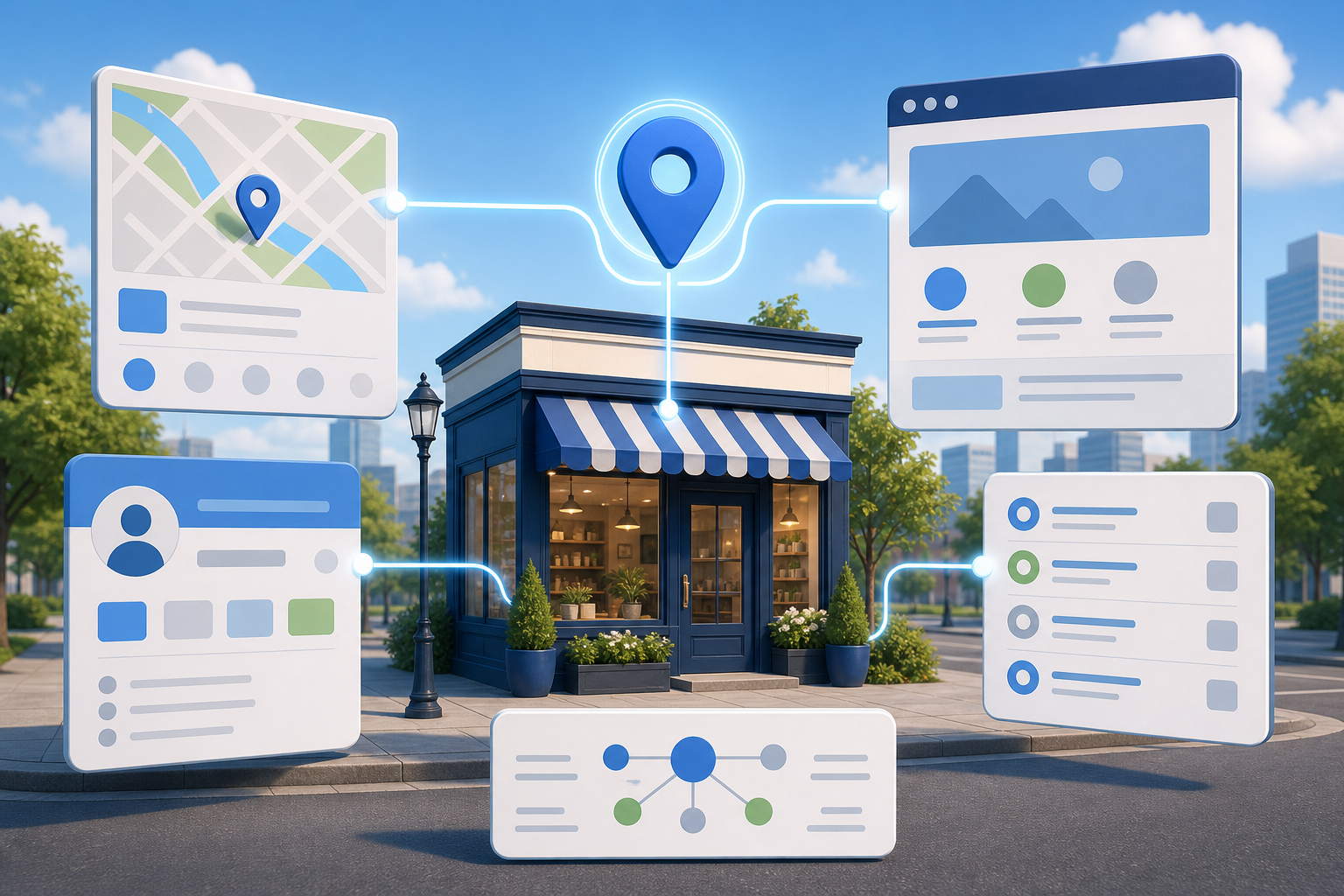
Google does not have to rely on one page or database to decide what your business is. It can compare on-page content, site structure, Google Business Profile data, citations, reviews, and schema markup. Agreement among those signals gives the system a coherent entity to work with. Contradictions force it to choose between competing versions of your name, location, hours, services, or status.
That distinction matters because local AI optimization is not simply another ranking exercise. A system may need to establish that your business exists, determine where it operates, understand what it offers, and decide whether the evidence is strong enough to include in an answer. Schema can make facts explicit, but it cannot turn conflicting information into reliable information.
You should also avoid treating every Google AI experience as the same destination. Google Search is oriented toward information, engagement, and connections to the web, while Gemini is positioned more as an assistant for productivity and creation. Those products share technology but follow different objectives, and their eventual degree of convergence remains unsettled. Build facts that can travel across systems instead of optimizing around a guessed interface.
Key takeaways
- Treat local visibility as an entity-confidence problem before treating it as a content-volume problem.
- Create one approved record of your business name, location, contact details, hours, services, and service area.
- Make visible page content, Google Business Profile data, citations, reviews, internal links, and structured data tell the same story.
- Use schema to confirm facts that people can also see on the page, not to introduce a more convenient version of the business.
- Measure factual accuracy and visibility separately across standard search, local results, AI Overviews, and Gemini.
Write a canonical local fact sheet before editing schema
Most consistency problems begin inside the business. The website owner has one phone number, the operations team has another, and an old directory still lists the number used before a move. A schema plugin then reproduces whichever version happened to be entered during setup.
Create a canonical fact sheet for each location. This is an internal operating record, not marketing copy. Give one person or team responsibility for approving changes, then use the record whenever you update the website, profiles, directory listings, or structured data.
- Identity: Record the customer-facing business name, the most accurate primary business category, and a short factual description of the operation.
- Location: Distinguish a staffed customer-facing location from an office, headquarters, mailing address, or service area. Do not let one address imply a function it does not have.
- Contact details: Choose the public phone number, canonical location-page URL, and any official appointment or enquiry URL.
- Availability: Record normal operating hours and identify services that follow different schedules. If customers can visit only by appointment, say so in visible language.
- Offerings: Use the service names customers will see on the website and confirm which location actually provides each one.
- Geographic scope: List the areas the business genuinely serves. Keep a service area distinct from an address and from places you merely hope to target.
- Official profiles: Maintain the URLs of the Google Business Profile and other profiles that clearly represent the same business entity.
Resolve ambiguity instead of encoding it
A fact sheet is useful only if it contains decisions. If the storefront sign, website header, and profile use different names, do not copy all three into different schema fields. Decide which customer-facing identity is correct, determine whether the alternatives still serve a legitimate purpose, and plan a coordinated correction.
Apply the same discipline after a relocation, rebrand, acquisition, phone-system change, or adjustment to opening hours. Old information is not harmless just because it appears on a low-priority page. It can still create another version of the entity for machines and customers to reconcile.
Do not place aspirational claims on the fact sheet. A city you want to enter is not yet a service area. A service you plan to launch is not an available offering. A shared building is not evidence of a customer-facing branch. Structured data should describe the operation customers can actually use.
Align every place Google can compare
Once the canonical record is approved, audit the surfaces that can confirm or contradict it. Work from high-consequence identity facts down to descriptive enhancements. A wrong address, closed status, or phone number can block a customer journey; a less-than-perfect description usually does not deserve priority over those failures.
| Signal | What to inspect | Common conflict | Corrective action |
|---|---|---|---|
| Visible website content | Header, footer, contact page, location page, service pages, and booking instructions | The footer shows current hours while an old contact page shows a previous schedule | Update the reusable template and every page that states the fact |
| Internal links and site structure | Navigation, location finders, breadcrumbs, service links, and XML sitemap entries | Current pages still point to a retired location URL | Link to the canonical live location page and remove obsolete paths from normal navigation |
| Google Business Profile | Name, category, address or service area, phone, hours, website URL, and listed services | The profile and website describe different operating scopes | Correct the underlying business record, then update both surfaces from it |
| Citations and directories | Prominent industry, regional, and customer-facing listings | An old brand, address, or phone number remains active | Correct the profiles most likely to be encountered or reused, keeping the same canonical facts |
| Reviews and reputation context | Recent customer language and references to a location, brand, or service | Customers continue to refer to a former name or location | Do not rewrite customer reviews; clarify the transition on properties the business controls |
| Structured data | Rendered JSON-LD, not only the fields displayed in a plugin dashboard | A theme or second plugin emits an outdated duplicate business entity | Fix the generating component and leave one coherent representation of each entity |
Do not turn consistency into a demand that every description be word-for-word identical. A directory may need a short category label while a service page needs a detailed explanation. The facts must agree even when the wording and level of detail differ.
Audit from the customer’s point of view as well as the database owner’s. If one page says a branch is open but its booking link offers no way to select that branch, the site is making two operational claims. Fix the journey, not just the sentence.
Use LocalBusiness schema as a confirmation layer
LocalBusiness structured data converts important business facts into explicit relationships and properties. Its value is clarity: it can help a machine distinguish the entity’s name from a page heading, the business address from a publisher address, and the location URL from a general site URL. In AI-assisted local search, that clarity helps reduce uncertainty about who the business is, what it does, and where it operates.
It is not a private channel for claims that the visible page cannot support. If the page says the office closes at one time and openingHoursSpecification says another, the markup has created a conflict. If areaServed lists places the page never discusses and the business does not genuinely serve, the markup is not providing stronger optimization; it is weakening the integrity of the entity record.
- Use the most specific LocalBusiness subtype that accurately represents the business. Specificity is useful only when it is true.
- Give each real location a stable page URL and a stable
@idso repeated references can point to the same entity. - Match
name,url,telephone, address details, and opening hours to the approved record and visible page. - Add
areaServedonly for genuine service coverage. Do not use it as a list of geographic keywords. - Use
sameAsfor official profiles that represent the same entity, not for any page that happens to mention the business. - Include only properties your team can keep current. More markup creates more maintenance obligations.
- Inspect the rendered output after theme, plugin, template, or location-data changes. A correct admin form does not prove that the live page emits one correct graph.
Keep multi-location entities separate
A multi-location organization should not collapse every branch into one ambiguous local entity. Give each genuine location its own visible facts and structured-data identity, then connect it to the parent organization where that relationship is accurate. This lets a system answer a local question with the appropriate branch instead of inheriting a headquarters address, organization-wide phone number, or service that is unavailable locally.
The same caution applies to practitioners operating inside a larger business. Represent a practitioner, department, location, and parent organization as distinct entities when they are distinct in the real world. Do not merge them merely because one plugin form is easier to complete.
No schema property guarantees a local ranking, an AI citation, or inclusion in an AI Overview. The useful test is narrower: does the markup make the correct business easier to identify without disagreeing with the rest of the web presence?
Create answerable local pages, then keep them synchronized

Consistency helps a system trust a fact, but it does not establish relevance to every local question. Your location pages must also explain the decisions customers are trying to make. A page containing only a business name, map, phone number, and generic brand copy identifies a place but says little about why that place fits a particular need.
Write for local decisions
Start the page with a plain statement of what the location provides and where it provides it. Then answer the questions that materially change whether someone can use the business.
- Which services are available at this location, and which are not?
- Is the address a place customers can visit, or does the business travel to them?
- What geographic area does the team actually serve?
- Are there appointment, access, delivery, or availability conditions a customer needs to know before acting?
- What should a customer do next: call, book, request a quote, visit, or choose another location?
- Which page provides the best supporting detail for each important service?
Use internal links to connect a location to the services genuinely available there, and connect service pages back to the appropriate locations. That structure gives people a usable path and gives machines a clearer relationship between the organization, its branches, and its offerings.
Avoid manufacturing near-identical city pages that change only a place name. They repeat a target phrase without adding evidence about local availability. If you cannot state what is operationally different or specifically useful for a location, strengthen the primary service-area or location page instead of multiplying weak pages.
Use a change protocol
Local information drifts when operational changes are handled as one-off edits. Treat every change to a name, address, phone number, schedule, service, location status, or service area as a coordinated release.
- Approve the new fact in the canonical record and note when it becomes effective.
- Update the visible website content, including reusable headers, footers, contact modules, and booking instructions.
- Update the structured-data generator and inspect the JSON-LD rendered on the live page.
- Update the corresponding Google Business Profile fields.
- Correct important citations and official profiles that still expose the previous fact.
- Check internal links, redirects, sitemap entries, and location finders if a URL or location status changed.
- Record what was changed so a later audit can distinguish an overlooked property from a system that has not yet reflected the update.
Measure each discovery surface separately. For standard search, local results, AI Overviews, and Gemini, record whether the business appears, whether the displayed facts are correct, which page or profile is surfaced, and whether the result offers a usable next action. A correct answer with no visibility is a relevance problem. Visibility with the wrong hours or location is an entity-accuracy problem. Those failures need different fixes.
Begin with one commercially important location and one service customers regularly seek there. Approve its fact sheet, compare every major signal, repair the highest-consequence conflict, and only then expand the process across the rest of the business. That gives you a repeatable local AI visibility system rather than another markup project that goes stale after launch.
References
- Search Engine Land — Exploring Google’s Vision: The Future of Search and Gemini
- Search Engine Land — Boost Local SEO with Schema: Enhance Your Visibility
Leave a Reply