
I’ve noticed something puzzling in my local business performance lately. Despite high rankings, the number of calls and website visits from Google Business Profiles seems to be dropping at an alarming rate.
This disconnect is becoming increasingly common in local search. Rankings are stable, but visibility and customer engagement are not keeping pace.
The alligator of local SEO, if you will, has made its presence known.
The visibility crisis behind stable rankings
I’ve observed that across various U.S. industries, the familiar local 3-packs are often getting replaced or supplemented by AI-run local packs. These new formats differ significantly from the traditional map results many of us are used to optimizing.
According to Sterling Sky’s analysis of Google Business Profiles, a startling pattern emerges. Clicks-to-call are taking a nosedive, particularly for law firms managed by Jepto.
When AI-powered packs take over, the landscape changes notably in four key areas:
- Shrinking real estate: AI packs frequently display only two businesses instead of the usual three.
- Missing call buttons: The summaries generated by AI often omit the instant click-to-call functionality, complicating the customer’s journey.
- Different businesses appear: Companies featured in AI packs do not necessarily align with those in the traditional 3-pack.
- Accelerated monetization of local search: The presence of paid ads increasingly results in the loss of direct call and website buttons in traditional 3-packs, thereby reducing opportunities for organic conversion.
There’s an additional challenge compounding this issue:

- Measurement blind spots: Most rank trackers have yet to account for AI local packs. A business may hold a top spot in a traditional 3-pack that users rarely encounter.
In 2026, AI local packs surfaced only 32% as many unique businesses as traditional map packs, according to Sterling Sky. Astonishingly, in 88% of the 322 markets examined, the total number of visible businesses plummeted.
Meanwhile, paid ads are steadily claiming the space that once belonged to organic results, marking a clear transition toward a pay-to-play environment in local search.
What Google Business Profile data shows
This trend is echoed in the U.S., where Google is proactively testing new local formats, as indicated by data from GMBapi.com. Increased impressions from traditional 3-packs are being nudged out by:
- AI-powered local packs.
- Paid placements inside traditional map packs: Sponsored listings now appear adjacent to or within the map pack, relegating organic results and removing essential call and website buttons. This interrupts organic customer interactions.
- Expanded Google Ads units: Even Local Services Ads are consuming space that once granted organic visibility.
Impression trends continue to vary due to seasonal factors, market disparities, and occasional API glitches. Nevertheless, a clearer picture emerges by focusing on GBP actions rather than mere impressions.
Mentions within AI-generated results still count as impressions, even if they no longer convert into calls, clicks, or visits.
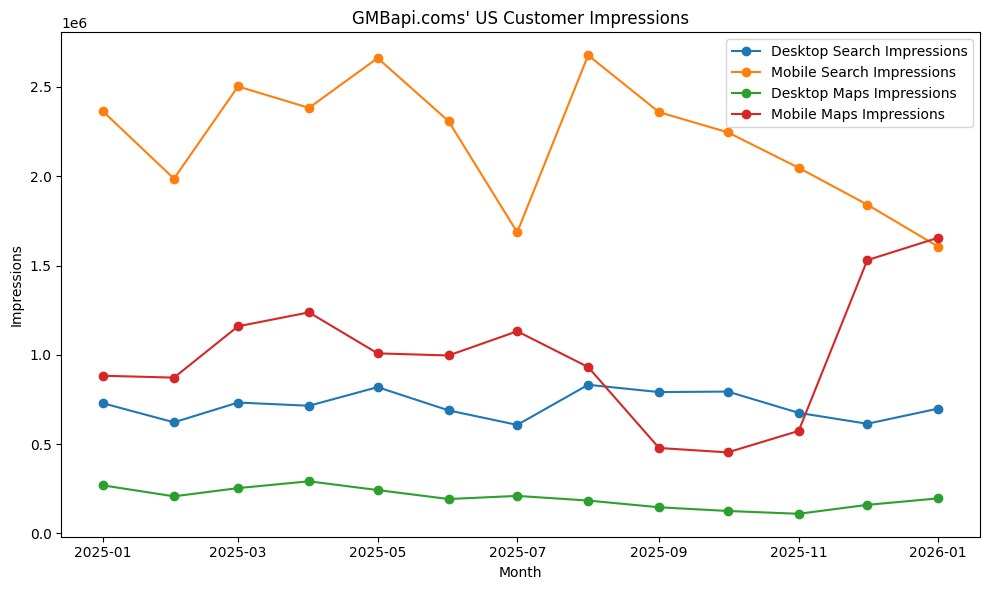
External factors, such as known Google API issues in June, also contribute to these fluctuations. Additionally, the spike in Google Ads investment by significant advertisers towards year-end heavily affects Mobile Maps impressions.
Currently, there’s no method to differentiate these impressions by Google Ads, organic results, or AI Mode.
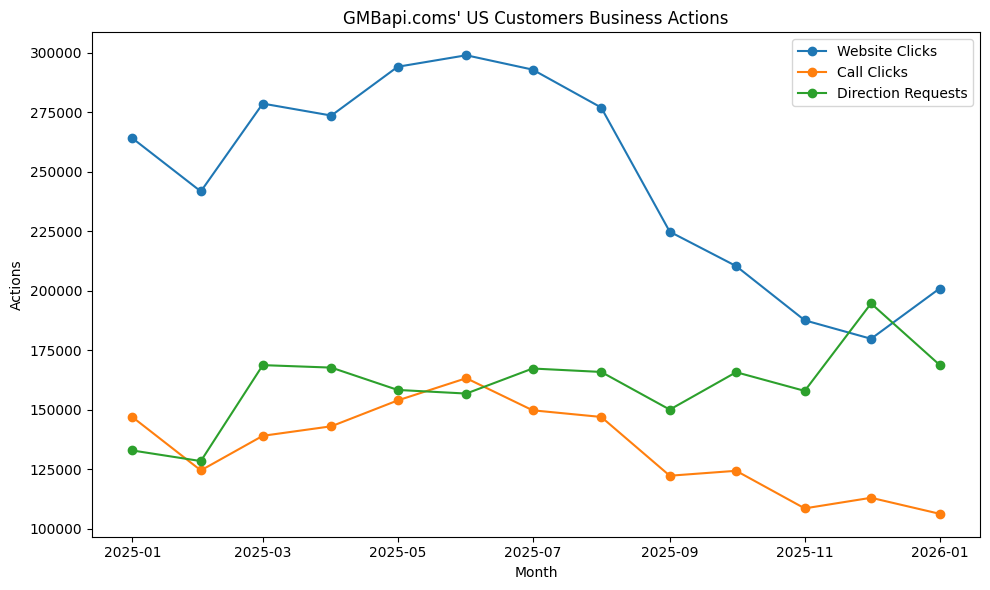
Despite these challenges, user behavior is undeniably shifting. Interaction rates are dwindling, with fewer direct actions taken from local listings.
Year-on-year data from the U.S. indicates that while impression losses remain moderate and somewhat seasonal, GBP actions are disproportionately affected.
In contrast, data from the Dutch market, where SERP experiments are limited, shows far more stable action trends.
The evidence is clear. AI-driven SERP alterations, increasing Google Ads, and the removal of call and website buttons from the Map Pack are eroding organic real estate. Despite appearances, businesses have fewer opportunities to convert visibility into actual user actions.
Local SEO is becoming an eligibility problem
Traditionally, local optimization focused on key ranking factors like proximity, relevance, prominence, reviews, citations, and engagement.

There’s now an additional layer to consider: eligibility.
Some businesses find themselves absent in AI-powered local results not due to a lack of authority, but because Google’s systems deem them inadequate for the specific query context. Research from Yext and experiences shared by experts like Claudia Tomina emphasize the importance of aligning three core signals:
- Business name
- Primary category
- Real-world services and positioning
Misalignment in these areas can prevent businesses from appearing in certain result types, regardless of how well their Google Business Profile is optimized.
How to future-proof local visibility
Navigating today’s zero-click reality involves moving beyond reliance solely on a well-optimized Google Business Profile. Here’s a new playbook for local SEO.
The eligibility gatekeeper
Inclusion in local packs is now influenced more by perceived relevance and classification than by links or review quantity.
Hyper-local entity authority
AI systems rely on platforms like Reddit, social media, forums, and local directories to evaluate if a business is legitimate and active. Inconsistencies across these platforms can erode visibility without any obvious signs.
Visual trust signals
High-quality and frequently updated photos, along with video, are critical. Google’s AI evaluates visual content to gauge services, intent, and categorization.
Embrace the pay-to-play reality
The hard truth is that Google Ads, particularly Local Services Ads, is now essential to retaining prominent call buttons that organic listings are steadily losing. Adopting a hybrid strategy that merges local SEO with paid search is no longer optional but necessary.
What this means for local search now
Local SEO has evolved beyond a simple directory exercise. Google Business Profiles remain central to local discoverability but now exist within a broader ecosystem informed by AI validation, constant SERP changes, and Google’s pursuit of local search monetization.

Visibility no longer depends solely on where your GBP ranks against local rivals. Search engines, including AI-infused SERP features and advanced models like ChatGPT and Gemini, are increasingly focused on understanding a business’s genuine purpose, not merely its listing position.
Success lies in being widely verified, consistently active, and contextually relevant within the AI-visible ecosystem.
Our findings reveal that there is little correlation between businesses ranking well in traditional Map Packs and those prioritized in Google’s AI-generated local answers. This discrepancy offers a real opportunity for businesses willing to adapt.
In essence, this entails blending local input with central management.
Authentic engagement across multiple channels, locally tailored content, and actual community signals are necessary alongside brand governance, data consistency, and operational scale. Businesses deeply ingrained in their community, discussed, recommended, and referenced, both online and offline, find themselves halfway there.
For agencies and brands with multiple locations, the challenge is balancing control with local nuances and ensuring trusted signals extend beyond Google, encompassing Apple Maps, Tripadvisor, Yelp, Reddit, and other pertinent review ecosystems. Producing locally relevant content and citations at scale without losing authenticity is the real test.
Even if rankings appear stable, true performance is occurring elsewhere.
The full data. Local SEO in 2026: Why Your Rankings are Steady but Your Calls are Vanishing
Inspired by this post on Search Engine Land.

Leave a Reply