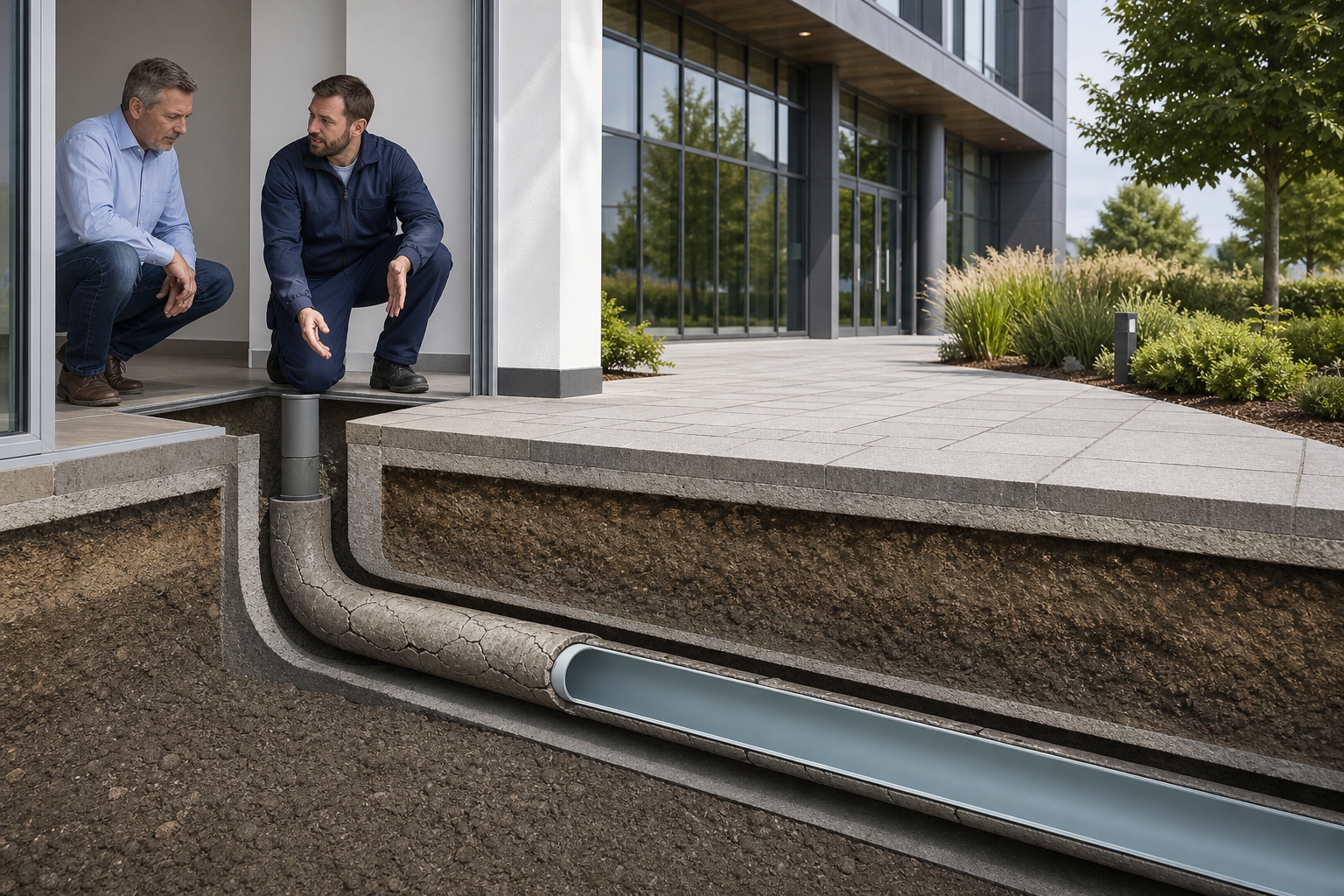
If you run a pipe relining business, your hardest competitor may not be another relining contractor. It may be the assumption that a damaged pipe has to be excavated and replaced. Until you change that assumption, prospects are comparing an unfamiliar solution with a familiar one, and price becomes their shortcut for making the decision.
Market leadership comes from owning the path between the first sign of trouble and a confident repair decision. You have to explain the method, show what is happening inside the customer’s pipe, compare the full consequences of each option, and prove that your company can deliver. That requires a coordinated education, evidence, local SEO, and operational strategy.
Lead the decision process, not just the service category
Many prospective customers do not begin by looking for a Cured-in-Place Pipe contractor. They begin with a symptom, a disruption, or a feared consequence: recurring sewer backups, a deteriorating line under a parking lot, or the possibility that repair will destroy finished surfaces.
This creates an unusual market-leadership opportunity. The contractor that merely promotes relining enters the journey after the buyer has formed an opinion. The contractor that teaches property owners how to understand the failure and evaluate trenchless repair can influence the criteria used to choose a solution.
Map your content and sales process to four decisions the customer must make:
- What is happening? Help the buyer connect symptoms such as recurring backups with the need for an inspection. Do not jump from a symptom to a diagnosis you cannot yet verify.
- What repair methods are available? Explain conventional dig-and-replace and trenchless relining in plain language. Clarify that CIPP rehabilitates an existing line from inside instead of requiring the entire run to be excavated.
- Which method fits this pipe and property? Use inspection evidence, access conditions, disruption risk, surface-restoration requirements, and project constraints to make the recommendation specific.
- Why should this contractor perform the work? Show diagnostic capability, training, completed-project evidence, warranty terms, and experience with the relevant property and regional conditions.
This sequence changes the competitive frame. You are no longer asking a buyer to accept a broad claim that relining is better. You are helping them determine when it is appropriate, what it avoids, and how to verify the expected result. A company that makes those decisions easier can build authority before an estimator arrives.
Audit your current website against the same sequence. If it starts with equipment, company history, or an unsupported superlative, it is starting where your company wants to talk rather than where the buyer needs help. Give the symptom, diagnostic process, available options, and decision criteria priority.
Make inspection evidence the center of the sales process
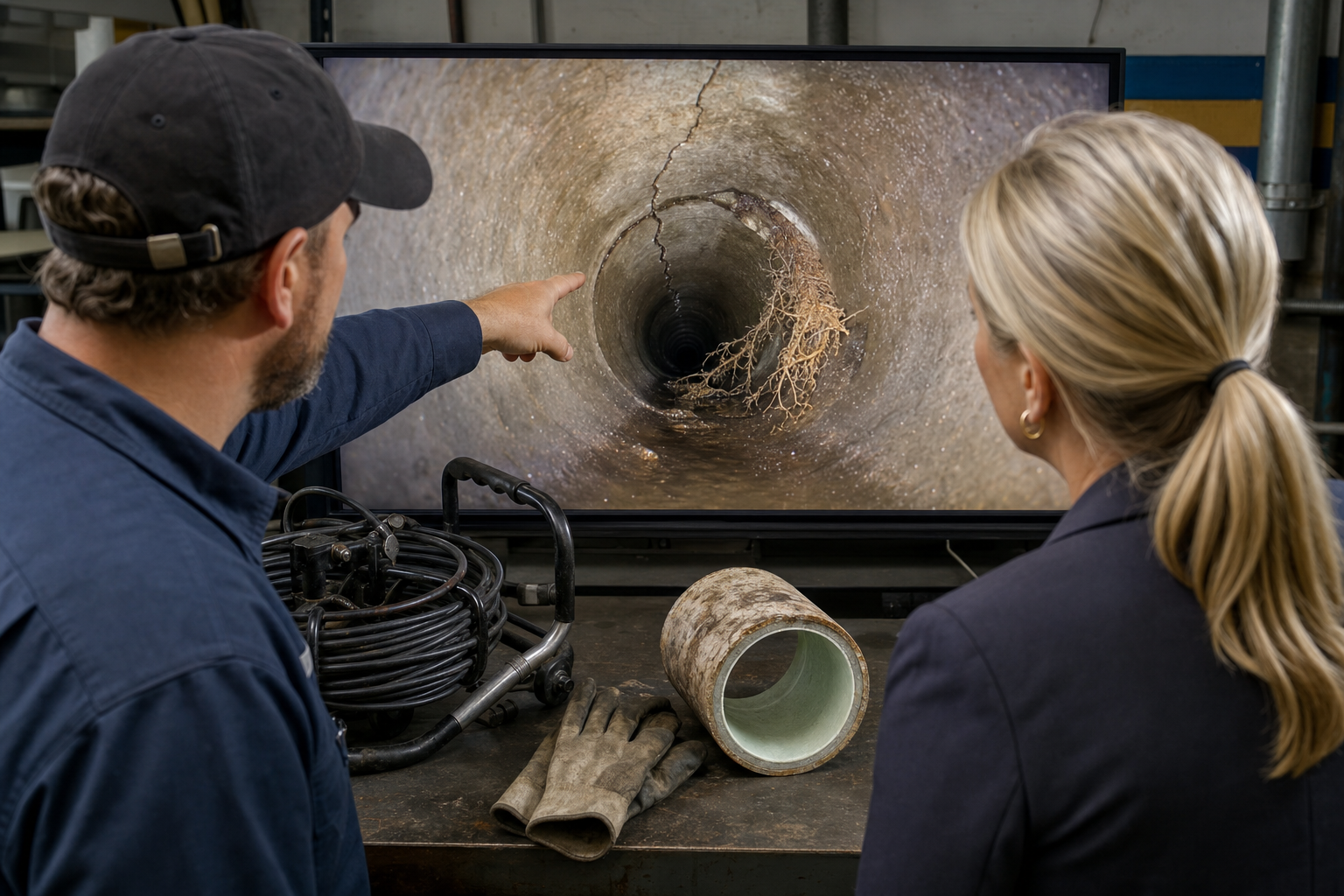
Pipe relining is difficult to evaluate from the surface. That makes video inspection more than a technical step. It is the bridge between an invisible problem and an understandable recommendation.
Show the customer the relevant footage and explain what is directly visible. Identify the location being inspected, describe the observed condition, and separate observation from interpretation. Then connect that evidence to the proposed scope. A generic presentation about CIPP cannot do the job of footage from the buyer’s actual line.
A useful inspection package should answer six questions:
- Which pipe or section was inspected?
- What can be seen in the footage?
- What remains uncertain or outside the inspection’s scope?
- Which repair options are technically plausible?
- What property disruption would each option create?
- What evidence will document the completed work?
The option comparison must also include the complete project consequence. Excavation pricing alone may omit surface restoration and the operational cost of opening landscaped areas, floors, walkways, or parking lots. A relining proposal that discusses only its own contract price makes it harder for the customer to compare the alternatives fairly.
Create a consistent comparison sheet covering the direct repair, excavation, surface restoration, access requirements, expected disruption, warranty coverage, and important exclusions. Use the customer’s known conditions where possible. Mark unknown amounts as unknown rather than quietly treating them as zero.
Pipe Restoration Solutions describes trenchless repair as often costing 40%-60% less than conventional replacement and offering a 50-year warranty. Those are commercially meaningful claims, but they should not be treated as universal industry outcomes. If your company publishes a savings range, document how it was calculated, identify the project types it covers, and state what costs were included. If you advertise a long warranty, give the buyer the actual coverage, exclusions, transfer conditions, and claim process before asking them to rely on the headline term.
This level of qualification does not weaken your message. It makes the message defensible. It also gives search engines, AI answer systems, salespeople, and prospects one consistent version of the claim instead of several incompatible versions scattered across the site.
Build search visibility around the questions before the call
A pipe relining content strategy should follow search intent, not the company’s internal service menu. A facility manager searching for help with recurring sewer backups has a different immediate need from an HOA board member investigating how to repair a sewer line without digging. Sending both to a thin service page forces them to do the diagnostic and comparison work themselves.
Cover the four content clusters that support a decision
- Symptoms and consequences: recurring backups, repeated spot repairs, inaccessible lines, and concern about damage to finished surfaces.
- Methods: what CIPP is, how trenchless relining differs from excavation, what an inspection does, and when relining may not be the appropriate choice.
- Commercial evaluation: total project cost, disruption, access, restoration, schedule considerations, warranty terms, and the evidence a buyer should request.
- Property and regional context: pages that connect the service to actual local conditions, property types, and operational constraints.
Each important page should begin with a direct answer to the query, then add the evidence and qualifications needed to act on it. State who the method may suit, what must be inspected first, which alternatives should be compared, and what the customer should ask a contractor to document. Add a clear next step, such as arranging an inspection, only after the page has earned it.
Case studies should be decision tools rather than galleries. Identify the property context, the problem observed, the diagnostic evidence, the alternatives considered, the chosen scope, and the documented result. Before-and-after footage is especially useful when the same locations or pipe sections can be compared clearly. Obtain any necessary permission before publishing customer, property, or location information.
Localize the diagnosis without fragmenting the brand
Local pages should explain why the service matters in that market. California positioning may need to address root intrusion and seismic concerns, while Florida positioning may need to address corrosive soil, high water tables, and hurricane-related ground shifts. Do not assume every condition applies to every property. Connect a regional issue to the need for inspection instead of presenting geography as a diagnosis.
A credible location page needs more than a swapped city name. Include the service area you can actually cover, relevant local property contexts, market-specific inspection or project evidence, the team or operating capability serving that area, and any constraints that affect delivery. If you cannot support a regional claim with local knowledge or evidence, narrow the claim.
Keep the business name, service description, locations served, warranty wording, and core method explanation consistent across your site and business profiles. Where it accurately represents visible page content, structured data such as LocalBusiness, Service, VideoObject, and FAQPage can make those entities and assets easier for machines to interpret. Markup does not create authority by itself, and it should never describe services, locations, ratings, videos, or questions that the page does not visibly contain.
For AI-search visibility, write answers that can stand on their own without stripping away essential qualifications. Use descriptive headings, name the property and repair context, keep important comparisons in visible text, and place the supporting inspection or project evidence next to the claim it supports. This cannot guarantee that an AI system will cite your page, but it gives that system a clearer, more internally consistent body of information to evaluate.
Turn operational discipline into a defensible authority moat

Marketing cannot sustain a leadership position that operations do not support. The visible authority must come from real diagnostic capability, continuing technical training, consistent project documentation, and repeatable communication with the customer. These practices also produce the raw material that makes your content difficult for a less disciplined competitor to copy.
Build a proof-production loop into the job workflow:
- Capture and label the initial inspection evidence.
- Record the condition, recommendation, alternatives, and scope limitations in consistent language.
- Document the completed project with comparable post-work evidence.
- Obtain permission and remove sensitive details before using customer material publicly.
- Convert suitable projects into case studies, sales examples, local proof, and answers to recurring questions.
- Feed new objections and field observations back into the inspection script, proposal, and website.
The same loop should inform training. If prospects repeatedly misunderstand the cost comparison, update the comparison sheet and the page that attracts those prospects. If salespeople routinely have to explain a warranty exclusion that the website omits, fix the public wording. If local pages attract inquiries outside your operating footprint, clarify the service area rather than allowing lead volume to hide poor fit.
Measure whether the system is becoming more useful, not merely larger. Track the percentage of completed jobs with usable before-and-after documentation, the questions that delay proposals, conversion rates for symptom and comparison pages, inspection-to-proposal progression, proposal outcomes by repair scenario, and leads that fall outside the claimed service area. These measures expose gaps between positioning and delivery.
Market-share claims deserve the same discipline. Terms such as largest, leading, and number one need a defined category, geography, measurement, and time period. Small-diameter pipe relining is not the same category as every form of trenchless infrastructure work. If you cannot define and substantiate the claim, lead with verifiable capabilities and project evidence instead.
Key takeaways and a 90-day execution plan
The practical principles are straightforward:
- Win the category-education decision before trying to win the contractor decision.
- Use inspection footage to connect an invisible problem with a specific recommendation.
- Compare total project consequences, not isolated contract prices.
- Organize content around symptoms, methods, commercial evaluation, and local context.
- Qualify savings, warranty, geographic, and leadership claims so they remain defensible.
- Make project documentation part of operations so authority compounds with every suitable job.
You can put the system into motion over the next 90 days without rebuilding everything at once:
- Days 1-30: Audit the path from the first symptom query to the inspection request. Inventory every cost, warranty, coverage, and market-leadership claim. Flag anything that lacks a definition, evidence, or qualification.
- Days 31-60: Standardize the inspection presentation, option-comparison sheet, and before-and-after documentation process. Update one high-intent symptom page and one repair-method comparison page using the same language.
- Days 61-90: Publish one evidence-rich local page for a market you actually serve, add a qualified case study, implement applicable structured data, and measure whether visitors progress to appropriate inspection requests.
Start with the customer journey that produces your most consequential inquiries. Make its diagnosis, comparison, proof, and next step coherent from search result to inspection review. Once that path works, expand the model across services and markets. That is how a pipe relining company turns expertise into a leadership position buyers can see and verify.
Leave a Reply