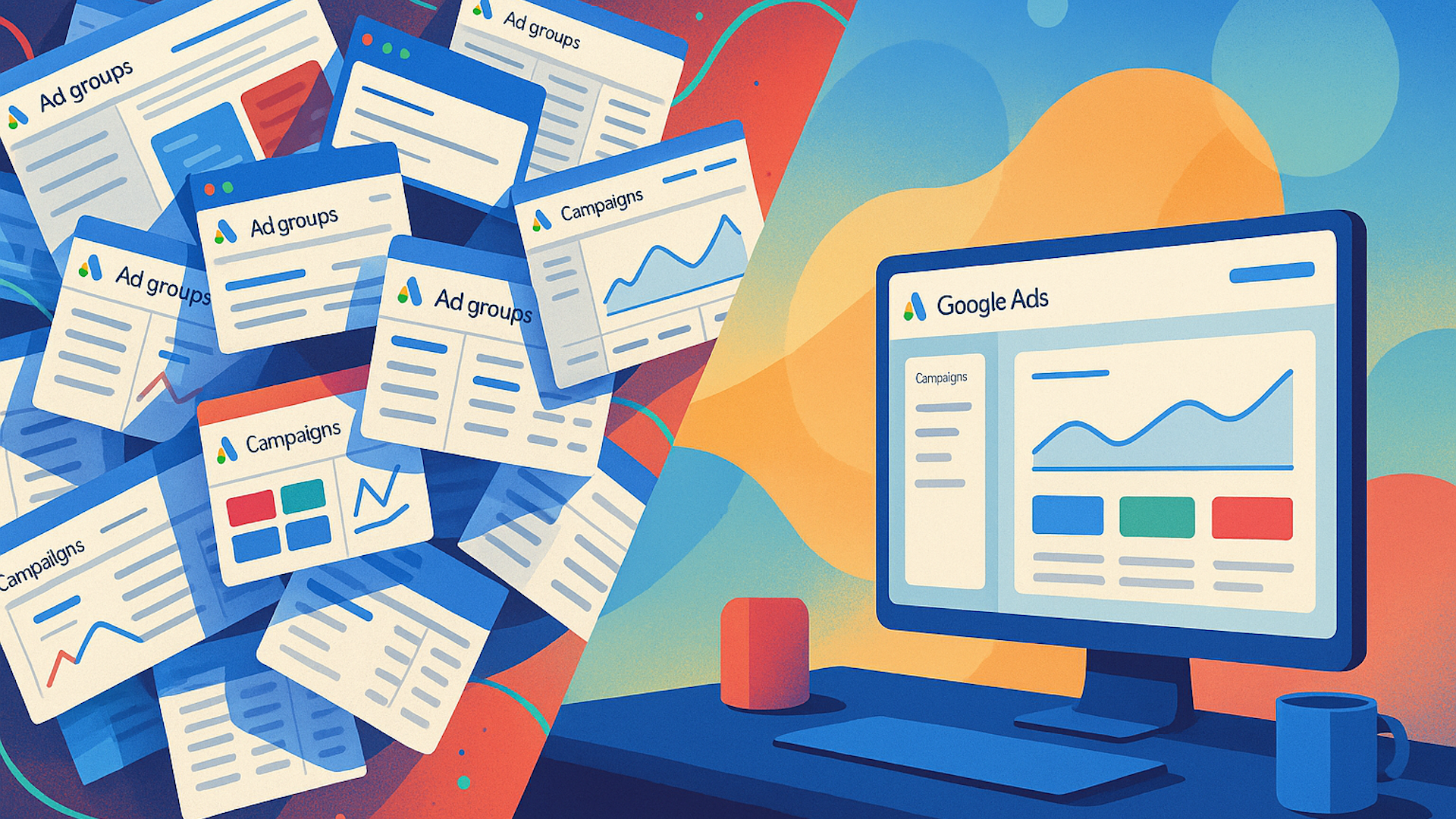
I remember when the Alpha Beta account structure was the gold standard in paid search.
As a PPC marketer, I’ve seen firsthand how we’ve had to adapt to Google’s shift toward automation and AI. We initially tweaked the Alpha Beta structure, built around single keyword ad groups (SKAGs), but eventually, we have had to move away from it completely.
Maintaining and building out SKAGs is no longer ideal for today’s paid search landscape, but transitioning isn’t as simple as flipping a switch.
However, existing SKAGs still contain valuable data and insights that can be carried into a more consolidated setup.
In this article, I’ll explore the benefits of consolidating SKAGs and share best practices for creating a structure that can set your campaigns up for success.
As someone who loves control over my campaigns, I get the allure of SKAGs.
Custom bidding, tailored ad copy, and specific landing pages offer precision that’s hard to relinquish.
The challenge is that “precision” no longer means the same thing it once did.
With Google’s looser match types, gaining control over every query is no longer feasible, even for top-performing ones.
Google now rewards data density and simplified account structures.
The user interface simplifies consolidation, and algorithms improve faster with enhanced data.
While results vary, a modest efficiency lift—around 10%—is achievable with proper consolidation.
Effective control is elsewhere:
- Enhanced conversions.
- Strategic offline conversion tracking (OCT).
- Negative keywords.
- Ad copy with deep user understanding.
Focusing on these areas is a far better use of my team’s time, enhancing tracking and measurement both within Google and across platforms.
Consolidating SKAGs effectively might allow you to avoid the drop in performance typically seen with major account restructures.
In my agency’s experience, consolidating accounts has not led to major negative impacts—but instead, allowed data density to work in our favor.
Dig deeper: When to restructure your Google Ads account – and how to do it right
To make consolidation successful, focus on structuring the balance of data density with control.
Remember, Google’s algorithm favors data density.
Switching from SKAGs to two-keyword ad groups won’t suffice; accounts often need more consolidation.
Over-segmented setups can lead to:
- Inefficient budget allocation.
- Data cannibalization, reduced performance visibility.
- Time-consuming management.
- Inconsistent ad coverage, messaging.
Consolidation saves time, which can be redirected toward higher-impact work, showing real business gains.
In one SaaS account, efficiency in cost per opportunity improved by 6% in the first month and 27% in the second, while maintaining opportunity volume.
These gains are not due to seasonality.
Dig deeper: 7 PPC mistakes hiding in your ad accounts
We’ve also encountered accounts with too many keywords in an ad group, resulting in ads serving irrelevant queries.
Over-consolidating limits insights into performance.
If dissimilar geos are grouped together, visibility into which areas drive growth is lost.
Google finds the easiest path to your goals, which often contradicts your interests.
Avoid clumping brand and non-brand keywords as Google will favor branded queries with lower incremental conversions.
Separate brand and non-brand to make Google work harder to convert new users.
Don’t group products with varying price points; Google will target the cheapest conversions.
Keep products with similar price points together for better performance alignment.
Avoid mixing high- and low-quality keyword leads to maintain high-value ad groups.
Set realistic volume targets and optimize for deep-funnel actions like SQLs or opportunities.
Using negative keywords aggressively helps manage irrelevant query exposure in consolidated ad groups.
Aim for broad coverage to protect budgets from inefficient spend.
The key benefit of consolidation goes beyond performance improvement. Saving time and allowing algorithms to work simplifies the structure and lets us focus on campaign differentiation.
Inspired by this post on Search Engine Land.
Leave a Reply