
When a Google review looks fabricated, your first impulse may be to challenge it in public. Pause. The useful work happens before the reply: preserve the review, identify exactly what makes it suspect, and send the evidence through the reporting route that matches the problem.
If someone is demanding money, goods, services, or another concession in exchange for removing a bad review or stopping more reviews, treat the incident differently from an ordinary rating dispute. Google provides a dedicated reporting form for negative review extortion scams. The workflow below will help you build a clearer case without escalating the situation or making claims you cannot prove.
First decide what kind of review problem you have
Fake is often used as shorthand for any review a business disputes. That is too broad for an effective report. A real customer can be wrong, unfair, confused, or posting under a name you do not recognize. None of those facts automatically proves fabrication.
Classify the incident by its observable features. That determines what evidence to collect and which reporting path to use.
| Situation | What you can verify | Best next step |
|---|---|---|
| Genuine but negative experience | The event, order, booking, or service interaction can be identified, even if you disagree with the account | Respond to the substance and try to resolve the complaint; do not label it fake merely because it is unfavorable |
| Reviewer cannot be matched | The displayed name does not appear in the records you checked | Investigate other names, purchasers, guests, dates, and channels before reporting; treat the mismatch as an indicator, not proof |
| Wrong business or location | The review describes a different company, branch, product, address, or service | Preserve the mismatch and report the review using the closest available reason |
| Fabricated or coordinated activity | Several observable signals align, such as repeated wording, connected demands, implausible details, or a cluster of related profiles | Save every review separately, document the connections, and report the specific reviews |
| Negative review extortion | A message makes a concession conditional on removing a review, changing a rating, or preventing additional reviews | Preserve the complete demand and use the dedicated extortion-reporting route |
The distinction matters most when you cannot find the reviewer in your customer records. A customer may use a nickname, post through a family member’s account, buy through a third party, or complain about an interaction that did not create a normal transaction record. Write down what you searched and what you found. Do not turn an incomplete match into a categorical accusation.
For an extortion report, focus on the conditional exchange rather than trying to prove a legal label. The important fact is that the person connected a demand to the review: provide something, or the review stays, changes, or multiplies.
Build an evidence packet before you report anything

A review can be edited, removed, or separated from the message that explains it. Capture the original context before replying, negotiating, blocking the sender, or asking staff members to report it.
- Preserve the complete review. Save a screenshot showing the review text, rating, displayed reviewer name, review date, and the business profile. Copy the review text and its direct URL when one is available. Avoid a tight crop that removes identifying context.
- Preserve the reviewer profile context. Record the profile URL and the public information visible when you collected it. If other reviews appear relevant, save their URLs and screenshots separately rather than relying on a single composite image.
- Keep demands in their original channel. Retain the original email, text message, direct message, voicemail, or letter. Include sender information and timestamps. If an email service allows you to download the original message, keep that file in addition to a screenshot.
- Create a chronology. List the first contact, the review publication, each demand, any promised consequence, later reviews, and your responses. Record the date, time, and time zone. A simple timeline is easier to evaluate than a folder of unsorted screenshots.
- Document your internal check. Note which booking system, order history, CRM, support inbox, or staff schedule you searched. Record the names, phone numbers, email addresses, reference numbers, locations, and date ranges used. State that no match was found only if that is what the search established.
- Separate observations from conclusions. Repeated wording and close timing are observations. A claim that several profiles are controlled by one person is a conclusion unless you have evidence connecting them. Keep that distinction clear in your submission.
Keep untouched originals in one folder and working copies in another. A practical case folder can contain four subfolders: originals, timeline, submitted evidence, and Google correspondence. Name files with the date, review identifier, and evidence type so another employee can understand the record without reconstructing the incident from memory.
Include only information relevant to the report. Do not publish customer records, private contact details, payment information, or employee data in a public response. If a demand includes credible threats of violence, stalking, disclosure of private information, or continuing fraud, preserve the material and seek appropriate local legal or law-enforcement guidance. A platform review report is not a substitute for responding to an immediate safety risk.
Use the Google reporting path that matches the conduct
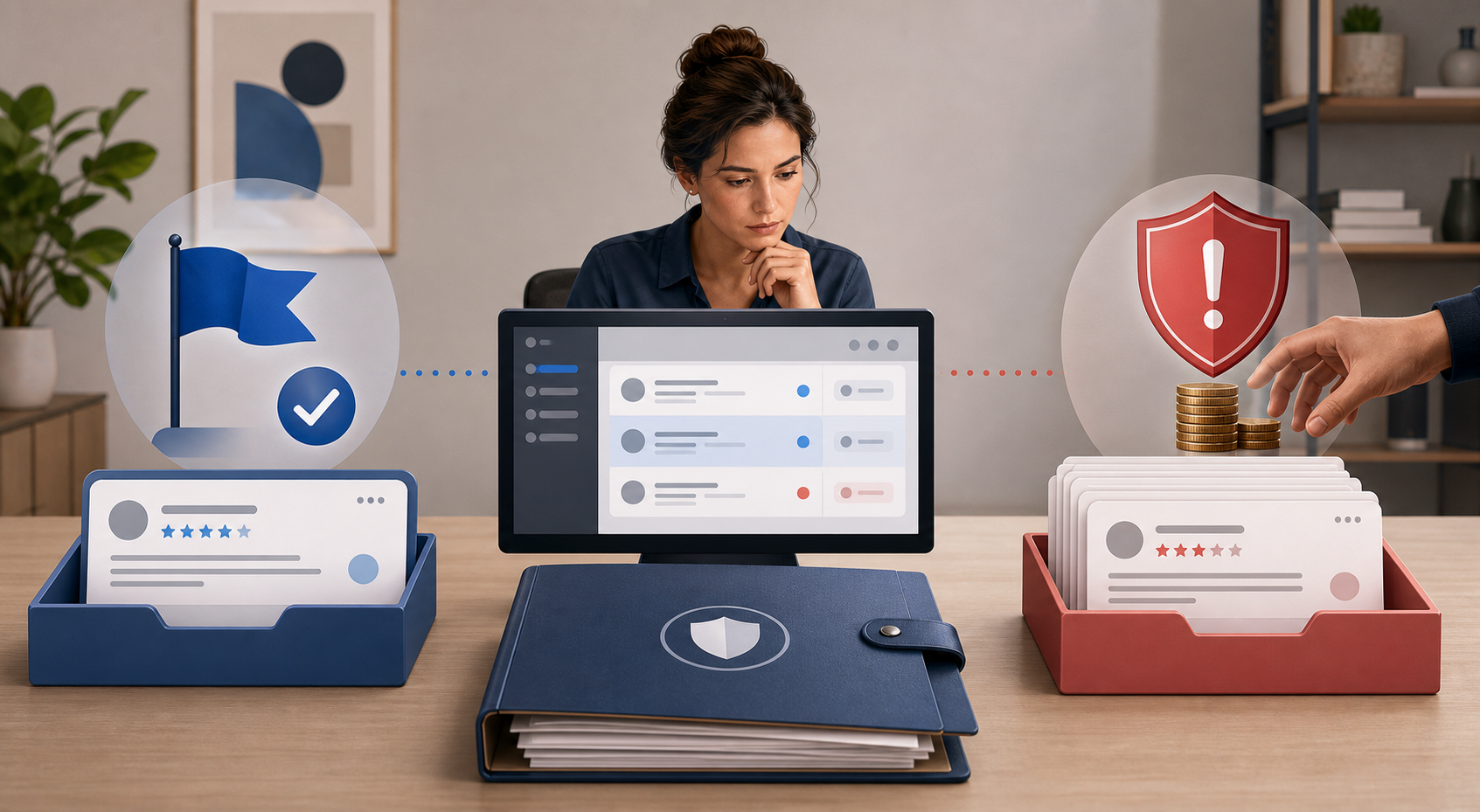
For an ordinary suspected fake or misplaced review
Open the review through the Google Business Profile management surface available to your business and use the review’s report or flag control. Interface wording can change, so choose the available reason that most closely describes the observable problem rather than the outcome you want.
- Confirm that you are reporting the correct review on the correct location profile.
- Select the reason that matches the evidence, such as irrelevant, misplaced, deceptive, or otherwise prohibited content, when that option is available.
- If you receive a field for additional information, explain the specific mismatch in a few factual sentences.
- Save the submission date, confirmation, case number, or other reference Google provides.
- Record the result in your case log and retain the evidence even if the review later disappears.
A useful explanation identifies the contradiction. For example, say that the review describes a service your business does not offer or names an employee who has never worked at that location. A bare statement that the reviewer is not a customer gives the reviewer no context and gives the evaluator little to assess.
For a review tied to an extortion demand
Use the dedicated extortion form and make the conditional demand the center of the submission. Identify the linked review or reviews, then attach the chronology and original communications that connect the demand to them.
Submission template: On [date, time, and time zone], [verifiable account or contact] demanded [specific payment, product, service, refund, or other concession] in exchange for [removing or changing a review, or not posting further reviews]. The linked review or reviews appeared on [dates]. The attached material includes the original messages, review URLs, screenshots, and a chronological timeline. We have retained unedited copies of the originals.
Replace every bracketed field with a fact you can support. If you suspect that a message sender controls a reviewer profile but cannot prove it, describe the connection as suspected and explain why. Do not fill the gap with certainty.
Keep one tracking row for each review, even when several belong to the same incident. Record the review URL, displayed profile, reporting path, submission date, selected reason, case reference, evidence included, current status, and next follow-up date. This prevents a multi-review incident from turning into a series of undocumented reports.
Protect your reputation while the report is pending
Use this sequence whenever possible: preserve the evidence first, submit the report second, and decide on a public reply third. Replying first can alert the sender before you have captured material that may later change or disappear.
If you respond publicly, write for the prospective customer reading the exchange, not for the reviewer you suspect. Keep the reply short, avoid personal information, and offer a verifiable channel through which a genuine customer could identify the transaction.
Public response template: We take complaints seriously, but we cannot match the details in this review to an interaction in our records. Please contact [verified support channel] with the service date, location, and reference number so we can investigate.
Do not publicly call the reviewer a criminal, disclose an alleged payment demand, threaten legal action, or post screenshots containing private information. Those moves can intensify the dispute and create avoidable legal or privacy exposure. When legal counsel is already involved, have counsel review any public statement before it goes live.
Do not organize a counterattack. Employees, friends, and customers should not be directed to argue with the reviewer or flood the profile with defensive ratings. Continue your normal review-request process with real customers, ask for honest feedback without prescribing a rating, and keep the incident response separate from ordinary reputation management.
Assign one case owner. Route new demands, staff questions, Google correspondence, and public replies through that person. During an active incident, set a review-monitoring cadence you can maintain, such as one check each business day. Save new evidence before reporting it, add it to the existing chronology, and tell customer-facing employees not to engage independently.
FAQ about fake Google review reporting
Is a missing customer record enough to prove a review is fake?
No. It is a reason to investigate, not proof by itself. Search alternate names, purchasers, guests, phone numbers, email addresses, locations, booking channels, and the date range implied by the review. Report the facts you can verify and avoid claiming more.
Should you reply before reporting the review?
Usually, preserve the review and connected evidence first, submit the appropriate report, and then consider a neutral public reply. If the incident includes credible threats, private information, or an active legal matter, get appropriate advice before responding publicly.
Can you use the extortion form for every suspected fake review?
No. The distinguishing feature is a demand tied to the review or the threat of further reviews. Use the normal review-reporting control for suspected spam, fabricated experiences, irrelevant content, or reviews posted to the wrong business when no conditional demand exists.
What should you do if Google does not remove the review?
Do not promise your team or client a removal date. Keep the case log, retain the original evidence, and use any follow-up or appeal option presented in your review-management interface. Add genuinely new evidence instead of repeatedly submitting the same assertion. Maintain a measured public response and continue collecting legitimate customer feedback. If threats, impersonation, fraud, or harassment continue outside the review platform, seek help through the channel appropriate to that conduct.
Start with the evidence you can preserve now: the complete review, its URL, the reviewer profile, and any connected demand. Build the chronology before the incident grows. Once the facts are organized, the choice becomes straightforward: use the ordinary review-reporting control for a suspected fake or misplaced review, and the dedicated form when a conditional demand turns the incident into negative review extortion.
Leave a Reply