I’ve discovered that images aren’t just for human eyes anymore—they are parsed like language by AI. With Optical Character Recognition (OCR), visual context, and pixel-level quality shaping how AI systems interpret content, the game of Image SEO has changed.
For years, Image SEO was all about technical best practices: compressing JPEGs for speedy loading, writing alt text for accessibility, and using lazy loading to enhance page performance. These remain crucial, yet now we must also cater to the needs of advanced multimodal AI models like ChatGPT and Gemini, which present both opportunities and challenges.
Multimodal search embeds diverse content forms into a unified vector space. We are learning to optimize for what I call the “machine gaze.” Generative search technology makes content largely machine-readable by segmenting media and extracting text from visuals via OCR.
It is essential for machine vision to clearly parse images. Low quality or poorly contrasted text on product packaging can lead to misinterpretation or completely missed content by AI systems—a significant problem.
This discussion explores the crucial aspect of improving machine readability, shifting focus from loading speeds to quality and interpretability of images.
Technical hygiene still matters
Before diving into optimization for machine comprehension, I make sure to respect the fundamentals: performance. Images are powerful tools for engagement but can also cause layout issues and slow speeds if not managed properly.
Designing for the machine eye: Pixel-level readability
Large language models view images, audio, and videos as structured data sources. Through visual tokenization, an image is divided into a grid of visual tokens, turning raw pixels into vector sequences.
Poor resolution or compression artifacts can degrade token quality, leading to errors where the AI misreads images or invents details that aren’t there. Ensuring clarity and quality is critical for accurate interpretation.
Reframing alt text as grounding
In today’s context, alt text offers critical grounding for large language models. It provides semantic cues that help the model discern ambiguous visual tokens, improving image interpretation accuracy.
The OCR failure points audit
Technologies like Google Lens and Gemini rely on OCR to read text directly from images, including labels. However, small or low-contrast text often fails this machine gaze.
Character height should be optimized to at least 30 pixels for OCR, and contrast should be clear to prevent errors in text reading. Stylized fonts and reflective packaging can exacerbate these problems.
Originality as a proxy for experience and effort
Original images are vital, serving as canonical signals that enhance page authenticity and origin credibility. Using tools like Google Cloud Vision’s WebDetection can help track duplicate content and boost your visual content’s scoring.
The co-occurrence audit
AI systems analyze the objects in images and their relationships, using these cues to infer brand attributes and audience engagement signals. This makes product placement in images crucial for SEO success.
Tools like Google’s OBJECT_LOCALIZATION feature allow you to audit your media library’s visual entities and ensure that adjacent objects tell the right story to support your brand’s narrative.
Quantifying emotional resonance
Images not only showcase products; they evoke emotions. AI can now quantify these emotions in images, making emotional alignment critical to image SEO.
Tools like Google Cloud Vision provide insight into emotion scores for faceAnnotations, allowing for content adjustments based on detected sentiment to better align with intended search queries.
Closing the semantic gap between pixels and meaning
Images should be curated with intent and precision, given that language models treat them as part of the language sequence. The quality and semantic accuracy of images are as vital as textual content for SEO success.
Today, I came across an intriguing development where Google has initiated legal proceedings against SerpApi. This lawsuit revolves around allegations that SerpApi has been bypassing Google’s security systems to scrape and resell copyrighted content from search results.
The Allegations: According to Google, SerpApi has:
Circumvented the security measures and standard crawling controls Google has in place.
Ignored directives from websites that specify content accessibility.
Employed techniques such as cloaking, rotating bot identities, and large bot networks to scrape vast amounts of content.
Appropriated licensed content from search features such as images and real-time data, subsequently selling it for profit.
Google’s Stance: Describing SerpApi’s actions as “brazen” and “unlawful,” Google expressed concerns over how stealthy scrapers like SerpApi override crawling directives, stripping sites of their choices. Alarmingly, Google noted a significant increase in SerpApi’s activities over the last year.
Quick Update: Interestingly, Google’s lawsuit mirrors similar legal action by Reddit, which also targeted SerpApi, Perplexity, Oxylabs, and AWMProxy. Reddit accused them of scraping content via Google Search results and concealing their identities to evade restrictions.
Reddit has licensing agreements with Google and OpenAI, suspecting other entities of attempting to bypass these deals.
They reportedly set a “trap” post, visible only to Google’s crawler, which eventually surfaced in Perplexity’s results as proof of scraping.
SerpApi’s Previous Statements: In defense, SerpApi has maintained that “public search data should be accessible,” viewing its actions as protected by the First Amendment. They also warned that lawsuits like the one from Reddit could endanger the “free and open web.”
Why It Matters to Me: Should Google triumph in this case, acquiring reliable SERP data might become increasingly challenging and costly. This could particularly impact teams reliant on services like SerpApi, as they navigate the complexities of understanding search results, performance metrics, and achieving success in an evolving digital landscape.
I’ve delved into a fascinating exploration of the U.S. and global market presence of two internet giants: Google and ChatGPT. By leveraging a combination of client analytics, third-party usage data, and anonymized user logs, our team crafted a model to gauge metrics like monthly active users, engagement time, and the share of total digital queries.
While Google remains the stalwart champion of online search, ChatGPT’s explosive growth has redefined what’s possible in search tasks, especially in areas requiring long-form conversations and creative input.
This report offers a comprehensive quantitative comparison of these platforms, beginning with an overview of their market shares. As we progress, we’ll examine how usage breaks down by device type, demographic segments, and user intent.
Google vs ChatGPT Market Share
The table below details the digital query market shares of Google and ChatGPT by the end of Q4 2025.
Google vs ChatGPT Market Share – Q4 2025
Platform
Monthly Active Users (Global)
Share of Total Digital Queries
Avg. Session Duration
Google Search
5 billion
77.9%
6m 12s
ChatGPT
858 million
17.1%
13m 09s
Other (e.g., Bing, Perplexity)
580 million
5.8%
4m 33s
Key Insights:
Google continues to lead with nearly 80% of global digital queries.
Commanding 17% of the market, ChatGPT is the most formidable competitor Google has seen in over two decades.
Gemini’s latest update has positively impacted market retention, signaling resilience in competition.
Despite fewer users, ChatGPT’s notably longer session times indicate robust user engagement.
Google vs ChatGPT Market Share Over Time
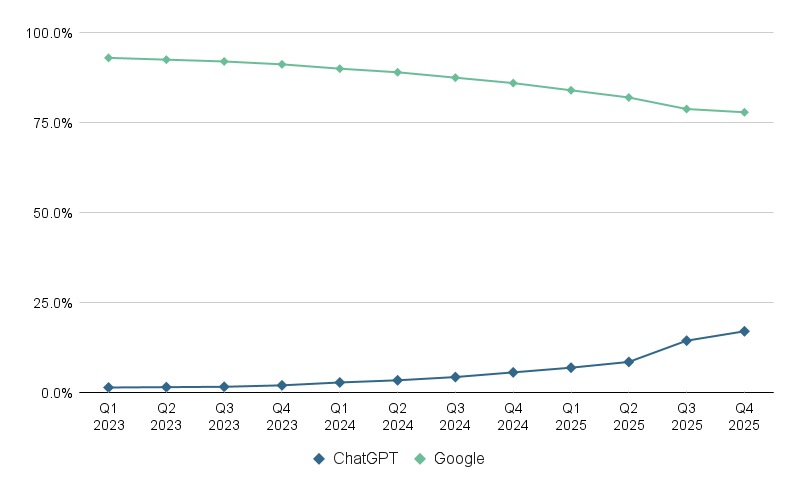
The graph below illustrates the market share trends for Google and ChatGPT from Q1 2023 to Q4 2025.
Google vs ChatGPT Market Share, Q1 2023 – Q4 2025
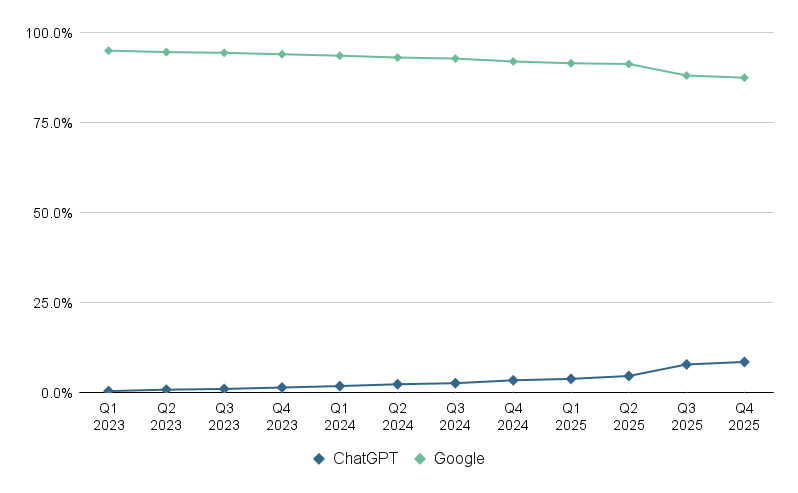
However, when focusing solely on transactional searches, Google’s dominance appears less threatened by ChatGPT.
Google vs ChatGPT Market Share, Transactional Queries Only Q1 2023 – Q4 2025
Market Share by Device Type
The following table shows the usage of Google and ChatGPT across mobile and desktop platforms, highlighting differing user behaviors.
Google vs ChatGPT Market Share by Device Type – 2025
Platform
Desktop Usage Share
Mobile Usage Share
Google Search
37%
63%
ChatGPT
62%
38%
Research Notes:
ChatGPT shows more engagement on desktops, indicating a preference among professionals and researchers.
Google’s design appeals to those on mobile, capturing the casual and on-the-go demographic.
Market Share by Age Group
Below is a breakdown of market share trends segmented by age group.
Google vs ChatGPT Market Share by Age Group – 2025
Age Group
Google Share
ChatGPT Share
13–24
74%
17%
25–44
80%
13%
45–64
86%
8%
65+
89%
5%
Key Takeaways:
Younger audiences lean towards ChatGPT, especially for academic and creative pursuits.
As age increases, Google’s usage aligns with more traditional search preferences.
Market Share by User Intent
Here’s how digital queries are utilized according to intent.
Google vs ChatGPT Market Share by User Intent – 2025
Intent Category
Google Share
ChatGPT Share
Navigational
93%
3%
Informational
71%
23%
Transactional
90%
5%
Generative/Creative
29%
64%
Analysis:
Google dominates in transactional searches due to rich e-commerce and trusted browsing formats in high-stakes scenarios.
ChatGPT excels in creative and generative tasks like storytelling and academic work.
Requesting a Copy of This Report
If you’re interested in a PDF version of this report or wish to learn more about what we do, feel free to reach out here.
First Page Sage Research Study, First Page Sage, June 2025
I’ve been following the significant regulatory move in which the European Commission launched a formal antitrust investigation into Google.
At the heart of this issue is Google’s use of publisher content to develop AI Overviews and other generative AI features, potentially diverting traffic from original publishers.
As someone involved in SEO or content strategy, I’m immediately affected by these developments.
The question I’m pondering is whether Google is overstepping by using publisher content for AI answers, or if it’s just part of being in an open web environment.
With regulators stepping in, I’m seeing the industry reevaluate how we use, manage, and value machine-readable content. It raises questions about the cost to brands, publishers, and agencies if regulation doesn’t catch up with innovation.
Here’s what’s going on, why it’s significant, and how the industry is already responding.
What’s Actually Happening: Core Allegations in the Complaint
This move from the EU is unfolding alongside other legal challenges, like those from publishers taking a stand against OpenAI and Penske Media’s recent antitrust suite targeting Google’s AI offerings.
Many publishers see Google’s actions as a no-choice situation: allow the use of their content for AI, or face losing vital search traffic.
At the same time, I notice how technical tools like robots.txt, Google-Extended, and new noai/nopreview conventions are reflecting an industry that’s striving to reclaim control.
The crux of the issue is whether AI training and answer generation stretch the bounds of traditional indexing and require licensing or proper attribution.
The Big Debate: ‘Google Doesn’t Owe You’ vs. ‘It’s Not Their Content’
I often see the assumption that control of web content lies in our hands.
Yet, without search engines, their reach is quite limited.
This tension fuels an ongoing debate dividing SEO perspectives.
On one side is the belief that ‘Google doesn’t owe you anything’.
Many argue that the web is open, allowing search engines to crawl freely grants implicit permission for content use.
Google facilitates discovery, but clicks or backlinks aren’t guaranteed.
On the flip side, there’s the perspective that ‘It’s not their content’.
Publishers argue against unlicensed use of content for LLM training and AI responses.
They see generation without attribution or compensation as disruptive.
This debate is active across social media and discussion forums.
Some suggest focusing on generative engine optimization, or GEO, replacing traditional rankings with AI quotes.
Nonetheless, that approach keeps publishers reliant on Google’s linking decisions.
In practice, there’s validity to both arguments.
Yet, the broader trend reveals the trajectory.
Even if Google faces consequences, search is unlikely to return solely to blue links.
The zero-click conversion is advancing.
The Dark Future of a Web Without Unique Content
Before diving into potential outcomes of the complaint, consider the impact on information itself.
As creators feel their work is reused without reward, the drive for original content wanes.
Simultaneously, AI-generated content is growing, often with minimal human input.
Entire sites now rely heavily on generative systems for content.
This often involves reworking existing text, with occasional inaccuracies.
As this cycle continues, the risk is declining informational quality due to a lack of truly fresh inputs.
The debate over AI training isn’t just about traffic or monetization.
It questions how the web can sustain unique knowledge creation and why protecting publishers is crucial to prevent information quality degradation.
What Can Happen if Google Loses
The traditional Google-publisher agreement was straightforward: “I let you crawl, you give me clicks.”
Generative AI disrupted this balance.
If the EU finds Google’s actions anticompetitive, we could witness major shifts:
Mandatory opt-out mechanisms: Effective changes could enforce a granular system that protects against AI summaries without sacrificing rankings.
The licensing economy: Following the music industry model, licensing could become compulsory, splitting organic search into free and premium sectors.
AEO formalization: Attribution could be legally required, turning source citations into a ranking factor.
Ads and the Shifting Economics of Visibility
While this primarily concerns AI and content rights, ads still significantly impact SERP dynamics.
As organic space shrinks due to AI summaries, paid ads remain a strong visibility tool.
Even if EU pressures curb AI answers, the space for blue links is unlikely to grow.
The landscape will continue to favor revenue-driven Google products.
If AI Overviews reduce organic visibility, CPCs could rise, affecting ad positions.
Whatever the AI outcome, one truth is apparent: the cost of visibility is on the rise.
How to Adapt Your SEO and Content Strategy
Before any EU decision, I see top teams already shifting their strategies from merely ranking for keywords to ensuring they are the main entity answer wherever an AI model scans.
This involves several key actions:
Enhancing entity clarity with schema and consistent data for accurate AI association.
Auditing brand representation in AI Overviews and tracking emerging visibility KPIs.
Reconsidering robots.txt strategies to manage IP protection versus AI visibility.
Educating leadership that visibility extends beyond traffic, incorporating citation and AI source value.
The strategic goal is remaining readable and rights-conscious while ensuring brand presence where AI answers are most trusted.
From May 2024 to November 2025, I personally delved into research on 57 agencies involved in AI-augmented search optimization. Known as Generative Engine Optimization (GEO) or Answer Engine Optimization (AEO), these agencies offer cutting-edge solutions that redefine visibility. Using a meticulous scoring model, I’ve narrowed it down to the top 8 agencies, which I’m thrilled to share with you today.
In evaluating these firms, I considered several crucial factors:
Location (5%): I regarded the team’s primary base, considering if their operating hours and familiarity with regulations match US fintech needs.
AI Visibility Score (25%): This is a unique measure of how visible the agency and its clients appear on platforms like ChatGPT, Perplexity, and Gemini.
Average Review Score (30%): I aggregated and weighted ratings from key review sites and client testimonials, placing high importance on consistent delivery.
Client Retention Rate (20%): This was calculated based on case studies, testimonials, and relationship maps to estimate loyalty year over year.
Technical Expertise (15%): Focused on the depth of SEO and analytics, emphasizing measurement and how AI-driven discoveries brand surfaces.
Specialty (5%): I noted what each agency excels in, especially those that seamlessly cater to the fintech world—trust, compliance, and more.
After sorting and ranking all the agencies, I proudly present the highest scorers in a detailed table below. Following the table, I provide insightful, qualitative analyses on each agency, enriched by public reviews and testimonials.
I’m excited to share that Semrush has launched the new AI Visibility Awards, highlighting which brands are excelling in AI-generated search results.
As AI chatbots increasingly become our go-to for travel plans and product recommendations, I often wonder how we can ensure our brands feature prominently in their answers.
Semrush seems to have found the solution and has introduced this award program to celebrate the trailblazers in this field.
The AI Visibility Awards honor brands frequently mentioned and recommended in AI-generated responses, assessed using Semrush’s AI Visibility Index—a dataset crafted from over 2,500 real prompts processed through ChatGPT and Google’s AI Mode.
Andrew Warden, Semrush’s CMO, notes:
“This year marks a turning point in how visibility is achieved. It’s driven by actual user behavior rather than submissions or panels. These awards spotlight those marketers who have mastered AI interaction and earned significant trust inside the answers.”
What the AI Visibility Awards Measure
The awards recognize three performer types within four major industries:
Category Leaders: Brands with the biggest presence in AI searches
Growth Engines: Brands rapidly gaining visibility
Challengers: Emerging brands gaining AI traction
To illustrate, Google tops the Business & Professional Services category, while Rippling stands out as a Challenger. In Consumer Electronics, Samsung leads, with Logitech and Nothing Technology recognized as a Growth Engine and Challenger, respectively.
Other notable winners include:
Microsoft, named Category Leader for Digital Tech & Software
UNIQLO as a Growth Engine in Fashion & Apparel
Anthropic as a Challenger in Digital Tech & Software
AI Search Trends Marketers Should Watch
The award insights reveal some emerging truths about AI-powered discovery:
Stability among leaders: Top brands display less than 20% monthly volatility in AI share-of-voice, suggesting AI platforms tend to “lock in” trusted names.
Niches break through: Brands with niche relevance—like Patagonia in ethical fashion or Logitech in gaming accessories—prove advantageously positioned.
Challengers can compete: Newer players, like Nuuly and Anthropic, gain traction with robust positioning and strategic momentum.
Verticals behave differently: While some sectors, such as Business & Professional Services, stay fiercely competitive, others benefit from consistency or unique specialization.
These awards highlight a significant message for marketers: gaining AI visibility is turning into a crucial part of the competitive landscape. For certain brands, it’s already reshaping strategies.
As I delve into the intricacies of JavaScript and SEO, I came across a fascinating update from Google that caught my attention. It’s about how Google handles JavaScript execution on pages that don’t return a typical 200 HTTP status code.
Google recently updated their JavaScript SEO documentation to shed light on this topic. They explained that all pages with a 200 HTTP status code are automatically queued for rendering, irrespective of the presence of JavaScript.
However, if a page returns a non-200 status code, like a 404 error page, rendering might be bypassed, which is something Google emphasized in their updated guidelines.
Diving deeper, I discovered that Googlebot efficiently queues all pages with a 200 status code for rendering. This clarification came as a pleasant surprise to me as it paints a clearer picture of how Google handles such pages.
In fact, the specific section in the documentation that got an update provides a visual explanation, and I appreciated the added clarity it brings.
Google explained further that while pages with a 200 status code head to rendering, pages with other status codes might not meet the same fate.
Google’s weekly updates to the JavaScript SEO documentation also included other significant changes. Notably, they clarified aspects like JavaScript’s role in canonicalization and cautioned against using JavaScript for noindex tags directly in the original page code.
Why do we care about these updates? Well, understanding these nuances ensures I make informed decisions about my web pages. Ensuring my pages return a 200 status code is crucial; otherwise, Google might skip rendering them, which could negatively impact my website’s search ranking.
Upon evaluating a whopping 10,000 keywords, I’ve discovered an intriguing insight: pages that successfully rank for Google AI Overview ‘fan-out’ queries are significantly more likely to be cited. In fact, they account for more than half of all citations on these platforms.
From my analysis, it’s clear that pages leveraging these queries dramatically increase their chances of being referenced. As data from Surfer SEO suggests, these pages offer more citation opportunities compared to those focusing solely on the main search query.
An analysis of these 10,000 keywords revealed a strong correlation—precisely, a Spearman of 0.77—between the volume of fan-out queries a page ranks for and its likelihood of citation in Google’s AI Overviews.
Diving into the numbers. I found that pages ranking for fan-out queries are 161% more likely to be cited than those ranking exclusively for the main query. Consider this:
76% of the keywords evaluated triggered AI Overviews.
Through Gemini, I extracted 33,000 fan-out queries.
Pages ranking for both the main query and at least one fan-out constituted 51% of AI Overview citations.
In contrast, pages ranking solely for the main query accounted for just under 20%.
Fan-outs outshine the main query. Recognizing the power of ranking for fan-out queries, I noticed such rankings were 49% more likely to earn citations than merely ranking for the main term. When the AI Overviews chose to reference organic results, here’s what stood out:
Approximately 20% of cited pages ranked only for the main query.
Conversely, around 30% ranked exclusively for fan-out queries.
Most AI citations skip top ranks. Fascinatingly, about 68% of cited pages didn’t appear among Google’s top 10 results for either their main or fan-out queries. However, for the top three most prominent citations, this figure dropped to roughly 46%.
But there’s more. It’s crucial to understand that correlation doesn’t equate to causation. Additionally:
Achieving a ranking for fan-out queries alone won’t guarantee an AI Overview citation.
User context and personalization affect fan-outs, with only about 27% remaining constant across test runs.
Normal SEO practices don’t fully determine citation selection.
Why this matters to us. If your goal is to be cited in AI Overviews, striving for broader topic authority might be the answer. Surfer SEO advises crafting extensive topical content around core subjects, creating content that naturally responds to a variety of related questions, and allowing AI Overviews to recognize your pertinence across different fan-outs.
As I’m deep into the marketing planning season, a familiar tension surfaces that I’ve often heard from CMOs and VPs:
“We build a plan, but the execution never matches the intent.”
If this echoes your experience, know that you’re not alone. The issue isn’t flawed strategies or incorrect goals, but rather that most SEO plans aren’t built to withstand operational hurdles like shifting priorities or unforeseen product launches.
Over the years, after guiding various businesses in developing SEO strategies, I’ve realized that success doesn’t hinge on lavish budgets or cutting-edge tools. Rather, it’s about creating plans that reflect actual workflow realities.
Let me guide you through crafting an SEO annual plan that’s not just aspirational but actionable in the real world. We’ll explore setting clear, actionable goals and establishing quarterly systems to keep us on track even when the unexpected arises.
Why Annual Planning Still Works
It might seem outdated to engage in annual planning when new tools like AI Overviews, ChatGPT, and Perplexity change the landscape overnight. The impulsiveness of frequent algorithm changes can make a 12-month plan seem laughable.
Yet, companies that avoid long-term planning often end up merely reacting, chasing trends without accumulating the assets necessary for sustained growth.
Annual plans should provide guidance and resource allocation frameworks that enable smart decision-making when adjustments inevitably occur.
The Need for Better Planning in a Fragmented Search Landscape
With your audience seeking answers from AI-generated summaries and multiple platforms competing for attention, SEO success involves more than just Google rankings. You need to build brand authority, so AI systems recognize and reference your content.
Your strategy has to unify brand authority and topical depth, applicable across various search situations—from traditional queries to conversational AI.
An effective SEO plan should lead to business results, competitive advantages through authority, and preparedness for market changes.
Setting Action-Driven Goals
It’s common for many SEO plans to falter by prioritizing metrics detached from actual business outcomes, like focusing on rankings or traffic that don’t translate to revenue or conversions.
1. Start with Performance Metrics
Identify what success means for your business—be it ecommerce revenue from organic traffic, SaaS trials, or qualified leads for services.
Analyze these metrics at granular levels, ensuring resource investment is targeted towards high-revenue opportunities.
2. Add Contextual Visibility Metrics
Rather than focusing on isolated keyword rankings, track keyword groups that represent business themes. This offers a comprehensive view of market segment performance.
3. Establish Leading Indicators
Identify metrics that signal future changes, allowing timely interventions to maintain performance. Such metrics might include publication rates or indexation issues.
The Baseline Audit: Know Your Current Position
A thorough assessment of your current stance, focusing on technical health, content gaps, and authority signals, is crucial to prioritize effectively.
Strategy Around Constraints
Most planning falters when it doesn’t account for resource limitations or shifting priorities. Use an effort-versus-impact matrix to prioritize tasks effectively.
Quarterly Execution
Break annual goals into achievable quarterly targets, reserving part of your bandwidth for unexpected challenges. This ensures plans remain actionable, not just theoretical.
Cross-Functional Alignment
SEO isn’t isolated. Regular collaboration with product, content, and PR teams ensures consistency and reinforces shared goals.
Common Pitfalls
Avoid rigidity, competitor mimicry, and neglecting fundamentals in your SEO strategy. Focus on aligning plans with business realities and remaining flexible.
Bridging the Gap Between Planning and Execution
Avoiding execution gaps requires plans that reflect real-world conditions, enabling flexibility and focus on impactful metrics.
I’ve heard that Apple plans to launch more ads within App Store search results in 2026, enhancing their ad inventory but maintaining their focus on relevance, not bid amount.
What’s changing? New ads are set to appear in-line with App Store search results, sitting alongside organic listings. Existing top-result ads will remain. And guess what? There’s nothing we need to do to get into these new placements — bidding won’t help.
What Apple is saying: According to guidance Apple shared with Apple Insider, relevance remains key: “If your app isn’t relevant to what the user is searching for, it won’t be displayed — no matter how much you’re willing to pay,” an Apple rep said.
They also mentioned that apps irrelevant to a user’s query won’t even make it to the auction, regardless of bid size. While relevance and bids matter, relevance is the real gatekeeper.
Why I care: As Apple expands its ad inventory, the competition might heat up, and this could affect how often ads show up during user discovery. Their relevance-first policy suggests that mere bidding isn’t enough, putting a premium on keyword strategy and creative finesse.
Without placement control, aligning closely with user intent seems to be the winning strategy for better exposure.
What I can control: The creative side still matters a great deal. Preparing multiple ad variations to align with different audiences or keyword themes can be a game-changer. If there’s no custom creative, Apple will auto-generate ads from the app’s product page.
Billing stays the same: Apple confirmed no pricing changes. We’ll continue to pay per tap or per install, depending on our current setup.
The big picture: Apple has been ramping up its ads business steadily. It added ads to the Today tab in 2022 and recently rebranded Apple Search Ads to Apple Ads, signaling its broader ambitions despite resisting traditional auction dynamics found elsewhere.
The bottom line: Apple is increasing ad density in the App Store search but not advertiser control. More ads are on the way — just not the ability to buy your way into better positions.