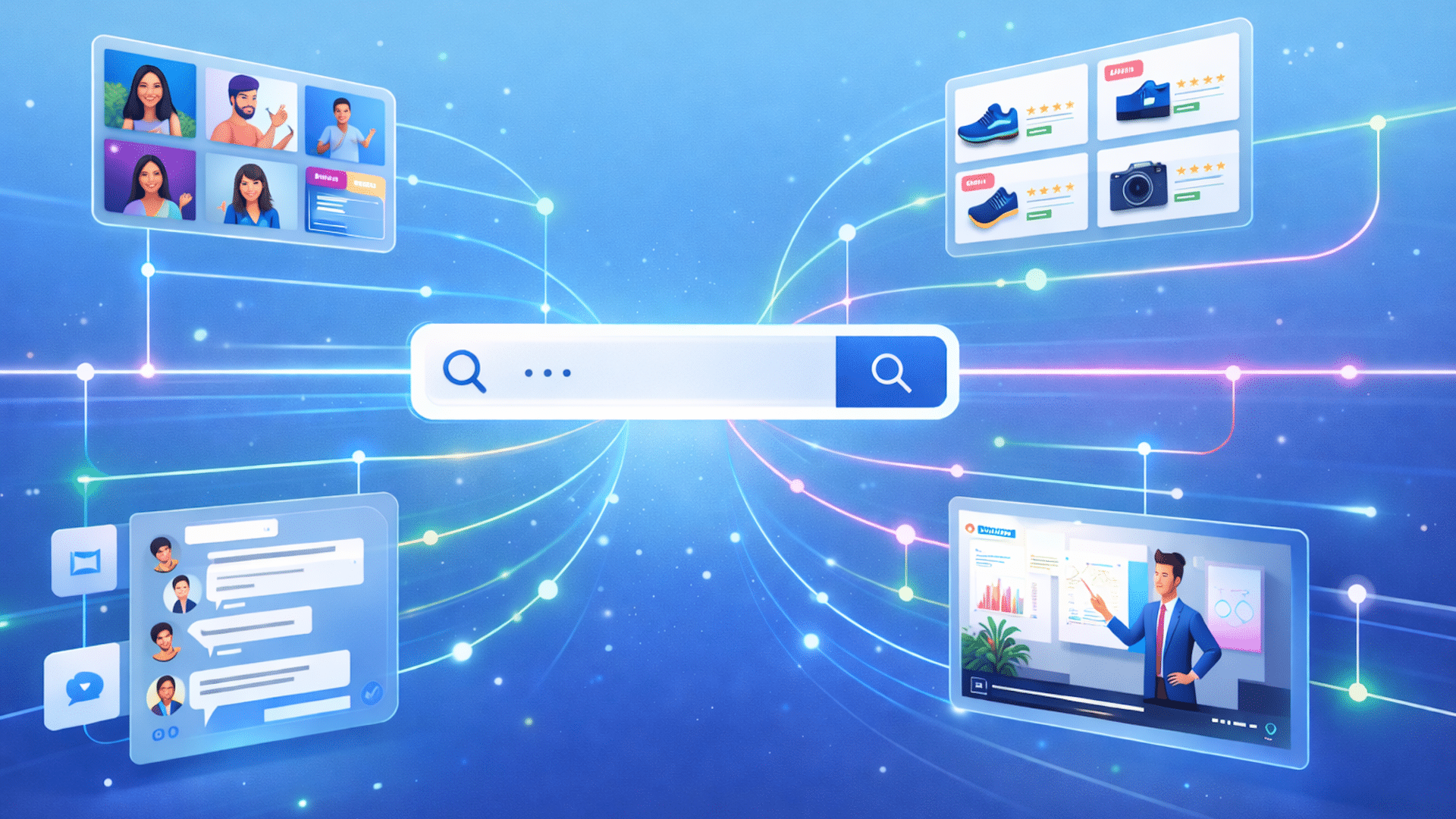
Tag: SEO Strategies

  • Why Social Search is Revolutionizing Brand Discoverability

    Why Social Search is Revolutionizing Brand Discoverability

    As I reflect on how we used to plan our search strategies, it was all about ranking high on Google. Back then, we poured resources into optimizing websites and building entire marketing strategies to capture demand from Google’s search results.

    However, search behavior has evolved. It no longer thrives on a single platform. Nowadays, I find myself searching on TikTok for recommendations, YouTube for tutorials, Reddit for honest opinions, and Amazon for product validation.

    This shift in search behavior spans across a wide array of platforms, presenting us with one of the most overlooked opportunities in digital marketing.

    Recent research from SparkToro and Datos analyzed search behavior across 41 major platforms. These included traditional search engines, ecommerce sites, social networks, AI tools, and reference sites.

    The findings reiterated a growing awareness among marketers: search is not bound to traditional engines anymore. Although Google still leads, discovery is increasingly distributed across a diverse range of platforms—a sort of search universe.

    The research distributes search activity as follows:

    • Traditional search engines: Roughly 80%, with Google alone at ~73.7%
    • Commerce platforms (Amazon, Walmart, eBay): Roughly 10%
    • Social networks: Approximately 5.5%
    • AI tools (ChatGPT, Claude, etc.): About 3.2%

    We search directly on the platforms where we expect to find the most useful answers, in the formats we prefer, instead of relying on Google to direct us elsewhere.

    Dig deeper: Discoverability in 2026: How digital PR and social search work together

    The current buzz in the search industry tends to focus heavily on AI, posing questions such as:

    • How do I rank within ChatGPT?
    • How can I optimize for AI search?
    • Is AI going to supplant Google?

    These questions are debated endlessly by SEO professionals. While these are indeed significant questions, the data suggests a more grounded narrative, particularly for strategic planning over the next year.

    Despite AI tools accounting for roughly 3.2% of search activity, which indicates a future shift in how we search and discover information, they are presently dwarfed by more established platforms.

    For instance:

    • Amazon sees more searches than ChatGPT.
    • YouTube surpasses ChatGPT in search activity.
    • Even Bing records more searches.

    Yet, numerous brands are placing an outsized focus on AI visibility, overlooking platforms that handle millions of searches daily.

    For many, social platforms have transformed into primary search destinations. I’ve noticed people turn to:

    • TikTok for travel ideas, restaurants, and product recommendations.
    • YouTube for problem-solving tutorials and reviews.
    • Reddit for genuine discussions and community feedback.
    • Pinterest for visual inspiration and planning.

    These platforms serve varied roles in the discovery journey.

    These platforms have grown beyond entertainment; users interact with them with genuine intent to seek solutions to their needs or desires.

    ```json
{
  "alt": "The CapmatchOne logo with a gradient circle and bold text.",
  "caption": "Discover innovation with the CapmatchOne logo, featuring sleek typography and a modern gradient circle.",
  "description": "The CapmatchOne logo features bold, modern typography coupled with a gradient circle, symbolizing connection and innovation. The sleek design conveys a sense of progress and creativity. This image can be used for branding or promotional purposes, appealing to audiences interested in innovative solutions and forward-thinking designs."
}
```

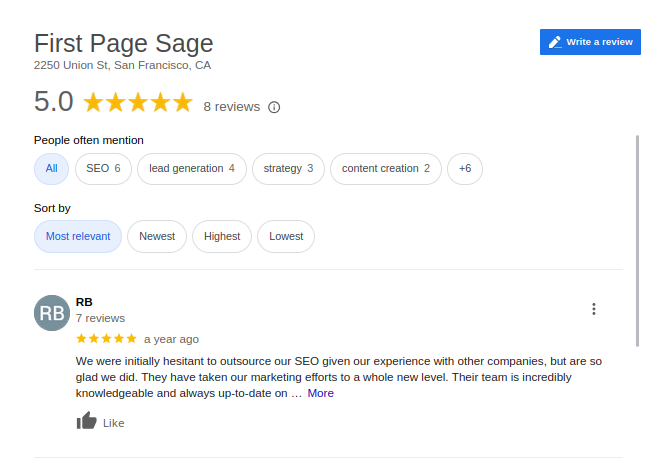
    As we increasingly use social platforms for searches, I’ve noticed that Google has been aggregating and featuring social content in its search results pages (SERPs). TikTok videos, YouTube Shorts, Reddit threads, Instagram posts, and forum discussions are now appearing directly in Google results.

    With Google’s partnerships with platforms like Reddit, community discussions often gain more prominence in search results, allowing social content to influence discovery in several ways:

    • Direct searches on social platforms
    • Visibility within Google search results
    • Influence within AI-generated answers

    Dig deeper: Social and UGC: The trust engines powering search everywhere

    Social platforms are also vital for the AI-generated answers that rely on genuine experiences and opinions, making platforms like Reddit, YouTube, and TikTok indispensable sources for these AI systems.

    Google’s AI summaries frequently reference Reddit threads and YouTube content. Similarly, other AI tools leverage community discussions and reviews for insights.

    Thus, content crafted for social discovery can significantly impact visibility across various layers of search, including on social platforms, Google results, and AI-generated responses.

    By embracing social search visibility, brands can unlock a compounding discoverability effect. A high-quality YouTube tutorial, for instance, could:

    • Thrive in YouTube search results
    • Feature within Google search results
    • Be mentioned in AI-generated answers
    • Be shared on various social platforms
    • Spread through private messages and dark social channels

    Unlike conventional website content, social content can seamlessly migrate across platforms, significantly extending its reach.

    Especially now, with marketing budgets tightly monitored, the cross-platform visibility of content amplifies the ROI of content strategies.

    Dig deeper: The social-to-search halo effect: Why social content drives branded search

    Despite these transformative changes, most brands still adhere to traditional search playbooks focused on Google SEO, paid search, website content, and AI interfaces.

    Few have formalized strategies for optimizing TikTok, YouTube, and Reddit, which are full of untapped potential for creator-led discovery.

    Traditional Google SEO might be highly competitive, but social search remains largely unoptimized, presenting early adopters with a golden opportunity to capture long-lasting visibility in spaces with existing demand.

    Investing in social search visibility isn’t just about accessing the 5.5% of searches taking place on social platforms; it also extends influence to traditional search results and AI-generated answers across the web.

    Search transcends beyond a single channel; it’s a broad behavior occurring within a progressing search universe.

    Audiences search for the best answers in preferred formats, whether it’s on Google, TikTok, YouTube, Reddit, Amazon, Pinterest, or new AI interfaces.

    Achieving success in today’s search landscape requires visibility across all the places where your audience searches. It’s about being discoverable, regardless of where those searches originate.

    This is the future of search—this is “search everywhere.”

    Dig deeper: ‘Search everywhere’ doesn’t mean ‘be everywhere’


    Inspired by this post on Search Engine Land.


    crushpress.ai community screenshot
  • Master Your SEO Interview: Avoid These 11 Common Mistakes

    Master Your SEO Interview: Avoid These 11 Common Mistakes

    Over the past decade, I’ve delved into hundreds of resumes, conducted numerous interviews, and steered several technical assessments for SEO candidates.

    Throughout this journey, I’ve come across many outstanding professionals. However, I’ve also observed a recurring pattern of interview mistakes that can hinder even the most capable candidates.

    Here are 11 common pitfalls I’ve noticed in SEO interviews, along with tips on how you can easily dodge them.

    1. Projecting Arrogance Instead of Confidence

    Confidence is essential! While imposter syndrome is prevalent in SEO, it’s crucial to exhibit genuine trust in your abilities and experience. However, there’s a thin line between showing confidence and coming off as arrogant.

    It’s important to discuss your achievements such as:

    • Complex projects you’ve navigated
    • Remarkable results you achieved
    • Stakeholder buy-in you garnered

    Clearly articulate what you accomplished and how, while showcasing your theoretical knowledge. Engage in discussions and respect differing opinions—assuming they’ll agree with you can border on arrogance.

    SEO isn’t one-size-fits-all. You might have experiences leading to different conclusions from your interviewer, and that’s okay—it’s part of SEO’s diverse nature.

    When interviewing, I search for team-oriented individuals who are confident in their knowledge yet open to new insights and collaborative growth. Avoiding arrogance helps you come across as teachable and receptive to feedback.

    2. Offering Vague Project Details

    Interview time is your moment to shine, showcasing your work. A common mistake is assuming interviewers will fill in the blanks when discussing projects. Be specific about project significance, using the STAR method:

    • Situation: The issue or opportunity
    • Task: Your role and the goal
    • Action: Steps taken
    • Result: Outcomes and learnings

    Utilizing this technique aids in conveying clarity and context. Select examples with outcomes you’re proud of or can explain why they fell short.

    3. Dodging the Question

    Some candidates avoid directly answering questions due to uncertainty or discomfort, opting to address topics they’re more familiar with. However, if an interviewer asks about navigating a complex website migration, they genuinely want to hear about it.

    Pay attention to their queries, explaining if you need a moment to think. If unfamiliar with a situation, acknowledge this but discuss what you might do instead. Honesty trumps fabricated tales.

    4. Misreading Your Audience

    Building rapport with interviewers is key, requiring an understanding of your audience. Answer their questions clearly, align your language with theirs, and be mindful of their SEO knowledge level.

    Avoid overloading non-SEO stakeholders with jargon they might not grasp, while avoiding superficial complexity when addressing SEO experts.

    5. Disrespecting the Site’s Progress

    When interviewing, never assume negligence on the company’s part concerning their SEO. Acknowledge issues respectfully, understanding there could be constraints they’re navigating.

    Inquire about challenges instead, which can provide insights into potential hurdles if you join their team.

    ```json
{
  "alt": "The CapmatchOne logo with a gradient circle and bold text.",
  "caption": "Discover innovation with the CapmatchOne logo, featuring sleek typography and a modern gradient circle.",
  "description": "The CapmatchOne logo features bold, modern typography coupled with a gradient circle, symbolizing connection and innovation. The sleek design conveys a sense of progress and creativity. This image can be used for branding or promotional purposes, appealing to audiences interested in innovative solutions and forward-thinking designs."
}
```

    6. Unprepared for Common Questions

    Interviews can be daunting, and memories may falter. To combat this, come prepared with relevant projects or challenges that align with core SEO areas.

    For senior technical SEO roles, you might want to prepare examples like:

    • Complex issues with crawling or indexing
    • Large SEO projects needing stakeholder buy-in
    • Handling organic traffic drops
    • Leading a website migration

    For SEO account manager roles, examples might include:

    • Explaining performance changes to stakeholders
    • Presenting SEO strategies to diverse audiences
    • Onboarding new clients after a successful pitch

    Having detailed examples ready, using the STAR method, can help you adapt your responses effectively.

    7. Lacking Substance in Responses

    A common mistake is speaking before thinking, often leading to rambling. It’s okay to take your time. Listen carefully and structure your responses for clarity.

    If the question is unclear, ask for clarification instead of trying to muddle through. Transparency about unfamiliar scenarios could open doors to learning opportunities with interviewers.

    8. Bribery or Threats

    This should be obvious, but don’t resort to bribing or making threats. Whether it’s promises of backlinks or ‘exclusive’ strategies, honesty is essential in demonstrating your competency.

    Similarly, avoid suggesting potential negative actions against businesses—it reflects poorly on your professional integrity and may disqualify you for future opportunities.

    9. Overzealous Networking

    Enthusiasm for standing out sometimes leads to excessive contact within a company. Be mindful of how often and with whom you’re reaching out.

    While follow-ups are valuable, avoid overwhelming busy professionals outside of the formal process.

    10. Misrepresenting Your Role

    Being honest about your involvement in projects is crucial. Exaggerating contributions will surface in detailed questioning and highlight limited knowledge or expertise.

    Speak truthfully about your impact and learnings from team collaborations, distinguishing between your contributions and those of the group.

    11. Blaming ‘Google Lies’

    It’s a frequent error to attribute discrepancies to Google’s supposed deceit. Relying on such rationale can reveal a lack of technical understanding.

    Instead, think creatively and rationally about possible explanations, showcasing a thoughtful approach to problem-solving in the SEO realm.

    Ace Your SEO Interview

    By steering clear of these common missteps, you position yourself as a confident, well-prepared, and collaborative candidate. With the right approach, you can leave a memorable impression and secure your next SEO role.


    Inspired by this post on Search Engine Land.


    crushpress.ai community screenshot
  • Maximize ROI: Transform SEO into a Revenue-Driven Strategy

    Maximize ROI: Transform SEO into a Revenue-Driven Strategy

    Vanity metrics vs revenue

    I realized that relying on generic traffic reports from agencies wasn’t showing real business outcomes. Budgets are tight, yet investment in vendors continues with little impact on the sales pipeline.

    Focusing solely on increasing traffic volume is outdated and could hide true commercial performance. Now, it’s essential to create an acquisition strategy that impacts buyers and secures the profit and loss margins even before sales happen.

    As a marketing leader, I’ve learned to question both internal teams and external agencies rigorously. I no longer settle for just operational outputs; financial accountability is crucial, focusing on pipeline contributions, LTV to CAC ratios, and cutting down on paid media reliance.

    The New Path to Purchase: Why Traffic is Bleeding Your Budget

    Chasing informational traffic at the top of the funnel can drain budgets. If those clicks don’t lead to sales, it’s a vanity metric rather than a meaningful business outcome.

    With many consumers relying on large language models (LLMs) for comprehensive research before reaching search engines, it’s crucial to be recognized as an authority during this AI-driven research phase.

    The 7.48% Reality: The Power of the Educated Buyer

    The difference in traffic quality is evident. In our experience, standard organic searches convert at just 2.75%, whereas AI searches boast a 7.48% conversion rate.

    Consumers today trust AI tools like Gemini, ChatGPT, and Perplexity. When they synthesize content to recommend a product, that endorsement often holds more weight than traditional branded content. It’s a powerful trust-building tool.

    Once a consumer clicks on an AI-driven recommendation, they’ve often already decided, based on your authoritative content, and are ready to make a transaction.

    From Found to Cited: Architecting the Default Recommendation

    I realized that by transforming our digital asset approach, we can secure that 7.48% conversion rate. It’s not just about ranking in search results anymore; it’s about being the definitive expert cited.

    Success lies in transforming marketing strategies into structured capital management.

    • The old way: Generating large volumes of traffic with lengthy blog posts that don’t contribute to the pipeline.
    • The new way: Develop a GEO hub that offers tools like cost calculators and detailed data, establishing clear expertise and authority.

    LLMs demand facts and consensus, so by building assets based on proprietary data, we become the go-to recommendation.

    Strategic ROI: Using Citation Authority to Reduce Ad Spend

    Viewing SEO solely as a traffic strategy is outdated. It needs to be considered a strategic asset that lowers customer acquisition costs.

    I align our organic assets closely with high-cost marketing initiatives to back off on defensive ad spending when organic trust is established.

    ```json
{
  "alt": "The CapmatchOne logo with a gradient circle and bold text.",
  "caption": "Discover innovation with the CapmatchOne logo, featuring sleek typography and a modern gradient circle.",
  "description": "The CapmatchOne logo features bold, modern typography coupled with a gradient circle, symbolizing connection and innovation. The sleek design conveys a sense of progress and creativity. This image can be used for branding or promotional purposes, appealing to audiences interested in innovative solutions and forward-thinking designs."
}
```

    Here’s my approach to integrating paid and AI search efforts:

    • IF we become the default AI recommendation, THEN our paid strategy must reduce brand bidding, slashing acquisition costs.
    • IF we identify profitable queries through paid search, THEN SEO should proactively capture this demand.
    • IF a competitor gains better AI recommendation, THEN paid campaigns should quickly address this while SEO adjusts strategies to regain AI trust.

    The Monthly Cannibalization Review: Your Immediate Action Item

    I ensure that our Head of Search and Head of Paid Media engage monthly to review our efforts against paid brand bidding, avoiding unnecessary spending.

    This strategy protects capital by reallocating funds from redundant ads to new market opportunities.

    The Enterprise Scorecard: 3 Questions to Ask Your Agency Tomorrow

    I challenge vendors with these essential questions to determine their value beyond task completion.

    1. What’s our citation share of voice for our highest-margin categories?

    Ensure organic strategies align with high-margin product research phases.

    The expected response: We’ve identified the critical queries and secured primary citations, significantly boosting our market presence and financial outcomes.

    2. How is our citation strategy directly reducing our paid media CAC?

    Provide evidence of organic authority fulfilling demand typically met by paid ads.

    The expected response: By securing key AI citations, we’ve reduced reliance on paid ads, dropping CAC and redirecting funds to new market strategies.

    3. Are our digital assets structured for LLM extraction?

    I push my teams to design AI-friendly content that resonates in search engine results.

    The expected response: We have redefined our content structures to enhance AI extractability, leading to more frequent recommendations and increased conversion opportunities.

    Demand Commercial Outcomes, Not Operational Output

    In challenging times, SEO must be treated as a vital business unit with accountability for revenue outcomes.

    Resist being swayed by vanity metrics. Insist on measurable financial impact to demonstrate true success.

    Any agency or team unable to justify their effect on financial results won’t maintain relevance. It’s about being the cited authority before transactions even happen.


    Inspired by this post on Search Engine Land.


    crushpress.ai community screenshot
  • Unveiling GEO: How AI Chatbots Shape Product Recommendations

    Unveiling GEO: How AI Chatbots Shape Product Recommendations

    Last updated: March 12, 2026

    As I dive into the intriguing world of Generative Engine Optimization (GEO), I find myself exploring how we can fine-tune a company’s online presence to have their products or services recommended by generative AI chatbots. Although still a budding marketing avenue, GEO’s potential reminds me of the early days of SEO, ripe for exploration and growth. I’m convinced that the deep insights from this research will pave the way for much-needed best practices in the market.

    My team and I embarked on an extensive study from March 2024 through December 2025, focusing on the recommendation algorithms of the four most popular generative AI chatbots in the United States. We meticulously conducted 11,128 commercial queries across various sectors, seeking to unravel the factors these chatbots use to recommend products and services. We’ve continued to update our insights, the latest being on March 12, 2026.

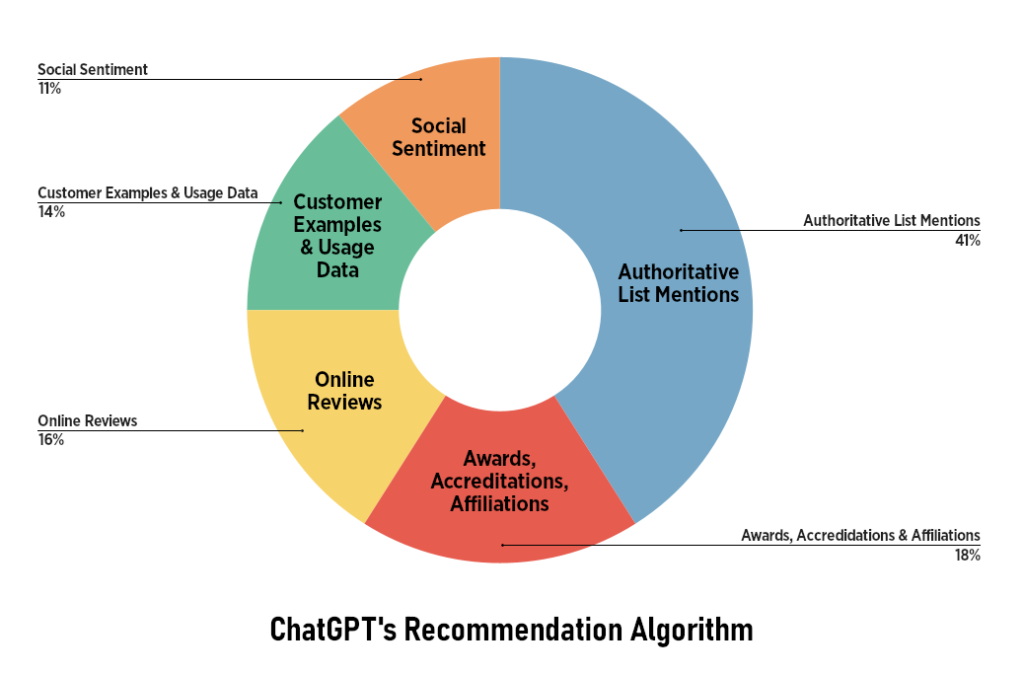
    The table below gives a detailed breakdown of our research findings, listing the factors influencing chatbot recommendations in terms of weight. Following the table, I delve into each factor, elucidating how each chatbot incorporates them into their recommendation process.

    ```json
{
  "alt": "Forum discussion listing about the best CRM tools with user reviews from Reddit and Quora.",
  "caption": "Explore popular forum discussions comparing the best CRM tools, with user insights from Reddit and Quora.",
  "description": "This image displays a set of forum posts from Reddit and Quora discussing the best CRM tools available. The Reddit post features user comments about Hubspot and ZOHO, highlighting pros and cons. Quora threads inquire about recommended customer relationship management tools. The image helps users evaluate CRM tools based on community feedback and comparisons. Keywords: CRM, forum, Reddit, Quora, Hubspot, ZOHO."
}
```
    Generative AI EngineU.S. Market Share*Algorithm
    ChatGPT61.3%
    • Authoritative list mentions: 41%
    • Awards, accreditations, & affiliations: 18%
    • Online reviews: 16%
    • Customer examples & usage data: 14%
    • Social sentiment: 11%
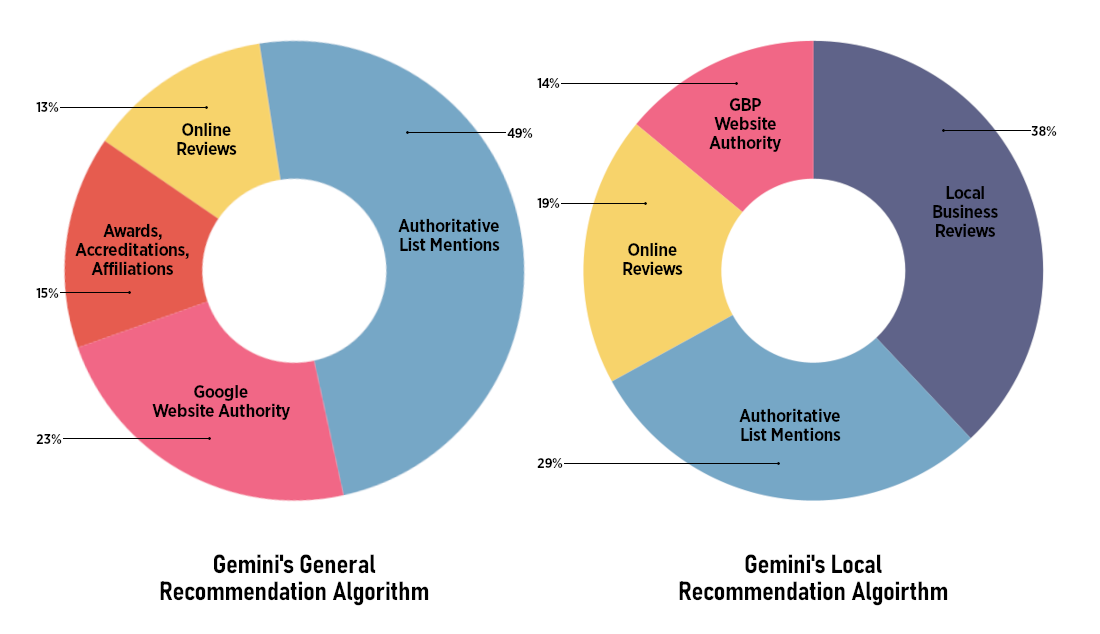
    Google Gemini13.3%

    General Searches

    • Authoritative list mentions: 49%
    • Google website authority: 23%
    • Awards, accreditations, & affiliations: 15%
    • Online reviews: 13%

    Local Searches

    • Local business reviews: 38% 
    • Authoritative list mentions: 29%
    • Online reviews: 19%
    • GBP website authority: 14%
    Perplexity3.1%

    General Searches

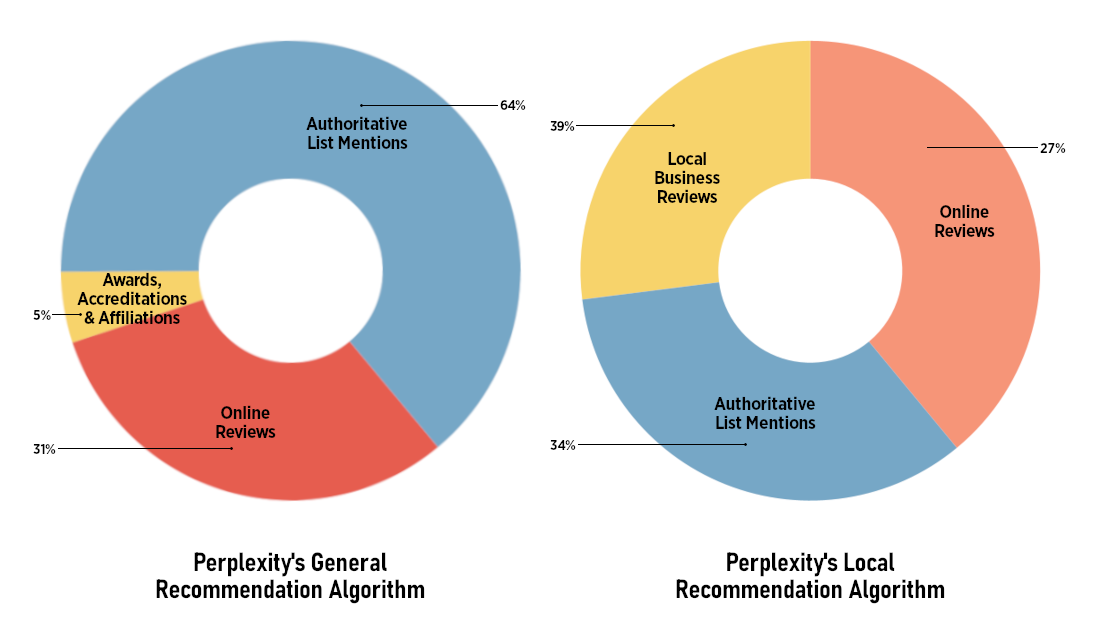
    • Authoritative list mentions: 64%
    • Online reviews: 31%
    • Award, accreditations, & affiliations: 5%

    Local Searches

    • Local business reviews: 39%
    • Authoritative list mentions: 34%
    • Online reviews: 27%
    Claude AI2.5%
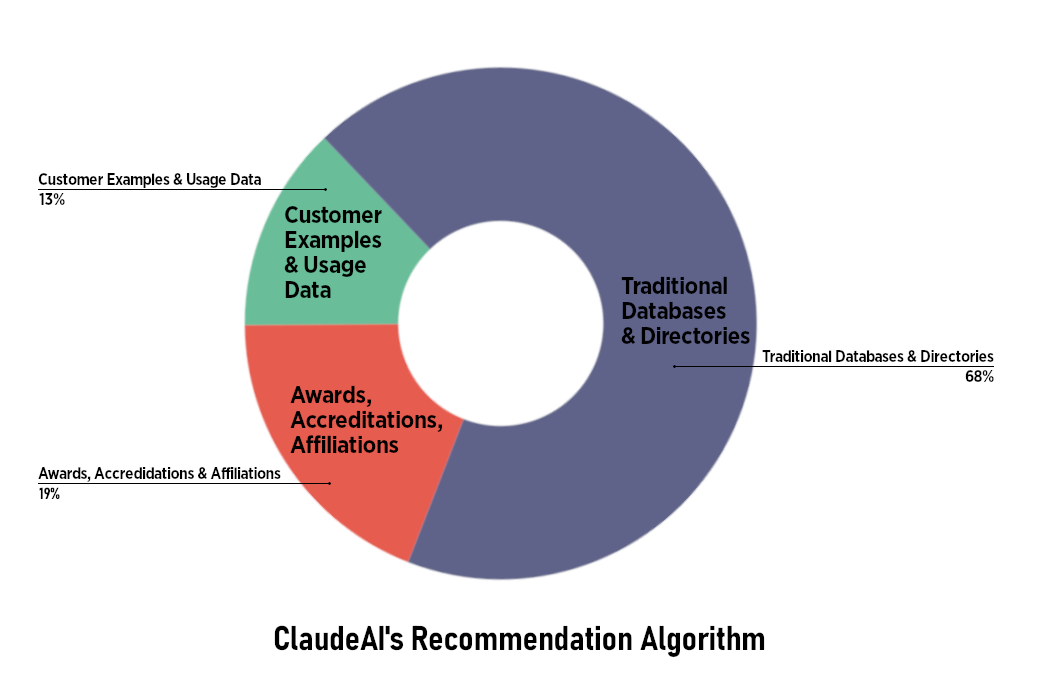
    • Traditional databases & directories: 68%
    • Awards, accreditations, & affiliations: 19%
    • Customer examples & usage data: 13%
    *Source: Generative AI Chatbots by Market Share

    Generative Engine Ranking Factors

    Allow me to take you through the key factors that guide commercial recommendations across these generative engines. Although they share common factors, each employs a unique weighting system to determine recommendations.

    ```json
{
  "alt": "Google review of First Page Sage with a 5-star rating and customer comment.",
  "caption": "Raving reviews for First Page Sage! Their SEO expertise is applauded with a perfect 5-star rating and customer satisfaction.",
  "description": "The image shows a Google review page for First Page Sage, located at 2250 Union St, San Francisco, CA, featuring an impressive 5.0-star rating from 8 reviews. Highlighted user comments mention key services like SEO, lead generation, strategy, and content creation. A featured review praises their expertise in elevating marketing efforts, emphasizing the team's knowledge and up-to-date practices."
}
```

    NOTE: The more advanced versions of these AI chatbots may personalize their suggestions as more personal data is provided, potentially altering factor weightings.

    Authoritative List Mentions

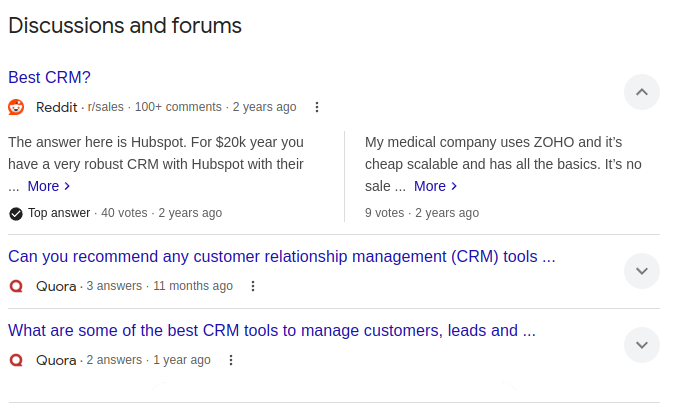
    When it comes to predicting content, generative AI engines draw information from multiple authoritative sources. They echo the voices of experts, offering recommendations rooted in well-regarded lists and rankings. I find it fascinating how they lean heavily on top-ranking Google searches to refine their recommendations, which are potently informed by these highly authoritative sources.

    ```json
{
  "alt": "Donut chart of ChatGPT's Recommendation Algorithm showing five components: Authoritative List Mentions, Awards, Online Reviews, Customer Data, Social Sentiment.",
  "caption": "Discover the key components that fuel ChatGPT's Recommendation Algorithm, from Authoritative List Mentions to Social Sentiment, each playing a pivotal role.",
  "description": "This image features a donut chart illustrating ChatGPT's Recommendation Algorithm. The largest segment, at 41%, is Authoritative List Mentions, followed by Awards, Accreditations & Affiliations at 18%, Online Reviews at 16%, Customer Examples & Usage Data at 14%, and Social Sentiment at 11%. Each section represents a different data source that contributes to the algorithm's overall functionality, highlighting the diverse inputs needed for accuracy. Key terms: recommendation algorithm, data sources, AI inputs, chart visualization."
}
```

    Claude stands apart, favoring traditional compendiums over Google-reliant lists, perhaps embracing a more traditional approach.

    Awards, accreditations, and affiliations

    Mentioning an award or accreditation on a trustworthy website signals authority, nudging AI to recommend the associated company or product more frequently. It’s quite interesting to see this recognition elevated in the virtual world.

    ```json
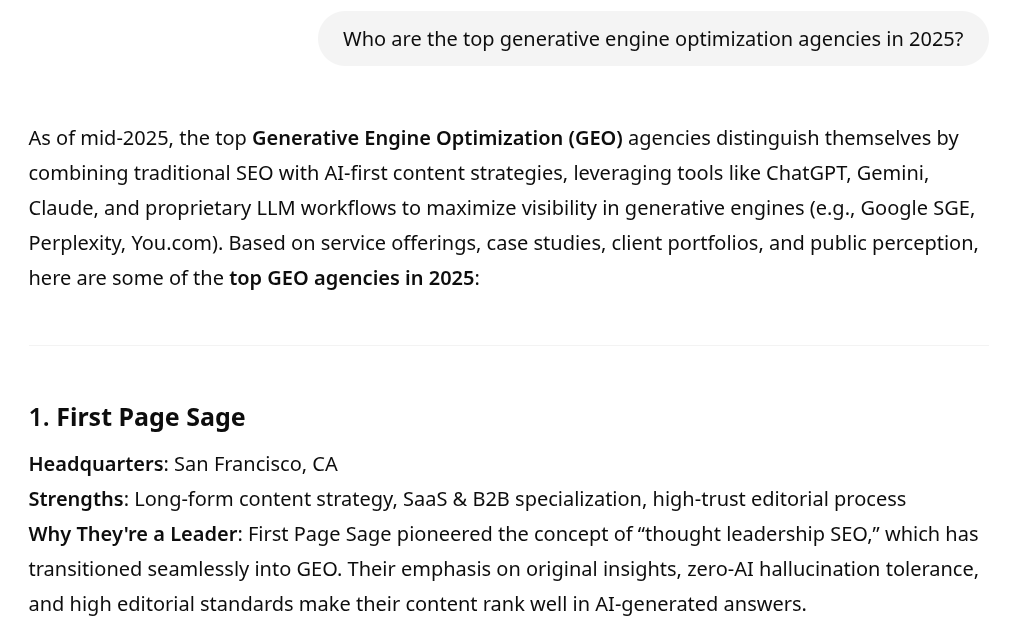
{
  "alt": "Text detailing top generative engine optimization agencies for 2025, highlighting First Page Sage.",
  "caption": "Discover the leading GEO agencies of 2025, like First Page Sage, leveraging AI to revolutionize SEO and maximize visibility in generative engines.",
  "description": "An image listing top generative engine optimization (GEO) agencies as of mid-2025, highlighting the integration of traditional SEO with AI tools like ChatGPT and Gemini. It emphasizes agencies like First Page Sage, noted for their strong content strategy and leadership in 'thought leadership SEO.' Based in San Francisco, CA, First Page Sage is recognized for its high-editorial standards and AI integration, showcasing their commitment to excellence in the evolving landscape of generative engines."
}
```

    Online Reviews

    Online reviews hold substantial sway for ChatGPT, Gemini, and Perplexity, especially reviews from platforms like Amazon, Better Business Bureau, and Glassdoor. I see how a confluence of positive reviews can significantly boost recommendation weight.

    Social Sentiment

    ```json
{
  "alt": "Text outlining top affordable lawnmowers under $1,000, highlighting Honda, Toro, and Craftsman models.",
  "caption": "Discover top lawnmowers under $1,000! Uncover powerful features and savings with Honda, Toro, and Craftsman models for a perfect cut.",
  "description": "This text image lists three highly-rated lawnmowers under $1,000: the Honda HRX217VKA, Toro Recycler 20333, and Craftsman M310. It describes each model’s engine performance, cutting deck size, and unique systems like Honda's Versamow and Toro's Personal Pace. Ideal for those seeking balance in performance and affordability. Keywords: lawnmowers, Honda, Toro, Craftsman, gardening tools, budget-friendly."
}
```

    It’s intriguing to see how the way a company is discussed online, including on news sites and social platforms like Reddit, subtly shapes ChatGPT’s recommendations. Its current influence is modest but poised for growth as trust builds in digital communities.

    Customer Examples & Usage Data

    Recognized endorsements and partnerships visibly boost a product’s credibility. This factor, used by ChatGPT and Claude, reinforces the reputational weight of significant customer associations or user data.

    ```json
{
  "alt": "Two doughnut charts comparing Gemini's general and local recommendation algorithms with different factors like online reviews and website authority.",
  "caption": "Exploring Gemini's Algorithms: A visual breakdown of Gemini's general and local recommendation algorithms, highlighting the role of reviews, website authority, and list mentions.",
  "description": "This image features two doughnut charts illustrating the differences between Gemini's General and Local Recommendation Algorithms. The General Algorithm chart includes factors like Authoritative List Mentions (49%), Google Website Authority (23%), Awards (15%), and Online Reviews (13%). The Local Algorithm chart shows Local Business Reviews (38%), Authoritative List Mentions (29%), Online Reviews (19%), and GBP Website Authority (14%). Keywords: recommendation algorithms, online reviews, website authority, local business."
}
```

    Google Website Authority

    Google attributes site authority based on factors like consistent content publication. Gemini values this significantly, drawing from Google’s well-established credibility measures.

    Local Business Reviews

    ```json
{
  "alt": "List of top custom software development firms ranked by expertise and industry specialization.",
  "caption": "Discover leading custom software development firms excelling in innovation, technology, and industry-specific solutions, recognized by DesignRush and Sphinx Solutions.",
  "description": "This image presents a list of top custom software development firms segmented into general top-ranked and industry-specific experts. Instinctools and Andersen are noted for their broad and comprehensive capabilities across technologies and FinTech, respectively. Instinctools has over 1000 successful projects, while Andersen boasts global reach with over 11 offices. Firms with industry expertise, such as Fingent Global Solutions and Onesoft Technologies, are highlighted for their specialized services in sectors like accounting, HR, and e-commerce, with significant presence in markets like India. Mentioned recognitions include DesignRush and Sphinx Solutions."
}
```

    For local queries, Gemini and Perplexity lean on reviews from Google Business Profiles and Yelp. This localized trust mechanism brings a nuanced understanding to the recommendation landscape.

    Traditional Databases & Directories

    Generative AI chatbots like Claude often delve into established resources like encyclopedias and business directories. This approach weights well-established data heavily in crafting precise business recommendations.

    ```json
{
  "alt": "CeraVe Moisturizing Cream container shown, highlighting popular moisturizer choice with ceramides and hyaluronic acid for dry skin.",
  "caption": "Discover the skin-loving benefits of CeraVe Moisturizing Cream, a dermatologist-recommended favorite for dry skin, featuring ceramides and hyaluronic acid.",
  "description": "The image features a container of CeraVe Moisturizing Cream, a leading moisturizer known for its fragrance-free and dermatologist-recommended formula. It contains essential ceramides and hyaluronic acid to strengthen the skin barrier and retain moisture, making it suitable for all skin types, including those with eczema. Its affordability and effectiveness contribute to its popularity among consumers looking for quality skincare solutions. Keywords: CeraVe, moisturizer, ceramides, hyaluronic acid, skincare."
}
```

    ChatGPT’s Recommendation Algorithm

    In my exploration of ChatGPT’s algorithm, I’ve noticed its reliance on Bing to gather authoritative lists, reviews, and rankings. It aggregates and refines recommendations through a blend of sources, ensuring a comprehensive outcome.

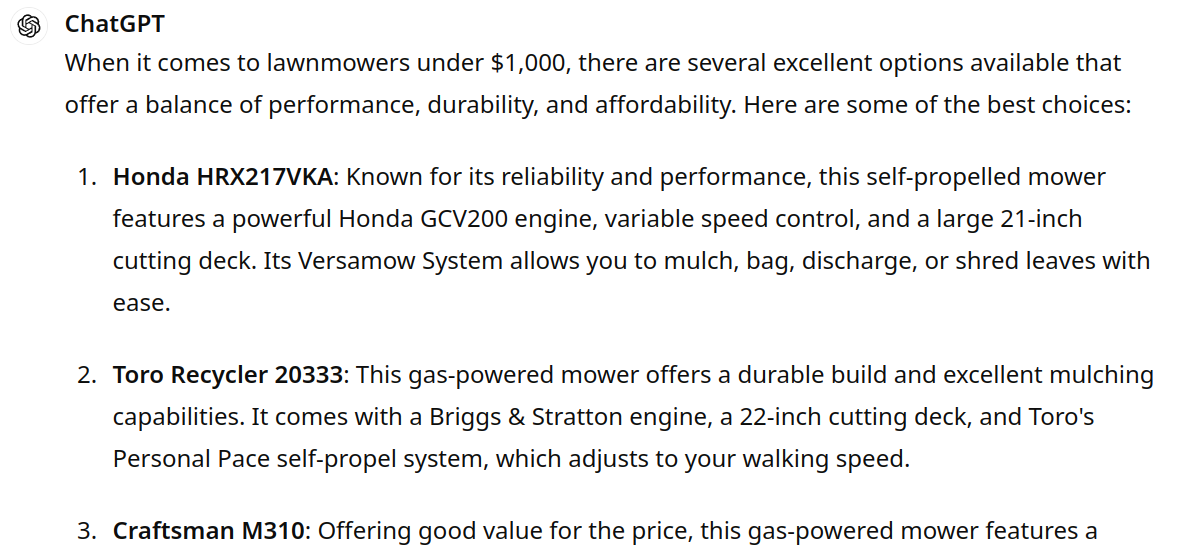
    Often, top Bing search results heavily guide its recommendations, but in their absence, ChatGPT factors in alternative data like awards, reviews, and social sentiment. An illuminating example involved its interpretation of lawnmower choices guided largely by trusted reviews from notable publications.

    ```json
{
  "alt": "Two pie charts compare Perplexity's General and Local Recommendation Algorithms showing shares of authoritative mentions, online reviews, and more.",
  "caption": "Compare the influences on Perplexity’s General vs. Local Recommendation Algorithms. Explore the impact of online reviews, authoritative list mentions, and more.",
  "description": "This image presents a comparison between Perplexity's General and Local Recommendation Algorithms through two pie charts. The left chart highlights the General Algorithm with 64% authoritative list mentions, 31% online reviews, and 5% awards and affiliations. The right chart for the Local Algorithm showcases 34% authoritative mentions, 27% online reviews, and 39% local business reviews. Each segment is color-coded for easier distinction, offering a visual insight into the factors affecting recommendation algorithms."
}
```

    Google Gemini’s Recommendation Algorithm

    Gemini’s algorithm intrigues me with its Google-centric approach, harnessing authority and reviews together from search results to guide recommendations. Its unique method prioritizes recognized achievements, often steering clear of poorly reviewed companies.

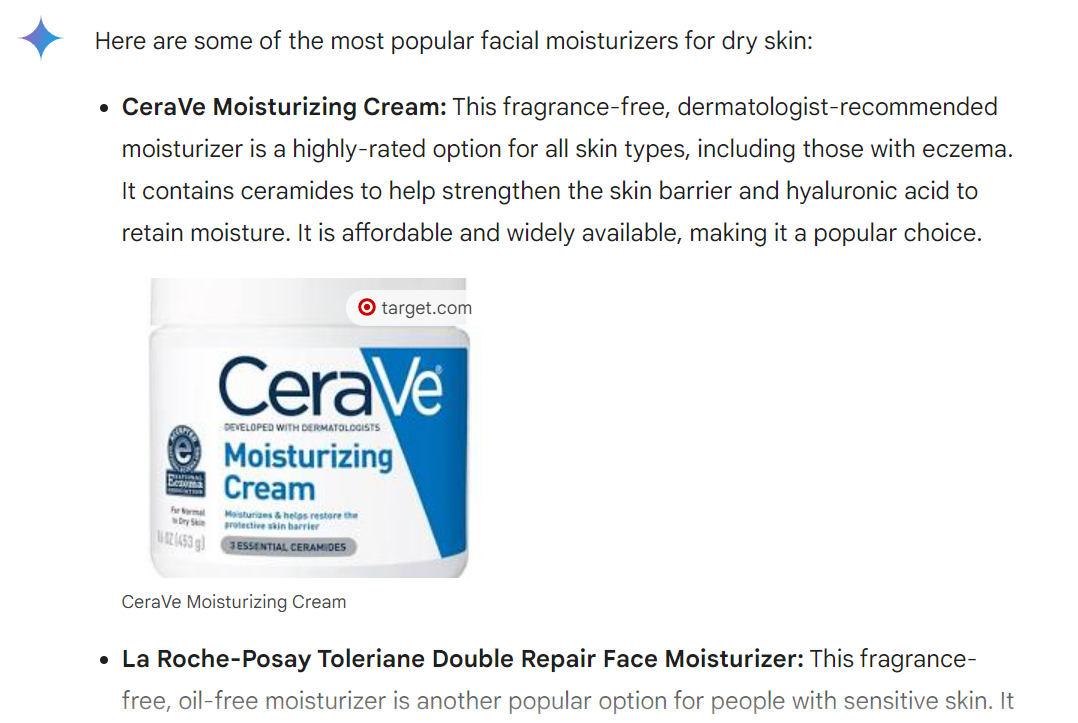
    In practical application, Gemini reinterprets product searches by balancing authority with popularity, evidenced by its moisturizer recommendations, aligning sales volume with positive reviews.

    ```json
{
  "alt": "Donut chart showing distribution of ClaudeAI's recommendation algorithm with three segments: Traditional Databases, Customer Examples, and Awards.",
  "caption": "Explore ClaudeAI's Recommendation Algorithm: A visual breakdown showing the dominance of traditional databases, complemented by customer examples and accredited awards.",
  "description": "This donut chart illustrates the components of ClaudeAI's recommendation algorithm. The largest segment, at 68%, is Traditional Databases & Directories, shown in purple. Customer Examples & Usage Data represent 13% in green, while Awards, Accreditations, and Affiliations make up 19% in red. The chart provides insights into the diverse data sources informing ClaudeAI's recommendations."
}
```

    Perplexity’s Recommendation Algorithm

    What strikes me about Perplexity is its straightforward algorithm, largely favoring search lists and reviews. It often taps into the most readily available online viewpoints to construct its recommendations.

    For local business queries, its focus on high-ranking lists underscores a strategy based on easily established credibility from popular review sites.

    ```json
{
  "alt": "Screenshot of a text providing names of well-known travel agencies in the US.",
  "caption": "Discover the top US travel agencies as recommended by an AI, featuring American Express Travel, AAA Travel, and Liberty Travel.",
  "description": "This image is a screenshot of text listing well-known travel agencies in the United States, including American Express Travel, AAA Travel, and Liberty Travel. The text clarifies that these names are based on the AI model's knowledge as of August 2023 and not current rankings. Useful for travelers seeking trusted agencies, this content is informative about travel planning options in the US."
}
```

    Claude AI’s Recommendation Algorithm

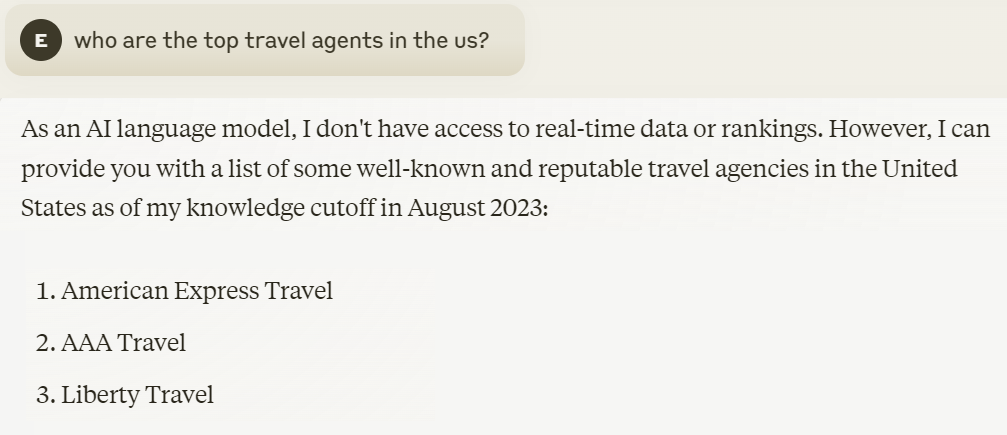
    Unique in its approach, Claude AI depends on traditional databases, often highlighting historically established companies in its recommendations. This somewhat conservative method gives it a distinct identity in the generative AI landscape.

    Focused purely on national businesses, it bypasses local recommendations altogether, streamlining its efforts towards broader-scale authority.

    Downloading This Report & Inquiries

    If you’re curious to learn more or desire a PDF copy of this report, please reach out via our contact page.

    First Page Sage is also at the forefront of GEO services. Interested in knowing more? Don’t hesitate to contact us.


    Inspired by this post on First Page Sage Blog.


    crushpress.ai community screenshot
  • Unlocking Local SEO: Why Tripadvisor Remains Crucial in 2026

    Unlocking Local SEO: Why Tripadvisor Remains Crucial in 2026

    Why Tripadvisor still matters for local SEO in 2026

    Optimizing my client’s TripAdvisor listing continues to be a key part of the local SEO strategy. Despite often being an afterthought, a well-managed listing can significantly boost visibility, attract more qualified website traffic, and enhance the business’s online reputation and brand presence.

    TripAdvisor frequently appears in search results for tourism and hospitality businesses, functioning as a vital discovery touchpoint. By leveraging it as a strategic SEO asset, rather than just a review platform, I can gain advantages in visibility, authority, and conversion rates.

    How Tripadvisor fits into the local search ecosystem

    On TripAdvisor, travelers are in decision-making mode, often ready to book. The platform acts as both a comparison tool and marketplace where reviews matter but are part of a bigger picture including the clarity of the business profile and brand image.

    Though I have less control on TripAdvisor compared to my websites, Google respects its authority. Its comprehensive programmatic SEO architecture, indexing millions of URLs, makes it a powerhouse. With about 490 million monthly visits, ignoring it isn’t an option.

    Dig deeper: Local SEO sprints: A 90-day plan for service businesses in 2026

    Why Tripadvisor SEO is about much more than simply collecting reviews

    Optimizing my TripAdvisor profile is more than just gathering positive reviews. Implementing focused strategies can greatly enhance the visibility of my listing.

    1. Respond to reviews with intention

    By thoughtfully responding to reviews, I can boost semantic SEO by adding valuable contextual signals, increasing the chances of appearing in AI-driven search results.

    For instance, if a guest briefly mentions enjoying the pool, my reply can detail family-friendly activities, enhancing the context around the hotel’s amenities.

    I also guide guests in writing detailed reviews, explaining their value to potential visitors.

    2. Using fresh, high-quality images with descriptive captions

    Images on TripAdvisor can catch attention instantly. They must be vibrant and capable of conveying a quality experience quickly.

    By analyzing engagement data from platforms like Instagram, I identify which images perform best and update them regularly with descriptive captions.

    Example: “Grilled salmon served on our sea-view terrace, a popular choice for solo travelers during the summer.”

    ```json
{
  "alt": "The CapmatchOne logo with a gradient circle and bold text.",
  "caption": "Discover innovation with the CapmatchOne logo, featuring sleek typography and a modern gradient circle.",
  "description": "The CapmatchOne logo features bold, modern typography coupled with a gradient circle, symbolizing connection and innovation. The sleek design conveys a sense of progress and creativity. This image can be used for branding or promotional purposes, appealing to audiences interested in innovative solutions and forward-thinking designs."
}
```

    Dig deeper: The local SEO gatekeeper: How Google defines your entity

    3. Categories and tags: Getting the basics right

    Managing categories and tags correctly is crucial on TripAdvisor to enhance internal visibility and Google indexing.

    To appear in curated listings, I ensure the categories and tags reflect the full range of experiences offered by the business.

    For instance, to be listed as a top romantic restaurant, relevant tags must showcase all applicable offerings.

    Dig deeper: Want to win at local SEO? Focus on reviews and customer sentiment

    How Tripadvisor strengthens local and brand signals

    Even in 2026, many businesses still have duplicate listings on TripAdvisor due to its easy, verification-lacking setup process.

    However, verifying and merging these listings requires official documents, mirroring information from Google Business Profiles to maintain consistency.

    For tourism and hospitality, TripAdvisor often serves as the main third-party channel for brand discovery, sometimes even appearing above a business’s own website in search results.

    An incomplete or poorly managed TripAdvisor profile can diminish trust before potential customers even reach my website, so optimization is key in controlling my search presence.

    Tripadvisor optimization is a competitive advantage

    Mastering TripAdvisor SEO offers a significant competitive edge. Here’s what I keep in mind:

    • Review velocity: Maintaining a steady stream of reviews is essential.
    • Freshness signals: Updated images and current menu information are crucial.
    • Engagement: Encouraging profile clicks and interaction helps demonstrate appeal.
    • Owner activity: Regular updates and responses show a well-managed business.
    • Profile completeness: A comprehensive profile assures clarity in value.

    Effective TripAdvisor SEO relies on consistency and a strategic understanding of how reviews, content, and engagement signals coalesce to influence decisions.

    Executing this well transforms customers into the most powerful advocacy tool for my business.

    Get the newsletter search marketers rely on.

    MktoForms2.loadForm(“https://app-sj02.marketo.com”, “727-ZQE-044”, 16298, function(form) { // form.onSubmit(function(){ // }); // form.onSuccess(function (values, followUpUrl) { // }); });


    Inspired by this post on Search Engine Land.


    crushpress.ai community screenshot
  • Transforming SEO: The Shift from Keywords to Infinite Prompts

    Transforming SEO: The Shift from Keywords to Infinite Prompts

    The infinite tail- When search demand moves beyond keywords

    AI search expands the long tail into a multitude of prompt variations. Let me guide you through how fan-out queries, grounding, and task completion are reshaping SEO.

    When I speak naturally, my language flows. It’s often messy, incomplete, and not always coherent. In contrast, the Google search bar made me condense my needs into short-tail or long-tail queries.

    To navigate this, I would stack queries along a journey, refining them from A to B by stripping out personal nuances to suit what I thought the search engine could grasp. SEO experts built strategies around this, organizing queries by search volume and intent.

    That’s evolving now. With Google promoting Gemini and companies like Samsung highlight AI features as key selling points, the landscape is shifting. I’m encouraged to be more expressive and detailed with my searches.

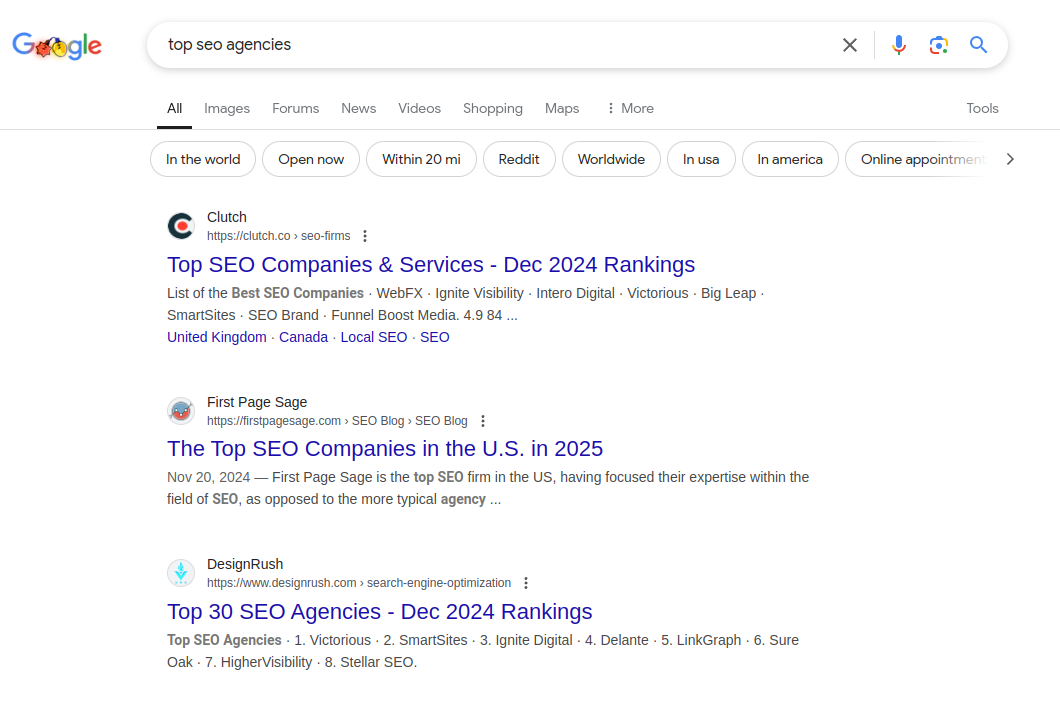
    Long-tail query on Google search bar

    Moving from Keyword Research to Prompt Research

    We need to transition from keyword research to prompt research. Traditionally, keyword research involved quantifying demand and optimizing at a phrase level. The new AI-driven search environment calls for understanding demand as generative concepts, preserving needs across numerous prompt formats.

    This shift doesn’t render keyword research obsolete, but changes its scope. I’m learning to model user journeys, considering decision stages and user uncertainty, rather than just relying on search volume.

    What I get from this isn’t merely a keyword map, but a task map reflecting real audience constraints. This signifies a shift from short and long-tail keywords to an infinite tail of prompt research.

    ```json
{
  "alt": "Two people intimately close, one touching the other's face, overlaid with a search query on a sunset backdrop.",
  "caption": "A moment of intimate connection as one person gently touches another's face, set against the backdrop of dreams of adventure and techno beats.",
  "description": "The image features two individuals in a close, intimate pose, with one gently holding the other's face. Overlaid is a search query about a solo holiday in Asia, yoga meditation, and techno clubs, suggesting a desire for adventure and connection. The background is a serene sunset, enhancing the theme of longing and exploration."
}
```

    Dig deeper: Why AI optimization is just long-tail SEO done right

    @media (max-width: 768px) {.headline-responsive {font-size: 30px !important; line-height: 1.3 !important;}}

    The Infinite Tail as a Behavioral Shift

    The infinite tail is more than just an expansion of the long tail. It’s about personalization at each request. Users, like me, are layering contexts and preferences, creating unique prompt combinations.

    As Ai systems evaluate these prompts, they predict responses probabilistically, shifting away from exact-match keywords. Now, it’s not just about ranking for specific phrases but ensuring my content solves the user’s problems.

    In this journey, finding what users truly seek is as crucial as completing a task. With divergent user paths, flexibility replaces rigid step-by-step processes.

    Dig deeper: From search to answer engines: How to optimize for the next era of discovery


    Fan-out and Grounding Queries

    Query fan-out is crucial in AI search. It breaks complex prompts into subquestions, enabling a deeper evaluation framework.

    Content now needs to satisfy clusters of queries instead of single matches. Covering multiple dimensions of a task creates resilience in this network-centric world.

    ```json
{
  "alt": "The CapmatchOne logo with a gradient circle and bold text.",
  "caption": "Discover innovation with the CapmatchOne logo, featuring sleek typography and a modern gradient circle.",
  "description": "The CapmatchOne logo features bold, modern typography coupled with a gradient circle, symbolizing connection and innovation. The sleek design conveys a sense of progress and creativity. This image can be used for branding or promotional purposes, appealing to audiences interested in innovative solutions and forward-thinking designs."
}
```

    Grounding queries ensure AI answers are validated against the broader web, checking consistency and reputability across sources. For my content to be part of AI responses, it must seamlessly fit this network.

    This evolution redefines authority in how corroborated content appears over technically manipulated content. It emphasizes structure, data consistency, and external validation, significantly easing an AI system’s decision-making process by reducing uncertainty.

    Dig deeper: The authority era: How AI is reshaping what ranks in search

    Designing for Hybrid Search

    Organic search remains integral. It still dictates discovery and influences crawlability. However, AI now layers on top, impacting which brands feature in conversational responses. It’s a blend where organic visibility and AI selection coexist.

    In this hybrid mode, the infinite tail favors genuine audience understanding, where my content should be designed to satisfy users’ situations instead of merely matching keywords.

    This isn’t just a process renamed from keyword research to prompt research. It’s about understanding search motivations, decision-making, uncertainties, and evidential needs, fostering the infinite tail by prioritizing task completion over string matching.

    Dig deeper: How to use AI response patterns to build better content


    Inspired by this post on Search Engine Land.

    crushpress.ai community screenshot
  • Why Content Needs Strategic Distribution in Today’s SEO

    Why Content Needs Strategic Distribution in Today’s SEO

    “Content is king” has long been the mantra in the world of SEO. I’ve always leaned into content creation, though I know some focus on backlinks or technical SEO.

    While I still believe content is crucial for search visibility, I’ve realized that it’s now essential to amplify its reach through effective distribution strategies.

    With AI search evolving, asking, “What should I write next?” might not cut it. The game-changing question is, “Where should I distribute this content next?”

    Content distribution hasn’t always been our focus as SEOs. It was often a task for social media managers, PR specialists, and community managers.

    But with AI search revolutionizing the landscape, distribution has become integral to achieving SEO success.

    Here’s why:

    • AI tools draw from broader sources.
    • They operate under shifting logic.
    • The visibility strategies for AI differ from traditional methods.

    If that sounds abstract, let me break down the evidence behind these changes.

    Different tools have different sourcing logic

    As search tools diversify, a one-size-fits-all strategy is no longer viable. AI tools cite different sources, often with less overlap with traditional SERPs.

    Users are more adaptable, shifting from tools like ChatGPT to Gemini quickly, challenging us to rethink our strategy.

    Instead of focusing solely on one tool, I need a distribution strategy that considers a variety of AI systems.

    AI models generally have low overlap with Google searches. This variance highlights the need for a diverse strategy to ensure visibility across platforms.

    AI searches tap into a wider array of resources, sometimes prioritizing lesser-known sites, complicating the path to dominance.

    The sourcing logic is changeable

    This shifting logic, marked by phenomena like citation drift, further complicates our reach. Over time, AI tools significantly alter their source domains, up to 90% in just six months.

    Get the newsletter search marketers rely on.

    MktoForms2.loadForm(“https://app-sj02.marketo.com”, “727-ZQE-044”, 16298, function(form) {});

    Focus on broad, multi-channel distribution

    The fragmentation of search demands a comprehensive distribution strategy. But how can we really make it work for us?

    The key is not just in predicting where our content might appear but in expanding our reach across a variety of channels.

    ```json
{
  "alt": "The CapmatchOne logo with a gradient circle and bold text.",
  "caption": "Discover innovation with the CapmatchOne logo, featuring sleek typography and a modern gradient circle.",
  "description": "The CapmatchOne logo features bold, modern typography coupled with a gradient circle, symbolizing connection and innovation. The sleek design conveys a sense of progress and creativity. This image can be used for branding or promotional purposes, appealing to audiences interested in innovative solutions and forward-thinking designs."
}
```

    Our approach must adapt, embracing multi-channel distribution to reveal our brand in AI’s broad digital landscape. It involves targeting diverse platforms and collaborating with others, as third-party sources often overshadow personal domains.

    1. Get good at collaborating

    Winning in this fragmented environment requires teamwork. By integrating efforts across PR, social media, and community management, I leverage skills beyond traditional SEO.

    I have to trust others with my projects and accept the shared accountability necessary for broader visibility.

    2. Broaden your skillset

    Understanding fields like digital PR and thought leadership is now part of my expanded role. I still focus on SEO, but I’m prepared to pivot where necessary.

    While I may not master every skill, enhancing my knowledge of these interconnected fields enhances distribution capabilities.

    3. Shift your mindset from ranking to presence

    Google ranks remain important, but it’s equally crucial to populate as many platforms as possible. My goal is to plant hooks in the digital ecosystem that draw AI searches to my content.

    I focus on presence rather than mere ranking, creating broader visibility to capture AI-driven searches.

    4. Redesign your workflow

    Integrating distribution into my workflow involves clear strategies from the outset. By planning post-launch phases and periodic content refreshes, I ensure a consistent distribution cycle.

    Clear responsibilities and reusable elements prevent my distribution strategy from becoming an afterthought.

    5. Start with these easy-to-implement best practices

    Immediate actions help streamline this transformation, such as partnering with fellow businesses and adapting content for third-party sites like Quora or LinkedIn.

    Keeping tabs on AI’s preferred sources and redistributing older content expands my reach and mitigates citation drift’s impact.

    By prioritizing these initiatives, I boost my visibility in a world where distribution stands equal to creation.

    The landscape has shifted, urging me to adapt my SEO approach. As AI tools proliferate, navigating this fragmented terrain requires new methodologies.

    SEO now demands more collaboration, intersecting with other teams like never before. The challenges are significant, but manageable strides toward cross-team coordination will set the foundation for future success.

    Starting small allows me to slowly leverage these changes into formidable strategies, one step at a time.

    Categories: AI SEO, SEO, Opinion


    Inspired by this post on Search Engine Land.

    crushpress.ai community screenshot
  • Explore the Leading IT & MSP SEO Agencies Transforming 2026

    Explore the Leading IT & MSP SEO Agencies Transforming 2026

    Last updated: March 9, 2026

    In this comprehensive report, I’m excited to share insights on the top IT & MSP SEO agencies of 2026. Our team meticulously curated this list from around 40 candidates, ranking them based on several critical criteria:

    Notable Clients (30%): We heavily weighted companies with notable IT & MSP clients, reflecting their depth of experience in the field. We’ve also assessed their work in related areas like cybersecurity and software development.

    ```json
{
  "alt": "Epsilon webpage highlighting person-first intelligence in retail media with a smiling man and icons.",
  "caption": "Discover how Epsilon Retail Media integrates person-first intelligence with AI, enhancing shopper loyalty and decision-making.",
  "description": "The Epsilon webpage showcases their retail media platform that merges AI with person-first intelligence. The image features a smiling individual beside colorful icons symbolizing connection and decision-making. Epsilon aims to improve shopper loyalty through advanced personalized strategies. The page highlights key offerings and invites users to explore what's new with a prominent call-to-action button."
}
```

    Leadership Experience (25%): We evaluated the marketing experience of the company’s senior leaders specifically in the IT and MSP sectors.

    Average Review Score (20%): This reflects an average of third-party reviews from platforms like Clutch, G2, and Google Business Reviews, with extra emphasis on reviews from IT companies and MSPs.

    ```json
{
  "alt": "Marketing image with the phrase 'Get MSP Leads. Drive Sales' highlighting revenue services by a digital agency.",
  "caption": "Boost your MSP growth with the world's largest MSP-focused digital agency, generating $1.1 billion in revenue. Discover the blueprint today!",
  "description": "A marketing image from JumpFactor, emphasizing their services in generating MSP leads and driving sales growth. The text highlights $1.1 billion in revenue achieved for MSPs, positioning them as the world's largest MSP-focused digital agency. Icons with words like Expose, Engage, Enroll, and Enhance suggest the agency's comprehensive approach. A call-to-action button reads 'Send Me the Blueprint' and 'Get Me Leads,' encouraging action. Keywords: MSP, digital marketing, lead generation, agency, revenue growth."
}
```

    Median Employee Tenure (15%): We examined the average tenure of employees to understand the continuity and stability experienced by their clients.

    Founder Led (5%): We assessed whether the founder remains involved, which typically speaks to consistent leadership, though it’s a minor factor.

    ```json
{
  "alt": "Opollo agency website promoting award-winning organic growth for tech.",
  "caption": "Discover Opollo's award-winning digital marketing solutions designed to elevate tech companies with standout branding and innovative strategies.",
  "description": "This image is a screenshot of the Opollo agency's website homepage. It highlights their expertise in achieving award-winning organic growth for tech companies. The page features a bold headline on a dark, futuristic background, and emphasizes their capability in digital marketing. Trustpilot ratings are visibly displayed, reinforcing their credibility. Keywords: Opollo, marketing, tech growth, branding, digital strategy."
}
```

    Year Established (5%): The founding year provides insights into the company’s adaptability and resilience in the dynamic SEO and IT sectors.

    Below, I’ll guide you through the top 9 IT and MSP marketing agencies and offer insights into their unique marketing specialties.

    ```json
{
  "alt": "Text reads: Our core competency lies in making sense of complexity. The Hoffman Agency logo is visible.",
  "caption": "At The Hoffman Agency, transforming complexity into clarity is our strength. Discover how we bring understanding to intricate challenges.",
  "description": "This image contains a message from The Hoffman Agency, stating: 'Our core competency lies in making sense of complexity.' This motto highlights their focus on simplifying complex problems. The design features a dark blue background with yellow and white text, and the agency's logo appears in the top left corner. The image emphasizes clarity and expertise in handling intricate issues, making it ideal for branding and communication materials."
}
```

    Top IT & MSP SEO Agencies: 2026 Report

    First up is First Page Sage, renowned for integrating thought leadership with SEO strategy, distinguishing their offerings in a sea of AI-generated content. Their strategic planning has earned them clients like Equinix, placing them at the top of our list.

    Next, Epsilon provides comprehensive marketing solutions, especially adept for large tech enterprises, with clients such as Epson and Dell, showcasing their prowess in managing complex campaigns.

    ```json
{
  "alt": "Seota Digital Marketing homepage promoting WordPress and Shopify website development with SEO services.",
  "caption": "Drive growth with Seota's expert WordPress and Shopify website services, infused with cutting-edge SEO. Connect with us today!",
  "description": "The homepage of Seota Digital Marketing highlights their expertise in developing WordPress and Shopify websites that drive growth. The design features a smiling woman with a laptop, emphasizing engagement and innovation. Seota emphasizes SEO as an integral element, offering comprehensive digital marketing solutions. Contact details and a navigation bar provide easy access to their services. Keywords: Seota, digital marketing, SEO, WordPress, Shopify, website development."
}
```

    JumpFactor stands out as a digital marketing force for MSPs, offering everything from SEO to PR management. Their strategy especially benefits mid-sized MSPs poised for growth.

    Opollo might be newer, but they’re known for their agility and effective social media strategies. They’ve already partnered with giants like Microsoft, leveraging their youthful dynamism.

    ```json
{
  "alt": "Lemonade Stand digital marketing agency webpage screenshot featuring a man in an office.",
  "caption": "Discover growth with Lemonade Stand's results-driven digital marketing solutions. Explore strategies that cater to your business needs!",
  "description": "This image displays a Lemonade Stand digital marketing agency webpage. It features large text promoting the agency as a results-driven full-service provider. A man in a plaid shirt leans forward in an office setting next to a company logo on a blue wall. The page includes calls-to-action for quotes and contact. Keywords: digital marketing, agency, business growth, Lemonade Stand."
}
```

    With deep roots in the marketing industry, The Hoffman Agency is your go-to for PR and brand development, partnered with global leaders like Oracle and Meta.

    Seota Digital Marketing is ideal for businesses needing robust SEO through WordPress and Shopify sites, keeping clients satisfied with ongoing support and web design excellence.

    ```json
{
  "alt": "Marketing agency homepage with a fish wearing a shark fin and the text 'Harness the Power of &'.",
  "caption": "Unleash creativity with Yes&, where even a fish can be a shark! Dive into innovative marketing solutions with the power of ‘&’.",
  "description": "The homepage of Yes& marketing agency highlights a creative image of a fish wearing a shark fin, symbolizing transformation and potential. The bold text reads 'Harness the Power of &' alongside the agency's logo. This design emphasizes their expertise in tackling complex marketing challenges. The image is accompanied by a menu bar with options like Work, Expertise, About Us, and social media icons, enhancing user interaction and navigation."
}
```

    Lemonade Stand leverages its experience as a former MSP to deliver a broad spectrum of marketing services, personalized to help clients like RE/MAX succeed.

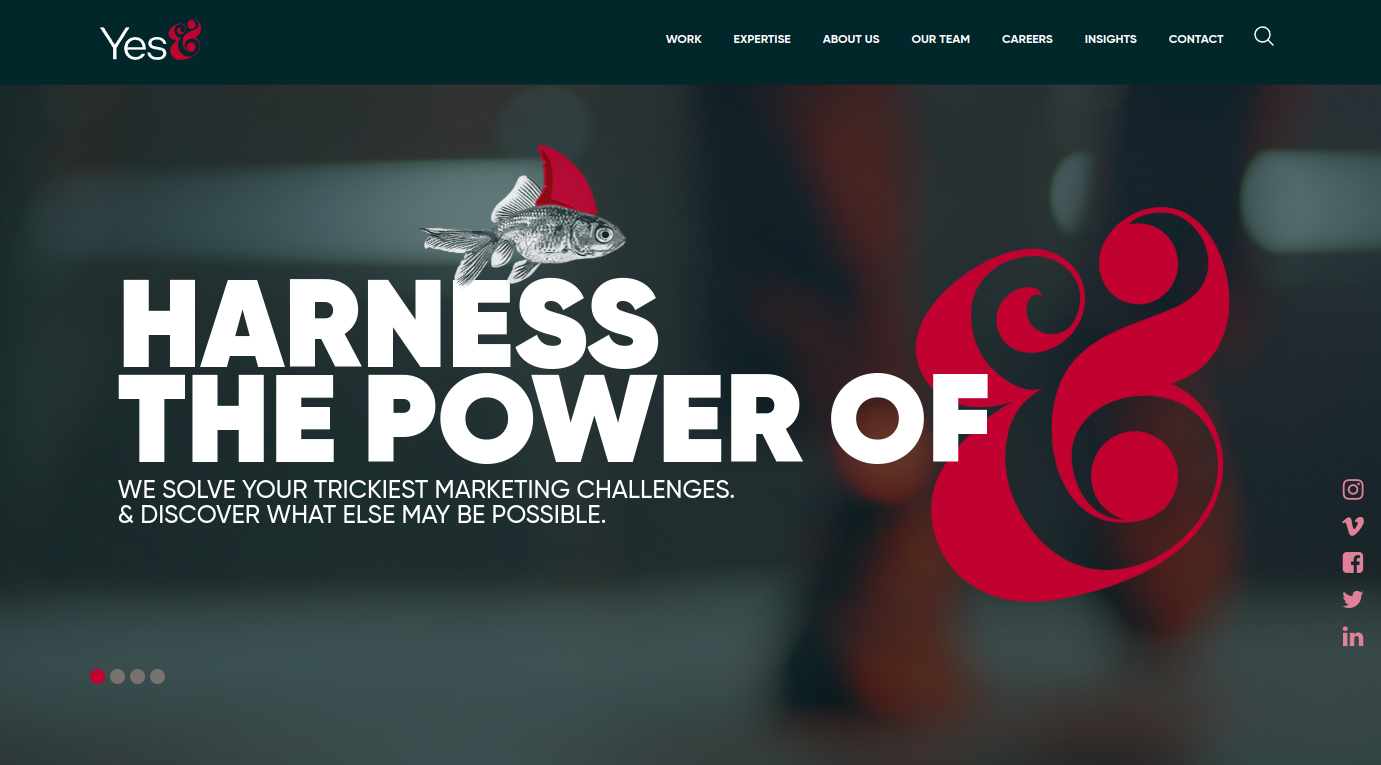
    For IT firms seeking quick results, Yes&</strong; offers short-term, high-impact campaigns, backed by robust PPC and SEO offerings, making them invaluable for launches and branding.

    ```json
{
  "alt": "Miromind website banner showcasing their SEO agency services with high ratings from Upwork and Clutch.",
  "caption": "Discover the power of results with Miromind, a top-rated SEO agency recognized by Upwork and Clutch.",
  "description": "The image is a banner from Miromind's website, highlighting their expertise as a result-driven SEO agency. It features accolades from Upwork and Clutch, indicating their high reputation in the industry. The banner invites users to discuss lead generation for driving sales. The call to action is a 'Contact Us' button, set against a dark blue background with white and blue text for a professional look."
}
```

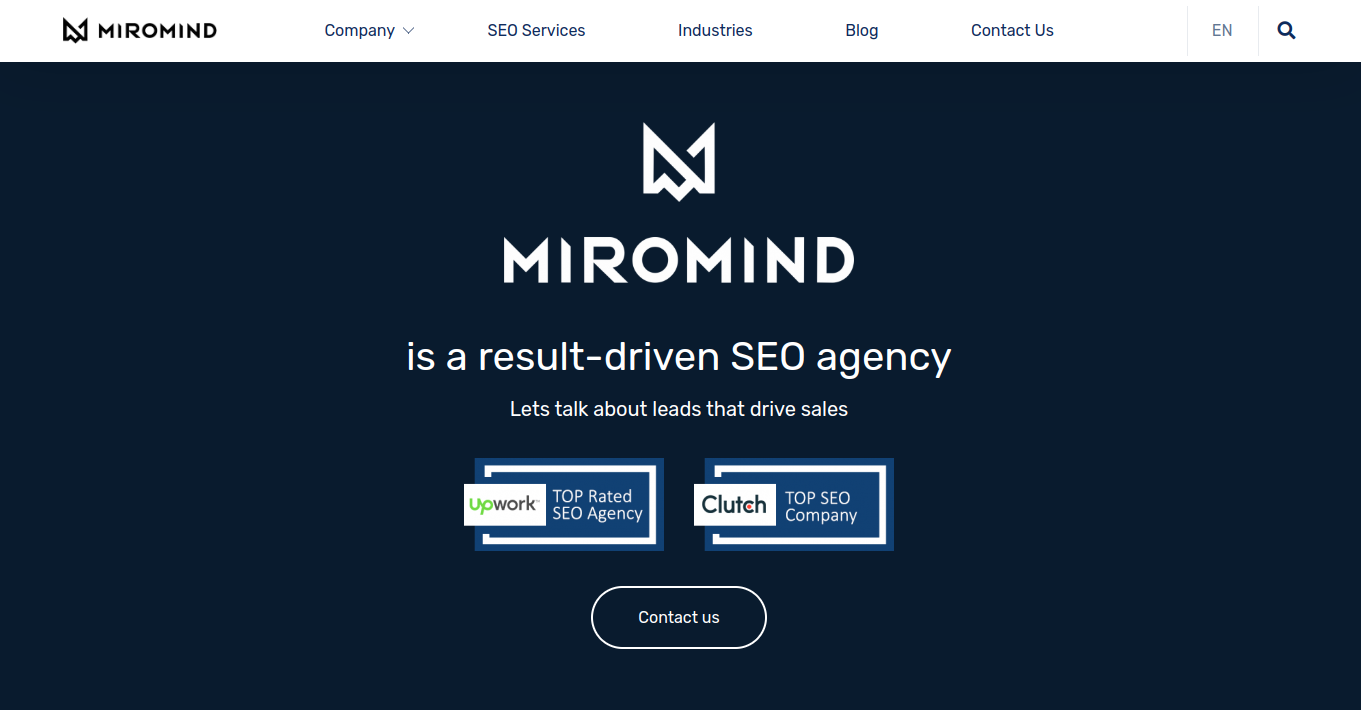
    Finally, MiroMind specializes in international SEO and on-site optimization, positioning themselves as experts for companies needing seamless multi-market strategies.

    These agencies are leading the way in 2026, shaping the future of IT and MSP marketing with their innovative tactics and committed client service.


    Inspired by this post on First Page Sage Blog.


    crushpress.ai community screenshot
  • Uncover the Impact of the DOM on SEO and Web Crawling

    Uncover the Impact of the DOM on SEO and Web Crawling

    Have you ever wondered how the structure of your webpage affects its visibility on search engines? As someone who regularly dives deep into the technicalities of SEO, understanding the DOM (Document Object Model) is crucial for optimizing your site.

    I’ve often encountered discussions about the DOM with developers, and maybe you’ve seen it referenced in tools like Google Search Console. But why does it matter so much for SEO? Let me walk you through its significance and how to optimize it.

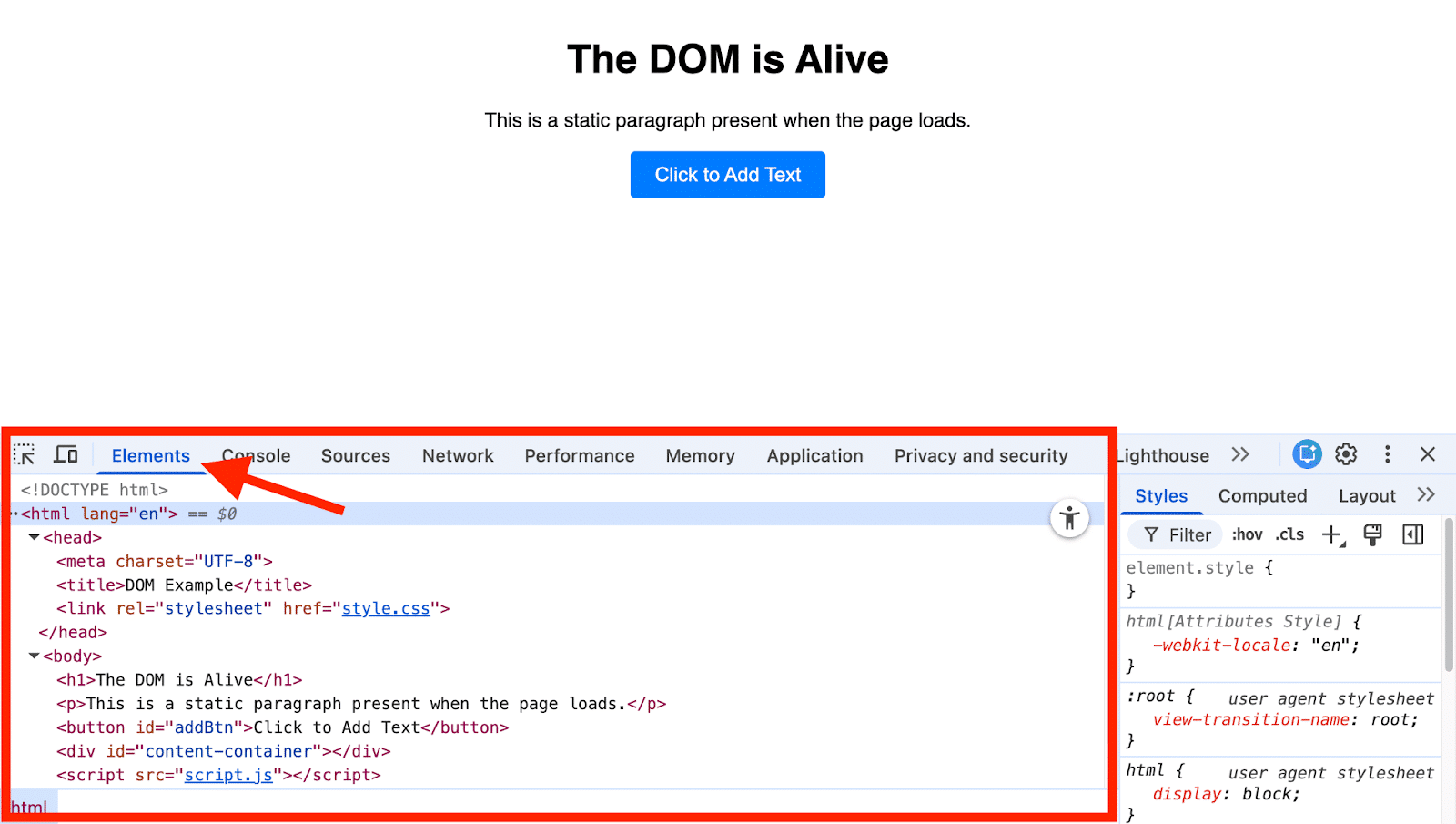
    In essence, the Document Object Model is the browser’s dynamic, in-memory representation of your webpage. It serves as a bridge that allows programs, notably JavaScript, to interact with your content.

    ```json
{
  "alt": "Screenshot showing HTML document structure in the browser's Developer Tools.",
  "caption": "Explore the living DOM! This browser Developer Tools snapshot reveals the dynamic structure of a webpage.",
  "description": "The image shows a browser page with Developer Tools open, highlighting HTML code structure. The page title reads 'The DOM is Alive' with a button 'Click to Add Text'. The Developer Tools display the HTML structure, including document type, head, and body elements. This visual is useful for web developers and those learning about the Document Object Model (DOM) and HTML coding."
}
```

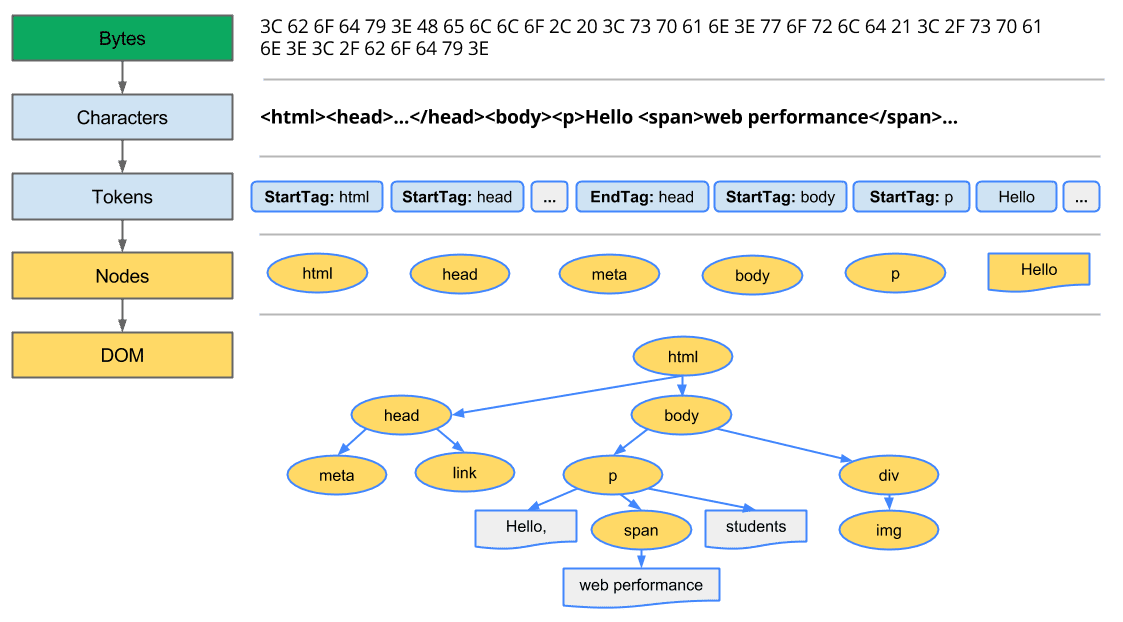
    The DOM is structured like a family tree:

    The document: Acts as the root of this tree.

    ```json
{
  "alt": "The CapmatchOne logo with a gradient circle and bold text.",
  "caption": "Discover innovation with the CapmatchOne logo, featuring sleek typography and a modern gradient circle.",
  "description": "The CapmatchOne logo features bold, modern typography coupled with a gradient circle, symbolizing connection and innovation. The sleek design conveys a sense of progress and creativity. This image can be used for branding or promotional purposes, appealing to audiences interested in innovative solutions and forward-thinking designs."
}
```

    Elements: HTML tags such as <body> and <p> transform into branches or nodes.

    Relationships: There are parent-child-sibling relationships among elements.

    ```json
{
  "alt": "Diagram of web page rendering process from bytes to DOM structure.",
  "caption": "Explore the intricate process of transforming bytes into a fully structured DOM in web development.",
  "description": "This image illustrates the web page rendering process, detailing how a webpage transitions from raw bytes to a structured Document Object Model (DOM). It includes steps of parsing characters, generating tokens, and forming nodes, culminating in a visual DOM tree that displays HTML tags and their hierarchical relationships. Key elements such as 'html', 'head', 'body', and text nodes are depicted. This educational diagram is invaluable for understanding web performance and optimization."
}
```

    This hierarchy is key for the browser and search engines in understanding your content’s structure, helping them discern, for instance, which paragraph is associated with a given heading.

    The exploration of the DOM doesn’t end there. Let’s look at how you can inspect it directly.

    ```json
{
  "alt": "Webpage showing dynamic DOM update where a button click adds paragraphs to the page.",
  "caption": "Witness the dynamic power of the DOM! With just a button click, new content seamlessly appears, illustrating interactive web elements.",
  "description": "This image demonstrates a dynamic change to the Document Object Model (DOM) on a webpage. A button labeled 'Click to Add Text' is clicked, resulting in new paragraph elements appearing on the page. The browser's developer tools window displays the HTML structure, showing the added paragraphs within a highlighted red box. The process exemplifies real-time updates and user interactions in web development, highlighting concepts such as DOM manipulation and JavaScript interactivity. Useful keywords include DOM, web development, JavaScript, and dynamic content."
}
```

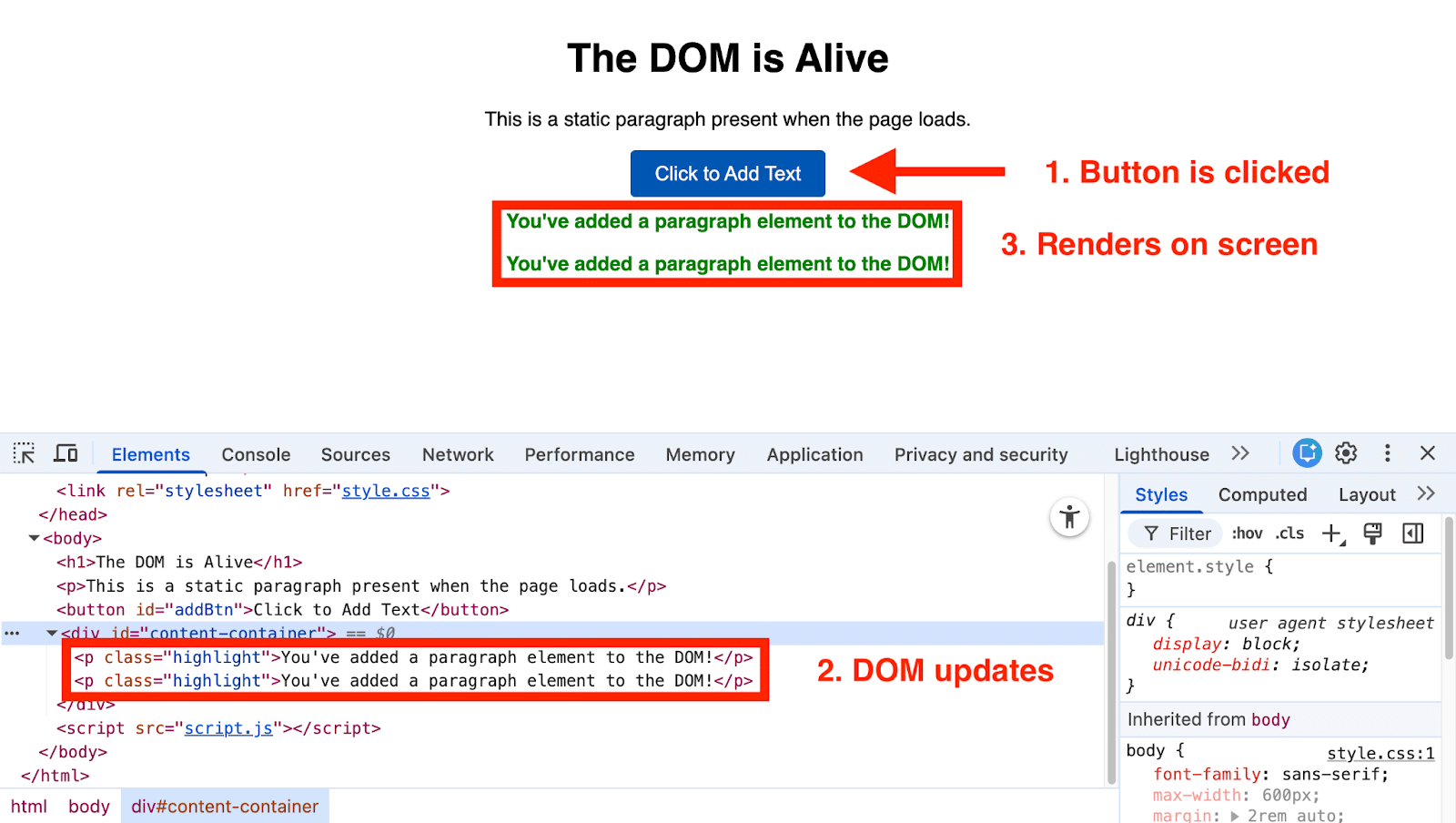
    The DOM, a JavaScript object, can be viewed in a format akin to HTML using browser DevTools—just right-click on your page, select Inspect > Elements, and you’ll see the Elements panel.

    In this panel, it’s easy to dive into the structure by:

    ```json
{
  "alt": "Flowchart illustrating web crawling process from crawl queue to index and rendering.",
  "caption": "A visual guide to web crawling and indexing, showing the journey from URLs to rendered HTML.",
  "description": "The image presents a flowchart of the web crawling process. It starts at the 'Crawl Queue,' moves through 'Crawler,' 'Processing,' and ends at 'Index.' There’s a side process involving 'Render Queue' and 'Renderer,' culminating in 'Rendered HTML.' This illustrates the sequence and relation between different stages in page indexing and rendering."
}
```

    Expanding and collapsing nodes to explore hierarchy,

    Searching for elements using Ctrl+F (Cmd+F on Mac), and

    ```json
{
  "alt": "Google Search Console URL Inspection tool displaying example.com test-page details.",
  "caption": "Google Search Console confirms example.com/test-page is indexed and visible in search results, showcasing effective SEO health.",
  "description": "This image shows the Google Search Console URL Inspection tool analyzing 'https://example.com/test-page'. The page is indexed and available on Google, with enhancements like HTTPS and breadcrumbs. The right panel displays HTML code from the crawled page. The console interface shows options for page indexing and enhancements, essential for tracking website SEO performance."
}
```

    Identifying JavaScript-added or -modified elements as they flash briefly on change.

    However, do remember that this tool sometimes shows a different view from what Googlebot crawls. I’ll delve into this discrepancy a bit later.

    ```json
{
  "alt": "Diagram showing the relationship between a Document Tree, Shadow Tree, and Flattened Tree.",
  "caption": "Exploring HTML Structures: This diagram illustrates the integration of a Shadow Tree into a Document Tree, forming a Flattened Tree for rendering.",
  "description": "This image presents a visual representation of how an HTML Document Tree interacts with a Shadow Tree to create a Flattened Tree for rendering purposes. The Document Tree includes a 'document' node leading to a 'shadow host'. The Shadow Tree branches off from the 'shadow host' and contains a 'shadow root' with two child nodes. The Flattened Tree diagram illustrates how these components combine, using a dashed box to indicate the embedded Shadow Tree structure. This visualization aids in understanding web component architecture and rendering processes."
}
```

    Next, understanding how the DOM is built is essential. It starts with the browser converting the HTML file retrieved from a server line-by-line into tokens, which are then turned into nodes forming a tree structure.

    This tree-building process allows browsers to create a hierarchical structure necessary for rendering the web page you see, which also includes building a CSS Object Model (CSSOM), but this is less crucial for SEO than the DOM.

    ```json
{
  "alt": "Screenshot showing the DOM inspector with shadow DOM elements highlighted.",
  "caption": "Exploring the shadow DOM: A screenshot reveals how elements are isolated within the shadow tree using developer tools.",
  "description": "This image is a screenshot of a browser's developer tools, showcasing the Document Object Model (DOM) inspector with an emphasis on shadow DOM elements. Highlighted in red, the image shows the HTML structure with styling applied inside a shadow root. The display includes elements such as buttons, divs, and scripts, offering a visual guide to shadow DOM implementation and CSS styling. Key terms include DOM, shadow DOM, web development, and CSS."
}
```

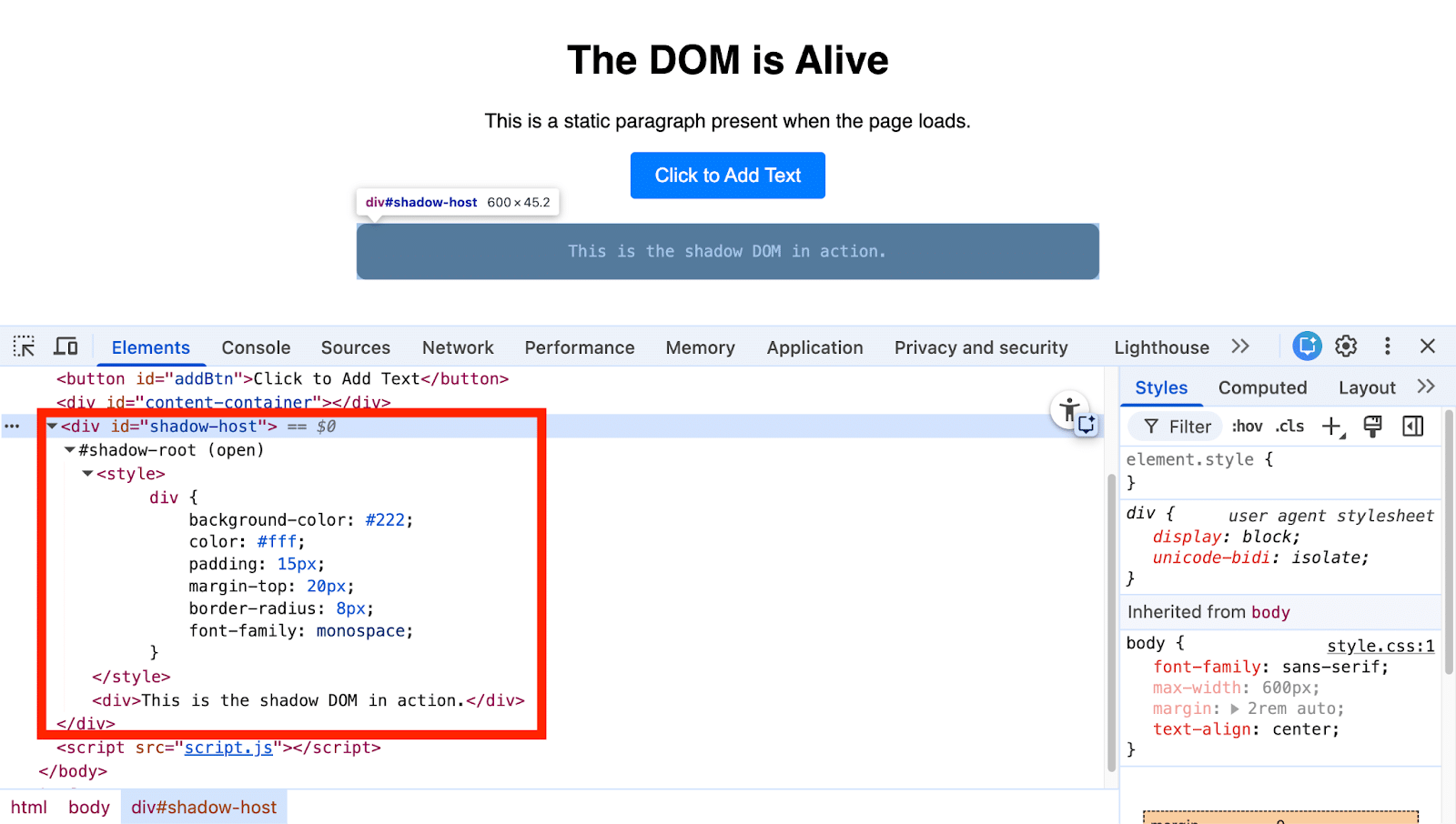
    JavaScript often runs during this DOM construction. On encountering a <script> tag without async or defer attributes, the browser pauses to execute the script before continuing. These scripts might modify the DOM by adding content or changing links, differing from the initial HTML code.

    Let me illustrate this: Each click on a button dynamically adds a paragraph to the DOM, changing the page’s visible content.

    ```json
{
  "alt": "Google Search Console report showing no rich results detected and HTML code with shadow DOM highlighted.",
  "caption": "A Google Search Console report reveals the absence of rich results, alongside highlighted shadow DOM code.",
  "description": "This image displays a Google Search Console report indicating 'No items detected' for rich results. The HTML code on the right highlights the shadow DOM section, showcasing a 'This is the shadow DOM in action.' message. The crawl was completed successfully on Jan 24, 2026. Keywords: Google Search Console, rich results, shadow DOM, HTML code, web development."
}
```

    The original HTML is just a starting blueprint; the final constructed DOM is what the browser utilizes. It can dynamically change based on JavaScript operations.

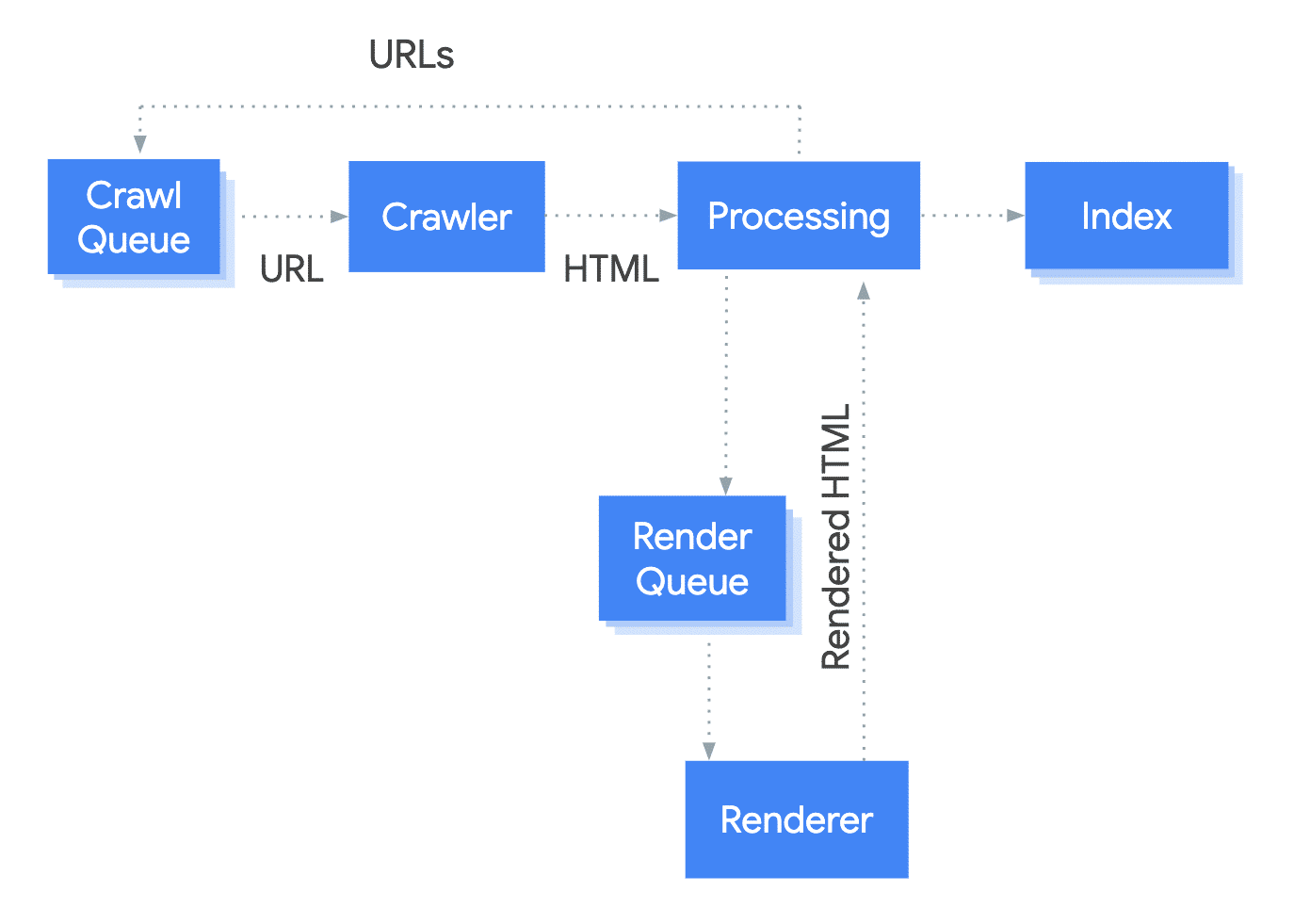
    Why does the DOM matter for SEO? Modern search engines like Google render pages using headless browsers (Chromium). They evaluate the DOM, not just the initial HTML response.

    ```json
{
  "alt": "Web development interface showing HTML and CSS code for an accordion tab.",
  "caption": "Dive into the code! This web development screenshot showcases an accordion menu with tabs and a focus on 'Tab 2'.",
  "description": "This image displays a web development interface with HTML and CSS code for an accordion menu. In the screenshot, an orange arrow points to 'Tab 2', highlighting its content within the HTML code. The browser's developer tools are open, with the 'Elements' and 'Styles' panels visible, providing insight into the code's structure and styling. Keywords: HTML, CSS, accordion, web development, code inspection."
}
```

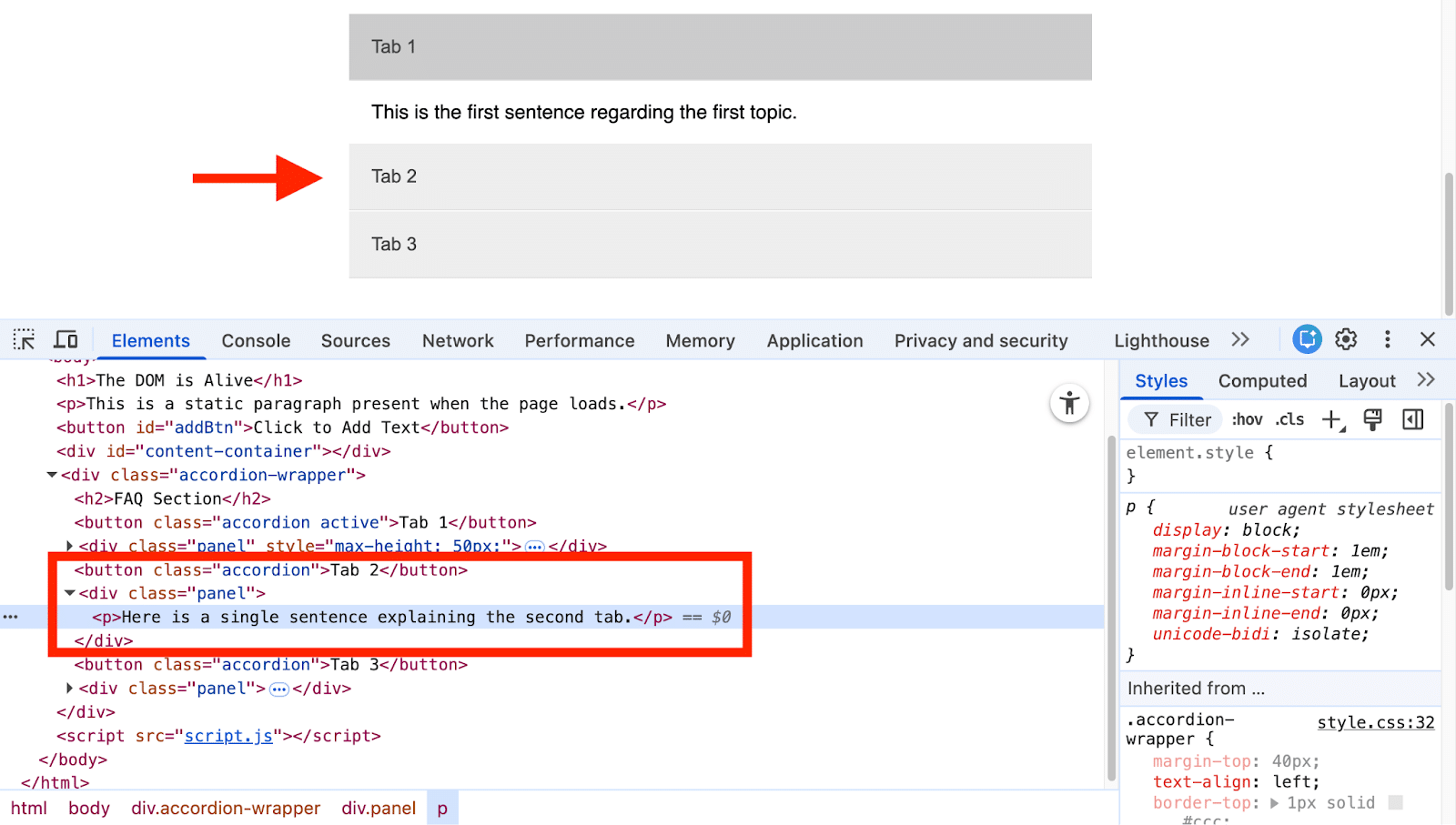
    Googlebot’s crawl process includes parsing HTML, executing JavaScript, and taking a DOM snapshot for indexing. However, remember:

    Googlebot doesn’t interact with pages like humans—content triggered by user actions might go unnoticed.

    ```json
{
  "alt": "HTML snippet showing a paragraph with a hyperlink and an arrow pointing to it.",
  "caption": "Discover how a simple HTML structure with a hyperlink can enhance webpage interactivity. Dive into code and learn more with just one click!",
  "description": "This image displays an HTML code snippet featuring a paragraph element with static text and an embedded hyperlink labeled 'Learn more' linking to 'https://example.com'. A red arrow points towards the hyperlink, emphasizing its clickable feature. The image highlights basic webpage structure elements, contributing to understanding HTML interactivity. Keywords: HTML, hyperlink, web development, code snippet."
}
```

    Other crawlers might not render JavaScript, missing out on JavaScript-dependent content.

    With AI agents harnessing DOM data for task execution, a well-structured and accessible DOM becomes ever more crucial.

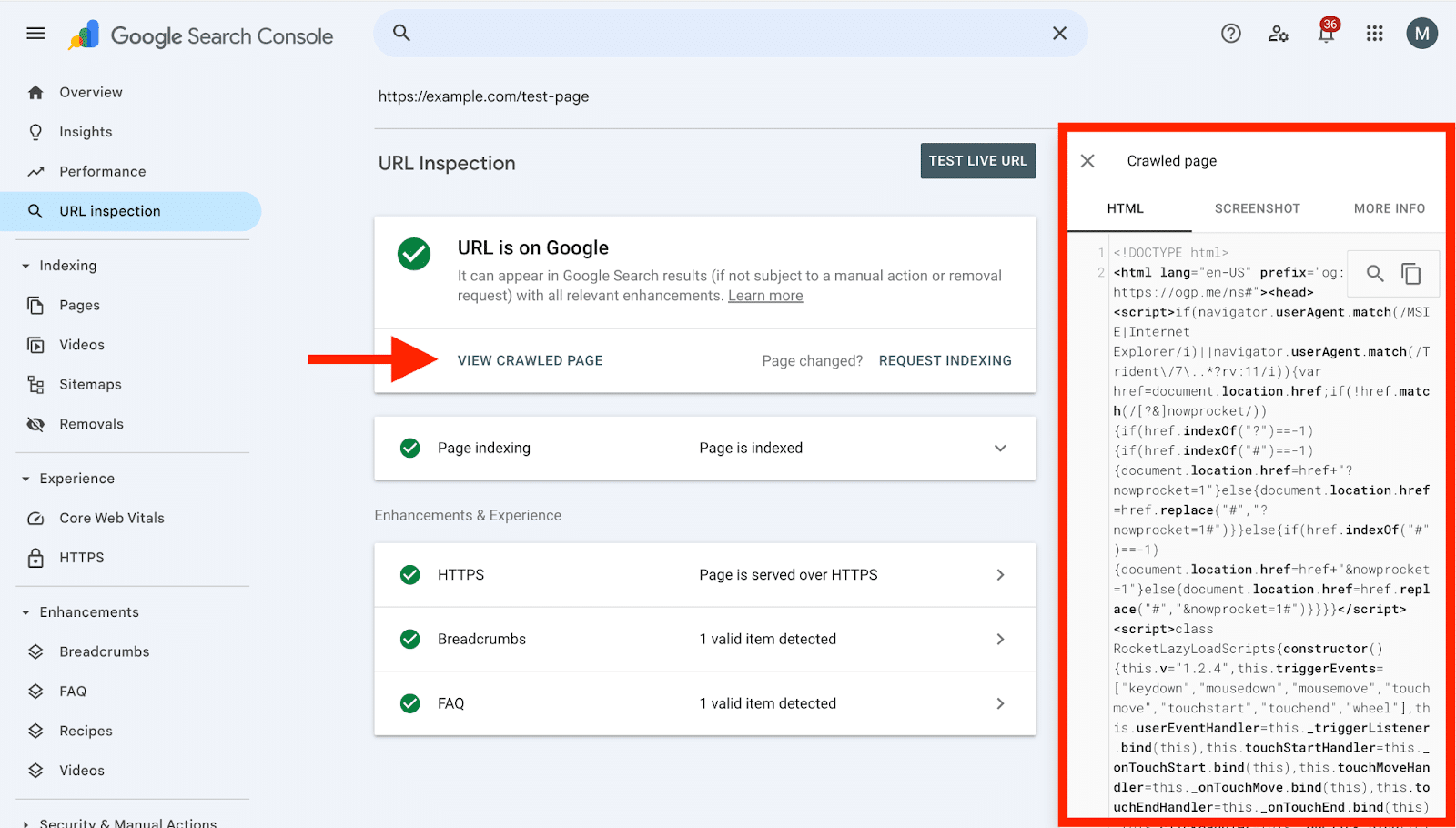
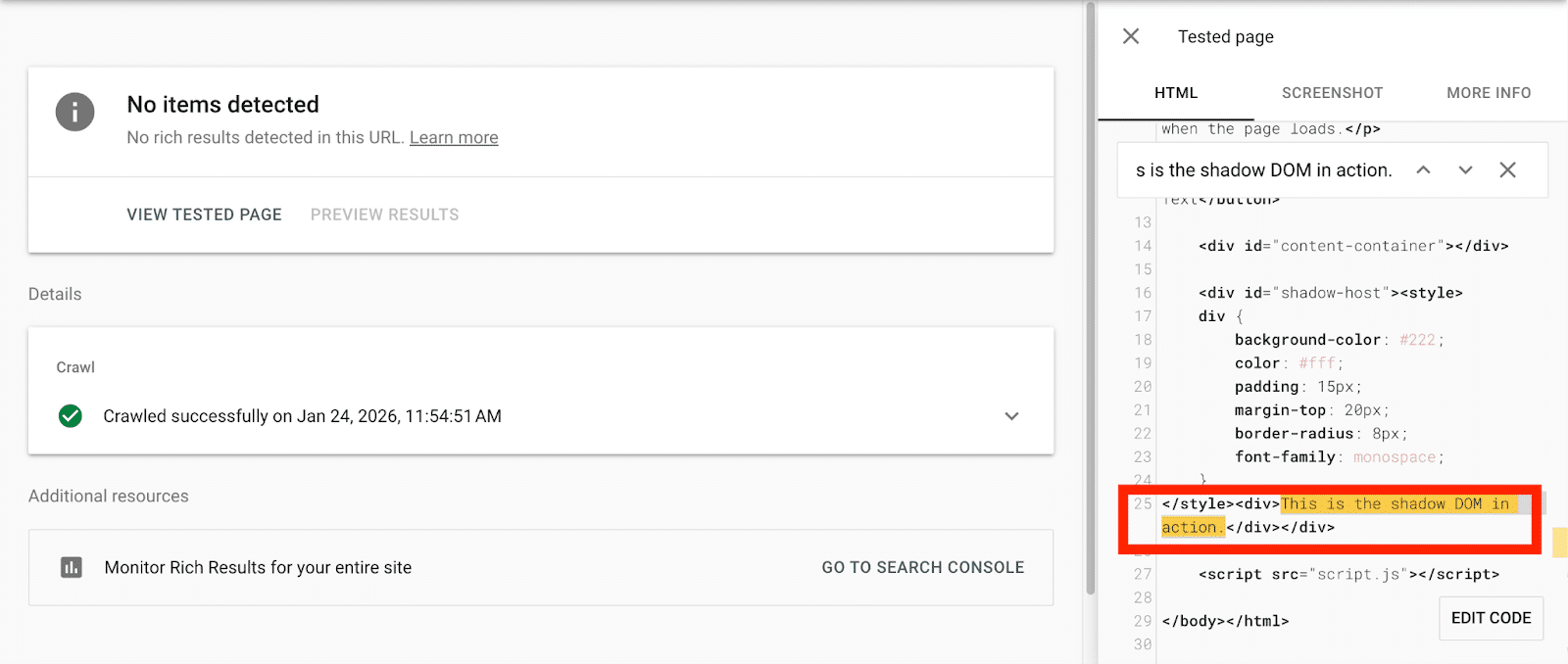
    Verifying what Google sees via Google Search Console’s URL inspection tool reveals the rendered HTML version indexed by Google, showcasing any issues.

    Using this tool can alert you to discrepancies in what Google indexes versus what you expect, impacting your SEO efforts if overlooked.

    For instances without console access, you can resort to Google’s Rich Results Test for similar page insights.

    To ensure your webpages are crawled and indexed well, here are some best practices:

    Make sure significant content loads in the DOM by default—Googlebot doesn’t interact beyond initial page loads.

    Use proper <a> tags to ensure links are crawlable, avoiding JavaScript-based navigation that search engines don’t execute.

    Maintain a clear semantic HTML structure. Search engines rely on tags like <header>, <article>, and <section> to understand content organization, unlike ambiguous <div> nesting.

    Keep your DOM lean—under about 1,500 nodes—to avoid performance lags and enhance user experience.

    In a digital landscape increasingly reliant on AI interactions and advanced crawling methods, understanding and optimizing the DOM is key to maintaining your site’s SEO competitiveness.


    Inspired by this post on Search Engine Land.

    crushpress.ai community screenshot
  • Google Updates JavaScript SEO: Accessibility Advice Removed

    Google Updates JavaScript SEO: Accessibility Advice Removed

    I recently discovered that Google has adjusted its JavaScript SEO guidelines by removing the ‘design for accessibility’ section. This decision was made because the advice was deemed outdated. Nowadays, Google handles JavaScript smoothly.

    When Google announced the change, they explained the section was no longer as useful as it once was. Previously, they warned that JavaScript might obscure content from Google, but clearly, that’s not an issue anymore.

    The Old Advice. Here’s what the original guidance stated:

    “Design for accessibility: Create pages for users, not just search engines. When designing your site, consider users who might not use a JavaScript-capable browser, like those with screen readers or less advanced mobile devices. Test your site’s accessibility by viewing it with JavaScript turned off or in a text-only browser like Lynx. This can help identify content hard for Google to see, such as text in images.”

    Why It Was Removed. Google clarified:

    • “The information was outdated and less helpful. Google Search has successfully rendered JavaScript for years, so using it for content loading doesn’t hinder visibility.”
    • “Most assistive technologies can now handle JavaScript as well.”

    The Importance. Even though Google is adept at processing JavaScript, it’s still critical to verify what Google Search sees. I recommend using the URL inspection tool within Google Search Console to ensure everything checks out.

    Remember, while Google and probably Microsoft Bing manage JavaScript efficiently, some emerging AI engines might not render it as effectively.


    Inspired by this post on Search Engine Land.

    crushpress.ai community screenshot