I recently discovered a new help document from Google that explains how their web crawlers operate. This document aims to offer basic educational information about crawling, highlighting key resources available to site owners.
There are currently nine essential insights listed in the document, and they’re pretty enlightening!
Frequent crawling is a good sign! It indicates that your site’s pages contain fresh or highly relevant content that attracts attention. Google specifically mentions, “If we’re crawling your site a lot, it’s an indication your pages have fresh or highly relevant content that people want to find, and that our systems are recognizing that demand. Online shopping is a great example: we crawl ecommerce sites often so that our results will display retailers’ most up-to-date prices, promotions, and inventory status.”
What’s included in the guide? Here’s a quick overview, though I’d definitely recommend diving into the document for a detailed read. It’s not new information, but it serves as a beneficial refresher:
What is crawling? In short, crawling is how Google “sees” the web.
Google uses numerous crawlers, each tasked with different jobs.
Repeat crawls help provide the freshest search results by catching the latest updates.
Frequent crawling remains a positive indicator!
With the increased complexity of pages over time, Google’s crawling has evolved.
Crawling is automatically optimized.
Google doesn’t access paywall or subscription content without consent.
Site owners have control over what gets crawled and how.
Respect for robots.txt and other instructions is a standard for Google’s crawlers.
Why does this matter? The art of crawling is a cornerstone of SEO, essential for being visible in Google Search and other platforms. This new help document can serve as a guide to enhance the crawlability of your site.
Before I dive into updating my Conversion Rate Optimization (CRO) strategies for AI, it’s crucial to focus on the basics first. Clear messaging, robust user experience, and technical precision are still the foundation of successful CRO efforts.
Every marketer wonders how CRO and findability differ between AI systems and humans. Do different strategies cater to AI needs versus human needs, or is there common ground?
As more marketers adopt AI-powered discovery tools, understanding how CRO functions for AI agents compared with humans is crucial. Despite various considerations, the main takeaway is straightforward: effectively serving people also enhances AI findability. Though technical aspects are important, drastically different strategies for AI compared to humans aren’t necessary.
Understanding CRO Beyond the Website
When customers interact with my business directly through AI or agents, my information needs to be clear and actionable. This means having clean, well-structured data that’s easily processed by downstream systems.
With more consumers using AI assistants, it’s important that my products and services seamlessly connect. Standards like Model Context Protocol (MCP) help agents effectively engage with shared information sources.
Sometimes, humans still prefer to interact directly on a brand’s website. In these cases, my content and formatting must consistently enable users to take the actions they want, whether through paid media or organic avenues.
In the past, SEO strategies suggested maximizing keywords and text blocks. That’s no longer the case.
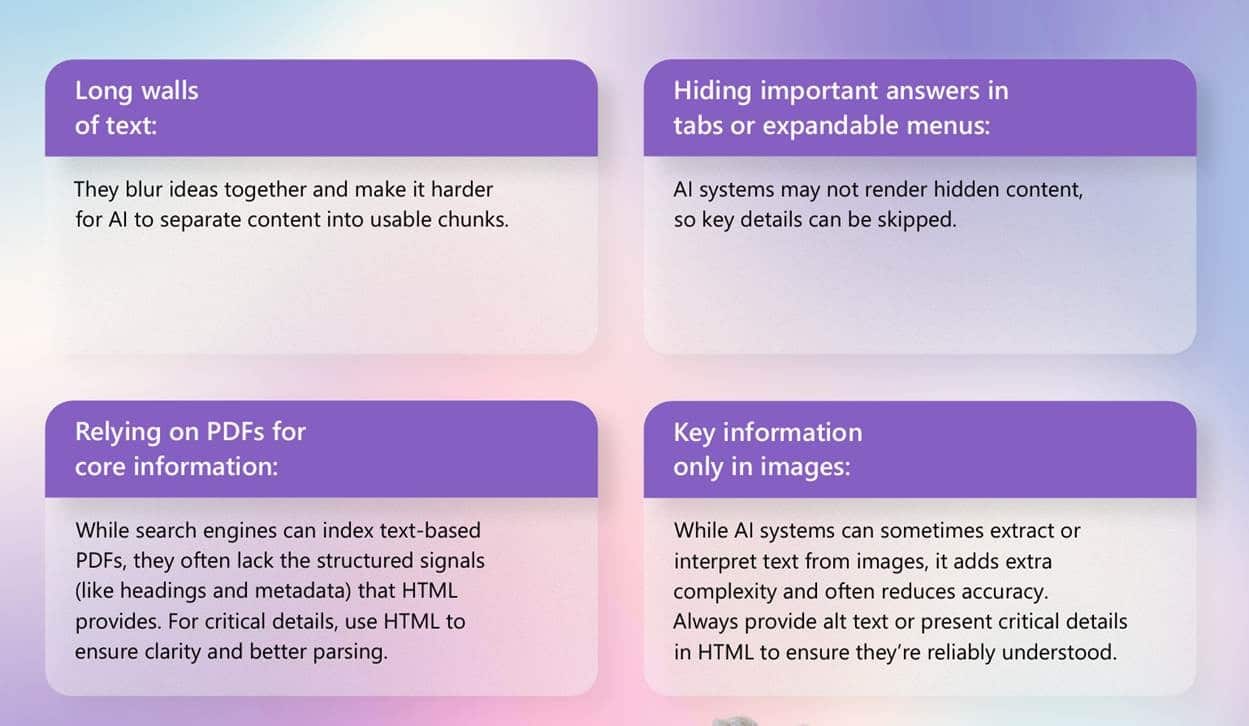
Both humans and AI favor well-structured, modular content. People find dense text blocks difficult to scan, which leads to misunderstandings. A clear layout with good spacing and a visual hierarchy helps users quickly grasp their objectives on the page.
There’s no perfect text amount for every situation. I aim to provide just enough content to clearly describe my offering, its benefits, and what makes it unique.
Visual elements, complete with effective alt text, can enhance user experience. Lead generation forms should be simple for humans to use and regularly tested to minimize spam or friction. Difficult content creates hurdles for both humans and automated systems.
The best way to communicate effectively with systems is to communicate well with people. I focus on showcasing my expertise without using excessive jargon. Descriptions should be precise, honest, and reflect the brand.
A simple test: If a 10-year-old can’t roughly understand what I offer, why it’s valuable, or how to engage, my messaging is overly complex. Even with sophisticated AI systems, clarity remains key to achieving human-focused outcomes.
If clarity is an issue, I might ask an AI assistant to critique my position statements. The goal is to simplify and clarify without adding embellishments or unfounded claims.
Visual aids like comparison tables can be useful if they genuinely clarify information. They can be detrimental if used as mere design gimmicks. Accessibility is paramount: adequate color contrast, readable fonts, and moderate font choices are necessary for everyone to access my site.
Images should be easily understood and relevant to their accompanying text, with alt text supporting users with assistive technologies and reinforcing content relations.
Optimization 3: Effective Calls to Action
People visit my site for a purpose, whether it’s shopping, requesting a quote, or contacting my team. They need to know what action to take.
When the intended action lacks clarity, it confuses both users and automated systems.
Good shopping experiences align with shopping intentions, as assistants aim to fulfill tasks they’re set to do. If checkout processes are unclear, it obstructs human businesses with me and AI might fail to understand my site’s transactional nature.
Lead generation also demands transparency. Include clickable phone numbers for calls, submit forms to lead systems, or initiate email clients. Avoid frustrating users with complex, multi-page forms.
Technical adjustments come last for a reason: the primary goal is to support my audience. Technical tweaks can help but aren’t game-changers on their own.
Excessive imagery, low text-to-background contrast, or unstable layouts can create usability issues.
Ensuring consistent and meaningful rendering is important for my site. Large layout shifts that occur after page load, measured as cumulative layout shift (CLS), frustrate users. Pages flooded with ads or pop-ups detract from their primary purpose, raising trust concerns.
Security is non-negotiable. Malware warnings, display issues, and incomplete page loads worry both users and automated systems.
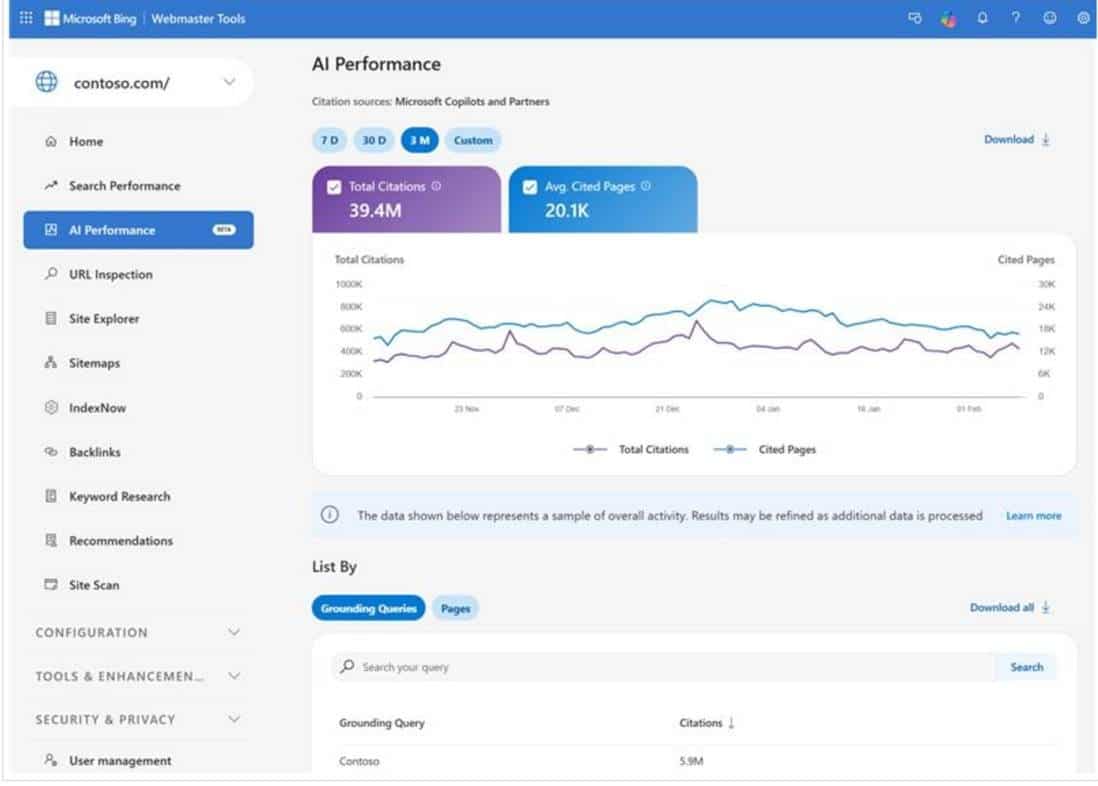
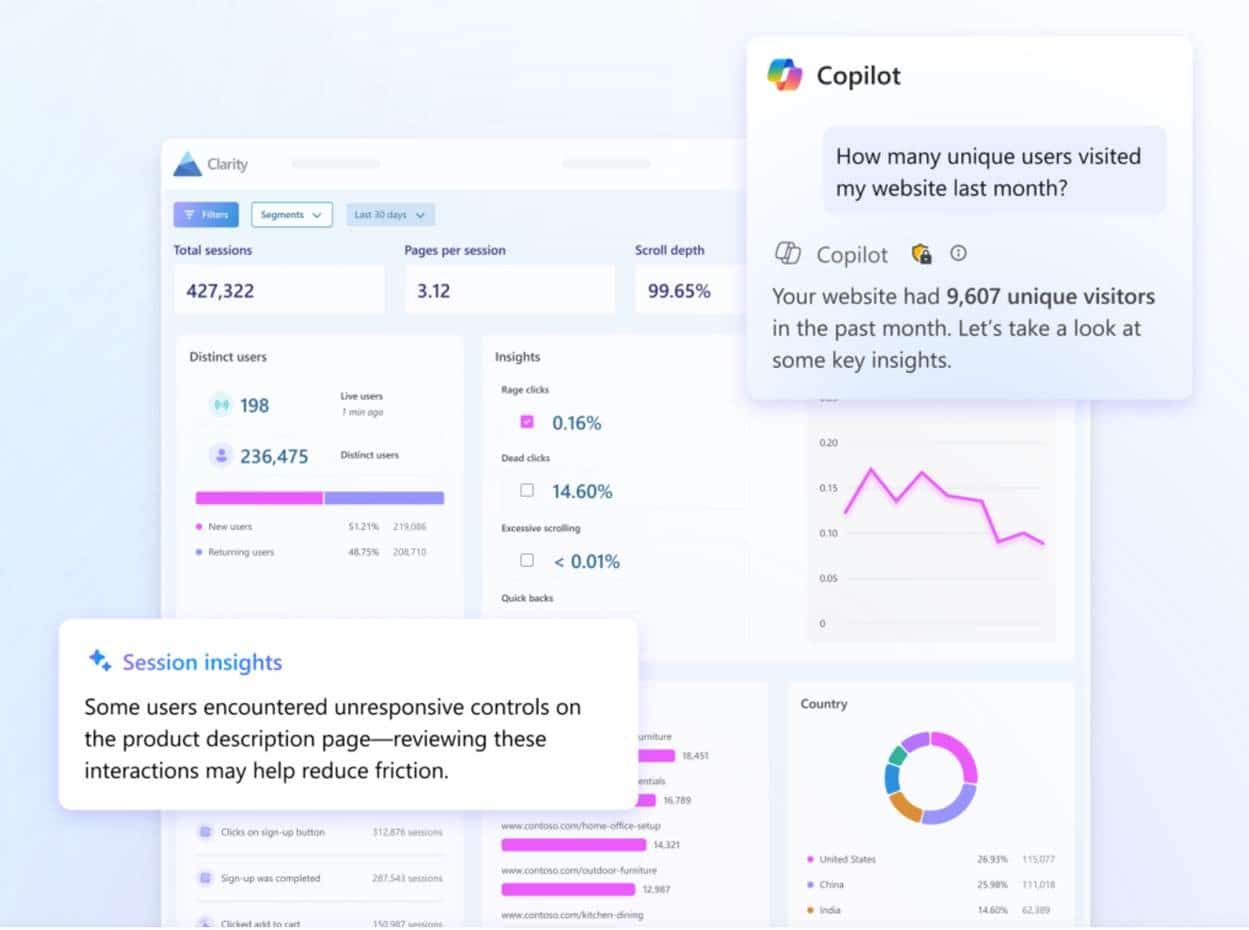
Using tools like IndexNow helps alert search engines about content updates faster. Microsoft Clarity is free and provides insights into user site behavior, identifying friction points that might go unnoticed without it. It’s particularly handy for improving chatbot experiences.
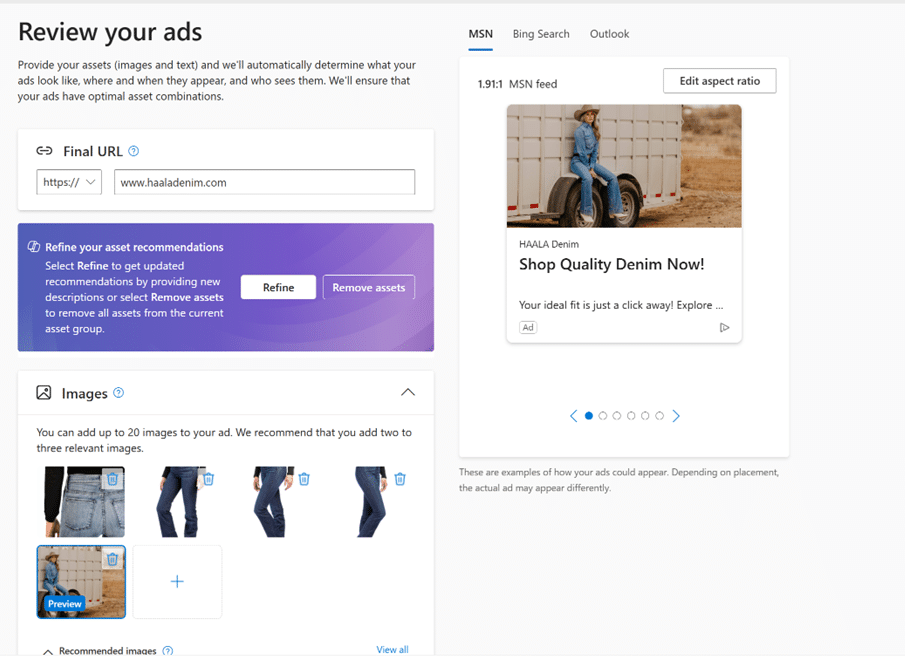
What’s more, utilizing ad platforms and auto-generated creative tools, like Performance Max campaigns, can be enlightening. They offer glimpses into how platforms interpret my content. If the output aligns with my intentions, I’m properly serving both humans and systems. If not, it’s a sign to reevaluate clarity and user flow.
As someone who’s been working with brand content for a while, I’ve gathered quite a bit of material that could use a refresh to improve our presence in AI-generated search results. In this context, let’s call this AEO—Answer Engine Optimization—to encapsulate our strategy going forward.
Recently, I’ve been fielding a lot of questions from brand marketers eager to enhance their AEO. To them, the suggestion of revising old content has often been an illuminating solution.
This insight opens up several important follow-up questions that I’d like to delve into now.
How do you reformat content for better AEO performance?
When it comes to content reformatting, I follow these core principles: topical breadth and depth, chunk-level retrieval, and answer synthesis.
Topical breadth and depth.
Chunk-level retrieval.
Answer synthesis.
Let me break down what these mean in practical terms.
Optimize for topical breadth and depth
I organize my site using a hub-and-spoke model. This involves creating a hub page for each main category or keyword theme, which serves as a comprehensive introduction and links to detailed spoke pages.
Each spoke page tackles one specific aspect in detail, which helps in addressing various user questions and broadens the overall topical landscape for our content.
By linking related spoke pages to each other and back to the hub, I reinforce content connections, providing AI systems with clearer signals about topic relationships.
Optimize for chunk-level retrieval
I focus on making each content chunk comprehensible on its own, without relying on the entire page for context. This involves crafting sections that are semantically tight, with each focused on a single idea.
Keep each passage tightly centered on one concept — Our Family Wizard does an excellent job of this
Optimize for answer synthesis
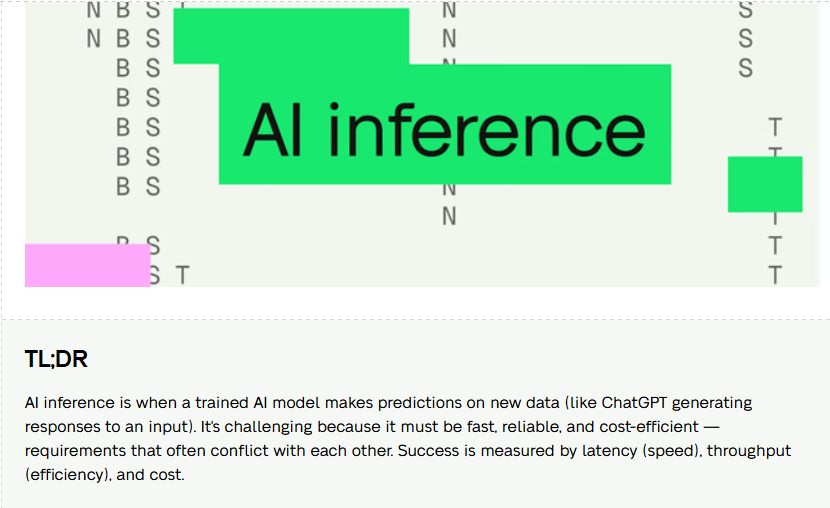
I start answers with a clear, concise sentence, then elaborate using well-structured summaries like “Summary” or “Key takeaways.” A plain, factual style works best.
Here’s an example of effective formatting from Baseten, which places a TL;DR summary at the beginning of a post discussing AI inference:
My experience so far has been that AI readability, focused on clarity, actually appeals to human readers who appreciate content they can understand quickly.
AI systems resonate with content that:
Names rather than infers answers.
Has sections with clear intent.
Allows easy extraction of key points without rewriting.
In some cases, it requires being more explicit than traditional SEO practices, like defining terms upfront, summarizing sections, and providing conclusions early on.
The challenge for me is balancing clarity with nuance, especially since AI-produced content can sometimes oversimplify intricate details.
When optimizing, I focus on:
Explaining initially, then expanding.
Identifying insights, then substantiating them.
Presenting the answer before adding any complexities.
This strategy makes the content appealing for both AI and human audiences.
Although, I’ve noticed that AI-generated content sometimes feels too generic, especially when it lacks personal perspectives and insights not readily available online.
I keep an eye out for AI content characteristics like the “dreaded em dash” and aim to remove them when refining my content.
How do you approach metadata when revising content for AEO?
While SEO uses metadata as ranking levers, in AEO, these elements act as context anchors.
Let’s dive into some key elements.
Title tags
For AEO, title tags should describe the page’s main answer or purpose in addition to the topic.
A title like “Session replay software” might become “Session replay: what it is, when to use it, and when not to use it.” Clearer signals aid AI citation decisions.
Headings (H1-H3)
Rather than generic headers, I align them with specific questions or assertions suited for user inquiries.
What is compliance monitoring?
Why does compliance monitoring matter for {x} industry?
Issues from lacking compliance monitoring
When to invest in compliance monitoring?
If answering these takes more than a few sentences, it likely needs refinement for clear, direct responses.
Meta descriptions
In AEO, meta descriptions serve as a compressed intent signal rather than appearing directly in search results.
They should clarify:
The target audience of the content.
The problem it addresses.
Its framing context.
Viewed through the AEO lens, they function as concise briefing notes for both users and AI systems.
While SEO and AEO often align, understanding where they diverge helps optimize for AI search visibility.
I’m not suggesting a drastic shift in strategy, but recognizing that AI engages with content differently from traditional algorithms is crucial for repurposing valuable content.
I’ve recently learned that ChatGPT has hit an extraordinary milestone: over 900 million active users every week. OpenAI proudly shared this achievement for the first time, and it’s nothing short of remarkable.
Why It’s Significant. Our online habits are evolving, extending beyond conventional search methods. With so many users turning to ChatGPT weekly, it’s clear that interactions and discoveries are shifting to AI platforms. However, as users, we often still seek reassurance from traditional search engines.
The Facts. OpenAI didn’t just stop at sharing user figures; they also unveiled a substantial $110 billion funding round. Additionally, they’ve gained over 50 million consumer subscribers and more than 9 million businesses are paying clients.
What This Means for Us. ChatGPT isn’t just a chat tool; it’s a competitive landscape where search, intent, and brand visibility meet. Understanding how our content appears in AI-driven results is crucial for boosting conversions, even if these interactions aren’t traditional searches.
OpenAI’s Announcement. For further insights, you can check out OpenAI’s official statement on Scaling AI for everyone.
I’ve noticed a shift in SEO from the traditional “rank, click, and convert” strategy towards a new model that emphasizes being scraped, summarized, and recommended. This change marks the beginning of the dark SEO funnel era, transforming how we measure success in search engine optimization.
Today, up to 84% of B2B buyers use AI tools to discover vendors, and an astounding 68% initiate their search journey with AI rather than Google, according to recent data from Wynter. It’s clear that tools like ChatGPT influence initial decisions, with Google merely acting as a verifier.
If, like me, you’re still considering SEO success through traffic, you’re likely focusing on an outdated model. Here’s what we need to prepare for.
Marketing professionals are already acquainted with the concept of dark social, where sharing happens away from trackable channels. Dark SEO is its algorithmic counterpart, where AI, rather than peers, offers brand recommendations, followed by a Google search for validation.
In this new phase, traditional analytics fail to capture the path from ingestion to recommendation to verification—all obscured within the dark SEO funnel. This gives direct or branded search undue credit, even though the groundwork was laid by SEO.
In this evolving dynamic, Google’s role is changing. A surveyed CMO mentioned using Google only when they know exactly which software or product they want. AI is for evaluation, Google is for verifying—a fundamental shift in our understanding of search behavior.
To succeed, we must understand two visibility types: brand mentions and LLM citations. In traditional SEO, the aim was to get clicks from links. In AI-driven search, it’s about visibility. An LLM could highlight your brand when relevant, impacting how users perceive and search for it.
Brand mentions occur when an LLM explicitly names your brand as a preferred solution—something influenced by your brand’s presence in relevant conversations and media. On the other hand, URL citations represent instances where AI uses your data as a credible source, an opportunity driven by unique data and information gain.
Emphasizing on relevant platforms like review sites and communities helps establish authority. As AI algorithms recognize your brand’s consistent presence, it can become an authoritative recommendation source.
When direct traffic is no longer a primary metric, leadership desires proof that SEO remains effective. This involves measuring more than just clicks. We should pivot to metrics like LLM recommendations visibility, branded traffic, product page visits, and conversion rates.
Ultimately, we’re heading towards a state where brand visibility is the triumph, and traffic is its byproduct. Adapting to this dark funnel era means we need to prioritize inclusion, recommendation, and intent over traditional traffic metrics. By focusing on high-intent queries and third-party visibility, you ensure the strategic progression of your brand in this new SEO landscape.
The past year has been a whirlwind as we all tried to grasp how to report on AI visibility and understand what it truly takes to be seen and cited by AI models.
Rand Fishkin’s recent study on the variability of AI responses pointed out how LLM outputs differ significantly from the stable and predictable nature of search rankings, making this KPI a challenging aspect of the analytics landscape.
The research illustrates a less than 1% chance that ChatGPT or Google AI will provide the same brand list in two different responses. They scrutinized thousands of prompts across various LLMs, revealing their unpredictable nature.
This unpredictability has led some in the SEO community to question the value of rank tracking on a broad scale. Despite these challenges, rank tracking remains a valuable, albeit misapplied, tool.
While AI response tracking is currently an unstable KPI, it proves to be incredibly potent when used as an analytical tool to inform content strategy.
I’m diving into why we should continue investing in prompt tracking and how this effort can illuminate our content strategy.
Why AI Visibility Tracking is Currently Unreliable
Understanding that language learning models aren’t deterministic ranking machines is crucial. They are probabilistic, synthesizing information from trained data or live searches, providing varying answers influenced by context and intent.
Responses shift depending on the prompts, and identical questions can be phrased in multiple ways, which can lead to challenging questions from your CMO about why certain prompts do not feature your brand despite previous citations. It’s a natural outcome in the evolving landscape of AI-driven visibility.
Even though tracking visibility might be uncertain until user prompting becomes clearer, it remains a valuable aspect of SEO analytics.
If we consider prompt response tracking not as a stable KPI but as a pattern analysis, it becomes something SEOs are already quite familiar with.
Shifting focus from merely checking if you are cited or listed to understanding how responses are structured offers more insightful strategies. Analyze these factors:
The structure of the response.
Recurring concepts.
Key phrases and terms.
Typical levels of detail involved.
This shift in mindset is imperative.
Traditional SEO vs. AI Pattern Analysis
Traditional SEO involves reverse engineering rankings, whereas AI search encourages us to apply this method by uncovering patterns in AI-generated results.
Traditional SEO
AI Pattern Analysis
Focus on rankings
Understanding concept synthesis
Content gap analysis
Topic associations
Fixed SERP results
Dynamic AI responses
Determined signals
Probability-driven responses
Through analyzing prompt response patterns, we can dive deep into content-level concept synthesis, beyond the technical framework.
In defining a pattern, look for the themes and recurring topics rather than exact response consistency across outputs.
Each LLM formats its outputs uniquely, yet patterns often emerge within the structures, despite differing retrieval methods and functionalities.
For identifying a pattern:
It appears in 75% or more outputs.
Observed across two different AI models, like GPT and Gemini.
Present across multiple prompts in a consistent way.
The 75% benchmark felt stable enough for my sample sizes to confirm strong patterns rather than randomness. You can adjust this based on your content and context, but this approach has helped me sift consistency from the noise.
For instance, if “pricing transparency” shows up in 9 out of 12 responses and across two models, that indicates semantic relevance—a crucial insight into your content strategy.
The Framework to Implement
Here’s how you can apply this for yourself with a structured framework.
Segment your analysis into the following pattern types:
Structural patterns.
Conceptual patterns.
Entity patterns.
Structural Patterns
Focus here on the organization of responses, identifying aspects like:
Header and section frequency.
Consistency in list formatting.
Order or procedural steps.
Framing of pros/cons.
Comparative tables.
Decision-making frameworks.
These indicators can show how models structure topics.
For example, if your prompt’s outputs repeatedly follow: Definition > Criteria > Tools > Implementation, that’s a structural pattern. Use it to gauge user preferences, although it’s crucial to remember that AI suggestions are just tools to enhance content alignment.
Conceptual Patterns
These vary per topic. They might require deeper analysis to uncover. For example, when focusing on “Best domain registrars,” you might look for:
Pricing transparency (renewal and purchase).
Customer service references.
Inclusion of addons (e.g., WHOIS privacy, free emails).
Security features.
Bundling opportunities.
Transfer processes.
If renewal pricing often emerges in different models and variations, adjust how you frame and discuss it in your content pieces to reflect high relevance.
These patterns offer insight into decision-making associations within AI model frameworks.
Entity Patterns
Examine the appearance of brands, tools, and references in responses, noting:
Mentions of specific brands.
Tool or feature associations with brands.
Category positioning within context.
Sourced citations and their relevance.
Evaluate how certain features align with specific brands, or notice frequently cited sources. This evaluation helps in assessing brand positioning and opportunities, maybe even within affiliate environments or third-party collaborations.
Constructing Your System
It’s not necessary to invest heavily in prompt-tracking tools, although they simplify the process—I manage with manual tracking, which, despite not being perfect, serves its purpose effectively.
If you’re working solo, adjust the methodology to fit your capacities. This might involve extended tracking periods or lowering pattern consistency thresholds from, say, 75% to a more feasible 60%.
Step 1: Choose and Cluster Your Prompts
Identify three main topics to monitor. Develop 3–5 variations of prompts for each topic.
For example, if one topic is domain registration, my cluster includes:
How do I register a domain name?
How can I get a domain name?
Where can I buy a domain?
Step 2: Create Your Tracking Sheet
To track responses, consider using a simple spreadsheet with columns like this:
Prompt
LLM
Web Search? (Y/N)
Date
Response
Sources (if applicable)
Is My Brand Mentioned?
Track LLM versions under the appropriate column to understand when new versions are released and how they impact your data.
Begin capturing this data, then enhance the sheet as needed to include pattern elements. Tools like Claude or ChatGPT can assist in automation, reducing manual labor.
Step 3: Develop a Tracking Plan and Begin Monitoring
To ensure effectiveness, define:
Which AI models to track.
Options for search mode—enabled, disabled, or model-decided.
The prompt frequency to run each test on each model.
Tracking schedule or frequency.
Engage team members wherever possible and use private modes to reduce contextual biases.
Every week, my team tests each prompt on platforms like ChatGPT and Perplexity, collecting several responses per prompt per model consistently.
Step 4: Conduct Analysis
Once you compile 20-30 responses per prompt, delve into the analysis phase. Select tools to streamline this process effectively.
Identify recurring patterns and link these insights to your site’s relevant pages. Ensure your content addresses discovered themes and questions, and consistently represents the patterns found.
Assess and revise consistently, making this analysis an integral part of your optimization strategy.
Beware of AI Pattern Analysis Pitfalls
AI is inherently probabilistic and not always correct. While it shouldn’t be the sole basis of your strategy, it can offer valuable insights to enhance your playbook.
Risks such as bias in training data, uncertainty in whether search or training data was utilized, and differences in new model launches across LLMs persist.
Use judgment and audience insights to determine when AI responses align with your optimization goals.
Linking Your Strategy to Performance
This is where it gets complex. Though AI responses are notoriously unpredictable, some measurable signals can reflect your content’s impact.
“Traditional” Metrics: Are you seeing better click rates or improved positions in tools like GSC? Are conversions increasing?
AI Traffic Monitoring: Analyze AI traffic data from platforms like Adobe or GA4 to note changes on updated pages.
AI Tracking Tools: While there’s variability here, if utilizing AI visibility tools, they might indicate the effectiveness of your strategy and reflect brand patterns using manual tracking as well.
I recommend experimenting with this manual tracking approach to witness potential brand emergence as a pattern and gain brand visibility.
Begin Examining AI Outputs
Indeed, many unknowns surround LLMs, seemingly changing daily. Yet, one constant remains: these tools provide insights. Leverage any understanding of these responses to enhance your strategies.
Patterns in responses can unravel how subjects are interpreted, how brands appear, and offer guidance on adapting your content strategy.
The real insight is not just that Google cracked down on spam or that affiliate content marketing is less effective. It’s that businesses reliant on one easily mimicked distribution channel are vulnerable when that channel shifts.
The future of content will challenge businesses using search as their sole channel.
Instead of focus on broadly applicable topics, many within the industry are emphasizing verticalized research and benchmarks to inspire genuine community dialogues.
Content is evolving beyond simple pages meant to rank, becoming a blend of discovery, discourse, and thought leadership across various channels.
Discovery, discourse, and thought leadership
Hypothetical: Imagine running a SaaS company in the fintech domain, offering advanced financial forecasting.
Rather than creating landing pages targeting “best financial forecasting software” or its affordable counterpart, consider delving into insightful discussions with industry leaders imparts significant wisdom.
Leverage their expertise to pinpoint the most significant financial forecasting gaps in 2026 and verify: Does my offering genuinely address this?
If yes, you’ve likely found a perfect entry to the community.
If not, there’s your direction.
Utilize these insights to craft interactive assessment-based landing pages, supporting them with benchmarking reports derived from top-tier industry organizations.
The intent is for the content to aid organizations in understanding their present state and aims.
These assessments or studies may not dominate Google for high-volume queries, but leveraging owned channels, partnerships, paid media, and other strategies can ensure they reach ideal clients.
These insights act as a springboard for sharing authentic insights from unique dialogues, spanning multiple channels, amplifying your impact.
If executed effectively, you’ll not only enrich the community but also achieve previously elusive growth.
Indexation was swift, and pages appeared for long-tail queries surprisingly quickly.
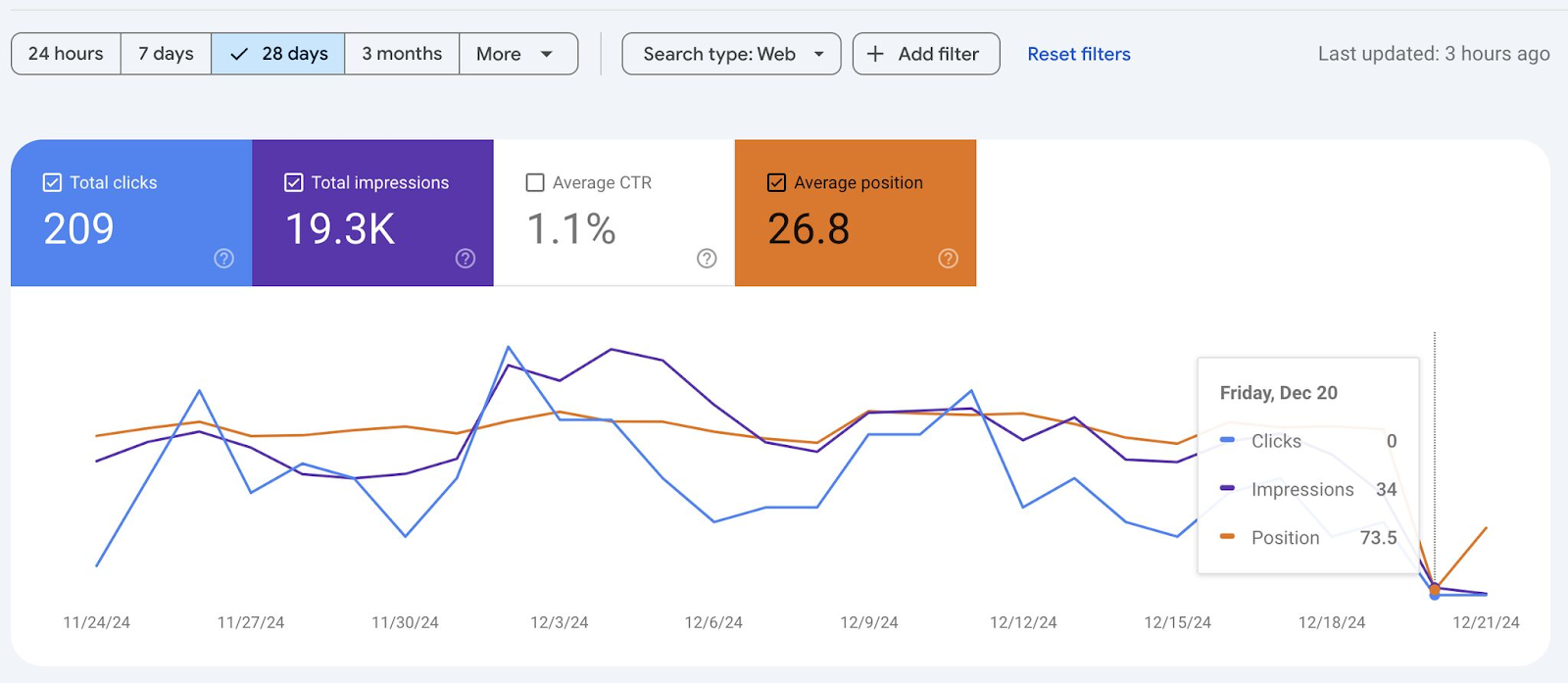
Within a couple of months, each site was generating around 200 in-market clicks.
However, the December spam update changed the game as clicks dropped to zero.
I attempted data updates and performance-enhancing plugins, which proved futile.
While I can’t pinpoint any single tactic’s failure, collectively, they resulted in sites whose only merit was temporary ranking. Once Google no longer found that useful, the sites were left bare.
The lesson here isn’t the failure of these websites; it’s that Google allowed them just enough time to learn from them.
Does affiliate content marketing still work?
Affiliate content marketing remains a viable monetization strategy but not a growth engine on its own.
There are many websites that offer a valuable user experience, adhere to best practices, and successfully generate affiliate income.
For further guidance, consult Google’s information on creating helpful and people-first content to assess if your website is publishing content “created primarily for people, not to manipulate search engine rankings.”
“If the ‘why’ behind your content is to primarily draw search engine traffic, it’s not aligned with what our systems aim to reward. Using automation, AI-generated content to manipulate rankings violates our spam policies.”
Even with best practices, factors such as the rise of AIO and other disruptions have tempered affiliate marketing’s past successes.
The real insight is not just that Google cracked down on spam or that affiliate content marketing is less effective. It’s that businesses reliant on one easily mimicked distribution channel are vulnerable when that channel shifts.
The future of content will challenge businesses using search as their sole channel.
Instead of focus on broadly applicable topics, many within the industry are emphasizing verticalized research and benchmarks to inspire genuine community dialogues.
Content is evolving beyond simple pages meant to rank, becoming a blend of discovery, discourse, and thought leadership across various channels.
Discovery, discourse, and thought leadership
Hypothetical: Imagine running a SaaS company in the fintech domain, offering advanced financial forecasting.
Rather than creating landing pages targeting “best financial forecasting software” or its affordable counterpart, consider delving into insightful discussions with industry leaders imparts significant wisdom.
Leverage their expertise to pinpoint the most significant financial forecasting gaps in 2026 and verify: Does my offering genuinely address this?
If yes, you’ve likely found a perfect entry to the community.
If not, there’s your direction.
Utilize these insights to craft interactive assessment-based landing pages, supporting them with benchmarking reports derived from top-tier industry organizations.
The intent is for the content to aid organizations in understanding their present state and aims.
These assessments or studies may not dominate Google for high-volume queries, but leveraging owned channels, partnerships, paid media, and other strategies can ensure they reach ideal clients.
These insights act as a springboard for sharing authentic insights from unique dialogues, spanning multiple channels, amplifying your impact.
If executed effectively, you’ll not only enrich the community but also achieve previously elusive growth.
Indexation was swift, and pages appeared for long-tail queries surprisingly quickly.
Within a couple of months, each site was generating around 200 in-market clicks.
However, the December spam update changed the game as clicks dropped to zero.
I attempted data updates and performance-enhancing plugins, which proved futile.
While I can’t pinpoint any single tactic’s failure, collectively, they resulted in sites whose only merit was temporary ranking. Once Google no longer found that useful, the sites were left bare.
The lesson here isn’t the failure of these websites; it’s that Google allowed them just enough time to learn from them.
Does affiliate content marketing still work?
Affiliate content marketing remains a viable monetization strategy but not a growth engine on its own.
There are many websites that offer a valuable user experience, adhere to best practices, and successfully generate affiliate income.
For further guidance, consult Google’s information on creating helpful and people-first content to assess if your website is publishing content “created primarily for people, not to manipulate search engine rankings.”
“If the ‘why’ behind your content is to primarily draw search engine traffic, it’s not aligned with what our systems aim to reward. Using automation, AI-generated content to manipulate rankings violates our spam policies.”
Even with best practices, factors such as the rise of AIO and other disruptions have tempered affiliate marketing’s past successes.
The real insight is not just that Google cracked down on spam or that affiliate content marketing is less effective. It’s that businesses reliant on one easily mimicked distribution channel are vulnerable when that channel shifts.
The future of content will challenge businesses using search as their sole channel.
Instead of focus on broadly applicable topics, many within the industry are emphasizing verticalized research and benchmarks to inspire genuine community dialogues.
Content is evolving beyond simple pages meant to rank, becoming a blend of discovery, discourse, and thought leadership across various channels.
Discovery, discourse, and thought leadership
Hypothetical: Imagine running a SaaS company in the fintech domain, offering advanced financial forecasting.
Rather than creating landing pages targeting “best financial forecasting software” or its affordable counterpart, consider delving into insightful discussions with industry leaders imparts significant wisdom.
Leverage their expertise to pinpoint the most significant financial forecasting gaps in 2026 and verify: Does my offering genuinely address this?
If yes, you’ve likely found a perfect entry to the community.
If not, there’s your direction.
Utilize these insights to craft interactive assessment-based landing pages, supporting them with benchmarking reports derived from top-tier industry organizations.
The intent is for the content to aid organizations in understanding their present state and aims.
These assessments or studies may not dominate Google for high-volume queries, but leveraging owned channels, partnerships, paid media, and other strategies can ensure they reach ideal clients.
These insights act as a springboard for sharing authentic insights from unique dialogues, spanning multiple channels, amplifying your impact.
If executed effectively, you’ll not only enrich the community but also achieve previously elusive growth.
The real insight is not just that Google cracked down on spam or that affiliate content marketing is less effective. It’s that businesses reliant on one easily mimicked distribution channel are vulnerable when that channel shifts.
The future of content will challenge businesses using search as their sole channel.
Instead of focus on broadly applicable topics, many within the industry are emphasizing verticalized research and benchmarks to inspire genuine community dialogues.
Content is evolving beyond simple pages meant to rank, becoming a blend of discovery, discourse, and thought leadership across various channels.
Discovery, discourse, and thought leadership
Hypothetical: Imagine running a SaaS company in the fintech domain, offering advanced financial forecasting.
Rather than creating landing pages targeting “best financial forecasting software” or its affordable counterpart, consider delving into insightful discussions with industry leaders imparts significant wisdom.
Leverage their expertise to pinpoint the most significant financial forecasting gaps in 2026 and verify: Does my offering genuinely address this?
If yes, you’ve likely found a perfect entry to the community.
If not, there’s your direction.
Utilize these insights to craft interactive assessment-based landing pages, supporting them with benchmarking reports derived from top-tier industry organizations.
The intent is for the content to aid organizations in understanding their present state and aims.
These assessments or studies may not dominate Google for high-volume queries, but leveraging owned channels, partnerships, paid media, and other strategies can ensure they reach ideal clients.
These insights act as a springboard for sharing authentic insights from unique dialogues, spanning multiple channels, amplifying your impact.
If executed effectively, you’ll not only enrich the community but also achieve previously elusive growth.
Indexation was swift, and pages appeared for long-tail queries surprisingly quickly.
Within a couple of months, each site was generating around 200 in-market clicks.
However, the December spam update changed the game as clicks dropped to zero.
I attempted data updates and performance-enhancing plugins, which proved futile.
While I can’t pinpoint any single tactic’s failure, collectively, they resulted in sites whose only merit was temporary ranking. Once Google no longer found that useful, the sites were left bare.
The lesson here isn’t the failure of these websites; it’s that Google allowed them just enough time to learn from them.
Does affiliate content marketing still work?
Affiliate content marketing remains a viable monetization strategy but not a growth engine on its own.
There are many websites that offer a valuable user experience, adhere to best practices, and successfully generate affiliate income.
For further guidance, consult Google’s information on creating helpful and people-first content to assess if your website is publishing content “created primarily for people, not to manipulate search engine rankings.”
“If the ‘why’ behind your content is to primarily draw search engine traffic, it’s not aligned with what our systems aim to reward. Using automation, AI-generated content to manipulate rankings violates our spam policies.”
Even with best practices, factors such as the rise of AIO and other disruptions have tempered affiliate marketing’s past successes.
The real insight is not just that Google cracked down on spam or that affiliate content marketing is less effective. It’s that businesses reliant on one easily mimicked distribution channel are vulnerable when that channel shifts.
The future of content will challenge businesses using search as their sole channel.
Instead of focus on broadly applicable topics, many within the industry are emphasizing verticalized research and benchmarks to inspire genuine community dialogues.
Content is evolving beyond simple pages meant to rank, becoming a blend of discovery, discourse, and thought leadership across various channels.
Discovery, discourse, and thought leadership
Hypothetical: Imagine running a SaaS company in the fintech domain, offering advanced financial forecasting.
Rather than creating landing pages targeting “best financial forecasting software” or its affordable counterpart, consider delving into insightful discussions with industry leaders imparts significant wisdom.
Leverage their expertise to pinpoint the most significant financial forecasting gaps in 2026 and verify: Does my offering genuinely address this?
If yes, you’ve likely found a perfect entry to the community.
If not, there’s your direction.
Utilize these insights to craft interactive assessment-based landing pages, supporting them with benchmarking reports derived from top-tier industry organizations.
The intent is for the content to aid organizations in understanding their present state and aims.
These assessments or studies may not dominate Google for high-volume queries, but leveraging owned channels, partnerships, paid media, and other strategies can ensure they reach ideal clients.
These insights act as a springboard for sharing authentic insights from unique dialogues, spanning multiple channels, amplifying your impact.
If executed effectively, you’ll not only enrich the community but also achieve previously elusive growth.
Do you remember when partial-match domains and headings could easily rank for commercially intended search queries? I do, and those were simpler times.
With the right strategies and conversion-optimized widgets, I was able to quietly generate tens of thousands of dollars in affiliate revenue each month with minimal upkeep.
Maintaining success was as simple as updating articles for relevancy and freshness signals.
Pressure-testing Google’s spam update
Before launching the experiment, I dedicated several months to scaling an affiliate initiative on a revered website within a YMYL category.
We succeeded by hiring subject matter experts to craft informative content that genuinely educated our readers.
While the newly created content targeted keywords with commercial intent, it wasn’t the sole purpose of the website. We also featured thousands of pages of user-generated content that guided the new writing and encouraged conversions.
Our site boasted brand trust, original research, and expert insights—elements you’d anticipate from a reputable publisher.
This was a perfect combination: a legacy of verticalized user-generated content, numerous earned backlinks, and a commercial element that met existing demand while complying with industry practices. It provided a genuinely helpful user experience.
The experiment: Scaling AI without trust
The initial model was founded on trust and earned authority, but this new venture removed those signals entirely.
During this period, many LinkedIn influencers were employing AI to mass-generate pages by scraping, rewriting content, or programmatically collating public data.
Inspired, I scrounged a few dollars, purchased three domains, and tuned them to match these queries: “best welding schools,” “best plumbing schools,” and “best electrical schools.”
The objective? To test a collection of low-trust, high-scale strategies popular online and observe how long they’d last.
I used AI to enhance the websites visually, fetched public data through a vibe-coded Python API, and crafted templates for subheadings and paragraph text with ChatGPT based on what typically ranks online.
Within hours, thanks to liquid content, I published thousands of bottom-funnel pages across three websites. It allowed me to integrate public data, target specific program types and states with superlatives, and offer a directory with individual pages for each school.
I even utilized aggressive internal linking tactics that favored crawl coverage over user intent.
This arrangement ignored nearly every long-term trust signal, providing a valuable test of system reactions.
The real insight is not just that Google cracked down on spam or that affiliate content marketing is less effective. It’s that businesses reliant on one easily mimicked distribution channel are vulnerable when that channel shifts.
The future of content will challenge businesses using search as their sole channel.
Instead of focus on broadly applicable topics, many within the industry are emphasizing verticalized research and benchmarks to inspire genuine community dialogues.
Content is evolving beyond simple pages meant to rank, becoming a blend of discovery, discourse, and thought leadership across various channels.
Discovery, discourse, and thought leadership
Hypothetical: Imagine running a SaaS company in the fintech domain, offering advanced financial forecasting.
Rather than creating landing pages targeting “best financial forecasting software” or its affordable counterpart, consider delving into insightful discussions with industry leaders imparts significant wisdom.
Leverage their expertise to pinpoint the most significant financial forecasting gaps in 2026 and verify: Does my offering genuinely address this?
If yes, you’ve likely found a perfect entry to the community.
If not, there’s your direction.
Utilize these insights to craft interactive assessment-based landing pages, supporting them with benchmarking reports derived from top-tier industry organizations.
The intent is for the content to aid organizations in understanding their present state and aims.
These assessments or studies may not dominate Google for high-volume queries, but leveraging owned channels, partnerships, paid media, and other strategies can ensure they reach ideal clients.
These insights act as a springboard for sharing authentic insights from unique dialogues, spanning multiple channels, amplifying your impact.
If executed effectively, you’ll not only enrich the community but also achieve previously elusive growth.
Indexation was swift, and pages appeared for long-tail queries surprisingly quickly.
Within a couple of months, each site was generating around 200 in-market clicks.
However, the December spam update changed the game as clicks dropped to zero.
I attempted data updates and performance-enhancing plugins, which proved futile.
While I can’t pinpoint any single tactic’s failure, collectively, they resulted in sites whose only merit was temporary ranking. Once Google no longer found that useful, the sites were left bare.
The lesson here isn’t the failure of these websites; it’s that Google allowed them just enough time to learn from them.
Does affiliate content marketing still work?
Affiliate content marketing remains a viable monetization strategy but not a growth engine on its own.
There are many websites that offer a valuable user experience, adhere to best practices, and successfully generate affiliate income.
For further guidance, consult Google’s information on creating helpful and people-first content to assess if your website is publishing content “created primarily for people, not to manipulate search engine rankings.”
“If the ‘why’ behind your content is to primarily draw search engine traffic, it’s not aligned with what our systems aim to reward. Using automation, AI-generated content to manipulate rankings violates our spam policies.”
Even with best practices, factors such as the rise of AIO and other disruptions have tempered affiliate marketing’s past successes.
The real insight is not just that Google cracked down on spam or that affiliate content marketing is less effective. It’s that businesses reliant on one easily mimicked distribution channel are vulnerable when that channel shifts.
The future of content will challenge businesses using search as their sole channel.
Instead of focus on broadly applicable topics, many within the industry are emphasizing verticalized research and benchmarks to inspire genuine community dialogues.
Content is evolving beyond simple pages meant to rank, becoming a blend of discovery, discourse, and thought leadership across various channels.
Discovery, discourse, and thought leadership
Hypothetical: Imagine running a SaaS company in the fintech domain, offering advanced financial forecasting.
Rather than creating landing pages targeting “best financial forecasting software” or its affordable counterpart, consider delving into insightful discussions with industry leaders imparts significant wisdom.
Leverage their expertise to pinpoint the most significant financial forecasting gaps in 2026 and verify: Does my offering genuinely address this?
If yes, you’ve likely found a perfect entry to the community.
If not, there’s your direction.
Utilize these insights to craft interactive assessment-based landing pages, supporting them with benchmarking reports derived from top-tier industry organizations.
The intent is for the content to aid organizations in understanding their present state and aims.
These assessments or studies may not dominate Google for high-volume queries, but leveraging owned channels, partnerships, paid media, and other strategies can ensure they reach ideal clients.
These insights act as a springboard for sharing authentic insights from unique dialogues, spanning multiple channels, amplifying your impact.
If executed effectively, you’ll not only enrich the community but also achieve previously elusive growth.
The real insight is not just that Google cracked down on spam or that affiliate content marketing is less effective. It’s that businesses reliant on one easily mimicked distribution channel are vulnerable when that channel shifts.
The future of content will challenge businesses using search as their sole channel.
Instead of focus on broadly applicable topics, many within the industry are emphasizing verticalized research and benchmarks to inspire genuine community dialogues.
Content is evolving beyond simple pages meant to rank, becoming a blend of discovery, discourse, and thought leadership across various channels.
Discovery, discourse, and thought leadership
Hypothetical: Imagine running a SaaS company in the fintech domain, offering advanced financial forecasting.
Rather than creating landing pages targeting “best financial forecasting software” or its affordable counterpart, consider delving into insightful discussions with industry leaders imparts significant wisdom.
Leverage their expertise to pinpoint the most significant financial forecasting gaps in 2026 and verify: Does my offering genuinely address this?
If yes, you’ve likely found a perfect entry to the community.
If not, there’s your direction.
Utilize these insights to craft interactive assessment-based landing pages, supporting them with benchmarking reports derived from top-tier industry organizations.
The intent is for the content to aid organizations in understanding their present state and aims.
These assessments or studies may not dominate Google for high-volume queries, but leveraging owned channels, partnerships, paid media, and other strategies can ensure they reach ideal clients.
These insights act as a springboard for sharing authentic insights from unique dialogues, spanning multiple channels, amplifying your impact.
If executed effectively, you’ll not only enrich the community but also achieve previously elusive growth.
Indexation was swift, and pages appeared for long-tail queries surprisingly quickly.
Within a couple of months, each site was generating around 200 in-market clicks.
However, the December spam update changed the game as clicks dropped to zero.
I attempted data updates and performance-enhancing plugins, which proved futile.
While I can’t pinpoint any single tactic’s failure, collectively, they resulted in sites whose only merit was temporary ranking. Once Google no longer found that useful, the sites were left bare.
The lesson here isn’t the failure of these websites; it’s that Google allowed them just enough time to learn from them.
Does affiliate content marketing still work?
Affiliate content marketing remains a viable monetization strategy but not a growth engine on its own.
There are many websites that offer a valuable user experience, adhere to best practices, and successfully generate affiliate income.
For further guidance, consult Google’s information on creating helpful and people-first content to assess if your website is publishing content “created primarily for people, not to manipulate search engine rankings.”
“If the ‘why’ behind your content is to primarily draw search engine traffic, it’s not aligned with what our systems aim to reward. Using automation, AI-generated content to manipulate rankings violates our spam policies.”
Even with best practices, factors such as the rise of AIO and other disruptions have tempered affiliate marketing’s past successes.
The real insight is not just that Google cracked down on spam or that affiliate content marketing is less effective. It’s that businesses reliant on one easily mimicked distribution channel are vulnerable when that channel shifts.
The future of content will challenge businesses using search as their sole channel.
Instead of focus on broadly applicable topics, many within the industry are emphasizing verticalized research and benchmarks to inspire genuine community dialogues.
Content is evolving beyond simple pages meant to rank, becoming a blend of discovery, discourse, and thought leadership across various channels.
Discovery, discourse, and thought leadership
Hypothetical: Imagine running a SaaS company in the fintech domain, offering advanced financial forecasting.
Rather than creating landing pages targeting “best financial forecasting software” or its affordable counterpart, consider delving into insightful discussions with industry leaders imparts significant wisdom.
Leverage their expertise to pinpoint the most significant financial forecasting gaps in 2026 and verify: Does my offering genuinely address this?
If yes, you’ve likely found a perfect entry to the community.
If not, there’s your direction.
Utilize these insights to craft interactive assessment-based landing pages, supporting them with benchmarking reports derived from top-tier industry organizations.
The intent is for the content to aid organizations in understanding their present state and aims.
These assessments or studies may not dominate Google for high-volume queries, but leveraging owned channels, partnerships, paid media, and other strategies can ensure they reach ideal clients.
These insights act as a springboard for sharing authentic insights from unique dialogues, spanning multiple channels, amplifying your impact.
If executed effectively, you’ll not only enrich the community but also achieve previously elusive growth.
Through my recent dive into the latest SDK findings, I’ve discovered why some pages never make it to the Google Discover ranking. Factors like predicted click-through rates, images, and content recency are key drivers.
One thing I’ve learned is that Google Discover operates using a detailed, multi-layered pipeline. This includes publisher blocks, detailed image specifications, a freshness decay model, and extensive experimentation that shapes what appears on users’ feeds, as explained by SDK-level researcher Metehan Yesilyurt.
Why this matters to us. As someone who’s eager to drive significant traffic via Google Discover, I’ve often found the process unpredictable. This research allows me a clearer understanding of how my content might qualify, rank, or get blocked, shedding light on potential pitfalls before a piece even begins to rank.
The nitty-gritty. In Yesilyurt’s exploration, Google Discover’s app framework was deconstructed into a nine-stage process. Here’s how it works:
It all begins with Google crawling and understanding the content I produce.
It examines key meta tags, such as image and title.
It classifies content types, be they breaking news or evergreen material.
Google checks if my content is blocked at any point.
Content is then matched to user interests.
An applied server-side click-through rate prediction model comes into play.
The feed layout is constructed based on these evaluations.
Content is served to users, inviting engagement.
Lastly, user feedback is recorded.
A significant insight. One crucial discovery is that publisher-level blocks occur before matching content to users’ interests. A user’s decision to block a source means my content won’t even make it to the ranking stage.
Such blocks are impactful. A single action to prevent showing content from my site can suppress the entire domain. Unfortunately, no similar sitewide boost exists.
The ranking mechanics. The ranking process leverages elements like my content’s title, image quality, and past engagement history. Google’s servers use a predicted click-through rate (pCTR) to estimate the possibility of clicks. Although the specific model remains unseen, the app indicates which signals Google considers for ranking, including:
The page title, sourced from og:title.
The size and quality of images.
The freshness of the content.
Past click and impression statistics for my URL.
Whether images load correctly on the page.
The importance of freshness. Google’s system groups content based on age:
1 to 7 days old: enjoys the strongest boost.
8 to 14 days old: retains moderate visibility.
15 to 30 days old: sees a drop in visibility.
Over 30 days old: experiences a gradual decline.
While evergreen content might receive special classification, newer content inherently gains an edge.
Image and meta tag criteria. Google Discover examines six key tags at the page level, such as og:image and og:title. Notably, missing images result in the absence of content cards.
Images must be at least 1200px wide for prominent card features. Smaller images often manifest as thumbnails, which typically receive fewer clicks.
Missing tags prompt Google to seek alternatives — if og:title lacks, the Twitter title tag or HTML title might be used instead.
Using meta tags like “nopagereadaloud” and “notranslate” can prevent a page from appearing on Google Discover altogether.
The personalization factors. With Google Discover, personalization hinges on:
Google’s broader interest data interconnected with user behavior.
Publisher signals, which include registration with Publisher Center.
Personal interactions like follows, saves, and story dismissals.
Engagement metrics, like the time users spend reading content.
If a reader dismisses my content, that action is stored permanently for that specific URL, preventing it from reappearing.
Everywhere I look, experiments abound. During moments of observation, about 150 server-side tests were simultaneously active, with an additional 50+ features controlling how content cards were depicted.
This means two users with similar interests can encounter vastly different feeds simply due to being in different experimental groups.
Real-time updates for your feed. Google Discover doesn’t stand still. It can dynamically add, remove, or reorder content in the feed as a user scrolls, no refresh needed.
Key insights for success. Excelling in Google Discover is less about using tricks and more about meeting eligibility criteria, establishing trust, utilizing compelling visuals, and maintaining engagement, especially in a system capable of filtering content before the ranking process even starts.
Publisher blocks occur before any ranking.
The system inherently values content freshness.
High-quality images and clear titles are indispensable.
User dismissals are long-term.
Heavy experimentation leads to a constantly evolving environment.
Ever wondered how to get your brand noticed by AI search engines? Let me walk you through the step-by-step process of getting your brand cited, recommended, and discovered by AI search platforms.
So, let me dive into the world of AI! Gartner forecasts a 25% drop in traditional search volume as AI engines take precedence. With Google’s AI Overviews attracting over 2 billion users monthly, and ChatGPT serving 800 million users weekly, the shift is here.
Gone are the days of just vying for a spot on Page 1. Now, it’s all about becoming the go-to source that AI engines cite in their answers.
This focus on generative engine optimization (GEO) is crucial in 2026. Here’s how to craft a GEO strategy that truly delivers.
What is GEO — and why 2026 is the tipping point
GEO is about aligning your content and digital identity so AI search platforms like ChatGPT, Google AI Overviews, Perplexity, and others, can easily find and recommend your brand.
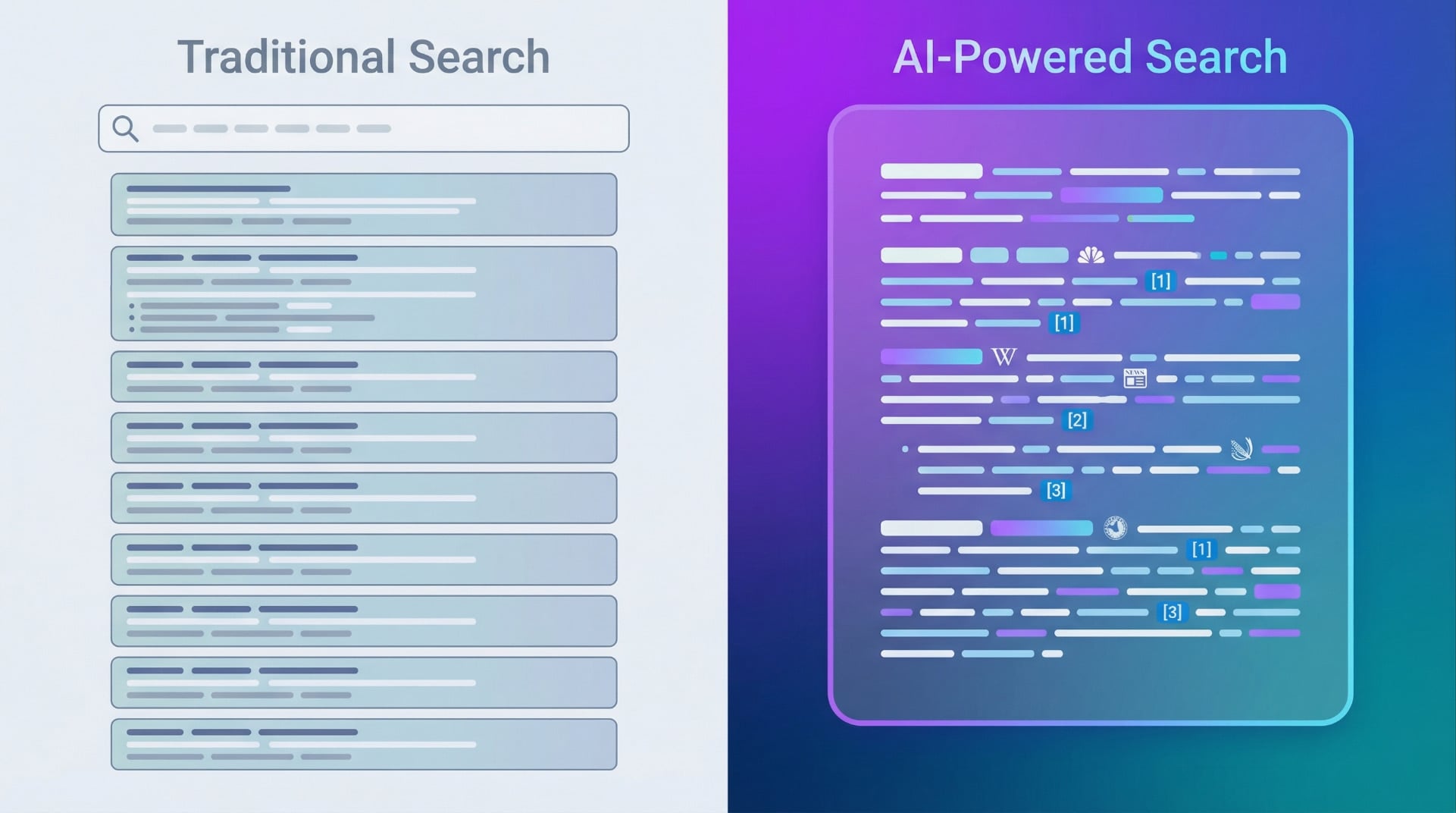
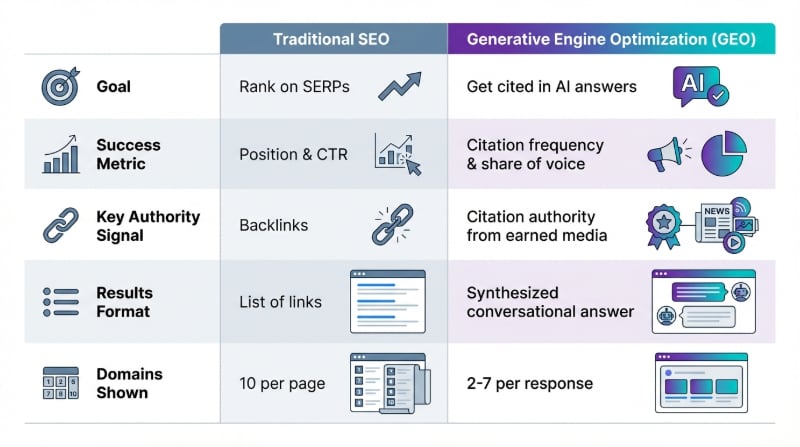
If traditional SEO got you among the top 10 links, GEO aims to secure your position among the few domains cited in AI responses. It’s tougher in terms of competition, but the credibility from being mentioned by an AI engine is worth it.
Several forces make 2026 a milestone year. Users are becoming loyal to specific AI platforms, elevating GEO from experimental to essential. Universities and enterprises are backing this shift, highlighting AI engines’ preference for authoritative external sources over internal content.
Understanding this trend is vital for building an effective GEO strategy.
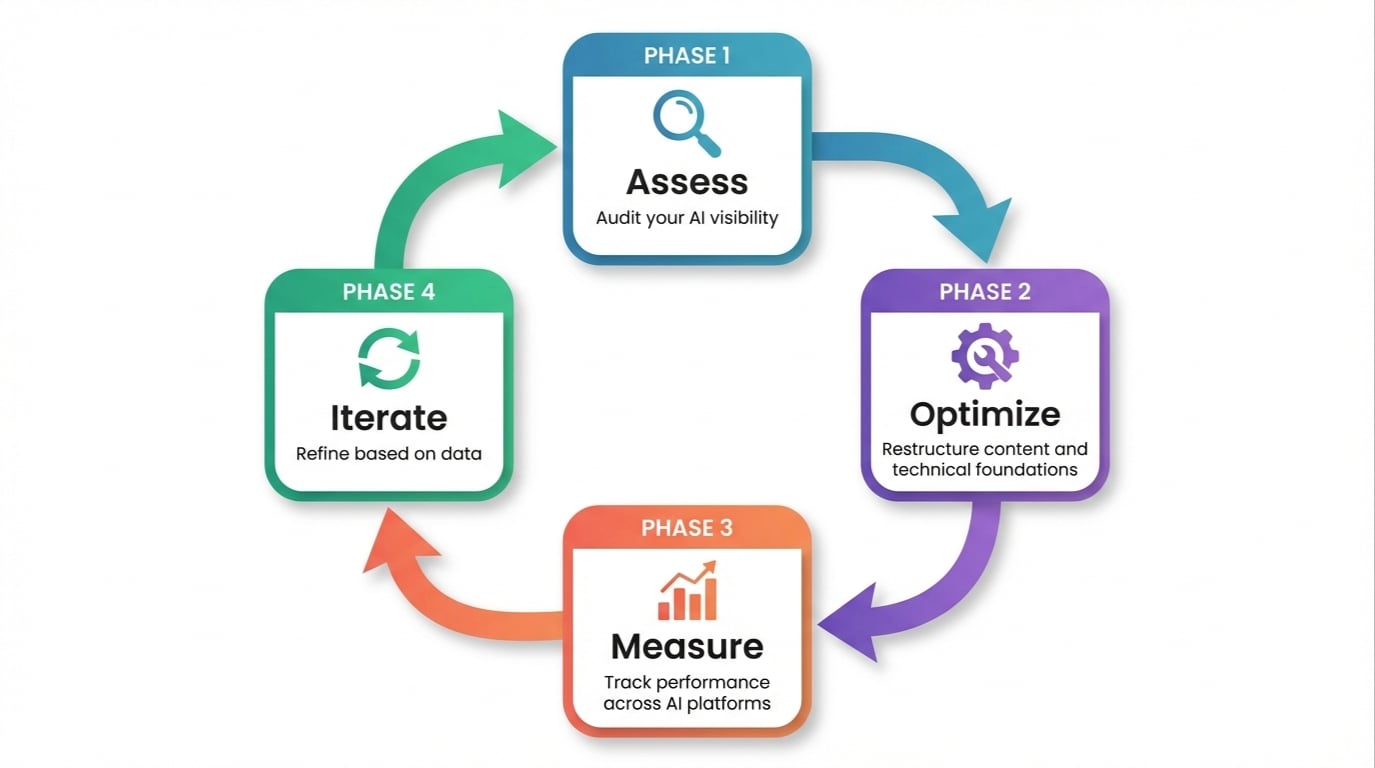
A practical GEO framework: assess, optimize, measure, iterate
Treating GEO as a mere content tweak is a misconception. Just like SEO, it requires ongoing commitment. Here’s a repeatable framework to master it.
Phase 1: Assess your AI search readiness
You need a baseline before optimization. Many brands monitor Google rankings but are blind to how AI engines portray them.
Ask yourself crucial questions: Are AI engines referencing your content? Can they read your structured data efficiently? How does your brand appear in AI-generated content? Are your competitors cited where you aren’t?
Consider using tools like Geoptie’s free GEO Audit for a quick assessment, providing actionable insights for optimization.
Phase 2: Optimize your content for AI engines
The heart of your GEO strategy is optimization. Focus on content structure, entity authority, technical foundations, and keeping content up-to-date.
Structure content for AI retrieval
AI breaks down content to assess relevance and clarity. Make sure each section stands independently.
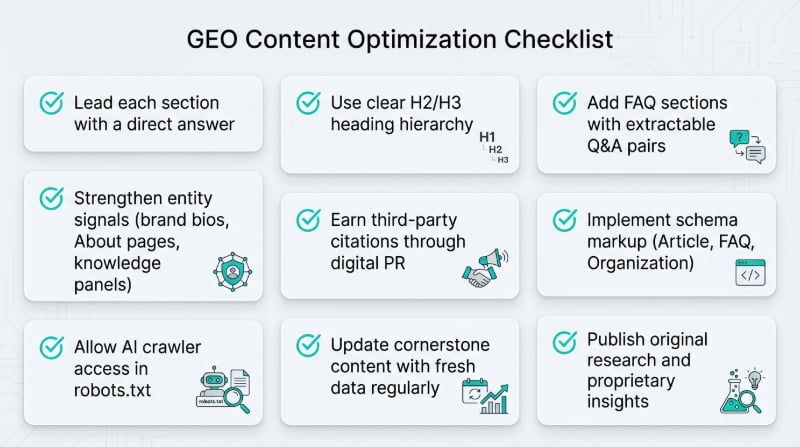
Begin sections with straightforward answers followed by context. Use headings properly and add TL;DR summaries to enhance retrieval chances. FAQs are crucial as AI relies heavily on Q&A formats.
Build entity authority
GEO emphasizes brands and entities rather than single pages. Strengthen these signals for better recognition and citation by AI engines.
Ensure brand mentions are consistent, develop comprehensive about and author pages, and maintain a Wikipedia presence if applicable. A well-managed knowledge panel is also beneficial.
AI engines prefer coverage from third parties over personal content. Thus, digital PR and thought leadership have become essential GEO components.
Nail the technical foundations
Technical optimization in GEO includes traditional SEO elements plus AI-specific enhancements.
Utilize schema markup, verify robots.txt settings accommodate AI crawlers, and consider adding an llms.txt file to guide AI interactions with your site.
Don’t forget the basics. Fast load times, clean architecture, and mobile optimization remain crucial.
Prioritize freshness and depth
AI values recency in sources. A guide from 2024 without updates will be overshadowed by a 2026 version on the same subject.
Keep cornerstone content refreshed with up-to-date data and insights, distinctly marked with a “Last updated” timestamp. Original research and exclusive data enhance your chances of being cited by providing unique value.
Phase 3: Measure your AI search performance
Measurement is often a missing piece in GEO strategies. Many marketers lack clear insights into AI search visibility after mastering traditional SEO metrics.
Important metrics include AI citation frequency, share of voice, citation sentiment, and AI-referred traffic. Traditional tools fall short in tracking these, necessitating specialized GEO platforms.
Geoptie’s free Rank Tracker is a convenient way to check your standing on various AI platforms as an initial assessment.
Phase 4: Iterate and scale
GEO doesn’t end after initial implementation. The AI landscape continuously evolves, requiring rapid adaptation.
Analyze performance data to understand citation success and refine strategies. Focus on platforms delivering the most value and monitor competitor movements.
Replicate successful content across various formats and integrate GEO tasks among content, SEO, PR, and product teams.
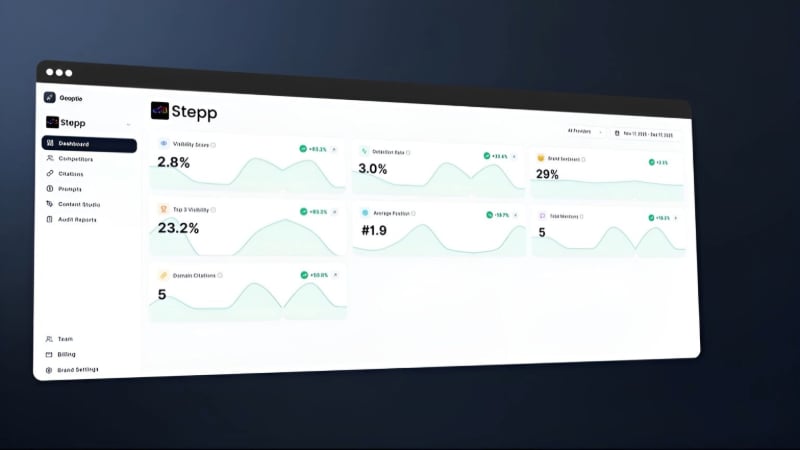
Geoptie offers a comprehensive dashboard for managing audits, competitor analysis, citation tracking, and content optimization all in one place, simplifying the GEO workflow.
Now is the time to build GEO capability
GEO is not a fleeting trend. As AI adoption surges in 2026 and beyond, an early commitment to GEO sets the stage for long-term success.
Follow this clear playbook:
Assess your current standing
Enhance your content and technical readiness for AI
Track performance on relevant platforms
Iterate continuously
Brands laying this foundation will reap ongoing benefits as AI becomes a primary tool for customer engagement.
The crucial decision is whether you’ll pioneer or be a follower in GEO.
Ready to take control of your AI visibility?
With Geoptie, you have a one-stop solution for mastering GEO. From in-depth audits to tracking AI rankings, competitor analysis, and crafting AI-specific content, Geoptie equips you from the start.
Whether beginning your GEO journey or scaling an existing plan, Geoptie helps translate insights into real progress. Start your free 14-day trial to gauge your brand’s AI search standing.
I often find myself over-crediting Google’s understanding of my web pages. It’s easy to imagine Google as an AI wizard that fully comprehends nuances, expertise, and quality. Yet, during the DOJ antitrust trial, I learned something intriguing.
Google’s VP of Search, Pandu Nayak, testified about a first-stage retrieval system that relies heavily on word matching, rather than any magical AI trick. The foundation is based on older information retrieval techniques, like inverted indexes and postings lists. Okapi BM25, a well-known lexical retrieval algorithm, was cited as a crucial link in Google’s system evolution.
After this initial stage, which is all about word matching, Google employs advanced AI models like BERT on a smaller set of content. These content tools are key to optimizing documents for this stage, yet many use them incorrectly, despite their real value.
In this exploration, I’ll dive into the mechanics of first-stage retrieval, its significance, what content tools actually reveal, and how to effectively use these tools to get noticed by Google without obsessing over perfect scores.
How first-stage retrieval works and why content tools map to it
Understanding BM25 is essential. This retrieval function, crucial to Google’s first-stage system, prioritizes topicality by scanning vast amounts of data quickly, narrowing candidates for further processing.
And for me, as a content creator, certain details stood out.
Term frequency with saturation: At some point, repeating keywords has diminishing returns.
Inverse document frequency: Less common terms score higher, so specificity is rewarded.
Document length normalization: Longer documents can be penalized, as density matters.
The zero-score cliff: Not mentioning a term means zero visibility for related queries.
So, effectively using these tools means identifying gaps in my content and ensuring relevant terms appear. Tools like Surfer SEO and Clearscope guide me in avoiding the zero-score pitfall, offering significant value.
AI enhancements like RankEmbed can assist, but counting on them to fill vocabulary gaps is a gamble. I focus on ensuring my core content is strong at the first retrieval stage.
What the research on content tools actually shows
Research shows a weak-positive correlation between content tool scores and rankings, with studies yielding a 0.10 to 0.32 range. While meaningful, these findings are often derived from studies conducted by vendors using their own tools.
The real test remains: do these tools help a new page climb in rankings? The consistent finding is their efficacy in positioning content for retrieval, not securing high rankings against competitors.
Why not skip these tools altogether?
It’s a mistake to write off these tools, especially since expert writers, myself included, often use overly technical language that audiences may not search for or understand, a classic example of the “curse of knowledge.”
A real-world example is Clearscope helping Algolia align their language with their audience’s searches, ultimately lifting their content’s page ranking significantly.
By showing me what vocabulary is used by successful pages, content tools reduce hours of analysis to minutes, whether I’m a frequent publisher or a solo blogger.
What about AI-powered retrieval?
Dense vector embeddings power AI retrieval but supplement rather than replace word matching due to computational limits. Hybrid systems combining traditional and AI search techniques consistently perform best.
The takeaway for me is clear: AI matters, but traditional retrieval carries significant weight and serves as the foundation of effective content scoring tools.
How to actually use content scoring tools
Common advice tells me to get high scores with tools like Surfer SEO or Clearscope. However, I focus on using them wisely to target the zero-score terms and refine competitor analysis.
Running these tools during research, not during writing, ensures I remain focused on quality and audience relevance rather than just scoring high numbers.
A note on entities
Google’s Knowledge Graph processes the relationships between entities more deeply than most tools measure. Recognizing the gap between flat keyword lists and Google’s more complex understanding helps me focus on providing detailed context.
Retrieval before ranking
Content tools effectively decode retrieval stage vocabulary, a less sensational, but fundamentally honest function. They help me pass the first stage of Google’s pipeline, setting the stage for engaging with more advanced ranking factors later on.