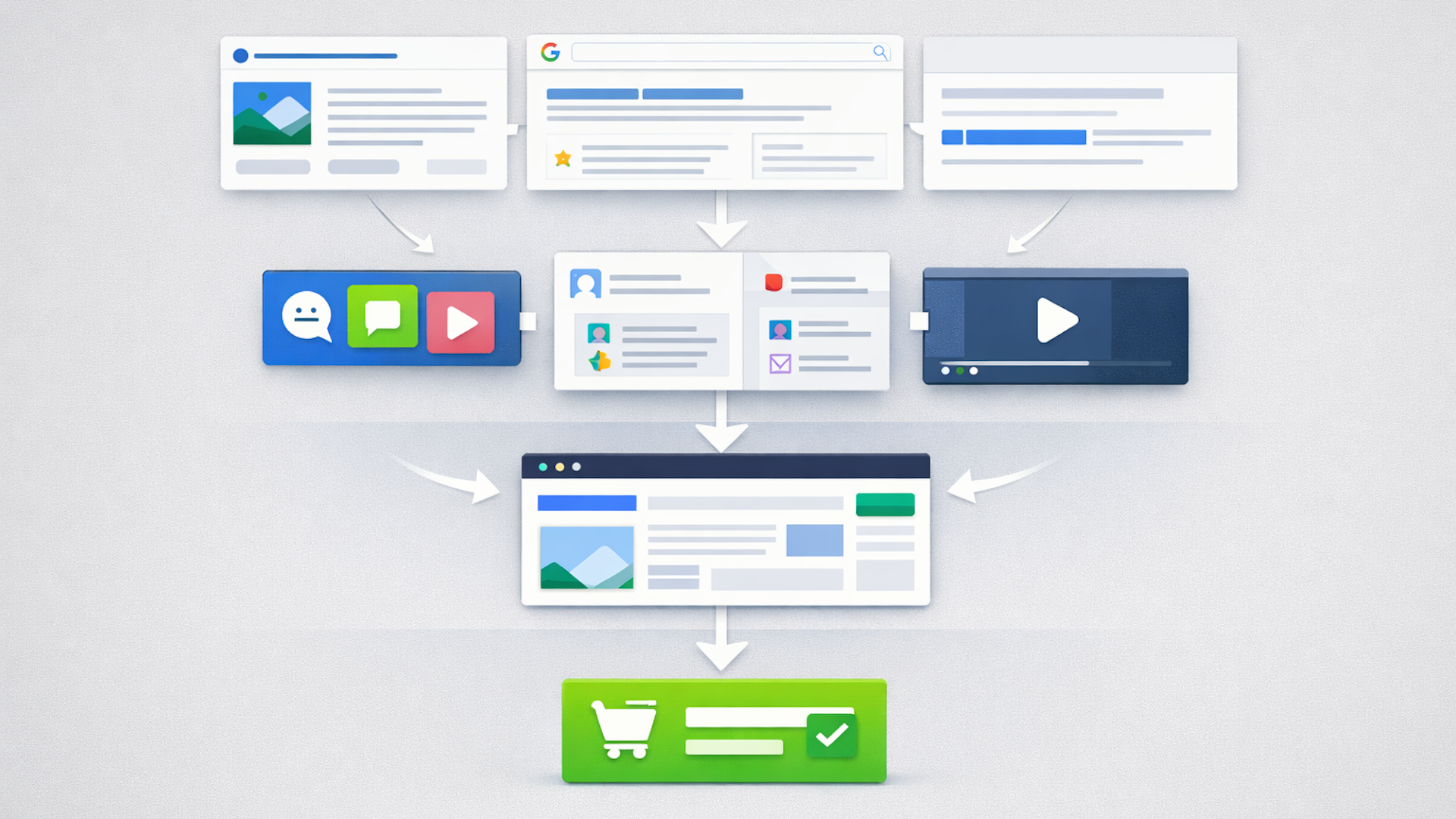
I realized relying solely on GA4 to assess the impact of AI SEO is like using a broken compass. While GA4 is a great starting point, it doesn’t paint the whole picture.
It’s crucial to look beyond Google’s tools to truly understand how audiences find and choose brands. SEO isn’t just about visits; it’s a journey shaped by algorithms and AI long before visits occur.
Focusing only on measurable visits hides parts of this journey, leaving potential customers adrift. Understanding user intent through share of voice and mapping brand visibility with AI analytics is key.
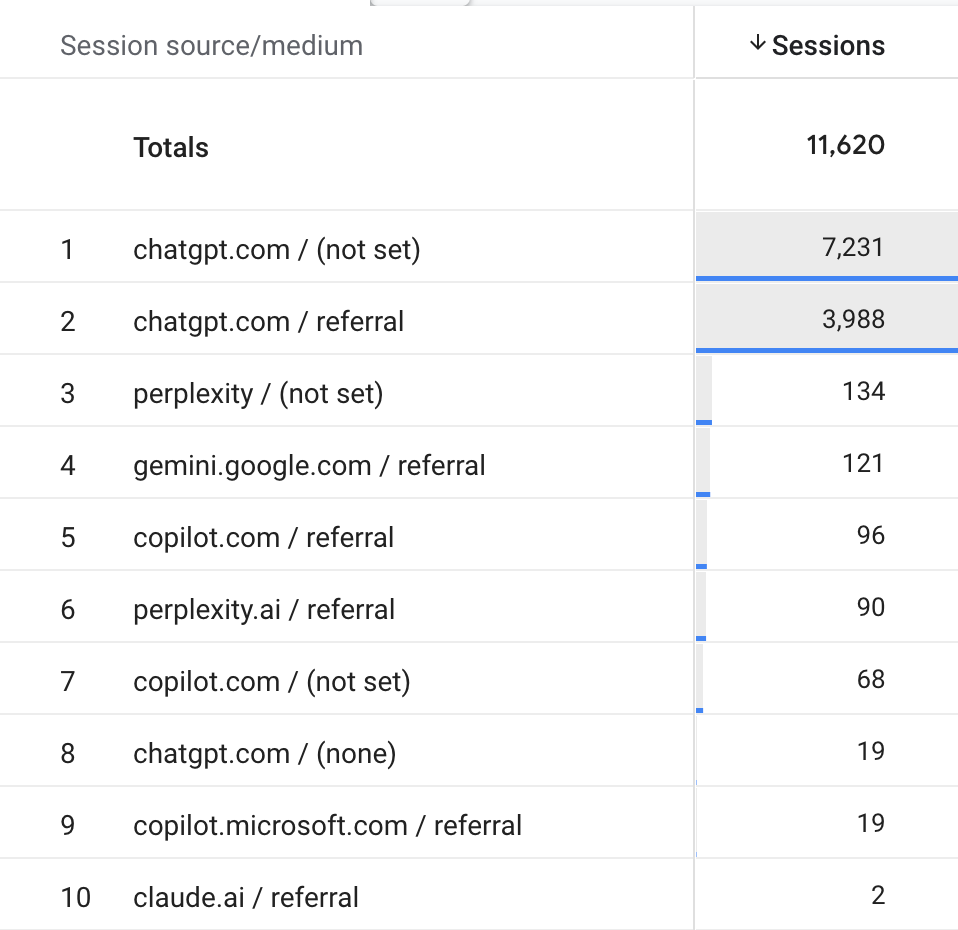
I’ve learned that measuring AI visits with GA4 begins with tracking sessions from various AI sources. Creating a custom exploration to track these is an important first step.
Despite its ease, GA4 struggles to fully capture AI’s impact. Many AI outputs can’t be distinctly tracked, making it crucial to explore other data sources to get a complete picture of brand impact.
Both Google Search Console and Bing Webmaster Tools don’t separate AI queries effectively, often mixing AI metrics with standard web traffic, making it challenging to gauge AI’s real impact.
I’ve found utilizing regex in GSC to identify conversational queries useful, but as query diversity grows, distinguishing synthetic from human becomes harder.
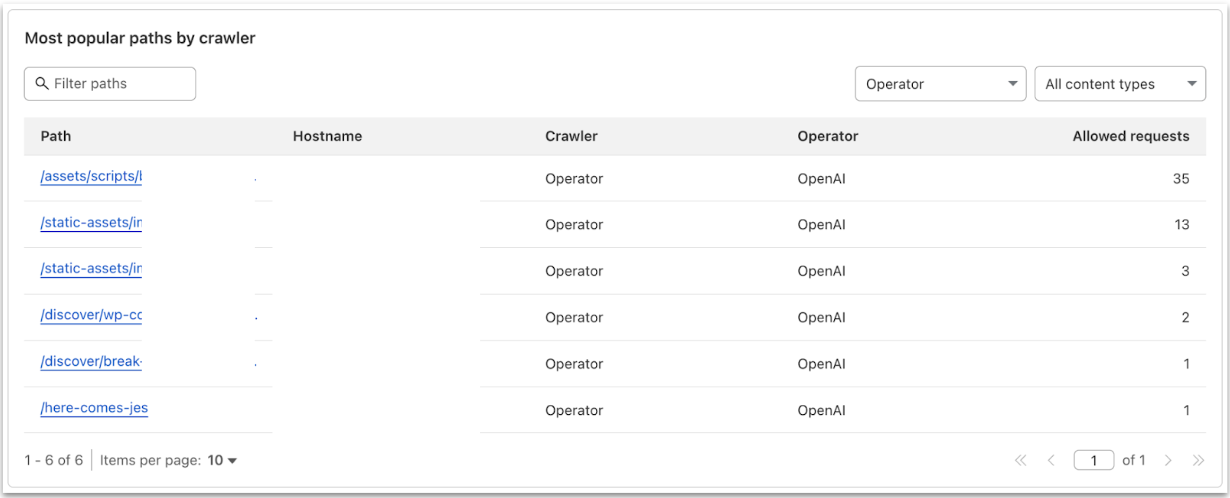
Exploring AI agent analytics through log files has been insightful. AI agents using text-based browsers evade traditional analytics, requiring SEOs to delve into bot logs for agent patterns without real human traffic miss them.
Following AI agent request paths, especially to conversion pages, reveals broken journeys and insights into improving user paths.
Reassessing traditional SEO reporting frameworks is essential for adapting to AI’s transformational role in search discovery.
We need tools that track in-chat brand mentions and citations beyond standard website links. AI search analytics must evolve, reflecting SEO’s expansion towards measuring meaningful marketing KPIs and increasing market share.
As an SEO, my goal is no longer optimizing just a website. It’s about building a robust digital brand—one that is visible and trusted across all organic surfaces.
Starting out in the B2B market, I quickly realized the power of making an impact right at the beginning of a buying decision. It’s surprising to learn that 86% of buyers have already picked their preferred vendors on Day 1. In this article, I’ll share how a strategic video approach can connect with buying groups and drive demand.
There’s a common misconception in B2B marketing: video is often seen merely as a tool for brand awareness. Many believe it either serves as a ‘viral’ content piece that gets views but no leads, or as a tedious demo that attracts leads but no engagement.
However, this black-and-white approach can actually harm your sales pipeline.
Being a part of LinkedIn, I have a unique perspective on the B2B buying ecosystem. The data clearly indicates that the most successful companies don’t confine video to one part of the sales funnel. Instead, they use it like a leverage for growth.
By integrating video across the entire buying journey, linking brand with demand, companies see a noticeable increase in lead generation—up to 1.4 times more leads.
Let’s delve into the framework that backs this success, guided by fresh insights into B2B buying behaviors.
The reality: The ‘first impression rose’
Many marketers underestimate how soon they need to influence a deal.
At LinkedIn’s B2B Institute, we refer to this critical window as the “first impression rose.” Much like in “The Bachelor,” not getting noticed early reduces your chances of winning at all.
Research by LinkedIn and Bain & Company shows that 86% of buyers’ decisions are practically made on Day 1, and 81% will eventually buy from the vendors on their initial list.
If your video strategy shows up only when buyers are actively looking, you’re left fighting for the remaining 19% who aren’t already committed. To truly compete, you need to be at the top of the list even before a request for proposal (RFP) is crafted.
This is where a three-play strategy becomes crucial.
Play 1: Reach and prime the ‘hidden’ buying committee
The goal: Reach the people who can say ‘no’
Many video strategies focus on the “champion” or the user, but often, they aren’t the decision-makers.
Picture this: After investing time in wooing the VP of Marketing, you find them enthusiastic about your solution and ready to proceed. But at the procurement meeting, the CFO questions, “Who is this company?” Due to a lack of recognition with those controlling the budget, you face unexpected hurdles.
Data shows you are over 20 times more likely to be chosen if the entire buying group is aware of you on Day 1.
The strategic shift: Cut-through creative
To capture this broader audience, mere visibility isn’t enough; you need to stand out. Reach and recall go hand in hand.
LinkedIn data highlights what makes content “cut-through creative”:
Be bold: Utilize bold, vibrant colors in video ads to boost engagement by 15%.
Be process-oriented: Simplify messaging into clear steps to enhance viewer retention by 13%.
The “Goldilocks” length: Videos running for 7-15 seconds hit the sweet spot for brand lift—outperforming both ultra-short and long-form ads.
The “Silent Movie” rule: Craft visuals that communicate without sound since 79% of LinkedIn users scroll soundlessly. If your video leans on spoken content initially, you’ve missed engaging 80% of your audience. Implement visual hooks and captions for instant engagement.
This is the stage where many B2B efforts fall short. Most content pushes capability—features and specs—while true buyability is often neglected.
Buyers are weighing personal and career risks when drawing up their list of vendors.
Our joint research with Bain & Company uncovered that buyers prioritize emotional assurance, with only two out of five primary considerations being centered around product capability.
The top priority (34%) was ensuring confidence in defending their decision if things went awry.
The strategic shift: Market the safety net
Video content should be more than a list of features; it should act as a safety net. What can this look like in practice?
Momentum is safety (the “buzz” effect)
Buyers gravitate toward leaders. By building a buzz, brands can increase leads by 10%.
You can generate buzz via cultural references, which increase engagement by 41% and even more significantly with memes, boosting it by 111%. This approach shows you’re in tune, relatable, and part of the conversation.
Authority builds trust (the “expert” effect)
If momentum draws them in, then expertise builds lasting trust. The presentation of that expertise is crucial.
Utilize video ads with executive experts for a 53% boost in engagement, and capture them on stage at conferences to increase this by 70%.
The implication of authority communicates a powerful message—”This person is insightful enough to be worth listening to.”
Consistency is credibility
Constant engagement, rather than sporadic bursts, is key. Maintaining an always-on campaign enhances conversions by 10% compared to brands that pause and restart their efforts. Trust is cumulative.
Have you heard the news about LinkedIn’s recent experiences with AI-powered search? It turns out that Google’s AI Overviews have significantly impacted our non-brand B2B awareness traffic, cutting it by up to 60% in some areas, even while rankings remained steady. This shift compels us to rethink our discovery strategies fundamentally.
I’ve noticed we’re transitioning from the traditional ‘search, click, website’ model to a more dynamic approach: ‘Be seen, be mentioned, be considered, be chosen.’ This new paradigm reflects a deeper understanding of modern digital visibility.
By the numbers. Early in 2024, our B2B organic growth team started researching Google’s Search Generative Experience (SGE). By the time SGE evolved into AI Overviews in 2025, the impact was undeniable. Our non-brand, awareness-driven traffic took a hit of up to 60% across specific B2B topics.
Yes, but. Many of the insights we’re gathering are reiterations of established SEO and AEO best practices. I’ve learned that LinkedIn’s guidance emphasizes strong headings, clear information hierarchy, improved semantic structure, and accessibility. It also stresses publishing authoritative, fresh content by experts and moving quickly to gain an early advantage.
Why we care. These strategies should be familiar to anyone versed in technical SEO and content-quality fundamentals. LinkedIn’s article may not present new tactics, but it highlights the relevance of modern SEO/AEO and AI-driven visibility.
Measurement is broken. A significant challenge we face is the ‘dark’ funnel—the difficulty of quantifying how visibility in LLM answers affects our bottom line when discovery occurs without a click.
LinkedIn has seen triple-digit growth in LLM-driven traffic to its B2B marketing websites. However, while we can track conversions from these visits, many websites are also experiencing similar growth. Although it’s an emerging channel, LLM-driven traffic still represents a small portion of overall traffic.
What LinkedIn is doing. To tackle these challenges, we’ve formed an AI Search Taskforce that spans SEO, PR, editorial, product marketing, and more. We’re correcting misinformation in AI responses, publishing new content optimized for AI visibility, and testing social content for AI discovery strength.
Is it working? It’s exciting to see our efforts yielding results. Our early tests are showing a meaningful increase in visibility and citations, particularly from our owned content. According to one external datapoint from Semrush, our structural advantage in AI search is significant, with Google AI Mode citing LinkedIn in 15% of responses.
Incomplete story. While LinkedIn’s developments are noteworthy, some details remain unclear. We’re still waiting on specifics like the exact topics behind the traffic decline, how much click-through rates have softened, sample sizes, and timeframes. These details could provide clarity on the broader industry impact.
Bottom line. I believe LinkedIn’s insights affirm that visibility is the new currency in digital marketing. However, there’s still much to prove if our playbook truly differentiates us from basic SEO practices.
I’m excited to share how combining SEO and AEO competitive research can reveal new opportunities, shape your strategic positioning, and enhance AI visibility before a click even happens.
Competitive research is like striking gold in organic discovery. Clients love seeing where they stand compared to rivals, and these insights pave the way for a multi-layered action plan on crucial topics.
This year, it’s time to integrate answer engine optimization (AEO) research—what I also call AI search—into your organic strategy. Whether or not your executives are already asking for it, the benefits are clear.
In this article, I’ll dive into the unique contributions of SEO and AEO competitive research, the tools at our disposal, and how these insights translate into actionable steps.
Traditional SEO excels at content planning and tackling specific keywords, but the landscape in 2026 demands more. Merging SEO with AI competitive research offers a holistic strategy for messaging, content creation, and even product marketing roadmaps.
Tools like Ahrefs and Semrush are invaluable for SEO, aiding demand capture and keyword mapping, but AI’s emergence in search means we need to pivot focus. SEO should now bolster AI strategies, refine content gaps for AI systems, and validate demand.
AEO tools address different customer journey stages, crafting demand, framing brands, and influencing decisions before a search result click. They synthesize insights like market perception, directly impacting how users see competitor visibility and perception.
With AI insights, I can pinpoint competitor feature expectations, spotlight emerging trends, and verify our strategies align with market explanations. This knowledge empowers us to lead in category perception and ensure our messaging resonates with users.
In tool selection, platforms like Profound, Ahrefs, and ChatGPT offer a diverse suite for both SEO and AEO, each contributing different insights and functionalities. These extend from classic ranking analysis to intricate AI-answer exposure.
Using AI tools alongside traditional methods helps offer a fuller understanding of competitive landscapes. Implementing these insights isn’t just academic—it’s crucial for clients and internal alignment on marketing action plans.
When I integrated WordPress, Sanity, and Slack, I unlocked the ability to effortlessly manage and update content. This integration dramatically improved how customers discover my brand, products, and services through AI Search.
With these native integrations, I’ve streamlined my workflow, enabling me to publish, update, and coordinate tasks more efficiently. This not only enhanced my brand’s visibility but also optimized customer interactions at every touchpoint.
Embracing these tools has revolutionized my content operations, ensuring my digital presence is cohesive and compelling. The ease of use and the seamless syncing of data have allowed me to focus on what truly matters—creating value for my customers.
I’ve discovered how custom GPTs can revolutionize how we handle SEO, transforming repetitive tasks into efficient workflows. By leveraging AI, we can speed up our processes, from planning and analysis to reporting and technical work.
If you don’t have access to paid ChatGPT, don’t worry. You can still utilize these prompts by saving them as standalone references in your notes. Remember, they’re just starting points, so modify them to fit your team’s requirements.
Working with AI requires trial and error. My advice is to start with small tasks to practice writing prompts. Iterate on them and take notes on what produces good outputs.
AI can sometimes be verbose, so it’s helpful to set strict formatting guidelines and clear context. Upload resources and articles to guide AI results, and always define the role and audience upfront.
Let’s dive into seven prompts that I’ve found incredibly useful for developing custom GPTs dedicated to planning, analysis, and ongoing SEO tasks:
1. Project plan GPT
By analyzing previous project plans, I can create a GPT that assists in drafting this year’s focus areas.
How to set it up
Input project plans from previous years.
Specify a format for consistency.
Determine the number of items or sections to include.
Include specific details unique to your team.
Optionally, integrate team feedback and retrospectives.
Example prompt
Based on last year’s project plan, outline this year’s focus. List three critical items for each quarter, ensuring at least one covers link building.
Include a one-sentence summary for each recommended item and at least two KPIs to measure success.
[Insert last year’s plan.]
Now critique the plan. Offer three reasons against focusing on these items, providing sources for your notes.
By connecting performance dashboards or custom GA reports to ChatGPT, it can handle initial issue identification. This allows me to focus on investigating critical trends.
How to set it up
Hook up reporting tools or upload data directly.
Direct AI on specific aspects to investigate.
Set frequency for data review, such as daily or weekly.
Provide examples of pages or categories to analyze.
Example prompt
Here’s the weekly site report. Analyze this week’s performance against last week’s data, summarizing sessions, conversions, and engagement.
Highlight three successes and three areas needing improvement, color-coded by significance.
[Insert report doc.]
3. Competitor analysis GPT
I’ve found it invaluable to scrutinize what works on competitor sites. This often involves tools like Semrush or Ahrefs.
How to set it up
Integrate Ahrefs, Semrush, or upload relevant reports.
Select competitors and identify top-performing pages.
List key metrics for evaluation.
Create unique prompts for various levels of analysis.
Now, more than ever, custom GPTs are making a significant impact alongside existing SEO tools and workflows. They’re not about replacing the tools we use, but about making initial tasks smoother so that we can focus on insightful and strategic actions. By integrating them into our everyday processes, from planning to technical checks, we can really enhance our productivity.
One of the biggest challenges I face in SEO isn’t AI itself—it’s battling the wave of misinformation about it.
SEO isn’t dying — it’s evolving. So, I need to be proactive in understanding these changes and be discerning about the voices I trust in the industry.
I’m not easily surprised, but some of the AEO (or GEO) talks I attended last year were genuinely shocking—even for someone like me who may have had a bit of Botox.
I recall one speaker apologetically addressing a room of marketers, only to promptly suggest outdated tactics as the “secret sauce” for LLM visibility. It was painful to witness.
Thankfully, trusted voices like Lily Ray, Kevin Indig, Steve Toth, and Ross Hudgens came together this week for an enlightening roundtable on the future of search. It was by far the most beneficial AEO session I’ve ever attended, each sharing tactics they’ve successfully used to enhance LLM visibility.
Here’s what they shared and what I’ve learned:
1. Advertorials work
I discovered that LLMs don’t currently differentiate between paid and organic editorial content. Well-placed advertorials on reputable sites can boost a brand’s visibility in AI search, similar to earned coverage. As with traditional PR, the publication’s credibility remains crucial.
2. Syndication can scale visibility
Paid syndication increases reach, but focusing on quality over quantity is essential. I learned to prioritize reputable and relevant publications when employing this tactic.
3. Map pages to every audience and use case you serve
By creating clearly defined pages for each audience, industry, and use case, I can better position my brand as AI search becomes more personalized. This structure assists LLMs in understanding relevance and remains a strong SEO strategy.
4. Homepage clarity
I ensure that my homepage clearly communicates who I serve and what I do. LLMs analyze homepage content more effectively than navigation menus, so relying on the latter alone is a missed opportunity.
5. Optimize your footer
I’ve started optimizing the footer of my site. As Wil Reynolds demonstrated in a compelling case study, LLMs pick up on brand and service signals located there, enhancing visibility.
6. Don’t prioritize llm.txt
Despite ongoing speculation, there’s been no confirmation from significant LLMs about the use of llm.txt files, and Google explicitly states they don’t. I focus my efforts elsewhere for better results.
7. Go multimodal
To improve brand recognition across multiple sources, I repurpose core content in various formats like text, video, audio, and imagery, maximizing the chances for LLMs to pick it up.
8. Actively shape your brand narrative
It’s estimated that 250 documents are needed to meaningfully influence an LLM’s perception of a brand. By consistently publishing and promoting content, I ensure that my brand narrative remains in my control.
9. Freshness carries disproportionate weight
Fresh content generally performs better in AI searches, reflecting LLMs’ preference for recent information. However, purely artificial “refreshing” without meaningful updates is not advisable.
10. Social works fast
Updates on platforms like LinkedIn, including Pulse articles, can appear in AI search within hours, sometimes minutes. Platforms with high trust like Reddit and YouTube display similar rapid visibility.
11. Authority accelerates inclusion
Publishing on respected, niche industry sites can lead to rapid inclusion in LLM responses, sometimes in mere hours.
12. Don’t hide FAQs
FAQs should be accessible and well-detailed, not concealed within accordions. Eight to ten well-addressed questions can effectively signal expertise, intent, and relevance to both users and LLMs.
Is AEO the same as SEO?
John Mueller from Google clarified at Google Search Live that AEO relies on SEO fundamentals: doing tricks may work short-term, but long-term success relies on proven stability.
The correlation is logical when considering modern LLMs like GPT-5, which utilizes Retrieval-Augmented Generation (RAG) to query real-time data. To gain LLM visibility, showing up in search results is essential.
In essence, good AEO practices align with good SEO, though there’s nuance, and while these tactics are effective now, they will evolve as LLMs grow more sophisticated.
The best AI search strategy for 2026
Forget the magic button. Keep testing, remain skeptical about the hype, and be selective about the advisors you trust.
Thanks to Bernard Huang and Clearscope for hosting this insightful panel.
Have you ever wondered what it would be like if Google knew exactly what you wanted to search for even before you started typing? Well, that’s the future Google is aiming for.
Currently, Google is pushing this innovation onto our devices with small AI models that rival much larger ones in performance.
What’s happening. In a recent research paper presented at EMNLP 2025, Google researchers have introduced a groundbreaking approach. By dividing “intent understanding” into smaller, manageable steps, they have enabled small multimodal LLMs (MLLMs) to deliver results comparable to more powerful systems like Gemini 1.5 Pro. These models operate faster, at a lower cost, and crucially, they keep data processing on the device.
The future is intent extraction. Presently, most large AI models infer intent from user behavior via the cloud, leading to speed, cost, and privacy issues. By dividing the process into two straightforward steps, Google addresses these concerns effectively with on-device models.
Step one: Each interaction is individually summarized. The model records what appeared on the screen, what action the user took, and a preliminary guess of their intent.
Step two: Another model reviews these summaries, focusing solely on factual information. It dismisses guesses and formulates a concise statement outlining the user’s overall goal for their session. This targeted approach prevents the common pitfalls when smaller models are asked to process long chains of actions at once.
How the researchers measure success. Success is determined with Bi-Fact, where small models employing the step-by-step strategy consistently outperform other small-model methods, as evidenced by their F1 scores.
Models like Gemini 1.5 Flash, despite being only 8B, match the performance of the Gemini 1.5 Pro on mobile data. Errors diminish since unfounded guesses are removed, speeding up operation and reducing costs compared to large cloud-based models.
How it works. Intent is analyzed by breaking it down into distinct facts, identifying missing or fabricated details. This process reveals how and where understanding fails, offering insights into how systems misinterpret meaning and miss crucial information.
The research further shows that noisy training data impacts large end-to-end models more significantly than this structured approach. The decomposed system remains robust against the unpredictability of real user behavior.
Why we care. For Google to develop tools that suggest actions or answers before a query is entered, understanding user intent from behavioral patterns across apps, browsers, and screens is essential. This research is a major step towards that vision. Although keywords will remain important, optimizing for clear, logical user paths will take precedence over mere query inputs.
As I navigated through 2025, I kept hearing the same narrative from my SEO peers: organic traffic seemed to be dwindling, clicks were on the decline, and attribution models just didn’t make sense anymore.
The evolution of AI-driven search experiences, with zero-click results and platform-level answers, has further complicated the gap between discovery and actual visits. This has made it even tougher to report accurately on organic performance.
For many, the impact was clear—visible through double-digit declines in organic traffic and leads, year-over-year.
Leaders rightfully asked, “Why are clicks dropping? Why does organic traffic appear 25% lower than last year? Is SEO failing us?”
The truth is, organic search hasn’t ceased to be effective. Instead, our measurement methods haven’t kept up with current discovery patterns.
Why Last-Touch Attribution is Outdated
We haven’t been measuring organic search accurately.
Many organizations still cling to last-touch attribution, only spotlighting the journey’s end rather than its beginning.
Our attribution models, often linear – Search → Click → Convert – fail to capture the intricate user behavior today.
Traditional models assume that discovery leads directly to a measurable click, but AI-driven SERPs are challenging that assumption.
Last-touch attribution focuses on the finish line, ignoring the starting point of the customer journey.
In this AI-first, zero-click landscape, the gaps in attribution widen, particularly for organic search.
Our measurement isn’t entirely broken but outdated. It doesn’t tell the complete story.
We need to rethink our KPIs and redefine success metrics, painting a full picture of the customer journey from beginning to end.
Generative AI is an integral part of my search, content, and analytical workflows these days.
However, with increased usage, I’ve noticed a recurring and expensive issue: confidently incorrect outputs.
Often referred to as “hallucinations,” this problem arises not because the AI is faulty, but due to vague instructions, or more specifically, unclear prompts.
Imagine asking AI for just a “cookie recipe” without any specifics. The result? Christmas cookies in July, or a peanut-filled recipe regardless of allergies!
To mitigate this, I try to expect missteps and set clear guardrails with the help of rubrics.
In this discussion, I’ll explore how rubric-based prompting can enhance factual reliability and how you can implement it to achieve more dependable AI results.
Fluency vs. Restraint: What Matters More?
When I request polished answers from AI without specifying how to handle uncertainties, the system usually opts for fluency over restraint.
This means it prefers to continue smoothly rather than pausing or qualifying a response where information is missing, leading to potentially costly errors.
For instance, Deloitte had to refund substantial costs due to AI errors in a government report, which included fabricated citations, as reported by Associated Press in 2025.
This incident highlights the necessity of keeping AI in the loop but ensuring it’s adequately constrained — defining protocols when uncertainties arise.
Understanding Rubrics: The Guiding Hand AI Needs
Generic safeguards against AI hallucinations exist, but are often ineffective as they describe outcomes instead of a decision-making process.
This is where rubric-based prompting becomes vital, establishing a framework to steer AI behavior.
Just like an academic rubric, AI rubrics define evaluation criteria but apply it to the decision-making process during response creation.
Clear boundaries set by rubrics significantly reduce the likelihood of AI hallucinations.
Writing Better Prompts Isn’t Enough
While refining prompts can improve surface-level results, they don’t address the root cause of hallucinations: insufficient decision-making guidance.
Often, I notice that prompts ask for specific outcomes without providing rules, leaving the AI to fill in substantial gaps autonomously.
This autonomy can lead to generated outputs where fluency trumps accuracy.
Switching from inference to explicit instruction using rubrics helps align AI responses with defined goals and limits.
The Unique Strength of Rubrics
While prompts set tone and format, rubrics tackle uncertainty, defining clear decision paths and reducing ambiguity.
By supplying concrete criteria, rubrics ensure factual accuracy takes precedence over spiraling completeness.
An effective rubric guides the model on how to act if the information is insufficient, significantly improving output reliability.
Anatomy of a Robust AI Rubric
To avoid over-complication, a solid rubric must focus on a concise set of enforceable criteria addressing hallucination risks directly.
Elements such as accuracy requirements, source expectations, and uncertainty handling are essential to include.
By ensuring clarity in these areas, rubrics bolster the AI’s ability to provide truthful and trustworthy responses.
For me, prompting with purpose means shaping AI behavior effectively by foreseeing where assumptions might occur and setting parameters clearly.
With rubrics, I am able to guide AI to halt, pause, or clarify when data is lacking, fostering accurate and dependable outputs.