Tag: Ecommerce

  • Unveiling Agentic AI: Guiding E-commerce Execs with Clarity

    Unveiling Agentic AI: Guiding E-commerce Execs with Clarity

    Agentic AI is now a hot topic among executives. I’m here to break down precisely what’s happening, what remains unchanged, and how e-commerce brands should adapt.

    As an SEO leader working with e-commerce brands, I’m often in the position of clarifying the realities behind buzzwords like ‘agentic AI’. Executives frequently inquire about its implications for growth, risk, and competition.

    Executives crave facts over hype. They seek concise explanations, grounded insights, and actionable advice.

    My role as an SEO leader becomes essential here, not in predicting the future, but in enlightening leadership about the changes, the constants, and how to proceed pragmatically. Here’s my roadmap.

    Start with Defining ‘Agentic’

    First, I focus on demystifying the term. Agentic systems don’t replace customers; they work on their behalf. While the intent and preferences originate from individuals, the execution is taken over by the software.

    The working dynamics shift, where tasks like discovery, comparison, and even execution are now managed by software, processing data faster than any human.

    In discussions with executive teams, I emphasize simple illustrations:

    • “We’re not losing customers; instead, we’re incorporating a new decision-maker, which is the software acting as a customer proxy.”

    Understanding this calms the conversation and steers focus away from fear towards preparation.

    Manage Expectations to Avoid Hype

    Another key role I play is in tempering expectations. Agentic AI won’t sweep over all at once. Its effects will be gradual and varied across different categories.

    Some industries, with standardized products and organized data, will adapt faster. Others will face more challenges due to complexities and regulatory hurdles.

    I often see leadership teams falling into two detrimental traps:

    1. Panic: Hastily altering strategies and budgets without clarity.
    2. Dismissal: Ignoring changes until it impacts performance, leading to rushed responses.

    I offer a steady perspective, noting that agentic AI merely accelerates existing trends. It’s not about chasing new features but reinforcing strong fundamentals.

    Dig deeper: Are we ready for the agentic web?

    Shift Focus from Rankings to Eligibility

    I encourage conversations to evolve beyond search rankings. When agents lead the journey, the critical question becomes, “Are we eligible to be chosen?”

    Eligibility hinges on clear, consistent, and trustworthy data. Agents must grasp your offerings, target audience, pricing, availability, and risk factors associated with choosing your brand.

    Raising thoughts about data consistency, pricing reliability, and whether policies add or reduce uncertainty positions SEO as a practical bridge between strategy and execution.

    SEO Beyond Marketing

    There’s a misconception that SEO is confined to marketing. Agentic behavior challenges this notion.

    Selection by an agent involves variables beyond marketing, like data accuracy, technical integrity, inventory management, and payment reliability.

    My explanations revolve around broadening SEO’s scope—it’s about ensuring the business is machines-readable, trustworthy, and consistent.

    SEO becomes vital in helping leaders identify system or data gaps that could hinder the brand’s selection, highlighting its connection to both risk management and operational resilience.

    Dig deeper: How to integrate SEO into your broader marketing strategy

    Discovery’s Evolution

    In most e-commerce brands, agentic systems affect the top of the funnel first. Discovery shifts towards more personalized, conversational interactions.

    ```json
{
  "alt": "The CapmatchOne logo with a gradient circle and bold text.",
  "caption": "Discover innovation with the CapmatchOne logo, featuring sleek typography and a modern gradient circle.",
  "description": "The CapmatchOne logo features bold, modern typography coupled with a gradient circle, symbolizing connection and innovation. The sleek design conveys a sense of progress and creativity. This image can be used for branding or promotional purposes, appealing to audiences interested in innovative solutions and forward-thinking designs."
}
```

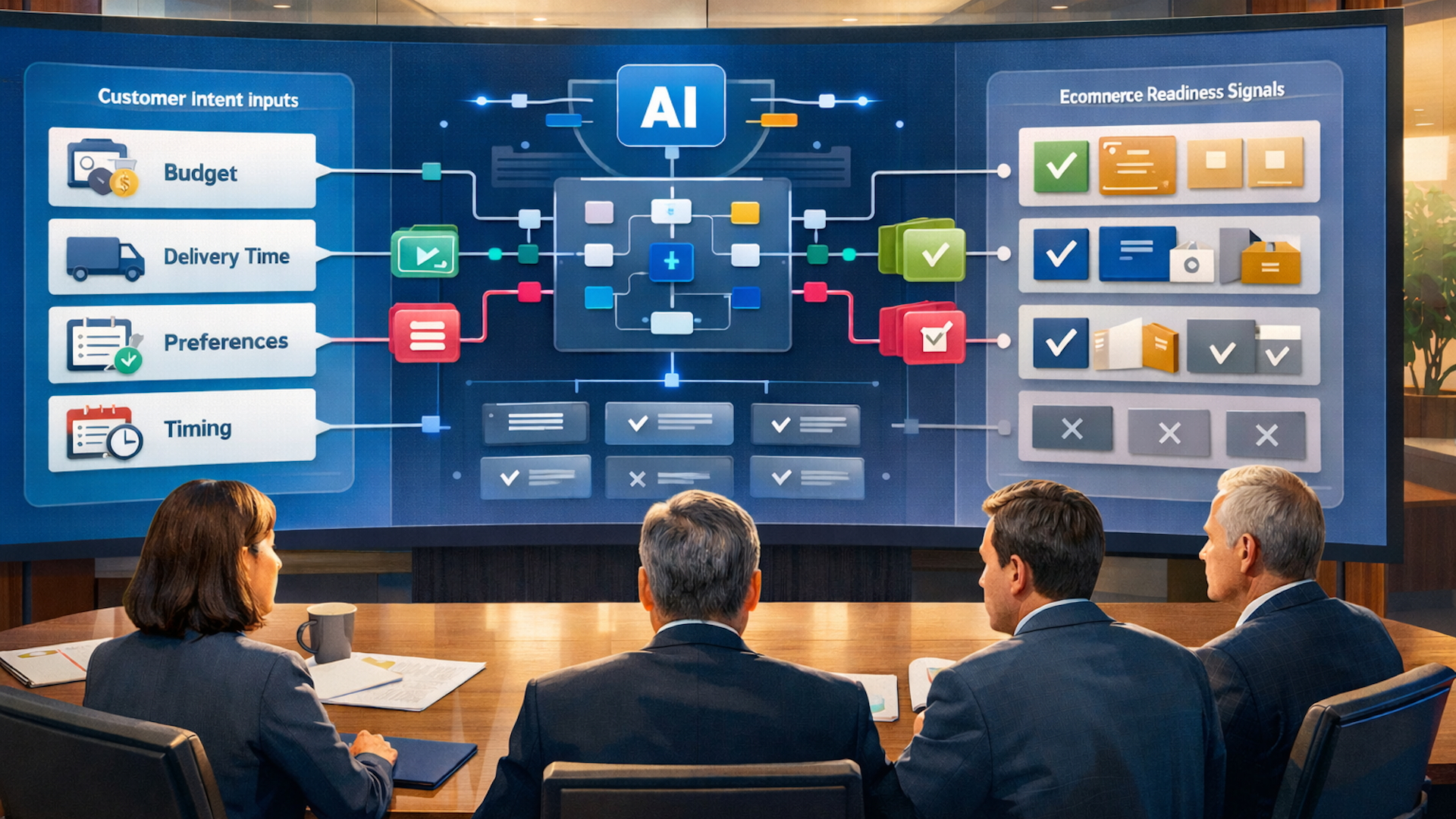
    Instead of brief search phrases, users convey needs, constraints, and preferences, which the agent then transforms into actions.

    This decreases the significance of owning category head terms. If an agent has comprehensive user data, it acts like a knowledgeable repeat customer.

    This presents a new reporting challenge. Not all SEO work will appear as direct demand creation, yet it still impacts outcomes. Leaders need to anticipate this shift.

    Rethink Consideration

    The consideration phase evolves too. Traditionally, it involves hosting reviews, comparisons, and reassurances.

    With agentic intervention, consideration morphs into a filtering process, retaining only the options that align with user preferences.

    This necessitates a quality over quantity strategy in content, emphasizing structural trust signals and consistent, verifiable information.

    Brands might be selected without user awareness. While this could boost conversions, it also poses a risk to brand recognition if not addressed elsewhere.

    Dig deeper: Align your SEO strategy with buyer intent stages

    Establish Honest Measurement Expectations

    Measurement often concerns executives, and agentic AI complicates this. With more processes happening inside AI, fewer interactions leave traceable or clear data.

    I address this early by stressing that while this isn’t a failure of optimization, it merely highlights the analytics limits in a complex digital landscape.

    The focus should shift to directional indicators and blended performance over precise attribution, acknowledging the new decision-making landscape.

    Advocate Proactive, Low-risk Responses

    The crux of leadership dialogue is next steps. Fortunately, most appropriate responses to agentic AI carry low risk.

    Enhancing product information, eliminating inconsistencies, strengthening reliability signals, and addressing technical vulnerabilities benefit the business now and pave the way for the future.

    Building brand trust outside search also plays a critical role. Trusted brands are more likely to be selected by agents performing comparisons.

    This strategy reassures leaders that success doesn’t require radical change but calls for focused improvement.

    Agentic AI: Focus Shifts, Fundamentals Persist

    For us SEO leaders, agentic AI modifies our focus. Instead of solely optimizing for visibility, we aim to protect eligibility, reduce ambiguities, and illustrate influence.

    This demands confidence and clear articulation, challenging hype with grounded perspectives. Agentic AI renders SEO more strategic and no less crucial.

    Agentic AI isn’t an imminent threat or foolproof advantage. It’s a transformation in decision-making approaches.

    For e-commerce brands, the winners are those who stay composed, communicate effectively, and transition their SEO approach from driving clicks to securing selections.

    This transition forms the backbone of the current SEO leadership discussions.

    Dig deeper: SEO Predictions for 2026: Insights from Leaders


    Inspired by this post on Search Engine Land.


    crushpress.ai community screenshot
  • Boost Ecommerce with Performance Max: Insider Insights Unveiled

    Boost Ecommerce with Performance Max: Insider Insights Unveiled

    When I first heard about Performance Max, I was skeptical. It seemed like an unfinished product, but over the past 18 months, Google has made significant improvements in transparency and control. If you haven’t revisited Performance Max since its early days, now is the perfect time to take another look.

    As I learned from Mike Ryan at SMX Next, the advancements are worthy of attention.

    Taking a Fresh Look at Performance Max

    Performance Max evolved from Smart Shopping campaigns, introduced with much excitement in 2019. Yet, industry experts quickly pointed out issues with transparency and control, which Google is only now beginning to address.

    ```json
{
  "alt": "Presentation slide on the case for PMax, comparing settings and reporting features with Standard and Smart Shopping.",
  "caption": "Exploring the benefits of PMax: This slide presents an analysis of PMax against Standard and Smart Shopping, highlighting advancements in campaign optimization.",
  "description": "This image displays a presentation slide titled 'The case FOR PMax,' discussing the advantages of PMax in digital advertising. It includes a comparison of settings and reporting features alongside Standard and Smart Shopping. The slide outlines how PMax fills critical gaps and reimagines campaign strategies, with a table showing various features like location modifiers, device modifiers, and reporting options. This presentation is attributed to SMX, a digital marketing conference."
}
```

    Smart Shopping took away vital controls critical for managing campaigns effectively. Essential features like promotional controls and search term reporting vanished, leaving many of us feeling limited.

    Fortunately, Performance Max reintroduces much-needed functionality, enhancing what was once lacking.

    Understanding Performance Max Search Terms

    ```json
{
  "alt": "Presentation slide showing campaign search term view with resource fields, segments, and metrics lists.",
  "caption": "An insightful breakdown of the campaign search term view, highlighting the key resources, segments, and metrics used for enhanced reporting and segmentation.",
  "description": "This presentation slide showcases the campaign search term view, featuring a detailed list of resource fields, segments, and metrics. Emphasizing the use of campaigns over ad groups for better asset grouping, it highlights enhanced segmentation options and reporting power. The slide includes bullet points explaining the advantages of this approach, offering a comprehensive understanding of the system's capabilities."
}
```

    In my experience, search terms are crucial for understanding the effectiveness of our campaigns. With Performance Max, Google has added a unique match type that brings detailed and scriptable data, allowing us to optimize with precision.

    Search Term Insights vs. Campaign Search Term View

    Initially, Google introduced search term insights, grouping queries into categories. Unfortunately, these lacked depth as they didn’t provide essential cost data.

    ```json
{
  "alt": "Webinar slide on search theme reporting with speaker visible, showing search volume and sources information.",
  "caption": "Exploring the dynamic world of search theme reporting—learn how to optimize search strategies effectively.",
  "description": "This image is a webinar screenshot discussing search theme reporting within search term insights. It features a speaker on the left and a slide on the right showing a chart with columns for search volume and source details. Text on the slide outlines how to discover and analyze search terms through search themes, touching on metrics like CTR and conversion rates. The SMX logo is visible, indicating the webinar's affiliation."
}
```

    The game-changer, though, is the new campaign-level search term view, offering access to more metrics and clearer visibility on performance.

    While these insights are only available at the search network level, they offer significant improvement over past limitations.

    Search Theme Reporting

    ```json
{
  "alt": "Presentation slide explaining negative keywords for PMax campaigns with instructions and a speaker at a conference.",
  "caption": "Discover how to optimize your PMax campaigns by adding up to 10,000 negative keywords. Enhance brand safety and performance with this step-by-step guide.",
  "description": "This image is a presentation slide from a conference discussing the use of negative keywords in Performance Max (PMax) campaigns. The slide outlines the allowance of up to 10,000 negative keywords for improving brand safety and performance. It includes a detailed guide on applying these keywords to campaigns, emphasizing their importance for Search and Shopping while noting exclusions for display and video. A speaker image is present, indicating a live presentation setting, with the SMX logo in the corner for branding."
}
```

    Through Performance Max, I’ve realized search themes act as a positive targeting method. By checking conversion data and the source of traffic, I can ascertain the value of search themes, identifying whether they contribute effectively or remain underutilized.

    Search Term Controls and Optimization

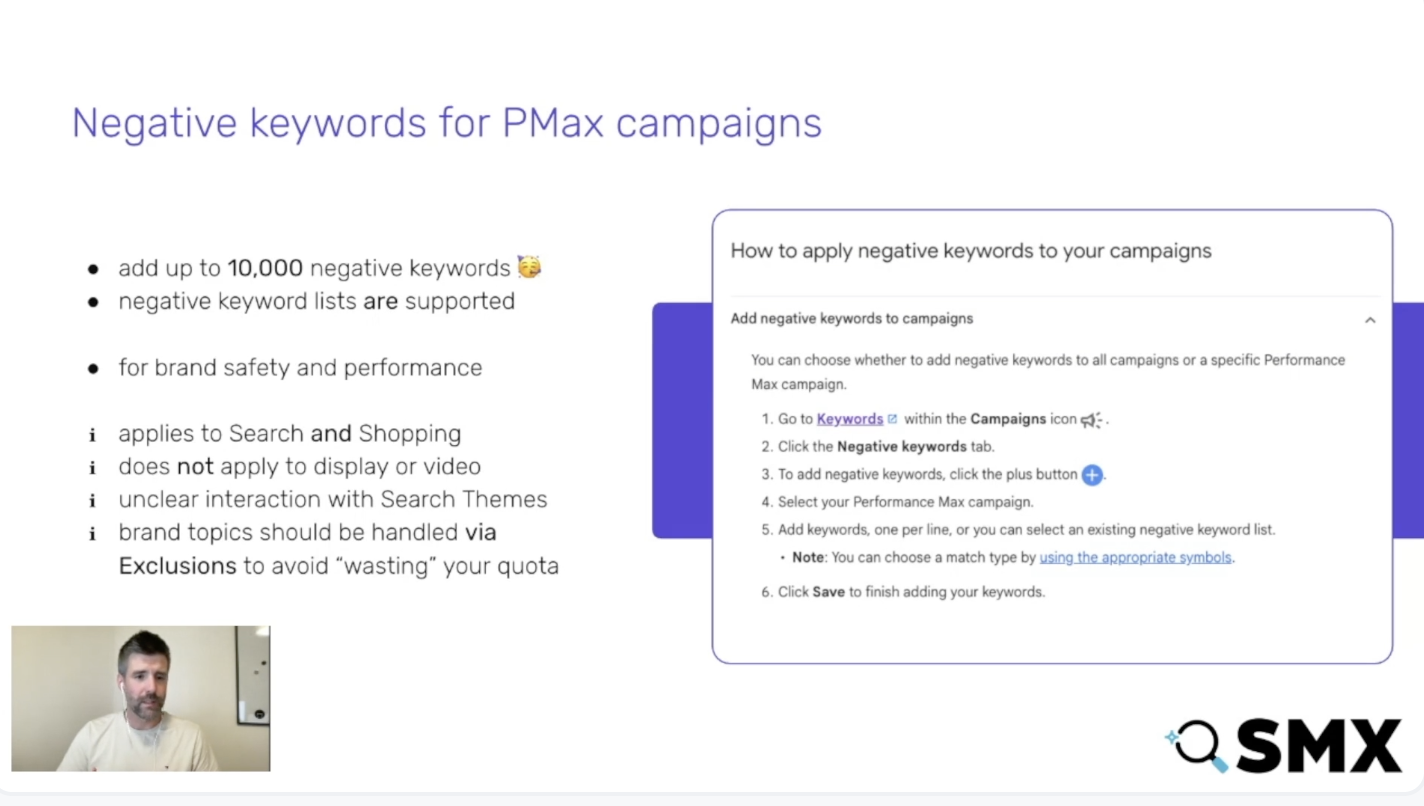
    Negative Keywords

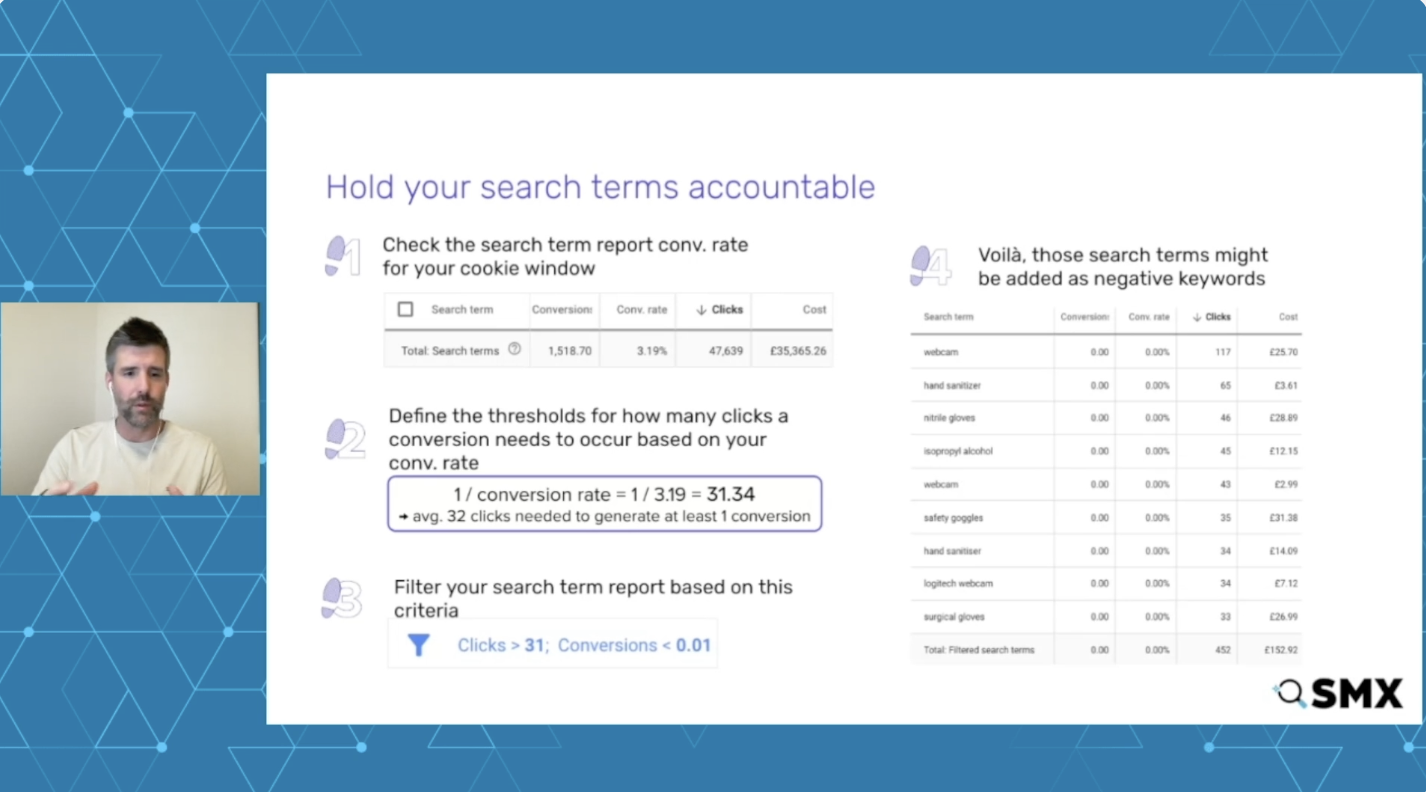
    ```json
{
  "alt": "Presentation slide showing steps to hold search terms accountable with a speaker on the left.",
  "caption": "Master your search campaigns with effective keyword management and conversion rate analysis. Insights from SMX guide you through optimizing for better outcomes.",
  "description": "This image features a presentation slide with four steps to manage search terms, aimed at optimizing conversions in ad campaigns. On the left, a speaker joins remotely, set against a blue background with geometric patterns. The slide offers details on checking conversion rates, setting click thresholds, and filtering search terms, supported by data tables. Keywords: search terms, conversion rate, ad campaigns, keyword management, SMX."
}
```

    At first, negative keywords in Performance Max were limited, which was frustrating. But now, they are fully supported and much more robust, giving me the control I need to fine-tune performance.

    Brand Exclusions

    While Performance Max tends to favor brand queries because of their high intent, I’ve noticed that using negative keywords provides a stronger solution for ensuring optimal performance without leakage.

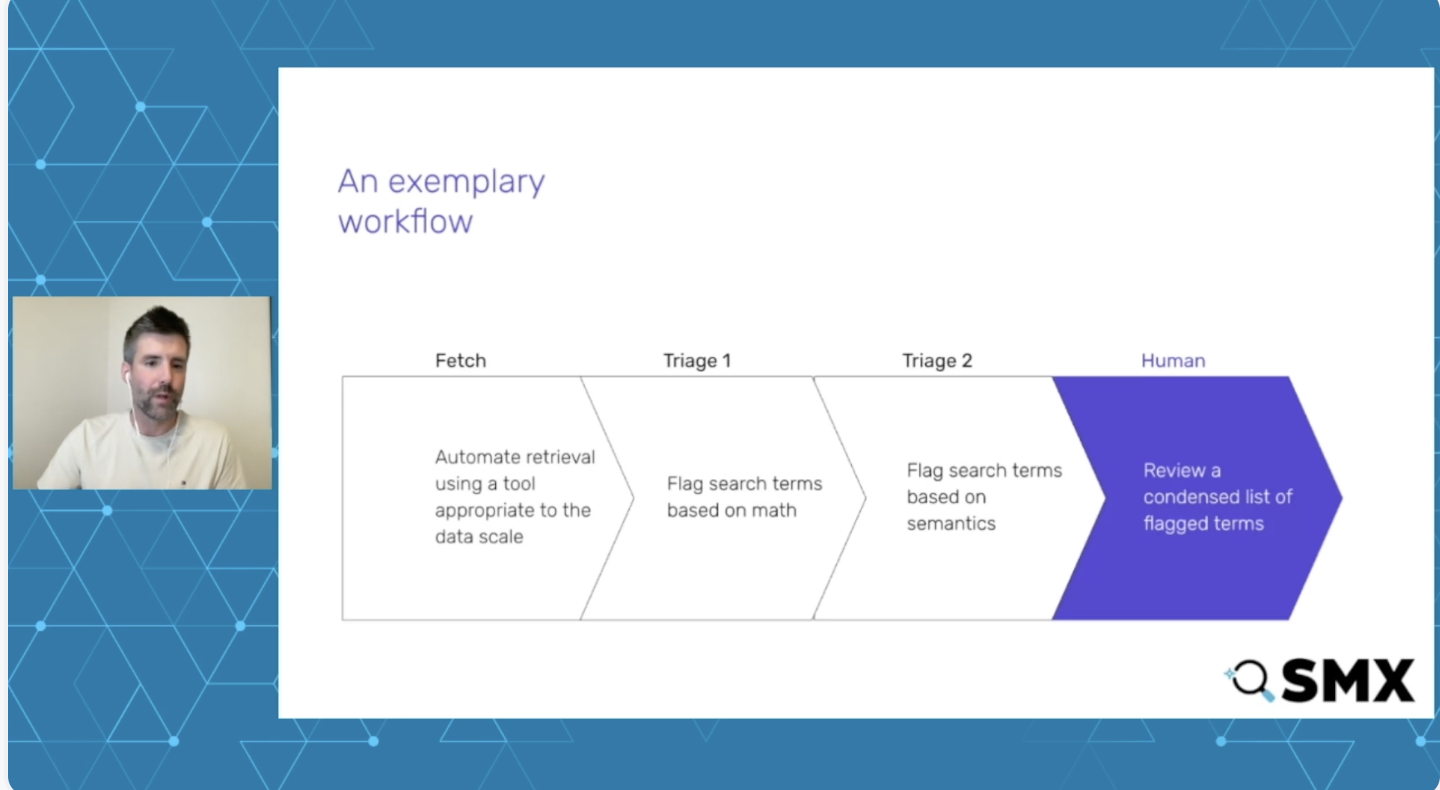
    ```json
{
  "alt": "Presentation showing an exemplary workflow with four stages: Fetch, Triage 1, Triage 2, and Human, alongside a presenter.",
  "caption": "Discover an efficient workflow combining automation and human analysis, detailed by the presenter, enhancing data processing through multiple stages.",
  "description": "This image features a presentation slide depicting a four-stage workflow process: Fetch, Triage 1, Triage 2, and Human, aimed at optimizing data retrieval and analysis. On the left, a presenter appears in a video feed, explaining how automated tools and human intervention work in tandem for effective search term flagging. The process involves automating data retrieval, followed by mathematical and semantic evaluation, and ending with human review. The design is set against a geometric blue background, with the SMX logo at the corner."
}
```

    Optimization Strategy

    My strategy involves identifying non-performing search terms with higher-than-average clicks but zero conversions, making them strong candidates for exclusion. This approach prevents overcorrection while maintaining a focus on impactful terms.

    Modern Optimization Approaches

    ```json
{
  "alt": "Channel Performance report infographic showing impressions, interactions, and conversions.",
  "caption": "Decoding the Channel Performance: A visual journey through impressions, clicks, and conversions to maximize your marketing strategies.",
  "description": "This image features an infographic titled 'The Channel Performance report, decoded' alongside a schematic representation of marketing data flow, illustrating impressions, interactions, and conversions from various channels such as Discover, Display, and YouTube. Key marketing metrics include Dynamic remarketing, Responsive Display, and Conversion rate. The data visualization uses colorful flows and numerical data to convey insights into digital marketing strategies."
}
```

    Instead of spending countless hours manually reviewing search terms, I leverage automation. Using the API for high-volume accounts and scripts for mid-range volumes significantly optimizes my workflow.

    Channels and Placements Reporting

    Channel Performance Report

    ```json
{
  "alt": "Presentation on Google Ads Search Partners Exclusions with a speaker on video call.",
  "caption": "Learn about the new Google Ads exclusion policies for Search Partners launching in March 2024. Key details help advertisers manage domain exclusions effectively.",
  "description": "This image displays a presentation slide discussing upcoming changes to Google Ads Search Partners exclusions, effective March 2024. It includes details about account-level placement exclusions, affecting Performance Max, App, Search, Shopping, and Smart campaigns. The slide outlines specific exclusion limits per account and manager account, and notes on Google domains. A speaker is visible via video call in a smaller frame, adding a personal touch to the technical presentation. Ideal for marketers and advertisers looking for updates on digital advertising policies."
}
```

    One of the tools I now rely on is the channel performance report, offering insights across different networks like Discover and Display. Though interpreting some diagrams can be tricky, it provides valuable data on how different channels perform.

    Channel and Placement Controls

    Placement Exclusions

    ```json
{
  "alt": "Device reporting interface showing ad performance by device type on a line graph and table.",
  "caption": "Exploring device metrics: Understand ad performance with a detailed look at how different devices impact campaign results, including CTR and CPC insights.",
  "description": "This image illustrates a device reporting interface focusing on ad performance metrics such as clicks, impressions, CTR, and CPC for computers, mobile phones, and tablets. The line graph represents the change in metrics over a specified period. Accompanying notes advise on interpreting usual trends, such as high CTR but low conversion rates on mobile. The image is part of a tutorial aimed at optimizing ad strategies across devices, highlighting typical patterns and considerations for marketers."
}
```

    Through API and Report Editor data, I focus on excluding specific placements that seem irrelevant or pose risks, particularly in sensitive content areas like politics and children’s videos on YouTube.

    Tools for Placement Review

    For reviews, especially in other languages, I’ve found that using Google Sheets’ translation function is effective. It helps me quickly determine the relevance of YouTube placements without relying on external systems.

    ```json
{
  "alt": "Presentation on device targeting with a slide showing conversion data and a speaker in the corner.",
  "caption": "Understanding the impact of device targeting in marketing campaigns can transform your strategy. This presentation delves into conversion data, urging critical decision-making.",
  "description": "The image displays a presentation slide titled 'Device targeting is a fundamental, structural choice' with tables showing conversion data for computers, mobile phones, tablets, and TV screens. A speaker appears in the lower left corner, likely delivering a talk on marketing strategies at an SMX event. Important points include examining monthly conversions and weighing risks versus benefits. Keywords: device targeting, conversion data, marketing strategy, SMX."
}
```

    Search Partner Network

    The inability to opt out of the Search Partner Network can be frustrating. However, I mitigate this by prioritizing exclusions where performance is subpar compared to the Google Search Network.

    Device Reporting and Targeting

    Device Analysis

    Analyzing device performance provides deeper insights into how specific products perform across different devices. This often reveals advantages or challenges when compared to competitors.

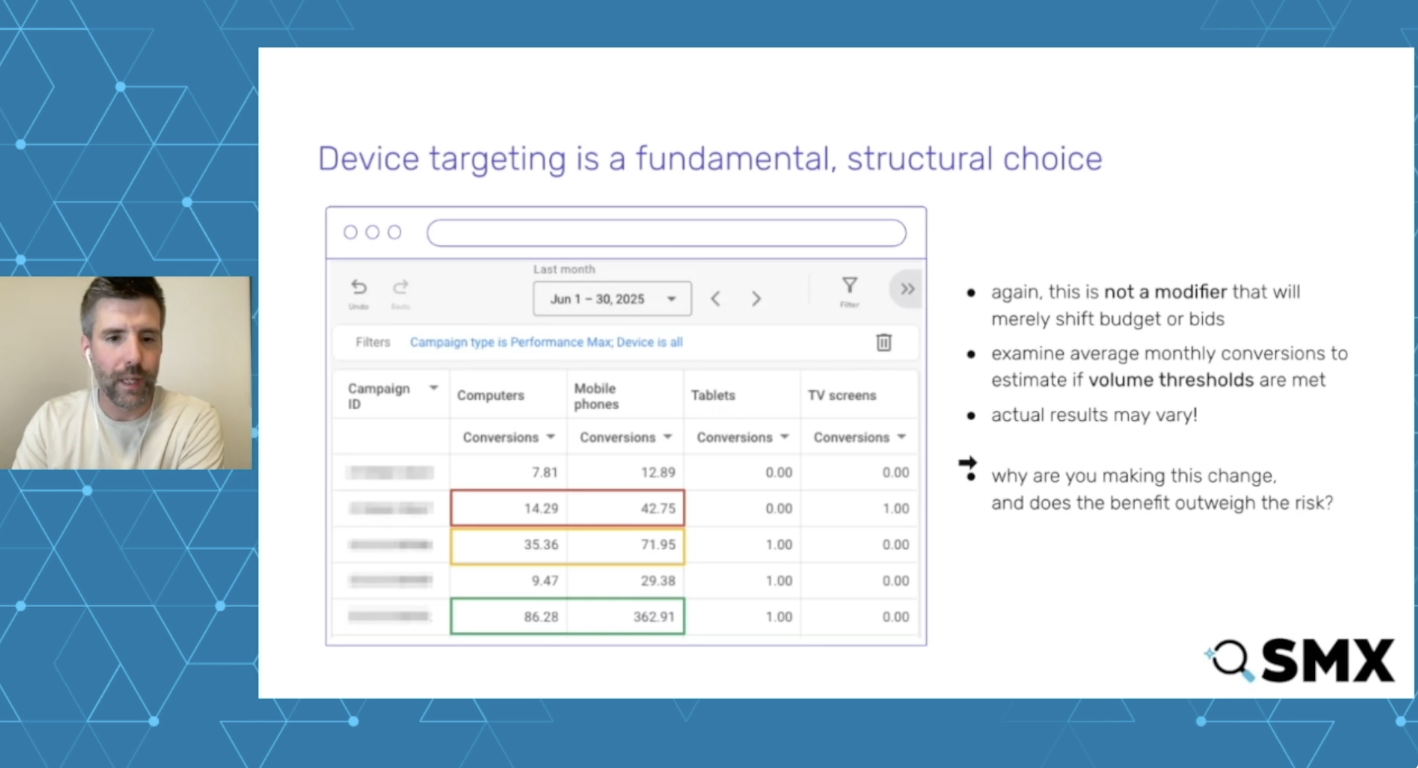
    Device Targeting Considerations

    Splitting campaigns by device can hurt data volume, impacting machine learning effectiveness. It’s crucial to weigh the benefits of splitting against the potential for data fragmentation.

    Conclusion

    Reflecting on Performance Max’s evolution, it’s evident that Google has made impressive strides in offering advertisers like myself more control and transparency. While it’s not without flaws, it’s a far more effective tool for ecommerce success now than ever before.

    The key lies in understanding available data, using modern tools to streamline processes, and applying performance insights strategically to achieve the best results.


    Inspired by this post on Search Engine Land.

    crushpress.ai community screenshot
  • Maximize Ecommerce Success with Demand Gen & Performance Max

    Maximize Ecommerce Success with Demand Gen & Performance Max

    When Google introduced Demand Gen campaigns in 2023, I saw them as a promising way to boost engagement across platforms like YouTube, Discover, and Gmail.

    Initially, they felt experimental, straddling the line between awareness and performance, but they’ve come a long way since.

    Now, the creative flexibility and enhanced audience control make Demand Gen a go-to campaign type for my ecommerce clients.

    This strategy allows me to scale revenue in a controlled manner, maintaining brand consistency while testing creative approaches to drive conversions.

    I’ve found that Demand Gen delivers the best results when strategically paired with Performance Max and Search campaigns.

    Advertising with Demand Gen is ideal if you crave more control.

    One major drawback of Performance Max is its lack of transparency and manual control.

    If precise targeting, placement, or creative control is essential, Demand Gen stands out as the better option.

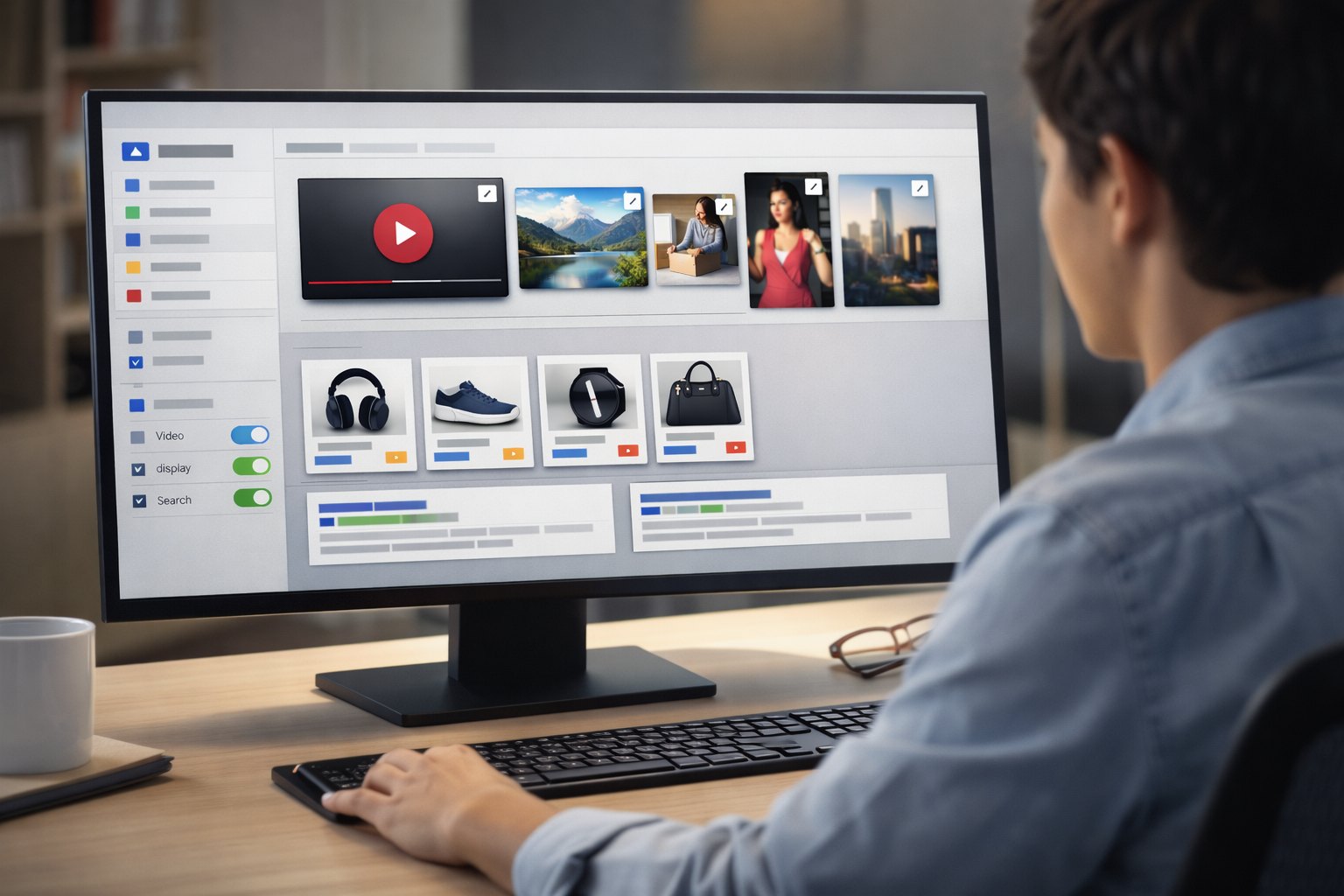
    Performance Max auto-generates ads from your uploads, relying on Google’s AI to mix and match for the best performance.

    This makes it crucial to provide top-notch creative assets.

    For example, a fitness brand might create separate asset groups for products like leggings, shorts, and vests.

    While this helps target relevant audiences, the control isn’t exhaustive.

    However, Demand Gen offers far superior flexibility.

    It allows me to upload, preview, and tweak ad combinations before launch, adapting each creative to its unique placement.

    For instance, I can customize YouTube ads for in-feed, in-stream, and Shorts placements.

    This control is perfect for ecommerce brands focusing on creative precision, message testing, and maintaining a strong visual identity.

    Dig deeper: The Google Ads Demand Gen playbook

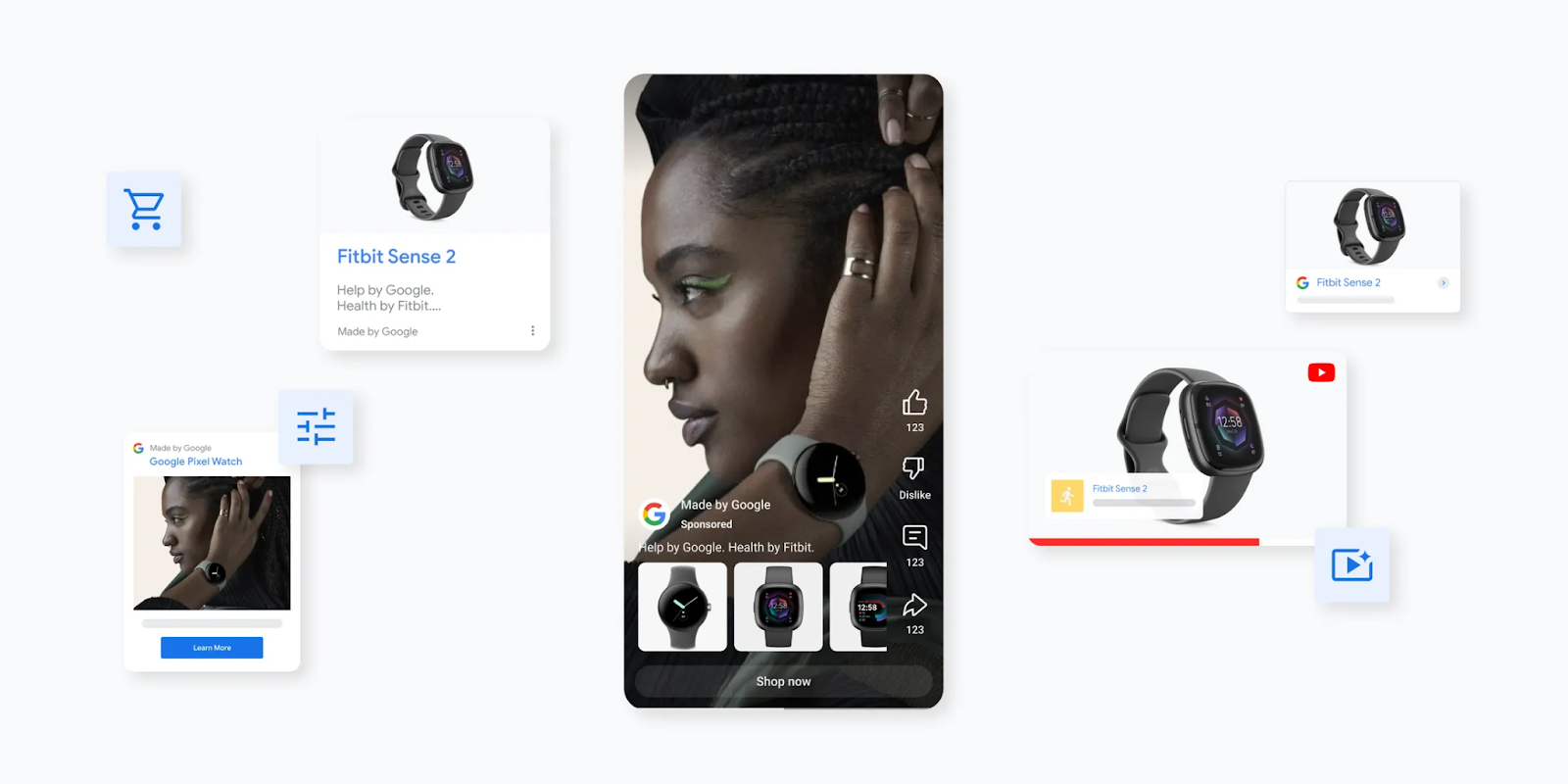
    Using Demand Gen alongside Performance Max can be incredibly effective if you leverage their roles within the customer journey. They enhance each other rather than compete.

    Demand Gen builds awareness and sparks interest by reaching higher-funnel audiences before they actively start product searching.

    Conversely, Performance Max focuses on converting lower-funnel users who are primed to purchase.

    ```json
{
  "alt": "Collage featuring the Google Pixel Watch and Fitbit Sense 2 with various display cards and interactive elements.",
  "caption": "Discover seamless integration with Google Pixel Watch and Fitbit Sense 2. Explore features and styles that keep you connected and healthy, right at your fingertips.",
  "description": "The image showcases a collage of the Google Pixel Watch and Fitbit Sense 2, emphasizing their sleek design and advanced functionality. The central focus is a profile of a person interacting with the Google Pixel Watch, surrounded by smaller display cards of the Fitbit Sense 2. Interactive social media elements like likes and dislikes hint at user engagement. The arrangement suggests an interactive and user-friendly interface, highlighting features like health tracking and connectivity options. Keywords: Google Pixel Watch, Fitbit Sense 2, health tech, smartwatches."
}
```

    For example, a fitness retailer might utilize Demand Gen for lifestyle videos and discovery ads promoting their latest activewear.

    When a potential customer begins to research or exhibit purchase intent, Performance Max engages with tailored Shopping and Search ads to finalize the sale.

    I’ve set up feed-only Performance Max campaigns, providing only a product feed within the asset group.

    This restricts Performance Max activities to Shopping placements, focusing it sharply on direct conversions.

    Meanwhile, Demand Gen operates across platforms like YouTube, Gmail, Discover, and Shorts, covering the upper and mid-funnel with more visual, creative content focused on awareness.

    This configuration minimizes overlap between campaign types while ensuring user engagement throughout the funnel, from brand discovery to purchase.

    For larger accounts with flexible budgets, this dual structure drives holistic performance and clearer attribution.

    In contrast, smaller accounts seeking efficiency should prioritize mastering high-intent campaigns before layering in Demand Gen once the core conversions are stable.

    The diverse campaign types now offer advertisers more flexibility than ever, yet it requires understanding Google’s restructuring of video and discovery products.

    Dig deeper: Why Demand Gen is the most underrated campaign type in Google Ads

    Since July 2025, Google’s Video Action Campaigns (VACs) have been replaced by Demand Gen.

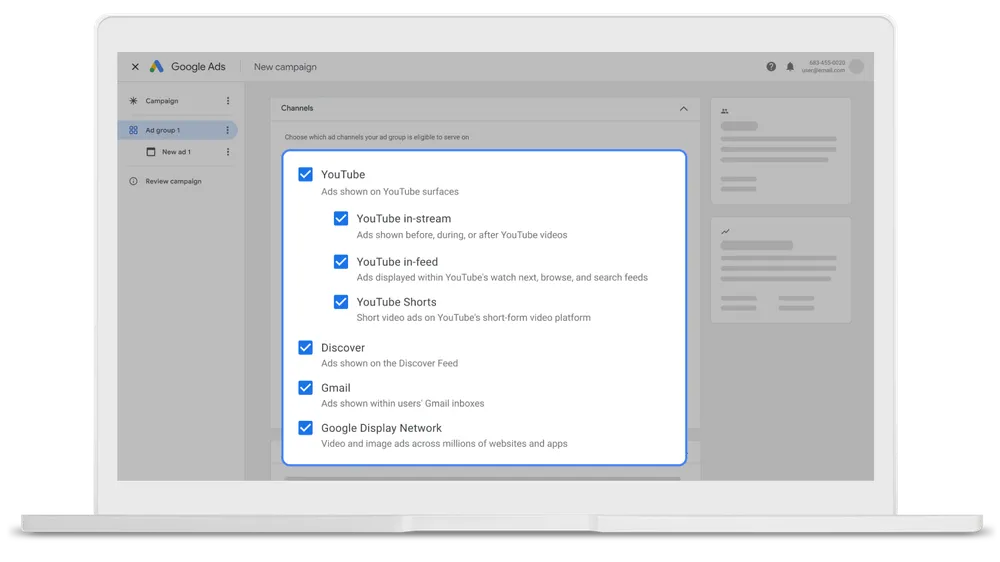
    It streamlines Google’s visual placements into one campaign type, including YouTube in-stream, Shorts, in-feed, Gmail, and Discover.

    This change is significant. VAC was successful for ecommerce, particularly for conversion-centric video. Its removal underscores Google’s encouragement to embrace Demand Gen.

    The advantage is that Demand Gen provides stronger creative control and diverse testing options across YouTube placements.

    If you previously ran VAC campaigns, they are now under Demand Gen. Ensure your top-performing assets and audiences have migrated correctly, then use the new controls to optimize performance.

    Audience control is a significant benefit of Demand Gen, and it’s a reason why I consistently use it for ecommerce.

    Demand Gen allows precise audience creation, letting me decide who sees the ads.

    I can select placements, merge audience types, and allocate the budget strategically.

    It’s the only Google Ads campaign type supporting lookalike audiences, valuable for brands focused on acquiring quality leads.

    ```json
{
  "alt": "Google Ads campaign settings screen showing various ad channel options.",
  "caption": "Maximize your reach by choosing from various Google Ads channels like YouTube, Discover, and Gmail to tailor your advertising strategy.",
  "description": "This image displays a Google Ads campaign setup screen on a laptop. The interface allows users to select ad channels including YouTube, Discover, Gmail, and the Google Display Network. Each option is highlighted with checkboxes that can be selected to target specific audiences and surfaces. This setup enhances the versatility and reach of digital marketing campaigns, providing advertisers with the tools to optimize ad delivery across multiple Google platforms."
}
```

    While Performance Max utilizes audience signals over fixed targeting, Demand Gen excels for control, testing, and segmentation strategies.

    In mid-2025, Google rolled out an open beta for advertisers to opt out of specific Demand Gen channels manually.

    This means I can now control ad display, excluding Discover or YouTube Shorts if they don’t align with my objectives or creative format.

    This small but significant update offers more control, a feature often lacking in many of Google’s automated campaign types.

    Dig deeper: Google Ads rolls out channel control for Demand Gen campaigns

    In early 2025, Google introduced product feed integration for Demand Gen campaigns. This change allows me to link the Google Merchant Center feed, incorporating live product data directly into visual ads.

    This development bridges performance and branding for ecommerce, enabling storytelling through creative visuals while displaying actual products.

    For instance, a fashion retailer can showcase a new collection in a video advert while featuring shoppable product cards below.

    This update positions Demand Gen as a hybrid between Shopping and Display, a much-anticipated capability among ecommerce advertisers.

    Demand Gen typically demands a larger budget than other campaign types.

    Google recommends starting at about £100 per day per campaign or 20 times your target CPA/tROAS, whichever is higher.

    Practically, the £100-per-day baseline is a viable starting point for effective data collection and optimization. Lower budgets restrict data flow and slow progress.

    Demand Gen complements your broader Google Ads strategy, rather than replacing Search or Performance Max.

    It’s a premium, visually led campaign type that boosts awareness leading to conversions, particularly effective when you have accurate measurement, a clean product feed, and clearly defined audiences.

    The table compares Demand Gen and Performance Max on key aspects that matter to advertisers.

    Dig deeper: Google pushes Demand Gen deeper into performance marketing

    Performance Max excels in scale but can be opaque.

    Demand Gen offers the control advertisers have demanded—genuine creative testing, audience precision, and placement visibility.

    For sustainable ecommerce growth, I recommend using both. Performance Max captures demand, while Demand Gen creates it.

    Together, they form a comprehensive framework for scalable and sustainable growth.


    Inspired by this post on Search Engine Land.


    crushpress.ai community screenshot
  • Google Ad Clicks Surge to Five-Year Peak with Q4 Spending Boom

    Google Ad Clicks Surge to Five-Year Peak with Q4 Spending Boom

    During the final quarter of 2025, I noticed a remarkable 13% rise in spending on Google search ads compared to the previous year, as reported by Tinuiti’s latest benchmark. It was eye-opening to see this surge in click growth, marking the strongest pace since early 2021, particularly as average CPCs slightly declined for the second quarter in a row. The expansion of AI-driven results seemed to be increasing the overall query volume, including those crucial commercial searches.

    Why we care. As I’ve observed, Google search ad clicks are skyrocketing while CPCs stay flat. This trend is largely due to Amazon’s strategic withdrawal from U.S. Google Shopping auctions, which has opened the door for advertisers to find both opportunities and challenges as spending patterns shift between search and shopping.

    ```json
{
  "alt": "Line graph showing Google US Paid Search Y/Y Growth from Q4 2024 to Q4 2025, highlighting trends in spend, clicks, and CPC.",
  "caption": "Exploring year-over-year growth in Google US Paid Search, this graph illustrates trends in spending, clicks, and cost-per-click from late 2024 through 2025.",
  "description": "This line graph depicts the year-over-year growth for Google US Paid Search from Q4 2024 to Q4 2025. It shows three lines representing different metrics: Spend (orange), Clicks (blue), and Cost-Per-Click (CPC, purple). The graph highlights the trends, with spend and clicks rising towards the end of 2025, while CPC decreases. The data is sourced from anonymized Tinuiti advertiser data, 2025, providing insights into digital advertising performance over the observed period."
}
```

    Additionally, AI-driven query growth is broadening the search funnel, offering more chances to connect with customers earlier in their buying process.

    ```json
{
  "alt": "Line graph showing year-over-year growth in Google US Shopping Ads from Q4 2024 to Q4 2025, depicting trends in spend, clicks, and CPC.",
  "caption": "This line graph illustrates the year-over-year growth of Google US Shopping Ads from late 2024 to 2025, highlighting fluctuations in ad spend, clicks, and CPC over the quarters.",
  "description": "The image features a line graph representing the year-over-year growth of Google US Shopping Ads, focusing on Performance Max and Standard Shopping Campaigns from Q4 2024 to Q4 2025. The graph includes three lines: orange for spend, blue for clicks, and purple for cost-per-click (CPC). Notable trends include an increase in spend and clicks with CPC showing varied performance. This analysis provides insights into advertising dynamics over the specified period."
}
```

    Shopping ad trends: During the holiday season, I followed how Google Shopping ad expenditure jumped 16% year over year, propelled by Target and Walmart stepping up while Amazon’s absence left a noticeable gap in auctions. Meanwhile, Shein and Temu maintained smaller roles. Interestingly, CPCs for Shopping Ads weakened slightly, falling 1% year over year.

    ```json
{
  "alt": "Bar chart showing Google Performance Max share for spend and sales across five quarters from Q4 2024 to Q4 2025.",
  "caption": "Tracking the shifts in Google Performance Max shares across spend and sales from late 2024 to 2025 reveals dynamic retail strategies.",
  "description": "This bar chart illustrates the Google Performance Max share of Google Shopping for median retailers with both PMax and Standard Shopping Campaigns. Data spans from Q4 2024 to Q4 2025, covering five quarters. The chart indicates a progressive change in the share percentage; for example, Q4 2024 shows a 69% share in spend, decreasing slightly in subsequent quarters. The sales shares display similar trends, signifying strategic adjustments. This visual is useful for understanding advertising trends over time."
}
```

    Performance Max. PMax campaigns captured my attention as they represented 62% of total Google Shopping spend and 61% of sales, which, although slightly down from the last year, showed an increase from earlier in 2025. Non-shopping inventory, such as video and display, accounted for 39% of PMax spending, with YouTube video making up 13% of impressions beyond search.

    ```json
{
  "alt": "Line graph showing Google Performance Max share of spend by ad type from Q4 2023 to Q4 2025 for Video and Non-Shopping Search and Display.",
  "caption": "Trends in Google ad spending reveal a rise in Non-Shopping Search and Display ads, peaking at 32% by Q4 2025, while Video ads maintain a consistent 7%.",
  "description": "This line graph depicts the Google Performance Max share of spend by ad type from Q4 2023 to Q4 2025. The orange line represents Non-Shopping Search and Display, which shows a significant increase, reaching 32% by Q4 2025. The blue line indicates Video ads, maintaining a steady trajectory around 7%. The data source is anonymized Tinuiti advertiser data from 2025. This graph highlights key trends in digital marketing investment, showcasing the growing importance of search and display strategies."
}
```

    Text ads. It’s exciting to note that Google text ad clicks reached a 19-quarter high, climbing 9% year over year. Spending was up by 11%, with CPC growth remaining modest at 2%. Brand keyword CPC growth saw a slowdown to just 2% year over year, with declining CTRs counterbalanced by strong impression growth, likely driven by AI-driven overviews in search results.

    ```json
{
  "alt": "Line graph of Microsoft US Paid Search Y/Y Growth in 2025 showing trends for Spend, Clicks, and CPC.",
  "caption": "Microsoft's US Paid Search sees dynamic changes in Spend, Clicks, and CPC throughout 2025, reflecting adaptive marketing strategies.",
  "description": "This line graph illustrates the year-over-year growth trends in Microsoft's US Paid Search for 2025. The data tracks Spend, Clicks, and CPC over four quarters. The graph shows a prominent rise in Spend by Q1, peaking in Q2, with a slight decline towards Q3, and stabilization in Q4. Clicks show gradual growth while CPC experiences fluctuation but ends higher. The graph's source is anonymized Tinuiti advertiser data."
}
```

    Microsoft search growth. Microsoft appeared to outpace Google in paid search spend growth, with a 16% year-over-year jump in Q4, rising from 12% in Q3. Click growth slowed slightly to 10%, while CPCs increased by 5%, as Amazon kept its presence in Microsoft Shopping listings.

    ```json
{
  "alt": "Line graph showing Amazon US Google Shopping Ads impression share from 2020 to 2025.",
  "caption": "Tracking Amazon's competitive edge, this graph reveals fluctuating Google Shopping Ads impression shares from 2020 to 2025.",
  "description": "This line graph illustrates the Amazon US Google Shopping Ads impression share for the years 2020 through 2025, with each year represented by a distinct colored line. The timeline spans from January to December 2025, indicating fluctuating market presence. The data is derived from anonymized Tinuiti advertiser data, showcasing trends in Amazon's advertising reach and competitive positioning in the US Google Shopping landscape."
}
```

    Amazon advertising. I observed that Sponsored Products clicks on Amazon rose by 23% year over year, showcasing an intriguing pattern despite a 1% drop in average CPCs. Sponsored Brands experienced modest spend growth (+2%) but with declining clicks, whereas Sponsored Display spending fell 47%. Meanwhile, Amazon DSP spending rose 31% year over year, propelled by offsite inventory and premium placements like Prime Video ads.

    ```json
{
  "alt": "Bar chart of Q4 2025 YouTube Ads showing 13% growth in spend, 38% growth in impressions, and 18% decline in CPM.",
  "caption": "In Q4 2025, YouTube ad impressions rose by 38%, while ad spend increased by 13%, but CPM saw an 18% decline. Explore the shifts in advertising dynamics.",
  "description": "This image presents a bar chart depicting the year-over-year growth metrics for YouTube Ads in Q4 2025. Data sourced from anonymized Tinuiti advertiser statistics indicates a 13% increase in ad spend and a 38% increase in impressions. Contrastingly, CPM has decreased by 18%. The visualization employs pink bars to represent growth percentages, serving as an insightful snapshot of advertising trends."
}
```

    Walmart trends. Sponsored Products were a dominant force in Walmart’s search ad spend, accounting for 89% with conversions remaining high through the holiday season. Display ad spending grew to 35% of the total, with 60% geared toward offsite inventory targeting.

    Video and streaming ads. I found it fascinating that YouTube ad spending increased by 13% year over year, coupled with a sharp 38% rise in impressions and an 18% drop in CPMs. Video now commands 66% of Google Demand Gen spending. Across traditional streaming platforms, Prime Video ad spending surged 31% from Q3 to Q4, overtaking Netflix in CPMs, while TV screens dominated spending, with phones crucial for direct-response formats.

    The bottom line. Google’s search and shopping landscapes continue to thrive, driven by AI-enhanced query growth and evolving retailer participation, presenting both opportunities and challenges. Meanwhile, Microsoft and Amazon are advancing their ad offerings, providing me with diverse options to engage high-intent audiences across search, display, and streaming.

    Dig Deeper. Digital Ads Benchmark Report Q4 2025


    Inspired by this post on Search Engine Land.


    crushpress.ai community screenshot
  • Discover Google’s Universal Commerce Protocol: Revolutionizing AI Shopping

    Discover Google’s Universal Commerce Protocol: Revolutionizing AI Shopping

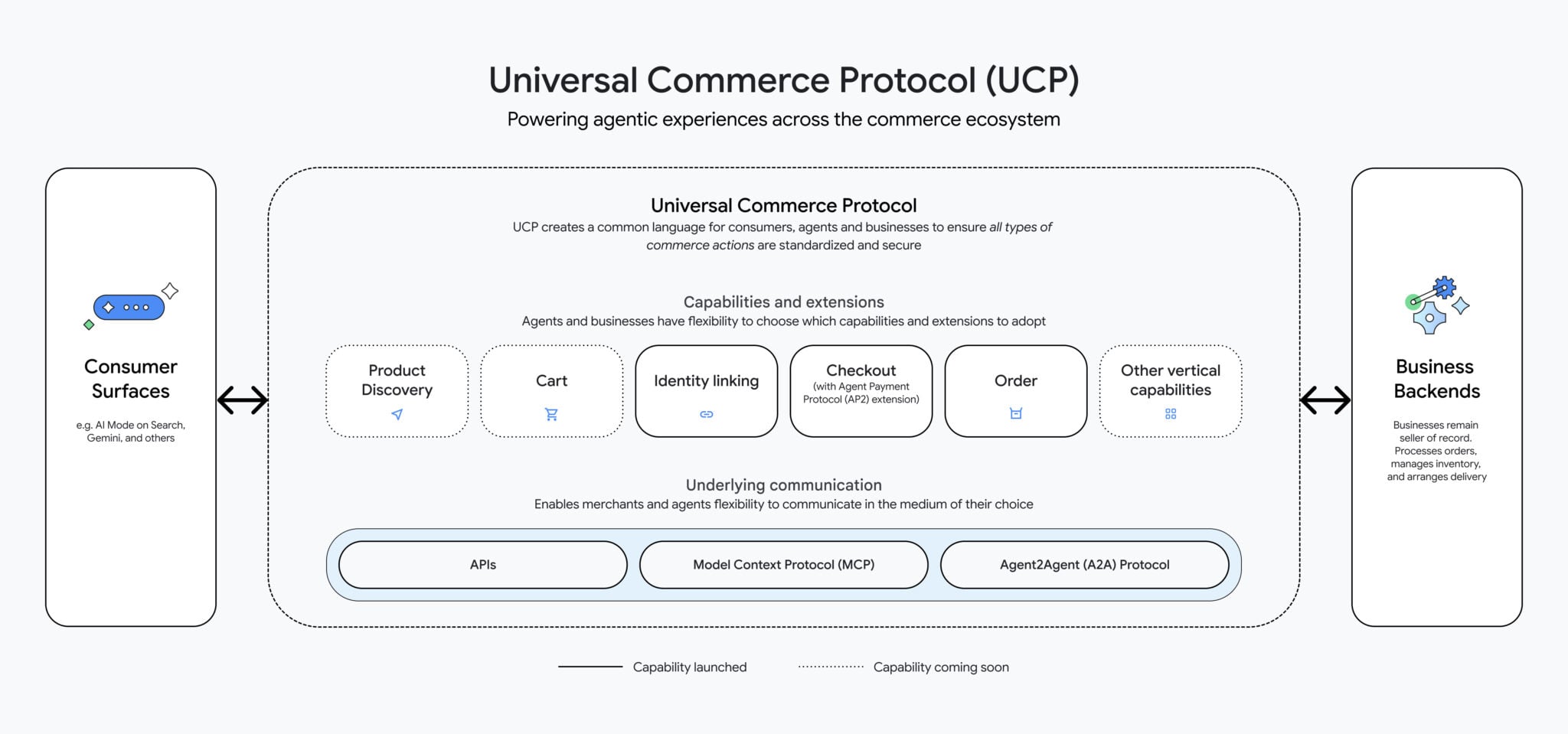
    Have you heard the news? Google has just launched the Universal Commerce Protocol (UCP), an innovative open standard that integrates AI agents throughout the entire shopping experience. From discovering products to making purchases and even receiving support after the sale, UCP facilitates it all.

    In exciting developments for retailers, Google is also rolling out new AI tools. These include branded shopping agents and ad formats that enhance AI-driven discovery, making the shopping experience more streamlined and engaging.

    About UCP

    This protocol offers a common language for AI agents and commerce systems, greatly simplifying the need for custom integrations across different platforms.

    • UCP is compatible with existing standards like Agent2Agent and the Model Context Protocol.
    • The protocol was co-developed with prominent partners such as Shopify, Etsy, Wayfair, and Target.
    • It’s already endorsed by over 20 additional companies in the retail and payments sectors.

    What’s Changing

    The UCP is set to enhance the checkout experience for Google product listings via AI Mode in Search and the Gemini app. Shoppers can make purchases through Google Pay, with options to use saved payment and shipping details. Integration with PayPal is also on the horizon.

    ```json
{
  "alt": "Diagram of Universal Commerce Protocol showing interaction between consumer surfaces and business backends with capabilities like product discovery and checkout.",
  "caption": "Exploring the Universal Commerce Protocol (UCP), this diagram illustrates seamless connections between consumer interfaces and business operations, highlighting essential capabilities such as product discovery and checkout.",
  "description": "This image of the Universal Commerce Protocol (UCP) depicts a framework that connects consumer interfaces with business operations. The diagram highlights capabilities like Product Discovery, Cart, Identity Linking, Checkout, and Order, along with extensions for various vertical capabilities. It shows underlying communication methods including APIs and protocols to facilitate flexible merchant-agent interactions, aimed at enhancing commerce actions' standardization and security."
}
```
    • Google aims to lower cart abandonment and provide retailers with tailored integration options suited to their needs.
    • Upcoming features include loyalty rewards and personalized shopping experiences.

    Business Agent

    In tandem with UCP, Google is unveiling the Business Agent, a branded AI assistant that provides shoppers with direct interaction opportunities on Search. Think of it as a virtual sales associate offering real-time responses in your brand’s own tone.

    • Major retailers like Lowe’s, Michael’s, Poshmark, and Reebok are already on board. Future capabilities may include deeper customization, data training, and a seamless agent-led checkout.

    Direct Offer

    Google is also testing Direct Offers, a fresh initiative within Google Ads tailored for AI adoption. When AI senses that a shopper is likely to make a purchase, a special discount can be presented.

    • This pilot will soon expand to incorporate offers such as product bundles, complimentary shipping, and more enticing incentives.

    Why It Matters

    The rise of agent-led shopping reshapes where and how buying choices are made. Google’s new AI tools and protocols are taking the lead, allowing advertisers to influence these pivotal moments during an AI-driven shopping journey.

    ```json
{
  "alt": "A smartphone screen displaying 'Meet AI Mode' with a virtual assistant query typed below.",
  "caption": "Explore the future of AI interaction with a sleek smartphone interface showcasing the 'Meet AI Mode' feature.",
  "description": "Image of a smartphone screen highlighting the new 'Meet AI Mode' feature, where a user has typed a query seeking a modern, stylish rug for a dining room. The keyboard and various icons such as GIF, voice input, and settings are visible, providing a glimpse into the seamless integration of AI in everyday tech use. This dynamic interface suggests an empowered user experience with cutting-edge AI capabilities."
}
```

    Tools like Direct Offers and branded agents create new pathways for advertisers to finalize sales efficiently, all while safeguarding profit margins. The balance between conversion improvements and losses in direct site traffic remains an open discussion.

    Bottom Line

    According to Google, agentic shopping is unstoppable. With innovations like UCP and its complementary retail tools, Google ensures that AI-driven commerce remains inclusive and accessible, keeping retailers engaged as agents transform the buying landscape.


    Inspired by this post on Search Engine Land.


    crushpress.ai community screenshot
  • Discover Microsoft’s Revolutionary Copilot Checkout & Brand Agents

    Discover Microsoft’s Revolutionary Copilot Checkout & Brand Agents

    At the NRF 2026 Conference, I had the opportunity to see Microsoft’s latest innovations firsthand: the Copilot Checkout and Brand Agents features.

    Seeing Microsoft roll out its first agentic experiences within Copilot feels like stepping into the future. With Copilot Checkout, I can now shop seamlessly without leaving the conversation, making it easier to switch from browsing to buying.

    What’s more intriguing is the introduction of Brand Agents for Shopify sites. Imagine having an AI chat that’s trained on your product catalog, offering personalized shopping experiences that echo your brand’s unique voice. It’s a smart solution for fast and scalable implementation.

    Copilot Checkout. I’m excited to share that Copilot Checkout is starting its U.S. rollout on Copilot.com. This feature allows conversational purchases directly within your current chat and integrates with partners such as PayPal, Shopify, Stripe, and Etsy.

    For Shopify merchants, enrollment in Copilot Checkout is automatic, though opting out is possible. Non-Shopify merchants interested in joining can apply through a dedicated form.

    Check out a glimpse of how it works:

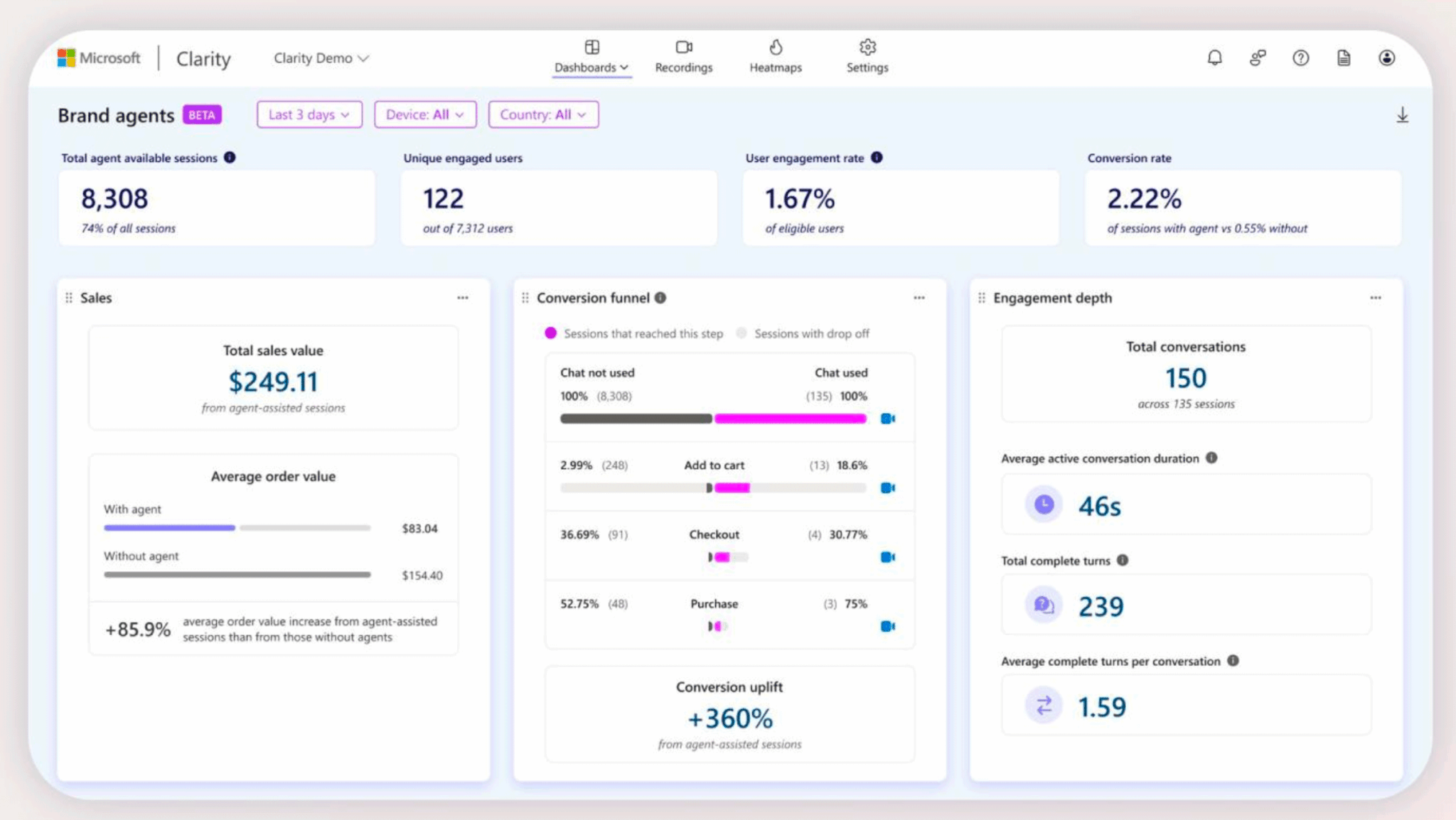
    Brand Agents. Now available for Shopify merchants, Brand Agents bring your brand’s voice into every interaction online. I was impressed to see how it leverages a brand’s product catalog to provide crystal-clear answers to product-specific inquiries.

    ```json
{
  "alt": "Microsoft Clarity dashboard displaying brand agents analytics with statistics on user engagement and sales conversion.",
  "caption": "Dive into detailed analytics with Microsoft Clarity's dashboard, showcasing insightful stats on brand agent engagement and sales conversion metrics.",
  "description": "The Microsoft Clarity dashboard image provides a detailed view of brand agents analytics, featuring data on total agent sessions, unique users, and engagement rates. It highlights sales metrics such as total sales value of $249.11 from agent-assisted sessions and an 85.9% increase in average order value. The conversion funnel outlines steps from 'Chat not used' to 'Purchase' with significant percentage uplifts. The engagement depth section covers total conversations, active conversation duration, and complete turns, offering a comprehensive overview for business insights."
}
```

    The AI speaks in your brand’s voice, seamlessly guiding customers from browsing to purchasing, and can be set up in just a few hours. Microsoft shared with me that sessions assisted by Brand Agents show higher engagement and conversion rates.

    Here’s a video showcasing Brand Agents in action:

    Brand Agents insights. Microsoft is innovatively using Microsoft Clarity to provide insights into Brand Agents conversations, helping merchants understand and optimize performance.

    Once I activated Brand Agents, I found myself equipped with additional insights to compare and optimize agent-assisted sessions against organic traffic, reinforcing my growth strategies.

    Here is where you can view these insights:

    Google and OpenAI. It’s fascinating to see how Google and OpenAI are also embracing agentic experiences. Google has introduced agentic checkout, whereas OpenAI announced its Instant Checkout in ChatGPT. Together, these developments mark a significant industry shift towards direct purchasing through AI experiences.


    Inspired by this post on Search Engine Land.

    crushpress.ai community screenshot
  • Discover the Best eCommerce SEO Agencies of 2026

    Discover the Best eCommerce SEO Agencies of 2026

    Last updated: January 7, 2026

    I’m excited to share my insights from our in-depth report on the top eCommerce SEO agencies of 2026. After carefully analyzing 49 companies between November 2025 and January 2026, our experts pinpointed the leading agencies based on several critical factors.

    ```json
{
  "alt": "Digital agency advertisement featuring bold text and a person wearing headphones.",
  "caption": "In a world driven by results, this digital agency blends innovation and creativity to stand out.",
  "description": "The image showcases an advertisement for a digital agency with the bold text 'The Digital Agency Driven by Results' in gradient blue and green. The upper left displays the agency's logo, 'aum'. On the lower right, there is a partial image of a person wearing headphones, highlighted by a red gradient. The design emphasizes modernity, technology, and professionalism, appealing to potential clients seeking creative digital solutions."
}
```

    We evaluated these agencies based on the following criteria:

    ```json
{
  "alt": "Person on a hydrofoil board holding a wing, silhouetted against an ocean sunset.",
  "caption": "Riding the waves into sunset: a breathtaking moment captured as a silhouette flies across the ocean on a hydrofoil board under the glow of a setting sun.",
  "description": "This image features an individual expertly maneuvering a hydrofoil board across the ocean, silhouetted against a stunning sunset. The rider balances on the board while holding a wing sail, showcasing the dynamic and adventurous sport of wing foiling. The scene captures the beauty of nature and the daring spirit of the sport, making it an inspiring and visually striking moment. Keywords: hydrofoil, wing foiling, ocean, sunset, silhouette."
}
```
    • Notable Clients (25%): This involved a nuanced review of each agency’s previous clients, focusing on the size and prominence of their top three partners.
    • Average Review Score (35%): This score reflects the average ratings on major review platforms, with an emphasis on eCommerce clients, while removing excessively positive reviews to ensure fairness.
    • Company Size (20%): We assessed the number of employees to understand each company’s growth and stability.
    • Years in Business (10%): This metric highlights the company’s ability to navigate various market and economic challenges.
    • Estimated Media References (10%): We gauged how frequently each agency was cited by reputable media outlets.

    Our detailed table, below, includes an overview of the top agencies, highlighting their unique SEO approaches and providing links for those interested in learning more.

    ```json
{
  "alt": "SmartSites homepage with award-winning digital marketing agency text and contact options.",
  "caption": "Discover the excellence of an award-winning digital marketing agency. Reach out and propel your brand forward with SmartSites.",
  "description": "This image is a screenshot of the SmartSites homepage, highlighting their status as an award-winning digital marketing agency. It features the company logo, navigation links to services, testimonials, and contact options. The design includes a sidebar for customer support and showcases partnerships and certifications from entities like Inc. 5000, Google, and Microsoft. The user interface prominently invites visitors to engage by providing their contact information. Keywords: SmartSites, digital marketing, agency, award-winning, partnerships, contact."
}
```

    The Top eCommerce SEO Agencies of 2026

    Each agency on our list has been meticulously evaluated, and I hope my findings help you find the perfect partner to enhance your eCommerce success.

    ```json
{
  "alt": "Nuanced Media website featuring marketing services for Amazon with a shopping cart graphic and partner logos.",
  "caption": "Elevate your business with Nuanced Media's Amazon marketing expertise. Discover data-driven strategies and client-centered service, trusted by industry leaders.",
  "description": "This image is from the Nuanced Media website, highlighting their focus on Amazon marketing. The design includes a stylized shopping cart graphic with the phrase 'Marketing on Amazon is What We Do,' signaling their strategic partnership approach. A red badge with the number 6 and logos of recognized industry leaders such as BuzzFeed and CNBC underscore their credibility. A button invites users to 'Start the conversation,' inviting potential clients to engage. The site’s sleek design and branding emphasize a commitment to data-driven, ROI-focused solutions."
}
```

    Inspired by this post on First Page Sage Blog.


    crushpress.ai community screenshot
  • Boost Your Visibility with ChatGPT’s Commerce Feed Optimization

    Boost Your Visibility with ChatGPT’s Commerce Feed Optimization

    I’ve discovered some fantastic insights on how to effectively submit and optimize product feeds for ChatGPT’s agentic commerce system. This is crucial for keeping your products visible, enhancing ranking, and minimizing conversion loss.

    Let me guide you through the process, so you can stay ahead of the competition and ensure your feeds are optimized to meet the latest standards. It’s essential for any business aiming to leverage the full potential of ChatGPT in boosting their ecommerce success.


    Inspired by this post on HiGoodie Blog.


    crushpress.ai community screenshot
  • Boost Shopify Conversions: Master Integrations for Success

    Boost Shopify Conversions: Master Integrations for Success

    I’ve realized that not every Shopify integration delivers the value we expect. Let me share how I organize and prioritize checkout, re-engagement, and optimization tools to make a real revenue impact.

    Shopify powers over 6 million live ecommerce websites, offering a rich app ecosystem that extends across the customer journey.

    Developers have the freedom to create apps for almost any function imaginable.

    Yet, with countless options available, ecommerce teams often waste time on shiny add-ons that promise gains but fail to deliver.

    Having been involved in numerous Shopify setups, I’ve seen firsthand which integrations truly enhance checkout completion and cart recovery while boosting revenue.

    From my experience, I’ve structured the most impactful integrations into three tiers. This helps prioritize essentials before advancing to sophisticated optimization.

    With 54.5% of holiday purchases happening on mobile, it’s crucial that the ecommerce experience is seamless and accommodating.

    Thus, every Shopify store should integrate two key components into its storefront:

    • Compatibility with digital wallets.
    • A ‘buy now, pay later’ (BNPL) option.

    Without these integrations, customers may face unnecessary friction and turn to competitors for a smoother transaction experience.

    The great news is that both of these features integrate easily with Shopify without requiring custom development.

    Digital wallets, like Apple Pay, Google Pay, and PayPal, streamline the payment process by autofilling necessary details, reducing friction on small screens.

    This efficiency reduces the purchase process to just a few clicks from a social ad to checkout.

    Up to 64% of Americans now use digital wallets as much as traditional methods, with 54% preferring them more often.

    Beyond convenience, customers seek payment flexibility. Providers like Klarna and Afterpay offer BNPL options that mitigate price objections at checkout.

    Last year, these options contributed $18.2 billion to online revenues.

    Combining digital wallets with BNPL functionality forms a robust foundation for a mobile-first checkout experience. With these in place, Shopify sellers can focus on re-engagement tools that drive customers back to complete their purchases.

    Dive deeper: The ultimate Shopify SEO and AI readiness playbook

    The second tier centers on re-engagement strategies. These tools are designed to entice back customers who have already shown interest.

    They enhance abandoned-cart recovery, boost repeat purchases, and build trust through social proof.

    Email remains a powerful channel for re-engaging customers across their journey. For Shopify users, platforms like Klaviyo and Attentive offer deep integrations with minimal setup.

    These platforms also extend to SMS, enabling automated texts to shoppers’ mobile devices.

    SMS consistently outperforms email in terms of open, click-through, and conversion rates, making it particularly effective for re-engagement needs such as recovering abandoned carts.

    However, navigating CAN-SPAM and TCPA regulations means explicit opt-ins are required for email and SMS marketing, respectively.

    While Klaviyo and Attentive excel at targeting opted-in customers, CartConvert helps merchants engage with the 50% to 60% who haven’t subscribed.

    CartConvert uses real agents to reach out via SMS, bypassing automated restrictions and engaging customers in real-time conversations.

    By combining CartConvert with platforms like Klaviyo, sellers can ensure comprehensive re-engagement strategies for both opted-in and non-opted customers.

    Human-centered marketing also enhances buyer confidence. Modern online shoppers depend on reviews heavily when deciding on purchases.

    Incorporating reviews directly into the shopping experience bolsters trust and legitimacy, boosting conversion rates.

    According to the Spiegel Research Center, a product with just five reviews is 270% more likely to be purchased than one without any reviews.

    Tools like Okendo, Yotpo, and Shopper Approved easily integrate with Shopify and sync with Google Merchant Center, enhancing Google Shopping ads’ performance.

    The third tier involves advanced integrations that help optimize your sales funnel and performance for scale.

    With GA4’s updates, tracking and attributing performance has become more challenging. Since 2023, Triple Whale has positioned itself as a robust alternative with third-party attribution tools integrating easily with Shopify.

    It supports various attribution models and provides real-time data—something Google Analytics lacks—offering valuable insights, especially during high-stakes periods like Black Friday.

    For improving conversion rates, custom landing pages are key. Replo allows Shopify users to design and A/B test landing pages on a large scale without coding risks.

    These personalized pages typically convert at higher rates than standard templates by using site data to adapt to users’ browsing patterns.

    Lastly, as TikTok grows as a paid media platform, its Shopify integration allows sellers to link ads directly to their sites, opening new opportunities for creative outreach and engagement.

    Remember, you don’t need to adopt every tool at once. Start by auditing your current set-up, fill in the gaps, and prioritize tools that promise to enhance conversions and re-engagement.

    Shopify’s greatest strength is its flexibility, empowering us to convert more visitors into loyal buyers.


    Inspired by this post on Search Engine Land.

    crushpress.ai community screenshot
  • Unlock Boosted Ad Performance with Google Merchant Videos

    Unlock Boosted Ad Performance with Google Merchant Videos

    I’ve discovered that Google has quietly introduced a new feature in their Performance Max (PMax) campaigns, allowing advertisers like us to access video assets directly from the Merchant Center. This seemingly small adjustment is poised to make a significant impact on how we handle retail and e-commerce ads.

    How it works. As part of this update, Google Ads now enables us to:

    • Auto-surface product-associated videos directly from Merchant Center during the PMax setup process.
    • Shorten creative workflows for our retail and e-commerce teams, saving us valuable time.
    • Improve product-to-creative alignment, thereby enhancing ad relevance.
    • Boost performance especially for those of us managing extensive SKU catalogs.

    Why this matters. This update is a game-changer because it eliminates a key friction point within PMax: the challenge of integrating high-quality, product-relevant videos into our campaigns. By streamlining this process and pulling videos directly from the Merchant Center, Google is enhancing the connection between inventory and creative assets. This means higher ad relevance, greater engagement, and improved overall performance.

    For brands like ours that have vast SKU inventories, this feature significantly accelerates the workflow and guarantees comprehensive video coverage — something we used to find challenging and resource-draining.

    ```json
{
  "alt": "Screenshot of video selection options for an ad, highlighting Merchant Center tab.",
  "caption": "Explore new video insertion options with the Merchant Center tab for your digital ads!",
  "description": "This image shows a screenshot of a user interface for selecting up to five YouTube videos for an advertisement. The highlighted 'Merchant Center' tab, marked as 'BETA', suggests a new feature in progress. Surrounding tabs include Suggested, Asset Library, YouTube, Social, and Upload, indicating comprehensive video source integration for ad campaigns. Keywords: YouTube, Merchant Center, ad video selection."
}
```

    The bigger picture. It seems that Google is on a mission to expand PMax’s creative capabilities. From integrating social video imports to this new Merchant Center video feature, there’s a clear intention to make PMax more user-friendly for advertisers heavily involved in commerce.

    First seen. This update caught my attention thanks to senior performance marketing executive, Rakshit Shetty, who shared his insights on LinkedIn.

    The bottom line. Although it’s a subtle change, it’s undoubtedly a meaningful victory for brands operating at scale in the eCommerce space.


    Inspired by this post on Search Engine Land.

    crushpress.ai community screenshot