Category: SEO

  • Unlocking AI Search: Insights from Historical Patents

    Unlocking AI Search: Insights from Historical Patents

    When I think about how much AI search has evolved, I’m amazed by how it’s deeply rooted in years-old patents. These historical blueprints are the architects of AEO, GEO, and our modern SEO strategies.

    It’s fascinating to me that whenever a new large language model (LLM) is released or Google makes an AI update, the SEO community seems to panic. We tend to overlook that the features we’re scrambling to optimize for were often designed in the patent offices a decade ago. Our focus on the present and future blinds us to the wisdom of the past.

    If we want to stay ahead in 2026, we need to shift from being futurists to becoming archaeologists.

    To truly serve our clients, a balanced research framework is essential. By revisiting foundational patents, we can grasp the core rules, while also keeping an eye on how current AI developments breathe life into those regulations.

    There’s a myth that understanding AI search requires being a prompt engineer or diving into every research paper from OpenAI. In reality, many of the algorithms powering today’s innovations were penned in mathematical language over a decade ago.

    I deeply respect Bill Slawski, the late, great SEO archaeologist, who spent over 20 years unearthing insights from dry, technical patent filings to forecast the present we are experiencing now.

    Looking back, his method of analyzing history certainly proved its relevance.

    The SEO algorithms aren’t mysterious; they’re mathematical. Many features introduced today are based on blueprints filed between 2007 and 2016. To succeed, it’s vital to dive into historical documentation.

    ```json
{
  "alt": "The CapmatchOne logo with a gradient circle and bold text.",
  "caption": "Discover innovation with the CapmatchOne logo, featuring sleek typography and a modern gradient circle.",
  "description": "The CapmatchOne logo features bold, modern typography coupled with a gradient circle, symbolizing connection and innovation. The sleek design conveys a sense of progress and creativity. This image can be used for branding or promotional purposes, appealing to audiences interested in innovative solutions and forward-thinking designs."
}
```

    Understanding strategy versus mechanics is crucial. We need to categorize our learning as either strategic or mechanical. The transition from ‘strings to things’, or entities, required verification to distinguish real from fabricated.

    It’s crucial to separate AEO from GEO, as they demand distinctive content architectures and fulfill different objectives. AEO targets direct answers, while GEO requires synthesis and demonstrates the interplay between concepts.

    Dig deeper: SEO, GEO, or ASO? What to call the new era of brand visibility in AI [Research]

    It’s easy to neglect basic SEO fundamentals amidst the influx of AI developments. The essentials, like technical SEO, remain pivotal.

    The persistence of technical debt exposes how the tolerance for neglecting foundational SEO tasks has vanished.

    The technical backend of our websites, whether using traditional CMS or modern headless architectures, requires careful attention to succeed in AEO and GEO.

    To become a proactive SEO architect rather than a reactive time traveler, we must integrate verified facts and trusted source connections into our strategic framework.


    Inspired by this post on Search Engine Land.


    crushpress.ai community screenshot
  • Unlocking True SEO Potential Through VGMM Scoring

    Unlocking True SEO Potential Through VGMM Scoring

    When I first encountered the Visibility Governance Maturity Model (VGMM), it struck me as a tool most SEO programs desperately need. It’s not merely about how we execute SEO; it’s about clear ownership and documented processes that prevent undoing our hard work by teams unfamiliar with our efforts.

    But how do I score something so foundational yet intangible? It all starts with tailored governance questions specific to each business domain. These aren’t about auditing tools or execution but focus on governance and accountability.

    The VGMM questions reach out to managers and the C-suite—those who should know governance but often remain unaware. Meanwhile, I’m familiar with the documented standards and quality assurance processes that exist.

    Through VGMM, I learned that the real test is whether our organization can maintain its capabilities without me. When I go on vacation, get promoted, or leave, can everything still run smoothly?

    Managers often respond with phrases indicating gaps like ‘I don’t know the answer’ or ‘I’d have to ask Sarah’. These gaps reveal that our processes aren’t institutionalized.

    Dig deeper: Why most SEO failures are organizational, not technical

    ```json
{
  "alt": "The CapmatchOne logo with a gradient circle and bold text.",
  "caption": "Discover innovation with the CapmatchOne logo, featuring sleek typography and a modern gradient circle.",
  "description": "The CapmatchOne logo features bold, modern typography coupled with a gradient circle, symbolizing connection and innovation. The sleek design conveys a sense of progress and creativity. This image can be used for branding or promotional purposes, appealing to audiences interested in innovative solutions and forward-thinking designs."
}
```

    Single points of failure (SPOF) questions can hold our organization back. I could be that SPOF, the go-to person for SEO solutions, which feels secure but is actually limiting. Identifying SPOFs helps leadership provide resources for documentation and training.

    The VGMM process involves a few steps where each domain—whether it’s SEOGMM, CGMM, or another—yields a maturity score. I see these scores as a reflection of whether we’re documenting and sharing SEO knowledge across the team.

    We don’t compare scores with competition because they vary by business model, domain combinations, and organizational context. Instead, I track our progress over time, marking improvements as we address governance gaps and SPOF conditions.

    For me, VGMM scoring shields me from unjust blame. It highlights systemic issues and demonstrates our impact when we improve organizational capabilities. Over time, I can see our organization evolving from hero work to sustainable SEO.


    Inspired by this post on Search Engine Land.


    crushpress.ai community screenshot
  • Google AI Boosts Shopping Searches with 14% AI Overview Penetration

    Google AI Boosts Shopping Searches with 14% AI Overview Penetration

    Google’s foray into AI Overviews is rapidly transforming the landscape of shopping queries. I’ve discovered that these AI Overviews now appear in 14% of all shopping searches—an impressive leap from just 2.1% in November 2025. This data comes from a comprehensive analysis by Visibility Labs.

    Ecommerce brands, which previously seemed shielded from the impact of AI-driven click reductions in search results, are now beginning to feel the heat. This change signifies a shift they can no longer ignore.

    Why This Matters to Us. As AI Overviews extend their reach across product searches, the risk for ecommerce brands is escalating. The chance of losing visibility and clicks prior to customers engaging with standard organic or Shopping listings is becoming a real concern.

    The Analysis. The Visibility Labs study specifically analyzed product-intent keywords associated with results that included a Shopping box, irrespective of whether they were paid or organic. This included terms like “weighted blanket,” “mushroom coffee,” “protein powder,” and “blue T-shirts.”

    Out of this extensive research, involving 20,900,323 shopping-related keywords, 2,919,229 keywords featured an AI Overview. This equates to a 14.0% penetration rate.

    Expert Opinion. Jeff Oxford, the founder and CEO of Visibility Labs, emphasizes:

    “Focusing on AI SEO is no longer a luxury; it’s becoming a necessity. Ecommerce sites must look beyond traditional SEO tactics and start weaving AI SEO best practices into their search optimization strategies.”

    The Full Report. You can dive deeper into these insights by reading the full report: AI Overviews Now Appear on 14% of Shopping Queries, Up 5.6x in 4 Months (Study of 20.9M SERPs).


    Inspired by this post on Search Engine Land.


    crushpress.ai community screenshot
  • Dramatic Traffic Decline: Small Publishers Hit Hard

    Dramatic Traffic Decline: Small Publishers Hit Hard

    I recently came across some alarming data showing that small publishers have experienced a significant decline in search traffic due to AI-driven search experiences. This information, gathered from global sites using Chartbeat analytics, highlights the challenges we face in maintaining visibility.

    The details. In our daily operations, if we manage a site with 1,000 to 10,000 daily pageviews, we’ve seen a dramatic 60% decrease in search referral traffic over the past two years, according to Chartbeat.

    • For those of us managing mid-sized sites with 10,000 to 100,000 daily pageviews, the decline is 47%.
    • Even the large publishers, who typically draw more than 100,000 daily pageviews, aren’t immune; they’ve seen a 22% drop.

    Reality check. Currently, AI referrals are not filling the gap left by lost search traffic.

    • We should be aware that Google Search pageviews have decreased by 34% year over year.
    • Google Discover has seen a 15% drop.
    • While ChatGPT referrals increased by 200%, they still account for less than 1% of our overall traffic.

    Yes, but. It’s important to note that traffic isn’t vanishing entirely; it’s just shifting. Total weekly pageviews across publishers have only fallen by 6% from 2024 to 2025, which is partly due to fluctuations in the news cycle. While search may be shrinking as a portion of traffic, direct, internal, and messaging channels are expanding.

    Why we care. Historically, SE has been the lifeline for smaller sites. Without a strong brand presence, direct audience engagement, returning visitors, or unique offerings, we confront increasing risks as search referrals decline.

    The Axios report. To delve deeper, check out the exclusive report from Axios on how small publishers are being hit hardest by these search traffic declines.


    Inspired by this post on Search Engine Land.


    crushpress.ai community screenshot
  • Master AI Search: Adapt Your Brand with GEO Strategies

    Master AI Search: Adapt Your Brand with GEO Strategies

    Join me on April 1 for the inaugural SMX Now event, where iPullRank will unveil their presentation, ‘AI Search Picks Winners: Here’s the GEO Strategy Behind It’.

    Visibility today means more than just ranking well; it’s about ensuring your content is found, evaluated, and chosen by AI-driven search platforms. On April 1 at 1 p.m. ET, I’m excited to launch our new monthly SMX Now webinar series featuring insights from iPullRank’s experts Zach Chahalis, Patrick Schofield, and Garrett Sussman.

    During the session, you’ll be introduced to iPullRank’s innovative Relevance Engineering (r19g) framework, which applies Generative Engine Optimization (GEO) using a comprehensive omnichannel content strategy. Engaging with this will deepen your understanding of how AI search leverages query fan-outs to discover and elect content sources, and how best to structure your content for optimal retrieval, visibility, and citation.

    It’s crucial to note that success with GEO is not a one-size-fits-all solution. It demands continuous testing, tailored strategies, and a robust three-tier measurement model that covers discovery, selection, and citation impact.

    Reserve your spot now and explore how you can elevate your brand’s visibility in an AI-powered world.

    I’m proud to partner with Search Engine Land as a media sponsor for the upcoming SEO Week by iPullRank.


    Inspired by this post on Search Engine Land.


    crushpress.ai community screenshot
  • Master Technical SEO: Prioritize for Maximum Impact

    Master Technical SEO: Prioritize for Maximum Impact

    When faced with limited development resources, it can feel impossible to address all technical SEO issues. I’ve found that focusing on architecture, indexing, and performance can drive significant gains.

    Let me share my insights on tackling technical SEO effectively, even when resources are stretched thin. Technical issues often stall progress, but they remain a top priority for many SEOs and are crucial for Google’s rankings.

    One major hurdle I encounter in-house is the limited resources available for implementing website changes. In fact, up to 67% of respondents in Aira’s State of Technical SEO Report cite non-SEO development tasks as a key impediment to making necessary changes.

    This shortfall in resources potentially costs businesses millions in revenue every year, according to seoClarity. Therefore, I believe it’s essential to focus on the tasks that deliver the highest impact.

    Let’s dive into where you should focus first by employing prioritization techniques. Aira’s report suggests focusing on quick wins, KPI impacts, user impact, best practices, and staying ahead of industry changes.

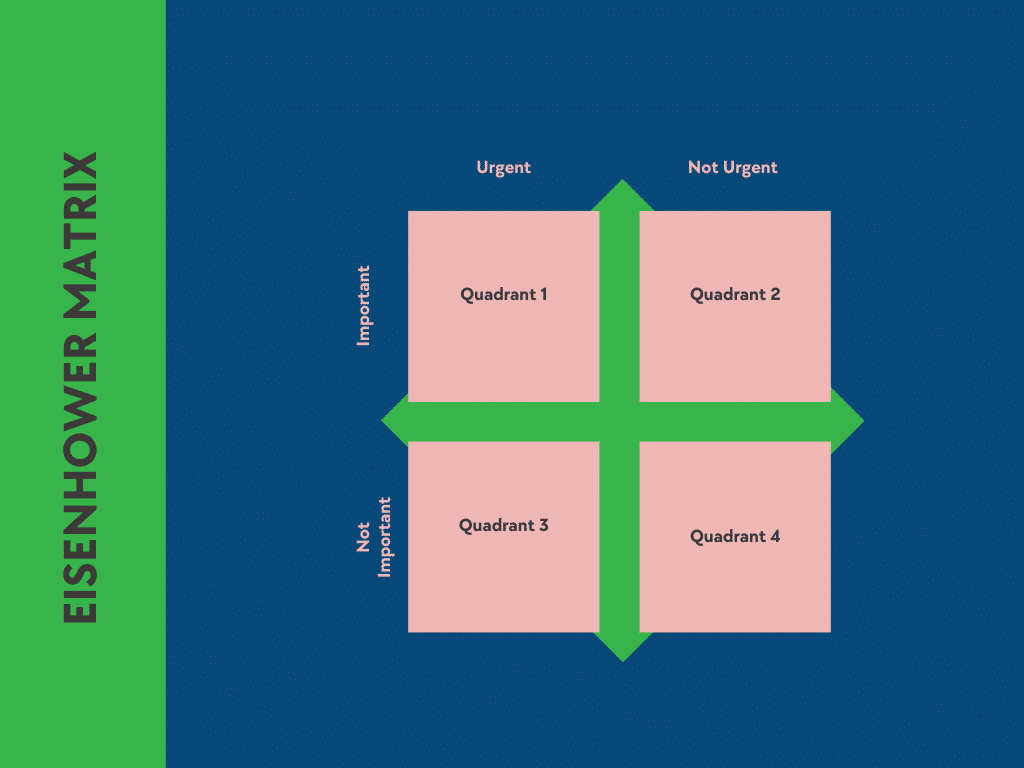
    ```json
{
  "alt": "Eisenhower Matrix showing four quadrants: Urgent and Important, Not Urgent but Important, Urgent but Not Important, and Neither.",
  "caption": "Master your time management with the Eisenhower Matrix. This effective tool helps you prioritize tasks by urgency and importance, ensuring productivity and focus.",
  "description": "This image illustrates the Eisenhower Matrix, a time management tool divided into four quadrants. The quadrants are labeled: Quadrant 1 (Urgent and Important), Quadrant 2 (Not Urgent but Important), Quadrant 3 (Urgent but Not Important), and Quadrant 4 (Neither Urgent nor Important). The design is clean, with a green cross dividing pink sections on a blue background, offering a clear framework for prioritizing tasks effectively."
}
```

    For massive sites, it can be hard to know where to start. I suggest working with small groups of keywords or specific product areas, addressing barriers to ranking, ensuring key pages are indexed, and improving or eliminating low-quality pages.

    Conducting a technical SEO audit helps pinpoint the exact issues needing attention and provides a prioritized list of tasks. SEO tools and resources like SEO prioritization techniques can guide you in focusing on impactful areas.

    Now, let’s discuss key foundational fixes, starting from site architecture, an essential part of a smooth-running SEO program. Proper site structure ensures effective crawling, indexing, and user experience, setting your site up for search success.

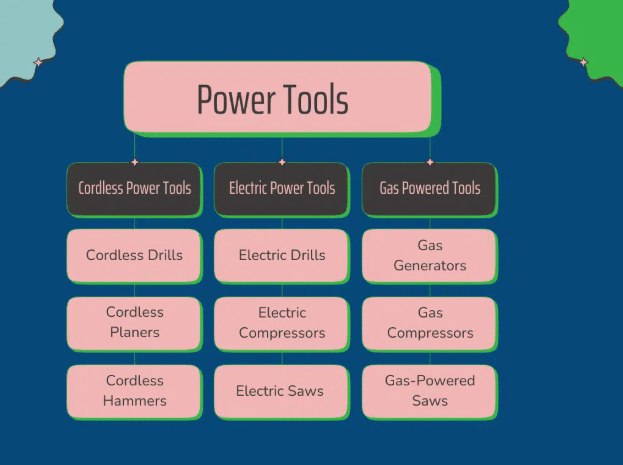
    By organizing your site around search patterns, you align content and navigation with the keywords and queries users are likely to use, thus enhancing the search and user experience.

    ```json
{
  "alt": "Diagram categorizing power tools into cordless, electric, and gas-powered types.",
  "caption": "Explore the world of power tools: from cordless drills to gas-powered saws, this chart categorizes essential equipment for every project.",
  "description": "This image features a diagram categorizing power tools into three main types: Cordless Power Tools, Electric Power Tools, and Gas Powered Tools. Each category lists specific tools, such as drills, planers, hammers, compressors, saws, and generators. The diagram is set against a blue background with decorative elements, and uses a pink and green color scheme for the boxes, enhancing its readability and appeal."
}
```

    With effective internal linking, you reinforce your site’s topical authority, guiding users to priority pages and turning your site structure into a ranking powerhouse.

    However, in large enterprises, a full site architecture overhaul can be daunting. I recommend focusing on specific tasks that can be implemented with minimal resistance, such as strengthening internal links and consolidating overlapping topics.

    Focusing on critical issues like crawling and indexing inefficiencies can dramatically improve search visibility. By addressing high-priority indexing issues first, you ensure search engines can accurately reflect your most valuable content.

    It’s crucial to eliminate signal dilution, which can occur from conflicting URLs or poorly managed canonical tags. Reducing crawl waste ensures that search engines focus their efforts on high-value pages, not unnecessary ones.

    ```json
{
  "alt": "The CapmatchOne logo with a gradient circle and bold text.",
  "caption": "Discover innovation with the CapmatchOne logo, featuring sleek typography and a modern gradient circle.",
  "description": "The CapmatchOne logo features bold, modern typography coupled with a gradient circle, symbolizing connection and innovation. The sleek design conveys a sense of progress and creativity. This image can be used for branding or promotional purposes, appealing to audiences interested in innovative solutions and forward-thinking designs."
}
```

    Regarding website performance, a site that’s difficult to use can squander hard-earned organic traffic. Sites like Yelp and Pinterest have shown how investments in site performance can significantly increase user engagement and revenue.

    Start by fixing any backend bottlenecks, as they impact everything from speed to user experience. Optimizing JavaScript and rendering processes can further enhance site interactivity and stability.

    Improving your website’s perceived speed by prioritizing essential elements for users can make a notable difference in performance scores. Focus on preload strategies, inlining critical CSS, and reserving layout space for dynamic content.

    For mobile user experience, it’s vital that your site not only looks good but performs optimally on mobile devices. With the majority of traffic coming from mobile, ensuring your site’s content and navigation are mobile-friendly is critical.

    Think about how to optimize for mobile-first indexing, easy navigation, and emerging behaviors like voice search to retain and convert mobile users effectively.

    By building momentum through strategic technical SEO wins, focusing on site structure, crawlability, and user experience, I know you’ll set your SEO program on a path to success, even with limited resources.


    Inspired by this post on Search Engine Land.


    crushpress.ai community screenshot
  • Transform ‘What’s Wrong?’ Searches into Local Leads

    Transform ‘What’s Wrong?’ Searches into Local Leads

    I’ve discovered that local SEO struggles with visibility, not in the way most of us expect. It’s not about showing up for ‘near me’ queries or specific service keywords.

    The real issue emerges before those searches, when potential customers are diagnosing their problems and deciding on further action. This is where a significant amount of high-intent demand is overlooked.

    Despite our efforts, most local service websites rely on a standard hierarchy: a main page, then service pages, often accompanied by location-specific sections. While this setup benefits the business, reflecting its internal organization, it misses out on capturing actual search behaviors.

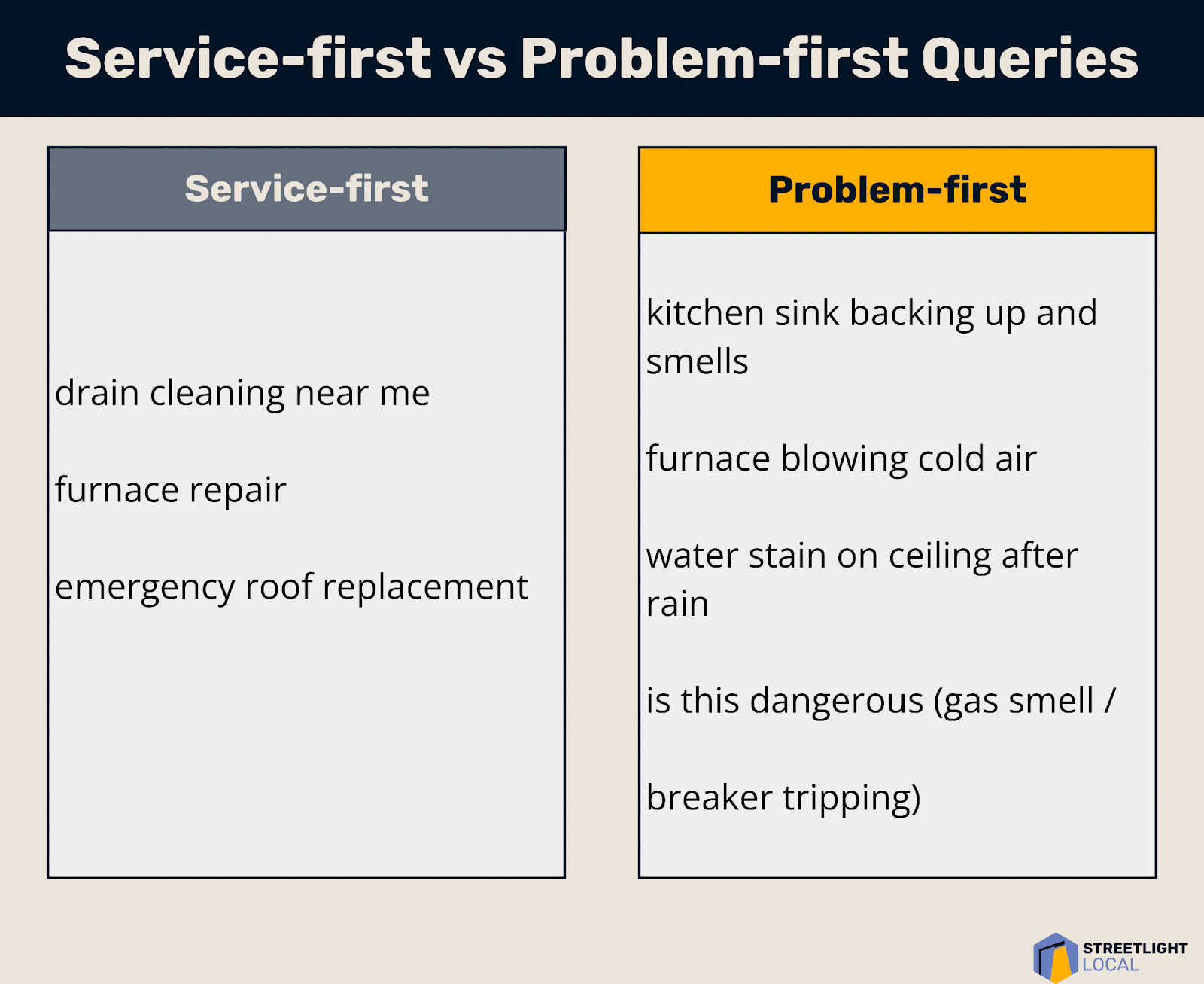
    Instead of searching for ‘drain cleaning in Brookline, MA,’ customers might be googling symptoms. They review what’s visibly wrong, perhaps thinking, ‘Why is my kitchen sink backing up?’ or ‘Why is the heater blowing cold air?’ That initial consideration often determines where they seek guidance.

    ```json
{
  "alt": "Comparison of service-first and problem-first search queries in a chart format.",
  "caption": "Explore the difference between service-first and problem-first queries with this insightful chart, highlighting how people search for solutions online.",
  "description": "This image presents a comparison between service-first and problem-first queries. The left column lists service-focused searches such as 'drain cleaning near me', while the right column features problem-specific searches like 'kitchen sink backing up and smells'. The chart aims to highlight different approaches people take when searching for home services. It includes a logo from Streetlight Local at the bottom right, emphasizing the brand's capability in understanding customer queries. Ideal for SEO and marketing strategy insights."
}
```

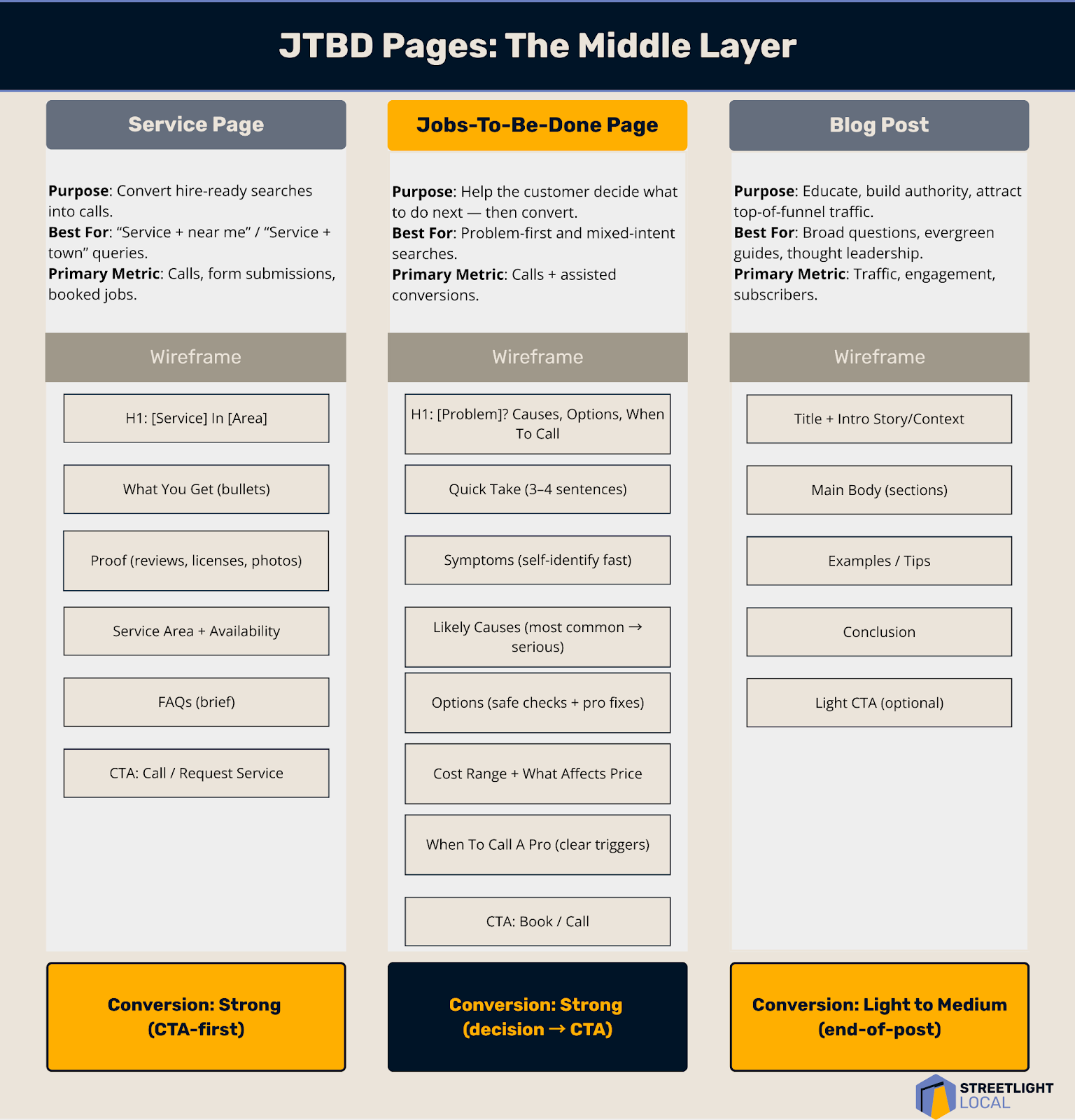
    By focusing only on service names, many websites fail to engage users earlier in their decision-making process. The ‘Jobs-to-be-done’ (JTBD) approach offers a practical solution to fill this gap.

    JTBD pages focus on real-life objectives searchers are attempting to achieve — clarity on their issues and guidance on whether they need professional assistance. Unlike traditional service pages meant for direct hires, JTBD pages are structured to inform and convert visitors by supporting informed decision-making.

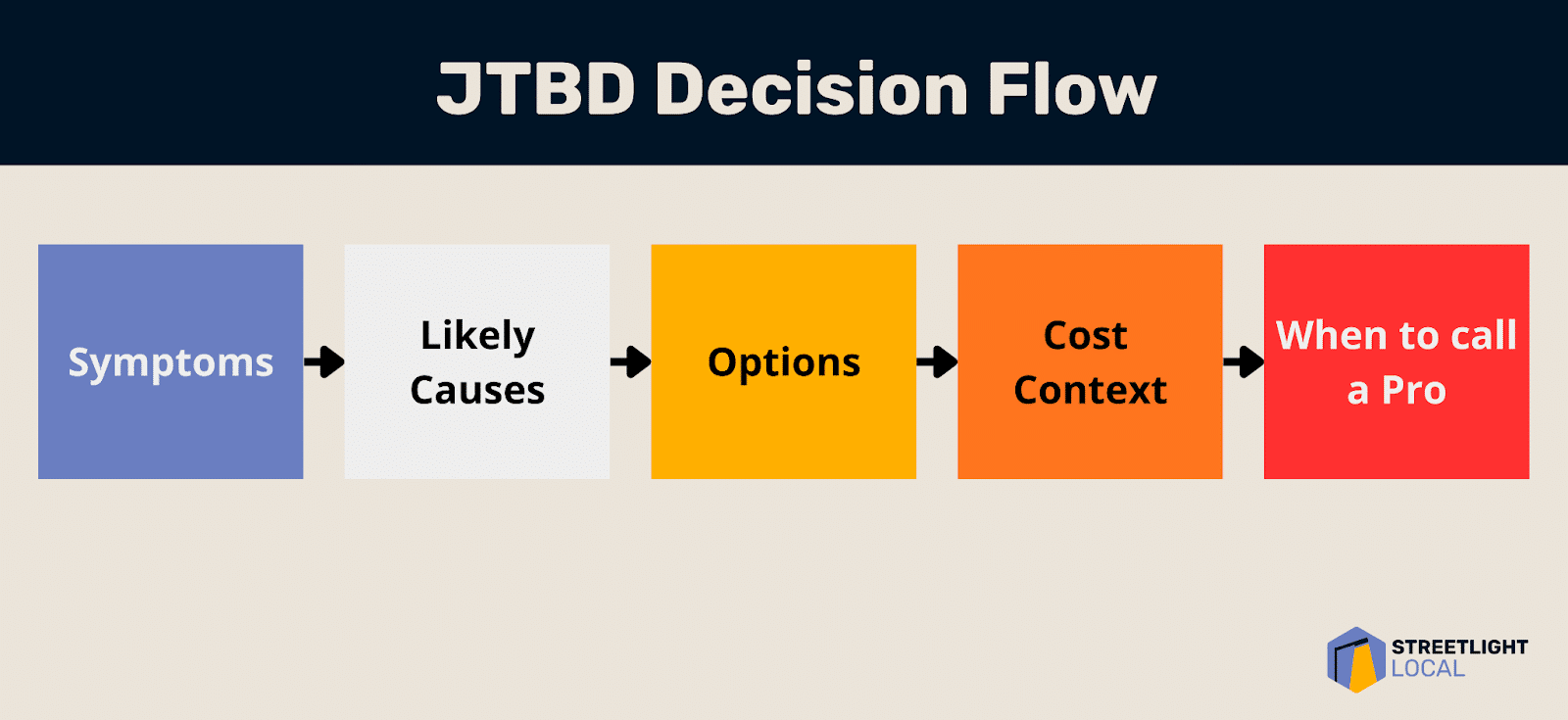
    From my experience, JTBD pages follow a logical progression akin to how a customer thinks: starting with symptoms, identifying likely causes, exploring options, and providing cost context before nudging them towards professional intervention.

    ```json
{
  "alt": "Diagram outlining JTBD pages: Service Page, Jobs-To-Be-Done Page, and Blog Post.",
  "caption": "Explore the JTBD Pages: A strategic view on how Service Pages, Jobs-To-Be-Done Pages, and Blog Posts contribute to conversions in digital marketing.",
  "description": "This diagram breaks down JTBD Pages into three types: Service Page, Jobs-To-Be-Done Page, and Blog Post, each with distinct purposes, best use cases, primary metrics, and wireframe structures. Service Pages focus on conversion through CTAs, JTBD Pages assist decision-making before converting, and Blog Posts build traffic and engagement. The image visually guides digital marketers in optimizing content strategies using defined page purposes and conversion goals."
}
```

    This front-loaded approach — beginning with symptoms — resonates more because it mirrors users’ own experiences and signals you’ve anticipated their needs.

    When explaining causes, avoid over-simplification or exhaustive technicality. I’ve found that listing potential causes in order of complexity, while subtly guiding next steps, builds trust.

    Providing options, including safe checks and pro tips, eases visitor anxiety — offering a reassuring glimpse of what hiring a professional would entail, often leading to conversions where the intent is to find relief and certainty from professionals.

    ```json
{
  "alt": "The CapmatchOne logo with a gradient circle and bold text.",
  "caption": "Discover innovation with the CapmatchOne logo, featuring sleek typography and a modern gradient circle.",
  "description": "The CapmatchOne logo features bold, modern typography coupled with a gradient circle, symbolizing connection and innovation. The sleek design conveys a sense of progress and creativity. This image can be used for branding or promotional purposes, appealing to audiences interested in innovative solutions and forward-thinking designs."
}
```

    Offering cost insights without promising exact prices is crucial. Articulating price ranges cultivates trust, informing users about possible costs without the dreaded sticker shock.

    Explicitly marking important signals for professional help enhances conversion potential. An effective JTBD page doesn’t just imply; it outlines clear triggers to engage experts.

    Placement of these pages can significantly influence their perception. Ensure they’re nested among valuable resources, highlighting their role in service solutions rather than lost in blog archives.

    ```json
{
  "alt": "JTBD Decision Flow chart with stages from symptoms to when to call a pro.",
  "caption": "Navigate the JTBD Decision Flow: from recognizing symptoms to deciding when it's time to call a professional.",
  "description": "The JTBD Decision Flow chart visually guides users through a process starting with 'Symptoms', followed by 'Likely Causes', then 'Options', considering 'Cost Context', and finally deciding 'When to call a Pro'. Each stage is represented by a distinct colored box with directional arrows indicating the flow. The design is clear and organized, facilitating decision-making at each step. Keywords: JTBD, decision flow, symptoms, professional, cause, options."
}
```

    From your most frequent customer inquiries, construct these pages around relatable search terms by engaging with real customer language and needs—this element is the linchpin of effective keyword strategy.

    JTBD pages have the added benefit of aligning with AI-driven summary requirements, improving indexing accuracy and aiding AI engagement in search results.

    Ultimately, JTBD pages close the loophole between customer inquiries and actionable business engagement. They don’t just enhance search visibility but convert curiosity into booked services, transforming local SEO landscapes.


    Inspired by this post on Search Engine Land.

    crushpress.ai community screenshot
  • Boost Brand Visibility with Our Social Optimization Suite

    Boost Brand Visibility with Our Social Optimization Suite

    As someone deeply immersed in digital marketing, I’m excited to introduce you to Goodie’s Social Optimization Suite! This powerful tool empowers brands like yours to track social AI citations effectively.

    By identifying the key drivers of visibility, you can make data-driven decisions that enhance your brand’s presence across various platforms. Our suite is designed to offer platform-specific insights, enabling you to take targeted actions.

    The journey of optimizing your brand’s social media visibility begins here. Dive into the details with us to unlock strategic opportunities for your brand.


    Inspired by this post on HiGoodie Blog.


    crushpress.ai community screenshot
  • Building a Nonprofit Digital Presence That Truly Makes an Impact

    Building a Nonprofit Digital Presence That Truly Makes an Impact

    For as long as I can remember, having a digital presence for a nonprofit has been more than just an optional asset—it’s the central hub for delivering our mission, engaging with donors, and advocating for change.

    Many organizations, including those I’ve worked with, often find themselves challenged by the technical and strategic requirements necessary to transform a simple website and social media accounts into an effective digital ecosystem.

    It’s not just about establishing an online presence. It’s about creating a dependable infrastructure that allows us to control our narrative, safeguard our assets, and accurately measure the results of our digital efforts.

    From my experience collaborating with multiple organizations, I’ve learned valuable lessons about managing a nonprofit’s digital presence. Here, I’ll share practical insights into key elements while highlighting the common pitfalls to avoid.

    If you’re supporting an organization with its digital marketing efforts and they haven’t embraced these practices yet, prioritizing the organization’s digital setup should be your first step.

    1. Own your foundations: Domains and account control

    Owning your organization’s name and story is an integral part of managing your online reputation efficiently. It is vital to ensure direct ownership of all technical assets—a risk I often see underestimated.

    Unfortunately, I’ve witnessed situations where volunteers or third-party agencies register domains or create social accounts using personal credentials. Consequently, if they leave, access to these crucial digital channels can be lost.

    Domain ownership should always be in the organization’s name, utilizing a general email address that multiple stakeholders can access. This mitigates potential access issues in the future.

    Similar precautions should be taken with website hosting and social media account management to ensure full control over these assets.

    For more information on optimizing nonprofit presence, consider resources like Google Ad Grants, which can boost engagement through targeted advertising efforts.

    2. Move beyond ‘winging it’: The editorial calendar

    Nonprofits often only post when they have an immediate need—typically during fundraising drives. However, this approach can lead to donor fatigue and low interaction levels.

    An effective content plan enriches community engagement by blending success stories and educational pieces with occasional action requests.

    ```json
{
  "alt": "The CapmatchOne logo with a gradient circle and bold text.",
  "caption": "Discover innovation with the CapmatchOne logo, featuring sleek typography and a modern gradient circle.",
  "description": "The CapmatchOne logo features bold, modern typography coupled with a gradient circle, symbolizing connection and innovation. The sleek design conveys a sense of progress and creativity. This image can be used for branding or promotional purposes, appealing to audiences interested in innovative solutions and forward-thinking designs."
}
```

    Employ an editorial calendar to organize content themes and individual posts, ensuring consistent and coordinated messaging across various platforms.

    3. Tracking what matters (and ignoring what doesn’t)

    Data is a powerful tool for informing future decisions, yet many organizations focus on vanity metrics without understanding their effect on actual outcomes.

    Implement conversion tracking to assess real visitor impacts, and use behavioral analytics to optimize user engagement and alleviate obstacles in the donation process.

    4. Optimize for the ‘mobile-first’ donor

    With most web traffic originating from mobile devices, nonprofits must ensure their online platforms are optimized for speed and simplicity. Slow or complex donation processes can deter potential contributors.

    Offering multiple payment options, like Apple Pay or PayPal, can further simplify the donation process, increasing the likelihood of conversion.

    Common pitfalls to avoid

    Occasionally, nonprofits undermine their digital strategy by targeting a broad audience. It’s essential to define and focus on your ideal supporter to create meaningful connections.

    Neglecting accessibility excludes portions of potential audiences. Ensuring your content is accessible to those with disabilities is critical to fulfilling your mission.

    Lastly, maintaining a dynamic digital environment through regular audits helps ensure continued relevance and effectiveness.

    Through consistent asset management, content planning, and data-driven decision-making, your digital presence can significantly amplify your mission’s reach and impact.


    Inspired by this post on Search Engine Land.

    crushpress.ai community screenshot
  • How Google’s AI Mode Threatens Web Traffic: Insights from Yahoo CEO

    How Google’s AI Mode Threatens Web Traffic: Insights from Yahoo CEO

    As I delve into the evolving landscape of web traffic, I find Yahoo CEO Jim Lanzone’s insights on AI-powered search engines, particularly Google’s AI Mode, incredibly fascinating. He believes this technological evolution poses a significant threat to the web’s traditional traffic model.

    Jim highlights a major concern: “I think that the LLMs are one big reason they’re under threat, with AI Mode in Google being the biggest challenge.” This makes me ponder the impact on publishers who rely heavily on these traffic flows.

    I resonate with Jim’s view that publishers truly deserve this traffic. He articulates a fundamental truth: “Those publishers deserve [traffic], and we’re not going to have the content to consume to give great answers if publishers aren’t healthy.” This reflects the delicate balance required in the digital content ecosystem.

    Why I care. Many websites, mine included, are noticing a dip in traffic coming from answer engines such as Google and OpenAI. It feels like a looming concern that could worsen. Yahoo’s dedication to maintaining the “search sends traffic” model is reassuring, as Jim passionately explains: “We have very purposefully highlighted and linked very explicitly and bent over backwards to try to send more traffic downstream to the people who created the content.”

    Yahoo’s unique AI approach. Listening to Jim on the Decoder podcast, I learn that Yahoo is carving its own path with AI. Unlike the more conversational chatbot models, Yahoo isn’t pursuing to be an AI assistant: “Ours looks a lot more like traditional search and it is more paragraph-driven. It’s not a chatbot that’s trying to act like it’s a person and be your friend.” I see this as a move towards emphasizing informative search experiences.

    Moreover, “We’re not a large language model. We’re not going to be the place you come to code. We’ve really launched Scout as an answer engine.” This strategy, I believe, could provide a clearer, more reliable information source online.

    What’s next: Embracing personalization. In observing Yahoo’s strategy, I’m excited to see their efforts to evolve. They’re embedding AI across platforms: “You are very shortly going to see us get into very personalized results. You’re going to see us get into very agentic actions that you can take.” This indicates a future where user-specific solutions take precedence.

    For instance, Jim notes, “There’s a button in Yahoo Finance that does analysis of a given stock on the fly… It is in Yahoo Mail to help summarize and process emails.” Such tools could transform how I interact with content on various platforms.

    Yahoo vs. Google: A non-competition. Interestingly, Yahoo isn’t trying to directly outplay Google. Instead, as Jim points out, the focus is on existing users and enhancing their experience: “Nobody chooses, you will not be surprised, Yahoo over Google or somewhere else to search. The way that we get our search volume is because we have 250 million US users and 700 million global users in the Yahoo network at any given time. There’s a search box there. And infrequently, they use it.” It’s more about nurturing the loyalties of existing users.

    A word of caution. The conversation also shines a light on the potential pitfalls of heavily relying on AI platforms. Jim references past experiences with Google: “You are tempting fate by opening up a way for consumers to access your product within a large language model.” This analogy resonates with me deeply, remembering the cautionary tales in tech history.

    Yet, he warns: “The big bad wolf will come to your door and say everything’s cool.” It’s a timely reminder of the ever-competitive and unpredictable nature of tech alliances.

    The interview. For those intrigued by Yahoo’s journey, check out Yahoo CEO Jim Lanzone’s full interview on reviving the web’s homepage.


    Inspired by this post on Search Engine Land.


    crushpress.ai community screenshot