Category: SEO

  • Why Zero-Click Searches Still Hold Immense Power

    Why Zero-Click Searches Still Hold Immense Power

    I recently had the opportunity to attend the Industrial Marketing Summit, where Rand Fishkin delivered a keynote highlighting our current “zero-click world”. His perspective resonated with me, emphasizing that while fewer users are visiting websites, their impact remains crucial.

    Diving deeper, it’s evident that the structural dynamics of how information is assessed and trusted online have shifted profoundly. This change has led many to misunderstand the true value of websites today.

    Despite the drop in clicks, websites still play a vital role. They are the bedrock of visibility and trustworthiness on the internet.

    Why ‘zero-click’ discussions often lead to the wrong conclusion

    There’s an undeniable trend: clicks are on the decline, and here’s why.

    • Search engines readily display answers directly on results pages.
    • Social media platforms have become discovery hubs, allowing users to explore without ever needing to leave.
    • AI assistants synthesize comprehensive responses from the web even before presenting a user with links.

    The focus on zero-click results disrupts traditional metrics for measuring online visibility. For decades, traffic and click-through rates have been the cornerstones for evaluating search performance.

    Yet, when answers are given directly by search results or AI systems, often outside our typical analytics frameworks, many assume websites are losing significance. This is far from the truth.

    Websites still underpin the information ecosystem. Their role in shaping visibility is arguably becoming more significant, especially with AI and modern information systems relying heavily on widespread, consistent signals from multiple sources on the web.

    Fishkin is right about the trend

    Information today is discovered in various environments, including search results, social media, and AI interfaces, leading to a real fragmentation of how we consume content.

    While these interactions might appear as lost website traffic, the true question is: where does the original information come from?

    Although people consume information through expanding platforms, these systems fundamentally depend on credible, original knowledge sources.

    Zero-click doesn’t mean zero influence

    The critical takeaway is differentiating between traffic and information influence.

    • Traffic measures visits to your site.
    • Influence assesses if your information shaped the answers people received.

    AI creates responses based on patterns from the web, and content creators who provide valuable information remain crucial in this ecosystem.

    ```json
{
  "alt": "The CapmatchOne logo with a gradient circle and bold text.",
  "caption": "Discover innovation with the CapmatchOne logo, featuring sleek typography and a modern gradient circle.",
  "description": "The CapmatchOne logo features bold, modern typography coupled with a gradient circle, symbolizing connection and innovation. The sleek design conveys a sense of progress and creativity. This image can be used for branding or promotional purposes, appealing to audiences interested in innovative solutions and forward-thinking designs."
}
```

    Even without direct clicks, reliable sources continue to influence the information pipeline, helping shape the responses generated by AI systems.

    The role of ‘rented land’

    In adapting to a zero-click landscape, the focus might shift towards platforms where brands lack control, such as social networks or other “rented lands”.

    Visibility stems from both types of territory — owned and rented.

    • Owned land encompasses your controlled content like websites.
    • Rented land includes platforms that distribute your message but aren’t owned by you.

    In an AI-driven discovery setting, both are valuable. Owned content serves as essential knowledge sources, while rented platforms amplify these insights.

    Yet, authority primarily emerges from robust original content, typically housed on first-party sites, which remains pivotal in influencing AI systems.

    Why AI often favors primary sources

    Contrary to some beliefs, AI systems value primary sources more than aggregated content.

    When AI generates answers, it frequently relies on sources with clear, expert explanations and well-reasoned content, mostly found in single-source publishing like legal blogs or technical documentation.

    This move places emphasis on creating authoritative content, which can enhance your influence in an AI-led world even as click metrics may reduce.

    The real shift you should understand

    Websites are evolving beyond their historical role as mere traffic generators. They are now key players in the AI-mediated informational landscape as sources of knowledge and bastions of expertise.

    The goal now is to ensure expertise is accessible and can be assimilated across various digital environments, be it search engines, AI responses, or social discussions.

    In our zero-click world, influence takes root earlier, reinforcing the importance of creating valuable, knowledgeable content.


    Inspired by this post on Search Engine Land.


    crushpress.ai community screenshot
  • Embrace ‘Search Everywhere’: Revolutionizing SEO Strategies

    Embrace ‘Search Everywhere’: Revolutionizing SEO Strategies

    AI is undeniably evolving search, but I notice that visibility is significantly leaning towards platforms that are dominating the results and capturing user attention.

    Much of today’s SEO discussions revolve around AI, from AI Overviews to ChatGPT and other LLMs. There’s genuine concern about these technologies diverting traffic from business websites, urging a shift towards GEO or AEO.

    This concern holds merit. AI is indeed diminishing traffic for numerous sites, particularly those dependent on top-of-funnel, informational content. However, data indicates that AI might not be the sole driving force of change.

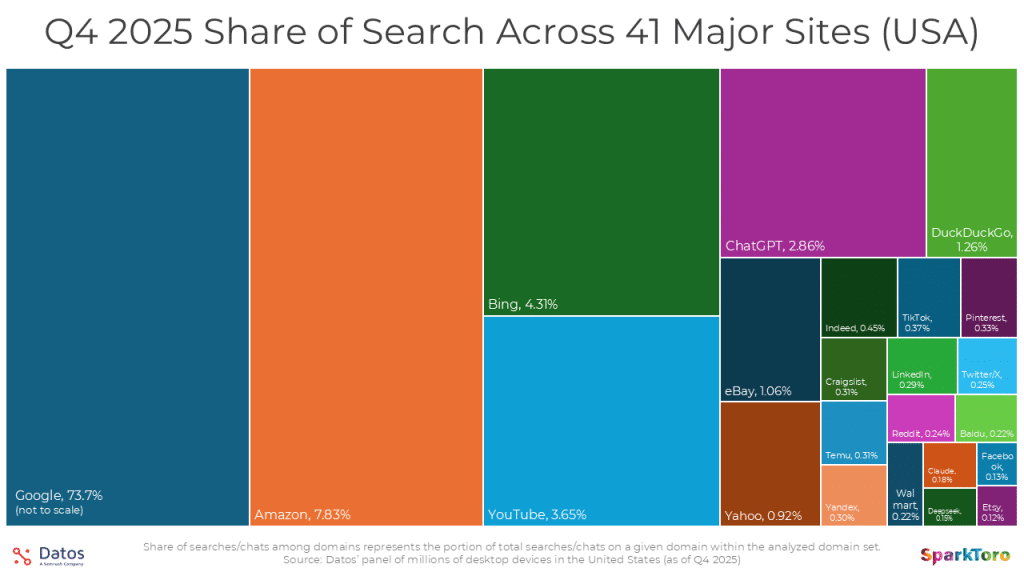
    For years, I’ve observed user behavior splintering across various platforms in my agency work.

    ```json
{
  "alt": "Infographic showing Q4 2025 search share of 41 major sites in the USA, with Google leading at 73.7%, followed by Amazon, Bing, and others.",
  "caption": "Discover how dominant players like Google and Amazon are sharing the search landscape in Q4 2025. Explore the colorful infographic depiction of search shares across 41 top sites in the USA.",
  "description": "This infographic illustrates the Q4 2025 share of search across 41 major sites in the USA. Google leads with a 73.7% share, followed by Amazon at 7.83%, Bing at 4.31%, and YouTube at 3.65%. Other notable mentions include ChatGPT, DuckDuckGo, and eBay, among others depicted in a colorful treemap. The graphic is designed by SparkToro and sourced from Datos, providing insights into the digital search ecosystem."
}
```

    Here’s the data on how search behavior is evolving across platforms and why adopting a ‘search everywhere’ strategy is crucial, beyond just focusing on LLMs.

    Third-party Platforms are Disrupting Traditional Search

    People now turn to TikTok for restaurant suggestions, YouTube for tutorials, Reddit for authentic reviews, and Amazon for purchasing products. These platforms are often replacing traditional search engines like Google and Bing as the initial resource.

    This shift isn’t just behavioral; it’s reflected in traffic metrics too. Amazon and YouTube, for instance, drive considerably more desktop traffic than ChatGPT, a trend highlighted by Rand Fishkin.

    ```json
{
  "alt": "Bar chart showing share of voice percentages for a client, competitors, and platforms like YouTube and Reddit.",
  "caption": "Discover how YouTube leads the share of voice with 9.84%, outshining competitors and platforms, followed by Reddit and the client.",
  "description": "This bar chart displays the share of voice percentages among various entities. YouTube holds a significant lead with 9.84%, followed by Reddit at 6.94% and the client at 6.69%. Other competitors have lower percentages, ranging from 1.11% to 3.19%. The chart provides a visual comparison of presence and influence across platforms and competitors."
}
```

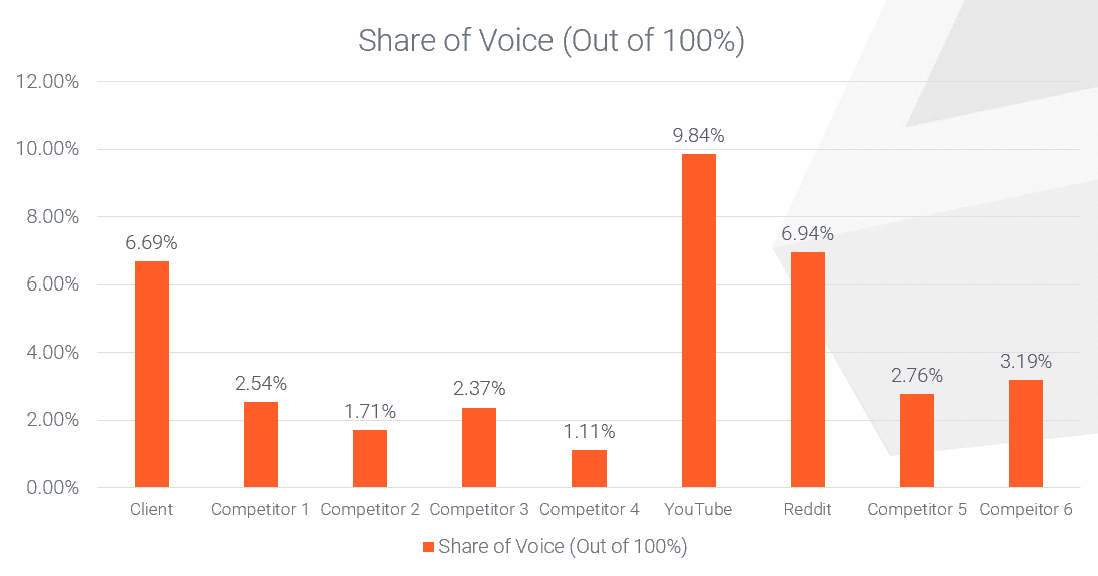
    Recently, I conducted a thorough share of voice analysis for a client, with objectives to identify competitors leading in traditional search, discover keyword and content gaps, and devise a content roadmap to address these gaps.

    Interestingly, the analysis revealed that our main competitors weren’t other traditional players, but rather platforms like YouTube and Reddit.

    These platforms perform strongly in traditional searches, claim valuable SERP real estate, and redirect users from Google and Bing to their ecosystems.

    ```json
{
  "alt": "The CapmatchOne logo with a gradient circle and bold text.",
  "caption": "Discover innovation with the CapmatchOne logo, featuring sleek typography and a modern gradient circle.",
  "description": "The CapmatchOne logo features bold, modern typography coupled with a gradient circle, symbolizing connection and innovation. The sleek design conveys a sense of progress and creativity. This image can be used for branding or promotional purposes, appealing to audiences interested in innovative solutions and forward-thinking designs."
}
```

    The key takeaway: neglecting these platforms means missing out not only on visibility in traditional search but also on grabbing valuable user attention when they move away from Google to watch videos or read threads.

    It’s not just my client’s site seeing this trend. Undertake this kind of analysis for your site to discover who your actual competitors are in traditional search; the findings might surprise you.

    Dive deeper: Why social search visibility is crucial for discoverability

    ```json
{
  "alt": "Keyword overview for 'how to fix a leaky sink faucet' with search volume and global volume data.",
  "caption": "Explore search trends for 'how to fix a leaky sink faucet' with 210 searches in the US and a global reach of 350, including data from AU, CA, UK, BD, and DE.",
  "description": "This image displays a keyword overview for the phrase 'how to fix a leaky sink faucet,' highlighting its search volume. In the US, the volume is 210, contributing to a global volume of 350. The data includes analytics from several countries like Australia, Canada, the United Kingdom, Bangladesh, and Germany. The interface allows for domain-specific data entry and location selection, collected for desktop users as of March 9, 2026."
}
```

    Third-party Platforms Can Have Higher Search Volumes

    Not only are platforms like YouTube and Reddit securing traditional SERP spaces, but searches within these platforms can sometimes outnumber those on Google or Bing.

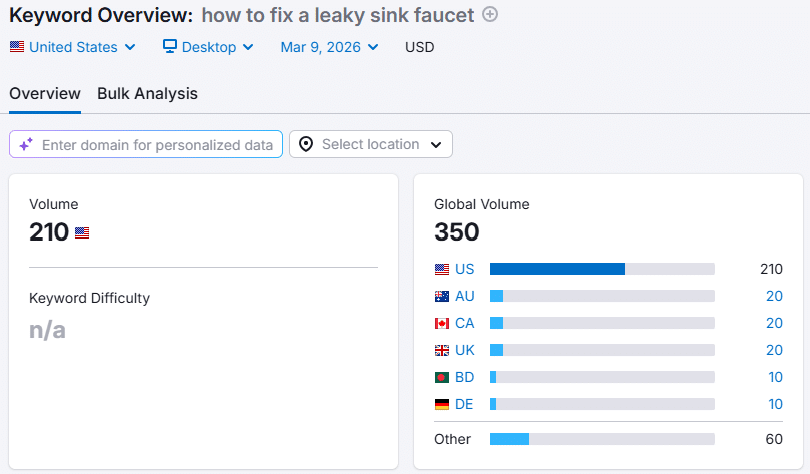
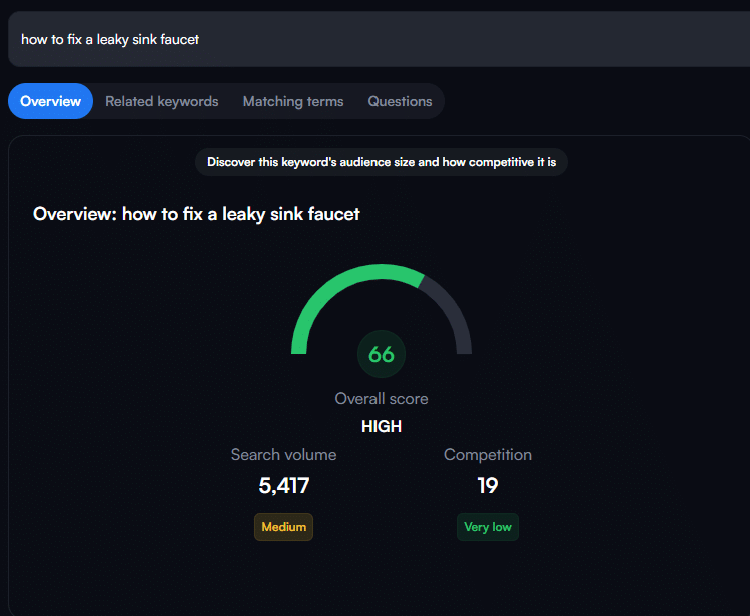
    For instance, YouTube is a powerhouse for tutorials and “how-to” content. A term such as “how to fix a leaky sink faucet” shows 15 times more search volume on YouTube than in traditional searches globally.

    While search volumes are estimates, aligning your content strategy with where users are actually searching is crucial. For topics like the one mentioned, creating a YouTube video is essential.

    ```json
{
  "alt": "Keyword analysis for 'how to fix a leaky sink faucet' shows a high score with medium search volume of 5,417 and very low competition of 19.",
  "caption": "Keyword insights reveal 'how to fix a leaky sink faucet' as a hot topic, scoring high overall with thousands searching and low competition.",
  "description": "This image displays a keyword analysis for 'how to fix a leaky sink faucet,' showing an overall score of 66 and classified as high. The search volume is 5,417, rated as medium, while the competition is very low at 19. These metrics suggest that the topic has a substantial audience interest but limited competitive content, presenting an opportunity for content creators. The image includes a visual gauge representing the overall score and textual data highlighted for search visibility."
}
```

    For a holistic ‘search everywhere’ approach, develop a blog post and embed the related video.

    Dive deeper: Why YouTube is essential for SEO in the AI era

    Third-party Platforms are Cited More in LLMs

    ‘Search everywhere’ isn’t just about traditional or in-platform searches; it also influences AI-generated content.

    ```json
{
  "alt": "Bar chart showing citation source types: Owned 7%, Competitor 3.6%, Third party websites 76.1%, Social & Forums 13.3%.",
  "caption": "Explore how citations are sourced: predominantly from third-party websites, with smaller contributions from owned, competitor, and social sources.",
  "description": "A horizontal bar chart illustrates the distribution of citation sources: 'Owned' at 7% (blue), 'Competitor' at 3.6% (red), 'Third party websites' at 76.1% (green), and 'Social & Forums' at 13.3% (orange). This indicates that the majority of citations come from third-party websites, providing insights into source credibility and diversity."
}
```

    LLMs rely on content for answer synthesis, and often, that content is sourced not from business websites, but from third-party and social platforms.

    Tools like AI visibility tools can illustrate the impact of ‘search everywhere’ in terms of citations. Consider these examples:

    Despite being different brands, a minimal percentage of citations are from their own or competitors’ sites. Nearly 90% originate from third-party news and online publications or social and forum platforms like Reddit or Quora.

    ```json
{
  "alt": "Bar chart showing citation source breakdown: Owned 6.2%, Competitor 4.9%, Third-party websites 75.8%, Social & Forums 13.1%.",
  "caption": "Explore the diverse origins of citations with this visual breakdown: a striking representation of how third-party websites dominate at 75.8%.",
  "description": "This image depicts a horizontal bar chart illustrating the breakdown of citation sources. The chart is segmented into four categories: Owned (6.2%), Competitor (4.9%), Third-party websites (75.8%), and Social & Forums (13.1%). The longest segment, representing third-party websites, is in green, highlighting its dominance. This visual representation aids in understanding the diverse sources contributing to citation data."
}
```

    Focusing solely on your website in the context of LLM citations offers limited reach. To enhance brand perception or accuracy in AI reflections, influence must reach places beyond direct control.

    Dive deeper: SEO’s new battleground: Securing the consensus layer

    Start Investing in ‘Search Everywhere’ Today

    The competitive arena is transforming, and many marketers focus narrowly on AI. Yet, discovery spans numerous platforms.

    YouTube, Reddit, Quora, and others dominate traditional search results and have significant search activity within their platforms. When AI generates answers, it chiefly draws from these sources rather than brand websites.

    To achieve success in modern search, it’s vital to understand where your audience is truly searching, which extends beyond just Google. It’s about appearing wherever decisions are shaped.


    Inspired by this post on Search Engine Land.


    crushpress.ai community screenshot
  • Mastering SEO for AI: The Essential Foundation for Success

    Mastering SEO for AI: The Essential Foundation for Success

    I’ve discovered that the most successful GEO and AEO strategies are deeply rooted in traditional SEO. It’s fascinating how these foundational principles seamlessly translate to AI visibility. Let me share why it’s crucial not to overlook these basics.

    In our quest to harness the power of AI, many of us might feel tempted to skip straight to advanced strategies. However, without a solid SEO foundation, even the best AI-driven tactics can fall short. The rules that govern traditional SEO are critical to unlocking AI’s full potential in search visibility.

    Consider this: AI systems thrive on structured data and clear content hierarchies. It’s precisely these elements that traditional SEO prioritizes, ensuring that our websites are not only user-friendly but also AI-ready. This is why every AI optimization journey should begin with tried-and-true SEO practices.

    As someone who loves diving into the nuances of AI and SEO, I’ve seen firsthand how these two fields complement each other. Embracing the basics doesn’t merely prepare us for AI; it catapults our strategy into an era of smarter, more efficient digital marketing.


    Inspired by this post on genmark.ai Blog.


    crushpress.ai community screenshot
  • Will AI Revolutionize or Replace SEO? Discover the Truth

    Will AI Revolutionize or Replace SEO? Discover the Truth

    As someone deeply invested in SEO, I’ve often pondered: Could AI eventually render SEO obsolete? This question has sparked considerable debate as AI capabilities continue to expand.

    While AI can streamline technical tasks, there’s a consensus that it won’t entirely replace the need for human expertise in SEO. Early studies affirm that human input remains vital.

    AI efficiently handles structured data tasks, yet it falls short without meticulous data oversight and expert human guidance.

    The advent of AI signifies a shift in workflow dynamics, raising the bar on execution and focusing human expertise on more strategic areas.

    AI’s potential to reduce reliance on semi-technical expertise is notable, especially in well-structured domains like coding. However, crafting AI-driven solutions without human refinement often proves inadequate.

    The challenge for generative AI lies in its machine-like processing. Only those with technical know-how can truly harness its potential for tasks like generating functional product descriptions or scalable alt text.

    AI’s effectiveness is directly linked to the quality of human instructions. Expertise in creating carefully structured prompts is indispensable.

    Despite the aid AI offers, its reliance on structured data and human oversight underscores why SEO isn’t fading anytime soon.

    ```json
{
  "alt": "The CapmatchOne logo with a gradient circle and bold text.",
  "caption": "Discover innovation with the CapmatchOne logo, featuring sleek typography and a modern gradient circle.",
  "description": "The CapmatchOne logo features bold, modern typography coupled with a gradient circle, symbolizing connection and innovation. The sleek design conveys a sense of progress and creativity. This image can be used for branding or promotional purposes, appealing to audiences interested in innovative solutions and forward-thinking designs."
}
```

    A closer look at AI’s progression reveals the persisting need for human intervention, especially as the web’s uncurated nature challenges AI’s data processing capabilities.

    While AI tools are growing more sophisticated, they still depend on human expertise to function seamlessly within comprehensive SEO strategies.

    The complexity of implementing full SEO automation highlights the irreplaceable value of human judgment in managing intricate data environments.

    As AI tools evolve, they serve as companions to SEO, boosting efficiency but not substituting the strategic insight SEO professionals bring to the table.

    For SEO to truly become obsolete, AI must autonomously manage tasks reliably and efficiently, a feat still eluding current technology.

    Society’s adoption of AI faces barriers; perceptions of AI as a threat slow its integration despite its potential to enhance SEO practices.

    As AI becomes normalized, its role within SEO will likely evolve, but the human touch remains essential in delivering creative and impactful results.


    Inspired by this post on Search Engine Land.

    crushpress.ai community screenshot
  • Dominate SEO’s New Frontier: Master the Consensus Strategy

    Dominate SEO’s New Frontier: Master the Consensus Strategy

    When I hear about someone ranking first but still being invisible, it seems strange, right? But here’s the real story:

    A potential customer might ask ChatGPT or Perplexity for the best tool or agency in your category—and your competitor is the one that gets mentioned, not you. Your top ranking isn’t helping in this scenario.

    This is the new reality in SEO that surprises many experienced marketers. Large language models (LLMs) gather consensus from multiple sources instead of relying on just one. This shift means it’s no longer just about ranking—it’s about being consistently mentioned across various sources. Missing this understanding means you’re losing ground.

    Let’s unravel what’s happening and, more importantly, how we can navigate this new landscape.

    From Rankings to Consensus: Understanding the Shift

    Traditional SEO was straightforward: rank high to get clicks and drive traffic. Google searches found pages, and users decided which ones to visit.

    However, AI-driven search introduces a new method. Platforms like Google’s AI Overviews and ChatGPT now create their responses by compiling information from numerous sources. They check for consistency to form a single, synthesized answer.

    Data reveals the magnitude of this shift: since mid-2024, organic click-through rates have dropped significantly for queries showing AI Overviews. Even queries without AI results saw a decrease.

    The technology behind this is retrieval-augmented generation (RAG), where AI pulls from across the web to discern repeating claims from credible publishers. The objective isn’t just publishing a great page—it’s about becoming one of those consistently cited sources.

    What the Consensus Layer Actually Is

    I think of the consensus layer as AI systems producing consistent outputs about your brand. It’s a large-scale pattern recognition.

    When AI systems find your brand mentioned in the same way across several credible sources, they build confidence in those claims. When they don’t, your brand becomes an outlier, which risks exclusion.

    This system prevents AI hallucinations, using corroboration as their defense. If multiple sources independently agree on a claim, AI considers it reliable. Sole sources tend to be ignored.

    I’ve observed brands being invisible despite their high rankings because they rely solely on traditional authority without corroborated recognition.

    Will Scott’s insight is valuable: Visibility issues arise because brands aren’t mentioned in AI answers, despite being high-ranked in traditional search.

    Explore more: When search demand surpasses keyword limits.

    The Signals That Actually Build Consensus

    What signals do AI systems rely on to build consensus? Here’s where we need to focus:

    Traditional Authority Is Just a Starting Point

    Foundational elements like backlinks and domain authority get you in the game. But achieving consensus is what truly sets you apart.

    Unlinked Mentions Matter More Than We Think

    AI scans for brand mentions, even when unlinked. Unlinked mentions signal both traditional and AI visibility, like when an unlinked mention in an industry publication serves as a consensus signal.

    Approximately 9 out of 10 webpages cited by ChatGPT fall outside the top 20 organic results, highlighting the game’s transformative nature.

    Publisher Diversity Strengthens Credibility

    Repeating mentions on the same site doesn’t build consensus. Diverse mentions across credible publishers are key.

    Community Platforms Are Consensus Gold

    Platforms like Reddit and Quora are becoming pivotal for consensus, as AI recognizes genuine user discussions as reliable data sources.

    With Reddit leading in SERPs, positive mentions in subreddits significantly contribute to AI perceptions. Genuine community trust can’t be fabricated—it must be earned.

    Entity Clarity Simplifies Retrieval

    Search engines use knowledge graphs to connect entities. If your brand is inconsistently presented or your category is vague, AI systems struggle to recognize you in answers.

    ```json
{
  "alt": "The CapmatchOne logo with a gradient circle and bold text.",
  "caption": "Discover innovation with the CapmatchOne logo, featuring sleek typography and a modern gradient circle.",
  "description": "The CapmatchOne logo features bold, modern typography coupled with a gradient circle, symbolizing connection and innovation. The sleek design conveys a sense of progress and creativity. This image can be used for branding or promotional purposes, appealing to audiences interested in innovative solutions and forward-thinking designs."
}
```

    Structured data, schema markup, and JSON-LD are crucial. The clearer your entity’s profile, the easier it is for AI to reference and cite you.

    How to Actually Build Consensus

    Alright, let’s dive into some tactical steps. Understanding your current standing is vital before taking action.

    Begin with an LLM Audit

    Use ChatGPT, Perplexity, Gemini, and Google AI Overviews to ask questions just as your customers would.

    • “What’s the best tool/service for the problem you solve?”
    • “Who are the leading providers in your category?”
    • “What do people say about your brand?”

    Focus on three outcomes:

    • Is your brand even mentioned?
    • If so, is the information accurate and current?
    • How are you compared to competitors?

    This assessment reveals gaps, misinformation, and your weakest points in the consensus landscape.

    Build Your Owned Media Foundation

    Ensure your website is technically sound with clear semantic structures. Utilize structured data, clearly define your entity, roles, and solutions, and affirm these consistently across your site.

    Develop topic clusters and pillar pages with related content to demonstrate expertise and depth. Without a robust foundation, efforts may falter.

    Leverage Earned Media for Consensus

    Press, guest posts, podcasts, and expert quotes help distribute your authority across the web. It’s about more than links; it’s about managing your narrative.

    Sustained visibility across reputable platforms amplifies your consensus reach. Balance unlinked mentions with traditional link building.

    Conduct and Share Original Research

    Original data and proprietary surveys serve as high-impact consensus assets. Other publishers referencing your research naturally boosts your credibility, offering long-term citation opportunities.

    Invest in Expert-Led Content

    Position team members as experts. When recognized continuously, they gain trust from AI systems. Optimize author profiles with structured data to enhance this.

    Engage Authentically in Communities

    It’s not merely about sharing links on Reddit. It’s about real participation—answering questions and building your brand reputation organically.

    When users naturally recommend your brand, it’s the strongest signal of consensus.

    Tracking What’s Vital Now

    Traditional rankings indicate where you stand in search results but don’t show AI citations. New metrics focus on visibility and share of voice rather than mere clicks.

    Experiment with high-value queries to check AI Overviews and ChatGPT responses. Note your brand’s mentions, descriptors, and accompanying sources.

    Measure share of voice across AI responses and monitor cross-domain mention density and entity co-occurrence to assess your consensus reach accurately.

    The New SEO Playbook

    Success now lies with brands building distributed credibility through a mix of owned media, earned media, and community platforms.

    While traditional SEO basics are necessary, they’re just the start. Integrate SEO, digital PR, and community efforts into a unified strategy to build a durable visibility moat.

    Building this network of mentions and citations is the defense against competitors, and the timing for action is critical.

    Dive deeper: Why distribution is essential in conjunction with content for SEO success.


    Inspired by this post on Search Engine Land.

    crushpress.ai community screenshot
  • AI Bots Could Dominate Internet Usage by 2027

    AI Bots Could Dominate Internet Usage by 2027

    I recently heard Cloudflare CEO Matthew Prince predict a fascinating future where AI bots might outnumber us humans on the web by 2027. The surge of agent-driven browsing, paired with the rise of generative AI, could really shake things up online.

    During his talk at SXSW, Prince warned us that bots are already transforming how we use and monetize the internet. This got me thinking about the big shift in search as more people rely on AI-generated answers instead of traditional clicks.

    Why this matters to me. With the prospect of bots becoming the main users of the web, I’ll need to adapt my strategy. Ensuring AI systems can access and trust my content will be crucial for staying relevant.

    Details from Prince. According to Prince, AI agents collect far more information than we do because of their unique browsing habits. While I might visit five sites for a purchase, an AI could browse thousands, generating significant traffic and load.

    Prince also pointed out the rapid changes in the internet’s baseline.

    He said that, for a long time, about 20% of web traffic was from bots, but by 2027, this could surpass human traffic.

    This isn’t a sudden spike, like during COVID-19; it’s a steady increase with no signs of slowing down.

    The broader implications. Prince compared this shift to other digital transformations, like mobile and social media. However, the difference here is profound: users may stop visiting websites directly, relying instead on AI interfaces for aggregated answers.

    The traditional business model of attracting traffic and selling through ads is under threat. After all, bots don’t click on ads, and customers are more likely to trust an AI’s output without further clicks.

    AI sandboxes. I found Prince’s vision of “AI sandboxes” particularly intriguing. These temporary environments for AI agents could appear and disappear millions of times per second, impacting how computing works behind the scenes.

    Such changes will undoubtedly put sustained pressure on our internet infrastructure as traffic continues to grow.

    Business ramifications. Companies are already debating how to adapt to AI’s influence, and there’s no clear consensus yet. Prince highlighted how the nature of bots might sever the direct relationship between businesses and their customers, as bots don’t prioritize brands.

    For content creators like me. AI can be both a challenge and an opportunity. It might reduce direct traffic, challenging ad-based models, but it also creates demand for unique, original data, which AI companies may pay for.

    Local media could thrive by licensing specific content to AI companies, potentially earning more than through digital ads.

    For small businesses. Prince put it wisely: AI agents prioritize price, quality, and efficiency over brand loyalty. This means traditional trust shortcuts might not hold any longer, driving towards relentless aggregation.

    Future considerations. The next era hinges on finding ways to balance control and compensation for content producers and providers. In Prince’s words, “There has to be some exchange of value.”

    The fundamental question remains unanswered: what will be the future business model of the internet?

    For more insights, check out the SXSW interview: The Internet After Search.


    Inspired by this post on Search Engine Land.

    crushpress.ai community screenshot
  • Boost Law Firm Conversions by Bridging Referral Gaps

    Boost Law Firm Conversions by Bridging Referral Gaps

    I’ve realized that when my law firm’s referrals don’t convert, the issue often lies in the validation process. This crucial phase can break conversions if my firm’s credibility, specificity, and authority don’t align with the lead’s expectations.

    Referred prospects aren’t direct conversions. They engage in research and verification on various platforms, like my website or search engines, to ensure what they’ve heard matches reality.

    Despite being premium leads — pre-sold through trusted recommendations — if their validation needs aren’t met, they lose momentum.

    This issue, known as the referral validation gap, is where trust falters rather than strengthens during the research phase. Addressing this is key for all referral-based businesses, even beyond law firms.

    The four types of referral validation failure

    Spotting and fixing predictable patterns of referral loss is essential. The main types are:

    Credibility gaps: When my digital presence fails to meet the reputable image conveyed by the referral.

    Specificity gaps: When my content doesn’t address the specific issue for which the prospect was referred.

    Authority gaps: When independent validations or AI tools don’t confirm my expertise.

    Friction gaps: When ready-to-act leads face unnecessary hurdles.

    Credibility gaps occur when visitors form impressions in seconds. If my website doesn’t immediately back up what the referrer promised, their trust wavers.

    To combat this, I need targeted landing pages, specific H1s, and visible credentials that match the referral’s expectations.

    Specificity gaps arise when my homepage doesn’t align with the specific issue that brought the referral. Simple headlines like ‘family law’ or ‘commercial real estate services’ don’t suffice.

    ```json
{
  "alt": "The CapmatchOne logo with a gradient circle and bold text.",
  "caption": "Discover innovation with the CapmatchOne logo, featuring sleek typography and a modern gradient circle.",
  "description": "The CapmatchOne logo features bold, modern typography coupled with a gradient circle, symbolizing connection and innovation. The sleek design conveys a sense of progress and creativity. This image can be used for branding or promotional purposes, appealing to audiences interested in innovative solutions and forward-thinking designs."
}
```

    It’s crucial to have content reflecting the search intent, proving the specific expertise that prompted the referral.

    Authority gaps hinder validation if AI tools can’t find structured data supporting my firm’s claims.

    Regularly running queries through AI tools can show whether competitors are outranking my firm, and adjusting content strategies based on these findings is imperative.

    Friction gaps lead to loss when prospects are ready but face difficulties in contacting us. Immediate and clear action steps are necessary to maintain momentum.

    Ensuring prospects can engage without delay, with clear contact information and easy processes, prevents loss at this critical stage.

    Your roadmap to close the referral validation gap

    To bridge this gap, I need strategic, step-by-step changes, starting with removing immediate friction and then building validation infrastructure.

    These actions range from simple technical fixes to comprehensive content strategies, ultimately ensuring that my firm stands out in both traditional and AI-driven environments.

    2026 is your firm’s inflection point

    Prospects now find answers without even visiting a firm’s website. Bridging the gap between digital presence and authority is critical, or the gap will widen, with leads slipping away.

    Mastering this process will not only enhance conversion rates but also capitalize on high-value leads, reduce costs, and build a competitive edge in an AI-driven environment.

    Ultimately, gaining an initial consideration through referrals is just the beginning. How we manage our digital presence to close the referral validation gap truly matters.


    Inspired by this post on Search Engine Land.

    crushpress.ai community screenshot
  • Adobe Phases Out Marketo SEO: Export Your Data by March 31

    Adobe Phases Out Marketo SEO: Export Your Data by March 31

    As a regular user of Adobe’s Marketo Engage, I recently learned that Adobe plans to discontinue the SEO feature by the end of March 2026. This information was detailed in Adobe’s February 2026 release notes, and I wanted to share my thoughts and remind you to take action if you use this tool.

    I know how crucial it is to export existing SEO data before the tool’s deprecation on March 31, 2026. You can find export instructions on this page. It’s essential to act promptly, as the SEO tile will be removed from the platform starting April 1.

    So, what’s the story here? Adobe’s Keith Gluck mentioned that retiring underutilized features will allow the Marketo Engage team to refocus resources elsewhere. If you’re seeking alternative SEO tools, Adobe’s acquisition of Semrush in 2025 offers a robust solution, with Semrush being a comprehensive SEO and visibility tool. (Remember, Semrush now owns Third Door Media, the publisher of Search Engine Land.)

    I wasn’t taken aback by this news, as it’s been common knowledge among those who keep up with Marketo updates. Reports have indicated that not many users fully tapped into the SEO capabilities. Additionally, the Marketo Engage team hasn’t prioritized these features recently.

    With shifts in the search landscape, driven by rapid advancements like LLMs, saying goodbye seemed timely. Semrush’s entry into the Adobe ecosystem feels like a fitting evolution of their service offerings.

    If you’re interested, check out a related update on LinkedIn:


    Inspired by this post on Search Engine Land.


    crushpress.ai community screenshot
  • Master Storytelling in Business Blogs for Engagement and Conversions

    Master Storytelling in Business Blogs for Engagement and Conversions

    In today’s SEO landscape, it’s about creating content that captivates, builds trust, and converts. I’ve discovered storytelling plays a crucial role in this process.

    By incorporating storytelling effectively, I can enhance engagement, improve relevance, and transform traffic into actionable results. Here are seven storytelling techniques I’ve found invaluable for my business blogs.

    7 Storytelling Techniques for Boosting Engagement and Conversions

    I use these strategies to craft my content’s flow, from the initial hook to the compelling call to action at the end.

    1. Hook the Reader

    T.S. Eliot wisely said, “If you start with a bang, you won’t end with a whimper.” In my blogging, beginning with an engaging entry point keeps readers invested. For B2B or B2C blogs, it’s crucial to hook the reader effectively.

    Here are techniques I use to captivate my audience right away:

    • Challenge a belief: Start by questioning established norms.
    • Weave a narrative: A story doesn’t need to start with “Once upon a time.”
    • Cite a statistic: Numbers, like “Google owns 89.9% of the search market,” can be compelling.
    • Make a promise: Offer enticing outcomes, such as blogs that drive traffic and conversions.
    • Empathize: Understand and relate to the reader’s struggles to draw them in.
    • Quote: Use a powerful quote that aligns with your message.

    Combining these methods has helped me set the stage effectively. A reader’s issue paired with a success story often lends itself well to both B2B and B2C blogging.

    2. Make Promises and Deliver on Them

    I love stories with foreshadowing that hint at what’s to come. In my blogs, I use phrases like “You will learn…” to tantalize and keep interest alive.

    This strategy also strengthens SEO. When I introduce keywords with promises about the content, it often boosts my click-through rate, as Google sometimes uses these excerpts.

    Dig deeper: 5 behavioral strategies to make your content more engaging

    3. Talk Directly to Your Readers

    For an engaging connection, I’ve found using “you” far more personal than “our,” establishing a direct communication line with my readers.

    In calls to action, I switch from “our” to “my” to tap into that hero narrative, portraying the action as theirs alone.

    ```json
{
  "alt": "The CapmatchOne logo with a gradient circle and bold text.",
  "caption": "Discover innovation with the CapmatchOne logo, featuring sleek typography and a modern gradient circle.",
  "description": "The CapmatchOne logo features bold, modern typography coupled with a gradient circle, symbolizing connection and innovation. The sleek design conveys a sense of progress and creativity. This image can be used for branding or promotional purposes, appealing to audiences interested in innovative solutions and forward-thinking designs."
}
```

    4. Kill Your Darlings

    I assess each paragraph for value. Does it advance the idea, engage the reader, or persuade? If not, I’m ruthless in trimming it down.

    Dig deeper: How to align your SEO strategy with the stages of buyer intent

    5. Show, Don’t Tell

    Getting potential customers to visualize using my products is key. Instead of heavy-handed sales pitches, I rely on vivid storytelling to illustrate problems and solutions, guiding them through their buying journey.

    6. Consider a Three-Act Structure

    Jessica Brody says Act 2 contrasts Act 1. I introduce an approach, reveal its flaws, and provide a viable solution, crafting a compelling narrative that leads to success stories.

    Dig deeper: How to apply ‘They Ask, You Answer’ to SEO and AI visibility

    7. Edit Your Business Blog

    In the drafting process, I’m all about getting the ideas down. Editing refines that initial mess into a narrative that resonates deeply with my audience, choosing the perfect hooks and calls to action.

    These techniques have not only polished my storytelling but also significantly boosted reader engagement and business conversions.

    Content Quality Shows Its Worth in Performance

    I’ve observed that quality content makes a difference in performance metrics. As I experiment with storytelling, I closely track these key performance indicators:

    • Organic traffic
    • Keyword rankings
    • Click-through rate (CTR)
    • Time on page
    • Conversions

    Google Search Console and Google Analytics are invaluable tools that provide data to evaluate my efforts. With continuous improvement, I not only craft better stories but also drive tangible business results.


    Inspired by this post on Search Engine Land.


    crushpress.ai community screenshot
  • Discover iOS Comet Browser: Blending Google Search & AI Excellence

    Discover iOS Comet Browser: Blending Google Search & AI Excellence

    I’ve recently discovered Perplexity’s innovative Comet browser for iOS, which defaults to Google Search. It makes perfect sense, given that mobile users typically focus on navigating, finding local results, and completing transactions. As Perplexity CEO Aravind Srinivas points out, “Google does a much better job … than anyone else … including Perplexity.”

    Comet for iOS. This browser integrates Perplexity’s AI assistant directly, providing a seamless experience. It cleverly merges AI-generated answers with standard search outcomes, so for numerous queries, you won’t miss the familiar results page.

    While browsing, I can query using my voice, which is incredibly convenient. The assistant’s capabilities include summarizing entire pages, answering questions, and even drafting emails on my behalf.

    One feature I find particularly useful is Deep Research, which generates cited summaries and prepares materials tailored for serious inquiry.

    What Comet does. The assistant can take action on my behalf. Among other things, it excels at summarizing articles and sharing outputs, researching people or topics across tabs, and assisting with bookings or filling out forms. It’s like having a digital personal assistant ready at all times.

    What Perplexity is saying.

    “The search experience in Comet iOS provides traditional search result pages for fast, local, and high-intent queries that are more common on mobile. Meanwhile, the Comet Assistant easily allows for more advanced knowledge and intelligence powered by the Perplexity answer engine. The intention is for users to have the smoothest browsing experience possible for the real use cases of iOS.”

    Why we care. As search continues to evolve towards hybrid models, optimizing for both traditional Google results and AI-generated responses becomes crucial. This shift underscores Google’s stronghold in commercial and local search, while driving the competition into the AI domain.

    The announcement. Comet is Now available on iOS


    Inspired by this post on Search Engine Land.


    crushpress.ai community screenshot