Category: SEO

  • Master AI Search: Craft Machine-Readable Content

    Master AI Search: Craft Machine-Readable Content

    In the 1990s, web copywriting was a wild ride of keyword stuffing and meta tag mayhem. Those days are long gone, as SEO copywriting has evolved alongside smarter algorithms.

    Today, with advanced retrieval systems, our priorities have shifted. It’s no longer about tricking crawlers with repetitive keywords. We need a fresh, more sophisticated approach.

    Let me share a playbook focusing on AI-friendly copywriting. It’s packed with actionable insights and high-density concepts that are ready to be implemented.

    The ‘Grounding Budget’: Quality Over Quantity

    Large language models, or LLMs, don’t need more information—they need better information. According to DEJAN AI’s analysis, Google’s Gemini uses a set budget of information, making precision crucial.

    Your content allocation is roughly 380 words per webpage, so accuracy in those words is key to helping the AI accurately match your content.

    • Weak retrieval: “Coffee maker” (Generic)
    • Strong retrieval: “Semi-automatic espresso machine” (High density)

    Moving Structure Inside the Language

    Think of Schema.org as the building’s skeleton, and structured language as the supportive internal framework. This framework makes sentences machine-readable, enhancing the power of “semantic triplets”—subject, predicate, object.

    For Google and AI models like ChatGPT, properly structured sentences are key. They require specific criteria sure to aid in retrieval.

    • Names entities: Clearly identifies subjects and objects (e.g., “Notion Team Plan”).
    • States relationships: Defines interactions with clear verbs (e.g., “costs”).
    • Preserves conditions: Adds context for authenticity (e.g., “$10 per user per month”).
    • Includes specifics: Offers verifiable detail over fluff (e.g., “includes 30-day version history”).

    Transitioning from marketing fluff to structured language not only boosts readability but also enhances machine utility.

    Best Practices for AI-Friendly Copywriting

    Like a line of dominoes, traditional copywriting flows smoothly. But AI technology “chunks” text, breaking that flow if sentences aren’t independently robust.

    Rule 1: Every Sentence Must Survive in Isolation

    Each sentence should be able to stand alone, naming its subject clearly. Vague pronouns are problematic when content is extracted by AI.

    • Broken: “It also includes unlimited cloud storage.”
    • Anchorable: “The Dropbox Business Standard Plan includes 5TB of encrypted cloud storage.”

    Rule 2: State Relationships, Don’t Just List Entities

    Keyword stuffing leads to errors; clear, structured language explicitly states the relationships between entities.

    • The keyword dump: “We offer SEO, PPC, and content marketing services.”
    • The structured relationship: “Our agency integrates PPC data into SEO strategies to lower cost per acquisition (CPA) by an average of 15% within 90 days.”

    Rule 3: Build ‘Anchorable Statements’

    Deliver clear claims with evidence, ensuring your passages hold weight in dense AI environments.

    • “Ramon Eijkemans specializes in enterprise SEO with a focus on platforms exceeding 100,000 pages. He developed the LLM Utility Analysis framework, which includes five lenses crucial for content scoring.”

    The AI Inverted Pyramid: Engineering ‘Citation Bait’

    Research shows claims positioned near the start or end of text are more likely to be extracted by LLMs. Therefore, too much additional content can dilute effectiveness.

    • “Pages under 5,000 characters see around 66% extraction. Exceeding 20,000 characters reduces this to 12%.”

    For creating effective citation bait, follow these four steps:

    • The direct answer: Begin with a concise answer in 40-60 words.
    • Context and detail: Continue with nuanced, dense information.
    • Structured evidence: Provide easy-to-extract data through lists, tables, etc.
    • Follow-up alignment: Use clear subheadings for potential queries.

    ```json
{
  "alt": "The CapmatchOne logo with a gradient circle and bold text.",
  "caption": "Discover innovation with the CapmatchOne logo, featuring sleek typography and a modern gradient circle.",
  "description": "The CapmatchOne logo features bold, modern typography coupled with a gradient circle, symbolizing connection and innovation. The sleek design conveys a sense of progress and creativity. This image can be used for branding or promotional purposes, appealing to audiences interested in innovative solutions and forward-thinking designs."
}
```

    Improving the relevance (cosine similarity) to AI, clear headings assist by up to 17.54%.

    The 5 Lenses of LLM Utility

    Ramon Eijkemans developed a robust scoring system measuring content’s citation likelihood:

    • Structural fitness: Builds clear hierarchies and relationships.
    • Selection criteria: Ensures information density.
    • Extractability: Avoids broken references or vague pronouns.
    • Entity completeness: Clearly names subjects and relationships.
    • Natural language quality: Is structurally rich but not robotic.

    Practical Content Testing Tips

    Four tests to ensure your pages are programmatically extractable:

    The Isolation Test

    Action: Select a random sentence from the webpage middle. Can it stand alone?

    Goal: Ensure each sentence is self-contained, avoiding reliance on prior text.

    The Context Test (‘Scroll Twice and Read’)

    Action: Scroll the homepage until the banner disappears, start reading.

    Goal: Ensure mid-page text can standalone without the primary layout for context.

    The Disambiguation Test

    Action: Read sentences aloud. Avoid generic language.

    Goal: Specific language ensures AI maps statements to correct entities.

    The URL Accessibility Test

    Action: Test your live URL with an LLM agent.

    Goal: Ensure readability without blockers like JavaScript or bot protection.

    AI Search Content Optimization FAQs

    Here are some frequently asked questions about optimizing for AI-driven search.

    Is Generative Engine Optimization (GEO) Legitimate?

    Yes, it is. Focused on optimizing citation frequency, GEO uses dense, structured sentences. It’s about embedding explicit entity relationships into copy.

    What’s the Ideal Section Length for Chunking?

    Start with a tight 40-60-word statement. Long, buried information is often ignored by AI.

    Does AI Search Copywriting Help Traditional SEO?

    Yes! Structured content for AI also boosts traditional visibility due to vector embeddings.

    Is Longer Content Better?

    No, it’s not. Dense information beats length. Pages below 5,000 characters see more effective extraction.

    What is the AI Copywriting Inverted Pyramid?

    The pyramid strategy involves placing key details upfront for seamless machine extraction.

    Write for Humans, Structure for Machines

    As a content creator, I see my role evolving into one of a machine-readability engineer. Crafting content that both engages humans and can be precisely extracted by neural networks is crucial.

    Without explicit entity relationships and self-contained, anchorable statements, AI might overlook your content entirely.


    Inspired by this post on Search Engine Land.


    crushpress.ai community screenshot
  • Master Influencer SEO: Optimize Content Across Platforms

    Master Influencer SEO: Optimize Content Across Platforms

    As someone who’s been up to speed with the digital marketing landscape, I’ve realized the immense potential of influencer content beyond just boosting brand awareness. It’s now a critical player showing up in Google SERPs, AI Overviews, and more, making it essential to incorporate keyword strategies into every influencer brief.

    When I brief influencers, I don’t just casually mention a keyword; it’s a required part of our strategy. It becomes part of the script, caption, on-screen text, and hashtags.

    This approach might seem like blending SEO into an influencer’s space might be overstepping, but the digital landscape in 2026 doesn’t recognize these boundaries anymore.

    If influencer marketing programs aren’t built around acknowledging social content as part of search inventory, a substantial share of the voice is going unnoticed.

    ```json
{
  "alt": "TikTok Creative Center keyword ranking with popularity and CTR metrics.",
  "caption": "Discover the top trending keywords on TikTok Creative Center. See which phrases are gaining popularity and engagement.",
  "description": "This image from the TikTok Creative Center shows a ranking of keywords based on their popularity and click-through rate (CTR). The top keywords include 'learn how to' and 'discover how' with associated metrics indicating growth and interest. The interface allows for detailed exploration and related video suggestions, tailored for effective content creation strategy."
}
```

    Today, search journeys are more multifaceted. They span various platforms, formats, and sources, marking a shift from simply optimizing for Google to a more comprehensive view.

    Nearly half of U.S. consumers, including Gen Z, use TikTok as a search engine. AI tools like ChatGPT are becoming increasingly popular starting points for search journeys, surpassing even Google for many users.

    For example, a user might search for the “best lightweight running shoes” on TikTok, watch videos, ask ChatGPT for a comparison, look for Reddit commentary via Google, and finally visit a brand’s website.

    ```json
{
  "alt": "The CapmatchOne logo with a gradient circle and bold text.",
  "caption": "Discover innovation with the CapmatchOne logo, featuring sleek typography and a modern gradient circle.",
  "description": "The CapmatchOne logo features bold, modern typography coupled with a gradient circle, symbolizing connection and innovation. The sleek design conveys a sense of progress and creativity. This image can be used for branding or promotional purposes, appealing to audiences interested in innovative solutions and forward-thinking designs."
}
```

    This multi-platform search journey amplifies the importance of treating influencer content as search content from the outset.

    As Ross Simmonds highlighted in our conversation, influencers exist on nearly every platform, creating daily content that searchers, whether via Google or through platforms like TikTok, consistently find.

    It’s a dream for marketers when influencers grasp the best practices around search and discoverability, allowing their content to rank on both native platforms and directly within the SERPs.

    ```json
{
  "alt": "Google search results for best skincare for moms with articles and videos.",
  "caption": "Discover the best skincare solutions for moms with these trending articles and videos, tailored for mature skin to maintain a youthful glow.",
  "description": "A Google search screenshot shows results for 'best skin care for moms' with trending posts and discussions. The results include video thumbnails and article links discussing skincare routines and products for mature skin. One video features a person applying skincare products, another discusses affordable options, and various articles explore moisturizers for mature skin. This image provides an overview of insights and recommendations on skincare tailored for motherhood and aging skin."
}
```

    Dig deeper: Why creator-led content marketing is crucial for search

    Google’s “What people are saying” SERP feature is a carousel showcasing user-generated content from YouTube, TikTok, LinkedIn, and more, including opinions that surface during purchase decisions.

    While a brand’s website might not always appear in top search results, its content, or that of its influencers, certainly can, making it all more visible.

    ```json
{
  "alt": "Screenshot of a Google search showing short video results for skin routine for moms, featuring various skincare tutorials.",
  "caption": "Explore quick skincare routines for busy moms with these engaging short videos, perfect for adding a touch of self-care to a hectic schedule.",
  "description": "This image displays a Google search result for 'skin routine for moms,' featuring four short videos from TikTok, YouTube, and Instagram. Each video highlights a skincare routine, varying from a minute to slightly over. The thumbnails show individuals demonstrating techniques, with text overlays announcing the routine duration. Ideal for moms seeking concise yet effective beauty tips, these videos are optimized for quick viewing and easy application."
}
```

    Meanwhile, AI answers are drawing from social content across the board, making YouTube and Reddit some of the most-cited domains in platforms like ChatGPT.

    Samanyou Garg from Writesonic highlighted how comprehensive video descriptions, even from smaller YouTube channels, enhance AI visibility significantly.

    Consistent language in influencer content makes AI more confident in recommending your brand. Without SEO keywords in your influencer content, it gets overlooked in crucial search moments.

    ```json
{
  "alt": "Search instructions for curling hair without clamp marks, highlighting wrapping techniques.",
  "caption": "Learn how to achieve flawless beachy curls without clamp marks using expert tips and techniques.",
  "description": "This image shows a set of search results and techniques for curling hair without leaving clamp marks. It includes wrapping methods and advice on heat settings to avoid 'kinks'. Featured platforms include Instagram and TikTok, offering various tutorials on maintaining smooth curls. Ideal for those seeking to perfect their hairstyling routine with comprehensive guidance."
}
```

    Dig deeper: Lessons from creators for performance marketers

    Influencers should integrate keyword research as a standard practice. Identify targets from organic insights, platform trends, and AnswerThePublic.

    Incorporate these keywords into the creator’s script, captions, on-screen text, and hashtags without resorting to keyword stuffing.

    ```json
{
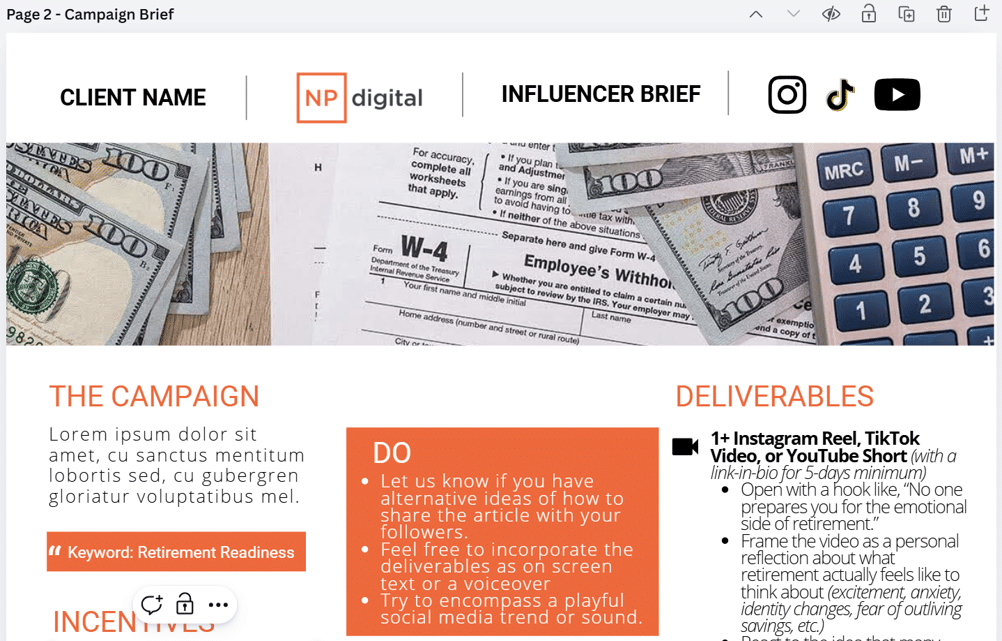
  "alt": "Campaign brief with NP Digital logo, influencer brief, a W-4 form, hundred-dollar bills, and a calculator.",
  "caption": "Dive into the latest NP Digital campaign briefing with tips for influencers and insights into retirement readiness.",
  "description": "This campaign brief from NP Digital features a visually engaging layout with the company's logo, an influencer brief section, and imagery including a W-4 tax form, several hundred-dollar bills, and a calculator. It highlights the campaign's focus on 'Retirement Readiness' with sections dedicated to campaign deliverables and strategic do's. The image includes text encouraging the creation of social media content such as Instagram Reels and TikTok videos, emphasizing the emotional aspects of retirement. Keywords include NP Digital, influencer brief, retirement, and campaign strategy."
}
```

    Ashley Liddell from Deviation emphasizes mapping search demand across platforms and aligning them with suitable creators for greater discoverability.

    The importance of capturing immediate data on keyword positioning across platforms cannot be overstated.

    Google’s shifting focus from traditional web content to social and video content is reshaping where search surface area exists.

    ```json
{
  "alt": "Image highlighting platforms for search optimization, including AI Tools, TikTok, Press, Pinterest, YouTube, Apps, LinkedIn, Podcasts, Voice, Meta, Google & Bing, Forums.",
  "caption": "Maximize your visibility by optimizing search across a wide range of platforms, from AI Tools to social media and forums. Reach your audience everywhere!",
  "description": "This image emphasizes the need for 'search everywhere optimization' in modern digital marketing. It highlights several platforms such as AI Tools, TikTok, Press, Pinterest, YouTube, Apps, LinkedIn, Podcasts, Voice, Meta, Google & Bing, and Forums where businesses can improve their visibility. The message stresses the importance of reaching target audiences on diverse channels to maximize engagement and presence."
}
```

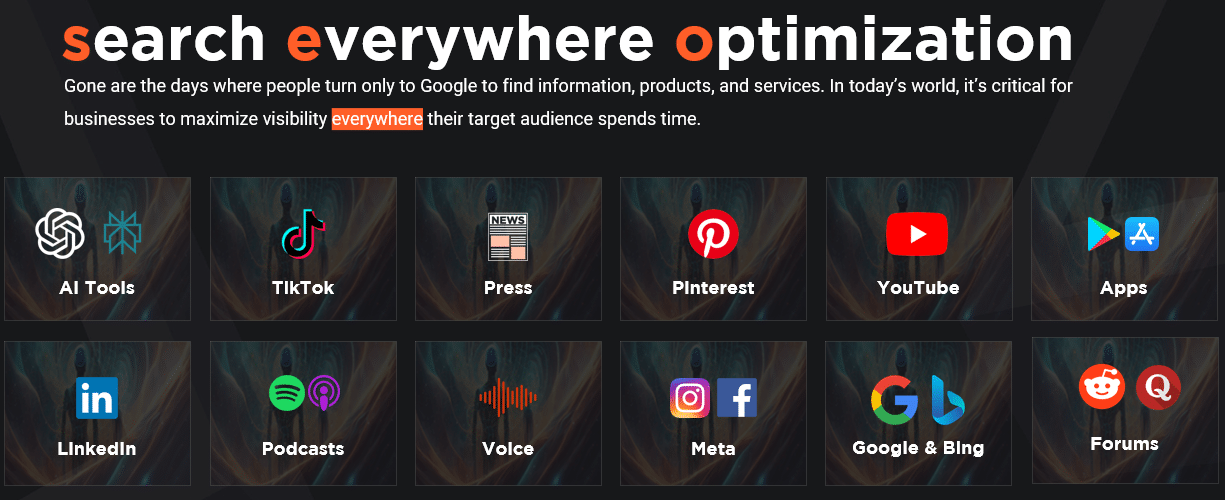
    In a world where younger audiences start their searches socially, it becomes essential to integrate search strategies with influencer content.

    Effective search everywhere optimization manifests in appearing where audiences actually search, with content that captures their attention.

    Dig deeper: The evolution of social search visibility

    Operationally, integrating keyword optimization into influencer programs involves bridging gaps between SEO and influencer teams, usually isolated in different structural parts, with distinct goals and KPIs.

    Instead of viewing keywords as creative constraints, treat them as topic signals allowing creators to incorporate them authentically.

    Integration involves a few key steps: sharing brief templates between SEO and influencer strategies, selecting keywords specific to each platform, reviewing content for keyword inclusion, and reporting on keyword-based search metrics.

    Influencer content shapes both brand perception and search visibility in today’s digital ecosystem.

    By applying a search strategy to content channels, brands can optimize these channels that traditionally operated without streamlined search strategies.

    Treating influencer videos as part of your search content inventory may just set your brand apart in a content-saturated world.


    Inspired by this post on Search Engine Land.


    crushpress.ai community screenshot
  • Google’s Lightning-Fast March 2026 Spam Update Now Complete

    Google’s Lightning-Fast March 2026 Spam Update Now Complete

    Well, it looks like Google’s March 2026 spam update wrapped up in record time! It took less than a day to roll out and was fully completed on March 25, 2026, at precisely 10:40 a.m. ET.

    The update was originally released the previous afternoon on March 24, 2026, at 3:20 p.m., meaning the entire process took just a swift 19 hours and 30 minutes. Incredible, right?

    Why this matters to us. This marks Google’s second announced algorithm update of 2026. While we don’t have specifics on the type of spam targeted, any changes you notice in your site’s ranking or traffic soon might be linked to this update.

    Diving deeper into the spam update. According to Google’s documentation:

    “While Google’s automated systems to detect search spam are constantly operating, we occasionally make notable improvements to how they work. When we do, we refer to this as a spam update and share when they happen on our list of Google Search ranking updates.

    For example, SpamBrain is our AI-based spam-prevention system. From time-to-time, we improve that system to make it better at spotting spam and to help ensure it catches new types of spam.

    Sites that see a change after a spam update should review our spam policies to ensure they are complying with those. Sites that violate our policies may rank lower in results or not appear in results at all. Making changes may help a site improve if our automated systems learn over a period of months that the site complies with our spam policies.

    In the case of a link spam update (an update that specifically deals with link spam), making changes might not generate an improvement. This is because when our systems remove the effects spammy links may have, any ranking benefit the links may have previously generated for your site is lost. Any potential ranking benefits generated by those links cannot be regained.”

    Impact. Primarily, this update aims at sites spamming Google Search. So, unless your site engaged in spammy practices, you likely won’t notice a negative impact.


    Inspired by this post on Search Engine Land.


    crushpress.ai community screenshot
  • ChatGPT Citations: Dominance of Key Domains Revealed

    ChatGPT Citations: Dominance of Key Domains Revealed

    Have you ever wondered how ChatGPT sources its information? According to a recent study, it turns out ChatGPT tends to pull pages significantly more often than it actually cites them, concentrating its citations primarily among roughly 30 key domains.

    Interestingly, AI citations in ChatGPT are far more concentrated compared to traditional search engines. Approximately 67% of citations within a specific topic are shared among only 30 domains.

    From Kevin Indig’s latest study, I learned that comprehensive topical coverage through long-form pages and cluster-based models tend to perform better than the older “one keyword, one page” strategy.

    The details. The visibility of citations isn’t spread out evenly. For product comparison topics, the top 10 domains capture about 46% of the citations, while the top 30 account for 67%.

    Though AI visibility is slightly less concentrated than classic organic search, the competition for citations is still incredibly centralized. As Indig concludes, without building sufficient authority, you’re likely excluded from these valuable citation “seats.”

    What changed. While ranking first on Google remains important, it’s not the sole factor anymore. Interestingly, of the pages ranked No. 1, only 43.2% were cited by ChatGPT, which is 3.5 times more than pages ranking beyond the top 20.

    ChatGPT retrieves a vast number of pages but cites only a fraction of them. According to AirOps, about 85% of the pages retrieved were never cited, and a significant portion of citations arose from fan-out queries that lacked search volume entirely.

    Why we care. Simply publishing the best answer for a keyword isn’t sufficient anymore. ChatGPT favors domains that offer comprehensive coverage of a topic, giving preference to pages that approach subjects from multiple angles.

    The patterns. It turns out, longer pages typically receive more citations, and this trend varies by industry. Notably, pages with 5,000 to 10,000 characters see the most substantial lift. For pages over 20,000 characters, the average number of citations hits 10.18 compared to a mere 2.39 for shorter pages.

    However, this pattern is not universal. For instance, in finance, shorter, densely packed pages often shine over lengthy guides. But in Education, Crypto, and Product Analytics, longer pages still hold their ground with little drop-off.

    Looking more closely at on-page behavior, ChatGPT tends to cite from the top sections of a page. Particularly, the 10% to 20% section excels across all industries, while the bottom 10% of the page barely garners recognition.

    About the data. For this study, Indig analyzed approximately 98,000 citation rows from about 1.2 million ChatGPT responses, using a variety of analytical methods to pinpoint which pages earned citations and their origins.

    The study. More about these findings can be found in the study titled The science of how AI picks its sources.


    Inspired by this post on Search Engine Land.


    crushpress.ai community screenshot
  • Uncovering AI’s Citation Preferences: Listicles Lead the Way

    Uncovering AI’s Citation Preferences: Listicles Lead the Way

    I recently delved into a fascinating study exploring how AI citations are significantly influenced by certain content formats. It turns out listicles, articles, and product pages are at the forefront, driving over 52% of mentions across various AI language models.

    The research, conducted by Wix Studio AI Search Lab, analyzed a whopping 75,000 AI answers and more than a million citations across platforms like ChatGPT, Google AI Mode, and Perplexity. It’s an exciting revelation that showcases the power of content structure in digital landscapes.

    The findings? Listicles claimed the top spot with 21.9% of citations, followed by articles at 16.7% and product pages at 13.7%. When combined, these formats make up a majority of the citations AI references.

    What’s interesting is that articles tend to dominate when it comes to informational queries, being cited 2.7 times more than other formats. Meanwhile, listicles capture nearly 40% of commercial-intent citations, almost double compared to any other type.

    The Why Behind Intent. It’s fascinating to see how query intent, rather than industry or AI model, is the strongest predictor of which content gets cited. This trend doesn’t shift much across different sectors, from SaaS to health industries.

    Informational queries skew towards articles (45.5%) and listicles (21.7%), while commercial queries are dominated by listicles (40.9%). Interestingly, transactional and navigational queries favor product and category pages, with those two formats comprising about 40% of the citations combined.

    The Impact for Us. This study is incredibly insightful, illustrating why aligning content types with user intent is more strategic than simply generating content. Articles serve to inform, listicles foster comparisons, and product pages drive conversions. Tailoring content to align with user goals might just be the key to snagging more AI citations and enhancing visibility.

    Not all listicles perform equally. In professional services, third-party listicles account for 80.9% of citations, showing a preference for neutral editorial comparisons over branded lists by large language models.

    Looking at Model Preferences. While all models have a penchant for listicles, their other preferences vary. ChatGPT leans heavily towards articles and informational content, Google AI Mode shows a balanced approach, and Perplexity stands out with 17% of its citations coming from discussions on platforms like Reddit and forums.

    Industry-Specific Trends. Though preferences shifted slightly among industries, there are notable trends. SaaS and professional services veer towards listicles, health sectors favor authoritative articles, and ecommerce spreads its citations across listicles, articles, and category pages. Interestingly, home repair maintains an even distribution across different formats.

    I’m intrigued to know more! The comprehensive research can be found here.


    Inspired by this post on Search Engine Land.


    crushpress.ai community screenshot
  • Uncovering SEO Threats: Is Your Organization Ready for 2026?

    Uncovering SEO Threats: Is Your Organization Ready for 2026?

    As I’ve navigated the evolving landscape of SEO over the years, one truth remains: our biggest challenges often come from within. We’re standing at the brink of 2026, and it’s becoming clear that our organization’s internal issues might be the most significant threat to SEO success.

    In recent discussions, AI tools and their impact on visibility have taken center stage. Yet, the conversation often overlooks a crucial issue. The real danger lies within our organizations—fragmented data, unclear KPIs, and poor collaboration silently erode even the most well-crafted SEO strategies.

    I want to share a few internal threats that we should start addressing now to ensure our SEO efforts remain effective.

    Many of us lean heavily on AI for tasks ranging from brief creation to data analysis. While AI expedites these processes, it’s essential to avoid falling into the trap of a one-size-fits-all solution. AI can provide speed, but the key is still in our unique perspective—what differentiates our content from the rest?

    Another concern is our fragmented data landscape. Despite advancements, we still struggle with incomplete information about our users’ journeys. Users engage with AI tools, forming product perceptions before reaching us, but we lack visibility into these early interactions.

    This brings us to another challenge: setting appropriate KPIs. While traditional metrics like traffic remain relics of past success, we now need to focus on visibility, considering the evolving role of AI. We’re being pulled towards metrics that may not directly align with business outcomes.

    ```json
{
  "alt": "The CapmatchOne logo with a gradient circle and bold text.",
  "caption": "Discover innovation with the CapmatchOne logo, featuring sleek typography and a modern gradient circle.",
  "description": "The CapmatchOne logo features bold, modern typography coupled with a gradient circle, symbolizing connection and innovation. The sleek design conveys a sense of progress and creativity. This image can be used for branding or promotional purposes, appealing to audiences interested in innovative solutions and forward-thinking designs."
}
```

    Furthermore, our roles must adapt beyond mere SEO execution to influencing broader strategic goals. Holding ownership without execution leads to misalignment. Instead, our insight should guide multi-platform visibility strategies, while leadership assigns responsibility for execution.

    I’ve noticed the absence of cross-team collaboration in leveraging AI visibility. If AI visibility isn’t a shared priority across teams, then executing a unified strategy becomes difficult. Our job includes rallying all teams around common goals.

    As SEO shifts to adaptability in a fast-paced AI-influenced world, action becomes vital. We can’t afford to stall in strategizing without executing. As I’ve experienced, prompt action allows us to learn quickly and adapt strategies effectively.

    Ultimately, strong collaboration defines successful SEO execution. As our field becomes integral to broader company capabilities, continued team effort ensures sustainable visibility.

    I urge you to see beyond traditional SEO. Embrace it as a dynamic business capability. The organizations that recognize this will lead the way in efficient discovery and sustainable growth.


    Inspired by this post on Search Engine Land.


    crushpress.ai community screenshot
  • Master Your Brand’s Digital Identity with Entity Homes

    Master Your Brand’s Digital Identity with Entity Homes

    Have you ever wondered how search engines and AI perceive your brand? It all starts with the entity home, a pivotal page that shapes your digital identity. Let me tell you why it’s more important than you might think.

    In my experience, this isn’t just about filling out the ‘About Us’ page on your website. It’s about creating a rich narrative that algorithms can trust. This single page acts as an anchor for how bots, algorithms, and even people view and validate your brand. I’ve seen firsthand how optimizing this page increased conversion rates by 6% for those who landed there.

    For years, many in SEO, myself included, overlooked this. The focus was always on rankings and traffic, often neglecting the foundational elements of how a brand’s identity is communicated online. But the landscape has changed, and so must we.

    ```json
{
  "alt": "The CapmatchOne logo with a gradient circle and bold text.",
  "caption": "Discover innovation with the CapmatchOne logo, featuring sleek typography and a modern gradient circle.",
  "description": "The CapmatchOne logo features bold, modern typography coupled with a gradient circle, symbolizing connection and innovation. The sleek design conveys a sense of progress and creativity. This image can be used for branding or promotional purposes, appealing to audiences interested in innovative solutions and forward-thinking designs."
}
```

    What the Entity Home Isn’t

    Let’s clear up some misconceptions before delving deeper.

    Not a Ranking Trick

    Improving the entity home isn’t some quick fix that will skyrocket your page views overnight. It’s about cultivating long-term trust and credibility.

    ```json
{
  "alt": "Illustration explaining the three audiences served by an Entity Home: Bots, Algorithms, and Humans.",
  "caption": "Discover the trio of audiences your Entity Home caters to: Bots mapping footprints, Algorithms building models, and Humans performing due diligence.",
  "description": "This image illustrates the three primary audiences that an Entity Home serves: Bots, which map your digital footprint; Algorithms, which construct models based on your data; and Humans, who conduct final due diligence. The graphic emphasizes the importance of an Entity Home as the canonical anchor for your brand identity, central to digital brand management."
}
```

    Not Just Schema

    Sure, schema is helpful for visibility in search, but it cannot replace substance. I’ve learned that the claims and evidence presented on your site are far more important.

    Not Always the About Page

    While it’s common, the About page isn’t always your entity home. In my case, I had to identify the URL that best showcased my brand’s identity and provided stable, long-term information.

    ```json
{
  "alt": "Bar graph showing focus weighting by year from 2026 to 2028 for Search, Assistive, and Agential.",
  "caption": "Explore the changing focus on Search, Assistive, and Agential from 2026 to 2028 with this insightful bar graph, highlighting strategic shifts in emphasis.",
  "description": "This image presents a bar graph illustrating focus weighting by year for Search, Assistive, and Agential dimensions from 2026 to 2028. In 2026, Search takes priority with 60%, followed by Assistive at 35% and Agential at 5%. By 2027, the focus shifts to 35% Search, 50% Assistive, and 15% Agential. In 2028, the priorities balance at 35% Search, 50% Assistive, and 35% Agential. This graphical representation highlights strategic changes over the years."
}
```

    Not Enough Without Corroboration

    Declaring your claims on one page won’t cut it if they’re not backed by credible third-party sources. I’ve realized that evidence and corroboration create a trust bridge algorithms rely upon.

    Three Audiences, One Anchor

    The entity home serves three critical audiences, and I’ve noticed that many brands neglect two of them.

    ```json
{
  "alt": "Comparison between Entity Home as one page and Entity Home Website as a full education hub.",
  "caption": "Explore the differences between a single-page Entity Home and a comprehensive Entity Home Website, offering an educational hub filled with valuable resources.",
  "description": "This image illustrates the distinction between an Entity Home, represented as a single-page with a clear entity statement, and an Entity Home Website, depicted as a full educational hub. The single page emphasizes a canonical anchor under '/about', while the website version expands into a structured hub, offering sections such as social, companies, peers, press, speaking, and books. This comparison highlights the broader reach and functionality of a full Entity Home Website. Keywords: Entity Home, education hub, website structure, SEO."
}
```

    Bots map your digital footprint. Algorithms resolve identities from your entity home. People use it to verify your credibility before converting. Each element requires a slightly different approach, one that I’m continually fine-tuning.

    The Entity Home is Just One Page and That Isn’t Enough

    Your entity home lays the groundwork, but it doesn’t tell your whole story. I’ve learned to extend my brand narrative across other pages on my site.

    ```json
{
  "alt": "Infographic comparing keyword cornerstones and entity pillar pages with a focus on SEO strategy.",
  "caption": "Navigating SEO: This infographic highlights the balance between keyword cornerstones and entity pillar pages, illustrating effective strategies for optimizing content.",
  "description": "This infographic explores the differences and relationships between keyword cornerstones and entity pillar pages in SEO. The left section lists keyword cornerstones like 'Technical SEO audit', focusing on user searches and a traffic-first approach. The right section presents entity pillar pages, organized by what the entity is, using an 'Entity Home anchor' for confidence-first strategies. A timeline at the bottom emphasizes the balance in URL strategy for both search and assistive eras. Keywords include SEO strategy, keyword cornerstones, and entity pillar pages."
}
```

    I’ve structured pages to express who I am, what I do, and align them with supporting, independent sources. This multi-layered approach has been pivotal in how AI and search engines understand my brand.

    Shifting my focus to assistive and agent-driven interactions has been a challenge, but it’s clear this is where the future lies. The change is happening faster than anticipated, and I’m adapting my strategy accordingly.

    ```json
{
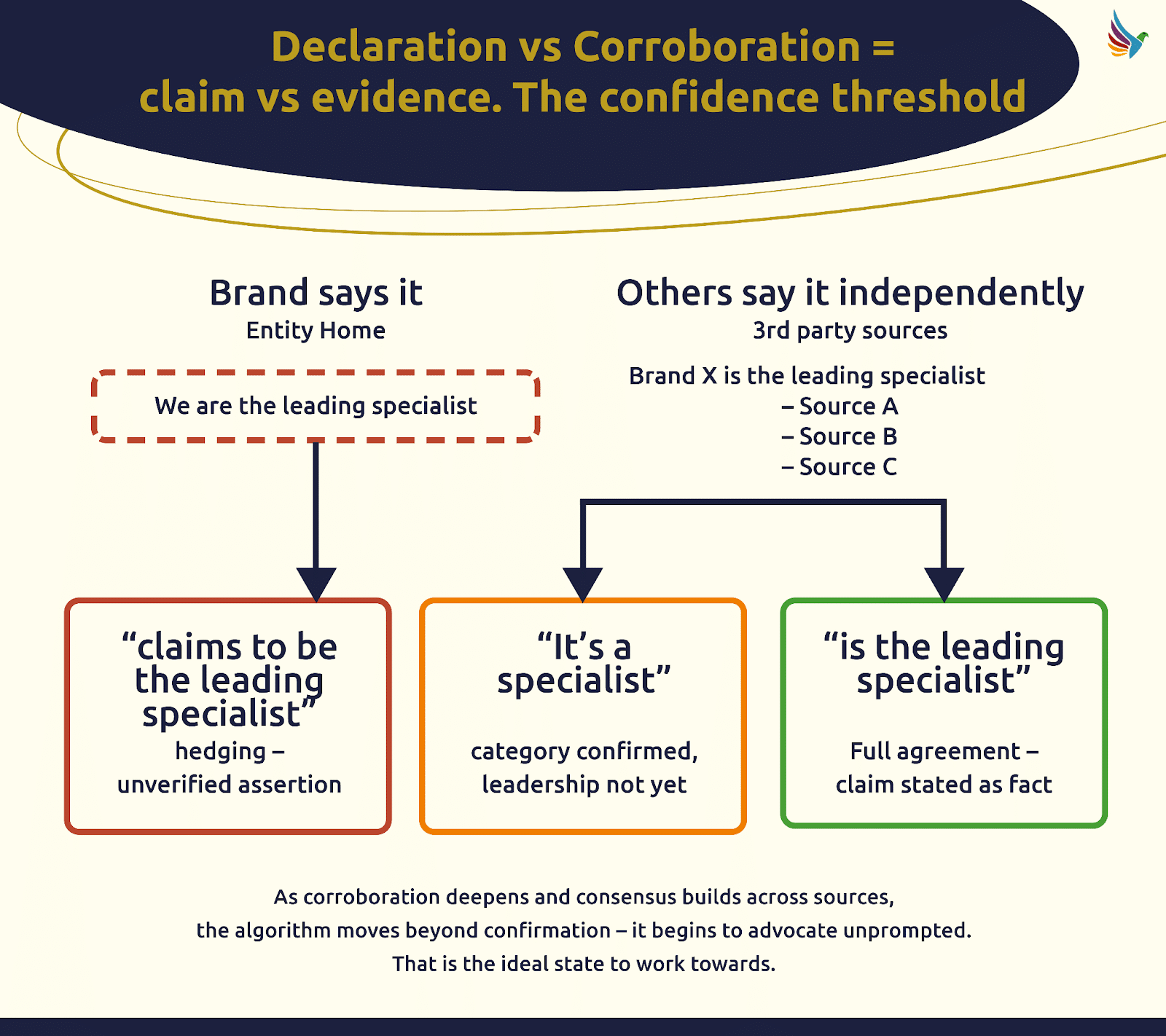
  "alt": "Flowchart illustrating the difference between declaration and corroboration in brand claims with various confidence levels.",
  "caption": "Understanding the path from simple brand declarations to confident, corroborated evidence, where claims evolve into widely accepted truths.",
  "description": "This image is a flowchart differentiating between declaration and corroboration in brand claims. It begins with 'Brand says it' and moves to 'Others say it independently,' with different confidence levels—'claims to be the leading specialist,' 'It's a specialist,' and 'is the leading specialist.' The image emphasizes the importance of corroboration, highlighting how consensus strengthens claims. Ideal for understanding brand credibility and confidence thresholds."
}
```

    Building for Machines and Humans Simultaneously

    At first glance, it seems building for machines might detract from the human element, but I’ve found the opposite to be true. Structured clarity satisfies both algorithms and human readers. There’s a mutual benefit in crafting content that speaks to both audiences effectively.

    Getting the Entity Home Right Requires Definition, Proof, and Corroboration

    Defining the core URL of my brand’s identity has been a meticulous process. I’ve ensured it contains explicit claims supported by robust third-party evidence.

    This isn’t a sprint; it’s an ongoing education for algorithms. I reinforce my claims through continuous corroboration, ensuring that my brand stands on stable, trustworthy ground.


    Inspired by this post on Search Engine Land.

    crushpress.ai community screenshot
  • Bing Enhances AI Query Links to Cited Pages for SEO Insight

    Bing Enhances AI Query Links to Cited Pages for SEO Insight

    Recently, I’ve noticed something exciting happening on Bing. Now, when I use Bing Webmaster Tools, I can click a query to view its cited pages or select a page to see its grounding queries. It feels like a new level of connectivity where multiple queries and pages are seamlessly linked together.

    Microsoft has introduced query-to-page mapping within its AI Performance report on Bing Webmaster Tools. I find this feature incredibly helpful because it lets me directly connect AI-generated queries to cited URLs. This makes my SEO strategies more precise.

    Why it matters to us. Before this update, Bing’s dashboard presented queries and pages separately, which limited our optimization efforts. Now, I can align specific AI-triggering queries with the exact pages they reference, focusing my updates on real AI-driven demand rather than guesswork.

    Here’s the scoop. The Grounding Query–Page Mapping feature is a game-changer in the AI Performance dashboard:

    • With a click on a grounding query, I can see which pages are cited.
    • I can also click a page to find out which grounding queries are driving its citations.
    • The mapping system is many-to-many, meaning one query can be linked to multiple pages and vice versa.

    Catch up with Bing. Back in February, Microsoft launched the AI Performance report in Bing Webmaster Tools, marking its initial GEO-focused dashboard. This tool keeps track of where and how often my content gets cited in AI answers across platforms like Bing, Copilot, and more.

    • It tracks the grounding queries, cited URLs, and visibility trends over time, providing an insightful view into citation visibility.

    The buzz. According to Microsoft, this update came about due to “strong positive customer feedback and numerous requests,” and I can see why it’s so well-received.

    The announcement. The unveiling of the query-to-page mapping feature was detailed in a Microsoft Advertising blog post: The AI Performance dashboard: Your view into where your brand appears across the AI web


    Inspired by this post on Search Engine Land.

    crushpress.ai community screenshot
  • Essential Checks for a Seamless Website Migration

    Essential Checks for a Seamless Website Migration

    I’ve learned that website migrations often fail due to small oversights. That’s why I focus on reducing risks with thorough pre-launch, launch-day, and post-launch SEO checks.

    Website migrations can notoriously go awry, even with the best planning. I’ve seen rankings slip, traffic drop, and tracking break. Surprisingly, it’s usually the small oversights rather than complex technical issues that cause these problems.

    I approach website migrations with a staging process. The checks I perform during staging, on launch day, and in the few weeks following the launch are crucial. They often determine whether a migration stabilizes quickly or spirals into a long recovery project.

    Before Launch: Catch Issues on Staging

    I’ve found that most migration problems should be identified and resolved on the staging site. If issues make it to the live site, recovery tends to be slower and more uncertain. Here’s how I set myself up for success:

    Keep the Staging Site Private (Even from Crawlers)

    A common mistake I’ve encountered is making the staging site publicly indexable. Google crawling a staging environment can lead to duplicate content in search results, causing rankings to fluctuate and unfinished pages to be indexed.

    I make it a point to block crawlers from the staging site or protect it with a password to ensure it stays invisible to search engines until the live launch.

    It’s not just about the crawlers. I’ve seen ecommerce sites where customers found the staging site and tried to place orders, creating confusion and frustration internally.

    Take Benchmarks

    To help identify real issues rather than reacting to normal shifts, I always take a baseline. I record organic sessions, rankings, top landing pages, indexed pages, conversions, and site speed before moving to the new site.

    Identify Priority Pages

    For me, it’s crucial to focus on pages that drive traffic, revenue, or attract links. These need extra care during redirect mapping, content review, and testing, with special attention to internal links, redirects, and URL rules.

    Review Templates and Content Continuity

    ```json
{
  "alt": "The CapmatchOne logo with a gradient circle and bold text.",
  "caption": "Discover innovation with the CapmatchOne logo, featuring sleek typography and a modern gradient circle.",
  "description": "The CapmatchOne logo features bold, modern typography coupled with a gradient circle, symbolizing connection and innovation. The sleek design conveys a sense of progress and creativity. This image can be used for branding or promotional purposes, appealing to audiences interested in innovative solutions and forward-thinking designs."
}
```

    Templates are the backbone of a website, controlling titles, headings, metadata, and more. If templates break, similar problems can spread across countless pages. Here’s what I check:

    • Presence and accuracy of titles and headings.
    • Canonical tags that use full URLs and point to live pages.
    • Correctly transferred structured data.
    • Intact copy, images, and internal links.

    Launch Day: Verify Everything Works on the Live Site

    On launch day, preparation meets reality. I join my SEO, developer, and design teams to make sure what worked on staging works on the live site as well. Even small oversights can immediately impact rankings, traffic, and user experience.

    Test Redirects at Scale

    It’s not enough to spot-check. Every mapped URL should redirect correctly, without chains or loops, as they can slow down crawling and delay signal consolidation.

    Crawl the Live Site

    Immediately after the site goes live, I run a full crawl and compare the results to the staging crawl to spot any differences. I’m on the lookout for broken links, redirected internal links, missing pages, and server errors.

    Menüs, breadcrumbs, and in-content links should directly point to live URLs. Allowing internal links to rely on redirects adds unnecessary load and risk.

    After Launch: Monitor and Stabilize Performance

    I know that even with the best planning, surprises can emerge once search engines and real users start interacting with the site. Small errors missed on staging can suddenly affect rankings or traffic.

    Structured monitoring in the days and weeks post-launch is crucial. By catching issues early, I can ensure they don’t impact performance or user experience.


    Inspired by this post on Search Engine Land.

    crushpress.ai community screenshot
  • Effortlessly Deploy Webpages with Profound Agents & Vercel v0

    Effortlessly Deploy Webpages with Profound Agents & Vercel v0

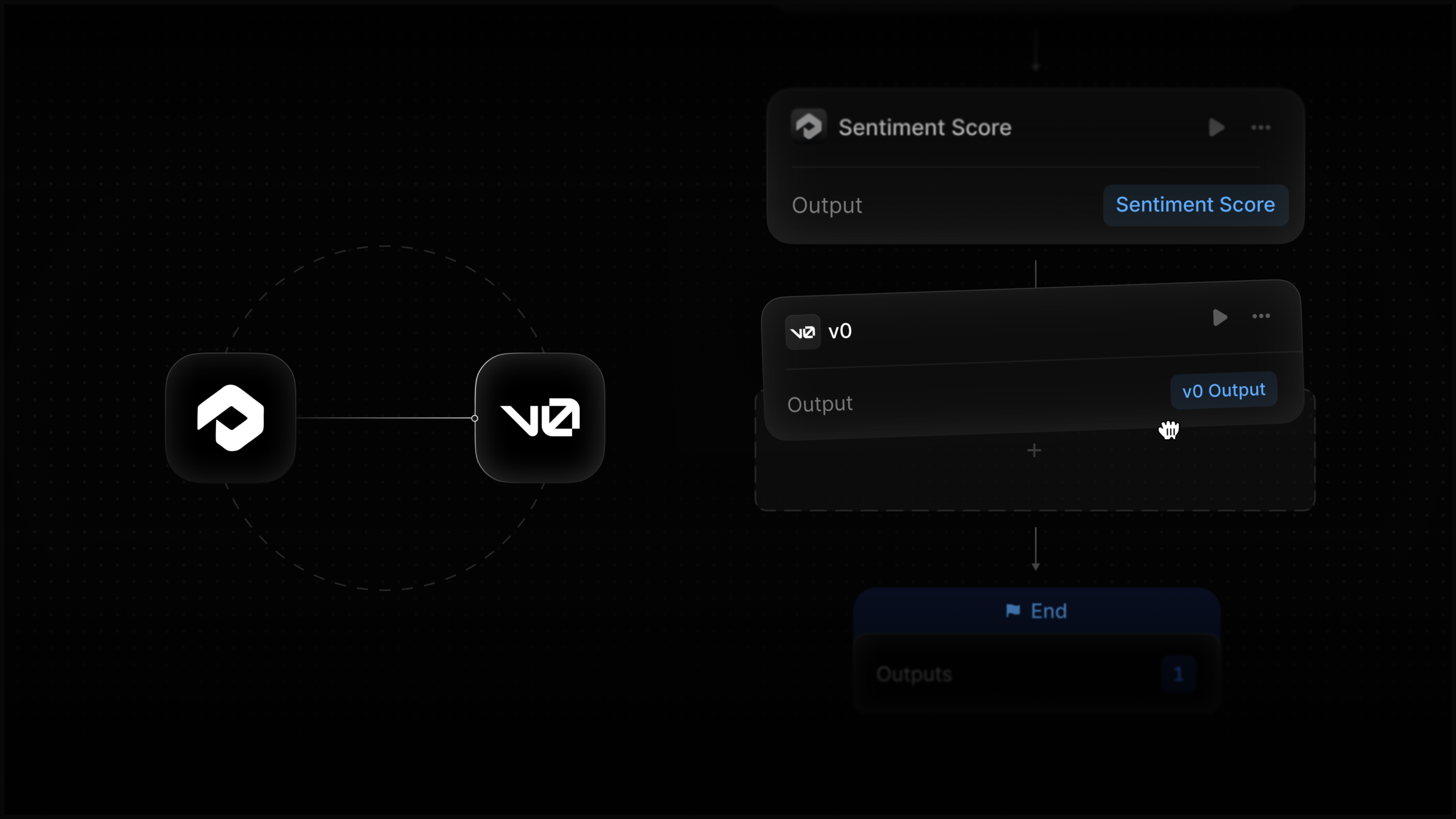
    Hey there! I’m thrilled to share something exciting: Profound Agents now seamlessly connect with Vercel v0. This means I can generate and deploy stunning landing pages without writing a single line of code.

    By leveraging my Profound AEO data as a solid foundation, deploying these pages has never been easier. It’s a game-changer for anyone looking to enhance their digital presence effectively and efficiently.


    Inspired by this post on Try Profound Blog.


    crushpress.ai community screenshot