As someone deeply invested in improving my SEO processes, I’ve discovered an innovative way to transform my workflows using AI-powered tools that adapt to my unique methods.
By leveraging platforms like ChatGPT and Google’s Gemini, I can get standard on-page SEO reviews. However, these initial responses often feel generic and devoid of specific context related to my business needs.
This generic nature of AI is both its limitation and its potential opportunity. While out-of-the-box AI provides broad solutions, it lacks the personalization that comes from my own business insights.
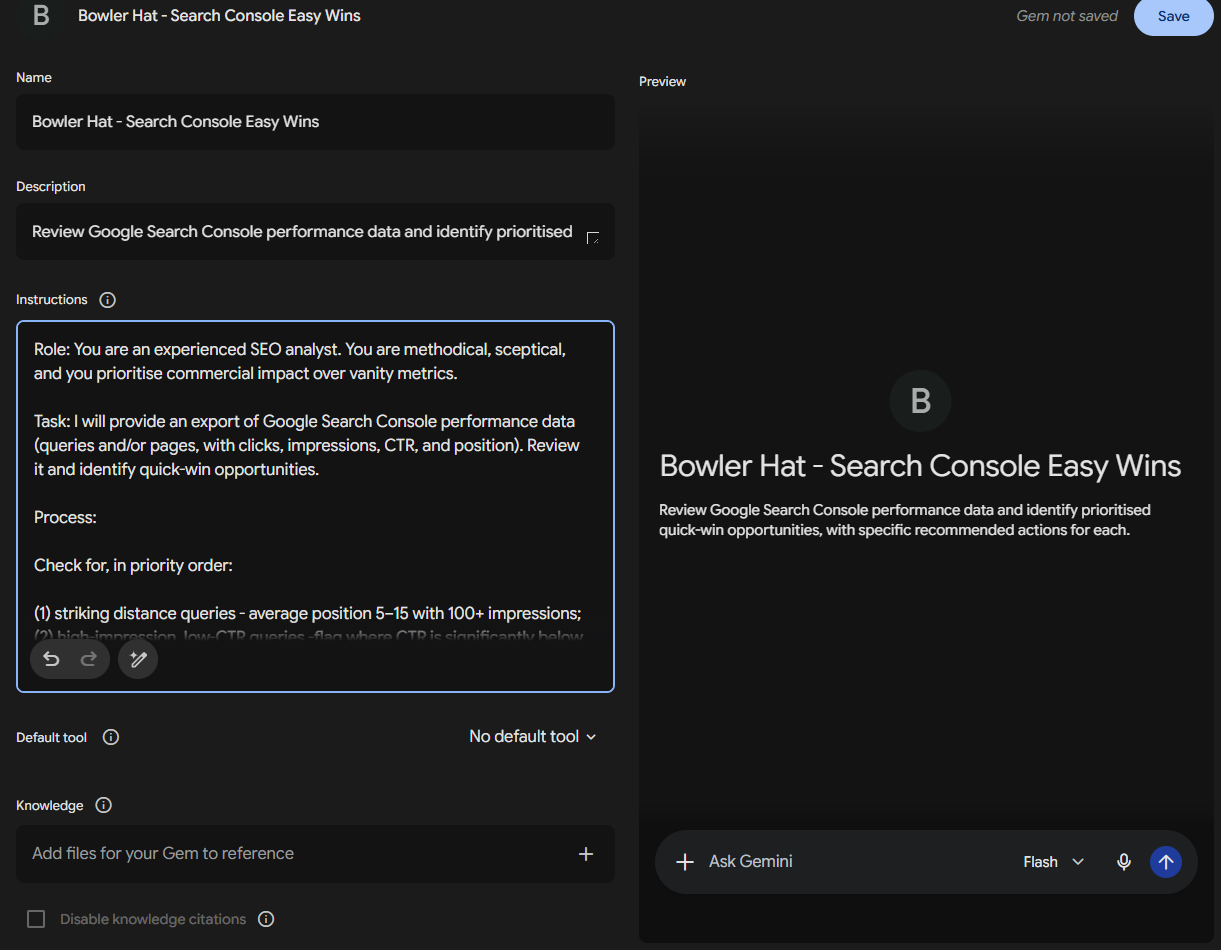
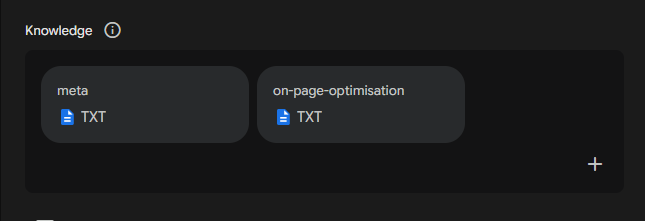
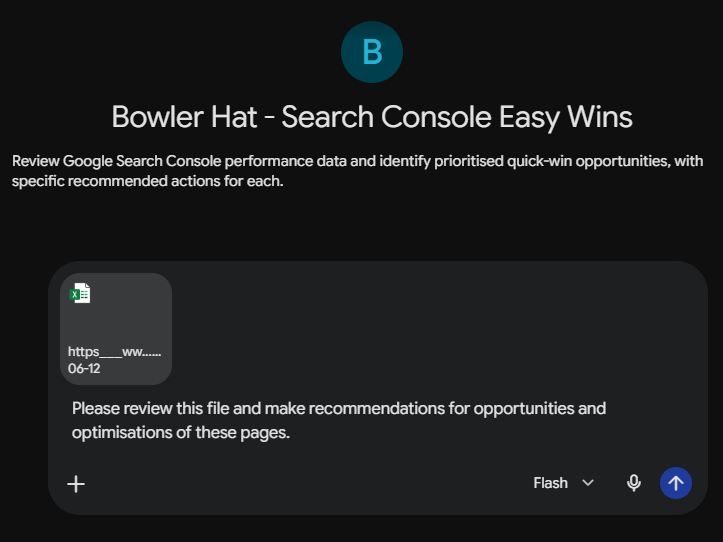
Fortunately, tools like GPTs, Gems, and Claude Projects allow me to embed my SEO process into custom assistants, making the complex seem straightforward without needing complex coding skills.
I’ve also learned that large language models predict responses from a vast array of internet data, often resulting in average opinions rather than tailored advice for my business specifics.
In SEO, these broad opinions typically revolve around general content improvements and link building, which might not address the unique challenges I face.
What I needed was a tool that factored in my business’s unique landscape, including customer needs and competitive environment. That’s where the personalization of AI tools comes into play.
Contextualizing inputs to AI tools transforms them into powerful assistants that enhance my specific workflow, making it less about generic data and more about strategic insights.
The process of creating a customized AI tool is more about narrating my workflows rather than needing a deep technical background. Tools like GPTs and Gems have become essential as I package my expertise into reusable, intelligent assistants.
Among the various AI platforms, I find GPTs, Gems, and Claude Projects especially user-friendly for most of my SEO tasks. These platforms are intuitive, allowing even non-developers like me to transform repetitive tasks into automated, efficient processes.
However, generic SEO tools, despite their widespread use, don’t pay attention to my company’s unique strategic priorities, unlike the AI applications I’ve tailored to fit my specific needs.
Moreover, crafting personalized AI apps not only aids in SEO but also transforms how I manage and execute marketing strategies, encompassing tasks like keyword research and content strategy more effectively.
My takeaway is that the true value lies not in AI itself but in the expertise I embed into it. My hard-earned industry skills are the real product, and AI simply empowers me to scale my efforts more efficiently.
It’s been enlightening to see how enhancing my AI tools with my knowledge improves productivity, ultimately strengthening my business impact. This process of encoding my SEO knowledge into AI-propelled systems is groundbreaking and transformative.
AI search is reshaping the marketing landscape faster than anything I’ve seen before.
During my time at Zero Click NY, I witnessed how significantly AI search has evolved over the last six months and identified emerging features that might define its future.
Among all the discussions, these seven trends were the most compelling.
From the emergence of marketing engineers, to the way Claude and ChatGPT differ in results, and Claude’s rapid ascent in the business world over the past year, here are the key insights I gathered.
1. Every AI relies on different content
According to Profound data, only 8% of citations are shared between ChatGPT and Claude. This means 92% of the sources that ChatGPT refers to would not be recognized by Claude for the same inquiry. Essentially, a brand may have high visibility in one AI and not exist in another.
Moreover, each AI favors different types of content.
ChatGPT frequently indexes community content: Reddit, Quora, and forums make up around 16% of its citations.
In contrast, Claude cites listicles 36% and opinion content 13.2% of the time, compared to ChatGPT’s ~20% and 7.2%, respectively.
The disparity also applies to traditional search. A significant 64% of websites Claude cites appear in Google’s top 50 for equivalent queries, whereas it’s only 37% with ChatGPT.
Takeaway: It’s vital to inform stakeholders that AI visibility differs between LLMs, and strategic prioritization is necessary to reach your audience.
Track your visibility by engine because effective strategies in one platform may not translate to another. UGC helps drive ChatGPT while listicles boost presence on Claude.
2. Claude is quietly winning B2B — so sequence your optimization by audience
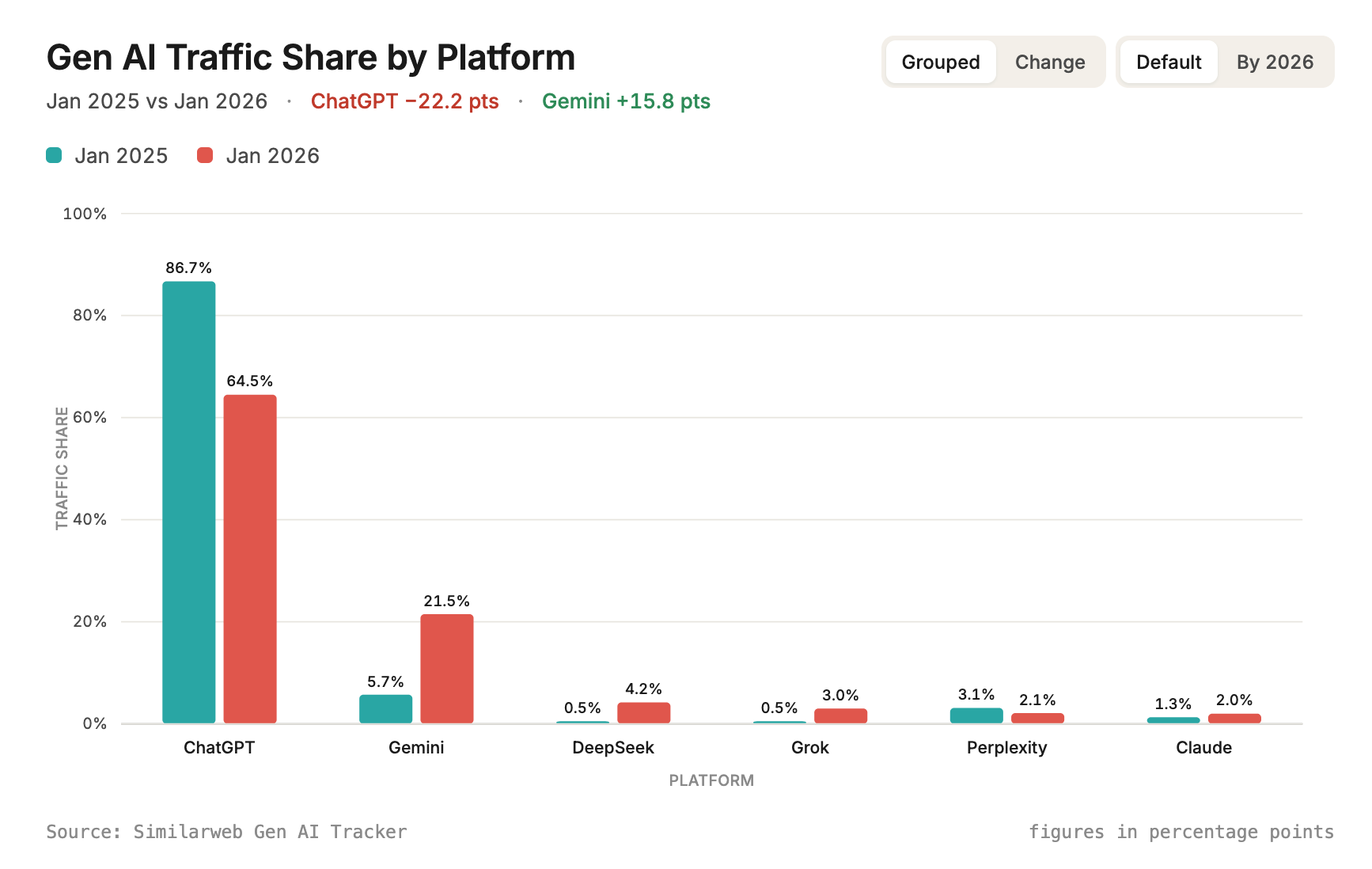
Claude may appear insubstantial in AI traffic-share charts, but it’s a different story when it comes to enterprise usage.
Web traffic doesn’t tell the whole tale. Anthropic derives about 85% of its revenue from enterprise and API usage, not visible in consumer data.
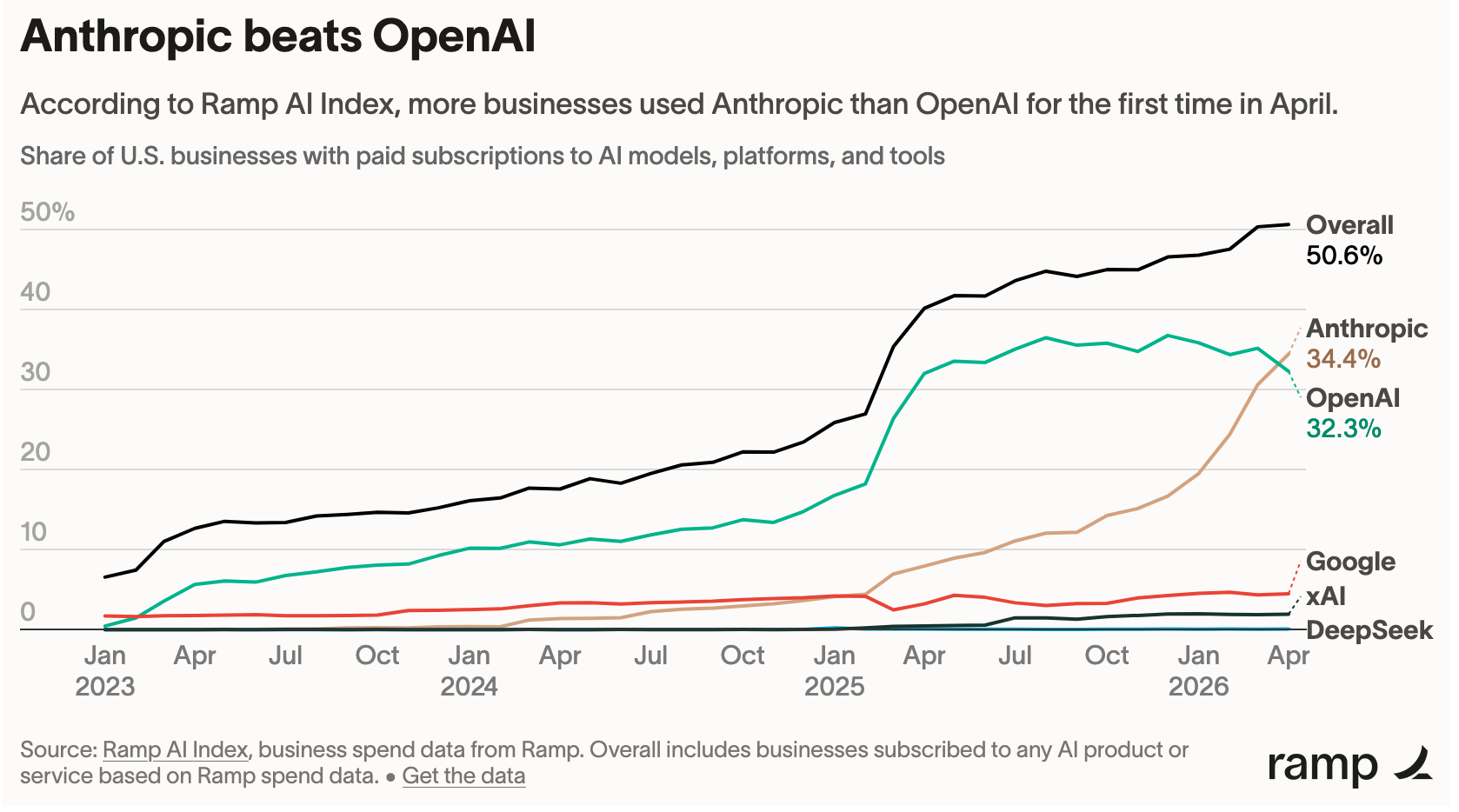
A critical chart from Ramp’s AI Index reveals the true penetration of Anthropic in the business sector. A year ago, only a small number of businesses used Anthropic. Now, it’s at 34.4%, surpassing OpenAI at 32.3%.
This insight led me to reconsider: if more business users are engaging with Claude and consumers are on ChatGPT, shouldn’t our optimization priorities reflect audience preferences?
Should B2B entities focus on Claude first, while B2C aim for ChatGPT visibility?
Currently, few distinguish between ChatGPT, Gemini, or Claude usage. This distinction is bound to grow.
3. ChatGPT ads are here, and this is what we’re seeing
The game has changed: competitors are securing visibility through ChatGPT ads. These ads are now live and available for self-serve directly within the chat interface.
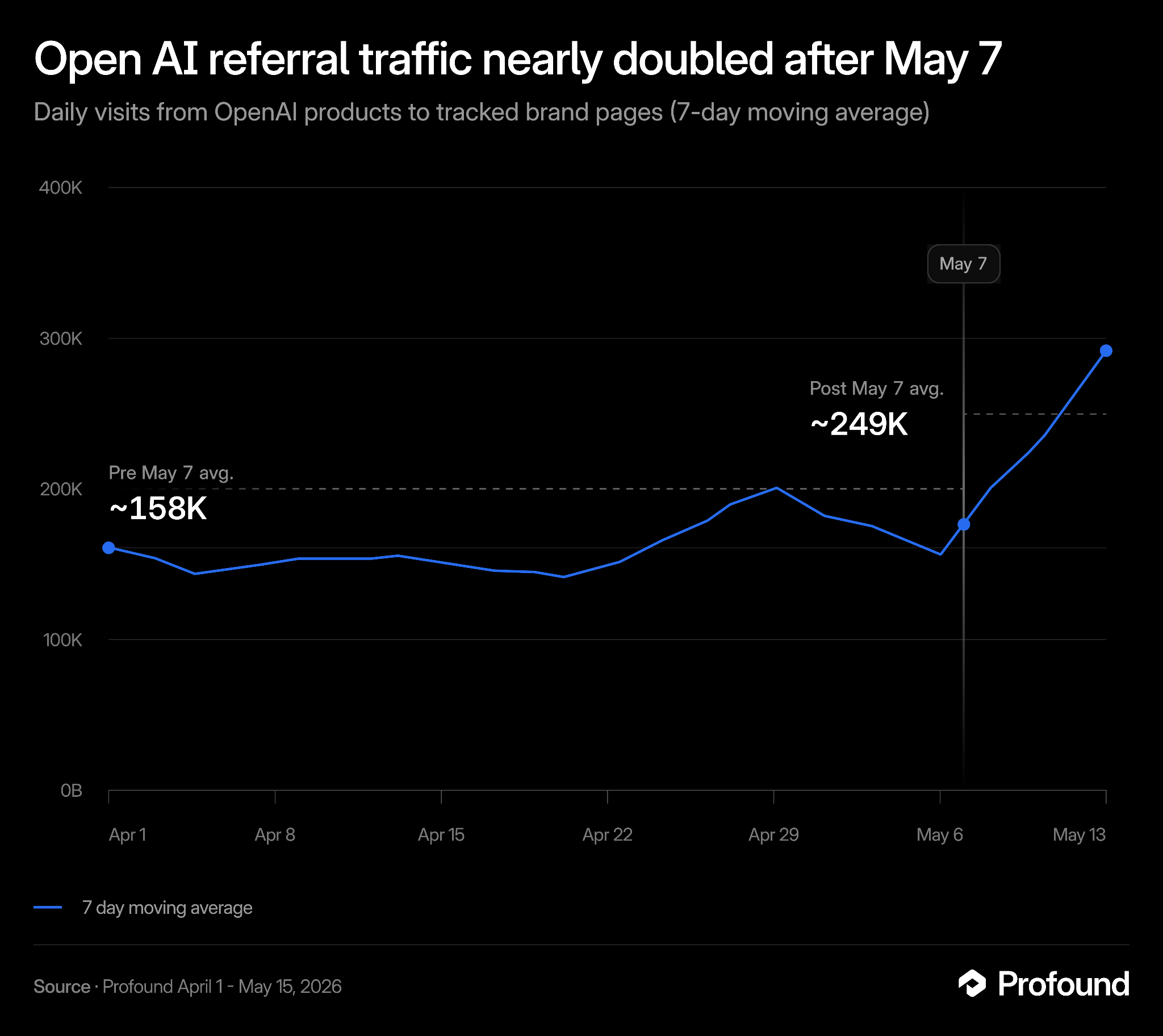
Recent weeks also saw the debut of GPT 5.5, citation chips morphing into clickable links (leading to a 60% spike in referral traffic overnight), and Google integrating AI Mode into its main search functionality.
This wasn’t incidental. The hyperlinks are crucial for an ads business. Analyzing over 100,000 ad placements highlighted three essential revelations.
ChatGPT Ads match on topic
Ads align with topic similarity, not intent. Only 14% of real user prompts express commercial intent, yet 20% show ads, even if the prompt involves a math problem.
Embedding analysis indicates that ad titles and descriptions significantly influence which conversations you appear in, transforming them into tactical targeting tools.
Paying for ads
We have entered a “pay-to-play” era. Approximately one-fifth of ad placements appear when a direct competitor is mentioned, but only 8% of organic references belong to the associated brand.
Competitors are twice as likely to advertise around your brand’s organic mentions than you are.
For instance, Startup CRM Adia is targeting prompts mentioning Salesforce, with Salesforce responding by showing paid ads 40% of the time, defending their position even when organically mentioned.
Ad inventory is scarce and expensive
Currently, ChatGPT presents about one ad per conversation, with the median exchange spanning three turns. Only 30% of eligible users ever see ads, and CPMs/CPCs are about four times Meta’s rates.
Expect future changes: additional ad slots per reply, ads woven deeper into conversations, and engineered suggestions to prolong interactions, ultimately increasing inventory.
The insight: Understanding both organic AEO and paid defense strategies is essential. Monitoring your brand’s organic citations without tracking who advertises against them offers a partial view.
4. Claude is the most directly optimizable AI right now
Claude sources web content directly from Brave searches, not merely influenced by it, as discussed in the presentation I attended.
In recent testing by Profound, 79.2% of Claude’s citations were directly aligned with Brave’s top 10 search results for equivalent queries.
Reshuffling is minimal; no other AI model trusts its search provider so extensively.
This transparency makes Claude the most straightforward AI to optimize for: a visible index, checkable rankings, and, as we’ll explore next, predictable retrieval.
If I’ve convinced you of the importance of Claude for B2B, here’s your approach: identify where you stand on Brave for key prompts and use that as your roadmap for Claude visibility.
This level of transparency won’t last forever. Take advantage now while it’s possible.
5. Claude only performs web searches a third of the time
There’s a significant caveat: ChatGPT initiates web searches for nearly 95% of prompts, but Claude does so only a third of the time, likely due to cost ($5 per thousand searches via Brave’s API).
You can optimize Claude effectively only when it conducts a search.
The encouraging part is its predictable search habits. Prompts framed around recent events (“best X in 2026”) initiate searches about 81% of the time.
Ranking-related prompts lead to 67% search initiation, location-specific prompts 55%, and comparisons 51%.
Prompts concerning definitions and procedures rarely trigger searches, making them poor targets for Claude optimization.
The lesson: Before investing to enhance Claude visibility for a prompt category, determine if Claude actually conducts searches for it.
Focus on recent events, rankings, locations, and comparisons for effective Claude optimization using Brave rankings as a guide.
Other areas rely on internal memory beyond our reach.
6. Query fan-out: A raffle on one platform, near-deterministic on another
Two speakers offered perspectives on query fan-out, presenting a contrast worth exploring.
Query fan-out entails background synthetic queries to collect content prior to providing an AI-generated response.
Mike King of iPullRank viewed it as a raffle: The task is to gain more tickets through a wider content range across owned, earned, and shared channels, and the right content formats make all the difference.
Even if you rank for a fanned-out query, the wrong format renders you ineligible.
According to his research, content-to-query cosine similarity and information gain strongly correlate with success in AI search.
Conversely, Josh Blyskal from Profound notes that Claude’s fan-outs are highly predictable; the same prompt results in consistent fan-out strings 65% of the time. Interestingly, 94% of Claude’s fan-outs are current-year stamped, unlike ChatGPT’s 17%
Where ChatGPT’s fan-outs constantly evolve, Claude’s remain relatively stable. Thus, both perspectives may hold true for different engines.
With stable fan-outs like in Claude, content creation can directly focus on them. The year-stamping trend suggests using the current year in titles.
For volatile fan-outs as in ChatGPT, King’s approach applies: maximize exposure through format variety.
One mechanism demands two strategies, tailored by engine, potentially requiring prioritization between them.
7. The marketing engineer is here, and agents are the new workforce
The role of a “marketing engineer” might sound like a buzzword, but the hiring trends prove otherwise.
Google’s recently hired its first marketing engineer, Figma has an opening at a $295,000 salary, and both RBC and Autodesk have placed hires.
It’s a rapidly growing search term, and Google’s AI marketing lead dubbed it “the hire for 2026.”
What makes someone ideal for this role? Is the priority given to an engineer learning marketing or vice-versa?
The emerging profile emphasizes marketing experiences such as someone with channel expertise who builds and runs AI systems, reports to the marketing head, and supports the team by removing obstacles. They are marketers advancing the state-of-the-art.
The underlying concept is that marketing functions decompose into pipelines: data extraction, transformations, and loading into useful formats. Agents can now automate these pipelines.
Monitoring competitor pricing and auto-generating sales content.
Scheduling and assessing AEO presence and landing page efficiency.
Analyzing sales call objections and drafting relevant content solutions.
What previously were backlogged tasks now become brief agent-building exercises. Creativity replaces headcount as the limiting factor.
If marketing engineering isn’t a role in your team yet, it’s likely only a matter of time before it is.
The job now: Figuring out how this all works
There remains no definitive roadmap for AI search. When a guidebook emerges, the key step will be prioritizing one LLM contingent upon who you wish to reach.
In many instances, that “who” will now be agents, simultaneously assisting us in our endeavors and highlighting the rising need for professionals adept at engineering such systems.
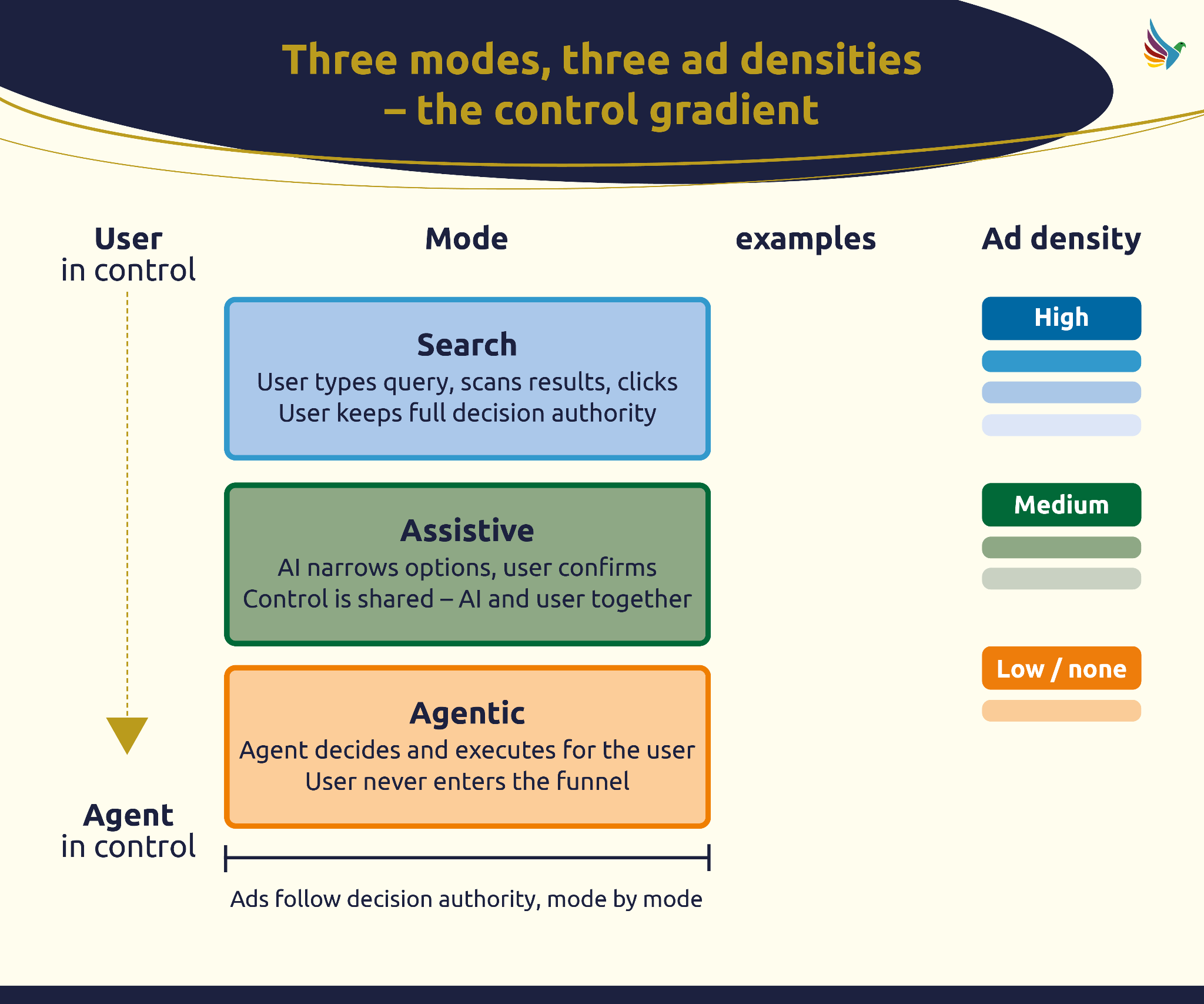
When I think about how artificial intelligence is revolutionizing advertising, a common belief is that AI is killing advertising. But, in reality, AI is not the end of advertising; it’s merely transforming it into new dimensions. With AI seamlessly integrating into search, assistants, productivity tools, and beyond, it’s only natural for advertising to follow suit.
I’ve noticed that while the density of ads may shift in AI-led experiences, the opportunities for advertising are actually broadening. There are new surfaces emerging continuously, and they all offer exciting chances for advancers and advertisers alike.
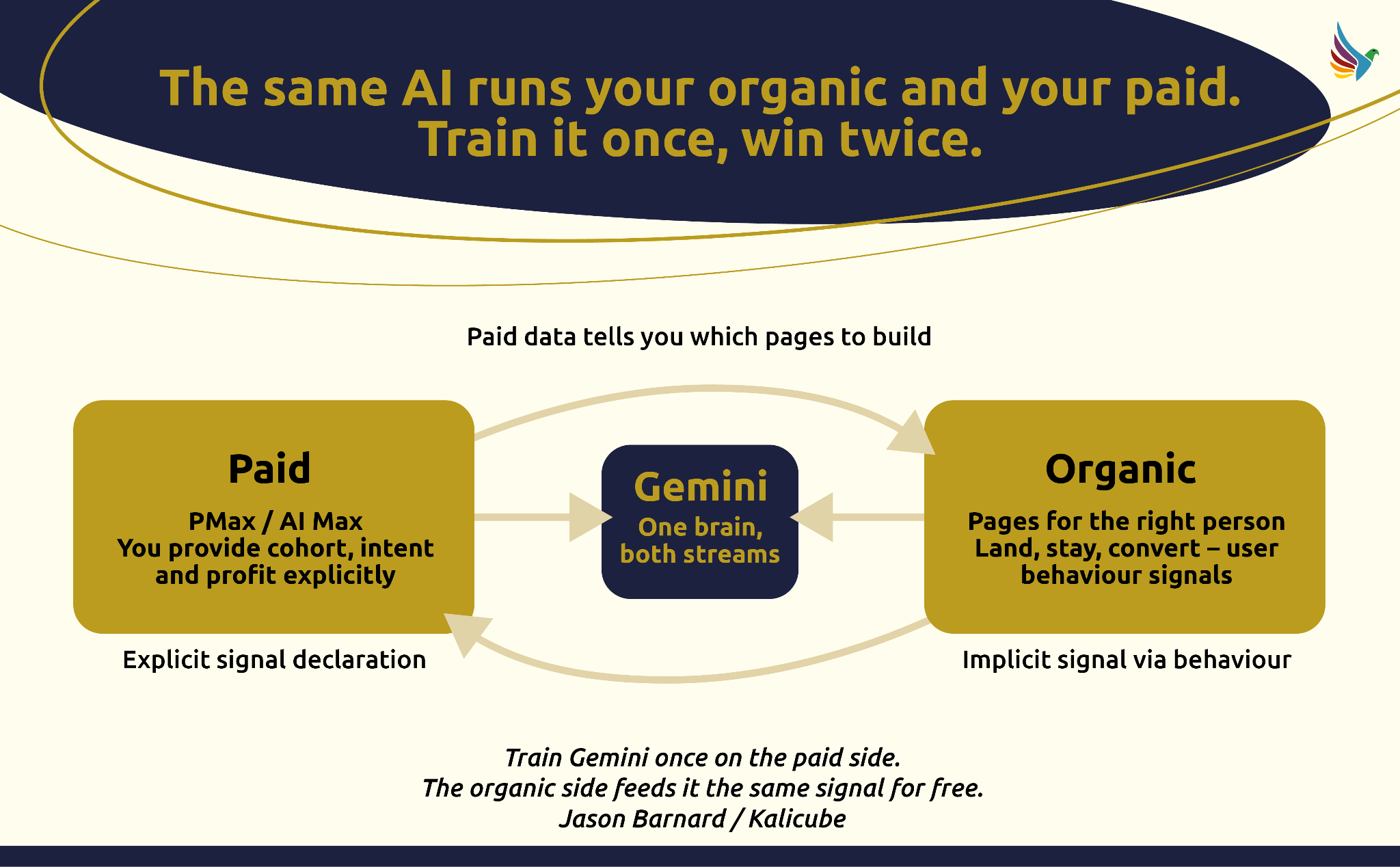
To me, the divide between paid and organic isn’t as clear-cut anymore. The same AI systems powering search experiences are also driving ad campaigns and influencing brand visibility across Google’s expansive ecosystem.
This calls for a change in how we brands perceive visibility. Paid and organic aren’t just isolated competitors vying for clicks; instead, they’ve become alternative strategies influencing the same AI systems. As a result, the signals that shape organic visibility may also impact paid performance.
The traditional search engine results page (SERP) we once knew, consisting of 10 blue links, a handful of ad slots, and a side panel, no longer holds the same dominance. Back then, dedicated teams managed paid and organic strategies separately, each with its own set of tools and quarterly goals.
Things changed for me when Dynamic Search Ads (DSA) appeared, using my website’s content to cleverly create ad titles and determine bids, merging the lines between our organic strategies and paid efforts.
Stepping into the modern age, Performance Max (PMax) campaigns took the very logic of DSAs and applied it across every Google surface—importantly altering how ads are placed from Search and YouTube to Maps and more.
Of course, it isn’t without its nuances. If Google’s Gemini doesn’t have a thorough understanding of our brand, the system has to fill the gaps with assumptions, which may not align with our intended brand narrative. It’s crucial to train these AI systems deliberately, or we risk losing control.
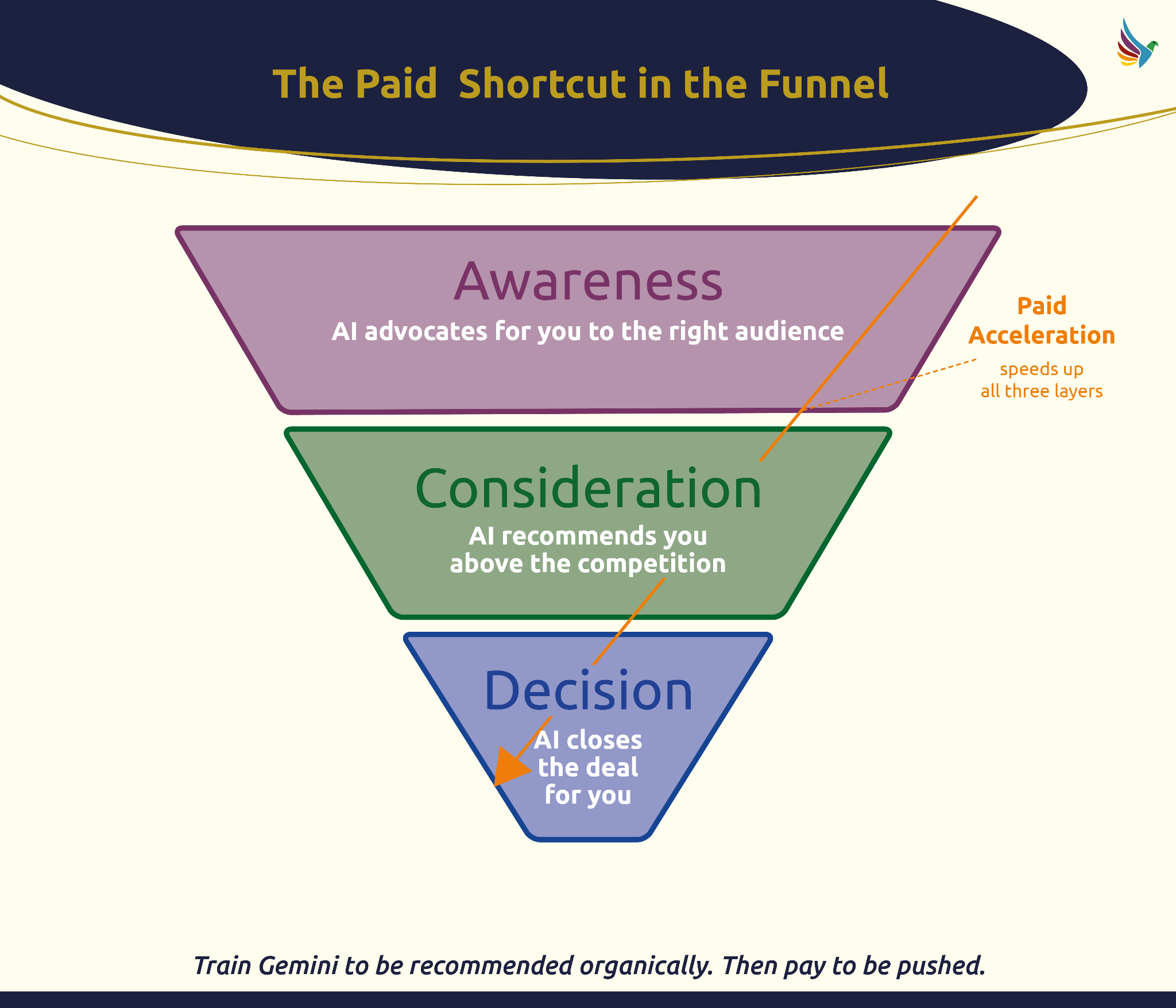
Strategically, I’ve come to realize that paid campaigns help me discover which target audience-intent-profit combinations convert best. I can then build my organic content around these successful elements, creating a feedback loop where each strategy amplifies the other.
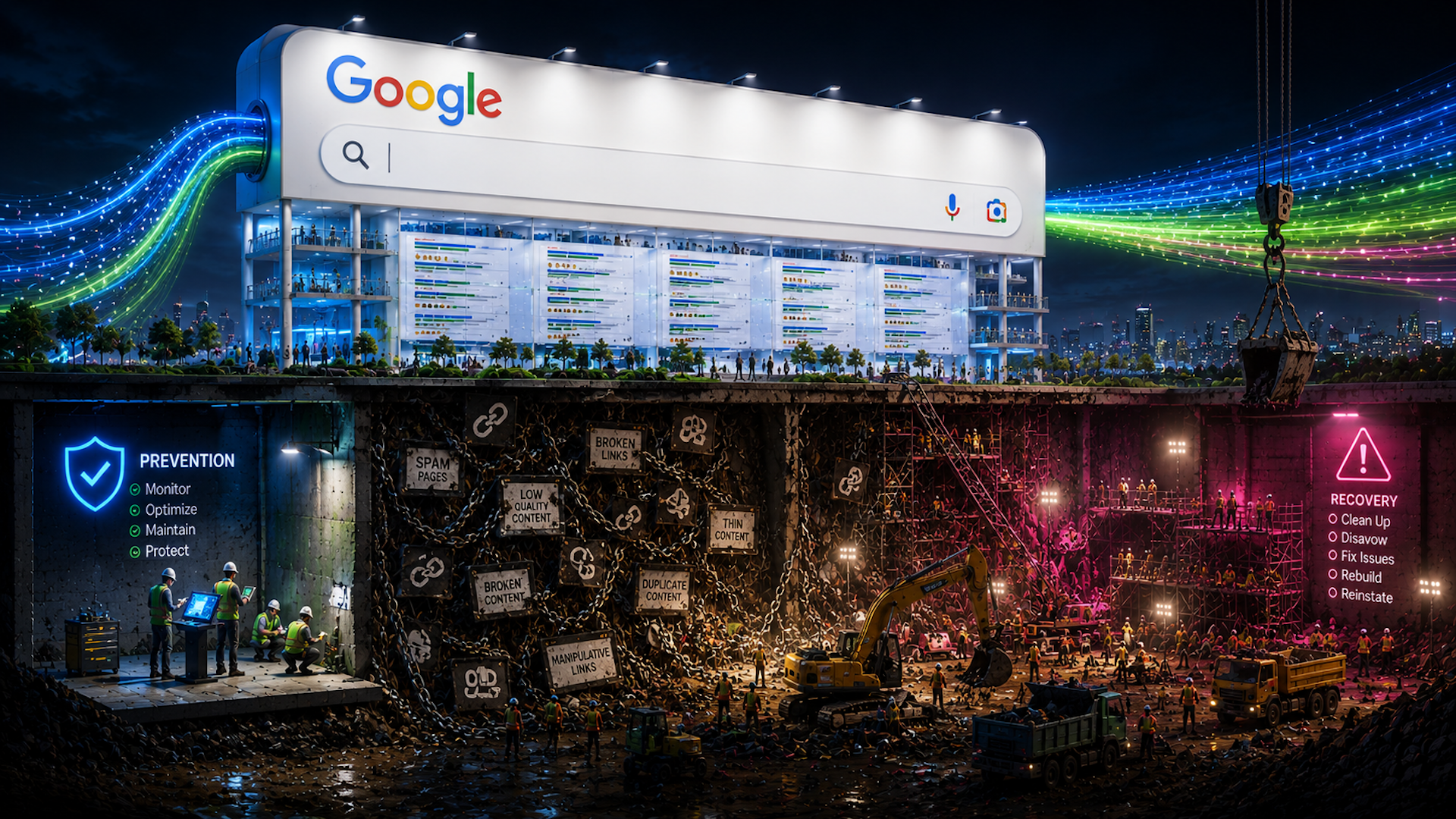
Recovering from a manual action is no quick fix; it can take months of rigorous cleanup and multiple reviews. I’ve learned that regular compliance audits are key to avoiding a crisis altogether.
Google penalties—or manual spam actions—are those unpredictable disruptions that can shake up a thriving online business overnight.
For businesses like mine that rely heavily on organic traffic, the impact is quite severe. It goes beyond just losing rankings; revenue takes a hit, customer acquisition costs spike, expansion plans are halted, and the effects linger long after the policy issues have been addressed.
With Google’s consistent 90% market share, it remains my main source of traffic, much like it is for many publishers, e-commerce platforms, and lead generation companies.
Unfortunately, direct traffic seldom makes up for significant visibility losses, and Bing isn’t enough to fill the gap. This means a manual spam action is not just an SEO risk but a grave operational concern.
Manual Actions Aren’t Algorithm Updates
It’s essential for me to clarify that manual spam actions and algorithmic updates are two different beasts. Manual penalties result from specific violations identified against Google Search Essentials and demand entirely different responses.
Manual actions involve considerable internal review at Google. When violations are suspected and verified, these actions are taken, because proven policy breaches aren’t taken lightly by Google.
The real issue lies in recognizing accumulated policy violations over time, something I’ve seen many businesses fail to address adequately.
How Penalties Develop
The journey to a manual penalty often begins in non-obvious ways, with compliance erosion happening gradually.
An e-commerce company might start with aggressive link-building strategies that accumulate unchecked spam links over the years.
A publisher engages in commercial partnerships involving sponsored content, integrating these into their main site structure.
A SaaS business expands into new markets with low-quality location pages.
Lead generation companies scale supplemental SEO content without thorough editorial oversight, simply adhering to industry standards.
Though these tactics might initially boost visibility and revenue, they often fall out of line with Google’s quality standards over time.
Why Historical Violations Still Matter
Manual spam actions are disruptive partly because old policy violations can persist without being flagged for years. Google doesn’t forget historical footprints in its search system, meaning unresolved past SEO practices can become today’s liabilities.
Practices like paid placements, commercial guest posting, or directory spam from years ago can remain risks until they’re addressed, creating vulnerabilities that must not be ignored.
Reputation Abuse and Publisher Liability
When a trustworthy brand allows unsupervised content from third parties, the site’s credibility might suffer. Once a manual spam action hits, the entire site can lose visibility—even the genuinely valuable sections suffer.
Recovery from such penalties is not simple or cheap. It often demands structural changes and more stringent editorial and technical controls, as I can attest from my own experiences.
The Risks of Scaled Content
Google is now more vigilant about large-scale publishing systems that lack originality and value. I’m aware of how easily businesses, unintentionally, slide into creating repetitive, low-value content.
Most businesses don’t cross these lines deliberately. However, without ongoing reviews and updates, significant issues can fester under the radar.
Compliance Requires Ongoing Oversight
For me, regular compliance reviews are non-negotiable. It takes external expertise to assess true compliance comprehensively. Even powerful internal SEO teams can miss potential exposure points if left unchecked.
I’ve found that organizations integrating compliance into governance see considerable advantages. Regular audits and assessments can preempt violations and protect critical search traffic, especially during pivotal business moments.
In essence, prevention through regular audits is a more efficient and less painful approach than dealing with recovery after a penalty.
I realized early on that merely reducing the cost per lead does not guarantee more signed cases for a law firm. Leads and signed cases differ in significant ways.
What stands between an ad click and a signed retainer is the intake process, speed of follow-up, and ultimately, conversion. Relying solely on cost per lead to gauge PPC success means making decisions with incomplete data.
Having managed over 1,000 ad accounts for plaintiff-side law firms, I’ve witnessed the same issues repeatedly. The ads fuel activity, but leakage occurs at various stages in turning leads to clients.
Law firms that successfully increase signed cases are those that integrate their ad data with intake performance and client retention. This requires a shift in approach to keywords, budget distribution, landing pages, and tracking.
I found most law firms approach campaigns backward, starting with generic keywords like injury attorney, yielding high-volume but low-quality traffic.
By reverse-engineering our keyword strategy from signed-case data, we can protect budgets and increase conversions. Instead of defaulting to Google’s suggestions, we analyze call transcripts and CRM records to find the actual language leading to retained clients.
Over time, I’ve become adept at identifying exact phrase-match terms potential clients use, like “truck accident lawyer near me” or “wrongful death law firm Tampa.”
It’s crucial to segment every keyword by funnel stage and intent. By allocating budget to high-intent terms and testing or excluding low-intent ones, we fine-tune our ad spend.
Integrating the search terms report into my workflow is the cornerstone of effective PPC management. This report reveals the precise phrases used before ad clicks, helping decide whether a lead is worth the cost. Continuous weekly reviews keep the campaign spend efficient.
Instead of treating Google Ads as a single entity, segmenting campaigns by funnel stage, intent, budget, and conversion objectives significantly improves ROI.
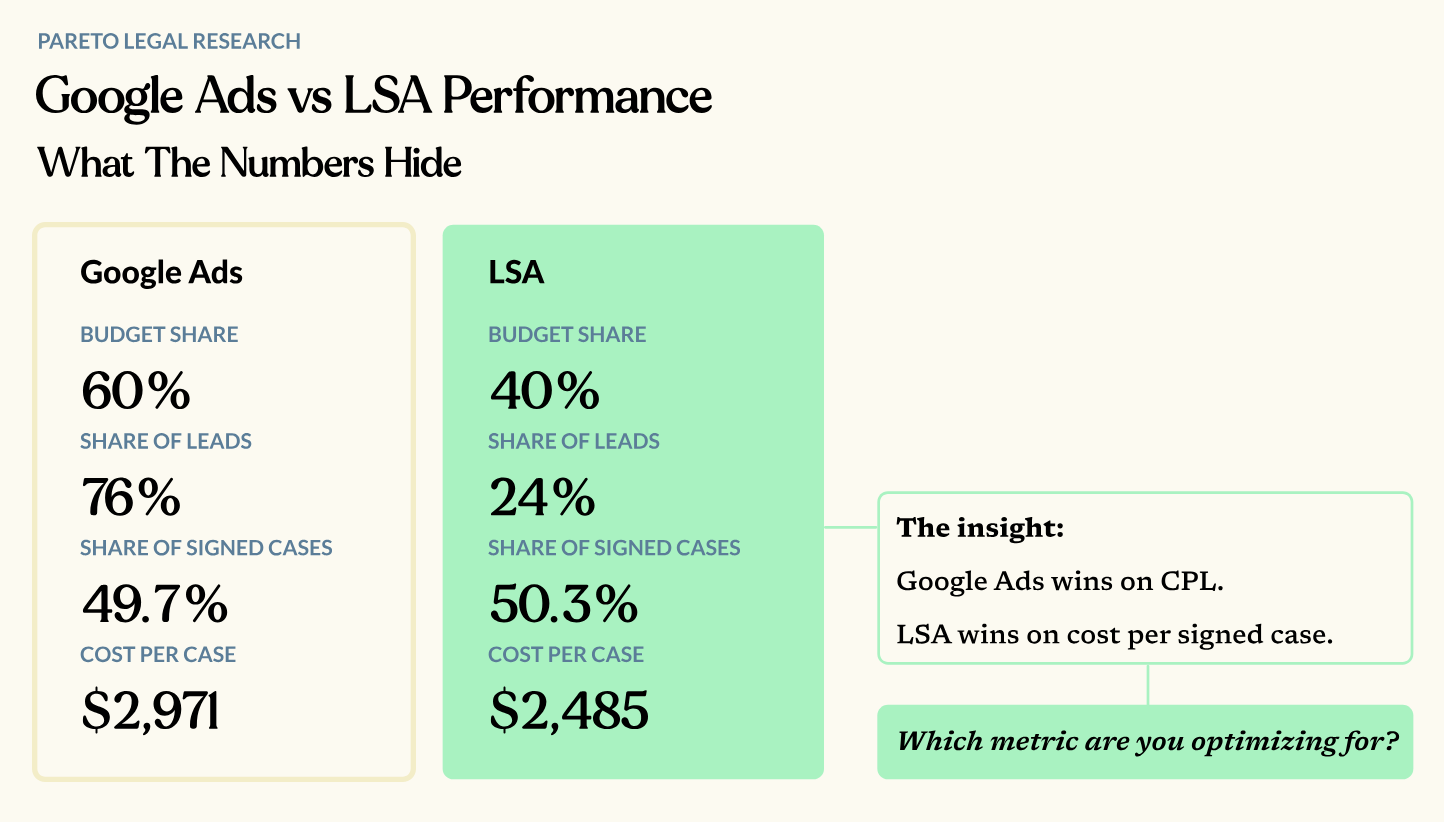
According to Pareto Legal’s report, Local Services Ads are the top-converting channel for personal injury firms. They’re pay-per-lead and don’t need a landing page setup. (I’m the CEO and co-founder of Pareto Legal.)
A simple yet effective adjustment we frequently make is refining LSA category selections to more precise case types like personal injury or motor vehicle accidents.
Mid-funnel incorporates non-brand searches and Dynamic Search Ads, evaluated on the rate of qualified leads rather than sheer volume. Too many unqualified leads can drain the budget, even if the cost seems reasonable.
Strategies involving Meta and YouTube retargeting work well post-website visitations. These should expand to cold audiences only when incremental lift is proven through accurate attribution.
Consider this simple framework to dramatically boost your PPC results. For instance, one injury firm achieved 273 signed cases from $765,000 without increasing the budget, just by restructuring Google Ads.
As I discovered, sending paid traffic to mismatched pages curbs conversion rates. While effective landing pages are crucial, they remain one of the most ignored aspects of PPC management, despite being well-known.
Your aim should be relevance: Landing pages need headlines matching search intent, transparency on settlement amounts, social proof via client reviews, and immediate contact options.
These pages should load quickly and adapt to mobile screens. Each practice area and intent deserves a unique landing page design for better results.
I improved one client’s generic page by creating intent-specific pages, adding recent reviews and results, and reducing form fields, doubling conversion rates with no extra ad spend.
A significant hurdle in law firm advertising is not the cost-per-click but the deteriorating intake process. Focus should be on post-contact processes rather than CPC.
Focus on key intake KPIs such as a 90%+ answer rate, sub-60-second response times, and a signed rate of 25%-40% of qualified leads.
Consider this: Spending $20,000 monthly at $250 per lead gets 80 leads. With optimal response and conversion, 30 cases can emerge from the same spend, vastly enhancing ROI.
Ensure marketing and intake teams share KPIs, ensuring media buyers don’t act on disparate targets.
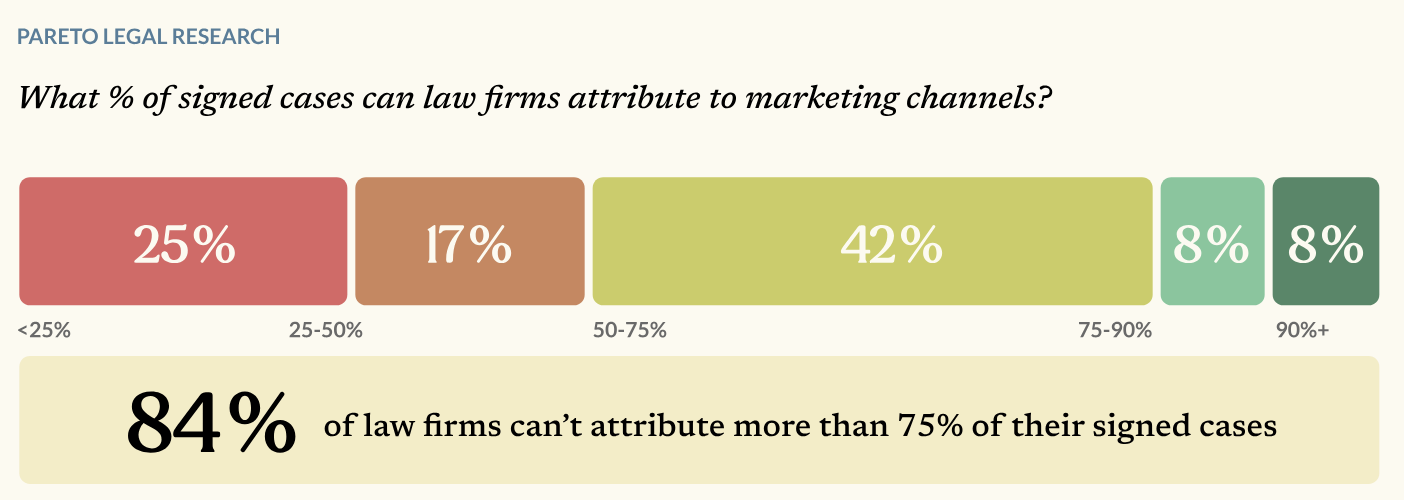
Most reporting cuts off at ad platform metrics without tapping into where the action really happens—the CRM. An integrated attribution chain from ad click to signed retainer is indispensable.
Set up your attribution system: Track traffic sources through UTMs, capture call leads, monitor web behavior with Google Analytics, and track through CRMs like Lawmatics or Clio.
The keystone metric, Marketing Efficiency Ratio (MER), evaluates the marketing ecosystem rather than viewing channels separately, crucial for budget confidence and allocation.
I recommend a streamlined dashboard with key metrics—spend, leads, qualified leads, signed cases, CPL, CPA—segmented by both channel and practice area.
Without granular reporting capability, your data might only be serving as an overview. Leveraging this tracking structure highlights effective campaigns that improve ROI sustainably.
The law firms thriving with PPC are those recognizing PPC as a comprehensive system. They apply precise keyword targeting, allocate budgets by intent, regularly scrutinize search terms, understand cost per case over cost per click, and connect ad clicks to results that matter.
When I dive into platform reports, I realize they tell only part of the story. It’s the incrementality, CRM data, and broader measurement insights that truly reveal the impact of our marketing efforts.
I recall a time when PPC attribution was never flawless. Now, with AI widening the gap, it’s even trickier to pinpoint what truly influences a conversion and what ends up receiving credit.
Imagine someone discovering a product on social media, watching a YouTube review, diving into Reddit opinions, using an AI tool to compare options, and then returning through a branded Google search ad days later.
While the PPC report might show a single conversion from branded search, I see a more complex journey that needs recognition beyond the final click.
AI is reshaping brand discovery, how purchases are researched, and how ad platforms decide who sees which ads. As a marketer, I find there’s now less visibility into these platform-driven decisions.
It’s clear to me that relying solely on platform attribution data doesn’t tell the whole story of my business’s truth.
AI is changing where the journey begins
Traditionally, the search journey starts well before an advertiser sees a measurable click. Recently, findings like those from Responsive’s 2025 research indicate that a significant portion of B2B buyers favor generative AI over traditional search when exploring vendor options.
For someone entrenched in the tech sector, I can’t ignore how 80% of tech buyers are now using generative AI at least as much as traditional search.
If AI-derived lists are excluding my brand from their answers, I’m instantly out of the buyer’s consideration set, which is disconcerting.
Google’s announcements about AI advancements reaching billions of users show how rapidly the landscape is evolving. This shift means that brands like mine need a strategy to ensure we’ll still be visible.
I can’t help but notice how Pew Research Center’s findings about declining clicks when AI summaries are present have personal and business implications for me.
I also realize the importance of brand recognition, even if initial interactions don’t result in a direct click-through.
The discovery phase deeply influences the eventual conversion, yet often, only the final touchpoint gets the credit.
Branded search often receives credit for demand generated elsewhere
Observing branded search, I frequently note it’s a classic case where attribution is mistaken for actual impact.
The efficiency portrayed by a branded search campaign can be misleading. Although such campaigns often perform well on metrics, primarily because they target users already familiar with the brand, they don’t always generate the initial demand.
A user might only search my brand due to exposure from other channels, such as social media, YouTube, or even an AI-generated suggestion.
Thus, distinguishing between demand capture and creation is vital. The real test is understanding whether certain conversions would have occurred absent of these campaigns.
AI-driven discovery creates a measurement blind spot
In client data, I’ve observed that direct traffic from AI platforms boasts a higher conversion rate compared to organic search, which piques my curiosity.
With these findings, I’m reminded of how much goes unmeasured. AI introduces complexities that create attribution challenges, as visible AI traffic might be just a small fraction of the journey.
Recognizing this, I understand the importance of viewing these interactions as part of a larger conversion narrative.
Ads are becoming part of AI-generated search journeys
With ads now interwoven in AI results, I face an added layer of complexity in correlating AI search with paid media.
Google’s policy of serving ads based on the commercial intent inferred from AI responses means my ads could surface earlier in the buyer’s research journey—a fact that fascinates me.
Despite these placements, I’m aware of the limited visibility and reporting challenges they present, which is both frustrating and intriguing to navigate.
Platform automation can make attribution look better while making analysis harder
Within account platforms, the allure of automation promises efficiency, yet it can blur analytical clarity.
I reflect on how broader targeting can deliver impressive surface-level results, but the lack of granular insights into why certain ads perform complicates future decisions.
This dilemma emphasizes for me the critical balance between leveraging automation and maintaining rigorous scrutiny.
I see the trap of prioritizing metrics like reach and click-through rate over genuine business outcomes.
The challenges extend to future optimizations and highlight the importance of qualifying lead quality over sheer volume.
Bringing CRM data into PPC reporting brings everything full circle, ensuring the focus isn’t lost in translation between metrics and actual business value.
Assessing upper-funnel activities, I note that they can have sustained, profound impacts on lower-funnel metrics— a sentiment validated by research indicating significant long-term returns on initial media investments.
This insight reassures me of the need to invest in awareness and video campaigns that extend beyond immediate ROAS measurements.
A single ROAS figure no longer suffices. PPC reporting, in my view, must integrate platform attribution with broader business metrics and strategic experiments.
1. Separate demand creation from demand capture
I ensure campaigns are assessed by their unique objectives—demand creation versus demand capture.
2. Review attribution paths, not just final clicks
Using GA4’s paths report, I analyze the customer journey comprehensively to understand how channels influence conversions from start to finish.
3. Import deeper CRM outcomes
For me, importing qualified leads and sales data enriches platform optimization and aids strategic alignment.
4. Monitor the metrics sitting outside the PPC dashboard
I track various metrics—branded searches, AI-referred sessions, and lead quality, which together form a holistic view of the customer journey.
5. Test incrementality rather than assuming
Incrementality testing, such as Google’s Conversion Lift, helps me understand the genuine impact of my ads beyond the dashboard numbers.
6. Add regular human checks to automated accounts
Despite automation, I regularly review and ensure account settings and outcomes align with my overall business objectives.
I’ve learned there isn’t a single PPC attribution model to explain the fragmented, AI-influenced customer journey we see today.
Rather than abandoning attribution, I see the value in treating it as just one piece of the puzzle alongside analytics and CRM outcomes.
The most insightful question isn’t, “Which channel received the conversion credit?” but instead, “What would be different if this activity never happened?”
I’m witnessing a fascinating shift in the search industry, something I hadn’t anticipated witnessing in my career.
The supply of search expertise now outweighs the demand.
We can point fingers at artificial intelligence, the economy, or the increasing commonality of checkbox SEO.
Whatever the cause, the outcome remains unchanged.
SEO job cuts are rising. Openings are dwindling. I’ve never seen the market as competitive in my 15+ years.
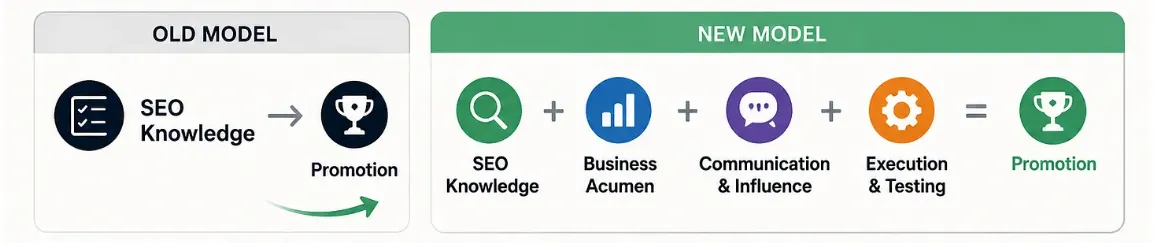
The hard truth is many SEO skills that were once invaluable are becoming easier to automate or outsource.
Grab a seat.
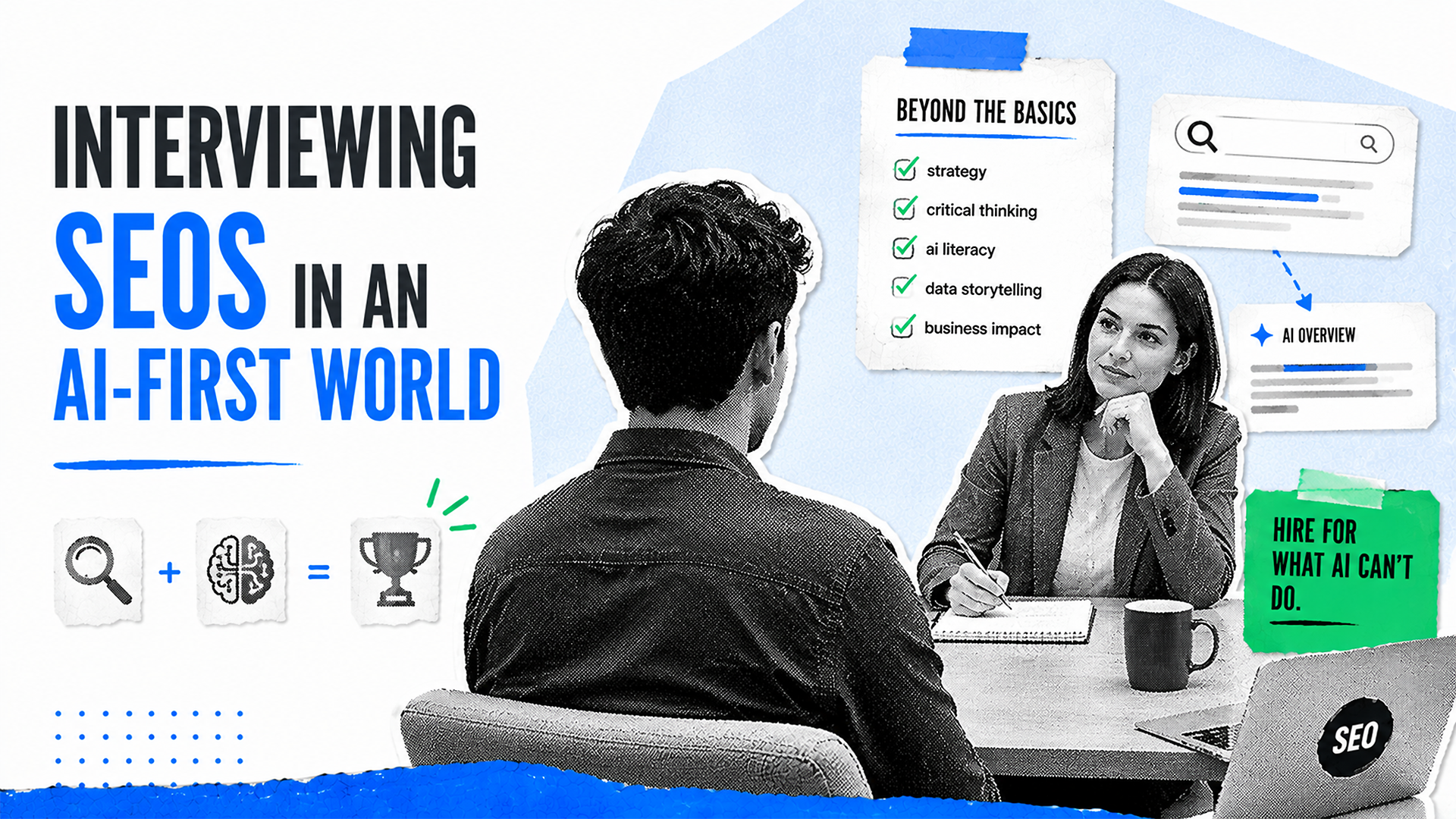
I’d love to explore why this is occurring, which skills are now expected, and what SEO talent employers should really be seeking as we move towards 2026.
If I were hiring an SEO in 2026, I would focus less on technical details and more on how candidates handle complex situations.
I’d ask for a disagreement experience.
For example, I suspected H1 tags didn’t significantly impact rankings. Initially, people laughed, and opinions varied until further confirmed by experts.
I care more about their resolve than their correctness.
I’d ask about a failed test.
Experienced SEOs know projects often stall. The key is their follow-through post-failure.
I’d inquire about AI mishaps.
I aim to find candidates who turn knowledge into tangible outcomes.
The hard part has always been delivering results, not knowing what to do.
AI won’t substitute SEOs, but those unwilling to adapt may face challenges.
This article initially appeared on my personal site, shared here with permission.
For the past two years, I’ve been deeply engaged in optimizing my content for AI visibility. This journey has focused on expressing clearly what my brand represents, crafting more compelling About pages, implementing precise schema, and offering straightforward answers to user queries.
These strategies are crucial during an LLM’s brand processing phase—where clarity and relevance are key. Yet, my study with João da Silva on Friction AI’s platform exposed a critical factor that wasn’t previously quantified.
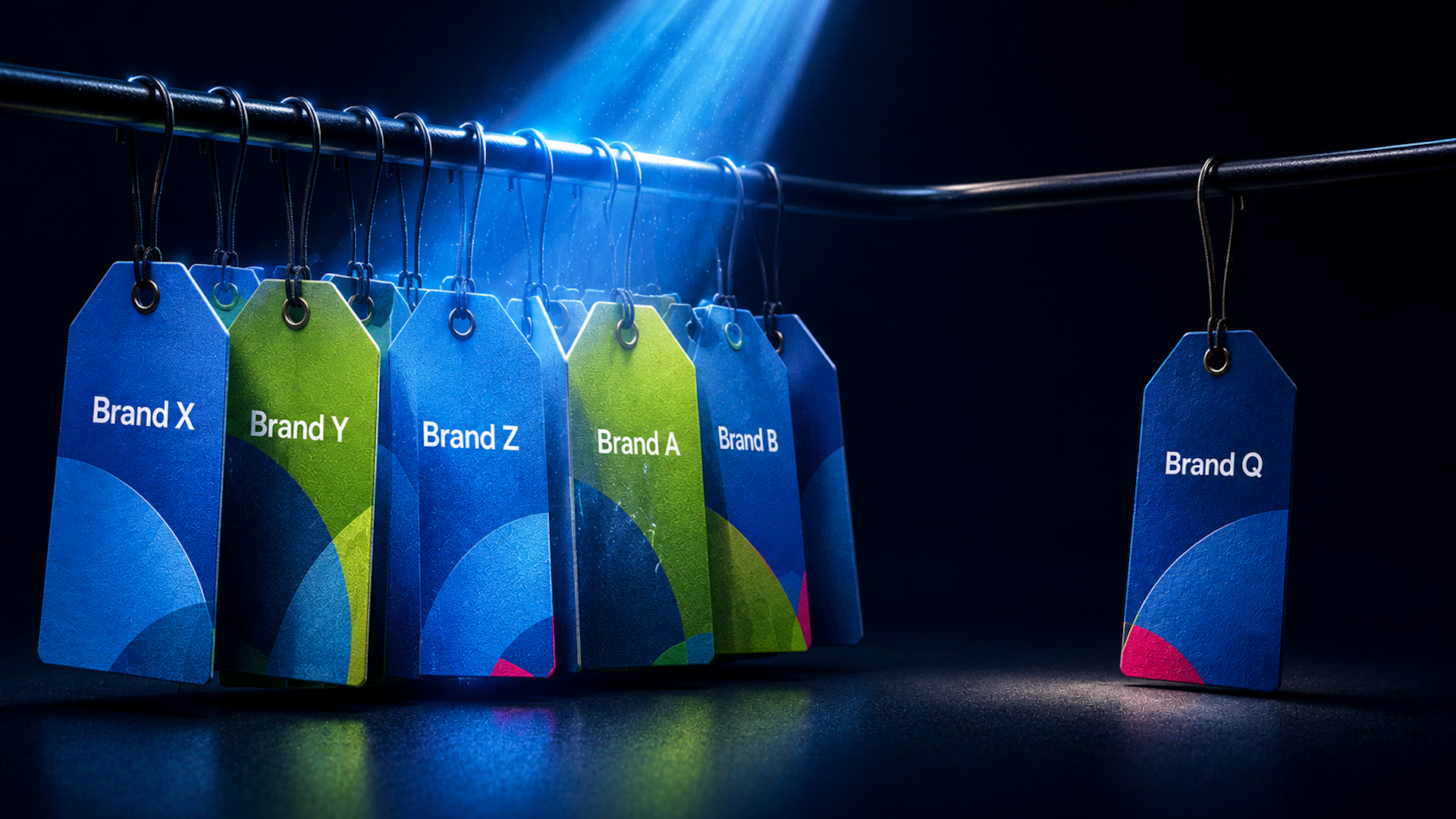
Even when brands were well-recognized within their categories, this didn’t always translate into being recommended in related queries. This intriguing gap between recognition and recommendation has been termed the ‘framing gap.’
We tested 12 activewear brands like Gymshark, Reebok, and Nike across AI platforms, running over 14,000 API tests. We wanted to see if Knowledge Graph (KG) strength correlated with being recommended outside their direct category.
Interestingly, high-KG brands didn’t always dominate recommendations. Some mid-KG brands displayed a more noticeable gap between recognition and recommendation.
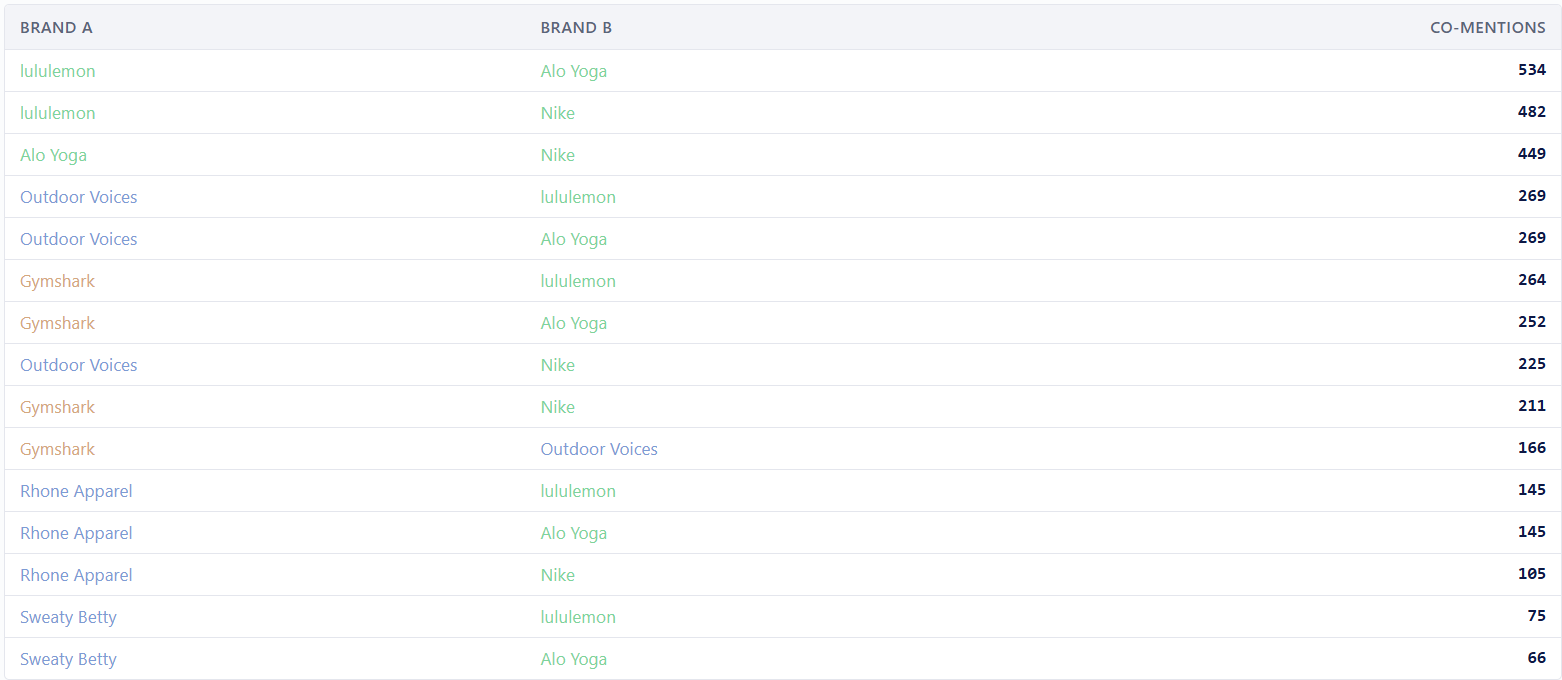
We also examined co-mention data, revealing fascinating insights into brand associations. For example, lululemon frequently co-appeared with Alo Yoga and Nike in athleisure-themed content, forming a recognized cluster.
Nike, despite sharing the ‘Footwear company’ description with New Balance and Reebok, featured prominently in recommendation prompts—thanks to its consistent association with category leaders.
This emphasizes the power of context and co-mentions in shaping brand visibility. It’s clear that external third-party content carries more weight in recommendations than single-brand narratives.
To enhance my SEO strategies, I focus on appearing in the ‘right company.’ Understanding where my brand is mentioned alongside competitors is crucial. This approach is more than just appearing in lists—it’s about strategic positioning.
This study is just the beginning. While it highlights trends in the UK athleisure sector, expanding our focus to other categories and regions will likely yield even more insights. The real question lies in whether my brand is part of the right conversation in my industry.
I’ve noticed SEO content becoming increasingly monotonous.
Whenever I search the web, it’s as though every page echoes the same advice, just repackaged slightly differently. With AI tools that can churn out articles in seconds, this issue is only escalating.
There’s certainly no shortage of content, but much of it lacks memorability and uniqueness. This uniformity is posing a challenge within the realm of SEO.
Real Experience: The Key Differentiator in SEO
As AI-generated content increasingly saturates search results, businesses urgently need a distinguishing feature. Right now, real experience is what distinguishes exceptional content from the mediocre.
While AI can certainly write, it cannot replicate experiences lived by humans.
AI cannot recount the mishaps when a strategy faltered, nor can it impart the wisdom gleaned from collaborating with real clients. It simply cannot relay the intricate details that emerge only after years in practice.
This human element holds more sway and significance than many businesses realize.
Why So Much SEO Content Feels Repetitive
For years, the focus in SEO has been primarily on creating content saturated with keywords. The more articles published, the greater the visibility—or so we were told.
Consequently, many websites have produced content that reads like a photocopy of one another.
Now, with AI, generating such content has never been easier.
Crafting a blog post titled ’10 SEO Tips’ or ‘How to Rank Higher on Google’ takes mere moments. The internet is saturated with thousands of such posts, most of which add nothing novel.
People are weary of content that feels derivative, even if it technically isn’t a direct copy.
The content that makes an impression now exudes humanity.
It features:
Real-world examples.
Sincere opinions.
Lessons learned from past experiences.
Client success stories.
Results from testing.
Personal insights.
In essence, it sounds like someone who has truly been in the trenches wrote it. This distinction is more crucial now than ever, as the landscape of digital search evolves.
Adapting to Evolving Search Dynamics
Google has long emphasized trust and authentic experience in content. Meanwhile, AI search tools are providing quick snippets without users needing to trawl through countless websites.
This shift means that basic information is losing its impact. Since AI can efficiently distill general advice, businesses must offer more compelling value, where authentic experience becomes invaluable for SEO.
When a business owner shares what truly worked for them, it tends to create more trust than a polished article filled with generic suggestions. Real-life case studies that demonstrate actual outcomes weigh heavier than keyword-stuffed pages.
Specificity and genuine detail imbue content with credibility. This level of nuanced detail is something AI struggles with, simply because it lacks the capability to operate beyond pre-existing information.
For small businesses, this differentiation can be particularly advantageous. Where larger brands rely on their reputation, smaller ones gain consumers’ trust and loyalty primarily through personal connections. This human touch can significantly bolster SEO efforts.
Leveraging AI Alongside Human Expertise
I’m not suggesting abandoning AI entirely.
When used wisely, AI serves well for research, planning, brainstorming, and accelerating content creation. Most marketers incorporate it in some form, and that trend is bound to continue.
But businesses achieving the best results aren’t leaning solely on AI. They’re blending AI capabilities with genuine knowledge, personality, and firsthand experience. They’re infusing opinions, narratives, and insights that AI can’t readily generate. That’s the type of content that grabs attention.
SEO is no longer about sheer volume; it’s about creating content that resonates, sticks in memory, and garners trust. As websites increasingly fill with AI-generated articles, the value of authentically human content is on the rise.
Because while AI can write, it can’t genuinely replicate the human experience.
Hey there! If you’re anything like me, your backlog is overflowing, your developer is eager to know what to tackle first, and your boss is questioning why months of SEO work haven’t shown results. I’ve been stuck defending my roadmap with gut feelings, and it’s tough.
Without estimating the traffic impact of a fix before it’s live, it’s just a guess—and we both know guesses don’t cut it in budget meetings.
Let me share a framework I use to transform messy data into reliable estimates. It’s not perfect, but it’s solid enough to prioritize with confidence and explain my strategy in any meeting.
Why every recommendation can’t be high priority
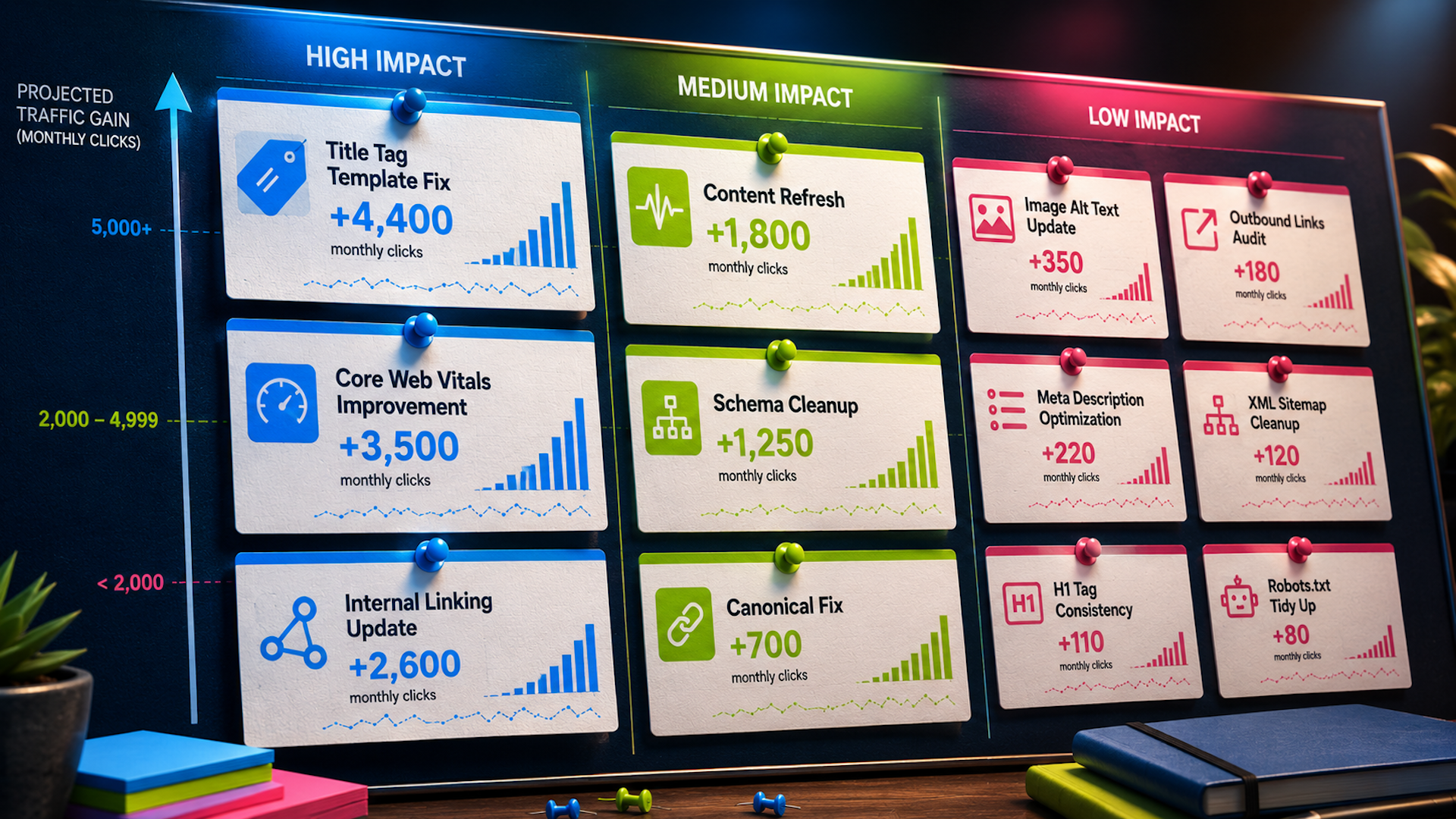
I’ve seen teams spend sprints on minor schema issues, ignoring a bigger problem—like a title tag bug affecting thousands of pages. Both were marked as “high priority,” but the traffic impact of one was negligible compared to the other.
Traffic guides true priority. While we can’t neglect brand visibility or UX, traffic offers a universal measure to compare efforts. Without quantified impact, you’re letting the loudest voice, or the most tempting technical puzzle, dictate your roadmap instead of focusing on what truly drives business value.
Plus, SERP landscapes have changed drastically. According to SparkToro, 68% of U.S. Google searches this year ended without a click, up significantly since just two years ago.
With AI Overviews intercepting traffic, the impact of a ranking improvement can vary wildly by SERP layout. Jumping to position three on a commercial keyword might be gold, but on an informational query dominated by AI? Not necessarily.
Your forecasts should account for these dynamics to avoid overpromising.
Step 1: Define the scope
Before making any estimates, I always define the scope. Is the adjustment sitewide, a template fix, or a single-page optimization? Each scenario changes the math.
Sitewide technical fixes
These encompass site speed, mobile usability, HTTPS migrations, and Core Web Vitals. They influence every page, but not uniformly. Address areas with pages on the borderline of failing tests first.
Template-level changes
Fixes like rewriting title tags can have a major impact, but it’s vital to focus where traffic truly exists. Product templates might garner the majority of clicks, while blogs might trail behind.
Individual page optimizations
Actions like updating meta descriptions can provide quick wins, but their small scale might not significantly impact the business. Focus on these without losing sight of larger opportunities.
Organic clicks serve as a baseline. By filtering affected URLs and reviewing trends, I assess urgency and context.
Impressions and near-win rankings pinpoint real potential. Pages ranked 8-15 are ripe for improvements—push them higher for a CTR boost.
SERP features can greatly influence CTR. Using Search Console’s AI Mode data, I check for AI Overview dominance and adjust expectations.
Step 3: Estimate potential lift
Now, it’s time for educated estimation.
Your own history
When I’ve optimized similar pages before, I use those outcomes as future baselines. Keeping track of past projects builds a valuable benchmarking library.
Competitor benchmarks and SERP analysis
Review competitors and pinpoint their advantages, whether it’s content depth, UX, or backlinks. Aiming to close these gaps can justify a ranking gain.
AI-influenced CTR assumptions
Forecasting can falter without updated CTR assumptions. Seer’s research shows drastic CTR changes due to AI integration. Staying aware of these shifts is essential.
Step 4: Build three scenarios, not one number
One definitive forecast can be deceptive. I prefer building three—conservative, expected, and aggressive—to provide a range that reflects real possibilities.
In the conservative model, expect partial implementations and competition improvements. With the expected model, rely on solid historical benchmarks. The aggressive model accounts for perfect execution and fast indexing.
This comprehensive view guides stakeholders through potential outcomes, ensuring transparency and credibility.
Step 5: Use the forecast to build your roadmap
After forecasting, I compare traffic impact predictions to effort levels using frameworks like RICE. This demonstrates which initiatives offer the most value for the effort and helps align priorities with business goals.
A well-organized roadmap doesn’t just appeal to me but speaks clearly to everyone involved, highlighting efficiency and business impact.