Profound has added support for Grok 4.5, according to an announcement published on its blog. The integration gives users another model option for workflows involving research, strategy, automation, and other forms of knowledge work.
The practical value will depend on more than model availability. Teams still need to determine where Grok 4.5 improves their work, how reliably it handles representative tasks, and whether it fits their operational requirements.
What Profound announced
Profound’s post says Grok 4.5 support is now available and describes the model as a new flagship designed for agentic workflows and knowledge work. It positions the integration as a way to use the model within a broader AI workflow rather than solely through isolated prompts.
The announcement names research, strategy, automation, and everyday knowledge work as areas to explore. These are proposed applications, however, rather than reported results from comparative testing. The source does not provide benchmarks, customer outcomes, configuration details, or comparisons with other models.
Key takeaways
Profound says Grok 4.5 support is available within its broader AI workflow environment.
The stated positioning emphasizes agentic workflows and knowledge-intensive tasks.
Research, strategy, automation, and routine knowledge work are the principal use cases identified in the announcement.
The announcement establishes integration availability, but it does not independently demonstrate performance, reliability, or superiority over alternative models.
Where the integration could matter
In general, an agentic workflow asks a model to help move a multi-step task toward completion. That can involve interpreting a goal, working through intermediate decisions, producing outputs, and responding to new context. Model support inside a workflow platform can therefore be more consequential than access to a standalone chat interface, provided the surrounding system can supply the context and controls the task requires.
For research work, the relevant question is whether Grok 4.5 can consistently organize evidence, expose uncertainty, and produce outputs that remain easy to verify. For strategy work, teams should examine whether its reasoning stays connected to the supplied constraints rather than merely producing polished recommendations. Automation use cases add another requirement: predictable behavior when a task is repeated, interrupted, or handed between people and systems.
These criteria are evaluation targets, not capabilities established by Profound’s announcement. The integration creates an opportunity to test them in context; it does not remove the need for that testing.
How teams can evaluate Grok 4.5 in Profound
Select representative tasks. Use real examples from research, planning, analysis, or automation rather than a small collection of showcase prompts.
Define a baseline. Compare Grok 4.5 with the model or process already used for the same work, keeping instructions and source material as consistent as possible.
Score the outputs. Assess factual accuracy, reasoning quality, adherence to constraints, completeness, and the amount of human correction required.
Test repeatability. Run comparable tasks more than once and examine whether the workflow produces dependable results when inputs become ambiguous or incomplete.
Review operational fit. Consider oversight, traceability, data-handling requirements, latency, and cost using the terms and controls actually available to the organization.
A useful evaluation should separate model quality from workflow quality. A weak result may come from the model, the instructions, missing context, or the way the integration passes information between steps. Recording those failure modes makes comparisons more informative than selecting a model from a few preferred answers.
What remains unconfirmed
The supplied announcement does not specify access requirements, pricing, context limits, supported tools, routing behavior, governance controls, or technical implementation. It also does not report independent tests showing how Grok 4.5 performs inside Profound against other available approaches.
Profound’s support is therefore best understood as expanded model choice and an invitation to evaluate new workflows. Documentation and task-level testing will determine whether that choice produces measurable gains for a particular team.
An AI marketing tool can look persuasive in a demonstration and still fail in day-to-day use. A sound evaluation therefore has to connect the product to a defined business problem, credible evidence, acceptable data practices and the team’s actual capacity to adopt it.
The most useful approach is a staged decision process. Each stage should eliminate a different kind of risk before price or novelty turns an interesting product into an expensive commitment.
Turn the business need into a testable decision
Evaluation should begin with the marketing problem rather than the product’s feature list. The source article recommends asking vendors to explain the challenge their tool addresses and how solving it affects a business outcome. If that connection remains vague, a sophisticated set of AI capabilities does not establish that the product is useful.
Before meeting a vendor, the buying team can create a short decision brief describing the current workflow, its most important constraint, the people affected and the result that should improve. That result might concern output, troubleshooting or another outcome already important to the organization. The purpose is not to manufacture a justification for buying software; it is to establish a baseline against which the tool can be judged.
Claims about saving time require an additional question: what will the organization do with the recovered capacity? The source cautions that time savings are not automatically valuable. They become meaningful when the team can redirect that time toward work that advances an existing objective.
This framing also exposes unnecessary purchases. If the problem can be resolved through a process change, better use of an existing platform or clearer ownership, adding another tool may increase complexity without addressing the underlying constraint.
Match the evidence standard to the vendor’s maturity
A relevant case study is more informative than a broad success claim. According to the source, buyers should look for evidence involving organizations with a comparable size, market, vertical or use case, along with concrete results. The closer the operating conditions are to the buyer’s own environment, the easier it is to determine whether the evidence transfers.
Evidence should also extend beyond customer logos. A credible vendor needs sufficient domain understanding to explain how marketers perform the work, where the recurring friction occurs and why the product was designed in its present form. The source notes that deep subject expertise does not have to reside with every salesperson, but a serious prospective customer should be able to reach someone who has it.
Vendor maturity changes the appropriate test. An established provider can reasonably be expected to show repeatable results from relevant customers. An early-stage provider may not have that record, so transparency becomes part of the evidence: the vendor should identify where the product is unproven, explain what has been observed in other settings and define what the early partnership would require.
Being an early adopter can offer an advantage, but the source also identifies added exposure to bugs, feedback demands and uncertain performance. Contract flexibility should reflect that imbalance. A newer vendor that expects the customer to absorb experimentation risk while offering no corresponding flexibility presents a weak partnership proposition.
Treat data terms as part of the product
Data governance is not a secondary legal review to perform after a product has been selected. It is part of the product evaluation because access to marketing, campaign or customer information can determine the consequences of a poor choice.
The source recommends obtaining clear answers about who owns the customer’s data, where it is stored, how long it is retained, whether it is used for model training and what happens when the relationship ends. Any training of shared or third-party models should require explicit consent. If training is permitted only for a customer’s own instance, that limitation should be stated precisely.
Verbal assurances are not enough. The source treats inconsistencies between a sales explanation and the terms of service as a warning sign and argues that material commitments belong in the contract. The practical evaluation standard is therefore documentary: can the vendor’s claims be located in binding terms, and do those terms cover the complete data lifecycle?
This review also tests vendor quality. Clear, consistent answers suggest that the provider understands its own systems and customer obligations. Deflection or ambiguity leaves the buyer unable to assess exposure, regardless of how compelling the product appears.
Calculate adoption cost, not just subscription cost
The commercial price is only one component of an AI tool’s cost. The source highlights implementation time, internal effort, integrations, training, quality assurance and possible disruption to the existing marketing technology stack. A product can be affordable on paper yet uneconomic if it consumes resources the organization cannot reliably provide.
A useful implementation review follows the proposed tool through the real workflow. It identifies who will configure it, which systems must connect to it, who will review its outputs, how exceptions will be handled and what ongoing maintenance the vendor expects from the customer. This makes hidden dependencies visible before a contract creates pressure to proceed.
Adoption is also a trust problem. As the source observes, a product that people cannot understand, trust or fit into their routines will not produce its promised value. The evaluation should therefore include the intended users, not only procurement leaders or executives. Their experience can reveal whether the tool removes friction or merely relocates it.
A limited pilot can combine these questions into one decision. It should start with the predefined problem, use agreed evidence of success, operate under acceptable data terms and expose the actual workload imposed on the team. The decision at the end should account for both the result and the effort required to produce it.
Key takeaways
Define the business problem and intended outcome before reviewing product features.
Demand evidence relevant to the organization’s size, market, vertical or use case.
Adjust expectations for vendor maturity, but require transparency and risk-sharing from early-stage providers.
Verify ownership, storage, retention, training and deletion terms in binding documents.
Evaluate implementation effort, workflow fit and user trust alongside the subscription price.
As AI products continue to multiply, disciplined evaluation will matter more than rapid purchasing. Teams that document the problem, evidence threshold, governance requirements and adoption burden in advance will be better positioned to recognize tools that deserve a durable place in the marketing stack.
AI-powered marketing data activation is not simply the use of a model to analyze a database. It is the operating discipline of turning available signals into decisions, actions, and measurable feedback while the information is still useful.
The two source articles examine that challenge at different levels. One presents a focused SEO workflow that joins competitive, search, and engagement data to prioritize content. The other argues for an enterprise performance model in which a unified data foundation and activation layer help marketers pursue business outcomes without continually expanding the technology stack. Together, they show what separates an isolated AI task from a repeatable activation system.
Data activation is a decision system, not another data store
Marketing teams can possess substantial amounts of data and still struggle to act on it. The performance-marketing article identifies fragmented customer profiles, disconnected activation systems, and stale audience definitions as barriers that AI cannot overcome by itself. Its central argument is that many apparent model failures are actually failures in the underlying data and operating architecture.
The content-gap workflow demonstrates the same issue in a narrower setting. Competitive rankings can expose thousands of missing keywords, but the list alone does not establish what the business should publish. The workflow adds Google Search Console signals and Google Analytics engagement data so that AI can interpret competitive opportunity alongside existing authority and business value.
This distinction is fundamental: data collection produces records, analysis identifies patterns, and activation connects those patterns to an approved action. AI can accelerate interpretation and propose a course of action, but it does not eliminate the need for relevant inputs, decision criteria, or an execution path.
Key takeaways
AI activation begins with connected, usable data rather than a model or agent selected in isolation.
First-party performance signals help distinguish attractive-looking opportunities from opportunities that support business goals.
A useful system converts a stated outcome into proposed logic, a reviewable action, and measurable feedback.
Human oversight remains important for competitor selection, exclusions, strategic context, and final approval.
The right foundation combines relevance, quality, and access
A strong activation foundation does not require every available data point. It requires the information needed to make a particular decision, joined at a level that preserves its meaning. More inputs can create more noise when they represent irrelevant markets, incompatible intent, outdated definitions, or entities that should not be compared.
The SEO source illustrates relevance through competitor selection. Its workflow narrows the comparison to three to five sites serving a similar business and audience, while generally filtering out marketplaces, community sites, reference properties, directories, and unrelated publishers that could distort the opportunity set. It also recommends a stakeholder check because product or sales teams may know about strategic competitors that are not yet obvious in organic-search data.
Quality then depends on cleaning the inputs. The workflow removes duplicates and excludes such noise as competitor-branded terms, careers, login and support queries, out-of-scope locations, mismatched intent, and overly broad commercial terms. This is not clerical work around the edges of AI. It defines the boundaries within which the model can form useful clusters and recommendations.
Access is the third requirement. The SEO article describes both manual exports and direct retrieval through Model Context Protocol connections. Either route can support the analysis; the important point is that competitive rankings, first-party search signals, and landing-page outcomes become available within one reasoning workflow. Direct connectivity may reduce transfer work, but it does not replace validation, exclusions, or governance.
At enterprise scale, the performance-marketing source extends this principle to customer profiles and activation destinations. It argues that the data foundation and activation layer should operate as a connected performance engine. That is a broader architectural claim than the SEO example, but both approaches depend on the same underlying capability: AI must be able to interpret trusted context and pass an approved decision toward execution.
A practical loop turns signals into marketing action
The sources suggest an operating loop that can be applied beyond SEO or audience management. The specific datasets and delivery channels will vary, but the decision sequence remains useful:
Define the outcome. Begin with the result the team wants to influence, such as improving a content opportunity, increasing customer value, or reducing churn. A clear outcome gives the model a basis for prioritization.
Select decision-relevant signals. Combine external opportunity data with first-party evidence and business performance. In the content-gap example, those roles are filled by Semrush, Google Search Console, and Google Analytics respectively.
Normalize and filter the inputs. Remove duplicate, stale, irrelevant, or mismatched records before asking AI to detect patterns. Retain the exclusions and assumptions so that another reviewer can understand the analytical boundary.
Ask AI for structured proposals. The output should be reviewable logic rather than an opaque verdict: topic clusters, priority tiers, audience conditions, supporting evidence, and uncertainties are more useful than a bare recommendation.
Apply business review. Marketers and relevant stakeholders should confirm that the proposed logic reflects strategy, customer meaning, brand constraints, and operational reality.
Activate through a defined destination. An approved decision must connect to a content roadmap, audience system, campaign platform, or another execution process. Without this step, the workflow remains analysis rather than activation.
Measure and feed back the result. Performance data should return to the decision process so the team can refine its definitions and priorities instead of repeatedly starting from a static segment or report.
The SEO workflow makes the prioritization stage concrete. It looks for missing competitor topics, areas where competitors rank higher, and subjects where the site already leads. Search Console impressions and positions between 8 and 20 can indicate existing topical association, while Analytics engagement and conversion signals add evidence of business relevance. The resulting roadmap is therefore based on the relationship among opportunity, attainability, and value rather than search volume alone.
The enterprise source applies outcome-led reasoning to audience creation. It describes an mParticle capability that lets a marketer express an objective in plain language, after which an agent proposes audience logic for review and approval. It also presents Audience Expansion and Household Reach as examples of using first-party data to seek additional prospects or address a wider decision-making unit. These are vendor-reported product examples, not independent proof of performance, but they illustrate how an AI proposal can be connected to an activation path.
Governance and measurement keep automation useful
The sources do not support a hands-off model of marketing. The performance article explicitly frames the marketer as the leader and the agent as a collaborator. The SEO workflow likewise preserves human judgment when selecting competitors, defining exclusions, checking stakeholder knowledge, and deciding which opportunities belong on the roadmap.
That division of labor offers a practical governance model. AI can reduce the effort required to reconcile large datasets, group related signals, draft audience logic, and surface patterns. People remain accountable for the objective, data scope, acceptable trade-offs, approval, and interpretation of results. A proposed segment or content cluster should therefore be traceable to its inputs and understandable before it reaches production.
Measurement should also match the original outcome. The content-gap source uses organic sessions, engagement rate, average engagement time, key events or conversions, and landing-page performance to add business context. The performance source emphasizes outcomes such as customer lifetime value and churn rather than the operational completion of an audience-building task. In both cases, task completion is not the same as marketing success.
A sensible maturity path is to begin with one bounded decision where data sources, reviewers, activation destinations, and success signals are identifiable. Once that loop is reliable, the organization can reuse its controls and feedback process for additional use cases. The durable advantage will come from shortening the distance between evidence and action while preserving the context and accountability that make the action worth taking.
I often get asked why I “only” run each prompt one time per day.
For me, the answer comes down to signal quality. Running a prompt once daily gives me enough consistent data to understand performance without overloading the process with unnecessary repetition.
The statistics show that a single daily run is plenty. It gives me a reliable view of how prompts behave over time, while keeping the workflow focused, efficient, and easier to interpret.
AI-powered advertising is moving beyond simple demographic segments or keyword lists. The emerging model combines advertiser-supplied audiences, platform-native attributes, exposure data, creative inputs and conversion outcomes to help automated systems decide whom to reach and how to optimize.
Reports about ChatGPT Ads and Microsoft Advertising illuminate different parts of that model. The former points to more direct audience control through customer-list uploads, while the latter shows how many supporting signals must work together before automated targeting can produce useful results.
Key takeaways
CrushPress.AI reported an apparent ChatGPT Ads feature that accepts email- or phone-based audience lists, but the report was preliminary and did not establish match rates or performance.
Microsoft Advertising offers a broader signal mix that reportedly includes LinkedIn profile attributes, impression-based remarketing, landing-page imagery and conversion data.
An audience identifier tells an ad system who may be relevant; measurement signals tell it which outcomes should guide optimization.
More data does not automatically improve targeting. Clean tracking, concentrated campaign structure and relevant creative help automation interpret signals correctly.
Advertisers need governance for consent, list handling, exclusions and platform-specific policies alongside performance controls.
Three signal layers now shape audience decisions
Advertiser-supplied identity signals
CrushPress.AI reported that an Audiences area was appearing under Tools in ChatGPT Ads Manager. According to the report, advertisers could upload raw or hashed email addresses and phone numbers in CSV or TXT files, then use the resulting audiences as campaign filters. The account was based partly on screenshots attributed to Craig Graham and Joss Froggatt on LinkedIn, so it should be treated as an apparent rollout rather than a complete product specification.
This type of first-party identity signal can connect an advertiser’s known customers or prospects with accounts recognized by an advertising platform. Its practical value depends on factors the report did not resolve, including audience matching, minimum usable size, availability across accounts, exclusions and measured lift. The important development is therefore not a guaranteed performance gain, but the appearance of a more direct way for advertisers to define relevant audiences inside a conversational advertising environment.
Platform-native profile and exposure signals
The Microsoft Advertising account describes a different source of audience intelligence: information already available within the platform’s ecosystem. It reports that LinkedIn Profile Targeting can support observation and bid adjustments, while Company, Industry, Job Function and Seniority data can serve as Performance Max audience signals. For B2B campaigns, those attributes can express professional relevance without requiring the advertiser to possess every prospect’s contact details.
The same source highlights impression-based remarketing, which can reportedly include, exclude or adjust bids for people who have seen an ad. It says this method does not require an existing email list or site pixel and that a person may remain eligible for up to 30 days after one impression. Unlike an uploaded list, this signal reflects prior advertising exposure rather than a known customer relationship.
Creative and outcome signals
Audience targeting is only one part of an automated decision system. The Microsoft Advertising source also treats creative assets as signals: the platform can reportedly retrieve images from landing pages when that capability is enabled, using the advertiser’s own site as material for ad experiences. Strong, relevant imagery may help the system represent the offer, while unsuitable page images can introduce a different kind of noise.
Conversion and attribution data complete the loop. The source identifies Microsoft Click ID, view-through conversions and simplified conversion setup as mechanisms that help connect advertising activity with outcomes. In general terms, identity and profile data indicate possible relevance, creative communicates the proposition, and conversion data tells automation which decisions appear to be working.
Signal quality matters more than signal volume
The two reports together suggest that AI targeting should be understood as signal engineering, not merely audience selection. Uploading a customer file may define a valuable group, but it does not establish the campaign objective, repair incomplete conversion tracking or ensure that the creative matches that group. Conversely, sophisticated bidding cannot recover reliable meaning from duplicated attribution, irrelevant conversions or poorly maintained landing-page assets.
Campaign structure affects this interpretation. The Microsoft Advertising source argues that ad-group-level scheduling and location settings can reduce unnecessary campaign duplication and concentrate conversion activity. It also warns that automatic synchronization from an imported campaign can overwrite platform-specific changes. Importing from another advertising system may accelerate setup, but preserving the original account’s assumptions can prevent the destination platform from learning from its own audiences and auction conditions.
Controls should be applied at the level where the underlying decision belongs. The source says Microsoft Advertising supports account-level phrase- and exact-match negatives, while noting that neither handles close variants. A broad account exclusion can remove unwanted traffic everywhere, but a nuanced restriction may belong at campaign or ad-group level. The broader lesson applies across AI advertising: guardrails help when they remove genuinely invalid choices, but overly broad rules can suppress useful learning.
Measurement and governance determine whether targeting is useful
A useful evaluation begins by separating audience availability from audience effectiveness. The reported ChatGPT Ads capability answers a setup question: can an advertiser provide identifiers and use the matched audience as a filter? It does not, on the evidence supplied, answer whether that audience improves incremental conversions, lowers acquisition costs or simply reaches people who would have converted anyway.
The Microsoft Advertising account emphasizes measurement before bid changes. That ordering matters because incomplete attribution can make an audience, keyword or bidding strategy appear responsible for a problem created elsewhere. Click-based and view-through measurements can also assign value differently, so teams need consistent definitions of the outcomes used to train automation.
Before expanding an AI-targeted campaign, advertisers should establish:
The targeting purpose: whether a signal is intended for inclusion, exclusion, observation, bid adjustment or automated prospecting.
The source and freshness: where the data originated, how recently it was collected and whether it still represents the intended audience.
The optimization event: which conversion actions represent business value and whether they are recorded consistently.
The comparison: what control group, holdout or other baseline can distinguish incremental impact from ordinary demand.
The creative fit: whether supplied or automatically retrieved assets accurately represent the offer for the selected audience.
The governance boundary: whether collection, uploading, hashing, retention and activation follow applicable consent requirements and platform rules. Hashing changes how an identifier is represented; it does not by itself establish permission to use it.
These checks also make cross-platform comparisons more meaningful. An uploaded customer audience, a professional-profile signal and an impression-based remarketing pool represent different relationships with a person. Treating them as interchangeable because all three appear under an audience label would conceal their different intent, reach and measurement requirements.
The next advantage will come from coherent signals
As conversational and established advertising platforms add more automation, audience access alone is unlikely to be a durable advantage. The stronger capability will be coordinating permissioned audience data, platform-specific context, suitable creative and trustworthy outcomes into one understandable learning loop. Marketers that can explain what each signal means, where it belongs and how its contribution will be tested will be better positioned to use new targeting controls without surrendering accountability.
Google Ads optimization is becoming less about adjusting isolated bids or keywords and more about designing the environment in which automation makes decisions. Campaign structure, audience eligibility, creative coverage, brand protection and post-click validation now influence whether Google’s systems receive useful signals and operate within acceptable boundaries.
Taken together, the source reports suggest a practical shift in the advertiser’s role: automation can handle more execution, but advertisers must become better architects, auditors and risk managers. The central challenge is deciding what to consolidate for stronger learning, what to separate for business control and what to verify outside the platform.
AI is expanding the surface area of optimization
Google’s automation affects at least three layers of a paid search program. It interprets account signals to make bidding and targeting decisions, distributes campaigns across inventory, and may increasingly influence how an ad is presented to the searcher. Optimizing only the visible ad therefore addresses just one part of the system.
The account-structure report describes each campaign as a data container. Its argument is that excessive segmentation can divide conversion evidence among campaigns that individually lack enough volume for stable Smart Bidding. The article offers roughly 30 to 50 monthly conversions per campaign as a practitioner benchmark for meaningful learning, rather than an independently verified or universal threshold. It also warns that repeated structural and bidding changes can prolong learning periods.
At the delivery layer, the report on Performance Max Channel Diagnostics says advertisers can inspect missing or disapproved assets across channels from Insights & Reports > Channel Performance. The feature reportedly identifies gaps involving assets such as headlines, descriptions and images, helping explain why a campaign may not be eligible to serve across parts of Google’s inventory. This adds useful visibility, although it does not by itself establish whether every eligible channel is valuable for the advertiser.
A separate report describes a more consequential experiment: AI-generated summaries appearing beneath some paid search ads. According to that source, the summaries were accompanied by a warning that the independently generated response could contain mistakes. Google had not publicly announced the test or explained its inputs, scope or advertiser controls when the article was written. It should therefore be treated as a limited, unresolved experiment, not an established product rollout.
The experiment nevertheless exposes a new optimization question. If a platform-generated explanation can sit close to sponsored copy, ad quality is no longer determined solely by the text an advertiser submits. Landing-page clarity, factual consistency and the way an offer could be summarized may also affect how users interpret the result.
Account architecture must balance learning with control
Consolidation can strengthen automated bidding by placing more relevant evidence in the same campaign, but consolidation is not an end in itself. Campaign boundaries still determine budgets, goals, exclusions and reporting. The useful question is not whether an account has few or many campaigns; it is whether every boundary represents a real business distinction that automation should respect.
The structure article argues that legacy patterns such as numerous low-volume campaigns or single-keyword ad groups can scatter data and slow learning. It also says bidding signals do not freely transfer between campaigns, even when campaigns share a conversion goal. On that reasoning, separating campaigns by match type, minor product variation or organizational preference can impose a learning cost without delivering a corresponding control benefit.
Performance Max requires a more nuanced version of the same decision. The source recommends coherent asset groups organized around meaningful product, service, audience-intent or creative themes. At the campaign level, it warns that Performance Max can overlap with Search, including branded demand, making attribution and incremental value harder to interpret. It identifies negative keywords, brand exclusions and clearer audience or goal boundaries as ways to reduce unwanted overlap.
Channel Diagnostics complements this architecture work by showing whether asset omissions are constraining delivery. Teams can use the reported diagnostics to distinguish a structural decision from an accidental eligibility problem. A campaign intentionally designed for a limited role is different from one that fails to enter a channel because a required asset is absent or disapproved.
The resulting principle is selective consolidation: pool data where products, economics and conversion objectives are genuinely compatible, while preserving boundaries where budgets, brand terms, geographic economics or customer value require separate control. This gives automation enough evidence without handing it an ambiguous objective.
Brand defense and traffic quality expose automation’s limits
Two of the source articles focus on different threats, but they point to the same operational lesson: platform metrics cannot always reveal why apparently relevant traffic is becoming less valuable. Competitor interception can alter who receives branded demand, while invalid activity can inflate clicks without producing corresponding human engagement.
The branded-traffic defense report describes several mechanisms that may remain within normal auction or policy processes. Dynamic keyword insertion can reportedly place a searched brand name into a competitor’s headline even when the advertiser did not manually write that trademark into the ad. Competitors can also bid on modifier queries involving alternatives, pricing, reviews or comparisons while keeping their ad copy generic. A comparison landing page can then deliver the competitive positioning after the click.
These mechanisms require a segmented response. The source recommends treating exact-brand searches separately from comparison-oriented modifier queries and monitoring Auction Insights for each intent group. It also distinguishes direct trademark use in ad copy, which may justify Google’s trademark complaint process, from lawful modifier bidding or comparison positioning, which usually calls for a PPC and search-results strategy rather than immediate legal escalation.
Detection also has to extend beyond the account interface. The branded-search article says dynamic insertion may only become visible through direct search-results inspection and that manual checks can miss campaigns constrained by geography, device or schedule. Its suggested response combines broader monitoring with stronger owned and third-party visibility around alternative, review and comparison searches.
The invalid-click case study presents a different use of platform controls. In one account advertising book editing and ghostwriting services, the source reported invalid click rates of 60% to 80%, unusually high search-term click-through rates and substantially fewer analytics sessions than Google Ads clicks. It said third-party fraud tools produced no measurable improvement and that Google maintained it had already detected the suspicious activity for which the account should not be charged.
The practitioner then added 540 Google-defined audience segments to Search campaigns in Targeting mode. According to the case study, the reported invalid-click rate fell by 50% and conversion performance returned to a profitable level. The proposed explanation was that rotating fraudulent traffic might be less likely to carry the behavioral signals required for membership in Google’s predefined audiences.
That outcome is useful as a hypothesis, not a general prescription. It came from one account, and the test does not establish that every excluded user was fraudulent or that the mechanism will transfer to other markets. Targeting mode restricts eligibility to searchers who both match the keyword criteria and belong to a selected audience; Observation mode does not. The source explicitly warns that this approach can block legitimate searchers and recommends considering it only when invalid activity is unusually severe.
Both cases show why optimization needs independent validation. Search-results inspections can reveal competitive presentation that aggregate reports obscure. Session analytics and behavior recordings can expose a gap between billed or recorded clicks and meaningful visits. Neither source suggests abandoning Google’s automation; each instead shows the value of testing whether the traffic and presentation produced by that automation match business reality.
Key takeaways
Treat campaign structure as an input to machine learning, not merely an account-organizing convention.
Consolidate compatible conversion data, but retain boundaries that protect distinct budgets, economics, goals and branded demand.
Use Performance Max diagnostics to find asset-related eligibility gaps, then evaluate whether the additional delivery supports the campaign’s intended role.
Validate branded auctions and traffic quality outside standard campaign summaries through search-results checks, analytics comparisons and behavior evidence.
Reserve restrictive audience targeting for exceptional invalid-traffic cases because it can reduce fraud-like activity and legitimate reach at the same time.
Prepare for a presentation layer in which Google-generated text may influence how users interpret advertiser-controlled copy and landing pages.
An operating model for the next phase of Google Ads
Stabilize the signal system
The first priority is to map campaigns to genuine business objectives and remove segmentation that exists only because it was useful under older manual-bidding practices. Conversion definitions, values and campaign boundaries should be examined together. Structural changes should then be made deliberately enough that their effects can be observed without constant resets and overlapping interventions.
Define where automation may operate
Search, Performance Max and audience targeting each expand or restrict eligibility in different ways. Brand exclusions, negative keywords, budget separation and audience settings should express intentional rules about which demand each campaign is allowed to capture. Diagnostics can help identify accidental restrictions, while query and auction monitoring can expose accidental expansion.
Audit the experience beyond the dashboard
Advertisers should compare ad-platform outcomes with the search results users encounter, the sessions analytics systems record and the behavior seen after a click. If AI-generated ad context expands, landing pages will also need review for factual clarity and summarization risk. The goal is to identify discrepancies early, before automation turns a weak signal, competitive loophole or presentation error into a scaled performance problem.
As Google assumes more responsibility for bidding, distribution and potentially ad interpretation, durable performance will depend on well-designed constraints and evidence from outside the automated system. The next advantage is likely to come from making automation easier to audit, not merely giving it more room to run.
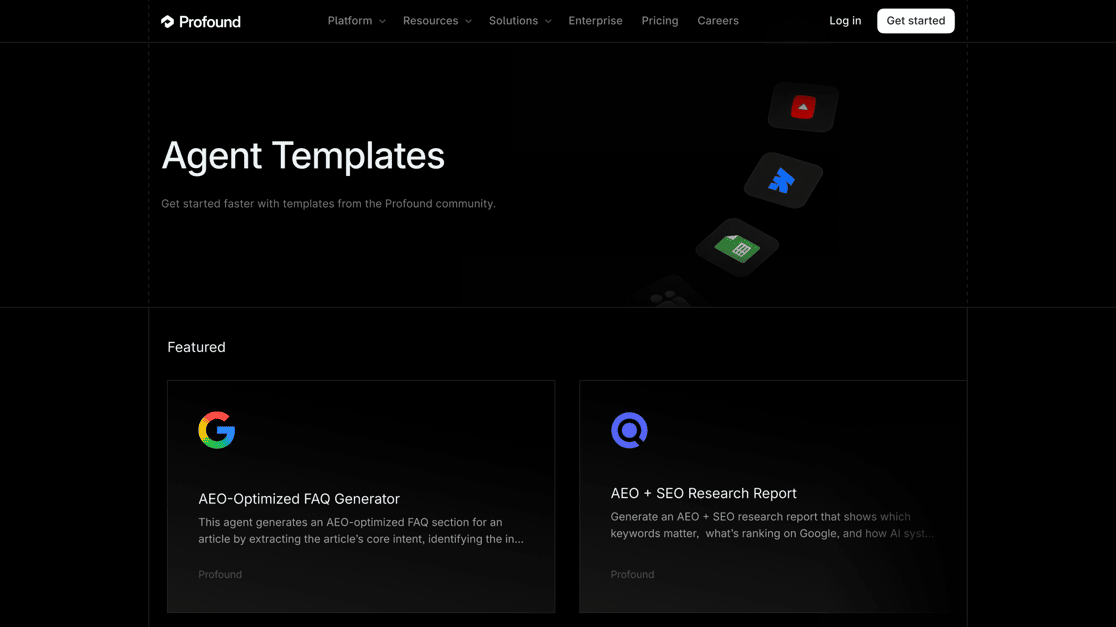
With Profound’s Agent Template Marketplace, I can start from pre-built AI agent workflows instead of building every process from scratch.
It gives me ready-to-clone templates designed for marketing, SEO, and AEO teams, so I can move from idea to live workflow in minutes.
For me, the biggest advantage is speed: I can choose a proven workflow, clone it, customize it for my team, and start using AI agents faster with less setup.
AI can misrepresent a brand without inventing an obvious falsehood. A technically correct description can still become misleading when an answer adds an unsolicited comparison, repeats an outdated assumption, or presents an opinion as settled fact.
That makes AI brand accuracy more than a visibility problem. The sources point to an interconnected challenge involving representation, consumer trust, source provenance, editorial controls, and responsibility for harmful outputs. Brands need a system that addresses all five.
Accuracy includes framing, not just factual correctness
Traditional fact-checking asks whether an individual claim is true. AI search requires a wider test: whether the complete answer represents the brand fairly and in the context of the user’s question.
A Profound article reported an analysis of 50,000 prompts across seven industries and said nearly half of the AI responses contained comparisons, opinions, or recommendations that users had not requested. The significance is not merely that models sometimes make errors. It is that they can change the meaning of an answer by deciding which competitors, attributes, or judgments belong beside a brand.
This creates at least three forms of accuracy risk. A claim may be factually wrong, such as an incorrect product capability. It may be stale, reflecting information that was once accurate but is no longer current. Or it may be contextually distorted: individual statements remain defensible, but the selection and framing leave users with the wrong overall impression.
Profound’s FactCheck announcement approaches the issue as a measurement problem. It describes a way to evaluate brand claims at scale, identify inaccurate statements, and examine the sources associated with those errors. As a product announcement, it does not independently establish how well the tool performs. It does, however, highlight an important operational principle: a useful accuracy program must connect problematic outputs to the evidence influencing them. Counting brand mentions alone cannot reveal whether those mentions help or harm understanding.
Rising use does not mean brands inherit rising trust
The consumer research reported by Search Engine Land shows why representation quality matters even as AI search expands. In a Fractl and Search Engine Land survey of 1,008 U.S. consumers and 150 marketers, 70% of consumers said they were using AI tools for search more than a year earlier. Yet the share describing AI-powered search as more helpful than traditional search reportedly fell from 82% to 54% between the 2025 and 2026 studies.
Those findings describe a convenience-trust gap. People may continue using a fast, accessible channel while becoming more cautious about its answers. A brand appearing prominently in that environment therefore gains exposure, but not an automatic endorsement. Accuracy, credible sourcing, and consistency across platforms become the conditions that determine whether visibility turns into confidence.
The same survey found that the average consumer consulted 2.4 platforms before a purchase decision. Google was reportedly the first destination for 39% of respondents, compared with 15% for Reddit and 14% for AI tools. This suggests that buyers can encounter an AI-generated brand narrative and then test it against search results, community discussion, reviews, or other sources. Contradictions that once remained isolated are easier to expose when the journey crosses several platforms.
Trust concerns also extend to brands’ own use of AI. The reported share of consumers who said heavy AI use would reduce trust in a brand rose from 20% to 39%. More than 80% wanted AI-generated material labeled across each content format measured, including 84% for written content and 91% for video. These figures do not show that audiences reject all AI-assisted work. They indicate that undisclosed volume and weak quality controls can become reputation signals in their own right.
Accountability is moving closer to the publisher of the answer
A separate Search Engine Land article reported that a German court held Google responsible for content in an AI Overview and rejected the proposition that a general warning placed the fact-checking burden entirely on users. According to that account, the court treated newly generated claims as Google’s content rather than merely a repetition of third-party material.
One reported ruling should not be treated as a universal legal standard, and the supplied source does not establish how other courts or jurisdictions will decide comparable cases. Its practical lesson is nevertheless relevant to any organization deploying AI: a disclaimer is not a substitute for controls proportionate to the possible harm.
The responsibility question changes depending on where an output appears. An inaccurate public article can damage readers or another company’s reputation. A faulty support response can misdirect a customer. An invented statement in an internal report can alter a decision even if it is never published. In every case, the organization receives the productivity benefit, selects the workflow, and decides whether a person reviews the result.
The consumer study suggests many organizations have started adding safeguards, but their coverage is uneven. It reported that roughly three in four organizations conduct human editorial review before publishing AI-generated content. Among the specific checks, 62% reviewed brand voice, 54% checked facts, 42% performed legal or compliance review, and 27% evaluated bias. Brand consistency was therefore checked more often than factual accuracy, while bias received substantially less attention. That ordering can produce polished material that still contains consequential problems.
A practical control system connects monitoring, evidence, and ownership
AI brand governance should cover both sides of the information boundary: what external systems say about the brand and what the organization publishes with AI assistance. These are related but distinct responsibilities. A company cannot directly edit every model answer, but it can improve authoritative source material, document errors, seek corrections where mechanisms exist, and prepare teams to respond consistently. It has much greater control over its own content, support messages, reports, and automated decisions.
External monitoring should test realistic questions across discovery, comparison, evaluation, and purchase contexts. Reviews should record the answer, platform, date, cited sources, exact claim at issue, and the type of failure. Separating false claims from stale information, unsupported recommendations, and misleading framing makes remediation more precise.
Source analysis should follow monitoring. When several answers repeat the same mistake, the next question is whether they rely on an outdated owned page, an ambiguous product description, a third-party article, or an unexplained model inference. Profound’s FactCheck announcement emphasizes this link between claims and contributing sources. Even without a specialized product, maintaining an evidence record helps distinguish a content correction from an escalation to a platform or publisher.
Internal controls should be based on consequence rather than content volume. Low-risk drafting may need a lighter review, while legal claims, product limitations, health or safety guidance, competitive statements, and customer-specific advice warrant stronger verification and named approval. The responsible reviewer should be identified before deployment, not after an error appears.
Finally, teams need a correction loop. Confirmed errors should update the relevant source material, prompt or workflow, review checklist, and monitoring set. Repeated failures should be treated as system defects rather than isolated copy edits. Useful reporting can track claim accuracy, contextual accuracy, source quality, correction status, recurrence, and the time required to resolve a material issue.
Key takeaways
AI brand accuracy includes factual truth, freshness, context, comparisons, and the overall impression created by an answer.
Greater AI search adoption does not guarantee greater trust; the reported consumer research showed use rising while perceived helpfulness weakened.
Brand monitoring is more actionable when each questionable claim is linked to its apparent evidence and classified by failure type.
Disclosure can address audience expectations, but it cannot replace factual, legal, compliance, and bias review.
Accountability should be assigned to a named owner and scaled to the consequences of an incorrect output.
As AI answers become part of ordinary brand discovery, the durable advantage will not come from producing the most material or collecting the most mentions. It will come from building an evidence-backed brand record, detecting distortions early, and showing that someone is accountable when automation gets the story wrong.
AI discovery is expanding beyond the conventional search results page. Two emerging models illustrate the change: Google Discover is experimenting with natural-language feed controls, while Yahoo Scout combines AI-generated answers with content and services from across Yahoo’s properties.
Together, the reported developments suggest that publishers may increasingly be discovered through declared interests, generated subqueries, citations and contextual recommendations. The opportunity is broader than ranking for one typed query, but each surface creates a different route from user intent to publisher visibility.
Two AI discovery models with different user journeys
Google Discover’s experiment begins with a feed. According to the report on its natural-language tuning feature, users can ask to see more content about a topic, creator, publisher or content format. Google then interprets that request and adjusts the cards presented in Discover. The report described this as a shift from personalization based only on inferred behavior toward personalization that also accepts declared preferences.
Yahoo Scout begins with a question or task. The Scout report described an AI answer engine available through its own website and integrated into Yahoo Search, News, Finance and Mail. Responses can include synthesized text, citations, source previews, tables, imagery and information drawn from Yahoo services.
Dimension
Google Discover tuning
Yahoo Scout
Primary experience
A personalized content feed
An AI answer and assistant interface
User signal
A request to see more or less of a subject, source or content type
A question, follow-up or task expressed in conversational language
Publisher exposure
Semantically relevant cards selected through topic expansion or query-intent fan-out
Links, highlighted citations, featured sources and content cards within or around an answer
Reported limitation
Early, cautious distribution with occasional loose matches
Unknown publisher click-through performance and room for more source links
The distinction matters. Discover tuning influences what a person may encounter while browsing, whereas Scout responds to an immediate information need. One is an AI-directed recommendation layer; the other is an answer layer that can also become a gateway to the web.
Declared intent creates new routes to publisher visibility
The Discover report identified two apparent retrieval patterns. In entity or interest expansion, a prompt can lead to related topics, people, publishers or concepts. In query-intent fan-out, a broad request is translated into several narrower retrieval intents. A general interest in SEO, for example, was reported to produce more specific intents concerning strategies, ranking updates and Discover guidance.
This fan-out process can widen the candidate pool. The report documented results from specialist publishers, individual creators and narrowly focused sites, including cases in which an article had no detectable previous circulation in the tracking dataset used for the analysis. That observation does not establish audience size or Search Console traffic, and the source cautioned that prompt-influenced cards did not appear to receive the broad amplification sometimes associated with conventional Discover distribution.
The same report observed structured actions such as SEE_MORE and SEE_LESS, along with current and historical natural-language tuning pipelines. It interpreted the historical pipeline as evidence that a prompt may influence later feed sessions rather than only the next refresh. These findings came from feature tracking, however, so they should be treated as reported observations about an experimental system rather than a complete account of Google’s internal ranking process.
Yahoo Scout offers another visibility mechanism: attribution inside a generated response. The Scout report described linked highlights, a featured-source area, citation previews and related article cards intended to make underlying publishers visible. Yahoo told the reporter that it wanted Scout to direct traffic to the open web, but it had not yet established an expected click-through rate. The company also said it planned to develop publisher impression and click reporting.
These models change the discovery question for publishers. Visibility may depend not only on whether a page ranks for the user’s original words, but also on whether it matches a derived interest, answers one of several generated subqueries or provides material an answer engine can attribute clearly.
A publishing strategy for feeds and answer engines
Make the site’s subject identity unmistakable
Entity expansion favors a publication whose subject can be recognized consistently. Descriptive titles, focused sections, coherent internal linking and clear authorship can help a retrieval system understand what the site and its contributors cover. The aim is not to repeat a keyword everywhere, but to remove ambiguity about the publication’s domain and the purpose of each page.
Cover the questions inside a broad prompt
Query fan-out means one prompt may represent several related information needs. A useful page should state its scope early, use headings that reflect genuine reader questions and answer the important subtopics directly. This makes the content easier to retrieve for an intent that the user did not phrase exactly as the publisher did.
Give answer systems attributable material
Scout’s emphasis on citations makes source quality part of presentation. Publishers can support attribution by distinguishing facts from analysis, naming original sources, explaining methodology and keeping important claims close to their evidence. Concise summaries can help an answer system identify relevance, but the surrounding article still needs enough context for a reader who follows the citation.
Measure each surface on its own terms
A card shown because one person tuned a feed is not equivalent to a widely distributed recommendation, and a citation impression is not equivalent to a visit. Publishers should avoid treating all AI visibility as one metric. Useful distinctions include being retrieved, being visibly attributed, receiving a click and producing a meaningful on-site action. The source reports indicate that measurement remains incomplete: the Discover analysis relied on observed tracking data, while Yahoo said publisher reporting was still planned.
Key takeaways
Google Discover’s reported experiment lets users declare feed interests in natural language, potentially opening a limited discovery path for specialist content.
Yahoo Scout uses an answer-engine model in which highlighted citations, featured sources and content cards can connect responses to publishers.
Clear topical identity supports entity-based discovery, while direct coverage of related questions supports retrieval through generated subqueries.
AI visibility should be separated into retrieval, attribution, referral traffic and on-site outcomes because the surfaces do not distribute content in the same way.
What will determine whether these surfaces matter
Neither report establishes a mature replacement for search traffic. The Discover feature was described as an early Search Labs experience with limited adoption and cautious distribution. Yahoo Scout was presented as a beta whose downstream click performance remained unknown, despite Yahoo’s stated intention to support publisher referrals.
The next meaningful signals will be broader user adoption, dependable publisher reporting and evidence that citations or tuned recommendations produce sustained visits. Until then, publishers can prepare by making content semantically clear and easy to attribute while treating traffic claims about these new surfaces with appropriate restraint.
AI-powered campaign automation is moving beyond isolated recommendations and into campaign execution. The two systems covered here illustrate that shift at different layers: Shopify’s Campaign Autopilot is designed to coordinate marketing across channels for merchants, while Google’s AI Max is reshaping how advertisers manage and evaluate automated Search campaigns.
Together, the reports suggest a new operating model for marketers. The human role becomes less about configuring every campaign element and more about defining objectives, setting boundaries, reviewing evidence and intervening when automation produces an undesirable result.
Key takeaways
Shopify’s reported approach automates campaign creation, budget distribution and ongoing optimization across selected marketing channels.
Google’s reported direction applies AI-led intent matching within Search and pairs it with more detailed search-term and landing-page reporting.
Automation does not eliminate advertiser control: approvals, budgets, exclusions, URLs and performance reviews remain important safeguards.
The practical skill shift is from manual campaign assembly to objective setting, governance and cross-channel performance interpretation.
Two automation models are emerging
Campaign Autopilot represents an orchestration model. According to the Shopify-focused source, a merchant selects a monthly budget, participating channels and operating guidelines. The system can then create and launch campaigns, allocate funds across channels, adjust spending in response to performance, recommend automated email initiatives and continue refining the campaign.
The source says the early-access feature works from Shopify’s admin and supports Meta, Shop Campaigns and email. It also reports that support is planned for ChatGPT Ads, Microsoft Advertising and Snapchat. Those prospective integrations should be treated as a roadmap described by the source, not as currently available functionality.
AI Max reflects a different model: automation within a particular advertising environment. The Google-focused source reports that updated guidance emphasizes intent rather than strict keyword matching, with conversion goals taking priority over surface-level keyword relevance. It also says Dynamic Search Ads campaigns are scheduled to begin upgrading automatically to AI Max in February 2027.
The distinction matters. Shopify is described as choosing and coordinating actions across merchant channels, whereas Google is described as expanding how a Search campaign discovers and matches demand. One system aims to simplify the marketing mix; the other changes the mechanics and management of paid search.
Control is becoming a governance layer
Neither report supports a fully hands-off interpretation of campaign automation. The Shopify source says merchants can approve or modify campaigns, change budgets and stop actions. It also notes that Campaign Autopilot operates separately from existing Meta or Shop advertising campaigns, so previously planned campaigns are not automatically displaced.
Google’s guidance places control in reporting and exclusions. The source describes reporting views for AI Max search terms and landing pages, as well as comparable views for Dynamic Search Ads. Advertisers can respond to weak traffic with negative keywords or URL exclusions. At the same time, the guidance reportedly cautions against excessive filtering because narrow restrictions can prevent the system from using broader intent signals.
This creates a governance problem rather than a simple on-or-off decision. Useful controls need to prevent unacceptable placements, destinations or spending without constraining the automation so tightly that it cannot explore. A practical governance framework should define:
Objectives: the conversion outcomes the system is expected to pursue.
Financial limits: the approved budget and the conditions for changing it.
Channel boundaries: where campaigns may run and which existing activity must remain separate.
Exclusions: unsuitable search terms, landing pages, URLs or other traffic that should not be targeted.
Intervention triggers: the performance or brand-safety conditions that require a human review, adjustment or pause.
Measurement must explain what the automation did
As campaign systems make more decisions, aggregate results alone become less informative. A marketer also needs to understand which demand was captured, where users landed, how funds moved and which conversion goals guided the optimization.
Google’s updated documentation, as summarized by the source, addresses part of that need by connecting search terms with landing pages and clarifying that search-term reporting reflects the destinations users reach after clicking. For travel campaigns, the source says advertisers can consolidate performance information and segment it by formats including Travel Promotion Ads, Booking Links and Travel Feed-based ads.
The Shopify source describes another measurement advantage: Campaign Autopilot reportedly draws on performance insights from millions of Shopify stores to inform optimization and budget allocation. That claim indicates the scale of the data informing the system, but the supplied report does not detail the methodology, the degree of transfer between merchants or how those insights affect any individual campaign. Advertisers should therefore judge recommendations by their own outcomes rather than treating scale as proof of effectiveness.
The Google source recommends reviewing search-term and item-group performance every one to two weeks. Shopify’s source, meanwhile, describes ongoing evaluation and gives merchants access to recommendations and results through its Sidekick assistant. Although the interfaces differ, both accounts preserve a recurring review function for the advertiser.
How teams can prepare for more autonomous campaigns
The immediate preparation is operational rather than purely technical. Teams need clear goals and clean decision rights before delegating campaign work to an automated system. Otherwise, faster execution can simply amplify unclear priorities.
Specify the business outcome. Define the conversion objective before selecting channels, budgets or targeting constraints.
Document the starting state. Record existing campaigns, exclusions and budget commitments so new automation can be evaluated without confusing it with pre-existing activity.
Set boundaries before launch. Establish approved channels, spending limits, destination rules and conditions requiring human approval.
Review decision-level evidence. Examine search terms, landing pages, channel allocation and conversion outcomes rather than relying only on a headline performance figure.
Adjust controls selectively. Use exclusions to address identifiable problems while avoiding restrictions so broad that they defeat intent-based optimization.
Plan for platform transitions. Advertisers using Dynamic Search Ads should account for the reported February 2027 start of automatic AI Max upgrades and use the available lead time to understand the newer reporting model.
The larger shift is not simply from manual work to automatic work. It is from managing campaign components to managing an adaptive system. As channel orchestration and intent-based advertising mature, the strongest teams will be those that can give automation enough room to learn while retaining clear accountability for budgets, customer journeys and business outcomes.