You have an AI answer that sounds precise, uses the right vocabulary, and gives you a clear next step. The problem is that you cannot tell whether it is correct without already knowing the subject.
You do not need to reject AI or fact-check every sentence with equal intensity. You need a verification process that becomes stricter as the cost of being wrong rises.
Confidence is not evidence
An AI hallucination is a plausible response that is incorrect, unsupported, or assembled from assumptions the model has not made clear. It can include real terminology, a logical sequence, and a confident conclusion. Those qualities make the answer readable. They do not make it reliable.
This distinction matters when you are working outside your expertise. A weak answer does not always look weak. You may notice an obvious factual error in your own field, yet accept the same style of answer about a vehicle repair, a legal requirement, analytics configuration, or unfamiliar platform.
Consequences can escalate quickly. Confident AI recommendations have included faulty technical SEO direction and a premature vehicle diagnosis. In the SEO case, misleading language about penalties could also have changed how leadership viewed a necessary migration. The risk was not limited to implementation. It extended to budgets, trust, and internal decision-making.
Treat polished language as a presentation layer. Evidence must still come from observable behavior, authoritative documentation, original data, or a qualified person who accepts responsibility for the judgment.
Match verification effort to the cost of being wrong
Start by asking what happens if you follow the answer and it fails. This is more useful than asking whether the output merely feels accurate.
Low consequence: The output is easy to reverse and affects no customer, budget, production system, or factual claim. Use it as a working draft and review it normally.
Meaningful consequence: The answer could affect rankings, reporting, client communication, or a public page. Verify its important claims against direct evidence before publishing or deploying.
High consequence: The recommendation could trigger substantial spending, irreversible changes, legal or security exposure, health decisions, or damage across a live site. Stop and obtain qualified human approval.
Raise the verification level when the answer contains absolute language such as “always,” “must,” or “penalty,” especially when no condition or evidence accompanies it. Also slow down when the AI reaches a diagnosis before gathering enough context, changes its conclusion after receiving basic facts, or recommends an action you cannot safely undo.
Your own familiarity is part of the risk calculation. If you cannot explain why the recommendation should work, you are not in a good position to approve it alone. That is a signal to involve an expert, not a reason to ask the model for an even more confident version.
Use a verification workflow that separates claims from decisions
Do not verify a long AI response as one object. Break it into the claims you can test and the decisions that require judgment.
State the proposed action. Reduce the output to a plain sentence: “Change this canonical,” “replace this component,” or “publish this claim.” If the action remains vague, it is not ready for approval.
Extract the supporting claims. List the facts that must be true for the action to make sense. Separate observed facts from assumptions and predictions.
Ask what is missing. Identify the data, configuration, version, environment, symptoms, or business constraint the AI did not have. Missing context is often where a persuasive answer becomes brittle.
Inspect direct evidence. Open any cited material, check the actual system, and compare the recommendation with real output. A citation generated by AI is only a lead until you confirm that it exists and supports the claim.
Test reversibly. Use a draft, preview, staging environment, isolated sample, or limited rollout where one is available. Record the expected result before testing so that you do not reinterpret failure as success.
Assign approval. Name the person who can judge the evidence and accept the consequence. High-risk work should not be approved by the person who merely generated or copied the AI response.
For technical SEO, this means checking the site rather than debating terminology with the model. Inspect the rendered canonical, the destination URL, parameter behavior, templates, and the affected page set. Test the proposed change in a controlled environment when possible. A model can help you form hypotheses and test cases, but the implementation decision should follow what the site actually does.
For content and structured data, verify each factual statement and each property that describes a real entity. Do not let AI invent credentials, reviews, product details, authorship, or organizational relationships. The final markup should agree with the visible page and the underlying business record.
Give experts a verification packet, not a chat transcript
Expert review works best when the reviewer can see the decision, evidence, and uncertainty without reconstructing your entire AI conversation. Prepare a compact verification packet with:
the exact action you are considering;
the material claims on which it depends;
the AI output, clearly labeled as unverified;
the documentation, screenshots, logs, crawl results, or other direct evidence you checked;
the assumptions and unanswered questions;
the likely consequence if the recommendation is wrong; and
the specific approval or correction you need from the reviewer.
Ask the expert to challenge the reasoning, not merely confirm the conclusion. Useful prompts include: “Which assumption is weakest?”, “What evidence would disprove this?”, and “What should we inspect before changing production?” These questions make disagreement visible while there is still time to act on it.
Keep the resulting decision record. Note what was approved, by whom, from which evidence, and under what conditions. If the recommendation later appears in a client deliverable, optimization playbook, or automated workflow, your team can trace why it was accepted instead of treating repeated AI language as established fact.
Key takeaways
Fluent, specific language does not prove that an AI answer is correct.
Verify more aggressively when an error could affect money, rankings, customers, production systems, or trust.
Separate testable claims from the judgment required to approve an action.
Use direct evidence and reversible tests before relying on another AI-generated explanation.
Bring in a qualified expert when you cannot evaluate the reasoning or safely absorb the failure.
Before acting on your next AI recommendation, write down the proposed action, the evidence it depends on, and the person qualified to approve it. If any of those fields is blank, the answer is still a hypothesis.
Your automated PPC campaign can hit its platform target and still be bad for the business. If accidental clicks, weak leads or low-margin sales count as success, the system will pursue more of them with impressive efficiency.
The fix isn’t constant bid tinkering. You need to improve the signals, values and boundaries that shape each decision. Use the framework below to diagnose an underperforming campaign and give its automation a better problem to solve.
Start with the question the bidding system must answer
AI-driven PPC changes your job from controlling every keyword and bid to designing the inputs that guide the system. That starts with a clear business objective. “Get more conversions” is not clear enough when a form submission, qualified opportunity and completed sale have very different value.
Write the campaign objective as a decision the system can repeatedly make: find additional qualified demo requests within an acceptable acquisition cost, sell available products while protecting margin, or reach relevant prospects without allowing low-quality inventory to consume the budget.
Name one primary outcome. Choose the action that best represents business success, not merely the event that is easiest to track.
Define what counts. State the conditions that distinguish a useful lead, order or visit from an irrelevant one.
Assign value where outcomes differ. Reflect meaningful differences in revenue, margin, lead quality or customer value instead of treating every conversion as equal.
Select the matching bidding objective. Target CPA makes sense when qualifying outcomes have comparable value. Target ROAS needs values that reliably represent what the business gains.
Record the guardrails. Note brand restrictions, excluded inventory, geographic limits, inventory constraints and any claims the ads must not make.
Then apply a blunt test: if the campaign doubled the primary conversion tomorrow, would the business be pleased with every additional result? If the answer is no, repair the definition before asking automation to scale it.
Make conversion data harder to fool
Smart Bidding can only learn from the events you send back. A thank-you page that fires twice, a spam form submission or a low-intent micro-conversion can teach the system that poor traffic is desirable. More data does not compensate for the wrong data.
Audit every conversion action included in bidding. For each one, answer these questions:
Does this event represent a business outcome or only progress toward one?
Can duplicate, accidental, internal or fraudulent activity trigger it?
Does the platform receive any later signal about lead qualification, completed purchases or cancellations?
Does its assigned value reflect revenue alone, or the economic measure the campaign is meant to improve?
Would you intentionally buy more of this exact action at the target cost?
Keep primary and diagnostic signals distinct. A brochure view or form start can help you understand the journey without carrying the same bidding weight as a qualified lead. When the buying cycle continues beyond the website, connect later outcomes back to the original ad interaction where your measurement setup permits it. That gives the system evidence about customer quality rather than just form completion.
Value design matters just as much. If two products generate the same revenue but have very different margins, revenue-only values can push spend toward the less profitable sale. The same problem appears in lead generation when every inquiry receives equal credit even though only some become viable opportunities.
Do not start by changing the bid target when reported performance and commercial results disagree. First verify the event, its deduplication, its value and the feedback coming from downstream systems. A bidding adjustment cannot correct a broken definition of success.
Use exclusions as signal control, not just brand protection
Placement exclusions still protect your brand, but they also protect the learning process. Display inventory that produces cheap clicks, accidental taps or automated traffic can create attractive engagement metrics without producing useful outcomes. Strategic exclusions help prevent those interactions from distorting the signals used for optimization.
Review placements by business result, not click-through rate alone. Start with the inventory consuming meaningful spend, then inspect conversion quality, downstream lead status and the context in which the ad appeared.
Remove clear contamination. Exclude malicious, bot-heavy or obviously irrelevant placements as soon as you can identify them.
Question high-click, low-outcome inventory. A placement producing many interactions but no useful commercial result may be training the campaign toward cheap activity.
Treat mobile apps intentionally. If app inventory is not part of the campaign strategy, exclude it rather than allowing accidental taps to become a hidden acquisition channel.
Match exclusions to the objective. A reputable broad-reach placement may suit awareness while being too expensive or unfocused for direct response.
Keep an audit trail. Record why each exclusion was added so that a temporary performance decision does not become an unexplained permanent rule.
Avoid building a blocklist simply because a placement has not converted yet. Sparse data can make normal variation look conclusive, and indiscriminate exclusions can remove useful reach. Look for a defensible reason: irrelevant context, suspicious interaction patterns, poor downstream quality or economics that conflict with the campaign objective.
Apply obvious safety and quality exclusions before launch when possible. During the learning phase, early low-quality traffic does more than spend money; it gives the system examples of the behavior it should seek. Clean boundaries let automation explore without making every corner of the network equally eligible.
Operate automation through inputs, budgets and diagnosis
Give audience and query expansion a useful starting point
Broad match, keywordless targeting, URL expansion and audience signals can uncover demand that a fixed keyword list misses. They are discovery tools, not substitutes for positioning. Supply accurate first-party audience data where available, keep landing pages tightly aligned with the offer, and review the new queries and destinations the system finds.
Judge expansion by the quality of the resulting customers. If volume rises while lead quality falls, inspect the newly reached queries, audiences, placements and pages before constraining the entire campaign. You are trying to locate the weak input, not eliminate discovery.
Write a brief that automation can use
When AI assembles or adapts ads, your brief becomes part of campaign control. Include the intended audience, the problem being solved, the offer, approved proof points, brand tone, required qualifications and prohibited claims. Specify which landing page supports each promise.
Product campaigns also depend on feed quality. Make sure product names, attributes, availability and other business data describe what can actually be bought. A bidding system cannot recover from an ambiguous feed or an ad promise that the destination page fails to support.
Build budgets around business constraints
Set budget architecture with margin, inventory, lifetime value, cash flow and growth priorities in view. Daily spend is an output of that structure, not the strategy itself. Use missed-opportunity reporting to distinguish a campaign constrained by budget from one constrained by demand, eligibility or weak inputs.
Before increasing budget, ask whether the next unit of spend is likely to produce an outcome the business wants. Before reducing it, ask whether the campaign is genuinely inefficient or simply being judged against incomplete conversion data. Budget changes amplify whatever signal architecture is already in place.
Diagnose the symptom before changing the target
Conversion volume rises but quality falls: inspect spam, placement mix, query expansion and the definition of the primary conversion.
CPA looks healthy but profit falls: check conversion values, product margin, cancellations and which outcomes receive bidding credit.
Traffic grows but conversions do not: compare the ad promise with the landing page, then review newly reached queries, audiences and placements.
Volume remains limited: verify tracking first, then examine eligibility, exclusions, budget constraints and available demand.
Brand representation drifts: strengthen the creative brief, approved claims and destination mapping before broadly restricting delivery.
Change the input closest to the diagnosed problem. If you alter the conversion setup, exclusions, creative, budget and bid target at once, you lose the ability to tell which intervention helped. Keep a decision log that records the symptom, evidence, change and expected business effect.
Key takeaways
AI-driven PPC improves when you define a valuable outcome clearly enough for the system to recognize and pursue it.
Clean conversion events and realistic values matter more than feeding the platform the largest possible volume of signals.
Placement exclusions can protect both brand safety and the quality of campaign learning.
Audience expansion, feeds and AI-generated creative need accurate starting inputs plus human review of the results.
Diagnose tracking, traffic quality and economics before responding to weak performance with a bid or budget change.
For your next optimization session, choose one campaign and audit its primary conversion, assigned value and highest-spend placements. Fix the clearest signal problem first, document the change, and let the next decision follow from business results rather than platform activity alone.
If you run Google Ads, the uncomfortable part of deeper automation isn’t simply that software can make more decisions. It’s that Google may have broader latitude to build and manage ads while your team still owns the consequences.
You don’t need to abandon automation. You do need a clearer record of what Google can use, which changes require human review, how regulated placements are handled, and whether invalid activity credits are reflected in your performance numbers. Here’s a practical way to put those controls in place.
Key takeaways
Treat the July 1, 2026 terms as a change in operating permissions, not a routine administrative notice.
Document which inputs, URLs, accounts, claims, and assets Google may use before expanding campaign automation.
Keep compliance requirements ahead of eligibility for ads in AI-generated search experiences, especially in regulated sectors.
Add invalid activity credits to recurring campaign reviews so media performance and billed costs tell the same story.
Reset your risk boundary before July 1
The updated Google Ads terms take effect July 1, 2026. They apply to Google Ads accounts rather than unrelated products such as Workspace, and advertisers aren’t being asked to complete an immediate account action.
That lack of an account prompt shouldn’t become a reason to ignore the change. Updated language covers how your inputs may be used across Ads features, information supplied through conversational tools, and the URLs and accounts authorized for automated campaign setup. It also gives automation a larger role while leaving advertisers accountable for campaign review and outcomes.
Control area
What to examine
Decision you need to record
Input rights
Copy, images, product data, prompts, audience material, and other information supplied to Ads
Who owns it, who approved its use, and whether Google may reuse it across campaign features
Authorized properties
Websites, landing pages, feeds, accounts, and connected properties available to automated setup
Which properties are in scope and which must remain excluded
Automated management
Campaigns where Google can create, combine, select, or optimize elements
What can run automatically and what requires human approval
Regional terms
Contract entity, arbitration language, fees, and local legal requirements
Which legal or procurement owner must review each affected account
Start with your highest-spend, highest-risk, and regulated accounts. Create a simple inventory of active automation, connected properties, approved asset libraries, and responsible owners. For every input, be able to answer two questions: do you have the right to provide it, and would you be comfortable seeing it adapted into a live ad?
Regional language deserves separate review. Changes involving arbitration, fees, legal compliance, and Google BR’s transactional authority in Brazil won’t affect every advertiser in the same way. Route the relevant terms to counsel or procurement instead of relying on a universal account-level interpretation.
Put human approval around the decisions that matter
A useful AI policy doesn’t require a person to approve every bid adjustment. It identifies the decisions where an error could create a legal, financial, reputational, or measurement problem.
Set the generation boundary. List the materials automation may use, including authorized pages, feeds, existing assets, and conversational inputs. Exclude expired offers, unapproved claims, restricted pages, and material with uncertain ownership.
Set the activation boundary. Decide whether generated assets can go live automatically or require review. Regulated claims, brand promises, pricing language, and required disclosures should have a named approver.
Set the inspection cadence. Review live combinations, destination pages, policy status, and account changes on a recurring schedule. Assign the task to a role, not a vague team.
Set stop conditions. Pause or remove an asset when its rights are unclear, a required disclosure is missing, a claim hasn’t been approved, or the destination doesn’t support the promise made in the ad.
Preserve evidence. Keep the approved wording, reviewer, date, authorized property, and reason for any exception in one change record.
Conversational tools need the same discipline. A prompt can contain customer information, internal positioning, licensed copy, or an unapproved claim. Treat prompt content as material supplied to an advertising system, not as a private scratchpad. A conversational shortcut is not an approval workflow.
This separation lets you retain fast bidding and optimization while keeping human control over the assertions customers actually see. It also gives an agency a defensible answer when a client asks who approved a generated asset or why a particular property was available to automation.
Handle AI Mode ads without weakening compliance
Google has begun a small healthcare advertising test in AI Mode for English-language queries in the United States. Eligible participation can come from Performance Max, AI Max with search term matching, Shopping, and broad match campaigns. Those campaign types can also place ads in AI Overviews.
The current creative boundary matters: healthcare ads with pinned assets or text disclaimers aren’t eligible for this initial test. That is an eligibility condition, not a reason to remove a disclosure your organization requires. If a disclaimer or pinned message is necessary for compliance, accuracy, or patient safety, keep it and accept that the ad may not qualify.
Healthcare advertisers should maintain a small eligibility register for candidate campaigns. Record the market, query language, campaign type, pinned assets, required disclaimers, approval owner, and whether an AI Mode or AI Overview appearance has actually been observed. Don’t label every eligible campaign as participating, and don’t assume a test has expanded beyond its stated sector or market.
If you work outside healthcare, use the test for planning rather than access claims. Review which creative controls your sector cannot surrender and which landing pages are suitable for an AI-generated search context. You will be ready if eligibility expands, without rebuilding compliant assets around a placement that isn’t available to you.
Keep paid and organic AI visibility separate in reporting. An ad shown near an AI-generated response is paid distribution; it isn’t an organic citation, brand recommendation, or proof of generative search authority. Your AEO or GEO dashboard should identify those outcomes separately even when they appear in the same user interface.
Make invalid activity credits part of campaign reporting
More automated distribution makes cost reconciliation more important. Google says its systems filter invalid traffic before it creates a charge, but activity detected later may result in a credit. The Invalid Activity Credit Report for Search and Performance Max exposes credited clicks, credited interactions, credited spend, campaign-level effects, and performance after credits are applied.
You can generate it in Google Ads by opening Report Editor, going to the Template Gallery, and selecting Invalid Activity Credit Report: Search & PMax. Add the campaign metrics used in your normal performance review so the credit information isn’t examined in isolation.
Use the same date range as the billing and campaign review you are reconciling.
Include campaign name, cost, clicks or interactions, and the applicable credited columns.
Compare campaign-level credits with billing and transaction records.
Use adjusted performance fields where provided, and avoid subtracting the same credit twice in a separate spreadsheet.
Investigate concentration. A credit clustered in one campaign deserves more attention than the same amount dispersed across an account.
Annotate material credits before making budget, bidding, or client-reporting decisions.
An invalid activity credit doesn’t, by itself, prove deliberate click fraud or identify an attacker. It shows that spend or interactions were adjusted. Use it to reconcile costs and spot patterns, then keep any stronger conclusion tied to evidence you actually have.
Build one operating record for policy, placement, and spend
These changes become manageable when one campaign record connects permissions, approvals, placement eligibility, and financial adjustments. At minimum, track the campaign owner, automation in use, authorized URLs or accounts, rights owner, creative approver, regulated-sector status, mandatory disclosures, AI Mode eligibility or observation, invalid activity credits, and the latest review date.
Before July 1, review that record for your most consequential accounts and close any ownership or approval gaps. Then add the invalid activity report to your recurring performance process and keep AI-generated search placements distinct from organic AI visibility. You can continue using automation, but you’ll know where it is allowed to act, who checks its work, and which numbers belong in the final decision.
Your team may already have AI tools, prompt libraries, and a growing pile of experiments. Yet campaigns still wait for handoffs, content still gets trapped in review, and nobody can explain whether AI has improved a business outcome.
That is the gap between adopting AI and transforming marketing with it. You close the gap by redesigning a small number of important workflows, preserving expert judgment, and measuring what becomes faster, better, or more visible.
Key takeaways
Treat AI transformation as an operating-model change, not a software rollout.
Begin with a recurring workflow that has costly handoffs, usable inputs, and an outcome you already measure.
Assign AI the repetitive work while keeping named people responsible for claims, decisions, and publication.
For SEO, AEO, and GEO, improve the underlying content and entity signals before automating distribution.
Scale only after the workflow produces reliable gains under documented controls.
Transform workflows before you transform job titles
AI changes the economics of routine marketing work. A strategist can classify a large set of queries, a content lead can generate several structural options, and an analyst can turn raw results into a first-pass explanation without waiting for a specialist to complete every intermediate step.
The useful idea behind positionless marketing is that work can move across traditional role boundaries when people have the right context and AI support. It does not mean expertise becomes unnecessary. It means specialists spend less time acting as queues for routine requests and more time setting standards, resolving ambiguity, and reviewing consequential decisions.
Look at one current workflow and mark every place where work stops. For each stop, ask why it exists:
Missing information: Fix the intake form or data connection.
Routine transformation: Let AI summarize, classify, format, or generate a controlled draft.
Specialist judgment: Keep the decision with a qualified person and give that person better evidence.
Unclear ownership: Name one person who is accountable for the final outcome.
Habit: Remove the handoff if it no longer protects quality, compliance, or customer trust.
This exercise prevents a common failure: inserting AI into an inefficient process and producing the same bottleneck at greater speed.
Choose a first workflow with evidence, not enthusiasm
Your first use case should be important enough to matter and contained enough to inspect. Avoid choosing a task merely because a model can perform it in a demonstration. Choose a workflow where you can compare the new process with a credible baseline.
Selection signal
What a strong candidate looks like
Reason to pause
Frequency
The team repeats the workflow often and follows a recognizable pattern.
The task is rare, novel, or different every time.
Input quality
The necessary briefs, customer data, content, or performance records are accessible.
Inputs are missing, contradictory, or prohibited from use.
Verifiability
A reviewer can check the output against defined requirements.
Accuracy depends on hidden assumptions or unavailable evidence.
Business connection
The workflow influences a metric the team already monitors.
The expected benefit is described only as producing more material.
Risk
Mistakes can be caught before they affect customers or systems.
An error could immediately create legal, financial, reputational, or security harm.
A content-refresh workflow is often easier to evaluate than an autonomous campaign system. It has observable inputs, reviewable outputs, and a clear publication checkpoint. You can assess whether the revised page is more accurate, more complete, easier to extract answers from, and better aligned with real demand.
Write a short pilot brief before configuring a tool. Name the workflow, its owner, the current baseline, the desired change, the allowed inputs, the approval requirement, and the condition that would stop the pilot. If you cannot fill in those fields, the use case is not ready.
Build the workflow around human decisions
A dependable AI workflow makes responsibility visible. A prompt alone is not a process, and a human somewhere in the loop is not a sufficient control. You need to specify what the system does, what a person decides, and what evidence the reviewer sees.
Define the trigger. State what starts the workflow, such as a decline in qualified traffic, a new product release, or an approved campaign brief.
Constrain the inputs. Identify the documents, datasets, brand rules, and page versions the system may use.
Assign the machine task. Describe a bounded action such as clustering queries, finding unsupported claims, proposing headings, or drafting schema properties from approved page content.
Name the human decision. Make one person responsible for validating intent, factual accuracy, positioning, and risk.
Set the publication gate. Define what must be true before an output can reach a website, advertising account, customer, or external system.
Capture the result. Record edits, rejected suggestions, performance changes, and failure patterns so the workflow can improve.
For an SEO, AEO, or GEO refresh, the machine might collect relevant page material, map questions to existing passages, identify missing context, and draft clearer answers. The editor should confirm the search intent, verify every substantive claim, preserve the brand’s position, and decide whether the update deserves publication.
Apply the same rule to JSON-LD. AI can help map visible facts into structured fields, but it should not invent awards, reviews, authorship, prices, availability, or other properties that the page and business records do not support. Structured data should describe the page accurately; it is not a place to add claims solely for machines.
Measure transformation at the workflow and market levels
Counting generated assets tells you how busy the system is. It does not tell you whether marketing improved. Use a scorecard that connects operational change to audience and business outcomes.
Workflow measures: Track elapsed time, rework, approval delays, cost, and the share of outputs that pass review.
Quality measures: Check factual accuracy, brand fit, completeness, originality, and compliance with the brief.
Search measures: Monitor whether important pages are crawlable, indexed where relevant, aligned with intended queries, and earning useful search visibility.
Answer-engine measures: Test whether priority questions receive accurate answers, whether your brand is represented correctly, and whether cited pages support the generated claims.
Business measures: Connect the workflow to qualified visits, leads, assisted conversions, retention, revenue, or another outcome your organization already trusts.
Use a fixed evaluation set for AI visibility. Select questions that reflect actual customer needs across discovery, comparison, and decision stages. Run the same questions under consistent conditions, save the responses, and review representation as well as mentions. A brand citation is not useful if the surrounding answer is inaccurate or positions the company for the wrong problem.
Do not promise that content, schema, or a particular publishing pattern will force inclusion in an AI-generated answer. These systems make their own retrieval and response decisions. Your controllable work is to publish accessible, specific, well-supported information; clarify entities and relationships; maintain consistency across owned properties; and measure how representation changes.
Review the scorecard with the people who operate the workflow. If speed improves while corrections rise, narrow the machine’s task or strengthen the input. If quality improves but publication remains slow, inspect the approval path. If content output rises without a market result, stop rewarding volume and reconsider the use case.
Scale only what you can govern and improve
Governance should live inside the workflow rather than in a policy document nobody consults. Give each production process an approved model or tool, data rules, an accountable owner, a review threshold, an audit trail, and a rollback path.
Separate public, internal, confidential, and restricted inputs before anyone sends data to a model.
Require stronger approval for customer-facing claims, regulated topics, pricing, legal language, and changes that execute automatically.
Store the prompt or instruction version, relevant inputs, output, reviewer, and final disposition when traceability matters.
Maintain examples of acceptable outputs and known failures so evaluation is based on shared standards.
Retest the workflow when the model, data connection, prompt, brand policy, or publishing system changes.
Keep a manual route available when the system is unavailable or its output cannot be verified.
Then expand by capability, not by buying more tools. A reliable classification step can support content planning, lead routing, and feedback analysis, but each new workflow still needs its own inputs, reviewer, risk threshold, and outcome metric.
Start with the workflow your team complains about most, provided its output can be checked before release. Map its delays, assign the decisions, and establish the scorecard before automating anything. When that process becomes measurably faster and more reliable, you will have an operating pattern worth extending.
You ask Claude for a polished draft, but the result sounds like polished AI: competent, smooth, and interchangeable with everyone else’s content. Repeating your preferred tone or asking it to sound more human rarely fixes the underlying problem.
You need to turn brand voice from a subjective impression into instructions Claude can apply and your team can review. With clear rules, representative examples, and a repeatable editing loop, Claude can reflect your brand voice without merely copying an old draft.
Translate your brand voice into observable choices
Words such as friendly, authoritative, bold, and conversational are too open to interpretation. A financial adviser and a fitness coach can both sound friendly while using completely different language, pacing, evidence, and calls to action.
Build a compact voice card that describes what a writer should do on the page. Cover these areas:
Audience: Name the reader, what they already understand, and the decision they are trying to make.
Relationship: Decide whether the brand acts as a specialist, teacher, peer, challenger, or reassuring adviser.
Sentence behavior: Describe the preferred pace, paragraph length, use of contractions, and tolerance for jargon.
Vocabulary: List preferred terms, words that require explanation, and language the brand avoids.
Evidence: Explain when claims need examples, data, citations, qualifications, or practical next steps.
Point of view: Specify when to use you, we, the company name, or a neutral construction.
Formatting: Define how headings, lists, calls to action, and emphasized text should work.
Boundaries: Identify tones the brand must never adopt, such as smug, alarmist, vague, or overly promotional.
Make every rule testable. Replace be clear with explain technical terms on first use. Replace sound confident with state the recommendation directly, then explain its limits. Replace avoid hype with remove unsupported superlatives, urgency, and promises of guaranteed results.
Add contrast when a rule could be misunderstood. For example: direct, not abrupt; informed, not academic; warm, not chatty; persuasive, not pushy. These boundaries help Claude distinguish your intended voice from a nearby but unsuitable one.
Choose examples that teach judgment, not imitation
Examples show Claude how your rules interact in real writing. Use approved material that still represents the brand. A rushed email, an outdated landing page, and an executive’s personal writing style can introduce conflicting signals.
Label why each example belongs
Do not paste examples into the prompt without explanation. Mark the behavior Claude should learn from each one:
This opening names the reader’s problem before introducing the company.
This explanation defines the technical term without talking down to the reader.
This transition moves from evidence to a recommendation without overstating certainty.
This call to action describes the next step without manufacturing urgency.
Also distinguish voice from content. Tell Claude that names, claims, prices, dates, product details, and recommendations in an example are not facts for the new draft. They are reference material only for language, structure, and tone.
Include useful negative examples
A rejected line becomes valuable when you explain the rejection. Pair it with an approved rewrite and a reason. The reason might be that the original buries the answer, uses an empty superlative, assumes too much knowledge, or turns a measured claim into a guarantee.
Negative examples work best when they are close to acceptable. Obvious failures teach little. A plausible sentence that misses your voice reveals the boundary Claude needs to recognize.
Give Claude a prompt with clear layers
A reliable brand prompt separates permanent voice rules from the current assignment. This prevents campaign details from being mistaken for lasting brand principles and makes the setup easier to reuse.
Use this sequence when assembling the prompt:
Set the role. Identify the brand, the type of writer Claude should act as, and the responsibility it has to the reader.
Define the reader and outcome. State who the content serves, what brought that person to the page, and what they should understand or do afterward.
Insert the voice card. Include observable language rules, preferred vocabulary, formatting conventions, and prohibited tendencies.
Add annotated examples. Explain which behaviors to reproduce and which factual details not to carry into the new work.
Provide task facts. Supply the brief, approved claims, required links, product information, and any material that must appear.
Set hard constraints. Name the required format, scope, compliance boundaries, and anything Claude must not infer.
Request a self-check. Ask Claude to identify any voice rule it could not satisfy and flag missing facts instead of filling gaps.
Keep priorities explicit. Accuracy and legal or editorial constraints come before style. Voice rules come before decorative flourishes. Examples demonstrate delivery but do not override the approved facts in the brief.
If the assignment is complex, ask for an outline before the full draft. Review whether the planned argument suits the reader and brand posture. Fixing a structural mismatch at that stage is easier than polishing an entire draft built on the wrong approach.
Review voice alignment with evidence
Do not approve a draft because it feels roughly on-brand. Review it against the voice card and point to the language that passes or fails each rule.
Does the opening address the reader’s actual concern, or does it begin with background they did not ask for?
Are recommendations stated directly and supported at the level your brand expects?
Would the intended reader understand every technical term without leaving the page?
Does the draft preserve uncertainty where the available facts are limited?
Are paragraphs, headings, and lists consistent with your publishing conventions?
Does the call to action offer a relevant next step rather than switching into sales language?
Could a competitor publish the draft unchanged? If so, which brand-specific judgment or vocabulary is missing?
When something fails, give Claude a diagnostic correction. Instead of make this warmer, identify the behavior: the paragraph sounds distant because it uses abstract nouns and never addresses the reader. Ask for a revision that speaks to you, keeps the technical meaning, and removes the abstract phrasing.
Save recurring corrections as new voice rules. If editors repeatedly remove inflated claims, add an explicit rule about claim strength. If introductions repeatedly take too long to reach the answer, define what the opening must accomplish. Your editing history should improve the system, not disappear into individual drafts.
Turn a successful prompt into a content workflow
Brand alignment breaks when every writer maintains a different prompt. Store the approved voice card, examples, exclusions, and review checklist in one controlled location. Give the material an owner and update it when the brand changes.
Separate the workflow into clear responsibilities:
Brand owner: Approves voice rules, terminology, and representative examples.
Subject specialist: Supplies facts, qualifications, and claims that may be made.
Prompt owner: Maintains the reusable instructions and resolves conflicts between them.
Editor: Checks the draft against the brief, voice card, and publishing requirements.
Approver: Accepts the final communication risk rather than assuming the model has done so.
Track failures by type. Voice drift, unsupported claims, weak structure, missing context, and formatting errors need different fixes. A voice rule will not repair a thin brief, and another example will not resolve contradictory product facts.
Test revisions with the same assignment whenever possible. If you change the voice card and the brief at once, you cannot tell which change improved the result. Keep approved outputs as benchmarks, but continue reviewing new drafts; consistency is a managed process, not a one-time prompt.
Key takeaways
Replace broad adjectives with observable rules about wording, structure, evidence, and reader treatment.
Use current, approved examples and label the behavior Claude should learn from each one.
Keep voice instructions, task facts, examples, and hard constraints in separate prompt layers.
Review drafts against explicit criteria and turn repeated editorial corrections into reusable rules.
Assign ownership for the voice system so every writer works from the same approved standard.
Start with one approved asset and extract the decisions that make it sound like your brand. Build the voice card, run a real assignment through it, and record every correction. That gives you something more durable than a good draft: a system your team can improve each time it publishes.
Are you looking to elevate your affiliate marketing efforts? With Profound and PartnerStack, I’ve been able to efficiently activate the right affiliate publications on a larger scale than ever before.
Through this powerful collaboration, I’ve discovered new ways to enhance my campaigns and drive significant growth by engaging with the right audiences at the right time.
I recently discovered that OpenAI is set to introduce conversion-optimized ad campaigns starting in early June. This marks a significant step towards creating a performance advertising ecosystem within ChatGPT.
Why does this matter to us? This move by OpenAI, as reported by The Information, confirms the development of conversion-focused ads along with necessary tracking infrastructure and performance measurement tools for advertisers like us.
What’s the current update? OpenAI has communicated with advertisers, stating that those who set up the OpenAI Pixel or Conversions API in advance will get early access to these campaigns in June.
According to the company:
Advertisers configuring conversions by June 1 will gain early access by June 5.
Advertisers can already start tracking conversions using Ads Manager today.
This system enables advertisers to measure actions triggered by ads, enhancing campaign effectiveness.
A deeper look. OpenAI is setting up an infrastructure akin to performance platforms like Google and Meta. With the OpenAI Pixel, advertisers can track website activity post-ad interaction, while the Conversions API allows them to send first-party conversion data back into OpenAI’s systems directly.
This capability allows OpenAI to optimize campaigns for measurable business outcomes, beyond just engagement metrics.
What’s at stake? The future of OpenAI’s advertising strategy largely hinges on measurement accuracy and gaining advertisers’ trust.
With browser restrictions and privacy changes eroding traditional tracking methods, OpenAI’s Conversions API could play a crucial role in demonstrating campaign performance and attribution within AI-driven ad experiences.
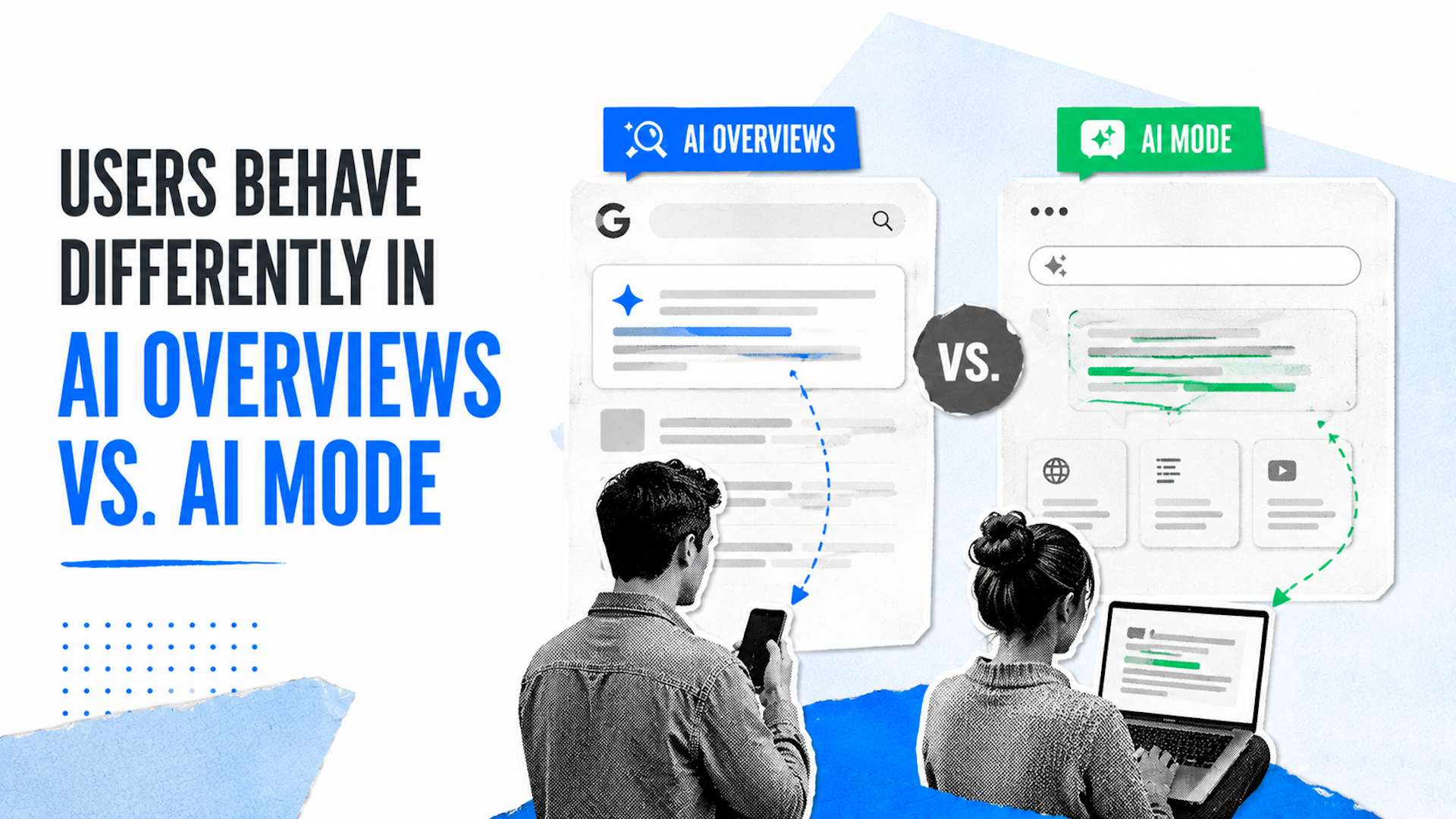
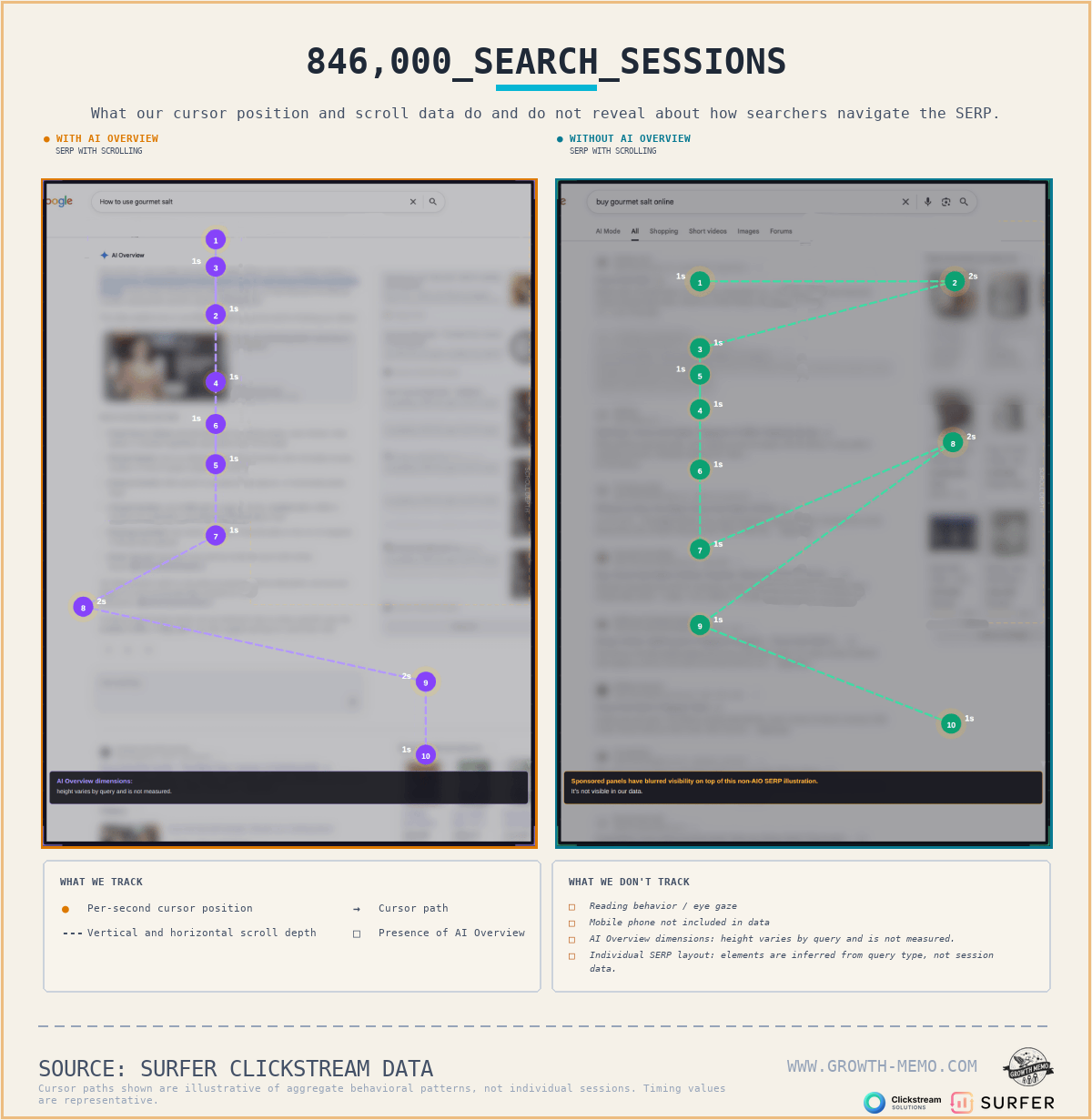
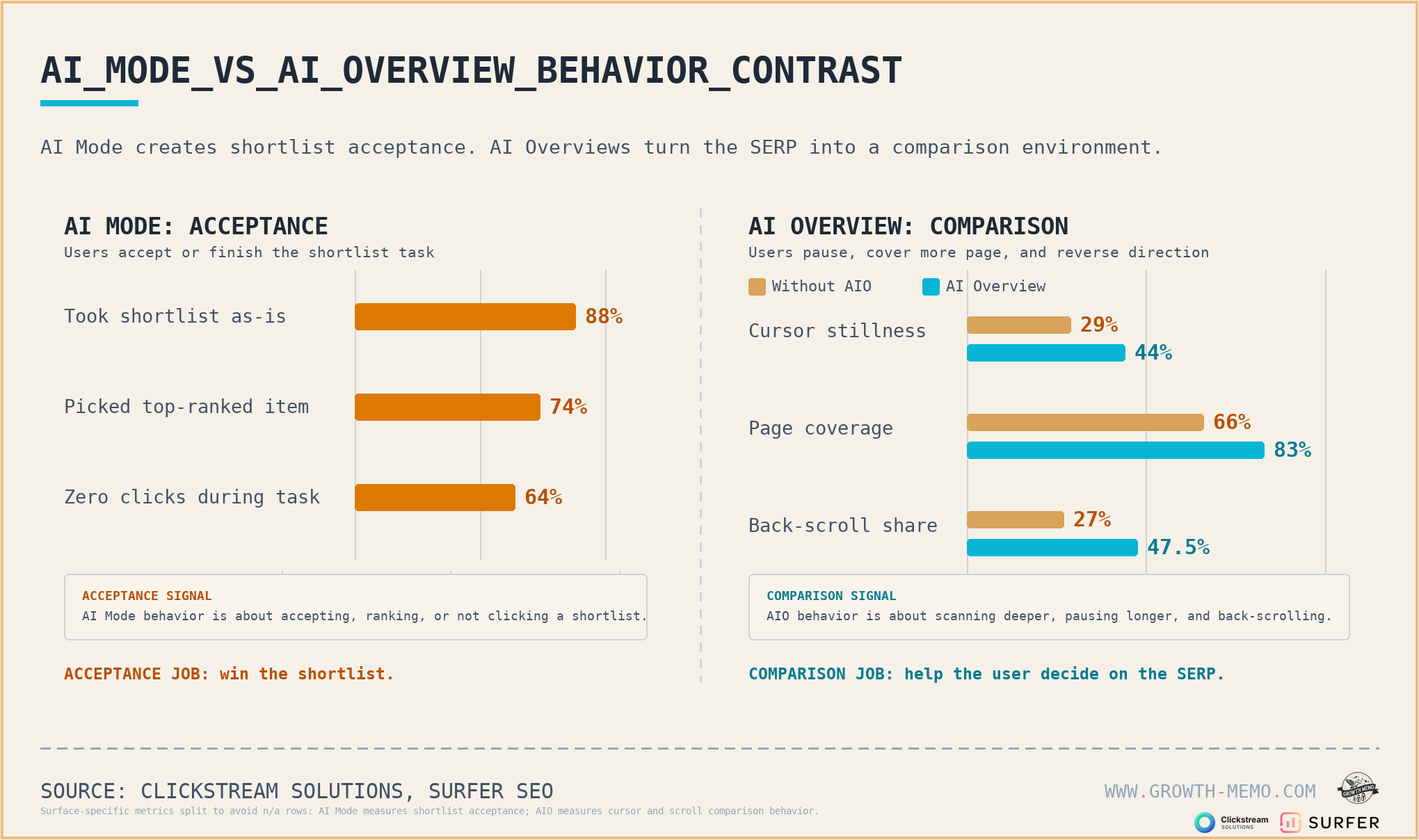
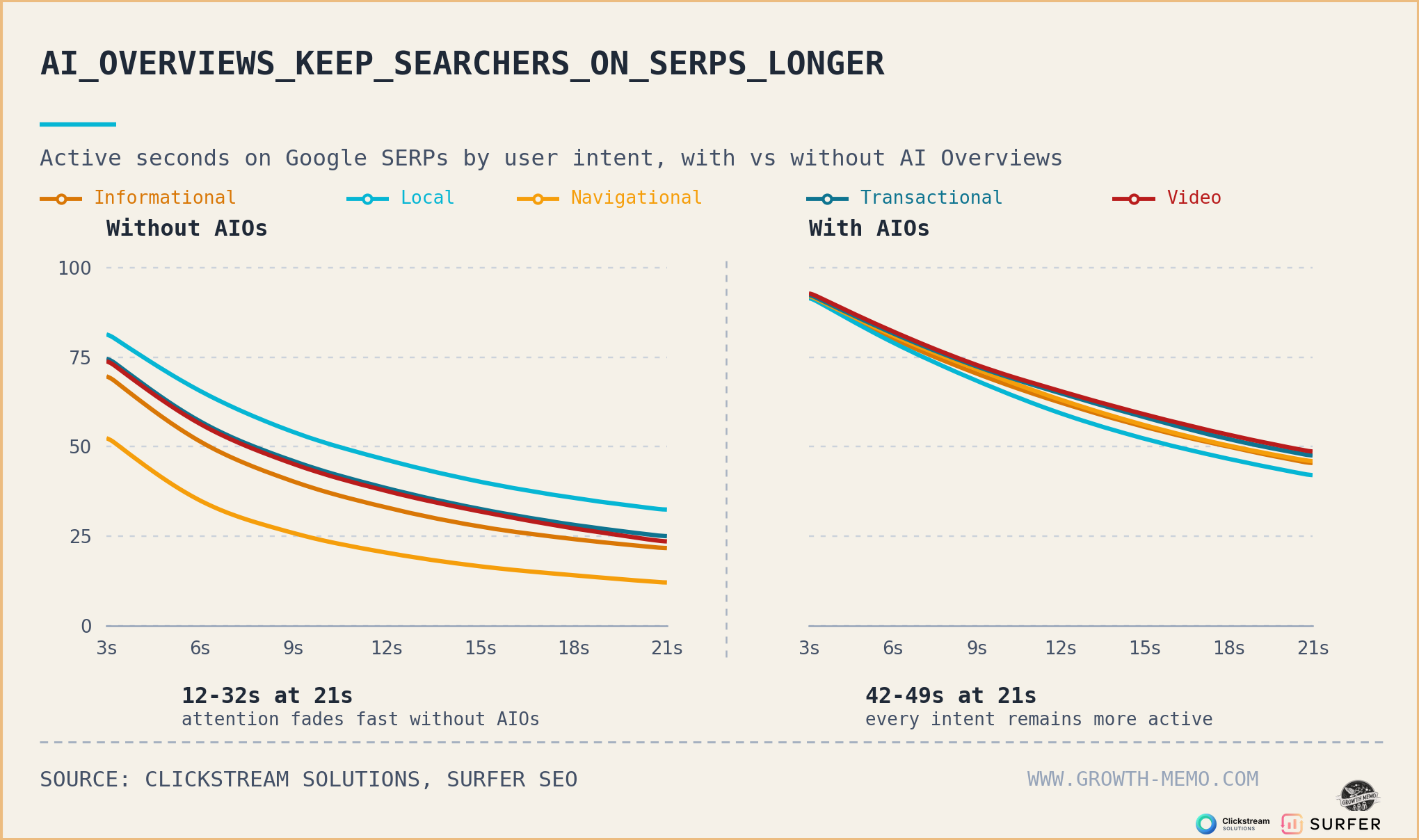
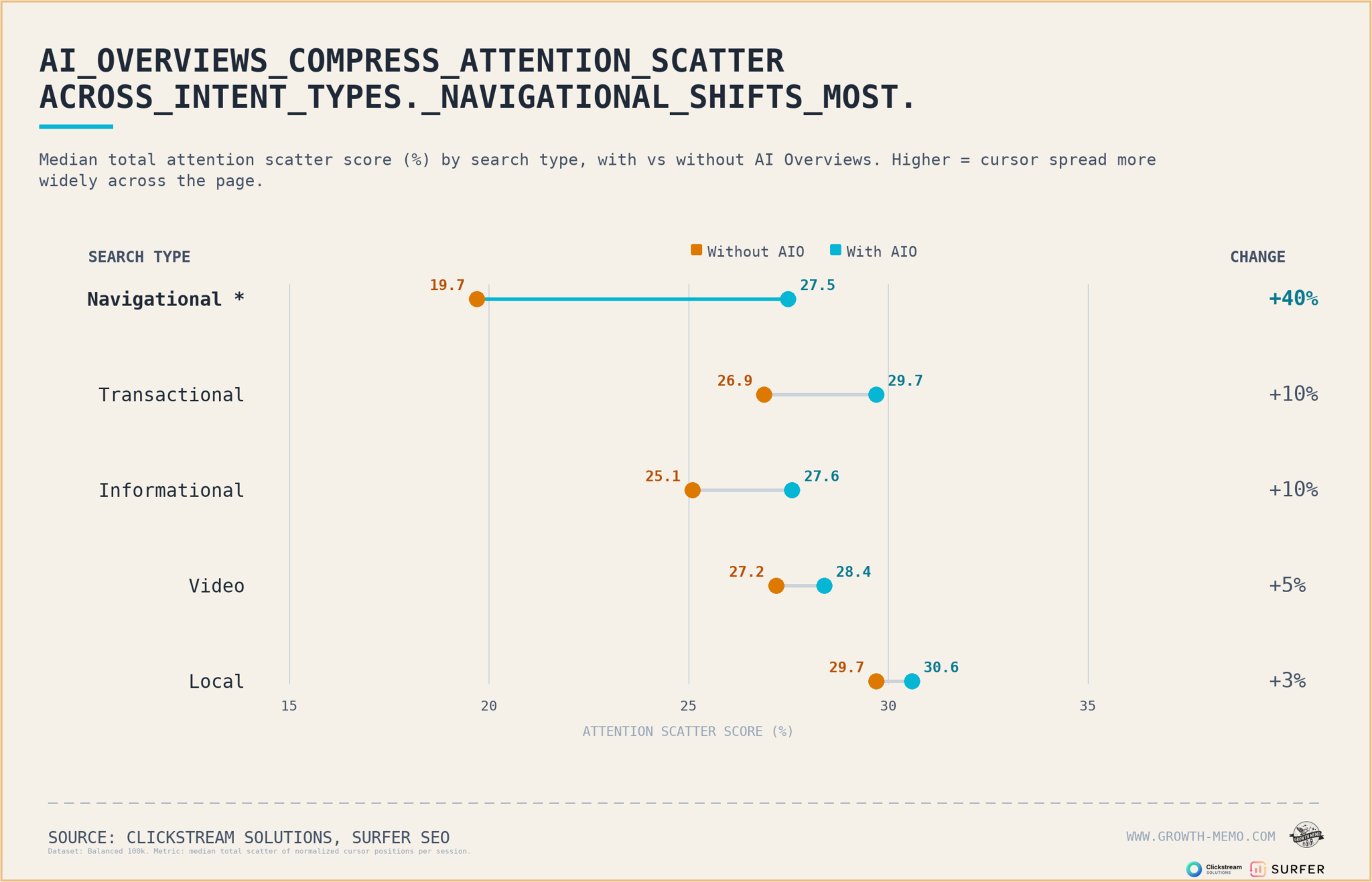
I find it fascinating that users interact differently when faced with AI Overviews compared to AI Mode. New clickstream data reveals that AI Overviews significantly alter user behavior—from reverse scrolling to extended evaluation of search results across various intents.
Take Netflix, for example. The average user spends about 18 minutes just browsing. They skim through tiles, watch trailers, and often circle back. It turns out, searching isn’t much different these days, thanks to new insights.
This week, I’m diving into:
Four notable behavioral shifts observed with AI Overviews, gathered from over 846,000 Google sessions.
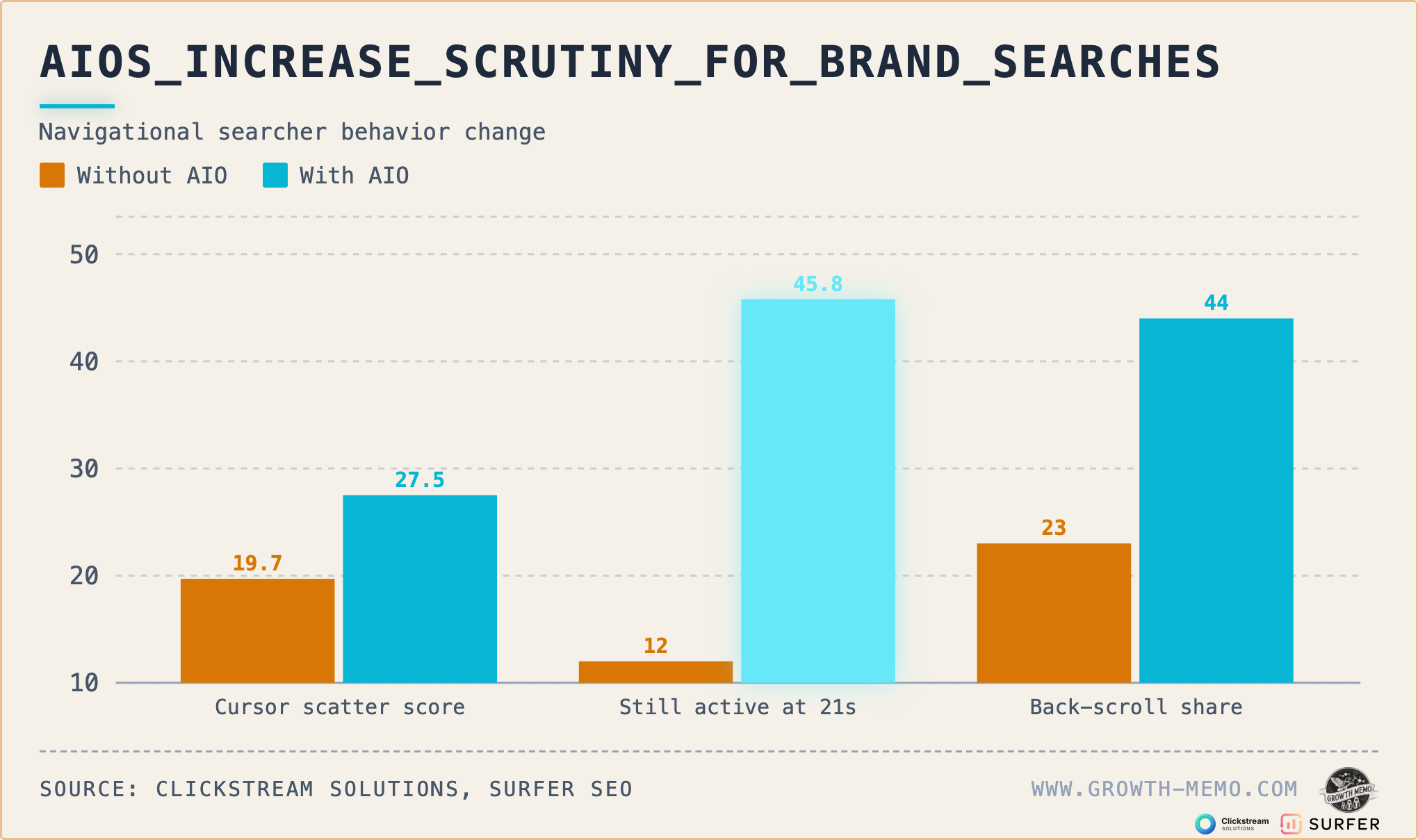
The evolving role of brand-name searches and why they no longer offer the same shortcuts.
An insight that might change how you craft title tags and meta descriptions this quarter.
Eric Van Buskirk from Clickstream Solutions mined anonymized clickstream data supplied by Surfer SEO. The study analyzed around 846,000 U.S.-based Google searches from February and March of 2026.
This marks the fifth study on user behavior with Google’s AI features over the past year. Earlier, a UX study on 70 users in May 2025 utilized think-aloud and screen recording methods, while a study from October 2025 examined AI Mode specifically. This research trades depth for scale, uncovering patterns too subtle for smaller studies.
For a bit of context, previous SERP mouse-tracking studies involved only a handful of people—this one, however, evaluates queries from tens of thousands of users.
A fascinating contrast surfaces: User behavior in AI Overviews starkly opposes that in AI Mode, where AI Mode is akin to autoplay, while AI Overviews replicate the browsing experience.
This article outlines four major findings from this recent study and how they might influence your title tags and meta descriptions in 2026. Full methodology available here.
With groundbreaking insights, like how nearly half of AI Overview interactions involve reverse scrolling and how search types no longer reliably predict behavior, this data is invaluable. It challenges traditional assumptions and has meaningful implications for e-commerce and decision-heavy categories.
Surprising findings include brand searches losing their shortcut advantage, implying even users searching specifically for brands might pause to consider adjacent content on the SERP.
Read more intriguing insights on how the AI landscape shifts user engagement and strategy in SEO.
You do not need another advertising dashboard that promises smarter automation. You need to know whether an AI-powered platform can reach the right people, optimize for a business result, and prove that it contributed to that result.
The safest way to evaluate these platforms is to separate reach, decision-making, and measurement. When those three layers are clear, you can use automation without surrendering control of your budget or accepting a platform’s preferred version of success.
Choose the buying journey before you choose the platform
Start with the moment you want to influence. A visual discovery campaign and a conversational recommendation may both use AI, but they address different behaviors.
Google is consolidating visual discovery inventory inside Demand Gen. A campaign can reach people across YouTube, Discover, Gmail, Maps, and Google Display Network sites. Advertisers can manage Display placements through Demand Gen and, when needed, keep delivery limited to the Display Network.
That setup is useful when your job is to create or reinforce demand across visual environments. It can support product discovery, introduce a service, or bring a previous visitor back with a stronger message.
Conversational advertising is developing around a different moment. OpenAI is preparing ads intended to generate purchases, appointment bookings, and contact-form submissions. The reported direction includes paying for completed outcomes rather than impressions, with an initial emphasis on smaller and local businesses. These capabilities are still emerging, so they belong on a readiness plan rather than in a forecast as guaranteed inventory.
Write one sentence before opening any platform: “We need this campaign to move a person from ___ to ___.” If the first blank is awareness and the second is consideration, broad visual distribution may fit. If the person is already discussing a need and the second blank is a booking or purchase, a conversational placement may eventually fit better. If you cannot complete the sentence, the platform will end up defining the campaign for you.
Evaluate AI at three separate layers
Calling a product “AI-powered” tells you very little. Ask what the system controls at each layer and what you can still inspect.
Layer
Question to ask
Evidence you should require
Distribution
Where can the platform place the ad?
A channel list, placement controls, exclusions, and a delivery breakdown
Decision-making
What signals determine who sees it and when?
Optimization settings, audience inputs, creative combinations, and change history
Measurement
What event counts as success?
A written conversion definition, deduplication rules, attribution settings, and reconciliation with your own records
This separation prevents a common mistake: treating more inventory as proof of better performance. Wider reach gives an algorithm more opportunities to serve ads. It does not automatically mean those opportunities are equally valuable.
For every automated expansion option, ask for a channel-level answer to three questions: How much did we spend? What did we receive? Would those conversions have happened through another channel anyway? If reporting cannot help you investigate those questions, do not increase the budget merely because the blended result looks efficient.
Build measurement before the algorithm starts learning
An optimization system can only pursue the signal you give it. If a low-value form submission and a completed sale are recorded as equivalent conversions, AI will optimize toward whichever event is easier to generate.
Name the business outcome. Use an event such as a qualified appointment, accepted lead, completed purchase, or retained customer. Avoid treating a page view as the final result when revenue happens later.
Document the event path. Record where the event begins, which system confirms it, and which identifier connects the ad interaction to the customer record.
Assign values that reflect the business. If outcomes have different economic value, send distinct values or separate them into different conversion actions.
Reconcile platform data with your records. Compare reported conversions with confirmed orders, bookings, or qualified leads. Investigate gaps before changing bids or budgets.
Define the feedback loop. Decide how cancellations, refunds, duplicate leads, spam, and unqualified enquiries will flow back into campaign analysis.
This work matters even more for conversational ads. OpenAI’s reported performance-advertising plans include a website pixel and API connections for conversion data. Pixel-only tracking can lose visibility because of browser restrictions and ad blockers. An API connection can provide a stronger path for confirmed customer actions, but only if your systems use stable identifiers and consistent event definitions.
Do not wait for a new platform to launch before cleaning up this layer. A reliable conversion specification can be reused across Google, Meta, a future ChatGPT campaign, and your internal reporting. It also gives finance, sales, and marketing one shared definition of a result.
Run a controlled test instead of handing over the account
Automation needs room to find patterns, but a useful test still needs boundaries. The goal is to learn whether the AI-controlled change produces incremental business value.
Choose one decision to test. For example, test the addition of Display inventory rather than changing inventory, creative, bidding, and the landing page at the same time.
Keep a comparison point. Preserve a campaign, channel view, geographic segment, or previous operating setup that helps you distinguish the tested change from normal demand fluctuations.
Set guardrails before launch. Define the permitted inventory, excluded placements, eligible locations, daily budget, conversion action, and the business metric that can stop the test.
Review placement and channel mix. A good blended cost can conceal weak delivery in one part of a cross-channel campaign.
Inspect lead and revenue quality. Compare platform conversions with accepted leads, fulfilled bookings, net sales, or another downstream result your team trusts.
Record every material change. Without a change log, you cannot tell whether performance moved because of the algorithm, new creative, tracking repairs, or a budget adjustment.
Channel controls are especially important as Google moves more Display management into Demand Gen. The ability to use broad cross-channel delivery or remain on the Display Network gives you a practical testing sequence: establish how the narrower setup behaves, expand deliberately, and then inspect where the additional spend went.
Use the same discipline when conversational ads become available to your business. A pay-for-success model sounds low-risk, but the definition and verification of “success” determine what you actually buy. Confirm whether the billable action is a submitted form, a qualified lead, a kept appointment, or a completed transaction. Those events are not interchangeable.
Key takeaways
Match the platform to the buying moment: visual discovery and conversational intent solve different problems.
Assess distribution, decision-making, and measurement separately instead of accepting “AI-powered” as a complete capability.
Give the algorithm a conversion that represents business value, then reconcile its reports with confirmed customer records.
Expand inventory through a controlled test with channel reporting, budget limits, exclusions, and a comparison point.
Treat emerging ChatGPT advertising as a planning opportunity until its formats, access, pricing, and measurement are available to your account.
Your next step is not to move the whole budget into an AI-led campaign. Write the conversion specification, audit the tracking path, and select one contained inventory or optimization decision to test. That gives the platform enough freedom to help while keeping the business outcome under your control.
Your AI pilot probably does not need a smarter demo. It needs an accountable owner, a credible baseline, reliable data, permission boundaries, an escalation path, and a clear reason to exist after the demonstration ends.
That is where many enterprise programs stall. In adoption data compiled through May 14, 2026, enterprises led at 25% adoption, but adoption covered everything from an initial trial to full-scale implementation. Among enterprise adopters, 62% remained in experimentation and only 13% had reached full deployment. If you are responsible for moving AI automation into production, the job is not to collect more use cases. It is to turn a carefully chosen workflow into a controlled, measurable operating process.
Key takeaways
Fund a defined workflow with a business owner, not a broad AI capability looking for a problem.
Record the current cost, delay, error rate, conversion rate, or customer outcome before changing the process.
Favor workflows with stable triggers, accessible data, verifiable completion, bounded exceptions, and reversible actions.
Treat the model as one component. Production also requires permissions, deterministic rules, evaluations, monitoring, audit logs, human escalation, and rollback.
Set stage-gate criteria and stop conditions before the pilot begins. A project that cannot prove value should end without becoming permanent experimental infrastructure.
Choose the first workflow by value and controllability
Start below the level of a department. Customer service transformation is too broad. Qualifying an after-hours inquiry, answering approved questions, and offering an available appointment is a workflow. Supply chain optimization is too broad. Detecting a delayed shipment, checking an approved set of alternatives, and preparing a resolution for review is a workflow.
This distinction matters because ordinary automation and agentic AI solve different parts of the process. A conventional automation follows predefined rules. Generative AI produces an output such as a summary or draft. An agentic system can plan, decide, and execute a multi-step task from beginning to end. More autonomy creates more ways to complete useful work, but it also expands the number of decisions, integrations, and failure modes you must control.
A strong initial candidate has the following properties:
A visible operational leak: Work is being delayed, repeated, missed, or handled at an unnecessarily high cost.
A stable trigger: The workflow starts from a recognizable event such as an inbound request, completed meeting, status change, or new record.
Accessible inputs: The required data can be retrieved with appropriate permissions and has meanings the operating team agrees on.
A verifiable finish: You can tell whether the appointment was booked, case was resolved, package was sent, record was updated, or decision reached the right person.
Bounded exceptions: Unusual cases can be recognized and routed to a person instead of forcing the system to improvise.
Manageable consequences: A wrong draft can be reviewed or discarded. An unauthorized payment, deletion, price change, or legal commitment is much harder to reverse.
Enough recurring demand: The workflow occurs often enough for reduced handling time, faster response, or higher completion to matter.
Score candidate workflows as high, medium, or low on each property. Do not average away a fatal weakness. Low data access, an undefined finish, or an unbounded consequence should block the candidate until the underlying process is redesigned.
A useful workflow can also be unglamorous. One documented PR automation locates a completed Zoom recording, creates a transcript, and prepares an email containing both for the journalist. It saves about 30 minutes per interview while shortening the handoff. The value comes from removing a specific delay, not from inventing a new communications platform.
Apply the same discipline to the build-versus-buy decision. Existing software should handle commodity functions such as scheduling, transcription, telephony, CRM records, and routine orchestration when it meets your requirements. Custom development is easier to justify when the workflow depends on a proprietary process, distinctive formula, or exclusive data that is central to the business. Otherwise, concentrate engineering effort on integration, policy, evaluation, and observability rather than recreating a mature product category.
Make the pilot prove a business case it cannot game
Before selecting a model or vendor, write a testable operating hypothesis:
By automating these defined steps for these eligible cases, we expect this business metric to move from its recorded baseline to an approved target, without worsening these guardrails, as measured in this system over this evaluation window.
If the team cannot fill in each part, it is not ready to approve the pilot. A goal such as improve productivity leaves too much room to declare success after the fact. Reduce median handling time for eligible requests while maintaining resolution quality and escalation compliance can be measured.
The measurement plan should separate five kinds of evidence:
Business outcome: Completed bookings, qualified opportunities, resolved cases, accepted deliverables, cycle time, recovered demand, or another result the operating owner already values.
Guardrail: Error severity, complaint rate, rework, policy violations, inappropriate messages, missed escalations, or another consequence that must not deteriorate.
Coverage: The share of incoming work that is actually eligible and processed. A system can perform well on a narrow subset without materially changing the operation.
Technical diagnostic: Extraction quality, classification quality, tool-call success, retrieval failures, latency, retries, and exception frequency. These explain performance but do not replace a business result.
Economics: Software, model usage, integration, monitoring, review labor, incident handling, and ongoing process ownership.
Measure the baseline before the team sees pilot results. Otherwise, definitions tend to drift toward whatever the system can demonstrate. Specify which cases qualify, which are excluded, where each metric comes from, and who resolves disputed labels. When feasible, compare pilot cases with equivalent manually handled cases rather than assuming every change came from the automation.
Do not count outputs as outcomes. Drafts generated, conversations handled, or tasks attempted are activity measures. They matter only when the workflow reaches a valid completion or produces verified capacity that the business can use. Time saved is not automatically a cash saving, either. State whether the capacity will absorb growth, reduce a queue, improve service, avoid new hiring, or be reassigned to higher-value work.
Revenue automations need an additional capacity check. AI can help build targeted prospect lists, accelerate qualification, recover missed calls, and respond outside staffed hours, but increased demand can damage the customer experience when the business cannot fulfill it reliably. Map the next handoff before accelerating the top of the funnel. A faster response is not valuable if it creates an unstaffed queue downstream.
Finally, define the stop rule while expectations are still neutral. Stop, narrow, or redesign the pilot if it cannot move the primary outcome, breaches an approved guardrail, depends on unsustainable review labor, or lacks a credible path to production economics. Unclear success criteria and weak data are recurring reasons AI projects fail to progress, while cost pressure is particularly important for smaller organizations. An enterprise budget may delay that reckoning, but it does not remove it.
Build the operating system around the model
Separate deterministic rules from model judgment
Map the workflow from trigger to completion before deciding what the model should do. For every step, record the input, rule or judgment, system of record, permitted action, expected output, exception path, and owner.
Use ordinary code or workflow rules where the answer is deterministic. Required fields, account permissions, arithmetic, approved status transitions, duplicate checks, and routing tables should not become probabilistic merely because a language model is available. Use AI where interpretation is genuinely required, such as extracting intent from a message, summarizing an interaction, comparing unstructured evidence, or preparing a response under policy constraints.
This separation makes failures easier to locate. It also reduces the chance that a persuasive output will bypass a rule the business intended to enforce.
Increase authority only after the evidence supports it
Autonomy should be an explicit permission level, not an accidental property of an integration. A practical authority ladder is:
Read and recommend: The system analyzes data but cannot change a record or communicate externally.
Prepare a draft: It creates a message, decision, or action package for a person to review.
Execute after approval: A named reviewer authorizes the action with the relevant evidence visible.
Execute within narrow limits: The system acts only for approved case types, values, destinations, and tools; exceptions are escalated.
Execute the bounded workflow: The system completes eligible work autonomously while monitoring, audit, and shutdown controls remain active.
Start at the lowest level that can test the business hypothesis. Advance only when the prior level meets predeclared quality and guardrail requirements. Full deployment does not require maximum autonomy. A stable draft-and-approval system can be the right production design when the action carries legal, financial, employment, security, reputational, or regulatory consequences.
Use least-privilege credentials and separate test access from production access. Restrict the agent to the systems, records, fields, and actions required for the approved workflow. Payments, deletions, contractual commitments, price changes, sensitive employee decisions, and regulated communications should not become autonomous merely to remove a review step. If the business later approves that authority, it needs risk-specific testing, monitoring, and recovery controls.
Make every handoff observable and recoverable
A production trace should let an operator reconstruct what happened without relying on the model to explain itself. Capture the case identifier, input snapshot, relevant data version, workflow and prompt version, model and tool calls, retrieved evidence, proposed action, approval or override, external write, error, retry, elapsed time, unit cost, and final business outcome.
Design retries so they do not duplicate a booking, order, message, refund, or record. Provide a clear shutdown control, queue failed work for recovery, and document how the operating team restores the last valid state. Alerts should identify an actionable condition and its owner; a dashboard that merely shows activity will not shorten an incident.
Data readiness should be scoped to the workflow. You do not need to repair every enterprise dataset before beginning, but you do need a reliable contract for the fields this automation uses: canonical definitions, stable identifiers, permitted sources, freshness expectations, missing-value behavior, conflict resolution, and write-back ownership. Poor-quality and inconsistent data are common barriers to successful agent deployment. Giving an agent access to more systems does not solve disagreement between those systems.
Build an evaluation set from representative normal cases, boundary cases, known exceptions, and costly failure modes. For each case, define an acceptable result, required escalation, and prohibited action. Run it before live access, compare the system with the existing process in shadow mode, and retain it as a regression suite whenever the prompt, model, tools, policy, or data mapping changes. Production monitoring then checks whether real traffic is drifting beyond what the evaluation set covered.
Use stage gates to escape permanent pilot mode
The large gap between experimentation and full deployment is a governance problem as much as a technical one. Teams can keep improving a demonstration indefinitely when nobody has defined the evidence required for the next decision. Gartner has projected that around 40% of agentic AI projects could be canceled by 2027. Cancellation is not necessarily the wrong outcome; discovering weak value or uncontrolled risk early is cheaper than scaling it.
Gate
Evidence required
Decision
Workflow approval
Named owner, process map, baseline, eligible cases, business hypothesis, risks, and stop rule
Approve a bounded test, redesign the workflow, or reject the use case
Offline validation
Data contract, representative evaluation set, expected results, prohibited actions, permission design, and cost model
Move to shadow operation only if declared quality and safety requirements are met
Shadow operation
Comparison with the existing process, exception analysis, reviewer feedback, diagnostic logs, and revised operating procedures
Enter limited production, narrow the scope, or return to offline work
Limited production
Verified business outcome, guardrail performance, coverage, review burden, incident response, rollback, and actual unit cost
Scale, maintain the bounded scope, redesign, or stop
Operational scale
Accountable service owner, support model, change control, recurring evaluation, capacity plan, security review, and portfolio funding
Expand only while value and controls remain intact
Set the thresholds for these gates according to the consequence of failure, and approve them before results arrive. A drafting assistant and a payment agent should not share the same tolerance. The important discipline is that the team cannot redefine success after seeing the output.
At portfolio level, centralize the controls that should be consistent and decentralize ownership of the business outcome. A central AI function can provide identity, approved integrations, logging, evaluation tooling, security patterns, vendor review, and incident standards. The operating team should still own the process, metric, exceptions, staffing impact, and customer consequence. If ownership remains with an innovation lab after launch, the automation has not truly entered the business.
Maintain a register of active automations showing the workflow owner, systems touched, data classification, permitted actions, risk level, deployment stage, model and vendor dependencies, current economics, and next gate. Use it to find duplicate experiments, unsupported integrations, and pilots that consume resources without approaching a decision.
Before the next platform purchase, choose a specific queue or handoff that is already causing measurable loss. Name its owner, baseline, eligible cases, prohibited actions, escalation path, and stop rule. If those items cannot be written clearly, more AI will not make the process ready. If they can, you have the beginning of an automation that can earn its way into production.