AI Search in Multilingual Regions: Lessons from Catalonia

```json
{
  "alt": "Collage of Barcelona landmarks and vintage maps with search bar in foreground.",
  "caption": "Explore the rich tapestry of Barcelona through iconic landmarks and historical maps, with a modern twist symbolized by a digital search bar.",
  "description": "This vibrant image collage features prominent Barcelona landmarks like Sagrada Familia and landmarks combined with vintage maps and artistic elements. A digital search bar floats in the foreground, symbolizing the intersection of history and exploration in the digital age. The design includes textural overlays and a color palette of blues, greens, and reds, enhancing the cultural richness and artistic allure of the city. Keywords: Barcelona, landmarks, maps, digital exploration."
}
```

When I think about AI search, I realize it’s more than just translating or localizing results. It’s about deciding which sources, narratives, and realities emerge on top. This complex system is incredibly fascinating to me, especially when I consider how multilingual regions like Catalonia challenge these AI search systems.

The unique geography of Catalonia, where Catalan and Spanish languages coexist, serves as an excellent stress test for AI technology. It’s intriguing to see the underlying patterns unfold when the same queries are entered in both languages across platforms like Google AI Overviews and ChatGPT.
```json
{
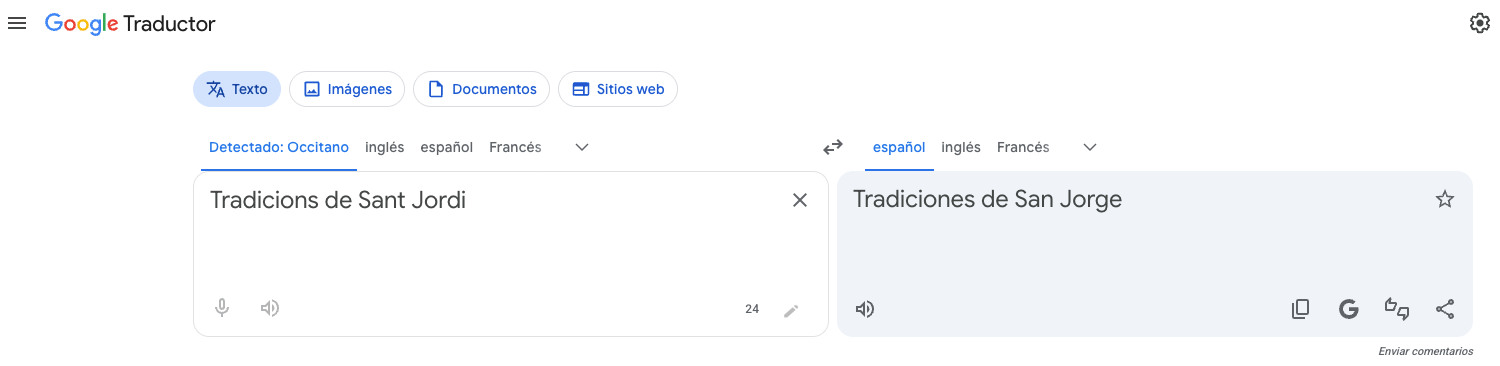
  "alt": "Google Translate interface translating Occitan text to Spanish.",
  "caption": "Google Translate translates 'Tradicions de Sant Jordi' from Occitan into Spanish as 'Tradiciones de San Jorge'.",
  "description": "The image shows the Google Translate interface with text input in Occitan being translated to Spanish. The Occitan text 'Tradicions de Sant Jordi' is translated to 'Tradiciones de San Jorge' in Spanish. The interface features options for translating text, images, documents, and websites. Language options include Occitan, English, Spanish, and French."
}
```

In Catalonia, a query like Tradicions de Sant Jordi shows how AI systems can sometimes misidentify the language, often tagging Catalan as Occitan. This discovery was both surprising and revealing, shedding light on broader problems that transcend multilingual spaces.

```json
{
  "alt": "The CapmatchOne logo with a gradient circle and bold text.",
  "caption": "Discover innovation with the CapmatchOne logo, featuring sleek typography and a modern gradient circle.",
  "description": "The CapmatchOne logo features bold, modern typography coupled with a gradient circle, symbolizing connection and innovation. The sleek design conveys a sense of progress and creativity. This image can be used for branding or promotional purposes, appealing to audiences interested in innovative solutions and forward-thinking designs."
}
```

Consider this: an AI system operating out of Barcelona with a local IP may choose the less prevalent language of Occitan over Catalan, a decision that feels bizarre given Catalonia’s linguistic and geographical context.
```json
{
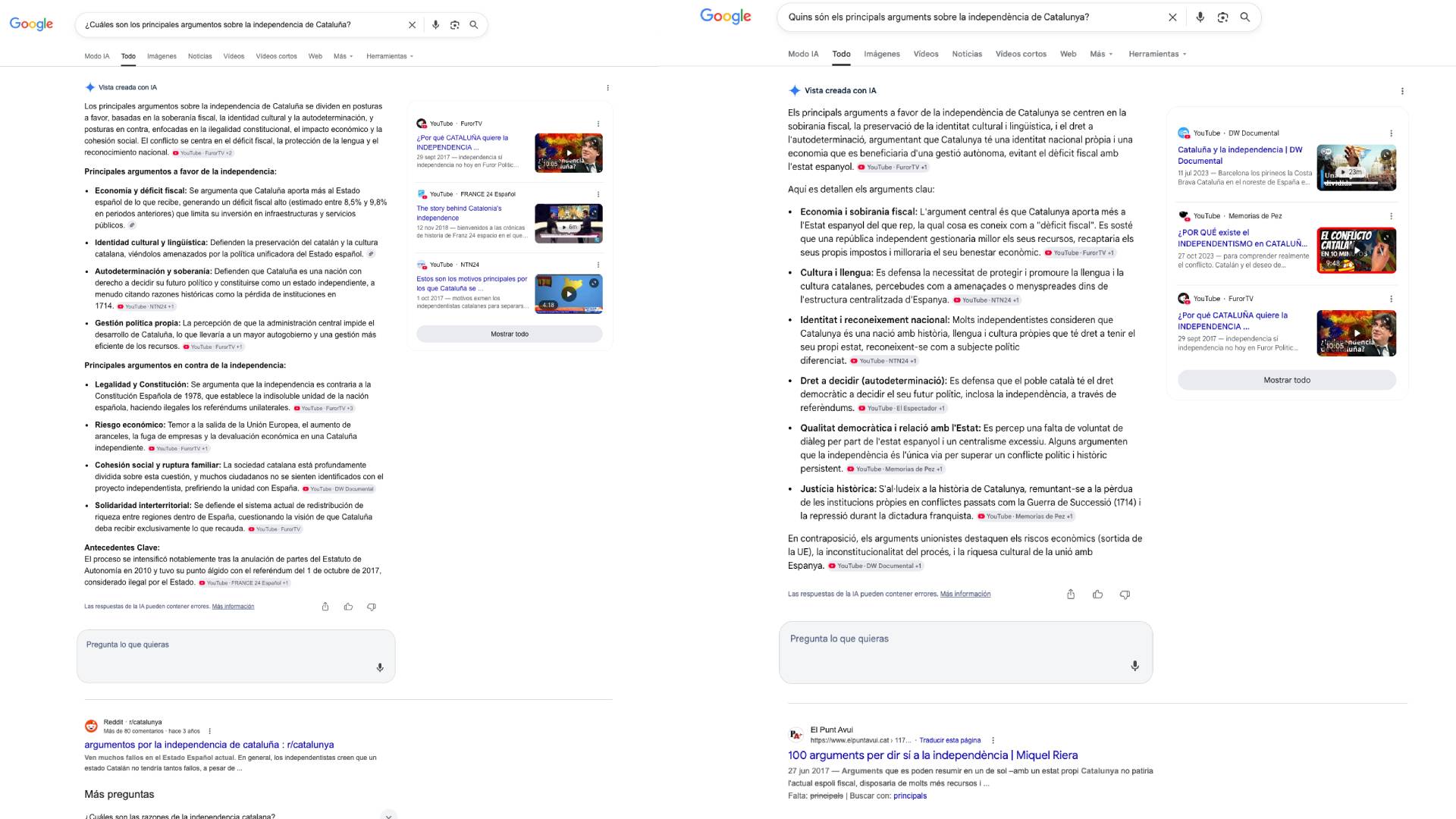
  "alt": "Google search results comparing arguments for and against Catalonia's independence in Spanish and Catalan.",
  "caption": "Exploring the heated debate on Catalonia’s independence, this image compares arguments in both Spanish and Catalan, highlighting economic, cultural, and political perspectives.",
  "description": "This image captures a side-by-side comparison of Google search results detailing the main arguments for and against the independence of Catalonia, presented in Spanish on the left and Catalan on the right. Each side discusses key aspects like fiscal solvency, cultural identity, and political autonomy, contrasting them with concerns about legality, economic risks, and social cohesion. The search includes links to related YouTube videos and discussions, offering a comprehensive view of the independence debate."
}
```

This issue isn’t isolated. In January 2023, Google acknowledged downgrading Catalan results in favor of Spanish, which sparked dissatisfaction among users. The subsequent updates improved things somewhat, but the root language-identification errors persist, affecting how AI synthesizes information today.
```json
{
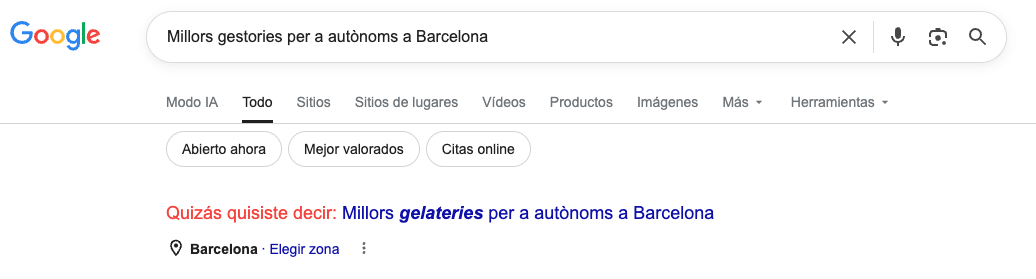
  "alt": "Google search showing suggestion for 'business managers' corrected to 'ice cream shops' in Barcelona.",
  "caption": "A Google search mix-up turns a query for business managers into a quirky suggestion for ice cream parlors in Barcelona.",
  "description": "This image displays a Google search results page where a query for 'Millors gestories per a autònoms a Barcelona' (best business managers for freelancers in Barcelona) is humorously corrected to 'Millors gelateries per a autònoms a Barcelona' (best ice cream shops for freelancers in Barcelona). The suggestion is highlighted in blue under a prompt reading 'Quizás quisiste decir' (Did you mean). Tabs for search modes like 'Modo IA', 'Todo', and others are visible. Keywords: Google search, autocorrect fail, Barcelona, business, ice cream."
}
```

My journey into this topic has involved documenting AI search variations across Hispanic markets, observing how it often treats diverse Spanish-speaking regions as uniform, ignoring their unique contexts. However, in Catalonia, where geography remains constant, the retrieval patterns unfold in more distinct and educational ways.
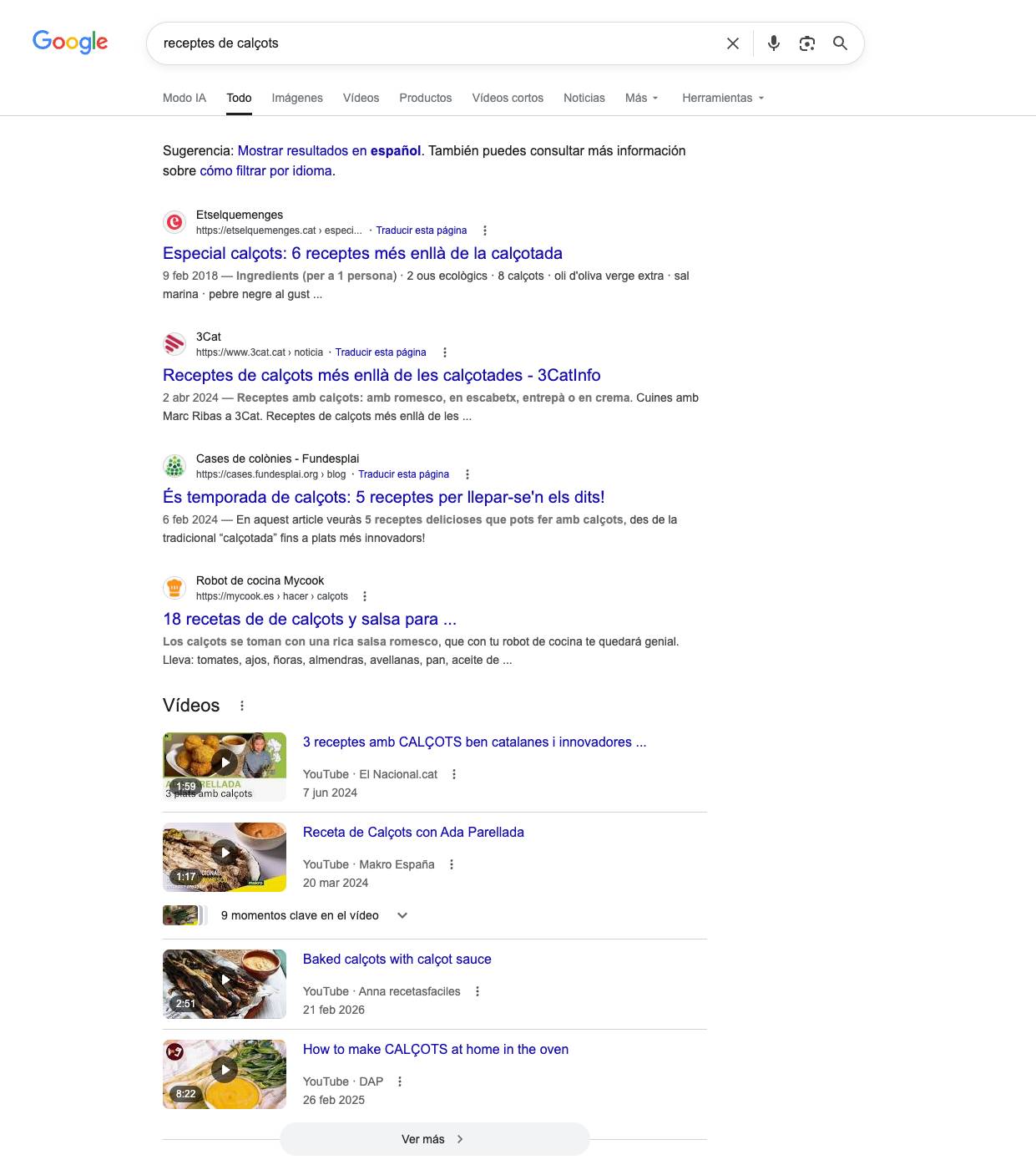
```json
{
  "alt": "Search results for recipes of calçots on Google, displaying webpages and YouTube videos.",
  "caption": "Discover how to make delicious calçots with these search results featuring a variety of recipes and instructional videos.",
  "description": "This image shows the Google search results page for 'recetas de calçots,' highlighting various online resources such as Estelquemenges, 3CatInfo, and Casces de colines. The results include both textual content and a section specifically for YouTube videos, offering recipes and cooking tips for preparing calçots, a popular Catalan dish. Keywords like 'calçots,' 'recipes,' and 'cooking' are relevant for discovering these culinary guides."
}
```

For me, multilingual regions expose the foundational defaults in retrieval systems. Here, users can switch languages and observe firsthand how the system reallocates meaning, authority, and even the language of an answer.

The reality is, the same issues will likely emerge in seemingly monolingual markets, manifesting in different ways as AI technology advances.


Inspired by this post on Search Engine Land.


crushpress.ai community screenshot

FAQs

Why does Catalonia serve as a stress test for AI search systems?

Because Catalan and Spanish coexist, AI must correctly identify language and determine which sources and narratives to prioritize. The post highlights language identification errors and shifting retrieval patterns in multilingual contexts.

What language identification issue is highlighted in Catalonia?

AI systems sometimes misidentify Catalan as Occitan, illustrating broader language-detection challenges. This mislabeling affects which results are shown.

What historical note does the post mention about Catalan results in search?

In January 2023, Google acknowledged downgrading Catalan results in favor of Spanish. The post notes these issues persisted despite updates.

How might a Barcelona-based IP influence language choice in AI search?

An AI system operating from Barcelona with a local IP may prioritize Occitan over Catalan, illustrating contextual biases in language targeting.

What broader conclusion does the post draw about multilingual regions and AI retrieval?

The same issues are likely to emerge in seemingly monolingual markets as AI technology advances. Multilingual contexts reveal underlying defaults in retrieval systems.

Comments

Leave a Reply

Your email address will not be published. Required fields are marked *