
An integrated search and discovery strategy starts with a practical observation: customers may encounter a brand on a recommendation platform, investigate it through an AI-generated answer, validate it on Google and convert through a paid or organic visit. Treating each of those encounters as a separate contest obscures how the decision develops.
The useful question is therefore not whether SEO, paid search or social media should win the budget. It is which combination can create demand, answer questions, establish confidence and convert attention efficiently.
Key takeaways
- Plan around the customer’s decision process rather than treating search, social and AI as isolated channels.
- Measure visibility and influence as well as clicks because many searches now end without a website visit.
- Assign paid, organic, local and discovery media different jobs according to the market, customer and economics.
- Manage brand visibility, media reach and post-click experience as one performance system.
Why the SEO-versus-PPC contest no longer describes the market
The traditional channel debate assumed that a customer entered a query, saw a reasonably stable results page and selected either an advertisement or an organic listing. Under that model, SEO and PPC could be evaluated as alternative ways to acquire substantially the same click.
The article SEO vs. PPC Is Over: Why AI Makes Integration Essential describes a different environment. It reports that 68.01% of U.S. Google searches during the first four months of 2026 ended without a click, compared with 60.45% in 2024. It also cites Seer Interactive findings in which the average organic click-through rate for queries displaying AI Overviews fell from 1.76% to 0.61%. These are source-reported figures rather than independently verified measurements, but they illustrate why rankings and traffic can no longer provide a complete account of search performance.
The same article cites SparkToro and Datos research spanning 41 platforms. In that research, Google accounted for 73.7% of desktop searches, while traditional search engines collectively represented about 80%. Commerce platforms accounted for roughly 10%, social platforms for 5.5% and AI tools for 3.2%. It further reported that Amazon, Bing and YouTube each handled more search activity than ChatGPT. The implication is not that Google has become unimportant. It is that information seeking is distributed across environments with different interfaces and forms of influence.
Integration addresses two related forms of compression. AI-generated answers can satisfy some needs before a click occurs, while crowded results pages can push even a top organic result below advertisements, local features and other links. A brand must consequently earn recognition before the query, be credible within answer and validation surfaces, secure prominent access when commercial intent appears and make any resulting visit more valuable.
Model the journey from passive discovery to commercial action
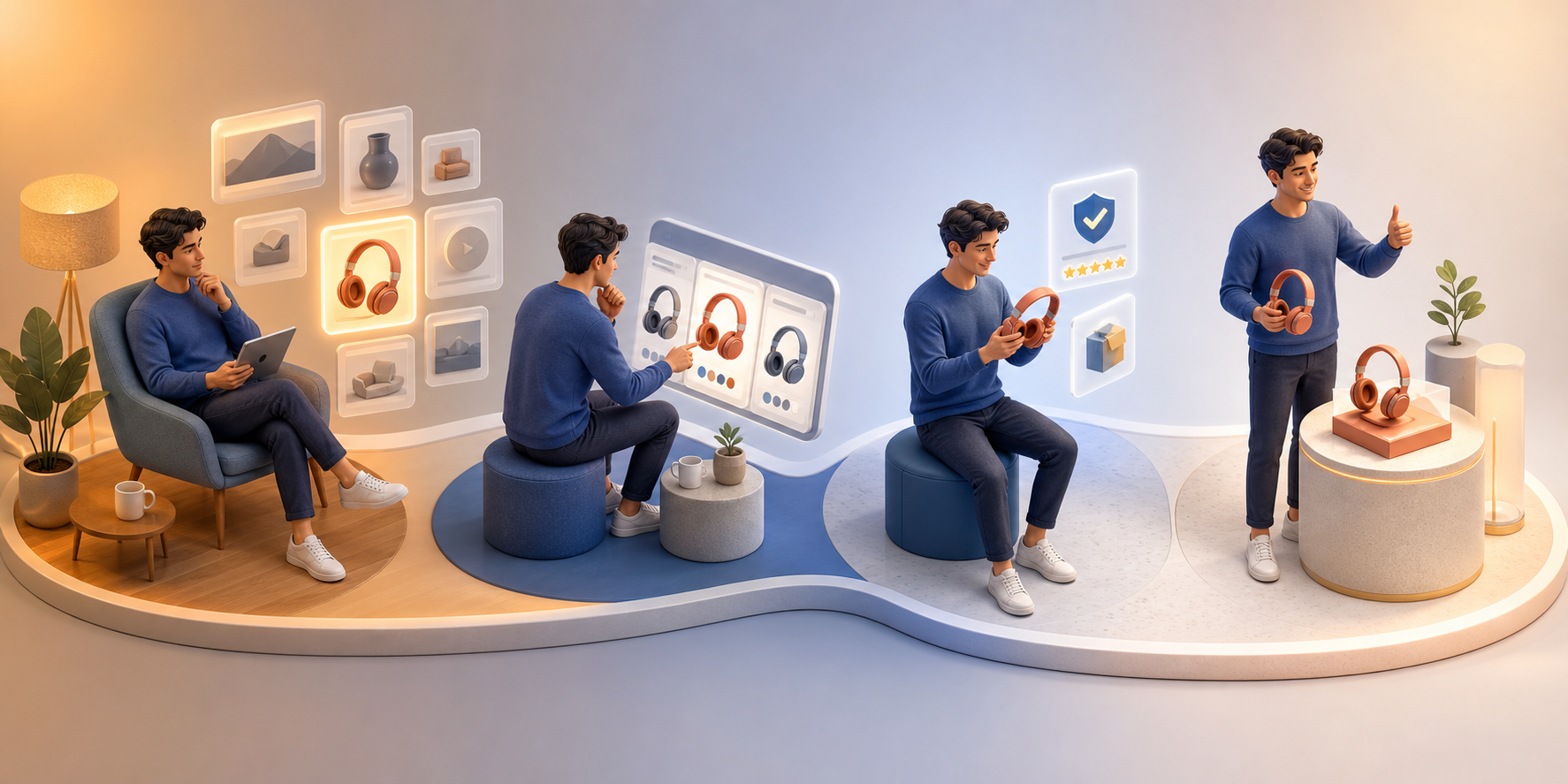
The beginning of a buying journey may now be an unsolicited recommendation rather than an expressed query. Why Your Next Customer May Find You on TikTok Before Google explains how TikTok can infer interests from signals such as watch time, rewatches, pauses, shares and saves. The article also cites a Google executive’s statement that almost 40% of young people looking for somewhere to eat turn to TikTok or Instagram instead of Google Search or Google Maps.
That pattern is especially relevant where appearance, atmosphere or demonstration affects confidence. The TikTok article identifies restaurants, hotels, beauty, fitness and retail as examples in which short-form video can create an initial preference before formal research begins. Google, Maps, reviews and a business’s website may then serve as confirmation and transaction surfaces.
| Decision stage | Customer behavior | Primary strategic job | Useful measurement |
|---|---|---|---|
| Discovery | Encounters an idea without requesting it | Use native video, creators, communities or editorial distribution to earn relevant attention | Qualified reach, viewing depth, saves and subsequent brand interest |
| Exploration | Looks for explanations, comparisons or possibilities | Publish useful material that search engines, social platforms and AI systems can interpret | Topic visibility, engaged visits, mentions and assisted actions |
| Validation | Checks reputation, location, suitability and alternatives | Coordinate organic results, local profiles, reviews, brand information and selective paid coverage | Branded demand, profile actions, qualified inquiries and conversion paths |
| Action and capture | Visits, inquires, purchases or continues a longer evaluation | Reduce friction, clarify the offer and obtain permission for an ongoing relationship when appropriate | Conversion quality, acquisition cost, lead progression and customer value |
This model also turns discovery platforms into research inputs. The TikTok article points to Creator Search Insights as a source of rising topics, unanswered questions and content gaps. Those observations can inform search pages, FAQs, local content, editorial planning and product positioning. The purpose is not to duplicate one asset everywhere, but to carry a coherent answer across formats suited to each environment.
Assign channels by the constraint they can resolve
A fixed channel hierarchy fails because businesses need different volumes, types and timings of demand. The two client examples reported in SEO vs. PPC Is Over demonstrate the contrast.
In the first example, an architect held top organic rankings for apparently valuable terms but received few leads. The article reports that advertisements, a search feature and local listings placed roughly 20 links ahead of the number-one organic result. Search Console showed about 300 monthly searches and a click-through rate near 1%, equating to approximately three clicks. Moving part of the SEO budget into paid search improved performance because the immediate problem was insufficient visibility where users were looking.
The second example involved a clinical psychologist whose capacity could be filled with only two or three high-quality inquiries per week. According to the article, a focused combination of a rebuilt website, on-page and local SEO, a Google Business Profile and relevant citations produced enough visibility across Maps, local organic results and AI-generated results. Paid reach was unnecessary because the constraint was not lead volume; it was attracting a small number of suitable local prospects.
These cases suggest a more disciplined allocation test. A business should identify whether its binding constraint is awareness, answer visibility, results-page prominence, local credibility, conversion capacity or lead quality. Paid search can bridge a prominence or timing gap. Organic and local work can build durable relevance and confidence. Recommendation media can introduce options before explicit demand exists. AI visibility can influence research even when no referral click follows.
Budget should follow the constraint and the marginal value of resolving it, not a predetermined percentage for each channel. A top organic position with negligible exposure may be less useful than paid placement, while a low-capacity specialist may gain little from purchasing additional volume. The relevant outcome is qualified business contribution across the journey.
Manage media economics and measurement as one system

Integration also changes how rising acquisition costs should be diagnosed. Why I See CPC Inflation Starting Before the Search Auction argues that cost pressure begins upstream when AI answers absorb clicks, organic traffic contracts and more advertisers pursue the remaining commercial opportunities. The article cites a WordStream cross-industry average cost per click of $5.42 and Stackmatix estimates that Google Search CPCs rose 14% to 18%. Those benchmarks may not describe every account, but the reported direction supports examining more than bids and ad copy.
The CPC article organizes the response around brand, reach and experience. Brand activity can increase recognition across publications, communities, organic results and AI answers before an auction occurs. Reach management includes targeting, match types, creative, bidding automation and guardrails, as well as testing less-crowded inventory. The article proposes measured experiments involving Microsoft Advertising, Reddit, LinkedIn Thought Leader Ads, niche newsletters, connected television, podcasts and emerging AI search advertising rather than abandoning Google Search.
Experience determines the value recovered from an acquired visit. The same source notes that landing-page experience contributes to Google’s Quality Score and argues that stronger pages can improve both conversion economics and auction competitiveness. For longer decisions, the page may also need to capture first-party permission or support a later return rather than forcing an immediate sale.
Measurement should mirror these connected roles. Discovery reporting can examine attention quality and later changes in brand interest. Search reporting can separate informational, navigational and transactional demand instead of blending unlike queries. Conversion reporting can follow qualified leads or revenue beyond the first click. Controlled budget tests, consistent campaign naming and shared definitions of a qualified outcome can help distinguish genuine contribution from platform-claimed credit.
No single metric will reconcile a journey distributed across recommendation feeds, AI answers, search features, advertisements and websites. The practical operating model is a shared evidence loop: discovery signals shape content, content strengthens validation, paid media covers consequential gaps, and conversion evidence informs the next allocation decision. As interfaces continue to change, organizations that maintain that loop will be better equipped to adapt without rebuilding strategy around every new platform.
References
- CrushPress.AI — Why I See CPC Inflation Starting Before the Search Auction
- CrushPress.AI — SEO vs. PPC Is Over: Why AI Makes Integration Essential
- CrushPress.AI — Why Your Next Customer May Find You on TikTok Before Google
Leave a Reply