Month: July 2026

  • How Expanded PMax Reporting Changes Performance Analysis

    How Expanded PMax Reporting Changes Performance Analysis

    Google’s product-level reporting now captures a wider share of the activity associated with Performance Max and several other campaign types. That added visibility can help advertisers understand product results across more of Google’s inventory, but it also creates an abrupt break in reporting continuity.

    The practical challenge is interpretation: a chart may rise because more activity is being counted, not because ads suddenly became more effective. Advertisers therefore need to distinguish a measurement expansion from a true performance change.

    What changed in product-level reporting

    Search Engine Land reports that, as of June 15, Google expanded Performance Max product reporting beyond Search network activity. Previously, reported metrics such as cost and conversions covered products served through Search networks and Standard Shopping campaigns.

    The expanded scope includes product performance data from the following eligible campaign inventory:

    • All Performance Max networks
    • Video campaigns
    • App campaigns
    • Demand Gen campaigns where product data is available through Google Merchant Center

    This is primarily a reporting change. It gives advertisers a broader view of where product interactions occur, but the source does not indicate that the campaigns themselves were altered by the update.

    Why performance charts may show a sudden jump

    When a report begins counting activity from additional networks, its totals can increase even when underlying campaign behavior remains stable. Search Engine Land says advertisers may see higher impressions, clicks and other metrics as a one-time consequence of the wider reporting scope.

    That distinction matters because a larger reported total is not automatically evidence of improved targeting, stronger creative or better bidding. Performance should be judged only after determining whether the apparent change came from campaign results, measurement coverage or a combination of both.

    Futuristic web browser and analytics dashboard overlap amid neon data streams, illustrating the convergence of SEO, PPC and AI-driven search marketing.
    Organic visibility, paid media and artificial intelligence merge into one connected search ecosystem, where vivid data streams link a creative website with a powerful analytics dashboard.

    Key takeaways for advertisers

    • Product reports now include more eligible Google Ads inventory than they did before the June 15 change.
    • Sudden increases in reported activity may reflect newly included networks rather than genuine growth.
    • Results from before and after the reporting expansion are not directly comparable without qualification.
    • Network-level filtering and clear report annotations can reduce the risk of misreading the change.

    How to handle historical comparisons

    The reporting boundary creates a discontinuity in time-series analysis. A month-over-month comparison that crosses June 15 may combine two different measurement scopes, so the percentage change alone cannot explain what happened.

    Advertisers can make those reports more useful by marking the date of the methodology change and explaining it in client or stakeholder summaries. Where possible, periods measured under the same scope should be compared with one another. If a report must cross the boundary, any observed lift should be presented as potentially influenced by expanded coverage.

    This caveat also applies to internal benchmarks, forecasts and automated dashboards that rely on historical trends. The underlying data may still be valuable, but the change in scope needs to remain visible to anyone using it for decisions.

    A practical review workflow for affected accounts

    A disciplined review can prevent a measurement change from being mistaken for a campaign win or loss:

    1. Identify reports and dashboards that use Performance Max product-level data.
    2. Check whether the analysis period spans the June 15 reporting change.
    3. Use the Network (with search partners) filter to examine where the newly reported activity originated.
    4. Review impressions, clicks, cost and conversions in context instead of treating any single increase as proof of improvement.
    5. Add a concise methodology note to recurring reports and explain the change to stakeholders.

    Google Ads specialist Bia Camargo highlighted the notice, according to the source, and cautioned that clients should be prepared for apparent gains caused by expanded measurement. That communication step is important because broader reporting is useful only when decision-makers understand what changed.

    As future reporting periods accumulate under the new scope, comparisons should become easier. Until then, advertisers should treat June 15 as a measurement boundary and require network-level evidence before crediting a spike to campaign optimization.


    Inspired by this post on Search Engine Land.


    crushpress.ai community screenshot
  • Google’s Local Inventory Ads Default: What to Check

    Google’s Local Inventory Ads Default: What to Check

    Google is consolidating how Local Inventory Ads are controlled in eligible Standard Shopping campaigns. The practical issue is not merely that a setting is moving: local inventory may become active by default where the linked Merchant Center account has the relevant add-on enabled.

    Advertisers should use the change as a prompt to verify which inventory each campaign can serve, especially when online and in-store products have separate budgets or strategies.

    What Google is changing in Shopping campaigns

    According to Search Engine Land, Google notified advertisers that Local Inventory Ads will be enabled by default beginning Aug. 31 for Shopping campaigns connected to Merchant Center accounts with the Local Inventory Ads add-on enabled.

    Google is also removing the legacy “Local products” control found under Other settings. Campaign-level management will shift to the Inventory filter, where an advertiser can select Channel = Local or Channel = Online.

    The reported rationale is simplification. The old arrangement included overlapping controls for local inventory, while the revised setup places channel selection in one filtering mechanism.

    Why a default change can affect campaign planning

    A default determines what happens when an eligible campaign is left without an explicit restriction. That makes this update particularly relevant to advertisers who have intentionally divided online and store inventory into different campaigns.

    If those boundaries are reflected only in the setting Google plans to remove, the campaign may no longer behave as intended after the transition. The concern is operational: inventory eligibility and budget allocation can become misaligned even when product data and campaign structure remain otherwise unchanged.

    This does not mean every Shopping advertiser needs to redesign an account. The reported change applies to eligible campaigns associated with Merchant Center accounts that have the Local Inventory Ads add-on enabled. Accounts outside that description are not identified in the source as affected.

    Futuristic web browser and analytics dashboard overlap amid neon data streams, illustrating the convergence of SEO, PPC and AI-driven search marketing.
    Organic visibility, paid media and artificial intelligence merge into one connected search ecosystem, where vivid data streams link a creative website with a powerful analytics dashboard.

    Key takeaways

    • Local Inventory Ads are set to become the default for eligible Shopping campaigns beginning Aug. 31.
    • The existing “Local products” option under Other settings will be removed.
    • Local and online inventory will instead be controlled through the Inventory filter.
    • Advertisers separating store and ecommerce budgets should confirm that each campaign uses the intended channel filter.

    A focused campaign review before the transition

    The most useful review starts with scope. Advertisers can identify Standard Shopping campaigns linked to Merchant Center accounts where the Local Inventory Ads add-on is active, then determine whether those campaigns are intended to advertise store inventory, online inventory or both.

    For campaigns meant to remain channel-specific, the Inventory filter should express that choice directly: Channel = Local for local inventory or Channel = Online for ecommerce inventory. This is especially important when separate campaigns carry separate budgets, because an unintended expansion of eligible inventory could blur the purpose of that structure.

    Advertisers should also document the intended role of each affected campaign before making changes. A simple record of campaign purpose, budget ownership and selected channel can make later troubleshooting easier without introducing assumptions about performance.

    What is known, and what still requires account-level verification

    Search Engine Land attributes the initial public identification of the update to PPC specialist Arpan Banerjee, who shared a notification email sent to affected Google Ads manager accounts on LinkedIn. The available report establishes the new default, the removal of the old setting and the replacement filter options.

    It does not provide account-specific forecasts or performance outcomes. Advertisers therefore should not assume the update will help or hurt results on its own. Its significance depends on existing campaign structure and whether local and online inventory are supposed to share targeting and budget.

    The durable approach is to make channel intent explicit in the Inventory filter. That leaves less room for a platform default to determine how a carefully separated retail strategy operates.


    Inspired by this post on Search Engine Land.

    crushpress.ai community screenshot
  • Google AI Mode Connects Instacart, Canva and YouTube Music

    Google AI Mode Connects Instacart, Canva and YouTube Music

    Google is turning AI Mode in Search into more than a place to generate answers. According to Search Engine Land, a rollout for U.S. users will let people connect supported apps and act on an AI-assisted plan through services including Instacart, Canva and YouTube Music.

    The early examples point to a broader change in the search journey: a result can lead directly into shopping, design or entertainment workflows. That convenience may also change where brands earn visibility and how much of the customer journey happens inside Google’s interface.

    AI Mode is moving closer to task completion

    Traditional search usually helps a person discover information before sending that person elsewhere to take action. Connected apps shorten that sequence. Google says users can securely link supported services and interact with them from AI Mode, as reported by Search Engine Land.

    The distinction matters because the integration is not merely another way to display a link. AI Mode can participate in the transition from deciding what to do to beginning the task in a relevant service. Completion may still occur outside Search; in the Instacart example, checkout happens through the retailer’s app or website.

    The first examples cover three different user goals

    Google’s initial examples illustrate how one connected-app model can support different kinds of intent. A person organizing a barbecue could connect Instacart, place the required ingredients in a cart and then move to Instacart to check out.

    For a creative task, someone making a flyer could ask Canva to surface template options. For entertainment, a person planning a party could build a playlist through AI Mode, save it to YouTube Music and begin listening. Together, these examples span a purchase, a design workflow and a media experience rather than concentrating on one vertical.

    Futuristic web browser and analytics dashboard overlap amid neon data streams, illustrating the convergence of SEO, PPC and AI-driven search marketing.
    Organic visibility, paid media and artificial intelligence merge into one connected search ecosystem, where vivid data streams link a creative website with a powerful analytics dashboard.

    Key takeaways

    • The connected-app rollout is starting with U.S. users of AI Mode in Search.
    • Instacart, Canva and YouTube Music are among the services highlighted in the initial examples.
    • The integrations reduce steps between planning in Search and acting through another service.
    • Google says it is working with more partners and intends to add further integrations.

    Why marketers should examine the handoff

    Search Engine Land notes that this approach could affect the traffic, visibility and control brands receive after a search. The key issue is not simply whether a company appears in an AI-generated response. It is also whether the next action takes place through an integrated service before the user visits other sites or evaluates more options.

    That creates a practical measurement challenge. Referral traffic alone may provide an incomplete picture if AI Mode assists with planning and starts a workflow elsewhere. Marketers may need to distinguish between visibility during the decision process, selection within a connected experience and the final conversion on a partner platform. This is an analytical implication of the reported design, not evidence that any specific traffic effect has already occurred.

    Brands should also consider how well their products, creative assets or media offerings can be represented through third-party services. When a platform becomes the execution layer for an AI-assisted task, the quality and availability of information within that platform can influence what the user is able to do.

    Important details remain unresolved

    The report describes the feature as a rollout rather than universal availability. It does not provide a schedule for broader access, name the next partners or explain the commercial arrangements behind the integrations. It also does not establish how frequently users will choose connected actions over conventional search paths.

    Those limitations make early conclusions about traffic or conversion premature. The more useful signals will be which app categories Google adds, where users complete each task and what measurement options become available. As the partner roster grows, marketers will gain a clearer view of whether connected apps become an occasional convenience or a meaningful new layer in the search journey.


    Inspired by this post on Search Engine Land.


    crushpress.ai community screenshot
  • What Practices Should Know About Virtual Medical Assistants

    What Practices Should Know About Virtual Medical Assistants

    Administrative capacity can determine whether a healthcare practice turns patient demand into timely, consistent service or leaves its existing team struggling to keep up. Virtual medical assistants are one way to add support, but their value depends on the work assigned, the person’s qualifications, and how well the role fits the practice.

    Drawing on First Page Sage Blog’s interview with DocVA founder and CEO Nathan Barz, this guide examines the embedded staffing model, the proposed onboarding process, and the questions practice leaders should answer before making a placement.

    Administrative overload is an operational constraint

    Barz told First Page Sage Blog that many practices have demand but lack enough staff capacity to manage it effectively. He identified phone coverage, scheduling, documentation, billing support, patient follow-up, prior authorizations, and inbox work as potential pressure points.

    These are not isolated back-office duties. A delayed response can affect the patient experience, while unfinished administrative work can consume provider time and add pressure to an already busy team. The larger operational lesson is that a practice should assess whether its service infrastructure can absorb more demand before treating growth as a marketing problem alone.

    Key takeaways for practice leaders

    • Define the specific workflow bottleneck before recruiting assistance.
    • Match the candidate’s healthcare experience to the tasks the role will perform.
    • Keep ownership of systems, standards, and daily workflows inside the practice.
    • Favor continuity when the work involves patients, documentation, or clinical support.
    • Confirm that the staffing partner will remain involved after placement.

    Embedded support differs from a rotating assistant pool

    According to Barz, DocVA’s approach is to place a dedicated assistant within a practice’s existing operations instead of supplying interchangeable general administrative help. The practice retains control of its tools, procedures, and expectations, while the assistant becomes a consistent member of the daily support team.

    Barz also described a candidate base with varied healthcare backgrounds. He said it includes licensed nurses, registered pharmacists, certified billers and coders, prior authorization specialists, and experienced medical scribes. Those qualifications should not be treated as interchangeable: the appropriate background depends on the actual responsibilities of the position.

    Continuity is a central potential advantage of this model. A dedicated person can become familiar with the practice’s communication norms and recurring processes. That familiarity does not eliminate the need for clear supervision, documented procedures, access controls, and performance expectations. A virtual role still has to be managed as part of the operating team.

    Circular portrait of a smiling man beside text naming Dave Hatley as CEO of Whisper Outdoor.
    A smiling man wearing glasses and a light blue polo appears beside the heading "Executive Interview Series: Dave Hatley, CEO of Whisper Outdoor."

    A useful hiring process starts with the work, not the title

    The process Barz outlined begins with discovery: the staffing provider learns about the practice’s specialty, systems, staffing gaps, and everyday problems. DocVA then presents a shortlist of candidates, often accompanied by resumes and introductory videos, and the practice chooses whom to interview. After selection, the company helps with integration and remains available if a performance problem or mismatch emerges.

    For a practice evaluating any provider, the strongest starting point is a concrete delay or workload problem rather than a broad request for help. Leaders can identify where work accumulates, determine which activities can be assigned appropriately, and describe what successful performance would look like. They can then evaluate candidates against that defined role instead of expecting one person to solve every administrative issue.

    Fit should also include the working relationship. Relevant experience matters, but so do reliable communication, consistent availability, comfort with the practice’s systems, and a clear escalation path when a task requires someone else to decide or act.

    Growth marketing only works when operations can respond

    Barz connected staffing directly to growth: marketing may generate calls, form submissions, and appointment requests, but the practice still needs enough capacity to answer and follow up. If response workflows are overloaded, additional visibility can expose the constraint rather than resolve it.

    Virtual support may help create that capacity by taking ownership of a defined set of recurring duties. It is not an automatic remedy, and the source presents DocVA’s own perspective rather than an independent comparison of staffing options. Practice leaders should therefore judge the model by role fit, candidate qualifications, continuity, integration support, and its effect on the bottleneck they originally identified.

    The most productive next step is a workflow review: locate the delay, define the responsibility, and only then decide whether a dedicated virtual medical assistant is the right operational response.


    Inspired by this post on First Page Sage Blog.


    crushpress.ai community screenshot
  • How Whisper Outdoor Connects Customer Experience to Growth

    How Whisper Outdoor Connects Customer Experience to Growth

    Whisper Outdoor is building its outdoor-lifestyle business around a simple premise: the customer judges more than the product. The buying process, delivery, setup, support, and long-term ownership experience all shape whether a high-value purchase earns lasting trust.

    In an interview published by First Page Sage Blog, Whisper Outdoor CEO Dave Hatley explains how direct sales, company-run retail teams, and a multi-category showroom strategy support that premise. His comments also offer a useful framework for evaluating customer experience as an operating model rather than a marketing slogan.

    The purchase is a means to a desired experience

    A spa, golf cart, off-road vehicle, or pontoon boat has functional requirements, but Hatley frames the underlying purchase in broader terms. Customers are seeking more outdoor time, family connection, restoration, or adventure. Product performance remains essential, yet it is only one part of the outcome they expect.

    That distinction changes how a company defines quality. A well-built product can still produce a poor overall result if the showroom visit is confusing, setup is inconsistent, or support becomes difficult after the sale. For a lifestyle brand, the customer journey therefore extends well beyond delivery.

    Direct sales create control and accountability

    According to the First Page Sage interview, most of Whisper Outdoor’s sales volume comes through factory-direct stores, although the company also works with three leading dealers that Hatley says represent its brand effectively. Whisper designs and sells its products directly, while its own organization trains, pays, and manages the retail teams in those stores.

    The benefit is continuity. The same company can establish expectations for product presentation, demonstrations, setup, follow-up, and problem resolution. Customers are less likely to encounter a retailer balancing the priorities of several competing brands.

    Control also carries a tradeoff: responsibility cannot easily be passed to an intermediary. Hatley’s view is that this pressure improves the organization because customer feedback reaches the company more directly and service failures remain clearly attributable. In general, a direct model only becomes an advantage when the business has the operational discipline to deliver consistently across locations.

    Showrooms turn a broad product range into one story

    Whisper Outdoor spans spas, swim spas, golf carts, off-road vehicles, and pontoon boats. That portfolio could feel disconnected if each category were presented as a separate transaction. Hatley instead describes the retail location as a place where customers can see how the products fit a shared outdoor-living vision.

    Headshot beside text reading Executive Interview Series: Nathan Barz, Founder and CEO of DocVA.
    A circular business headshot appears beside the title "Executive Interview Series: Nathan Barz, Founder and CEO of DocVA," with the DocVA logo below on a pale gray background.

    Physical interaction matters for products whose construction, comfort, scale, and intended use are difficult to communicate fully online. Placing several categories together can also shift the sales conversation from choosing an item to understanding how a customer wants to use their outdoor space and leisure time.

    First Page Sage Blog reports that the company has 100 retail locations nationwide. At that scale, showroom design and staff training do more than support sales; they become mechanisms for keeping the brand promise recognizable from one market to another.

    Key takeaways

    • Customer experience includes discovery, purchase, setup, support, and long-term ownership, not merely the moment of sale.
    • A direct-sales structure can improve consistency, but it also makes the brand fully accountable for service problems.
    • Multi-category showrooms work best when every product supports a coherent customer outcome.
    • Repeat purchases, referrals, and customer feedback can reveal whether trust survives beyond the initial transaction.

    Loyalty provides evidence beyond revenue

    The interview identifies repeat engagement and referrals as important signs of success. A spa buyer who later returns to consider a golf cart is not simply generating another sales opportunity; that return also suggests the earlier experience preserved enough confidence for the customer to re-enter the relationship.

    Referrals provide a related signal because customers attach their own credibility when recommending a company to family, friends, or neighbors. First Page Sage reports that Whisper Outdoor has accumulated more than 10,000 five-star Google reviews. The figure is presented by the source as evidence of customer advocacy, although review volume alone cannot explain which parts of the experience created that response.

    The durable advantage is organizational alignment

    The broader lesson is not that every brand should adopt factory-direct retail. It is that the channel, employee incentives, service standards, product design, and brand promise must reinforce one another. A company that promises ease and consistency needs systems capable of producing both after the purchase, when marketing has the least influence over the customer’s judgment.

    For Whisper Outdoor, future growth will depend on maintaining that alignment as its locations and customer relationships mature. The meaningful test will be whether buyers continue to return, recommend the brand, and associate its varied products with one dependable ownership experience.


    Inspired by this post on First Page Sage Blog.


    crushpress.ai community screenshot
  • A Practical Framework for Auditing Local AI Visibility

    A Practical Framework for Auditing Local AI Visibility

    A strong Google Maps presence does not reveal whether an AI assistant will recommend a local business, describe it accurately, or favor a competitor. A local generative engine optimization (GEO) audit measures those outcomes directly.

    The goal is to establish a controlled baseline before changing content, citations, reviews, or technical settings. That baseline turns an uncertain visibility problem into a set of errors and opportunities that can be tracked.

    Why local AI visibility needs its own benchmark

    Traditional local rankings and AI recommendations are related, but they are not interchangeable. Search Engine Land cites SOCi’s 2026 Local Visibility Index, which analyzed nearly 350,000 business locations. ChatGPT reportedly recommended 1.2% of those locations, compared with a 35.9% appearance rate in Google’s local three-pack. The reported recommendation rates were 11% for Gemini and 7.4% for Perplexity.

    The source also reports that business information was about 68% accurate on ChatGPT and Perplexity, while Gemini reached 100% accuracy in that analysis and relied entirely on Google Maps data. These findings illustrate why map rankings alone cannot serve as an AI visibility scorecard: different systems can select different businesses, consult different sources, and reproduce business facts with different levels of accuracy.

    Key takeaways

    • Test discovery, comparison, trust, and logistics questions across the AI platforms customers may use.
    • Record whether the business appears, where it appears, how it is framed, whether its details are correct, and which sources support the answer.
    • Separate visibility failures from factual errors and weak competitive positioning.
    • Resolve crawl access and business-data inconsistencies before investing heavily in new local content.
    • Repeat the same test set over time so changes can be compared against a stable baseline.

    Build a test that produces comparable evidence

    Begin with a spreadsheet and a fixed set of prompts. The prompt set should represent four kinds of customer questions: discovery queries such as the best service in a city, comparisons between the brand and a competitor, trust questions about reviews or reliability, and logistics questions covering hours, address, parking, or phone number.

    Run the same questions in the relevant interfaces, which may include ChatGPT, Perplexity, Gemini, and Google AI Overviews. For every response, log the prompt, platform, date, test location, and session state. Search Engine Land recommends comparing logged-in and clean logged-out sessions to help identify personalization noise. The city or ZIP code must also remain explicit because local context can change the answer.

    Each result should capture five observations: whether the brand was mentioned, its order in the answer, the positive, neutral, or negative framing, the accuracy of operational facts, and the cited sources. Competitors should be recorded in the same rows, including their position and supporting sources. This makes the audit useful for both brand diagnosis and competitive analysis.

    Translate results into three types of failure

    An aggregate visibility percentage shows how often the business appears, while an accuracy percentage shows how often its details are correct. Those summary figures are useful, but the underlying problem determines the appropriate response.

    Futuristic web browser and analytics dashboard overlap amid neon data streams, illustrating the convergence of SEO, PPC and AI-driven search marketing.
    Organic visibility, paid media and artificial intelligence merge into one connected search ecosystem, where vivid data streams link a creative website with a powerful analytics dashboard.
    • Invisible: The business is absent from relevant answers. Possible causes identified by the source include crawler restrictions, insufficient citable material, or limited third-party mentions.
    • Inaccurate: The business appears with an obsolete address, incorrect hours, or outdated services. On-site errors and inconsistent name, address, and phone data across directories should be investigated.
    • Misframed: The business is mentioned but placed below competitors or presented as a weaker choice. A limited review profile or weaker authority signals may be contributing factors.

    This classification prevents a common planning mistake. Publishing another city page will not correct blocked access, and adding schema will not by itself overcome weak third-party validation. The audit should connect each observed symptom to the most plausible layer of the problem.

    Prioritize access, trust, and then relevance

    Remediation should follow the dependency chain. First, confirm that relevant crawlers can reach the site by reviewing robots.txt and applicable security or Cloudflare controls. Search Engine Land notes Cloudflare’s announcement that AI crawlers would be blocked by default on sites using its network, making the site’s actual configuration worth checking rather than assuming access.

    Next, align the business name, address, and phone number across the website and external profiles. Validate appropriate structured data, including LocalBusiness, Organization, FAQ, and Service markup where the page content supports it. Then strengthen trust through accurate profiles, reviews, responses to customer questions, and a consistent description of the business across directories, social accounts, and coverage.

    Content becomes the priority after those foundations are sound. Useful local pages should contain genuine city-specific information, concrete service examples, and practical details rather than repeating a template with a different place name.

    Turn the baseline into an operating metric

    Search Engine Land suggests a quarterly audit for most local businesses. Reuse the same core prompts and controls, then compare mention rate, position, factual error rate, citation count, and competitor share of voice with the previous run. Changes in cited sources or answer wording may indicate model drift and should be documented rather than treated as isolated anomalies.

    Clicks are not the only relevant outcome because an AI answer may influence a decision without producing a website visit. Branded search activity, calls, and direction requests can provide additional business context. The next audit should then test whether the chosen fixes improved the specific weakness originally observed.


    Inspired by this post on Search Engine Land.


    crushpress.ai community screenshot
  • B2B PPC Measurement: From Lead Counts to Revenue Signals

    B2B PPC Measurement: From Lead Counts to Revenue Signals

    Lead totals can make a B2B paid search program look productive while obscuring whether it creates viable sales opportunities. The gap is especially important for complex, high-cost, regulated, or consultative purchases, where a website conversion begins the buying process rather than completes it.

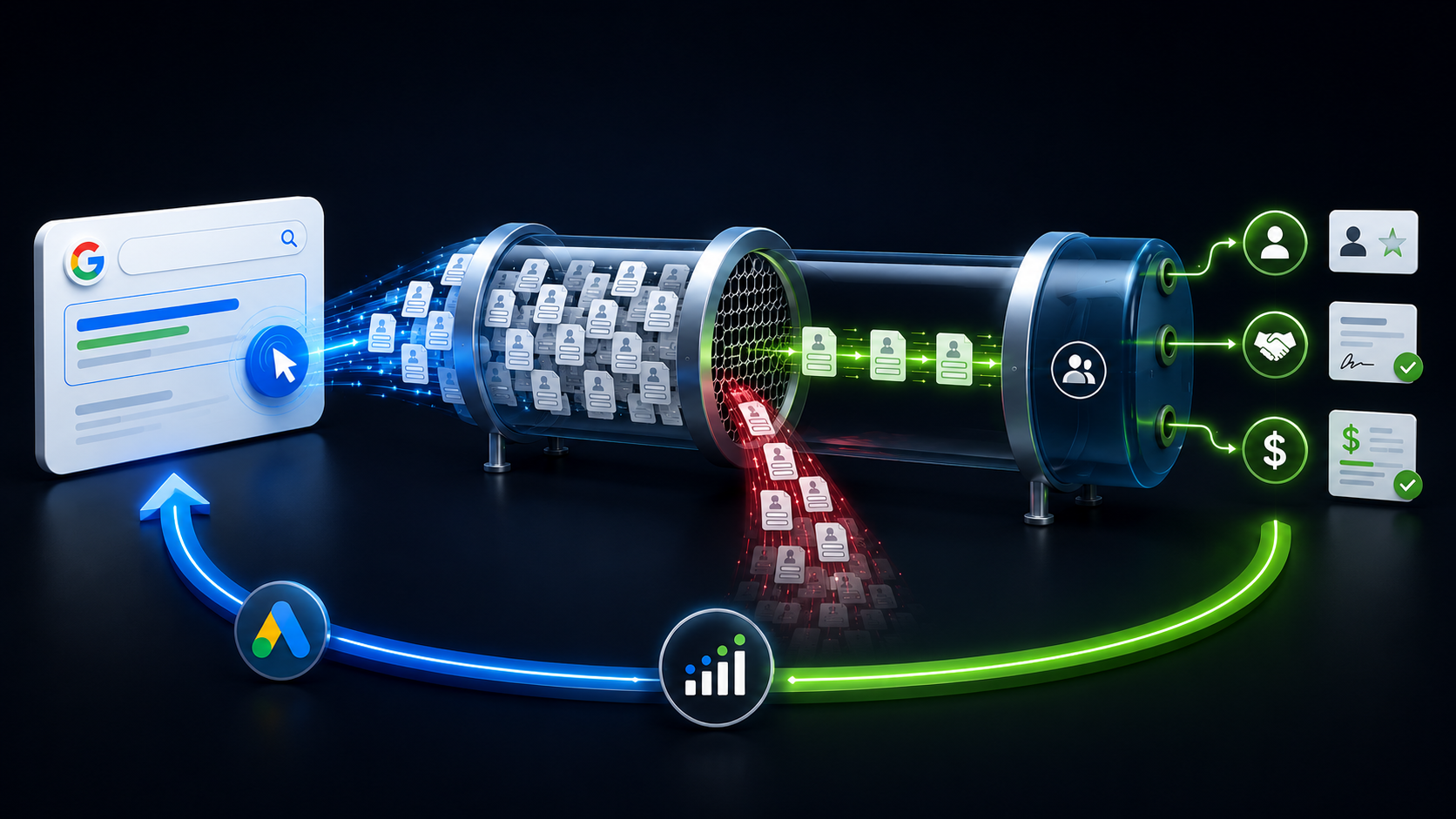
    A more useful measurement system follows prospects beyond the form, connects campaign activity with CRM outcomes, and gives Google Ads signals that better reflect commercial value.

    Replace the lead scorecard with a business scorecard

    Clicks, conversion rate, lead volume, and cost per lead remain useful diagnostic metrics. They show whether ads attract responses efficiently. They do not reveal whether those responses match the target customer profile, become opportunities, or produce revenue.

    Search Engine Land illustrates the distinction with two hypothetical campaigns. The campaign with the cheaper leads generates less qualified pipeline and revenue, while the apparently expensive campaign produces the stronger commercial result.

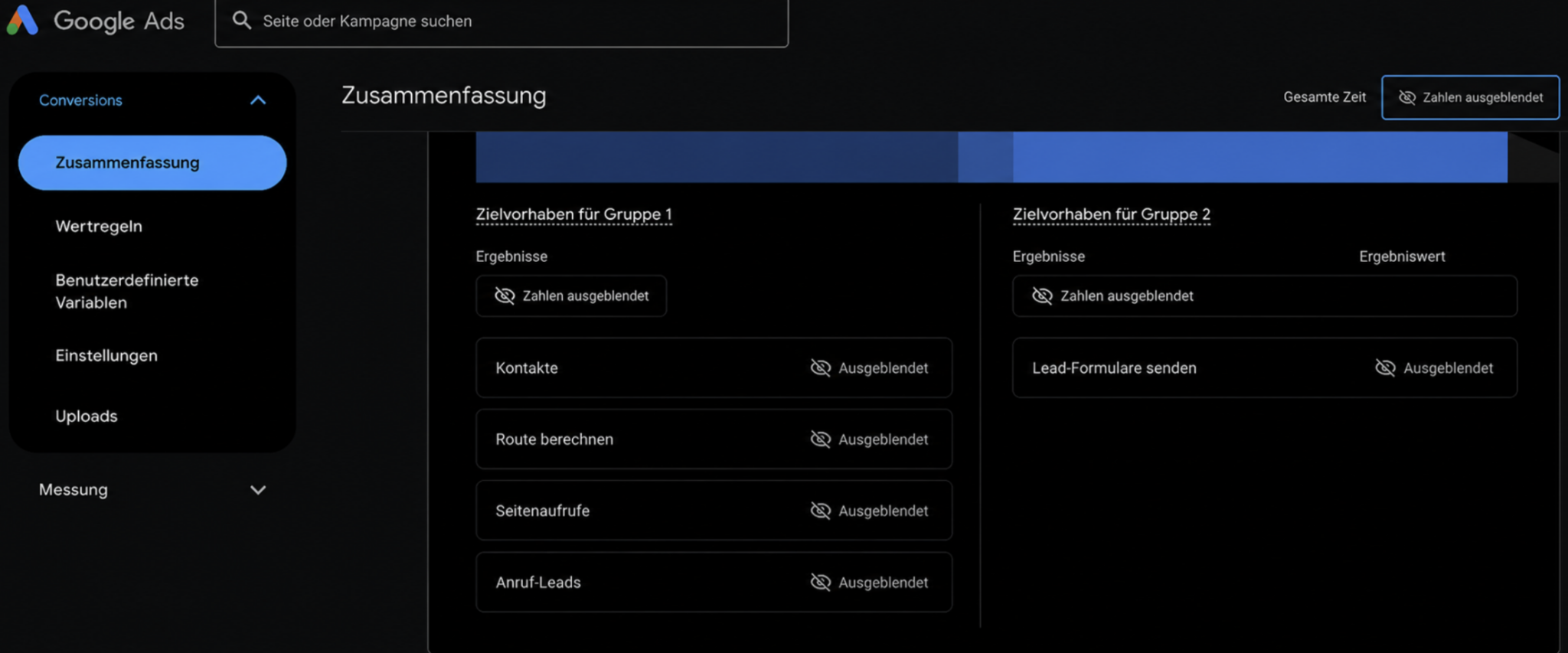
    Google Ads conversion summary listing contacts, route calculations, page views, call leads, and lead forms.
    A German-language Google Ads conversion summary groups contacts, route calculations, page views, call leads, and lead form submissions, with all result figures hidden.
    MetricCampaign ACampaign B
    Leads8015
    Cost per lead$50$200
    Total spend$4,000$3,000
    Qualified opportunities28
    Opportunity value$20,000$120,000
    Revenue$15,000$95,000
    ROAS3.8x31.7x

    The example shows why a higher CPL is not automatically a problem. The relevant question is what the business receives for that cost. Cost per qualified lead, cost per opportunity, pipeline value, close rate, customer acquisition cost, revenue, and ROAS provide the missing context.

    Give conversion actions a hierarchy

    Not every action labeled as a conversion represents equal intent. A page view, route click, general form submission, direct contact request, sales-qualified lead, and closed deal occupy different positions in the commercial journey. Counting them together can inflate reported performance and blur the signal used for optimization.

    This creates a predictable incentive problem: if an ad platform receives only a generic form-submission signal, automated bidding will seek more people likely to submit that form. It cannot infer which submissions came from serious business buyers and which came from consumers, students, competitors, or other poor-fit visitors.

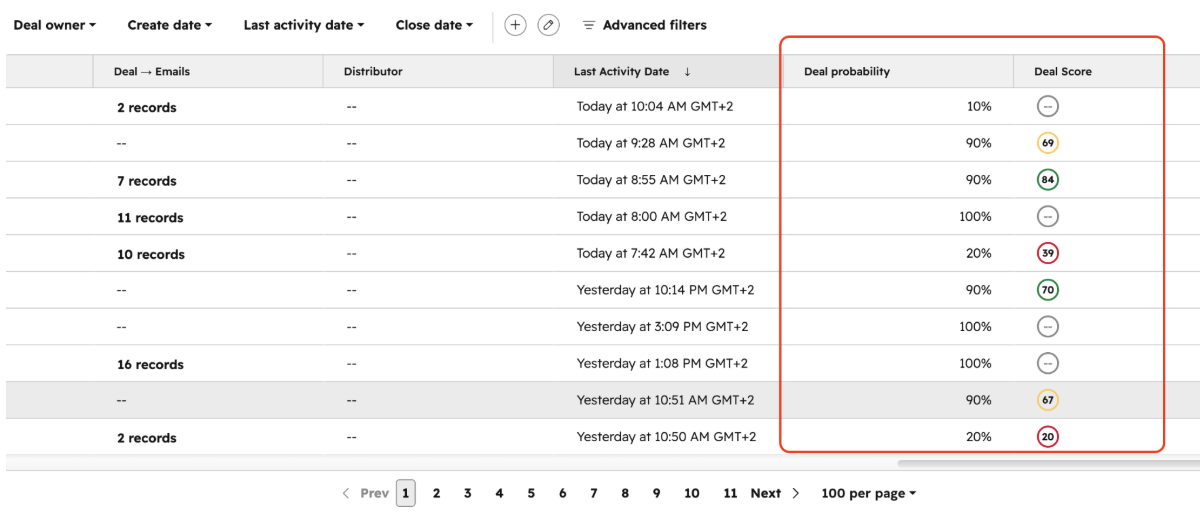
    CRM deal table with Deal probability percentages and color-coded Deal Score values outlined in red.
    A deal list displays email record counts, recent activity times, probability percentages, and circular Deal Score indicators, with the final two columns outlined in red.

    Teams should therefore define which actions are primary business outcomes, which are useful secondary indicators, and which exist only for observation. The classification should reflect buying intent and sales value rather than ease of tracking.

    Use the CRM to connect acquisition with pipeline

    The ad account explains how a prospect arrived and what the initial interaction cost. The CRM records what happened afterward. Combining those views makes it possible to compare campaigns by lead quality instead of response volume alone.

    The source describes evaluating deals with two additional signals: a probability updated by sales according to conversations, budget, timing, and intent, and an AI-generated score based on available deal and engagement data. These are examples of downstream evidence, not universal scoring rules. Each business needs lifecycle definitions that match its own sales process.

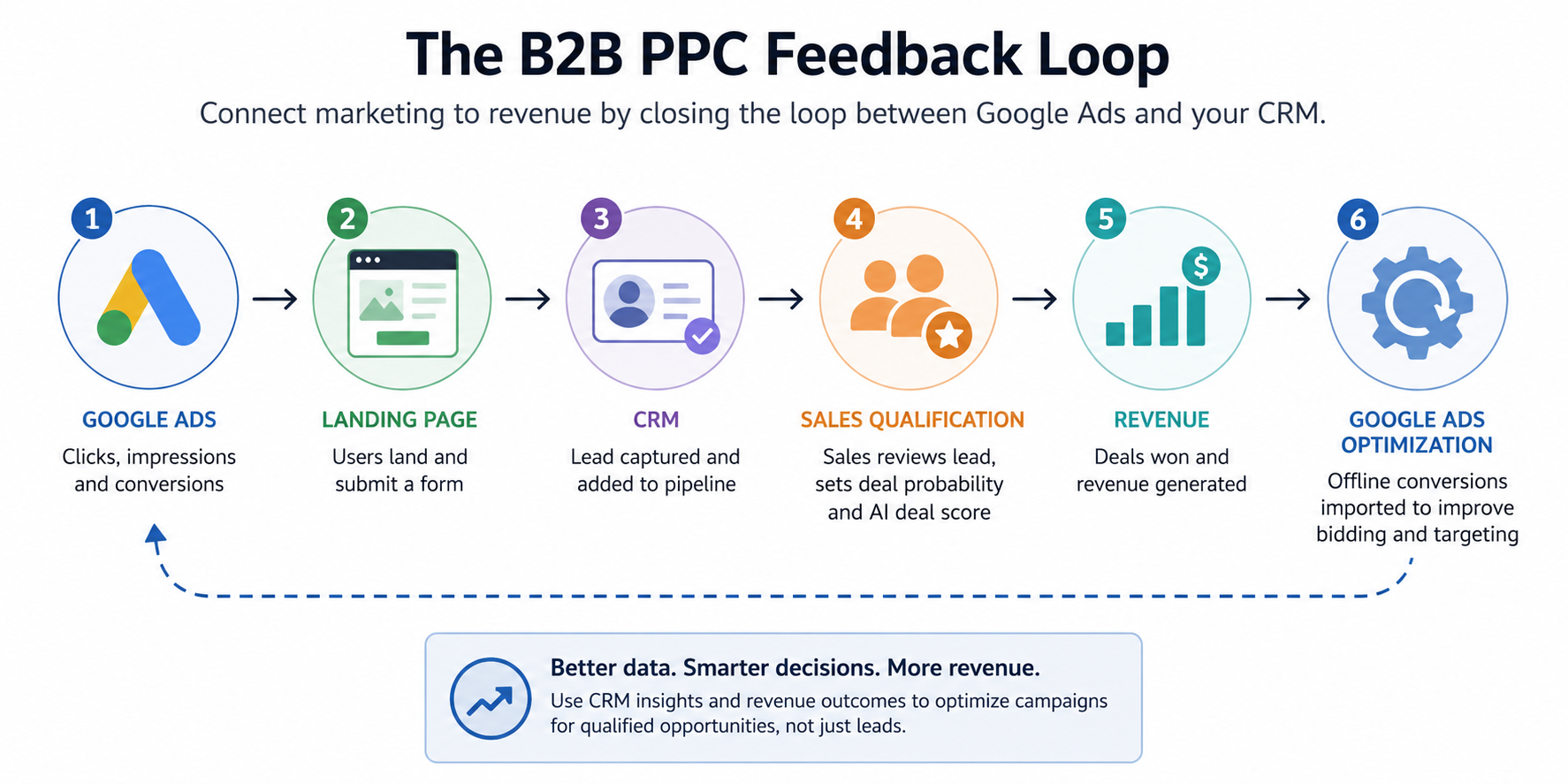
    Six-step B2B PPC feedback loop linking Google Ads, a landing page, CRM, sales qualification, revenue and optimization.
    A six-step flow moves from Google Ads through form submission, CRM capture, sales qualification and revenue, then returns offline conversions for ad optimization.

    A connected analysis should reveal which campaigns, keywords, and landing pages produce high-probability opportunities; which sources attract poor-fit inquiries; and which acquisition paths ultimately contribute revenue. GA4 and advertising data can support that analysis, but neither replaces the CRM record of qualification and sales progress.

    Return qualified outcomes to Google Ads

    Measurement becomes more actionable when lifecycle changes are imported as offline conversions. Depending on the sales process, useful events can include qualified lead, sales-qualified lead, opportunity created, deal won, and associated revenue value.

    This feedback matters when automated bidding is in use because optimization follows the supplied signals. Better downstream data does not guarantee strong results, and long sales cycles can delay learning, but it gives the system a closer approximation of the outcomes the business actually wants.

    Futuristic web browser and analytics dashboard overlap amid neon data streams, illustrating the convergence of SEO, PPC and AI-driven search marketing.
    Organic visibility, paid media and artificial intelligence merge into one connected search ecosystem, where vivid data streams link a creative website with a powerful analytics dashboard.

    Implementation also requires data discipline. Campaign identifiers must survive the handoff into the CRM, lifecycle stages need consistent definitions, and duplicate or incorrectly assigned conversions can distort the feedback loop. Before changing bidding around deeper events, teams should confirm that those events are recorded reliably and occur often enough to support useful decisions.

    Key takeaways

    • Use lead volume and CPL as diagnostics, not final judgments of B2B PPC value.
    • Separate weak engagement signals from qualified, opportunity, customer, and revenue outcomes.
    • Connect ad, analytics, and CRM records so campaigns can be assessed by pipeline quality.
    • Import reliable offline outcomes to move automated optimization closer to revenue.
    • Treat structured sales feedback as performance data that can inform targeting, search terms, landing pages, and budgets.

    The practical shift is from asking how many contacts paid search produced to asking which investments created credible buying opportunities. As CRM feedback becomes cleaner and more consistent, budget decisions can follow commercial evidence instead of whichever campaign fills the top of the funnel fastest.


    Inspired by this post on Search Engine Land.


    crushpress.ai community screenshot
  • Diagnose Content Decay Before You Rewrite a Page

    Diagnose Content Decay Before You Rewrite a Page

    A traffic decline is a warning, not a diagnosis. Before rewriting an underperforming page, teams need to determine whether the page lost rankings, stopped matching search intent, encountered more zero-click results, or serves a topic with shrinking demand.

    This framework uses Search Console trends and a live results-page review to connect each pattern with an appropriate response.

    Start with the decision, not the refresh

    Content decay is a sustained reduction in organic performance, rather than an isolated weekly fluctuation. Search Engine Land identifies four distinct causes. Only ranking decay is consistently suited to a conventional content refresh.

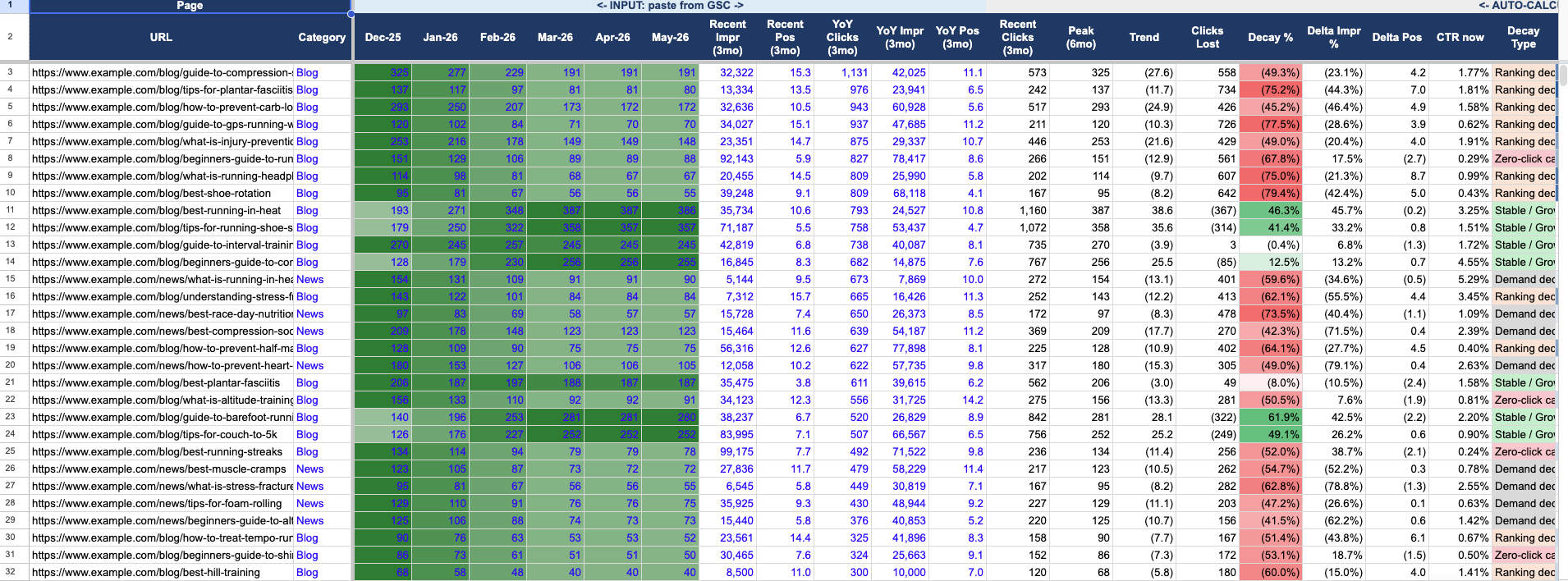
    Spreadsheet of example.com pages with monthly clicks, search metrics, color-coded decay rates, and decay-type labels.
    A wide spreadsheet compares example.com Blog and News URLs from Dec-25 to May-26, alongside impressions, positions, click losses, decay percentages, CTR, and trends.
    • Ranking decay: The page has lost visibility to competitors, become outdated, lost links, or begun competing with another page on the same site.
    • Zero-click capture: The page remains visible, but an AI Overview, featured snippet, or another search feature satisfies more users without a visit.
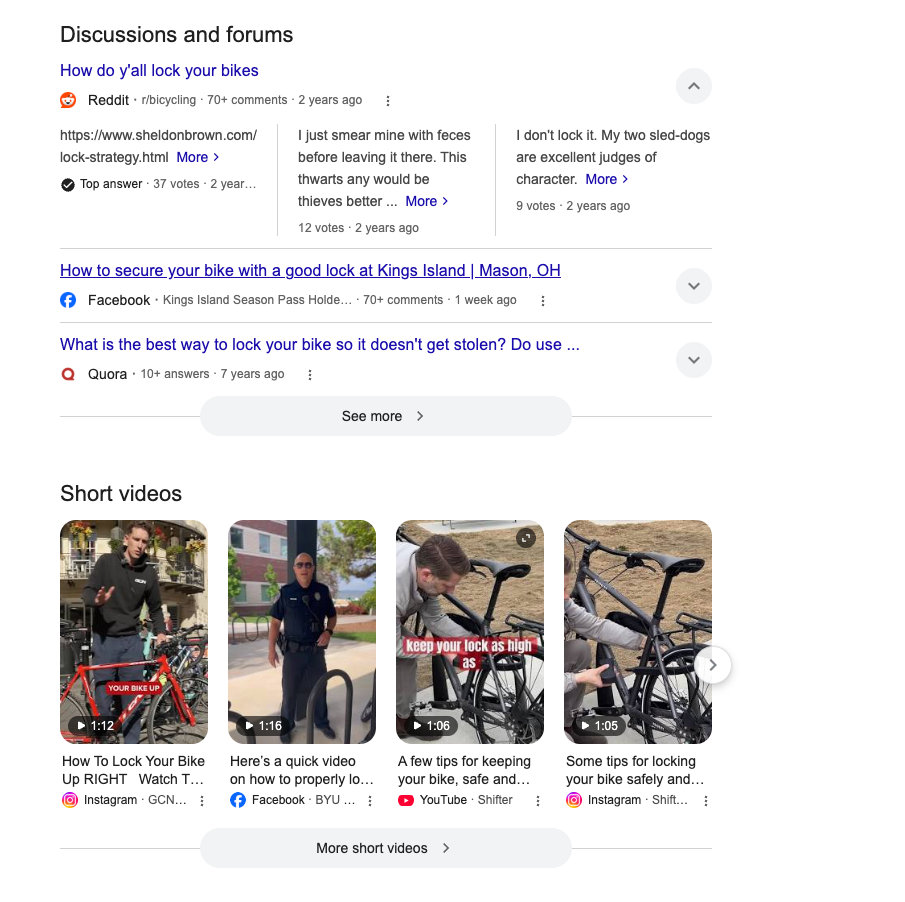
    • Intent drift: Google now favors a different type of result, such as a video, product page, forum discussion, or comparison table.
    • Demand decay: The page still performs competitively, but fewer people search for its subject.

    A fifth pattern sits outside this framework: a date-aligned, site-wide decline may indicate an algorithm-related issue requiring broader investigation.

    Read the combined Search Console signals

    Clicks reveal that performance changed, but impressions and average position help explain why. The source recommends reviewing six months of monthly clicks for the trend, then comparing three months year over year for clicks, impressions, and position. This reduces short-term noise while accounting for seasonality.

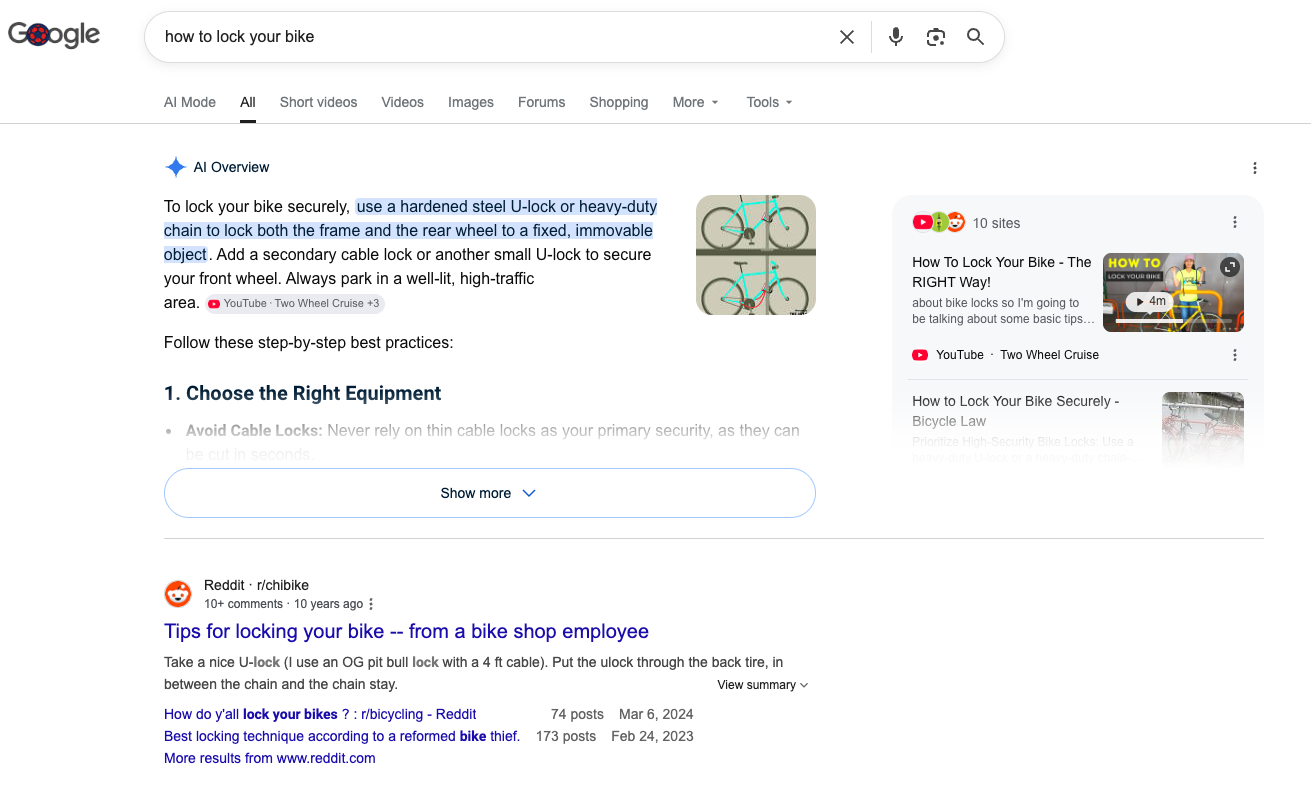
    Google results for "how to lock your bike" showing an AI Overview, videos, and a Reddit result.
    Search results for "how to lock your bike" feature an AI Overview with locking advice and bike diagrams, alongside video suggestions and a Reddit tips thread.
    ClicksImpressionsAverage positionLikely diagnosis
    DownDownWorseRanking decay
    DownFlat or upStable or betterZero-click capture
    DownDownStable or betterDemand decay
    DownVariesHolding, but results changedIntent drift

    Intent drift cannot be confirmed from exported metrics alone. Search the main queries manually and inspect which formats, features, and source types now occupy prominent positions.

    Match the intervention to the cause

    Rebuild pages with genuine ranking losses

    A ranking-decay refresh should add substance rather than merely change the publication date. Useful interventions include original testing, proprietary information, missing answers, stronger internal links, and consolidation of competing URLs. Competitor analysis should also consider whether Google now prefers a different source type.

    Search results showing bike-locking discussions and short video thumbnails from Reddit, Facebook, Quora, and YouTube.
    A search results page displays discussions and forums about how to lock a bike, followed by four short video previews demonstrating bike-locking techniques.

    Create value that a search summary cannot replace

    Zero-click capture calls for assets that reward a visit: calculators, tools, original data, or a defensible perspective. Clear organization and unique evidence may also make a page more suitable for citation by answer systems. If the query no longer produces meaningful visits, resources may be better directed toward comparison, service, or other conversion-oriented pages.

    Change the format or retire the topic

    For intent drift, preserve the established URL when practical but reshape the experience around the format users now receive. For confirmed demand decay, first check whether attention moved to forums, video, social search, or AI assistants. If the audience has genuinely disappeared, consolidation, redirection, or pruning is more rational than rewriting.

    Futuristic web browser and analytics dashboard overlap amid neon data streams, illustrating the convergence of SEO, PPC and AI-driven search marketing.
    Organic visibility, paid media and artificial intelligence merge into one connected search ecosystem, where vivid data streams link a creative website with a powerful analytics dashboard.

    Rule out measurement and editing problems

    Before assigning any decay type, compare the decline date with the page’s revision history. If performance fell immediately after an edit, restoring the previous version provides a cleaner test than adding another rewrite.

    Historical impression data also needs caution. Search Engine Land reports that Google’s removal of the num=100 parameter in September 2025 reduced bot-inflated counts. The source also notes that Google disclosed a logging error that had inflated impressions from May 2025 and corrected it without repairing the historical figures; clicks were reportedly unaffected. A pattern that resembles lost demand should therefore be checked against the live results page, especially when position is stable or improving.

    Turn diagnosis into a quarterly operating habit

    A practical review sorts declining pages by decay type, recoverable traffic, and business value. GA4 conversion or revenue data can improve prioritization, while rank-tracking and search-feature data can help evaluate zero-click exposure at scale.

    Key takeaways

    • Use clicks, impressions, and average position together before deciding to refresh.
    • Confirm intent changes and ambiguous zero-click patterns on the live results page.
    • Reserve rewrites for pages where better content can address the diagnosed cause.
    • Redirect effort when demand has disappeared or the search result no longer produces valuable visits.

    The strongest content-maintenance program is selective. Its advantage comes from recognizing when editing can recover value and when another decision will produce a better return.


    Inspired by this post on Search Engine Land.


    crushpress.ai community screenshot
  • What Google’s Indexing API Really Tells Job Boards

    What Google’s Indexing API Really Tells Job Boards

    Job listings have a timing problem: they can change or expire before ordinary crawling catches up. Google’s Indexing API appears to solve that problem by accepting notifications when eligible pages are created, updated, or removed.

    The important limitation is that an accepted request confirms delivery of a notification, not the outcome a job board ultimately needs. Understanding that distinction helps teams measure the API accurately and avoid treating clean server responses as proof of search visibility.

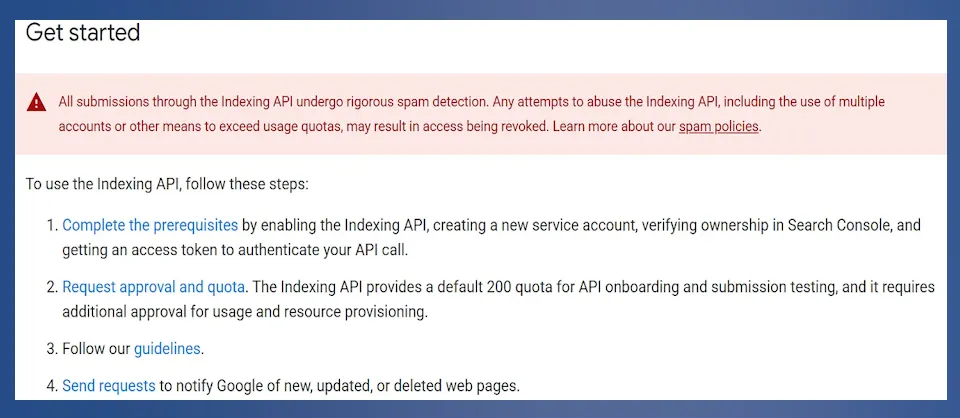
    Indexing API "Get started" page with a spam warning and four setup steps.
    A "Get started" panel warns that submissions undergo spam detection, then lists prerequisites, approval and quota requests, guidelines, and request submission.

    A notification is only the first event in the chain

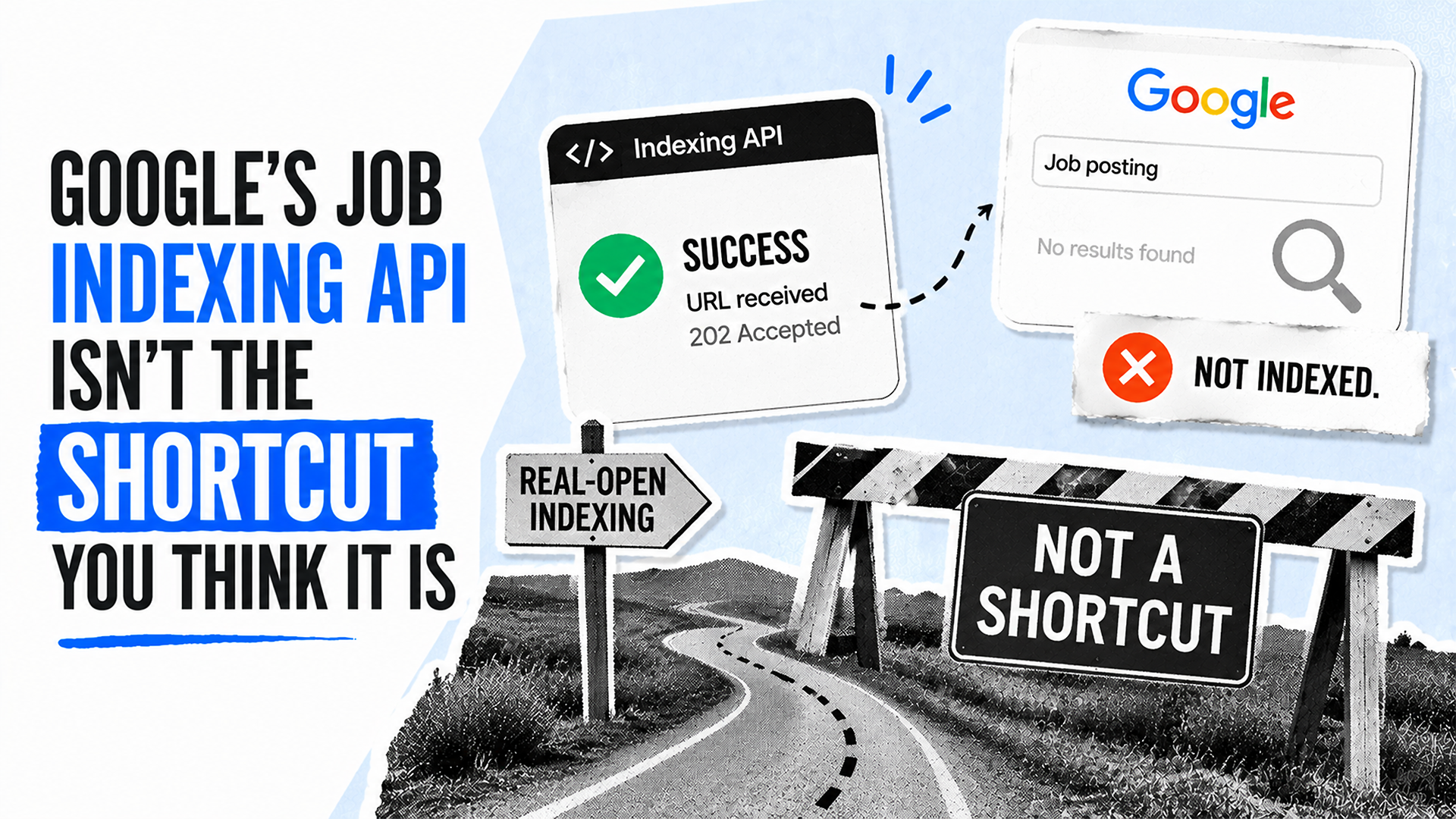
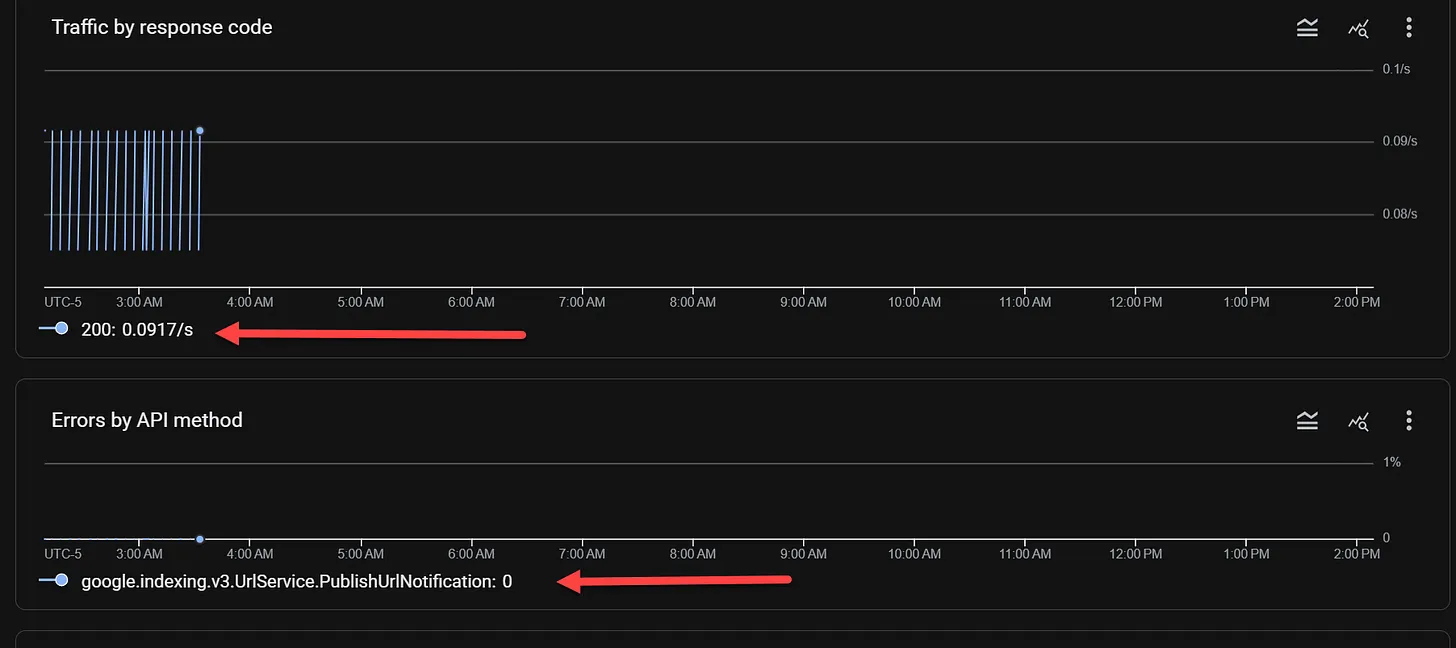
    According to Search Engine Land, a successful API request means Google received the submission. It does not establish that Google crawled the page, added it to the index, displayed it in the Google Jobs experience, or generated traffic from it.

    Dark API metrics table showing requests, error rates, and median and 95th-percentile latency for three services.
    A filtered metrics table lists 204 Web Search Indexing API requests, 36 reCAPTCHA Enterprise API requests, and one Gemini for Google Cloud API request.

    Those are separate stages with separate evidence requirements:

    Dark dashboard charts show HTTP 200 traffic at 0.0917/s and zero API errors, with red arrows pointing to the legends.
    Two dark monitoring charts display intermittent HTTP 200 traffic near 3:00 AM and zero errors for the listed PublishUrlNotification API method.
    • Submitted: The site’s system sent a notification.
    • Accepted: Google returned a successful response to that request.
    • Crawled: Google fetched the page.
    • Indexed: Google made the page eligible to appear in search.
    • Visible and productive: The listing earned impressions, clicks, or conversions.

    A reliable reporting setup should preserve these distinctions. Otherwise, an operational metric such as API acceptance can be mistaken for an SEO result.

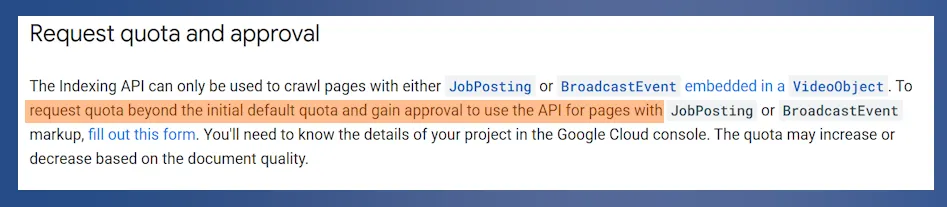
    Documentation excerpt titled "Request quota and approval" with a quota request sentence highlighted in orange.
    A documentation excerpt says the Indexing API is limited to JobPosting or BroadcastEvent pages and directs users to submit a form for more quota and approval.

    Key takeaways

    • The Indexing API is restricted to eligible job-posting and livestream pages; it is not a general acceleration tool for arbitrary URLs.
    • An HTTP 200 response confirms receipt, not crawling, indexing, removal, ranking, or traffic.
    • Notification metadata describes submissions rather than the current index status of a page.
    • Quota availability and successful test requests do not necessarily prove that an account has production access.
    • Job boards should validate structured data, API behavior, and search status as separate layers.

    The API has a narrow, defined scope

    Search Engine Land reports that Google permits the API for pages carrying JobPosting structured data and for livestream pages using BroadcastEvent within a VideoObject. Blog posts, product pages, category archives, service pages, and other ordinary URLs are outside that stated use.

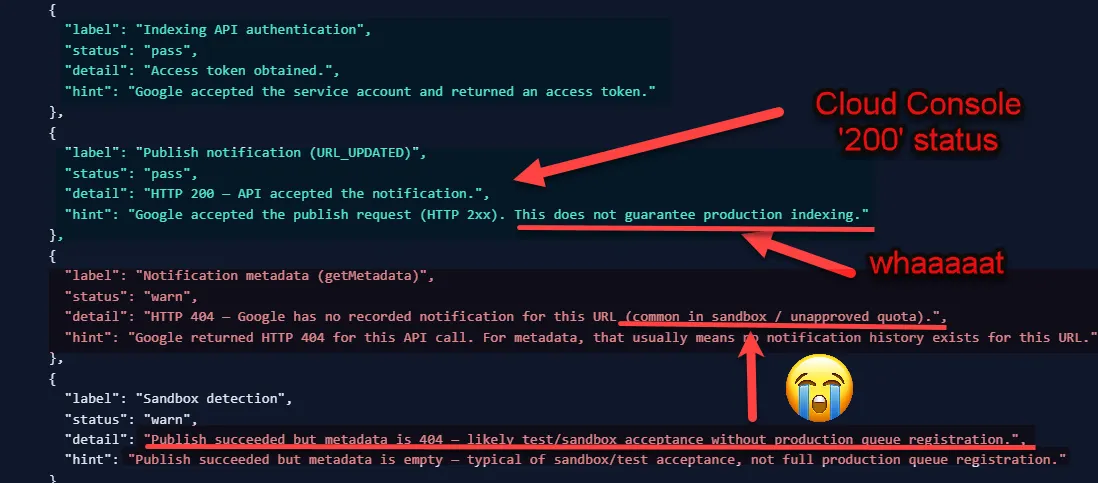
    Annotated API results show HTTP 200 publish success, a 404 metadata warning, red arrows, and a crying emoji.
    A dark code-style report contrasts a passed URL_UPDATED request and HTTP 200 response with a getMetadata HTTP 404 warning, highlighted by red arrows, "whaaaaaat," and a crying emoji.

    For an eligible job page, the two relevant notification types are straightforward. URL_UPDATED can be sent when a listing is published or meaningfully changed. URL_DELETED can be sent when the listing has been removed and should no longer remain indexed.

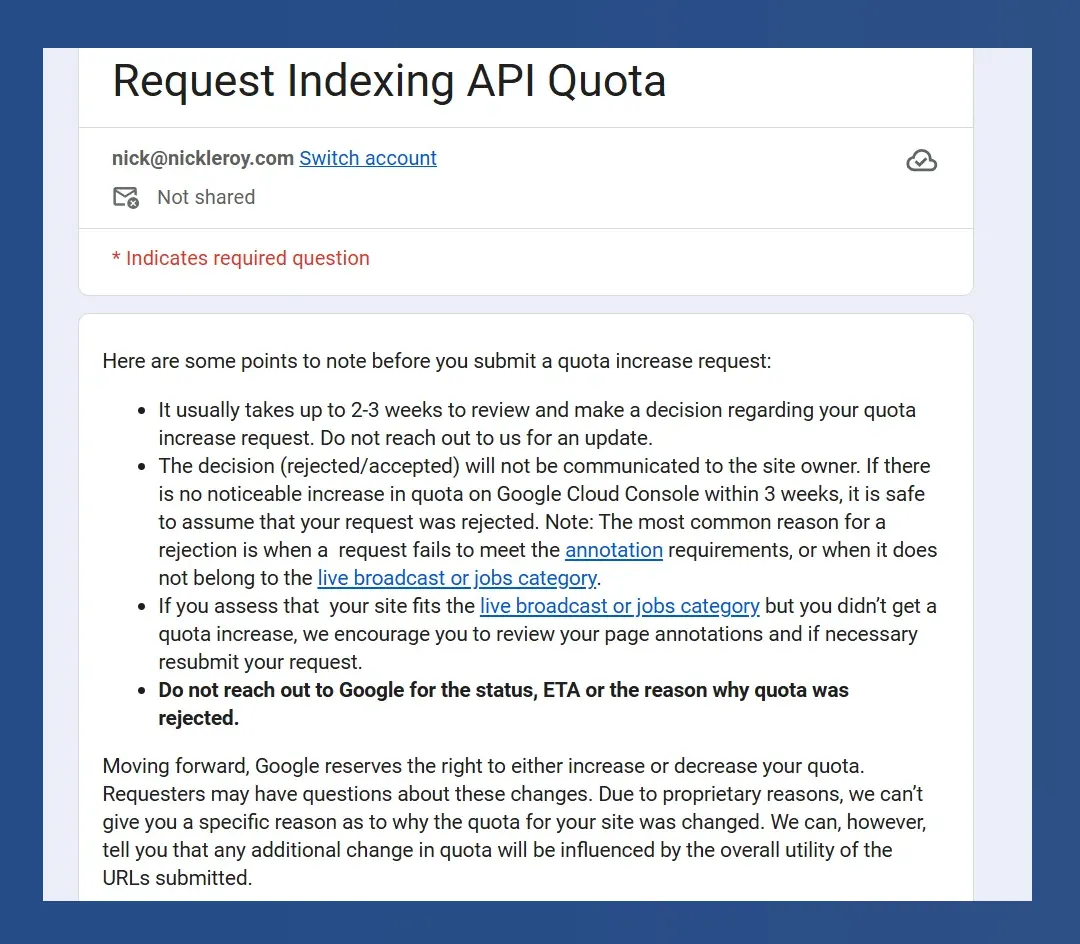
    Request Indexing API Quota form with notes on review times, eligibility, rejections, and quota changes.
    A Request Indexing API Quota form says reviews usually take two to three weeks and warns that annotation and eligible-content requirements must be met.

    Even here, the request is not a command. The source notes that Google’s documentation says the company may recrawl a URL after an accepted update request and may remove one after an accepted deletion request. That wording preserves Google’s control over what happens next.

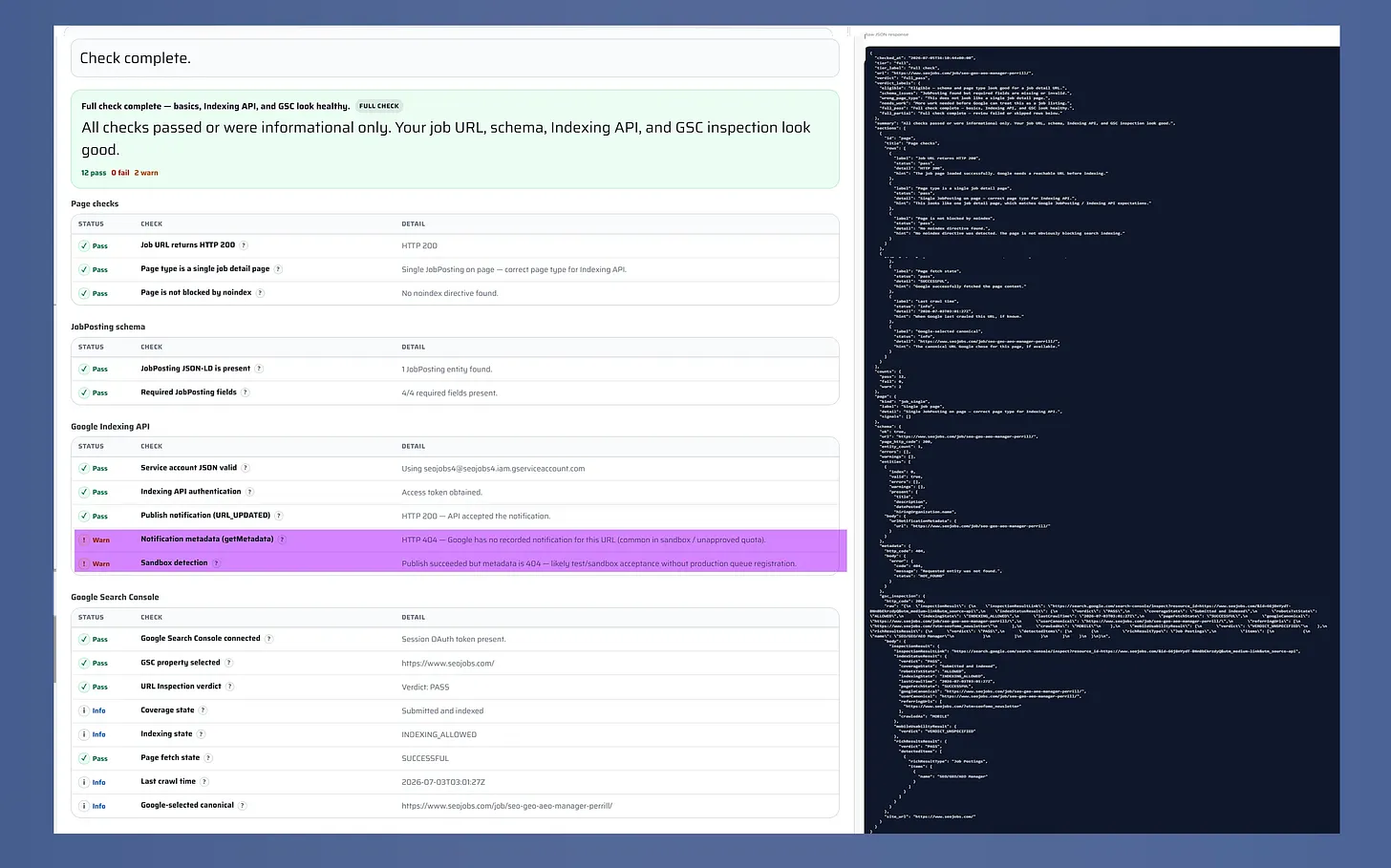
    Job indexing health check with passing results, two warnings, and a raw JSON response.
    A completed job indexing health check shows 12 passes, no failures, and two warnings beside a dark panel containing the full raw JSON response.

    Metadata, sandbox access, and quotas require careful reading

    The API’s getMetadata capability can help confirm the history of update and deletion notifications for a URL. It cannot answer the larger question of whether that URL is currently crawled, indexed, removed, or receiving exposure. Metadata is therefore useful for diagnosing the submission pipeline, but it is not an index-status report.

    ```json
{
  "alt": "SEO For Lunch newsletter promotion with Nick Leroy smiling in checkered shirt.",
  "caption": "Join Nick Leroy for a fresh take on SEO with the #SEOForLunch newsletter—bringing actionable insights straight to your inbox.",
  "description": "This image promotes the #SEOForLunch newsletter by Nick Leroy, featuring a smiling Nick in a checkered shirt against a blue graphic background. The design includes a plate graphic with 'Not Your Average Table Talk' and emphasizes SEO insights, inviting viewers to subscribe at seoforlunch.com. Keywords: SEO, Nick Leroy, newsletter, marketing, insights."
}
```

    Access also has an onboarding dimension. Search Engine Land says Google’s quickstart documentation describes a default quota of 200 requests for onboarding and submission testing, with further approval required for usage and resource provisioning. A visible quota or apparently successful test can therefore create confidence without demonstrating full production service.

    Futuristic web browser and analytics dashboard overlap amid neon data streams, illustrating the convergence of SEO, PPC and AI-driven search marketing.
    Organic visibility, paid media and artificial intelligence merge into one connected search ecosystem, where vivid data streams link a creative website with a powerful analytics dashboard.

    The source also reports approval delays, but the evidence should be treated as observational rather than definitive. The article’s author said two job-board requests had received no response after six months in 2026. Alexander Chukovski reportedly said none of the job boards he worked with over roughly 10 to 12 months received a response. These accounts suggest that approvals may have become harder to obtain, but they do not prove that Google has stopped processing every request.

    How job boards can validate the system responsibly

    A practical audit should test the implementation in layers rather than seeking one all-purpose success signal:

    1. Confirm that the URL represents a supported job posting and contains the required structured data.
    2. Verify that update and deletion requests use the appropriate notification type.
    3. Record response codes and notification metadata as evidence of API delivery only.
    4. Check crawling, indexing, and search performance through appropriate search diagnostics instead of inferring them from the API response.
    5. Track expired listings separately so removal can be verified rather than assumed.

    The source highlights a free Job Indexing Health Check on SEOJobs.com that can review job schema and, in its fuller mode, API and Google Search Console responses. Whether teams use that tool or their own diagnostics, the sound approach is the same: measure each stage according to what its evidence can actually prove.

    For job boards, the API can remain a useful notification channel. Its value becomes clearer, not weaker, once acceptance is treated as the beginning of verification rather than the finish line.


    Inspired by this post on Search Engine Land.

    crushpress.ai community screenshot
  • Web Push Advertising in 2026: A Shift Toward Quality

    Web Push Advertising in 2026: A Shift Toward Quality

    Web push advertising is not disappearing, but the conditions that once rewarded scale are changing. Easier opt-outs and tighter platform enforcement have made subscriber quality, compliant messaging, and durable performance more important.

    A sponsored article published by Search Engine Land and supplied by RollerAds presents the channel as a maturing market rather than a declining one. Its figures and platform observations point to modest growth, alongside near-term pressure for publishers, advertisers, and ad networks.

    Platform controls changed the economics of push

    Web push lets opted-in users receive browser-based notifications outside a publisher’s active webpage. That reach can make the format useful for timely campaigns, but it also means poor messaging practices can become intrusive quickly.

    According to the Search Engine Land article, Google introduced changes in the fourth quarter of 2024 that made unsubscribing more accessible on Android and strengthened Google Safe Browsing policies. The stated direction was greater user control, fewer deceptive notification practices, and better engagement quality.

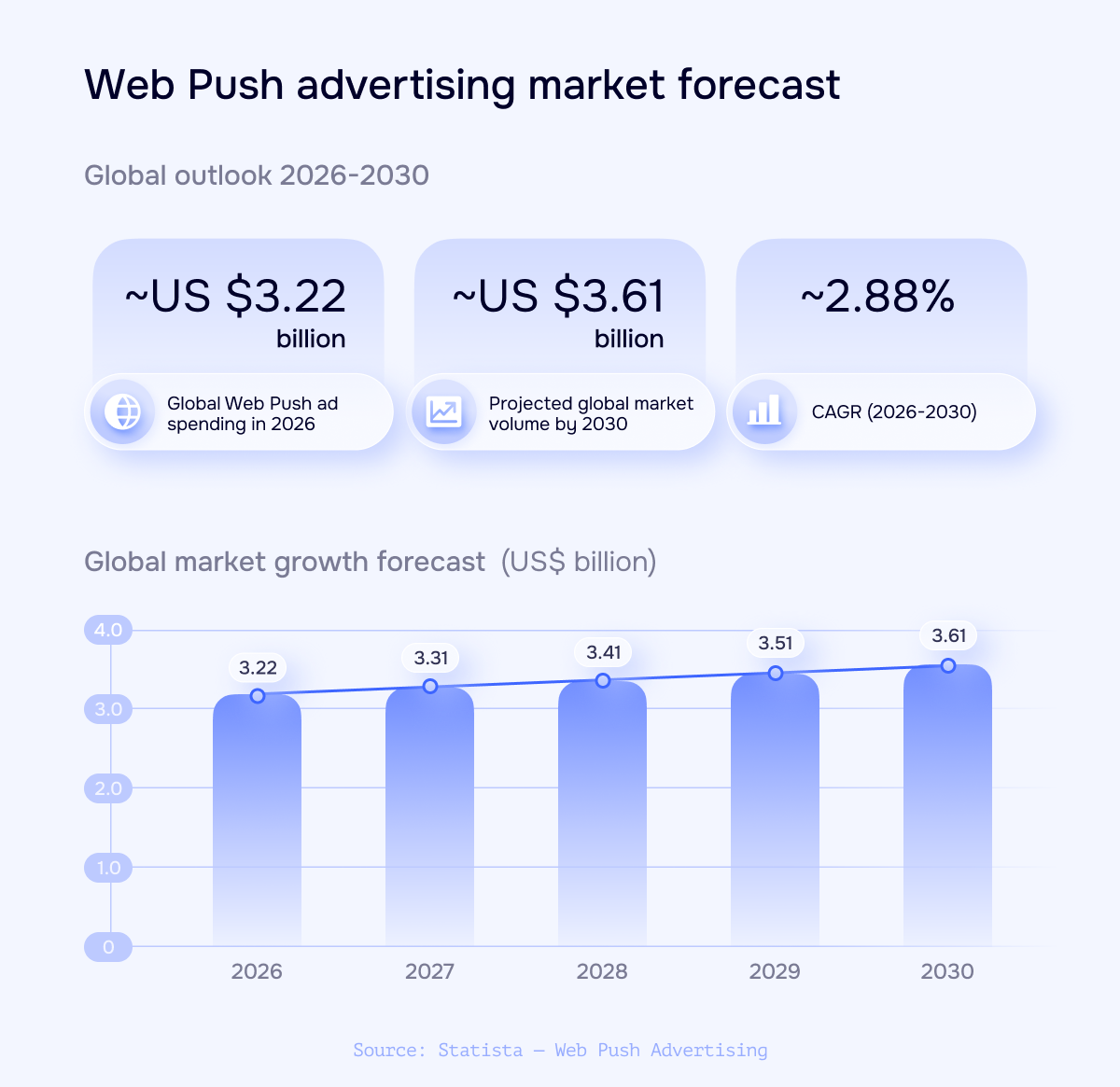
    Chart forecasting web push ad growth from US$3.22 billion in 2026 to US$3.61 billion in 2030.
    Global web push advertising is shown rising from about US$3.22 billion in 2026 to US$3.61 billion in 2030, with a stated 2026-2030 CAGR of roughly 2.88%.

    The immediate commercial effect was less comfortable. RollerAds reported that unsubscribe rates increased by 30% to 40% in some cases on its own platform. The article also says some domains were flagged, restricted, or banned over compliance problems and negative quality signals. That platform-specific result should not be treated as an industry-wide rate, but it illustrates the exposure publishers face when access to an audience depends on browser rules.

    The forecast describes maturity, not rapid expansion

    The market outlook cited in the source projects global web push ad spending of about US$3.22 billion in 2026 and approximately US$3.61 billion in 2030. The reported compound annual growth rate for 2026 through 2030 is about 2.88%.

    YearProjected global spending
    2026About US$3.22 billion
    2027About US$3.31 billion
    2028About US$3.41 billion
    2029About US$3.51 billion
    2030About US$3.61 billion

    These projections indicate continued expansion, but not a return to a volume-at-any-cost phase. Moderate growth is consistent with a channel moving toward established use cases, more selective inventory, and closer scrutiny of traffic quality. The forecast does not guarantee better returns for an individual campaign; results will still depend on targeting, creative, acquisition costs, and the quality of the underlying subscriber base.

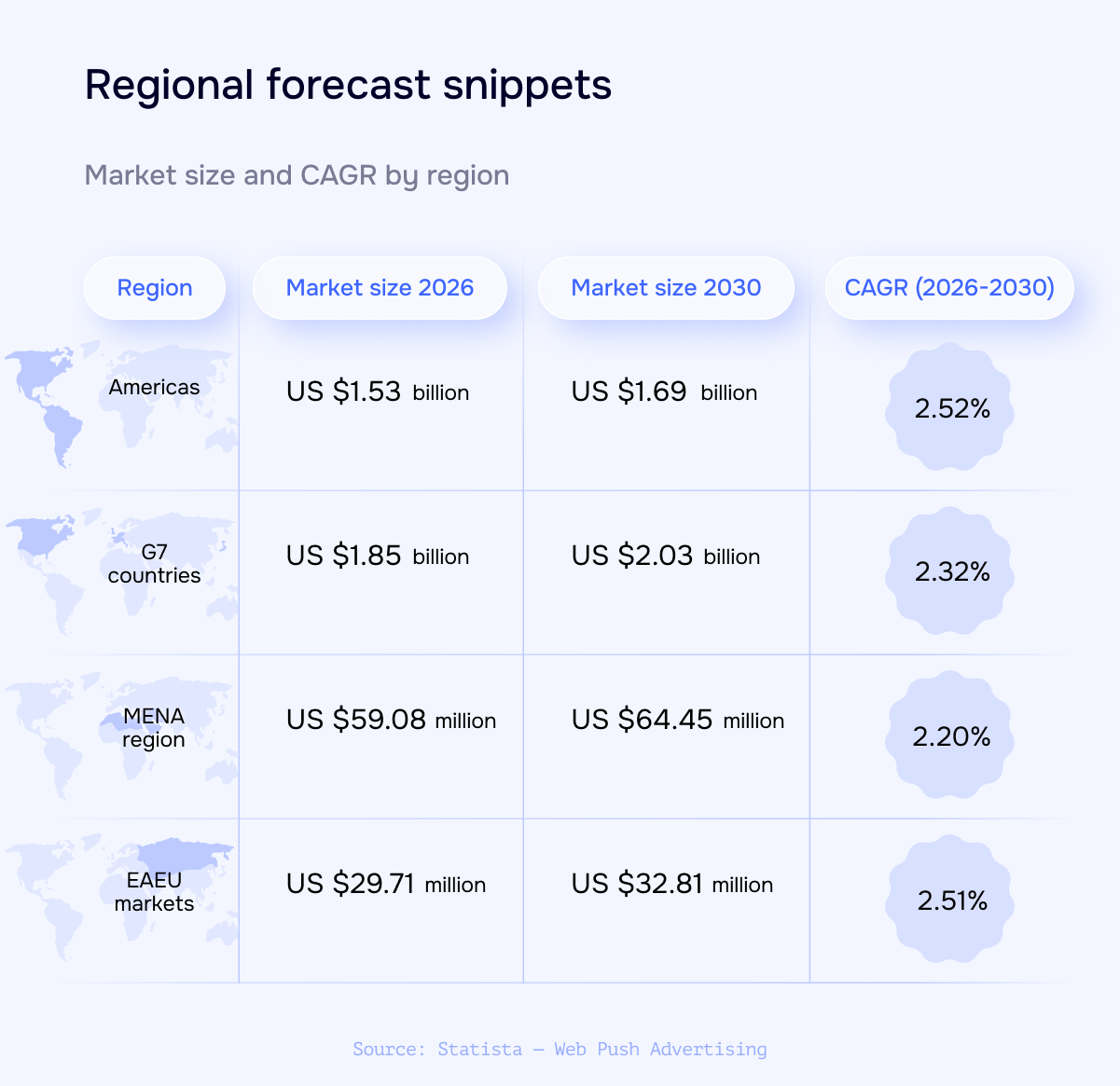
    Table comparing 2026 and 2030 market sizes and CAGR for the Americas, G7, MENA, and EAEU.
    Regional forecast table lists 2026 and 2030 market sizes for the Americas, G7 countries, MENA region, and EAEU markets, with CAGR from 2.20% to 2.52%.

    Regional projections point in the same direction

    The regional forecasts cited by the article vary in size and pace, yet all four examples show growth through 2030.

    Market20262030Reported CAGR
    AmericasAbout US$1.53 billionAbout US$1.69 billionAbout 2.52%
    G7 countriesAbout US$1.85 billionAbout US$2.03 billionAbout 2.32%
    MENAAbout US$59.08 millionAbout US$64.45 millionAbout 2.20%
    EAEU marketsAbout US$29.71 millionAbout US$32.81 millionAbout 2.51%

    The differences are relatively narrow in growth-rate terms. As the source interprets them, they reflect varying levels of market maturity and digital advertising penetration rather than opposing regional trajectories. The projections are best used as market context, not as a substitute for country-level campaign evidence.

    Key takeaways

    • Web push remains a growing advertising channel in the forecast cited by Search Engine Land, although its expected growth is moderate.
    • More accessible opt-outs can reduce the size of a subscriber list while making consent and audience relevance more visible performance factors.
    • RollerAds’ reported 30% to 40% unsubscribe increase applies to some cases on its platform, not necessarily to the whole market.
    • Stricter enforcement raises compliance risk for publishers and networks using misleading language or low-quality traffic.
    • Advertisers should judge the channel by qualified engagement, acquisition economics, and customer value rather than notification volume alone.

    What advertisers and publishers should change

    For publishers, the central issue is no longer simply how quickly a subscriber list can grow. They need clear opt-in expectations, messaging that matches what users agreed to receive, and monitoring that reveals whether campaigns are driving engagement or accelerating opt-outs.

    Futuristic web browser and analytics dashboard overlap amid neon data streams, illustrating the convergence of SEO, PPC and AI-driven search marketing.
    Organic visibility, paid media and artificial intelligence merge into one connected search ecosystem, where vivid data streams link a creative website with a powerful analytics dashboard.

    Advertisers should examine the source and quality of push inventory, segment audiences by relevant behavior, and test the complete funnel rather than optimizing only for clicks. A high click-through rate can still be unhelpful if the post-click experience fails to produce worthwhile outcomes. Networks, meanwhile, have an incentive to improve screening and technical controls because weak supply can expose every participant to policy and performance problems.

    The source argues that lower message pressure may eventually support stronger engagement and click-through rates, but that remains an expectation rather than a guaranteed timeline. The safer conclusion is narrower: web push still has a market, while its next phase will favor operators that can demonstrate relevance, compliance, and sustainable economics.


    Inspired by this post on Search Engine Land.


    crushpress.ai community screenshot