Month: July 2026

  • How I Justify GEO Investment Without Perfect Attribution

    How I Justify GEO Investment Without Perfect Attribution

    Fractured attribution

    My eight-year-old daughter desperately wanted a Nintendo Switch. Her “evil” parents—my spouse and I—refused to buy one for her.

    She was too young to get a job, so she did what any resourceful child would do: she opened a lemonade stand in front of our house.

    She did more than set out a table and a pitcher, though. She designed what amounted to a high-stakes A/B test.

    Her hypothesis was simple: if she could persuade more people to stop, she could sell more lemonade and reach her Nintendo Switch goal faster.

    Variant A was her two-year-old sister, Julie, stationed out front to attract attention.

    Variant B was our dog, Ginger.

    Lemonade stand visibility A/B test comparing Julie and Ginger

    I know what I would have guessed.

    The dog. Obviously, the dog.

    But Julie won—and it was not even close.

    The only metric that mattered

    The funny part is that my daughter did not really care about the A/B test result. She was not interested in how many people stopped at the stand or which variant produced the best response.

    She cared about one outcome and one outcome only:
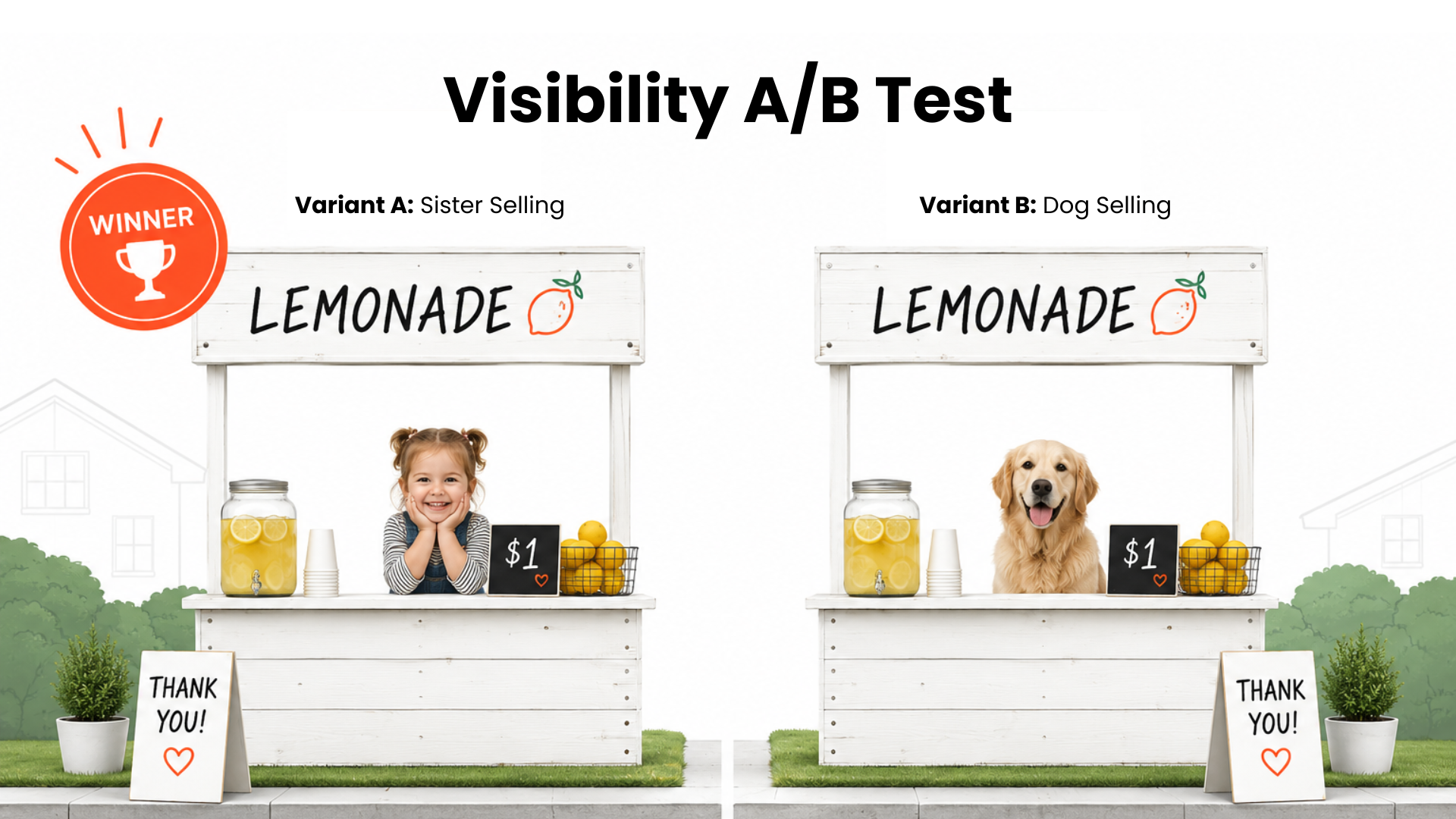
    Side-by-side lemonade stand A/B test comparing a smiling young sister with a golden retriever, with Variant A marked the winner.
    At this lemonade stand, the cute-dog advantage loses: Variant A, featuring the seller’s young sister, wins the visibility A/B test over Variant B’s golden retriever.

    Did she make enough money to buy the Nintendo Switch?

    I believe marketers are facing a similar problem right now.

    Generative engine optimization (GEO) is the practice of increasing a brand’s visibility in AI-generated answers across platforms such as ChatGPT, Gemini, Perplexity, and AI Overviews.

    I can track AI visibility, citation share, impressions, rankings, and nearly every other signal available. Meanwhile, leadership is asking a much simpler question:

    Is any of this helping the business grow?

    I answer that question with a simple test I call the Dollar Rule: if I cannot put a dollar sign in front of a metric, I treat it as a channel metric rather than a business metric.

    That distinction captures the central measurement challenge in GEO.

    Most of the numbers we track are valuable operational signals. They show us what is happening within the channel, but leadership wants to understand the resulting business impact.

    GEO emerged at precisely the moment attribution was becoming less reliable.

    Traditional SEO measurement relied on a straightforward journey: someone searched, clicked, visited a website, and converted. We could trace that path and connect it to an outcome.
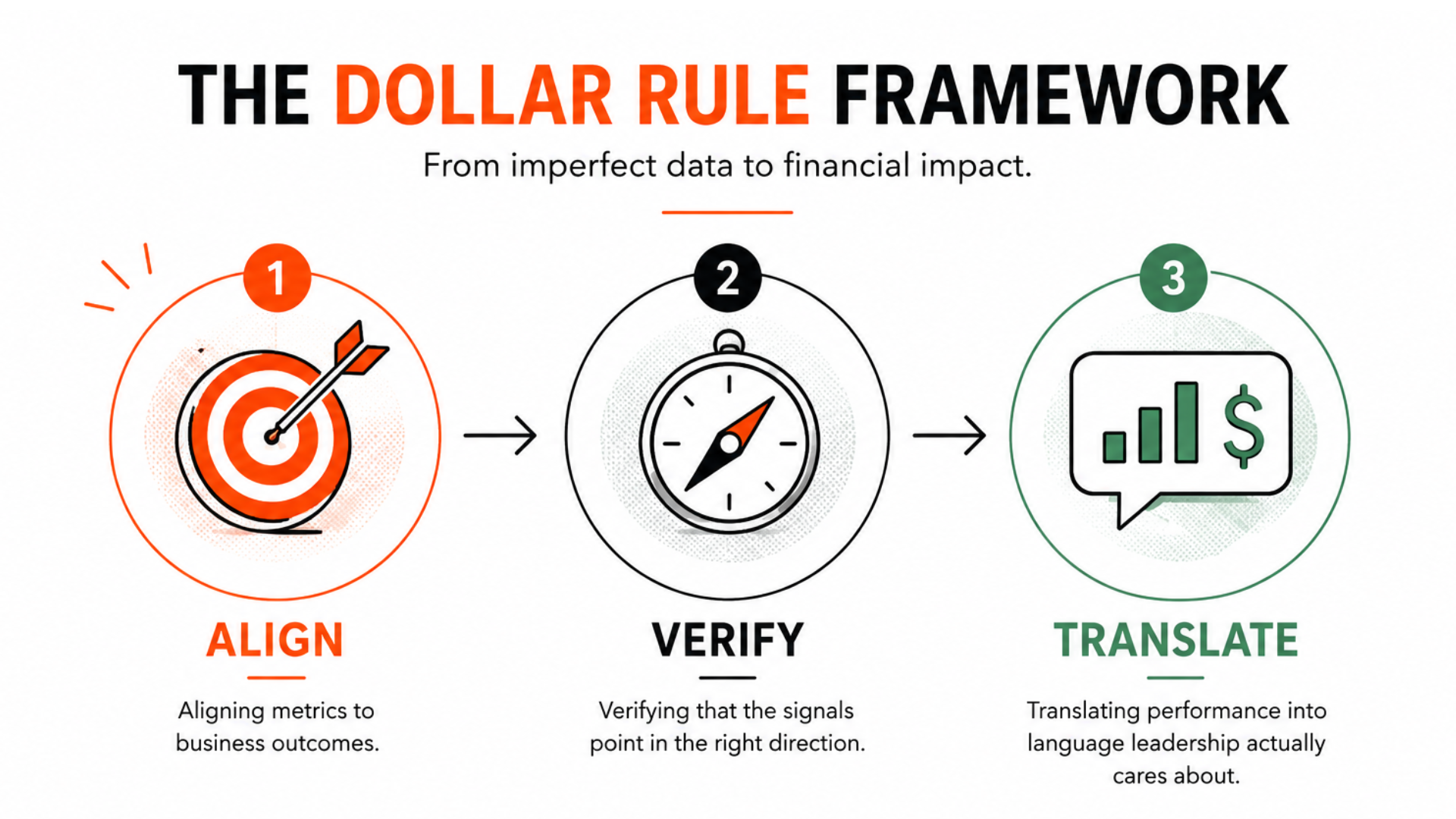
    Dollar Rule Framework infographic showing Align, Verify, and Translate steps for connecting imperfect GEO data to measurable financial impact.
    The Dollar Rule turns imperfect GEO attribution into a business case: align metrics with outcomes, verify directional signals, then translate performance into financial language leaders value.

    AI search disrupted that model.

    I now see buyers forming opinions and making decisions before they ever reach a company’s website. That makes AI’s influence much harder to capture with conventional attribution.

    AI search broke attribution

    I see buyers discovering brands through AI-generated answers, citations, publishers, forums, reviews, videos, and many other sources. Those touchpoints can shape a decision long before a click occurs, and much of that influence never appears cleanly in analytics.

    That is why I see so many teams struggle to justify GEO investments. The visibility is real, and the influence is real, but the attribution is frequently incomplete.

    I do not believe waiting for perfect attribution is a sound strategy. Increasingly, it is simply a convenient reason to avoid acting.

    When I want leadership to support GEO, I need to connect its influence to business outcomes—even when I cannot connect every interaction to a conversion.

    How I make the financial case for GEO

    The biggest mistake I see marketers make is trying to prove attribution before proving value.

    Before I worry about attribution, I ask whether I am measuring something the business actually considers important. That is where the Dollar Rule becomes useful.

    I have found that justifying a GEO investment usually comes down to three actions:

    • I align my metrics with business outcomes.
    • I verify that those metrics reliably point me in the right direction.
    • I translate the evidence into language a CFO understands.
    The Dollar Rule framework for connecting GEO metrics to financial impact

    My Dollar Rule is deliberately simple:
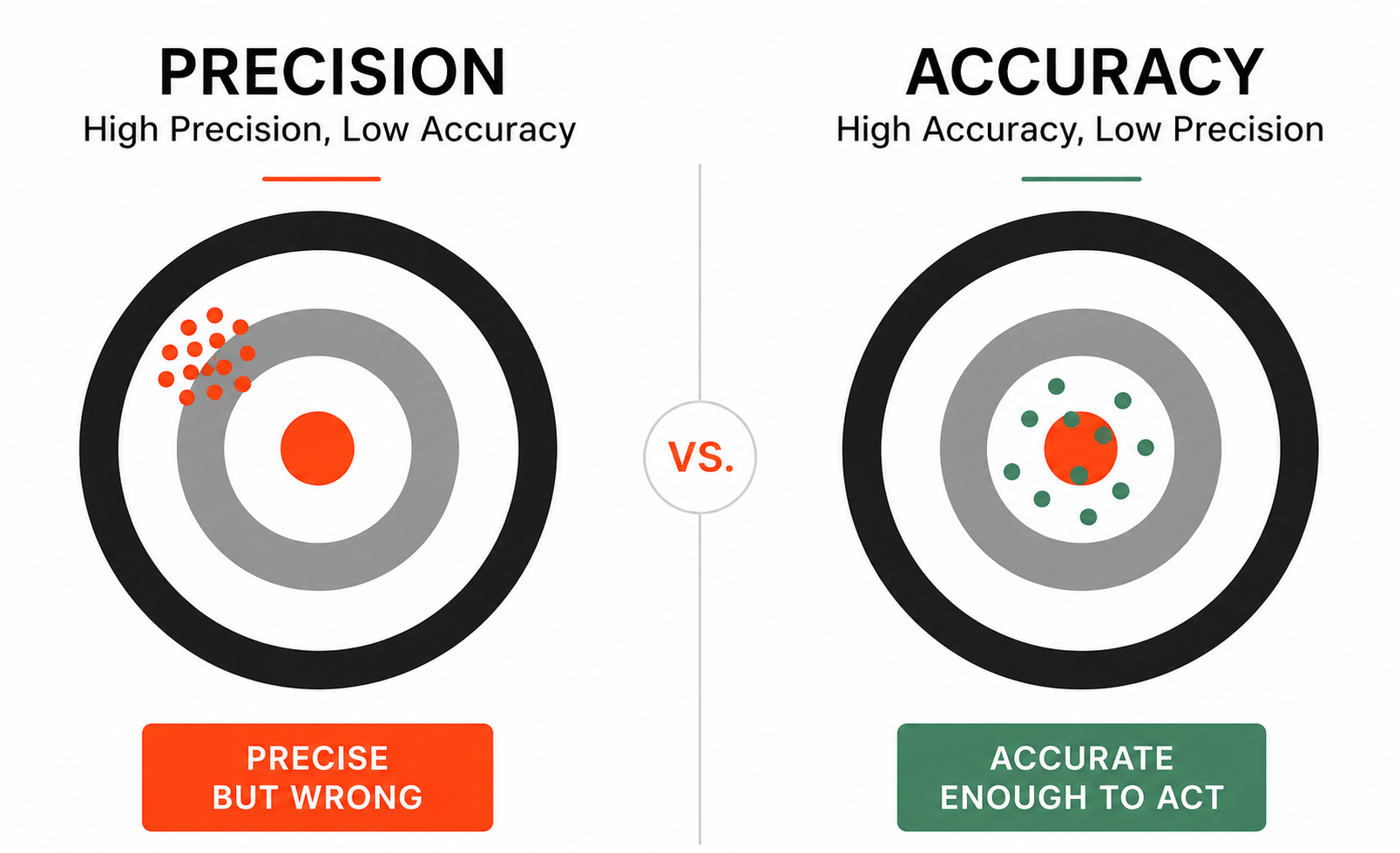
    Split target infographic contrasting high precision but low accuracy, with clustered misses, against high accuracy but low precision around the bullseye.
    Precision can form a tight cluster in the wrong place; accuracy keeps evidence centered on the outcome that matters. For GEO measurement, a useful estimate can beat an exact but irrelevant metric.

    If a number does not translate into dollars, I treat it as a channel metric, not a business metric.

    I focus on revenue opportunity, revenue at risk, payback period, and customer acquisition cost. Those metrics live on a P&L, and they are the numbers leadership teams use to evaluate investments.

    In my experience, CFOs do not allocate budget because an attribution model looks impressive. They allocate budget based on credible expectations of financial return, risk, and growth.

    That principle changes how I measure and present GEO.

    I measure influence, not just attribution

    AI search did more than change discovery. It changed what I can realistically measure.

    Traditional organic attribution assumes a clean sequence: search, click, visit, convert.

    AI platforms increasingly answer questions before a click, influence buyers across multiple touchpoints, and withhold the referral data marketers once relied on.

    That leaves me in an unusual position: a GEO campaign may be influencing pipeline even while the analytics platform struggles to prove it.

    One estimate illustrates the gap. Loamly estimates that roughly 70% of AI-influenced traffic appears as Direct traffic in GA4, making a substantial share of AI’s contribution difficult to trace through traditional attribution models.

    I do not take that measurement gap to mean measurement is impossible. I take it as a reason to broaden the evidence I examine.
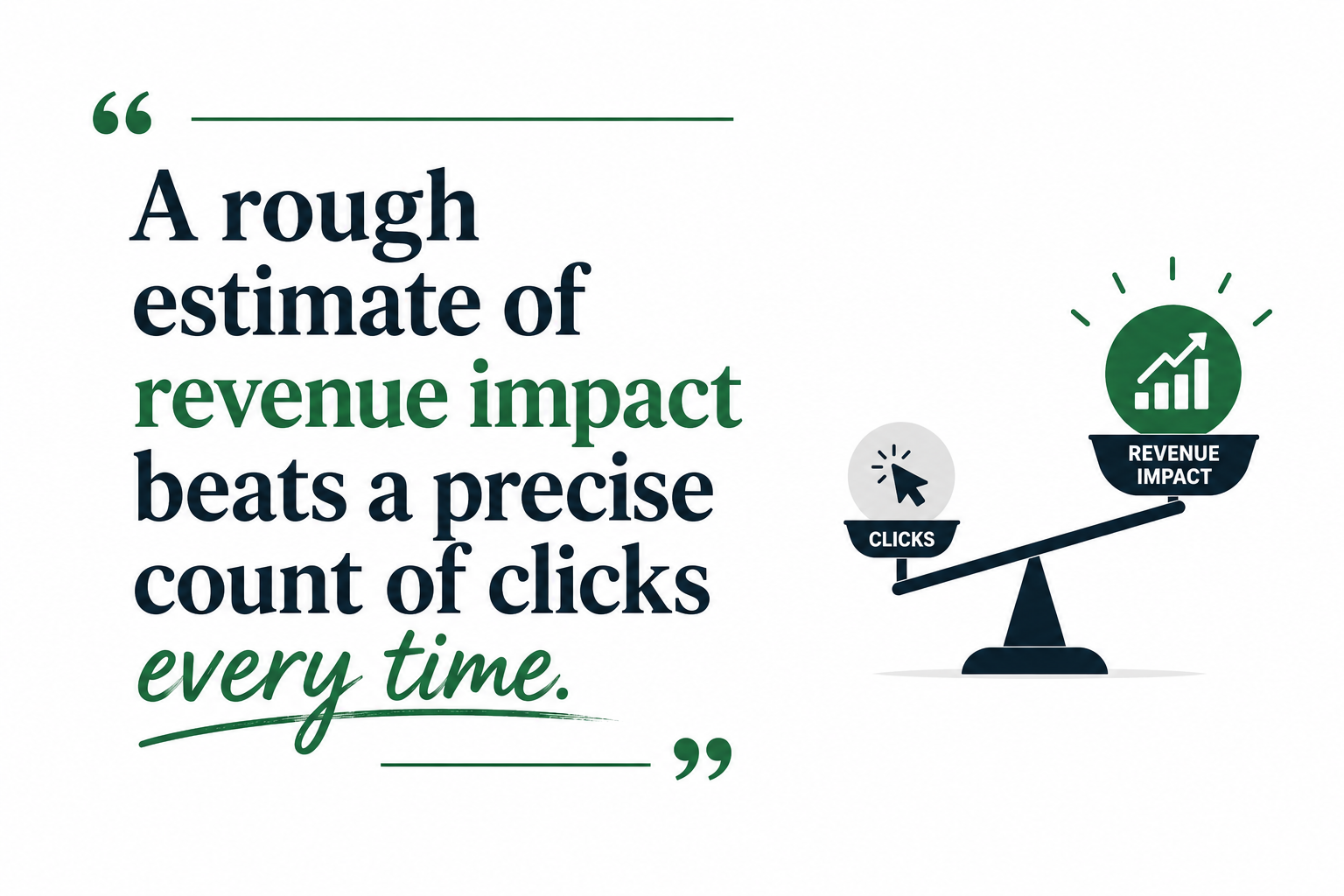
    Quote graphic stating that a rough estimate of revenue impact beats a precise click count, illustrated by a scale weighing clicks against revenue impact.
    When attribution is incomplete, business value tips the scale: a credible estimate of revenue impact can guide GEO investment better than a perfectly precise tally of clicks.

    Instead of asking only, “How many clicks did we receive from AI search?” I ask:

    • Is our branded search growing?
    • Are prospects arriving already familiar with our positioning?
    • Are we being cited in AI answers for questions that drive revenue?

    I would not treat any one of these signals as definitive. When I combine them, however, they can create enough confidence to support a responsible investment decision.

    That is the essential difference between GEO measurement and traditional SEO measurement. I am not simply measuring a click path; I am measuring market influence.

    I believe the marketers who adapt fastest will stop treating attribution as a traffic-sorting exercise. We will combine quantitative signals with qualitative evidence because the goal is not absolute certainty. The goal is confidence that our GEO investment is moving the business in the right direction.

    Why I may be measuring the wrong thing

    I do not think SEO or GEO metrics are inherently wrong. The problem is that they can be highly precise without being relevant to the business outcome I am trying to influence. They tell me exactly what happened inside a channel, but not whether the business is moving in the right direction.

    SEO tools are packed with precise numbers. The challenge is that many of those numbers have only a weak connection to business outcomes.

    Precise = exact

    Accurate = connected to business outcomes

    I have found that leadership would rather receive a roughly correct estimate of revenue impact than a perfectly precise count of clicks.

    I studied engineering in school, where we spent a great deal of time discussing precision: how exact and repeatable a measurement is, right down to the decimal point.
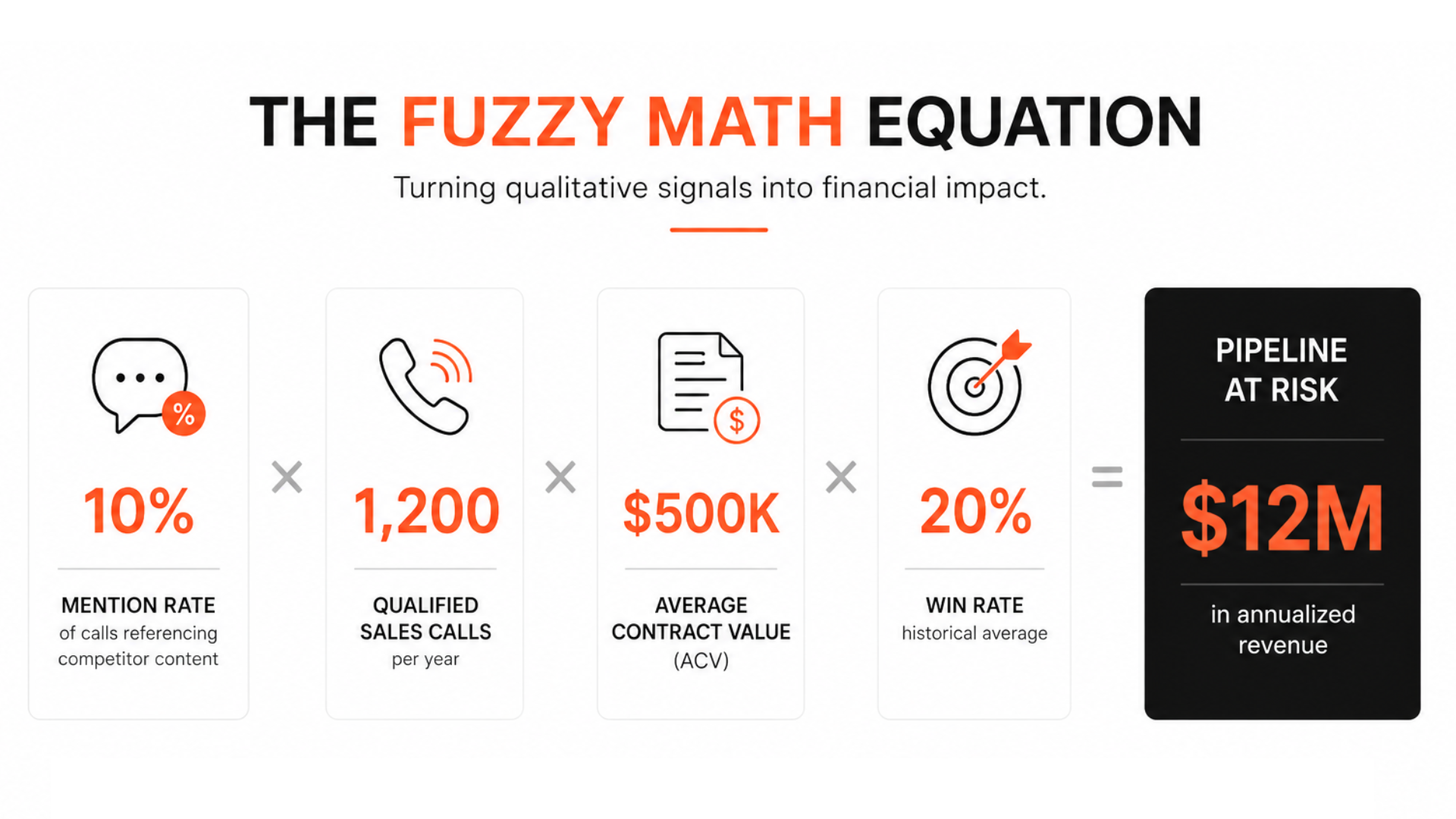
    Infographic showing fuzzy math: 10% mention rate × 1,200 sales calls × $500K contract value × 20% win rate equals $12M in pipeline at risk.
    The fuzzy math equation turns a qualitative sales signal into a figure leaders understand: a 10% competitor-content mention rate translates to $12 million in annualized pipeline at risk.

    In marketing, I see that kind of precision in organic clicks, rankings, impressions, and click-through rates. Tools such as Google Search Console can give me extremely exact figures for those channel activities.

    Precision compared with accuracy in GEO and SEO measurement

    The problem is that a precise channel number is not necessarily accurate in the business sense. I consider a measurement accurate when it tells me whether I am getting closer to an outcome that matters.

    Even when those measurements are not perfectly precise, I find them more useful if they point toward the bullseye: the business outcomes leadership cares about.

    Knowing that a page received 40 organic clicks is precise. It tells me almost nothing about whether we are winning or losing in the market—just as a visitor count did not tell my daughter whether she was close to buying her Nintendo Switch.

    Revenue impact compared with a precise click count

    That is how I apply the Dollar Rule in practice. When attribution is incomplete, I translate the evidence I do have into a directional estimate of business impact.

    Why I put revenue ahead of attribution

    For me, a rough number tied to revenue beats an exact number tied only to channel activity.

    When reliable attribution is unavailable, I build the case from signals I can actually access and then work through the math.

    I do not use fuzzy math to replace SEO metrics or attribution. I use it alongside them when traffic-based attribution cannot capture the influence taking place.

    One of our healthcare clients gave us a useful example.

    Prospects were arriving at sales calls already convinced of claims that were not true.
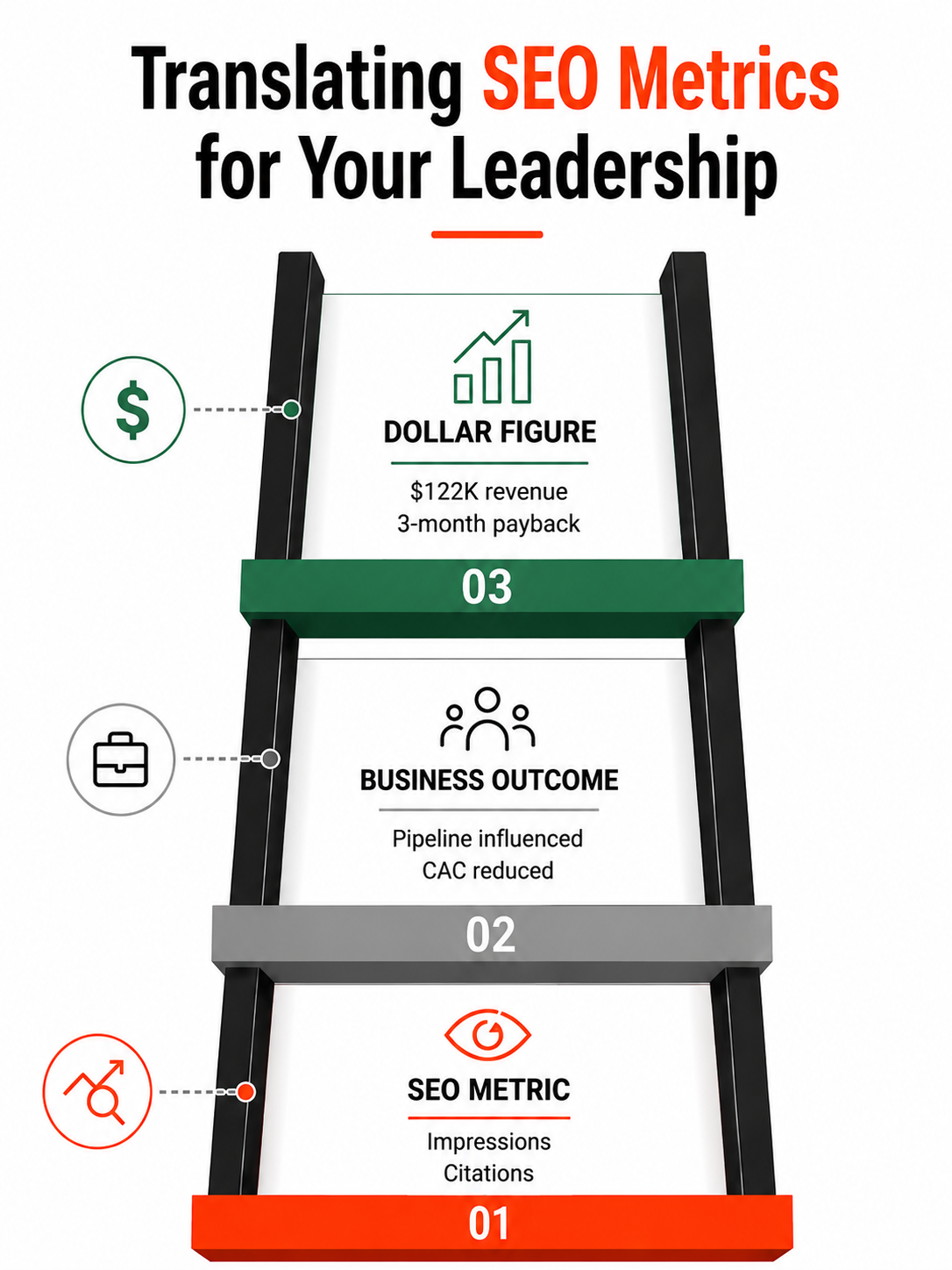
    Vertical ladder infographic titled “Translating SEO Metrics for Your Leadership,” moving from impressions and citations to business outcomes and $122K in revenue.
    Climb from channel data to executive value: translate SEO impressions and citations into pipeline and lower CAC, then show leadership what matters—$122K in revenue and a three-month payback.

    We traced the source to a competitor’s comparison page. That page was shaping buyer perceptions long before our client had an opportunity to present its side of the story.

    We recommended publishing content that would counter the narrative, but the leadership team did not believe there was enough evidence to justify a response. We needed to make a stronger business case.

    SEO tools estimated that the competitor’s page received roughly 40 organic visits per month. Whether that estimate was right or wrong was beside the point: it did not measure the page’s influence on active buyers.

    So we looked for evidence that was closer to the business outcome.

    We spoke with our client’s salespeople. They told us that roughly 10% of qualified B2B discovery calls included unprompted mentions of specific claims from the competitor’s page.

    That was not a clean number suitable for an exact attribution model, but we could not dismiss it. The influence was real, and it was showing up during live sales conversations.

    We used that evidence to build a directional calculation:

    10% mention rate on discovery calls

    × 1,200 qualified B2B sales calls per year

    × $500,000 average contract value
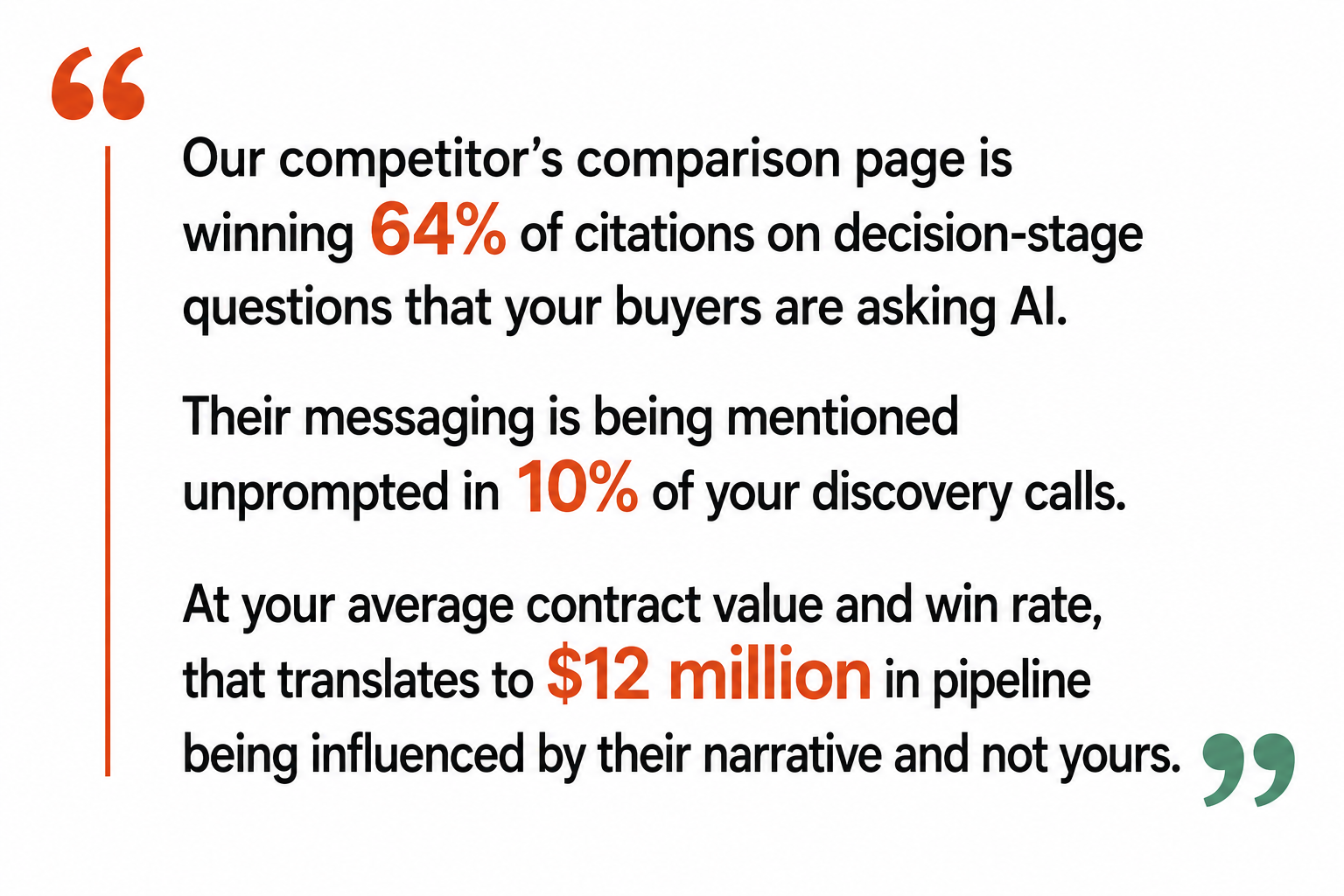
    Quote graphic stating a competitor wins 64% of AI citations, appears in 10% of discovery calls, and influences $12 million in pipeline.
    A competitor’s comparison page earns 64% of citations on decision-stage AI questions and surfaces in 10% of discovery calls—putting an estimated $12 million in pipeline under its narrative.

    × 20% average win rate

    = $12 million in annualized revenue being influenced by the competitor’s narrative

    I did not present this as a forecast or a formal attribution model. It was a directional estimate of how much revenue the competitor’s messaging could influence.

    That reframing changed the conversation. We stopped debating 40 clicks per month and started discussing $12 million in influenced revenue.

    Fuzzy math equation estimating revenue influenced by a competitor narrative

    That is the number we brought to leadership—not impressions or citation share, but $12 million in revenue being influenced by a page our client had declined to counter. That is a number a CFO immediately understands.

    I lead with value metrics

    If we enter a GEO campaign review and lead with rising citation share or growing impressions, our CMO may lose interest and our CFO may wonder what those numbers mean financially. In the worst case, we can lose budget because leadership cannot see the return.

    Translating SEO and GEO channel metrics for leadership

    Here is how we framed the situation for our client’s leadership team:

    Executive talking points connecting market influence to revenue

    I have learned that leadership funds marketing campaigns based on business impact. Translating a problem into dollars changes the nature of the discussion.

    The decision-makers did not need certainty. They needed a credible financial story supported by leading indicators, observable momentum, and enough evidence to inspire confidence.

    I focus on what the business values

    That is what my eight-year-old intuitively understood at her lemonade stand. Her goal was never to count visitors. Her goal was to buy the Nintendo Switch.

    Angled smartphone displaying a ChatGPT screen with an Advertisement card, illuminated by blue and magenta neon light against a dark background.
    A neon-lit smartphone imagines advertising inside ChatGPT, highlighting how AI platforms are reshaping brand discovery, GEO strategy, and the measurement of marketing influence.

    GEO has created anxiety because it disrupted attribution models we relied on for years. But I remind myself that attribution was never the ultimate objective.

    The real objective is business growth.

    If I can connect GEO activity to revenue opportunity, revenue at risk, pipeline influence, or customer acquisition, I do not need perfect certainty to justify the investment.

    I need credible evidence that our GEO campaigns are moving the business in the right direction.

    Precise metrics tell me what happened. Relevant metrics tell me whether we are winning.

    Before I deliver my next GEO report, I can examine every metric on the page and ask one question:

    If this metric doubled tomorrow, would the business care?

    Then I ask the follow-up:

    Can I translate this metric into revenue opportunity, revenue at risk, pipeline influence, or customer acquisition cost?

    If I cannot, I am probably reporting channel impact rather than business impact—and that is unlikely to justify the next GEO investment.


    Inspired by this post on Search Engine Land.


    crushpress.ai community screenshot
  • How Paid Social Shapes Search ROAS and Budget Decisions

    How Paid Social Shapes Search ROAS and Budget Decisions

    Search can appear to be the most efficient paid channel while benefiting from demand that paid social created earlier. That makes channel-level return on ad spend useful for optimization but potentially misleading for budget allocation.

    The practical question is not whether social deserves credit for every later search conversion. It is whether reducing social changes the volume, readiness, or acquisition cost of people arriving through search. Answering that question requires treating search and social as connected parts of the customer journey.

    Key takeaways

    • Paid social can influence search without generating a measurable click, particularly when exposure leads to a later branded query.
    • Search ROAS may reflect both search execution and the strength of upstream demand generation.
    • Brand-query impressions, non-brand conversion rates, and search auction metrics can provide early evidence of a cross-channel effect.
    • A social budget cut may not damage search immediately because previously exposed audiences can continue searching for several weeks.
    • Budget decisions should combine channel reports with lagged analysis and controlled tests wherever practical.

    The mechanism extends beyond attribution credit

    ROAS compares attributed revenue with advertising spend. It does not, by itself, reveal which activity originated the demand. Search is often positioned near the end of a journey because a query expresses an existing need or interest. Paid social can operate earlier, introducing a brand or product before the person is ready to act.

    The supplied source article describes three ways this relationship may appear. First, its author reports frequently seeing weekly Meta or TikTok spend move with branded-query impressions in Google Ads. The proposed explanation is that some people notice a social ad, do not click, and later search for the advertiser by name.

    Second, the article reports stronger conversion rates on generic search queries when audiences may already know the brand. The query, auction, and landing page can remain unchanged while prior exposure alters the searcher’s willingness to convert. In that situation, search captures the transaction, but its conversion rate partly reflects work performed upstream.

    Third, the article proposes an auction effect: greater familiarity may improve click-through rates on brand-adjacent searches, which can affect expected click-through rate and potentially influence cost per click. This is a more indirect hypothesis than the branded-search relationship, so it should be tested rather than assumed.

    Together, these mechanisms separate two questions that channel dashboards often merge: which ad received conversion credit, and which advertising changed the probability that the conversion would happen. The second question is the more important one for incremental budget decisions.

    Why channel reports can overstate search’s independence

    Cutaway illustration showing an apparent search path to purchase supported by a hidden stream of people arriving from social discovery.

    Last-click reporting naturally favors the touchpoint nearest the transaction. Even data-driven attribution remains constrained by the interactions a measurement system can observe. A social impression followed by no click may leave little or no usable path data when the same person searches later.

    Social platforms may report view-through conversions, but the source notes that teams often distrust figures calculated by the platform selling the ads. Discarding view-through credit entirely avoids accepting an inflated platform claim, yet it creates the opposite risk: treating an unobserved influence as no influence at all.

    This produces an uneven comparison. Search is judged largely on its ability to capture expressed intent, while social is judged on whether its exposure generated an observable conversion path. A search campaign showing a higher reported ROAS can therefore be the better conversion-capture channel without necessarily being the best destination for the next unit of budget.

    The source is best read as a practitioner account rather than controlled proof. Its author identifies as a paid search specialist and bases the argument on patterns observed across accounts. Those observations offer a credible hypothesis and useful diagnostic signals, but correlation between social spend and search results can also be affected by promotions, seasonality, total media investment, or changing demand. Attribution reports should not settle the question, but neither should a simple correlation chart.

    Delayed search decay can hide a poor reallocation

    Illustration of a flywheel continuing to turn after its input is reduced while the downstream flow of customers gradually thins.

    The timing of the effect complicates budget evaluation. According to the source, search performance can remain stable for four to eight weeks after social spending is reduced because people reached by earlier campaigns may continue to search. The apparent success of moving money into search can therefore precede a decline in the audience that social had been preparing.

    The article recounts cases in which teams cut social spending by 40% and later saw search cost per acquisition rise by 25%, despite no meaningful changes inside the search account. These figures are reported examples, not a universal forecast. Their value is in illustrating why the date of a budget change should remain visible when later search deterioration is investigated.

    A useful diagnosis connects several signals over time. Weekly social spend can be compared with branded-query impressions using multiple lag periods. Non-brand conversion rate can show whether generic searchers are becoming less likely to buy. Click-through rate and cost per click on relevant terms can indicate whether auction behavior is also changing. Promotions, pricing changes, search impression share, competitive pressure, and seasonality should be examined alongside those trends so that an upstream-media explanation does not become the default answer to every decline.

    The sequence matters more than any isolated metric. A social reduction followed by softer branded demand and weaker non-brand conversion provides a more coherent signal than a simultaneous movement in two weekly charts. Even then, the pattern supports a hypothesis; it does not prove causation.

    Measure the halo before changing the channel mix

    The strongest evaluation asks what happens to total acquisition when upstream exposure changes. Where scale and operations permit, a holdout or geographic test can compare markets or audiences with different levels of paid social support while search activity remains as consistent as possible. The evaluation window must be long enough to capture the lag suggested by normal buying behavior rather than only immediate social conversions.

    When a controlled test is not feasible, teams can still improve the decision. They can mark budget changes, examine lagged relationships, separate branded and non-branded search, and compare channel results with blended revenue or acquisition outcomes. The aim is not to assign a perfect fractional credit to every impression. It is to estimate whether social spending causes enough additional business, including downstream search performance, to justify its marginal cost.

    The underlying principle is channel-agnostic. The source argues that YouTube and Demand Gen can generate upstream exposure within Google’s ecosystem, while Microsoft Audience Ads can play a similar role across Microsoft properties. Keeping discovery and search activity on one platform does not eliminate the measurement problem: an earlier visual exposure can still assist a later search conversion without receiving proportionate credit.

    Budget governance should therefore distinguish reported channel ROAS from incremental portfolio value. Search teams can optimize queries, ads, bids, and landing pages while also monitoring the demand inputs that make those optimizations productive. Social teams, in turn, should be accountable for more than platform-reported conversions by tracking credible downstream indicators and participating in incrementality tests.

    The next budget cycle should treat search efficiency as a shared outcome, then test how much of it persists when upstream exposure changes. That approach protects strong search performance without assuming that search created all the demand it converted.

    References

  • How AI Commerce Turns Product Data Into Buyer Trust

    How AI Commerce Turns Product Data Into Buyer Trust

    AI commerce discoverability is becoming a qualification problem, not merely a ranking problem. Before a product can be compared, recommended, or purchased by an AI system, the system must be able to identify the seller, interpret the offer, verify critical details, and connect the product to the buyer’s actual need.

    The source articles approach that challenge from different directions: shopping data readiness, brand identity alignment, and agentic commerce infrastructure. Together, they point to a broader conclusion: product trust is produced by an information system spanning brand, catalog, policy, inventory, and transaction data.

    Key takeaways

    • AI visibility depends on whether a machine can confidently identify a brand and evaluate its products, not simply whether a page ranks.
    • Complete product feeds, structured markup, crawlable policies, and current inventory reinforce one another; no single implementation creates trust by itself.
    • Brand identity is part of commerce data. Conflicting descriptions across websites, profiles, schema, and third-party sources can weaken otherwise strong catalog information.
    • Buyer alignment matters alongside technical completeness. A brand can become visible for the wrong topics and still remain absent from the decisions that generate revenue.
    • Agentic commerce raises the cost of errors because an AI assistant may narrow choices or move toward a transaction before the shopper visits the merchant’s site.

    Discoverability now has three trust layers

    Traditional ecommerce SEO often concentrates on pages, queries, rankings, and clicks. Those remain relevant, but AI-mediated shopping introduces additional decision points. A system may first determine what the business is, then decide whether its catalog data is usable, and finally assess whether the current offer satisfies the request.

    The article on SEO priorities for AI shopping describes static, real-time, and entity information as distinct parts of brand knowledge infrastructure. The article on the brand identity gap broadens that idea by showing how company messaging, search-engine interpretation, AI citations, and actual buyers can diverge. The agentic commerce analysis then places product feeds at the transaction layer, where data may help determine which products an assistant recommends or buys.

    Trust layerWhat the system needs to resolveTypical evidenceLikely failure
    Brand identityWho the seller is and what it offersConsistent names, organization markup, authoritative profiles, clear positioningThe brand is confused with another entity or classified in the wrong category
    Product understandingWhat the item is and whether it fits the requestTitles, descriptions, identifiers, specifications, images, comparisonsThe product cannot be confidently included in a shortlist or comparison
    Transaction readinessWhether the offer is valid and purchasableCurrent price, availability, shipping, returns, feed data, platform integrationsThe product is excluded, shown inaccurately, or abandoned before purchase

    This layered view explains why isolated optimizations have limited value. Product schema cannot compensate for stale inventory. A complete feed cannot resolve an ambiguous company identity. Strong brand recognition cannot make a missing shipping estimate usable. Trust emerges when the layers agree.

    A correct catalog cannot repair an unclear brand

    Two identical products shown with fragmented brand signals on one side and a coherent, connected identity on the other.

    The identity-gap article reports that four AI engines produced materially different descriptions of the same company. Its proposed diagnostic compares how engines describe the company’s category, location, founder, and products. The point extends directly into commerce: a machine cannot reliably recommend an offer if it has not resolved which organization stands behind it.

    Entity consistency therefore belongs in the same operating model as feed quality. The AI shopping article recommends consistent brand naming across owned and third-party properties, an accurate Google Business Profile, and Organization schema using properties such as sameAs. It also discusses knowsAbout as a way to clarify the subjects associated with an organization. These implementations provide explicit clues, but their value depends on agreement with visible content and authoritative external sources.

    A second risk is subtler: the machine may understand the brand yet associate it with the wrong audience or use case. The identity-gap article calls this audience mismatch. Its suggested test places traffic-generating queries and pages beside closed-won customers in the CRM, categorized by source and intent. If informational traffic clusters around free tools or early discovery while customers buy because of compliance, migration, or another scarcely covered concern, discoverability is not aligned with commercial demand.

    That distinction becomes more consequential when AI interfaces mediate the first impression. The identity-gap source cites an early-2026 randomized field experiment from the ISB Institute of Data Science that reportedly found a 38% reduction in outbound publisher clicks when an AI summary appeared. The source explicitly identifies the research as a working paper rather than peer-reviewed evidence. It also cites Tow Center findings of misattributed citations in more than six out of 10 tested cases. Those reported results should not be treated as universal performance benchmarks, but they illustrate the risk: users may have fewer opportunities to inspect a site and correct an inaccurate machine-generated interpretation.

    Product trust must survive the path from page to purchase

    An unbranded product travels through connected verification, comparison, payment, and delivery checkpoints monitored by abstract AI agents.

    The two commerce-focused sources converge on the importance of product data completeness, accuracy, and freshness. The AI shopping article identifies titles, descriptions, prices, availability, GTINs or MPNs, shipping terms, return policies, and high-quality images as part of an AI-ready product record. The agentic commerce article likewise argues that product feeds and structured attributes may determine whether a product qualifies for an AI recommendation.

    Completeness alone is insufficient. The same fact may appear in a product page, JSON-LD markup, a merchant feed, a policy page, and an inventory system. If those surfaces disagree, the merchant has created several possible versions of the offer. Price and availability deserve particular attention because they change frequently and can affect whether a purchase can proceed.

    Presentation also matters. The AI shopping source distinguishes schema from structured on-page content: markup explains what data represents, while page structure makes the information accessible in the visible document. It recommends HTML specification tables, factual comparison tables, and purchase-critical policies at stable, crawlable URLs instead of relying exclusively on JavaScript interfaces or PDFs. This distinction is useful because a valid structured-data implementation does not guarantee that every system will use it, while clear HTML gives machines and people another interpretable source.

    The agentic commerce article frames this work as preparation for a transaction environment rather than an advertising format. It reports that Google introduced Universal Cart at Google I/O 2026 on the Universal Commerce Protocol and says merchants could already onboard with UCP. It also reports that Amazon combined Rufus and Alexa+ in an experience called Alexa for Shopping. These platform claims come from the source and are not independently verified here, but the strategic implication does not depend on predicting which interface wins: data needs to remain usable when discovery, comparison, and checkout occur across different systems.

    A practical operating model for AI commerce data

    Taken together, the sources support a cross-functional workflow rather than a one-time SEO project. Search teams can identify machine-readable gaps, but catalog operations, merchandising, brand, engineering, customer research, and sales each control part of the evidence an AI system may encounter.

    1. Define the canonical brand identity. Document the company name, category, markets served, core offers, and authoritative profiles. Compare that definition with the homepage, organization markup, business listings, sales materials, and third-party descriptions.
    2. Establish a canonical product record. Assign ownership for titles, identifiers, specifications, images, price, availability, shipping, returns, warranties, and other purchase-critical attributes.
    3. Map every distribution surface. Identify where each field appears across product pages, structured data, merchant feeds, platform APIs, policy pages, and internal systems.
    4. Test consistency as well as presence. A field should not merely exist; its value should agree across surfaces and update at a speed appropriate to how often it changes.
    5. Connect discoverability to buyer evidence. Compare the queries and pages attracting attention with customer research, sales objections, and closed-won intent so that the catalog is described around real purchase criteria.
    6. Run representative AI evaluations. Ask several systems what the company is, what it sells, and which products fit important buying scenarios. Record contradictions, missing products, unsupported claims, and citation patterns as diagnostic evidence rather than treating a single answer as a definitive ranking.

    This workflow also clarifies ownership. Brand teams should resolve positioning conflicts; commerce teams should govern product and inventory fields; engineering should support reliable rendering and integrations; SEO should validate accessibility and entity signals; sales and research teams should identify the criteria buyers actually use. A shared issue log can then distinguish identity failures, catalog omissions, freshness errors, and audience mismatches.

    Measurement should follow the AI decision path

    Rankings and referral traffic reveal only part of AI commerce performance. A more useful measurement model follows the stages through which a product may pass: recognition, eligibility, comparison, recommendation, and transaction readiness.

    • Recognition: Do major search and AI systems describe the organization consistently?
    • Eligibility: Are required product attributes present, current, and machine-readable?
    • Comparison: Can systems extract the specifications and policies needed to compare the product fairly?
    • Recommendation: Does the product appear for buying scenarios that resemble real customer needs?
    • Transaction readiness: Do price, stock, shipping, returns, and destination details remain accurate when the user moves toward purchase?

    The AI shopping article reports using Google’s Rich Results Test for conventional eligibility and manually reviewing AI Mode citation behavior for priority queries. That combination reflects an important limitation: traditional validators can confirm syntax and search-feature eligibility, but they do not fully measure how a generative system will interpret, cite, or recommend a product.

    Teams should also avoid treating mentions as equivalent to business value. A brand may be cited for educational content yet omitted from commercial comparisons, or recommended for an audience that rarely converts. Pairing AI visibility observations with feed diagnostics, product-page quality checks, CRM outcomes, and customer language provides a more credible view of whether discoverability is producing qualified consideration.

    The durable advantage is dependable evidence

    AI shopping interfaces and transaction protocols will continue to change, but their need for dependable evidence is likely to persist. Brands that make identity, product, policy, and live offer data agree across every surface will be better prepared for both human-led research and agent-assisted purchasing. The next competitive step is not to optimize for one chatbot; it is to build commerce information that remains trustworthy wherever a buying decision is assembled.

    References

  • How to Choose an Industry-Specific AI Search Agency

    How to Choose an Industry-Specific AI Search Agency

    An industry-specific AI search agency should do more than increase mentions in generated answers. It must understand how buyers evaluate providers, which claims require special care, what evidence AI systems are likely to rely on, and what action should follow a recommendation.

    Two supplied 2026 agency rankings – one covering healthcare agentic search optimization and the other covering transportation and logistics GEO/AEO – illustrate why sector fit matters. They also show how buyers can separate meaningful specialization from a broad AI-search service presented with industry language.

    Key takeaways

    • Industry expertise affects content accuracy, positioning, compliance, query selection, and conversion design; it is not simply an editorial preference.
    • Four agencies – First Page Sage, Genevate, Focus Digital, and Driven Metrics – appear in both supplied rankings, but each is presented as serving a different operating need.
    • The rankings cannot be merged into a universal league table because their scoring systems emphasize different outcomes and use different category weights.
    • Buyers should validate reported visibility with query-level evidence, accurate brand descriptions, qualified conversions, and a review process suited to their sector.

    The vertical is part of the optimization problem

    Healthcare and logistics teams use different evidence and workflows within a shared AI search network.

    ASO, GEO, and AEO overlap, but the labels point to somewhat different goals. GEO and AEO generally concern inclusion in generated responses and direct answers. Agentic search optimization extends the problem toward systems that may compare options, select a provider, or complete a task. Before evaluating an agency, a company therefore needs to specify the desired behavior: being cited, being described accurately, being recommended, or enabling an agent to take the next step.

    Healthcare demands controlled claims and trusted actions

    The healthcare report says AI platforms apply a high credibility threshold to health and medical information because errors can directly affect the public. It describes additional complications for pharmaceutical companies, including promotional restrictions, cautious treatment of health-related information, and differences between older AI knowledge and a company’s current positioning.

    That makes subject-matter review and claim governance central to agency selection. The report presents First Page Sage as a broad healthcare option spanning providers, pharmaceutical companies, medical devices, and health technology. It identifies Genevate as particularly relevant to pharmaceutical positioning, Focus Digital as a fit for smaller practices and midsize provider groups, and MGMT Digital as a specialist in behavioral health and addiction treatment. These are reported assessments, not independently verified performance findings.

    Logistics requires fidelity to the operating model

    The transportation and logistics report frames AI search as an entry point for B2B buyers asking systems to recommend freight, logistics, and supply-chain providers. In this environment, apparently similar companies may serve different lanes, geographies, shipment types, buyer roles, or commercial models. Generic content can attract the wrong comparison even when it earns visibility.

    The report consequently gives transportation specialization 20% of its scoring model. It describes First Page Sage as having experience across carriers, third-party logistics providers, freight technology platforms, and supply-chain consultancies. It positions Focus Digital toward regional carriers and smaller freight brokers, while noting that clients should review industry content carefully. It also reports that Driven Metrics may need additional operational input from clients because its transportation portfolio is still developing.

    What the two rankings reveal – and what they do not

    The healthcare study says it evaluated more than 40 agencies in the second quarter of 2026. Its largest weight was ASO expertise at 25%, followed by client reviews and leadership experience at 20% each. The transportation study says it evaluated 34 firms, weighting AI visibility at 25%, transportation specialization at 20%, and GEO/AEO expertise at 20%.

    Those differences matter. One framework gives substantial weight to healthcare leadership, regulatory fluency, institutional history, and media references; the other places greater emphasis on observable AI visibility and transportation specialization. A rank in one list therefore does not measure precisely the same thing as a rank in the other.

    AgencyHealthcare reportTransportation reportSelection signal reported across the sources
    First Page SageRanked 1stRanked 1stBroad, full-service delivery with established sector experience
    GenevateRanked 3rdRanked 2ndEmphasis on correcting how AI systems characterize a brand through positioning, PR, and citations
    Focus DigitalRanked 2ndRanked 3rdSmaller-team model presented as accessible to focused or regional engagements
    Driven MetricsRanked 4thRanked 4thMeasurement-oriented delivery emphasizing reporting and conversion tracking

    The recurrence of these four firms is a useful pattern within the supplied material, but it is not independent corroboration: both referenced articles are hosted on First Page Sage’s website, and both place First Page Sage first. Buyers should treat the lists as vendor-produced research that can inform a shortlist, then verify claims using direct evidence, references, and a scoped pilot.

    Match the agency model to risk, scale, and specialization

    The most suitable agency is not necessarily the firm with the highest composite score. A pharmaceutical company may value controlled positioning and regulatory fluency more than publishing volume. A multi-location health system may need delivery capacity and intake infrastructure. A regional carrier may prioritize founder access and affordability, while a larger logistics company may need coverage across multiple services and buyer groups.

    The supplied reports support several practical distinctions. First Page Sage is presented as the broadest full-service option in both sectors. Genevate is depicted as a newer specialist whose differentiator is not merely earning a mention, but improving the accuracy of AI-generated brand descriptions. Focus Digital is described as a more accessible choice for smaller organizations, with the trade-off that its model may be less suitable for complex enterprise campaigns. Driven Metrics is distinguished by its attention to reporting, inquiry quality, and conversion attribution.

    The sector-only names are also informative. The healthcare list includes Medico Digital, Signal Hill Strategies, and MGMT Digital, while the logistics list includes Virayo and Elevation Marketing. Their absence from the other ranking should not be read as a negative judgment; it may instead reflect a narrower industry portfolio or the different candidate pools and criteria used by the two studies.

    A credible proposal should translate specialization into an operating plan. That means naming the audiences and decisions to target, identifying who reviews technical claims, explaining how citations and brand descriptions will be monitored, and showing how generated visibility connects to an appointment, inquiry, study download, quote request, or other appropriate action.

    Validate measurement before buying the service

    Analysts trace an AI-generated recommendation back to sources and a resulting customer action.

    AI-generated results can vary by platform, prompt, context, and time. A single screenshot is therefore weak evidence of durable visibility. A stronger agency evaluation uses a repeatable baseline and distinguishes a favorable mention from a commercially useful outcome.

    1. Define the decision set. Document the buyer or patient questions, service categories, locations, and journey stages the campaign is meant to influence.
    2. Record visibility and characterization separately. Track whether the brand appears, which competitors appear, how the brand is described, and whether material inaccuracies are present.
    3. Inspect supporting evidence. Ask which owned pages, third-party citations, public relations placements, structured information, and authority signals are expected to support the desired answer.
    4. Set an approval workflow. Healthcare organizations should establish clinical, legal, or regulatory review where appropriate. Logistics companies should assign operational experts to verify service descriptions and buyer terminology.
    5. Connect exposure to action. Reporting should distinguish citations and recommendations from qualified inquiries, consultations, downloads, or other agreed conversion events.
    6. Test delivery fit. Confirm staffing, reporting cadence, content capacity, stakeholder responsibilities, and the agency’s ability to support the organization’s number of markets, locations, or service lines.

    The durable advantage will come from selecting an agency whose sector knowledge changes the quality of its work, not merely the vocabulary in its pitch. As AI search develops, labels and platform tactics may shift; a disciplined system for accuracy, authority, measurement, and useful next actions will remain the more reliable buying criterion.

    References

  • Growth Marketing Investment: Earning the Right to Scale

    Growth Marketing Investment: Earning the Right to Scale

    Growth marketing discipline is not simply a matter of spending less. It is the practice of matching each investment to the strength of the evidence, the speed of the feedback loop, and the financial risk the business can absorb.

    Viewed together, the source articles expose two sides of the same capital-allocation problem. Paid media can consume cash before a campaign has learned enough to use it efficiently, while underinvesting in SEO can create a slower, compounding liability. The practical goal is therefore neither maximum growth nor minimum cost, but evidence-based investment across different time horizons.

    Key takeaways

    • Budget consumption is an input, not evidence of business performance.
    • Paid campaigns should generally earn larger budgets through validated conversion quality, unit economics, and operational learning.
    • SEO should be judged partly by the future acquisition costs and competitive exposure that sustained investment may prevent.
    • Channel metrics become decision-useful only when connected to pipeline, revenue, payback, or measurable risk.
    • Growth plans need explicit scale, hold, reduce, and stop conditions before spending begins.

    The same budget can create very different financial risks

    A dollar allocated to paid acquisition and a dollar allocated to SEO do not mature on the same schedule. Paid media can generate immediate traffic and relatively fast campaign signals, but it can also amplify weak targeting, immature bidding, poor creative, or an unproven offer. SEO usually takes longer to affect commercial outcomes, yet reducing it may allow competitive positions and accumulated authority to deteriorate over time.

    The paid-media source argues that most campaigns should begin with a measured rollout because algorithms are still learning and the strongest audiences, keywords, and creative assets are not yet known. It also warns that a long or variable sales cycle limits the value of forcing more spend into an early period: if sales arrive months after the first exposure, the campaign cannot quickly convert additional volume into reliable learning.

    The SEO source describes almost the inverse danger. Organic positions are presented as contested rather than permanent, so a budget reduction may produce a delayed and potentially compounding decline. Competitors can continue publishing and building authority while the withdrawing company loses visibility, and replacing lost organic demand with paid acquisition may increase customer acquisition costs. That makes maintenance investment relevant even when its short-term incremental return is difficult to isolate.

    This distinction changes the budgeting question. Paid media requires protection against premature amplification; SEO requires protection against deferred deterioration. A disciplined portfolio accounts for both instead of applying one universal demand for immediate return.

    Commercial evidence must replace activity as the investment case

    Both sources reject the idea that channel activity is a sufficient measure of progress. The paid-media article states that the amount spent is not a key performance indicator. The SEO article reaches a parallel conclusion about rankings, traffic, and keyword opportunities: those metrics cannot support a capital request unless their commercial implications are made clear.

    The SEO source illustrates the gap with an enterprise software example. It reports that one product line produced 291 inbound demo requests in a month in 2008 and 274 in the corresponding month of 2026, despite a digital marketing budget that had grown to roughly eight times its earlier size. The example is not proof that any single channel failed, but it shows why a finance leader may focus on qualified opportunity output and acquisition efficiency rather than favorable channel charts.

    The paid-media source reports a similarly consequential measurement failure at a startup that had raised more than $250 million. According to the article, most of the funding had been consumed before measures such as revenue-producing new accounts and lifetime revenue from those accounts became serious priorities. The lesson is broader than paid search: measurement introduced after capital is depleted cannot restore the option value that early discipline would have preserved.

    A credible investment case should therefore connect leading indicators to a commercial chain: exposure creates qualified demand, qualified demand creates customers, and customers create revenue and margin over time. Where that chain cannot yet be demonstrated, the uncertainty should be visible in the size and reversibility of the commitment.

    A stage-gated model connects experimentation to capital allocation

    An isometric pathway sends small experiments through checkpoints, stopping weak paths while stronger evidence unlocks progressively larger pools of investment.

    The synthesis of the two sources suggests a stage-gated approach. It preserves the paid-media article’s principle of testing before scaling while incorporating the SEO article’s emphasis on business risk, counterfactuals, and the cost of withdrawal.

    1. Define the commercial outcome. Specify the qualified action, customer, revenue, or risk outcome the investment is expected to influence. Channel metrics can remain diagnostic measures, but they should not become the final objective.
    2. State the uncertainty. Identify what is not yet known about audience quality, conversion value, attribution, sales-cycle delay, competitive response, or organic displacement. This prevents confidence from being inferred merely from a large budget.
    3. Choose a reversible initial commitment. For an unproven paid campaign, this generally means enough volume to produce useful signals without treating the entire available budget as test capital. For SEO, it means distinguishing experimental expansion from the baseline work needed to protect strategically important visibility.
    4. Set decision thresholds in advance. Establish what evidence will trigger scaling, continued observation, redesign, reduction, or termination. Thresholds should include commercial quality and payback considerations, not only clicks, traffic, or conversion counts.
    5. Increase investment in calibrated increments. Each increase should answer a defined question, such as whether performance persists in a broader audience or whether greater content investment protects or expands commercially valuable visibility.
    6. Reassess the portfolio effect. Evaluate whether one channel is creating, capturing, or merely receiving credit for demand, and estimate what another channel would need to spend if that contribution disappeared.

    This process does not require every channel to meet the same payback schedule. It requires every channel to have a defensible role, an appropriate evidence standard, and a known consequence if investment rises or falls.

    Governance should make both upside and downside visible

    Business leaders examine a transparent tabletop model showing both an illuminated opportunity route and a guarded downside route beside a finite pool of investment tokens.

    Investment discipline weakens when the person advocating aggressive growth does not bear the full consequences of failure. The paid-media source highlights this risk asymmetry and reports observing a recurring pattern across close to 1,000 ad accounts: advertisers that overspent early in pursuit of rapid growth often exhausted momentum and stakeholder support. That reported experience is not a universal causal estimate, but it reinforces the need for governance before enthusiasm becomes an irreversible commitment.

    Finance and marketing can reduce that asymmetry by reviewing paired scenarios. The upside case asks what additional investment could produce if the thesis works. The downside case asks how much capital can be lost, how quickly the result will become observable, and whether the company will still have enough runway to adapt. For durable channels such as SEO, the downside analysis should also examine what withdrawal could cost through lost visibility, higher replacement acquisition expense, and a more difficult recovery.

    Counterfactual thinking is essential in both directions. The SEO source identifies the central attribution challenge as whether credited revenue would have happened without the investment. The corresponding question for budget cuts is whether apparent savings will simply reappear as higher costs elsewhere. Neither question can always be answered with precision, but an explicit range of outcomes is more useful than presenting attributed revenue or budget savings as certain.

    The most resilient growth plans will treat capital as a sequence of informed commitments. Paid acquisition can expand as customer quality and economics become clearer, while SEO can be funded according to both its growth potential and the liability created by neglect. That balance allows a company to pursue opportunity without spending away its ability to learn.

    References

  • AI Search and Agentic Commerce: A Readiness Framework

    AI Search and Agentic Commerce: A Readiness Framework

    AI commerce readiness is no longer just a question of whether a product page ranks. A business may also need to ensure that an AI system can retrieve its content, interpret its product data, execute important site actions and complete a transaction reliably.

    Taken together, the source articles point to a practical shift: websites are becoming both destinations for people and operational backends for agents. The payoff from preparing for that shift is broader than visibility. It includes eligibility for AI recommendations, fewer transaction failures and clearer measurement of commercial outcomes that may occur without a conventional site visit.

    Key takeaways

    • Agentic readiness has four connected layers: accessible content, reliable product data, callable actions and transaction-capable commerce infrastructure.
    • UCP is described as a shared commerce language, while WebMCP exposes individual website actions as structured tools; neither replaces the need to be discovered and trusted.
    • Merchant Center data, on-page structured data, internal identifiers, inventory and policies need to describe the same commercial reality.
    • Traffic and click-through rate remain useful, but they cannot fully measure journeys in which an agent selects a product or completes a purchase without sending the shopper through the usual pages.

    The journey is separating into discovery, action and transaction

    Traditional search optimization concentrated heavily on discovery: match a query, earn a ranking and persuade the searcher to click. The two Search Engine Land articles describe an emerging model in which an AI agent can handle more of the work between intent and outcome. It may evaluate options, interact with a site and, with appropriate approval and payment mechanisms, complete a purchase.

    This does not make discovery irrelevant. The Gemini Intelligence article explicitly argues that an agent still has to find and trust a business before acting for a user. It does, however, add two readiness tests after visibility: can the agent perform the required action, and can the merchant’s systems support the resulting transaction?

    The sources assign different roles to the emerging protocols. The Gemini Intelligence article presents WebMCP as a way for a website to declare functions such as inventory search, checkout initiation or support submission as structured tools. Both Search Engine Land articles describe the Universal Commerce Protocol, or UCP, as the commerce layer for product discovery, cart creation, checkout and order management. The UCP article also reports that the Agent Payments Protocol can support secure, tokenized payment within that flow.

    The distinction matters operationally. Readable content helps an agent understand an offer. Structured actions help it use the business’s systems. Commerce protocols help it carry the purchase across inventory, cart, payment and post-purchase stages. Implementing only one layer leaves gaps elsewhere in the journey.

    A four-layer audit reveals where agents will fail

    A glowing digital agent travels through four stacked commerce-system layers with several visible broken connections and blocked passages.

    Content access and retrieval

    The first question is whether automated systems can access the same useful information that a person sees. Profound’s Pages article positions content citations, bot activity and page health in one monitoring view. Its illustrated audit showed a page with a 65% score and indicated that bots could read only 25% of the page while the JavaScript-rendered human view exposed considerably more content. Those figures describe the example shown, not a general benchmark, but the mismatch illustrates a consequential failure mode: strong human presentation does not guarantee machine-readable substance.

    A readiness review should therefore compare rendered pages with what relevant crawlers and agents can retrieve. Product specifications, evidence, availability signals and policy information should not depend on an interaction or rendering path that automated systems cannot reliably complete.

    Product data consistency

    The UCP article treats Google Merchant Center as an important product-information source for AI discovery, not merely an advertising feed. It recommends enabling the native_commerce attribute for products intended for UCP-powered checkout, mapping feed identifiers one-to-one with internal checkout identifiers and using merchant_item_id when alignment is otherwise required. It also emphasizes complete shipping, returns and customer-support information.

    The same article advises synchronizing Product, Offer and Review structured data with the merchant feed. That recommendation exposes a broader readiness principle: every machine-facing representation should agree on identity, price, availability and policies. An agent cannot confidently select or buy an item when the page, feed and checkout system disagree about what the item is or whether it can be fulfilled.

    Action reliability

    The Gemini Intelligence article recommends auditing the site’s highest-value actions, including lead submissions, bookings and checkout flows, to determine whether an agent can complete them reliably. This is wider than ecommerce. Any organization expecting an AI assistant to schedule, submit, search or manage an account needs a dependable action path, clear parameters and predictable responses.

    Human escalation also belongs in the design. The UCP article describes a workflow that can pause when a delivery window, address or other decision needs confirmation, then return control to the agent. Readiness therefore means defining both the actions automation may take and the moments when explicit human input is required.

    Transaction and policy execution

    Checkout readiness extends beyond exposing an add-to-cart command. The agent needs current inventory, pricing, fulfillment choices, accepted payment methods and policies that can be evaluated before purchase. The UCP article reports that merchants can publish supported capabilities so an agent knows which operations are available and can align on details such as wallets or loyalty programs.

    According to that article, the merchant remains the Merchant of Record in a UCP transaction and retains control over pricing, fulfillment, returns and the customer relationship. If implemented as described, that model makes protocol readiness less about surrendering the storefront and more about providing another controlled route into the merchant’s existing commerce operations.

    Measurement must follow outcomes that happen without clicks

    Abstract AI agents carry products through baskets, payment rings, and fulfillment packages while cursor trails fade in the background.

    A click-based dashboard can understate value when an AI interface performs research, comparison or checkout on the user’s behalf. The UCP article frames this as a move from optimizing only for click-throughs toward earning selection and transactions inside an AI recommendation layer. Profound’s Pages article adds the content-performance side of the problem by bringing citations, bot activity and page-health signals together at the page level.

    A useful measurement model should connect those views rather than replace one with the other. Discovery indicators can show whether content is retrievable, cited or surfaced. Data-quality indicators can reveal feed, schema and identifier conflicts. Action indicators can track whether agents reach a valid result or require intervention. Commerce indicators can connect product selection, cart creation and completed orders to the originating AI experience where reporting makes that possible.

    This also changes how teams diagnose performance. Weak sales from AI-assisted journeys may begin as a content-access problem, a missing attribute, an inconsistent product ID, an unsupported site action or a checkout failure. Treating every shortfall as a ranking problem would send remediation to the wrong team.

    Readiness should be staged around business-critical journeys

    The most defensible starting point is a small set of valuable journeys rather than a site-wide protocol project. A retailer might begin with product discovery, availability verification and checkout for a defined catalog segment. A service business might begin with search, qualification and booking. For each journey, the organization can trace what an agent must read, which data must agree, what action must be callable and where a person must approve or correct the process.

    That sequence also creates clearer ownership. Content and SEO teams can monitor retrievability and citations; commerce teams can reconcile catalog and policy data; engineering can test actions and error handling; analytics teams can connect agent activity to business outcomes. Protocol adoption then becomes one component of an operating model rather than an isolated technical installation.

    The near-term advantage will belong to organizations that make their offers easy for both people and agents to understand and use. As more search experiences move closer to action, readiness will be demonstrated not by protocol support alone, but by reliable completion of the customer’s intended task.

    References

  • OpenAI’s Desktop Consolidation: What Atlas Users Face

    OpenAI’s Desktop Consolidation: What Atlas Users Face

    OpenAI’s reported plan to retire ChatGPT Atlas is more than a product cancellation. It points to a desktop strategy built around one primary ChatGPT application that combines browsing, agent-led work, and Codex capabilities.

    For users and organizations, the immediate questions are practical: how firm the retirement date is, whether adopting an OpenAI browser remains necessary, and what the consolidation could mean for research and digital discovery.

    The desktop app is becoming the center of the product

    CrushPress.AI reported that OpenAI intends to discontinue Atlas as a standalone desktop browser and move its browser-based AI features into a new ChatGPT desktop app. The same report describes that app as bringing together ChatGPT Work, OpenAI’s work-focused agent, and ChatGPT Codex.

    This is a consolidation of entry points as much as a consolidation of features. Instead of asking users to choose among a dedicated AI browser, a separate Codex application, and the broader ChatGPT experience, the reported direction places those functions inside a common desktop environment.

    The sequence reported by CrushPress.AI helps explain the shift. Atlas launched on Mac in October, a dedicated Codex app followed, and an in-app browser was added in April. The planned unified app appears to gather capabilities that had been introduced through separate products, although the source does not provide a detailed migration map.

    Key takeaways

    • ChatGPT Atlas is reportedly scheduled to be retired as a standalone browser.
    • The stated Aug. 9 date is a target, so it should not be treated as an unconditional deadline without further notice.
    • Browser functions, ChatGPT Work, and Codex are being positioned within a unified ChatGPT desktop app.
    • Chrome users are expected to retain access to ChatGPT and Codex through OpenAI’s Chrome extension.
    • The change could concentrate more research and task completion inside ChatGPT, increasing its role in digital discovery.

    The Aug. 9 date carries an important qualification

    CrushPress.AI cited OpenAI’s James Sun as saying on X that Aug. 9 was the current targeted date for deprecation. According to the report, Sun also said that more information would be shared in the application and by email.

    That wording establishes a planned direction but preserves uncertainty around execution. A target date can change, and the supplied report does not specify when access will stop, whether data or settings will transfer automatically, or whether every Atlas feature will have an equivalent in the new app.

    Atlas users should therefore treat official in-app and email notices as the operative migration guidance. Before the target date, organizations can identify which workflows depend on Atlas and document any browser-specific behavior they would need to reproduce. That is prudent continuity planning, not evidence that any particular feature will be lost.

    Users still have two reported browser paths

    A computer user views two visual pathways from a desktop application to separate generic browser experiences.

    The consolidation does not necessarily require every user to replace an existing browser. CrushPress.AI reported that the new desktop app will include browser capabilities, while people who prefer Chrome can use OpenAI’s Chrome extension to access ChatGPT and Codex.

    Those paths serve different working preferences. A unified desktop app can keep browsing and agent tools in one OpenAI-controlled environment. An extension can place the same broad services closer to an established Chrome workflow. The source does not compare feature parity, security controls, performance, or account requirements, so it would be premature to declare either route universally better.

    For teams, the decision should follow the work being performed. Relevant considerations include whether tasks depend on existing Chrome profiles and extensions, whether the unified app offers necessary workflow controls, and how each option fits internal software and security policies. These are evaluation criteria rather than reported product guarantees.

    Consolidation could expand ChatGPT’s role in discovery

    A person uses a central desktop assistant connected to floating research pages, documents, code panels, and media tiles.

    The strategic consequence extends beyond desktop software. When browsing, questions, research, coding, and task execution occupy the same interface, the distance between finding information and acting on it becomes shorter. CrushPress.AI argues that this gives ChatGPT another opportunity to influence how people research brands and discover information outside traditional search-result pages.

    For marketers and publishers, the relevant change is not merely the disappearance of an Atlas icon. It is the possibility that more discovery activity will occur within the main ChatGPT experience, where answers and actions may be combined. That makes accurate, accessible, and clearly attributable information increasingly important, while the supplied source does not establish how the new app will select or present particular brands.

    The next signals to watch are OpenAI’s promised notices, the final treatment of Atlas accounts and workflows, and the practical feature differences between the desktop app and Chrome extension. Those details will determine whether this is mostly a packaging change or a meaningful shift in how desktop users browse and complete work.

    References

  • Google Canonicalization Fixes: Why Results May Take Two Weeks

    Google Canonicalization Fixes: Why Results May Take Two Weeks

    A corrected canonicalization problem may not disappear from Google Search immediately. According to the supplied report, Google’s updated troubleshooting guidance says affected pages can remain in a duplicate cluster for up to two weeks after the underlying content issue has been fixed.

    That distinction matters when evaluating a repair. The visible search result can lag behind the site change, so an unchanged canonical selection during this window is not, by itself, evidence that the fix failed.

    What the two-week window does and does not mean

    The source reports that Google added the timing clarification near the beginning of its canonicalization troubleshooting guide. The stated period is an allowance of up to two weeks, not a promise that every case will take that long or resolve at the end of a fixed countdown.

    It is therefore best understood as an observation window. Once Google has processed the relevant update, teams may need to allow the full period before treating the continued clustering of a page as a persistent problem. Making another change too quickly can blur the result of the original repair and make diagnosis harder.

    Page similarity is central to duplicate clustering

    Several structurally similar web-page cards grouped inside a translucent cluster, with a different page outside it.

    The reported guidance also explains an important condition behind canonicalization: pages must be sufficiently similar for Google’s systems to place them in the same duplicate cluster. Google then selects one version from that group as the canonical page.

    This connects the timeline to the substance of the fix. If two URLs still present substantially similar material, changing a preference signal alone may not immediately alter how the system groups them. By contrast, the source says clearer differences in the content can help prompt faster reevaluation.

    That does not make content differentiation a universal remedy. Some URLs are intentionally duplicate or near-duplicate versions and should remain consolidated. The useful question is whether the observed cluster reflects the site’s intended relationship between the pages.

    A monitoring sequence that preserves diagnostic clarity

    A repaired web-page card, an hourglass, and a magnifying glass arranged as a three-stage monitoring sequence.

    The two-week guidance supports a more disciplined way to assess canonicalization work:

    1. Confirm that the underlying content issue has actually been corrected and that the intended relationship between the URLs is unambiguous.
    2. Record when the corrected version became available for Google to process.
    3. Observe the affected URLs during the reported window without repeatedly changing the same pages.
    4. If the unwanted clustering persists after sufficient time has passed, reassess whether the pages remain similar enough to justify Google’s selection.
    5. Separate a delayed response from a genuinely incorrect outcome before planning another intervention.

    This sequence avoids treating every day of unchanged results as a new failure. It also preserves a cleaner connection between a particular change and the eventual search outcome.

    Key takeaways

    • The supplied report says canonicalization fixes can take up to two weeks to appear in Google Search.
    • A page may remain in an existing duplicate cluster while Google reevaluates the corrected content.
    • Clustering depends on pages being sufficiently similar, so the actual relationship between their content remains important.
    • A continued canonical selection inside the reported window is not conclusive proof that a repair failed.
    • Teams can reduce unnecessary rework by documenting the change, allowing time for processing, and reevaluating only after the observation window.

    Going forward, canonicalization reviews should pair technical correctness with patient measurement: make the intended page relationship clear, preserve a stable test period, and judge the result only after Google has had time to reconsider the cluster.

    References

  • Credibility-First Link Building: How We Earn Lasting Authority

    Credibility-First Link Building: How We Earn Lasting Authority

    Link building for lasting brand authority

    At Resolve, we define link building for legitimacy as earning authoritative backlinks, brand mentions, and media coverage that demonstrate trust, expertise, and credibility to search engines and AI systems. Instead of chasing link volume, we use digital PR, original research, thought leadership, and journalist relationships to earn genuine editorial citations. These are the authority signals behind Google’s E-E-A-T framework, and they can help us appear in AI Overviews, earn citations from large language models, and build visibility that survives ranking swings.

    We believe a little competition is healthy. It challenges us, sharpens our thinking, and pushes us to pursue bigger and better results.

    However, today’s search environment is changing faster than ever. Large language models, AI-generated answers, and frequent algorithm updates are reshaping how people find information, making it increasingly difficult for us to rely on yesterday’s playbook.

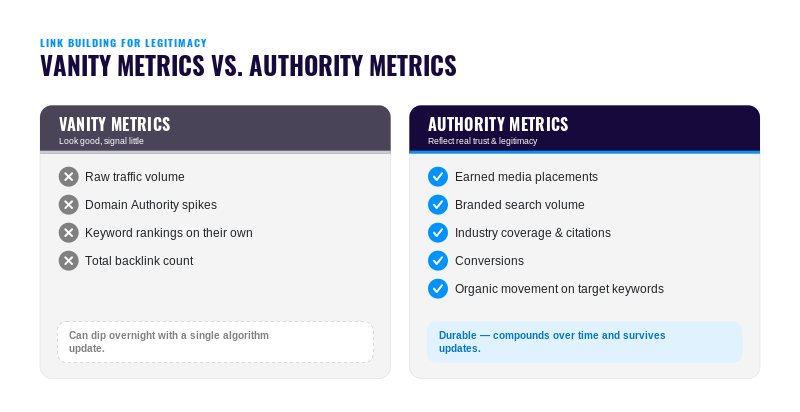
    The metrics we once used to keep brands afloat — traffic, domain authority increases, and keyword rankings — no longer define SEO success on their own. We can reach the top of a search results page and still see very few conversions.

    If we continue chasing those numbers in isolation, we risk being left behind. We have to adapt.

    We now widen our view to the outcomes that matter most: trust and brand authority. Unlike a temporary ranking or traffic spike, trust and authority are not earned quickly or easily.

    We need time to spread the word about our brand, and we need even more time to prove that people can rely on us. Once we establish that trust, however, it becomes much harder to dislodge.

    An algorithm update can cut our traffic overnight. It cannot erase genuine trust overnight.

    Our challenge is learning how to build trust and strengthen our brand while every competitor is trying to do the same. We also need meaningful ways to measure concepts that can initially seem difficult to quantify.

    We have found that the answers involve some nuance, but they are simpler than they appear. The process begins with a shift in perspective.

    For years, we treated link building like a popularity contest. The site that collected the most votes, in the form of backlinks, was often rewarded with a prominent position in the search results.

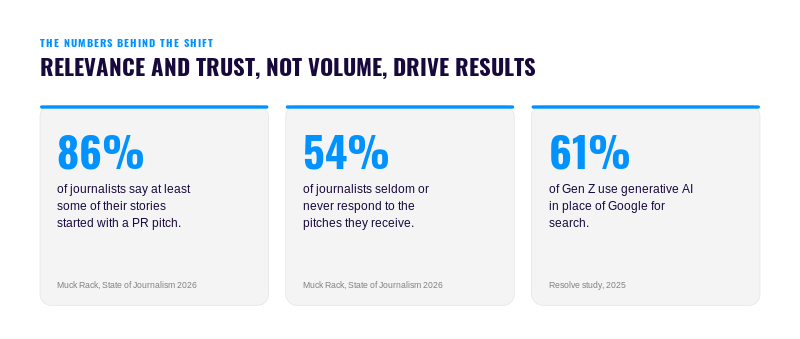
    Infographic showing 86% of journalists use PR-pitched stories, 54% rarely answer pitches, and 61% of Gen Z use generative AI instead of Google.
    Relevance and trust beat volume: 86% of journalists use at least some PR-pitched stories, yet 54% seldom respond, while 61% of Gen Z turn to generative AI instead of Google.

    Over time, Google and other search engines updated their algorithms to improve the search experience. With each change, Google cracked down on more sites that tried to manipulate the system with backlink volume instead of earning links with real editorial and audience value. Countless sites lost traffic, and many still feel the effects.

    Today, we see Google place more emphasis on relevance, industry trust, and authority. That helps explain why a familiar brand can attract more searchers than a smaller competitor even when both publish similar content and target similar keywords.

    Large language models and Google’s AI Overviews have widened this divide. These systems can use retrieval-augmented generation, or RAG, to retrieve relevant sources, often favoring authoritative publications and proprietary information. If we merely repeat a statistic already cited by a top-tier publication, an AI system may choose the better-known source to reduce the risk of spreading inaccurate information.

    We also see younger searchers moving toward AI tools. In a 2025 Resolve study, 61% of Gen Z respondents said they used generative AI instead of Google.

    None of this means every form of link building looks like spam to Google or an LLM. It means we need backlinks to work alongside a broader set of authority signals.

    When publications and journalists cite our brand, they signal authority. When we publish original content and proprietary data, we signal authority. When we create useful graphics and informative videos, we signal authority again.

    Once Google and AI systems recognize these signals, the backlinks supporting them become meaningful votes of confidence. Our site may then be more likely to rank prominently, appear in AI Overviews, and receive citations in LLM-generated answers.

    How we use E-E-A-T in a competitive search environment

    In 2018, Google updated its quality-rater guidance to place greater focus on expertise, authoritativeness, and trustworthiness, commonly shortened to E-A-T. In 2022, Google added another E for experience. Together, these qualities provide a framework for understanding how Google considers credibility and legitimacy.

    • Experience: We demonstrate that an author has personally engaged with the subject. Examples include a forum where people describe testing a product or a gardener documenting firsthand pest-prevention trials.
    • Expertise: We show that the author has relevant knowledge, qualifications, or credentials supporting the information and advice.
    • Authoritativeness: We earn recognition from credible sources and industry voices that cite or link to our work, helping establish us as a respected participant in the field.
    • Trustworthiness: We remain transparent, accurate, and honest. We avoid deceiving readers or using manipulative link-building practices.

    We apply E-E-A-T both on and off the page. Author biographies can demonstrate expertise, while accurate sourcing can demonstrate trustworthiness. Off the page, we strengthen E-E-A-T signals through the quality of the sites that link to us and the journalists who rely on us as a source. Both dimensions influence how search engines assess whether our information is useful, accurate, and credible.

    If we consistently earn backlinks from dozens of irrelevant websites, that pattern can look like a low-quality or manufactured signal. If several respected journalists mention our brand because we published a valuable study, those mentions are much more likely to function as genuine votes of confidence.

    Infographic comparing vanity SEO metrics like traffic and backlinks with durable authority metrics such as media placements, conversions and branded search.
    Move beyond fragile SEO numbers. This side-by-side graphic shows how earned media, branded searches, industry citations and conversions build authority that can survive algorithm updates.

    For us, link quantity is no longer a reliable proxy for legitimacy. We look for backlinks that demonstrate real relevance and value.

    We cannot earn those links half-heartedly. We need a coordinated strategy that strengthens credibility both on and off our site.

    The off-page SEO tactics we use to demonstrate value

    When we ask how to earn links that search engines and LLMs will treat as signs of trust, we do not look for a single outreach tactic. Strong links usually emerge from several activities that we sustain over time.

    We create genuinely linkable assets

    To prove that people genuinely want to reference our site, we first create content worth referencing. If we are accustomed to quick and easy links, this may require a larger investment in content than we have made before. A routine how-to article or listicle is rarely enough by itself.

    We define linkable content as something journalists, publishers, and readers find distinctive and useful — something they have not already encountered dozens of times. We often draw from the following content formats.

    • Original data and proprietary research: We publish information people cannot find elsewhere. In a crowded search environment, that means conducting original research rather than recycling familiar statistics. When a journalist needs a statistic and our site is the primary source, we can earn a natural backlink.
    • Thought leadership and expert commentary: We share an original perspective from a credible expert within our organization, giving publishers a useful idea or quotation they may cite in future coverage.
    • Authoritative long-form guides: We answer the main question thoroughly and anticipate the follow-up questions a reader is likely to ask. This depth can help us earn links as audiences move further into their research.
    • Engaging visuals and infographics: We invest in visual assets that make complex information easier to understand and share. Ahrefs found that YouTube mentions strongly correlated with inclusion in AI Overviews. Videos can be especially valuable, but informative infographics also give publishers a useful visual for their own audiences.

    These formats demand more time, effort, and money, but we have found that they are often more sustainable than disposable content. They help us earn credible editorial citations and build industry authority that is more resilient to algorithm updates.

    We connect link building with digital PR

    We place digital PR at the center of authority building because it connects brand development with link acquisition. It helps us earn coverage, attract links, and introduce our organization to new audiences through credible journalists. Those are precisely the kinds of signals search engines can consider when assessing legitimacy.

    Unlike traditional PR, our digital PR work focuses on online coverage and backlinks from news organizations and media outlets. We create useful assets or proprietary data, identify the journalists most likely to care, and pitch stories that fit their established beats.

    Many of these publications carry significant influence and reach large audiences that can introduce our brand to more people. When a highly authoritative outlet covers our story, other journalists may discover and cite it organically. Syndication can amplify the effect further when a media group republishes an article across its network, potentially producing many relevant links from one story.

    Our strongest digital PR campaigns typically use one or more of the following approaches.

    Infographic outlining five steps for a credibility-focused SEO strategy, from targeting trusted publications and creating linkable assets to measuring results.
    Build lasting brand authority in five steps: target trusted publications, create citation-worthy assets, launch digital PR, nurture journalist relationships, then measure and refine your approach.
    • Data-led PR campaigns: We begin with what journalists and their readers care about, not simply what we find interesting. We review local news, Google News, and current coverage to understand which subjects are gaining attention. By considering journalist intent from the start, we improve our chances of receiving responses and earning placements.
    • Newsjacking or reactive PR: When we can move quickly, we contribute expert opinions, data, or commentary to breaking stories that relate to our brand. This gives journalists material they can use while the topic is still timely.
    • Proactive PR: We anticipate trends before they break and prepare insights around recurring news cycles, holidays, and other relevant media moments.
    • Contributed content and guest features: We place useful content written by our experts in relevant publications, allowing us to speak directly to established audiences and earn recognition.

    When we combine these tactics effectively, we can elevate our brand to a level that competitors cannot reproduce with a batch of low-value links.

    We build relationships with journalists and publishers

    We know that even fascinating proprietary data, packaged in an expertly designed analysis, can fail if our journalist outreach is poorly targeted.

    Resolve data about journalist outreach and PR pitches

    Journalists receive an enormous number of PR pitches, and those messages can either support or obstruct their work. According to a 2026 Muck Rack study, nearly nine in 10 journalists said at least some of their stories originated with PR pitches.

    The same survey found that 54% of journalists seldom or never responded to most pitches. Relevance was a central problem: nearly half said a genuinely relevant pitch was rare.

    If we send a journalist at an economics publication a pitch about music-listening habits, we should expect a rejection because the subject may matter to only a small part of that publication’s audience. We do not take that response personally. Journalists build their careers around particular topics and beats, and our job is to support that work rather than distract from it.

    We therefore approach outreach as relationship building: a two-way exchange that should benefit everyone involved. Above all, we remember that there is a real person on the other side of every email.

    • We personalize our emails and explain why a story fits the journalist’s audience.
    • We respond graciously when a journalist says no because our next idea may be a better fit.
    • We share relevant work from journalists and publications through social media.
    • We contribute thoughtful comments when we have something useful to add.
    • We cite journalists’ reporting in future content when it genuinely supports our work.

    As we strengthen these relationships, journalists become more likely to consider future opportunities. A thoughtful follow-up or second pitch can receive a warmer response when a reporter already knows that we provide reliable data and useful commentary.

    PR relationships grow over time. Even when our first pitch does not fit a journalist’s beat, we remain willing to return with a better story or a new set of relevant data.

    How we measure real brand authority

    We recognize that authority, trust, and legitimacy feel less concrete than traffic or keyword position. Yet they have become more important. A traffic surge may look encouraging while reflecting temporary attention, weak intent, or an advantage that disappears after an algorithm update.

    Authority and legitimacy are more durable. We can also measure the impact of credibility-focused work through several meaningful indicators.

    Infographic showing EZ Contacts’ digital PR results: 1,000+ media placements, a Domain Rating of 43, and doubled visibility in ChatGPT and AI Overviews.
    EZ Contacts’ six-month digital PR campaign delivered 1,000+ media placements, raised Domain Rating from 40 to 43, and doubled visibility across ChatGPT and Google AI Overviews.
    • Earned media placements: We track the publications that cover our brand, including coverage containing an unlinked mention. These placements help us assess brand credibility.
    • Branded search volume: We monitor whether more people search for our company or products after discovering us through media coverage.
    • Industry coverage: We look for the point at which publications we have not contacted begin citing our work. That organic pickup is a valuable sign that our authority is spreading.
    • Conversions: We measure whether greater credibility leads more people to trust our organization, products, or services and ultimately take meaningful action.
    • Organic ranking improvements for target keywords: We still review rankings, but we treat them as one indicator within a broader picture. Sustained movement can show that search engines increasingly view us as a credible result relative to competing pages.
    Metrics for measuring brand authority and credibility

    We do not expect these indicators to appear overnight.

    • We invest real effort in creating proprietary data.
    • We build trust with journalists through repeated, useful interactions.
    • We grow authority through sustained work over time.

    Our advice is simple: we stay patient, keep improving, and allow credible results to compound.

    How we build a credibility-focused link strategy

    Knowing the principles of SEO authority is one thing; building an entire campaign around them is another. We use the following five-step process to turn those principles into consistent action.

    1. Step 1 — We define our target publications: We identify five to 10 publications that our audience trusts and that search engines are likely to recognize as authoritative within our field. These become our priority coverage targets.
    2. Step 2 — We develop linkable assets: We create at least two content or media assets designed around the interests of those publications. We may use original survey data, visual guides, proprietary analysis, or expert thought leadership.
    3. Step 3 — We launch a digital PR campaign: We proactively pitch our assets to relevant publications. We can also use platforms such as Connectively or Muck Rack to identify ongoing opportunities with writers covering subjects related to our research.
    4. Step 4 — We nurture relationships: We treat every positive media interaction as the beginning of a longer relationship. We follow up with useful information, engage with published coverage, and build the kind of rapport a journalist can rely on.
    5. Step 5 — We measure and iterate: We review our authority indicators each quarter, learn from the response to our campaigns, and adjust our content and outreach accordingly.
    Resolve credibility-focused link-building process

    We know this process can consume a team’s time, particularly when resources or specialized expertise are limited.

    In those situations, we may benefit from working with a link-building and digital PR specialist who can expand our capacity and keep pace with search changes. The right support can help us establish sustainable visibility without allowing every minor ranking fluctuation to pull us off course.

    How we build authority that lasts at Resolve

    We know that quality usually stands the test of time better than quantity. The difficult part is maintaining that focus when competitors appear to be winning with sudden traffic spikes or eye-catching vanity metrics.

    We do not let temporary numbers distract us from the larger goal. We focus on lasting authority and legitimacy earned through sustained content creation, thoughtful PR outreach, and genuine relationship building.

    When an internal team lacks the time or patience required to maintain that effort, we can step in.

    At Resolve, we work with brands to build credibility-focused SEO campaigns through linkable content, data-led digital PR, and hands-on link building. Our goal is sustainable organic growth, not a burst of visibility that disappears after the next algorithm update.

    Resolve results from credibility-focused digital PR

    We have seen this approach pay off. In a recent data-led campaign for EZ Contacts, we earned more than 1,000 placements in outlets including the New York Post and Yahoo. As the coverage grew, the brand’s visibility in ChatGPT and Google’s AI Overviews doubled. That is the kind of durable growth we want to build — growth that extends beyond the next algorithm update.

    Large Google logo over colorful stacks of digital pages and folders, symbolizing search advertising, web content, and online marketing updates.
    A bold Google logo sits atop layered, colorful digital documents, evoking the fast-moving world of search marketing, ad formats, campaign assets, and platform updates.

    When we are ready to build links that last, we can visit growresolve.com to learn more.

    We see considerable overlap between link building and digital PR, but we do not treat them as identical. Link building is the broader practice of acquiring backlinks from other websites to improve search authority. Digital PR is a particular approach within that practice, focused on earning links through media coverage, journalist relationships, and placements in credible publications rather than relying on directory submissions, guest-post exchanges, or other lower-authority tactics.

    We often use digital PR to pursue the strongest editorial backlinks because reputable outlets have real audiences and established review standards. At the same time, this work builds brand visibility and consumer trust in ways that many conventional link-building methods do not.

    How long do we wait for meaningful results?

    We do not expect authoritative backlinks or earned media coverage to produce results overnight. That is an honest trade-off when we choose a credibility-focused approach instead of more aggressive tactics. Most brands can begin seeing meaningful domain-authority gains and early ranking movement after three to six months of consistent execution, while highly competitive keywords and top-tier placements may require more time.

    The advantage is that our results can compound. Links from credible publications tend to endure, strong journalist relationships can create repeat opportunities, and the authority generated through consistent coverage can keep delivering value long after the initial campaign.

    We define an authority backlink as a link from a source that search engines and its audience regard as credible and trustworthy. These sources typically have genuine readers, clear editorial processes, established authority, and topical relevance to our industry.

    A regular backlink can come from any website willing to link to us, regardless of its relevance, quality, or editorial standards. That distinction matters because search engines do not evaluate every link equally. One editorial link from a respected industry publication can be more valuable than dozens of links from low-authority sites, while also supporting the kind of E-E-A-T credibility that bulk link acquisition cannot reproduce.

    Do we value brand mentions without hyperlinks?

    Yes. We recognize that Google can associate brand mentions with entities even when a publication does not include a hyperlink. Relevant, unlinked mentions in credible coverage can still contribute to the wider authority signals surrounding our brand.

    That is why we consider digital PR valuable even when every placement does not produce a direct link. A credibility-focused off-page strategy should not be reduced to backlink acquisition alone. Our larger objective is to build a brand that respected publications genuinely want to mention, cite, and cover.

    We see risks ranging from wasted effort to serious search penalties. Link buying, reciprocal-link schemes, private blog networks, and manipulative anchor-text optimization can violate Google’s spam policies. These tactics may trigger manual actions or algorithmic suppression that substantially reduces our search visibility.

    Even when outdated tactics do not produce an immediate penalty, they can lose their value as search systems become better at identifying manufactured signals. Recovering from a link-related penalty can be slow and expensive. We would rather invest in credible link building from the beginning than repair the damage caused by shortcuts later.


    Inspired by this post on Search Engine Land.


    crushpress.ai community screenshot
  • GPT-5.6 in Profound: Tiers and Workflow Implications

    GPT-5.6 in Profound: Tiers and Workflow Implications

    Profound has announced support for GPT-5.6, giving its users access to the model family through the platform’s existing AI workflows. The announcement emphasizes a choice among Sol, Terra, and Luna tiers rather than presenting GPT-5.6 as a single configuration for every task.

    The practical significance is workload matching: teams can consider different tiers for demanding reasoning and production-scale activity while evaluating whether the reported gains in capability, reliability, and efficiency hold for their own use cases.

    What GPT-5.6 support changes in Profound

    According to Profound’s announcement, GPT-5.6 is now available directly within the workflows supported by the platform. Profound characterizes it as OpenAI’s newest flagship model family and identifies advanced AI performance as the central reason for adding it.

    This is an integration announcement, not an independent benchmark. The source reports improvements in capability, reliability, and efficiency, but it does not provide test results, pricing, latency figures, context limits, or comparisons with earlier models. Those omissions matter when deciding whether the new option should replace an existing model or serve only selected workloads.

    Sol, Terra, and Luna introduce a tier-selection decision

    Profound says its GPT-5.6 support spans the Sol, Terra, and Luna tiers. It presents this range as a way to cover work extending from frontier reasoning to high-throughput production workloads, although the announcement does not assign detailed specifications or a fixed use case to each named tier.

    For teams, the important shift is therefore operational: model selection can be treated as a workload decision. A demanding research or reasoning task may call for a different balance than a repeatable, high-volume process. Without tier-level measurements in the source, however, buyers should avoid assuming which option will deliver the best quality, speed, or cost for a particular application.

    The workflows Profound expects to benefit

    Abstract task objects travel along branching illuminated paths through three differently scaled processing chambers before converging into organized outputs.

    The announcement highlights four areas: agentic workflows, coding, research, and enterprise knowledge work. These categories share a need for dependable handling of instructions and context, but they create different evaluation requirements.

    • Agentic workflows: Evaluate whether the selected tier follows multi-step instructions consistently and handles failure conditions appropriately.
    • Coding: Test against the languages, repositories, review practices, and validation tools used by the organization.
    • Research: Check source handling, factual accuracy, uncertainty, and the usefulness of generated synthesis.
    • Enterprise knowledge work: Examine performance with internal terminology, access controls, document retrieval, and required approval processes.

    These checks are general implementation practices rather than performance claims about GPT-5.6. Profound’s post identifies the target workflow categories but does not publish evidence for individual tasks within them.

    Key takeaways

    • Profound reports that GPT-5.6 is supported within its AI workflows.
    • The integration includes the Sol, Terra, and Luna tiers.
    • Profound positions the model family for uses ranging from advanced reasoning to high-throughput production.
    • Agentic systems, coding, research, and enterprise knowledge work are the principal use cases named in the announcement.
    • The post reports capability, reliability, and efficiency improvements but supplies no benchmarks or tier-level specifications.

    How teams can evaluate the integration responsibly

    A sensible evaluation begins with representative tasks rather than a broad platform-wide switch. Teams can define the required output quality, acceptable error patterns, response-time needs, and operating constraints for each workflow, then compare the available tiers under the same conditions.

    1. Select a small set of real tasks from each intended workflow.
    2. Define pass criteria before comparing model outputs.
    3. Record quality, consistency, failure modes, and human-review effort.
    4. Compare tiers without presuming that the same option will suit every workload.
    5. Expand adoption only where the results support Profound’s reported benefits.

    GPT-5.6 support broadens the choices available inside Profound, but the integration’s value will ultimately depend on how clearly organizations match those choices to their own work. More detailed tier documentation and workload-specific evidence would make that decision easier.

    References