Month: July 2026

  • A Revenue-Focused SEO Strategy Built on Profit, Not Traffic

    A Revenue-Focused SEO Strategy Built on Profit, Not Traffic

    A revenue-focused SEO strategy starts with a different decision: organic visibility is a means, not the outcome. Rankings and traffic remain useful indicators, but priorities should ultimately reflect the sales, margins and profit that search can influence.

    The practical payoff is a more defensible investment plan. By combining search demand with commercial value, an SEO team can identify which pages deserve attention, sequence work around likely business impact and explain its choices in terms leadership can compare with other acquisition channels.

    Key takeaways

    • Treat rankings and organic sessions as diagnostic signals rather than final business outcomes.
    • Evaluate search demand alongside margins, average order values and existing organic performance.
    • Prioritize commercially valuable pages that are decaying or already close to stronger visibility.
    • Use paid-search conversion data to compensate for organic search’s limited query-level conversion reporting.
    • Connect content, internal links and digital PR to the commercial page clusters they are intended to support.

    Build the strategy from the business model backward

    Traditional keyword research begins with the search market: query volume, ranking difficulty, current positions and estimated traffic. The supplied Search Engine Land article argues that these demand-side measures reveal where an audience exists but not where that audience is most valuable to the business.

    A commercial planning process therefore needs a second layer. Margin by category, transaction value and the long-term profitability of customer segments can materially change which opportunities deserve investment. A lower-volume category may be more attractive than a popular one when each resulting sale contributes more profit.

    Planning questionDemand-side evidenceValue-side evidence
    Where is there an addressable search audience?Search volume, intent and ranking difficultyNot sufficient on its own
    Which area matters most to the business?Current organic visibility and traffic potentialMargin, transaction value and customer profitability
    Where could SEO produce a meaningful result?Ranking position and competitive gapPotential sales, revenue and profit contribution

    This framing does not make keyword data less important. It changes its role. Demand establishes whether an opportunity exists; commercial evidence determines how much that opportunity should matter.

    Use a commercial scorecard without inventing false precision

    Unlabeled page tiles are compared using coins, customer tokens and margin blocks under a focused spotlight.

    The article identifies organic sales, revenue, profit, average order value, average margin per sale and channel return on investment as useful financial measures. Obtaining them generally requires analytics data to be connected with transactional records. Channel costs also need to be captured if the organization wants a meaningful view of return rather than revenue alone.

    One especially useful measure in the source is organic profit per sale, calculated as organic profit divided by organic sales. It shows the average profit contribution associated with each organic transaction. Broken down by category, subcategory or landing page, it can reveal that two similarly sized traffic opportunities have very different economic consequences.

    These figures should guide prioritization without being presented as more certain than the underlying attribution allows. Organic search can assist a purchase that is eventually credited elsewhere, while branded demand may reflect earlier marketing activity. The scorecard is therefore best used as a consistent decision framework, not as a claim that every sale has one perfectly identifiable cause.

    A workable prioritization sequence is:

    1. Identify categories, products or services with attractive margins or transaction values.
    2. Measure relevant search demand and classify the intent behind it.
    3. Review current rankings, page performance and the competitive gap.
    4. Estimate the commercial role of improving each page, using available sales and profit data.
    5. Rank initiatives by the combined strength of business value, demand and realistic opportunity.

    The process does not require an elaborate universal formula. A transparent qualitative score can be more useful than a highly precise number built on weak assumptions. What matters is that the same commercial questions are applied across competing SEO initiatives.

    Organize execution around defend, capture and compound

    Once commercially important areas are known, SEO tactics can be organized by the job they perform. This prevents content production, technical work, link acquisition and conversion improvements from becoming disconnected activity streams.

    Defend revenue-bearing pages

    Commercial pages can lose performance as competitors improve, result pages change and content becomes dated. The source consequently recommends reviewing valuable existing pages before defaulting to new production. Useful interventions include finding competitive content gaps, restructuring information into readily extractable formats such as tables where appropriate, reviewing drafts against competing pages and strengthening internal links.

    This is a defensive revenue task as much as a content task. A modest recovery on a page with proven transactions may be more consequential than publishing an informational article with a much larger theoretical audience.

    Capture opportunities near meaningful visibility

    The article highlights transactional terms ranking in positions 10 through 20. These queries are already associated with pages that search engines consider relevant, yet their visibility may be too limited to produce substantial traffic. Filtering that group by commercial intent and business potential creates a more focused recovery list than treating every near-Page 1 keyword equally.

    Content improvements, internal links and relevant authority building can then be directed at the pages with both a plausible ranking opportunity and a valuable destination. The principle is broader than any fixed position range: closeness to visibility matters only when the underlying query and page can contribute to the business.

    Compound authority around commercial clusters

    Informational content still has a role because a strategy restricted to transactional queries eventually runs out of room. Its purpose should be explicit: answer relevant audience questions, establish topical depth and pass users and internal authority toward appropriate commercial pages.

    The same logic applies to digital PR. The supplied article favors campaigns that are thematically connected to priority product categories and use an on-site destination within a deliberate linking environment. That architecture gives earned attention a route to support commercially important clusters instead of leaving links isolated from the pages expected to generate returns.

    Connect SEO decisions with paid-search intelligence

    Organic and paid search pathways converge through a shared prism toward a purchase symbol and stacked coins.

    Organic reporting commonly provides landing-page conversion data without revealing exactly which query led to each purchase. The article proposes recent paid-search data as a practical source of conversion intelligence, with seasonality taken into account. It specifically suggests reviewing a recent 30- to 90-day window to identify keyword patterns associated with sales and valuable customers.

    This evidence should inform, rather than mechanically dictate, organic priorities. Paid and organic results occupy different environments, and advertisement performance does not guarantee an equivalent SEO result. Even so, paid-search data can reveal commercially productive language, offers and landing-page themes that ordinary organic keyword tools cannot connect directly to transactions.

    The resulting collaboration can work in both directions. Paid data helps SEO choose valuable queries and pages; organic landing-page performance can expose content and conversion lessons that benefit the broader acquisition program. Shared commercial definitions also make budget discussions less dependent on channel-specific metrics.

    Make revenue accountability part of the operating rhythm

    A commercially aware strategy needs reporting that follows the chain from work to outcome. Technical fixes, content changes and new links remain important, but they should be connected to changes in qualified visibility, landing-page behavior, transactions and profit where the available data permits.

    That chain also improves diagnosis. If rankings rise without sales, the problem may involve intent, offer alignment or conversion performance. If revenue rises but profit does not, the strategy may be attracting low-margin orders. If a high-margin category has demand but little visibility, the case for targeted SEO investment becomes clearer. These interpretations are more useful than celebrating traffic growth in isolation.

    The next stage for revenue-focused SEO is not the abandonment of technical excellence or audience-building content. It is the consistent connection of those capabilities to economic choices. Teams that establish that connection can direct their next unit of effort toward the pages and markets most likely to matter.


    References

  • How to Evaluate AI Marketing Tools Before You Commit

    How to Evaluate AI Marketing Tools Before You Commit

    An AI marketing tool can look persuasive in a demonstration and still fail in day-to-day use. A sound evaluation therefore has to connect the product to a defined business problem, credible evidence, acceptable data practices and the team’s actual capacity to adopt it.

    The most useful approach is a staged decision process. Each stage should eliminate a different kind of risk before price or novelty turns an interesting product into an expensive commitment.

    Turn the business need into a testable decision

    Evaluation should begin with the marketing problem rather than the product’s feature list. The source article recommends asking vendors to explain the challenge their tool addresses and how solving it affects a business outcome. If that connection remains vague, a sophisticated set of AI capabilities does not establish that the product is useful.

    Before meeting a vendor, the buying team can create a short decision brief describing the current workflow, its most important constraint, the people affected and the result that should improve. That result might concern output, troubleshooting or another outcome already important to the organization. The purpose is not to manufacture a justification for buying software; it is to establish a baseline against which the tool can be judged.

    Claims about saving time require an additional question: what will the organization do with the recovered capacity? The source cautions that time savings are not automatically valuable. They become meaningful when the team can redirect that time toward work that advances an existing objective.

    This framing also exposes unnecessary purchases. If the problem can be resolved through a process change, better use of an existing platform or clearer ownership, adding another tool may increase complexity without addressing the underlying constraint.

    Match the evidence standard to the vendor’s maturity

    A glowing software module passes through a sequence of visual testing gates in a modern evaluation lab.

    A relevant case study is more informative than a broad success claim. According to the source, buyers should look for evidence involving organizations with a comparable size, market, vertical or use case, along with concrete results. The closer the operating conditions are to the buyer’s own environment, the easier it is to determine whether the evidence transfers.

    Evidence should also extend beyond customer logos. A credible vendor needs sufficient domain understanding to explain how marketers perform the work, where the recurring friction occurs and why the product was designed in its present form. The source notes that deep subject expertise does not have to reside with every salesperson, but a serious prospective customer should be able to reach someone who has it.

    Vendor maturity changes the appropriate test. An established provider can reasonably be expected to show repeatable results from relevant customers. An early-stage provider may not have that record, so transparency becomes part of the evidence: the vendor should identify where the product is unproven, explain what has been observed in other settings and define what the early partnership would require.

    Being an early adopter can offer an advantage, but the source also identifies added exposure to bugs, feedback demands and uncertain performance. Contract flexibility should reflect that imbalance. A newer vendor that expects the customer to absorb experimentation risk while offering no corresponding flexibility presents a weak partnership proposition.

    Treat data terms as part of the product

    Data governance is not a secondary legal review to perform after a product has been selected. It is part of the product evaluation because access to marketing, campaign or customer information can determine the consequences of a poor choice.

    The source recommends obtaining clear answers about who owns the customer’s data, where it is stored, how long it is retained, whether it is used for model training and what happens when the relationship ends. Any training of shared or third-party models should require explicit consent. If training is permitted only for a customer’s own instance, that limitation should be stated precisely.

    Verbal assurances are not enough. The source treats inconsistencies between a sales explanation and the terms of service as a warning sign and argues that material commitments belong in the contract. The practical evaluation standard is therefore documentary: can the vendor’s claims be located in binding terms, and do those terms cover the complete data lifecycle?

    This review also tests vendor quality. Clear, consistent answers suggest that the provider understands its own systems and customer obligations. Deflection or ambiguity leaves the buyer unable to assess exposure, regardless of how compelling the product appears.

    Calculate adoption cost, not just subscription cost

    A marketing team handles system setup, data preparation, training and workflow changes beside a simple subscription token.

    The commercial price is only one component of an AI tool’s cost. The source highlights implementation time, internal effort, integrations, training, quality assurance and possible disruption to the existing marketing technology stack. A product can be affordable on paper yet uneconomic if it consumes resources the organization cannot reliably provide.

    A useful implementation review follows the proposed tool through the real workflow. It identifies who will configure it, which systems must connect to it, who will review its outputs, how exceptions will be handled and what ongoing maintenance the vendor expects from the customer. This makes hidden dependencies visible before a contract creates pressure to proceed.

    Adoption is also a trust problem. As the source observes, a product that people cannot understand, trust or fit into their routines will not produce its promised value. The evaluation should therefore include the intended users, not only procurement leaders or executives. Their experience can reveal whether the tool removes friction or merely relocates it.

    A limited pilot can combine these questions into one decision. It should start with the predefined problem, use agreed evidence of success, operate under acceptable data terms and expose the actual workload imposed on the team. The decision at the end should account for both the result and the effort required to produce it.

    Key takeaways

    • Define the business problem and intended outcome before reviewing product features.
    • Demand evidence relevant to the organization’s size, market, vertical or use case.
    • Adjust expectations for vendor maturity, but require transparency and risk-sharing from early-stage providers.
    • Verify ownership, storage, retention, training and deletion terms in binding documents.
    • Evaluate implementation effort, workflow fit and user trust alongside the subscription price.

    As AI products continue to multiply, disciplined evaluation will matter more than rapid purchasing. Teams that document the problem, evidence threshold, governance requirements and adoption burden in advance will be better positioned to recognize tools that deserve a durable place in the marketing stack.

    References

  • Google Search Partners Performance: A Practical Audit

    Google Search Partners Performance: A Practical Audit

    Google Search Partners can extend a campaign beyond the main Google search results page, but additional reach is useful only when it produces meaningful business outcomes. Lower click costs and higher traffic volume can look efficient while concealing weak conversion quality.

    The practical question is therefore not whether the network can generate clicks, but whether its traffic creates enough incremental value to justify the spend. The supplied CrushPress.AI article recommends answering that question with network-level reporting, placement review and conversion-quality checks.

    Key takeaways

    • Search Partners should be assessed separately from Google Search because blended campaign totals can hide major differences in traffic quality.
    • Cheap clicks are not sufficient evidence of efficiency; advertisers need to examine valuable conversions and the quality of the actions used for optimization.
    • New Search and Shopping campaigns can begin without Search Partners, establish a reliable Google Search baseline and then test the additional reach deliberately.
    • Performance Max requires a different response because Search Partners cannot simply be disabled; monitoring and optimization controls become more important.

    Why lower CPCs can give the wrong performance signal

    Search Partners are third-party properties that use Google-powered search results. According to the source article, eligible environments can include YouTube, directories, other search experiences and parked domains. Although the activity remains search-related, the context and audience quality may differ from traffic generated on Google’s primary search results page.

    The article reports a recurring pattern of substantial impressions and clicks at lower cost per click, followed by limited meaningful conversion value. That distinction matters because CPC measures the price of acquiring a visit, not the commercial value of the visit. A less expensive click is beneficial only if its downstream results remain economically useful.

    Search Partners should also not be treated as another name for the Google Display Network. The source distinguishes search-based partner activity from ads shown while people browse websites or apps using AdSense. Some properties may participate in both systems, but the user context and placement logic are different.

    Traffic sourceUnderlying contextPrimary audit question
    Google SearchSearches on Google’s main results pageDoes this provide a dependable performance baseline?
    Search PartnersSearch-based activity on participating third-party propertiesDoes the added reach produce valuable incremental conversions?
    Google Display NetworkAds encountered while browsing participating sites and appsDoes the audience and placement context support the campaign objective?

    A useful audit separates volume, outcomes and quality

    An analyst sorts anonymous traffic tokens into three trays while examining unbranded partner-site tiles with a magnifying glass.

    For Search and Shopping campaigns, the source recommends opening the campaign view and using the Network (with search partners) segment. This creates separate rows for Google Search and Search Partners, preventing stronger results from one network from masking weaker results on the other.

    The comparison should move through three layers. First, impressions, clicks and CPC show how much traffic each network supplies and what that traffic costs. Second, conversion volume, conversion rate, cost per conversion and conversion value indicate whether the visits produce measurable outcomes. Third, the advertiser must determine whether those outcomes represent genuine business progress rather than merely easy-to-complete actions.

    That final layer is especially important. The source cautions that Search Partner traffic can appear productive when optimization relies on shallow signals such as page views or low-friction form submissions. A campaign can meet its reported conversion target while generating outcomes that sales teams cannot use or that contribute little economic value.

    The Content Suitability report under Insights and reports provides another diagnostic view. The article says it can reveal websites or YouTube channels where Search Partner ads appeared. Placement context does not replace outcome data, but it can explain suspicious performance and expose properties that appear irrelevant or low quality.

    Performance Max changes the available controls

    The opt-out decision applies differently across campaign types. The source states that Search Partners are required within Performance Max, so advertisers cannot manage the network with the same checkbox available to conventional Search or Shopping campaigns.

    Instead, the article directs advertisers to the Channel Performance report. Heavy Search Partner activity should prompt a review of conversion tracking, bid-strategy settings and the conversion actions guiding optimization. This reframes the task from excluding the network to ensuring that the automated system is learning from business-relevant signals.

    The source also reports that conversion-focused Smart Bidding may reduce Search Partner spend as it learns that the placements are not producing desired conversions. That observation should not be treated as a guarantee. Automated bidding can only respond to the objectives and measurement signals supplied to it; weak conversion definitions can reward weak traffic.

    A baseline-first test makes the decision clearer

    Two parallel traffic channels run from a shared starting platform into separate outcome reservoirs connected by a balance mechanism.

    The source’s starting recommendation is to leave Search Partners disabled when launching new Search or Shopping campaigns. Concentrating the initial budget on Google Search can establish a cleaner baseline for traffic quality, conversion behavior and unit economics before another source of variability is introduced.

    Once the core campaign is performing reliably, Search Partners can be evaluated as an incremental-volume test. The decision should be based on the additional network’s own results rather than on blended totals or CPC alone. If it supplies conversions that retain their value after qualification, the extra reach may be worthwhile. If it mainly adds inexpensive visits, questionable placements or low-value actions, disabling it protects budget for the stronger source.

    This approach avoids turning a campaign setting into a universal rule. Search Partners remains a testable inventory source, but it should have to demonstrate business value independently. As Google Ads automation takes on more delivery decisions, accurate conversion definitions and network-level scrutiny will become even more important.

    References

  • AI Marketing Data Activation: From Signals to Outcomes

    AI Marketing Data Activation: From Signals to Outcomes

    AI-powered marketing data activation is not simply the use of a model to analyze a database. It is the operating discipline of turning available signals into decisions, actions, and measurable feedback while the information is still useful.

    The two source articles examine that challenge at different levels. One presents a focused SEO workflow that joins competitive, search, and engagement data to prioritize content. The other argues for an enterprise performance model in which a unified data foundation and activation layer help marketers pursue business outcomes without continually expanding the technology stack. Together, they show what separates an isolated AI task from a repeatable activation system.

    Data activation is a decision system, not another data store

    Marketing teams can possess substantial amounts of data and still struggle to act on it. The performance-marketing article identifies fragmented customer profiles, disconnected activation systems, and stale audience definitions as barriers that AI cannot overcome by itself. Its central argument is that many apparent model failures are actually failures in the underlying data and operating architecture.

    The content-gap workflow demonstrates the same issue in a narrower setting. Competitive rankings can expose thousands of missing keywords, but the list alone does not establish what the business should publish. The workflow adds Google Search Console signals and Google Analytics engagement data so that AI can interpret competitive opportunity alongside existing authority and business value.

    This distinction is fundamental: data collection produces records, analysis identifies patterns, and activation connects those patterns to an approved action. AI can accelerate interpretation and propose a course of action, but it does not eliminate the need for relevant inputs, decision criteria, or an execution path.

    Key takeaways

    • AI activation begins with connected, usable data rather than a model or agent selected in isolation.
    • First-party performance signals help distinguish attractive-looking opportunities from opportunities that support business goals.
    • A useful system converts a stated outcome into proposed logic, a reviewable action, and measurable feedback.
    • Human oversight remains important for competitor selection, exclusions, strategic context, and final approval.

    The right foundation combines relevance, quality, and access

    Three interlocking data layers support a glowing activation hub while incoming signals pass through quality filters and access gateways.

    A strong activation foundation does not require every available data point. It requires the information needed to make a particular decision, joined at a level that preserves its meaning. More inputs can create more noise when they represent irrelevant markets, incompatible intent, outdated definitions, or entities that should not be compared.

    The SEO source illustrates relevance through competitor selection. Its workflow narrows the comparison to three to five sites serving a similar business and audience, while generally filtering out marketplaces, community sites, reference properties, directories, and unrelated publishers that could distort the opportunity set. It also recommends a stakeholder check because product or sales teams may know about strategic competitors that are not yet obvious in organic-search data.

    Quality then depends on cleaning the inputs. The workflow removes duplicates and excludes such noise as competitor-branded terms, careers, login and support queries, out-of-scope locations, mismatched intent, and overly broad commercial terms. This is not clerical work around the edges of AI. It defines the boundaries within which the model can form useful clusters and recommendations.

    Access is the third requirement. The SEO article describes both manual exports and direct retrieval through Model Context Protocol connections. Either route can support the analysis; the important point is that competitive rankings, first-party search signals, and landing-page outcomes become available within one reasoning workflow. Direct connectivity may reduce transfer work, but it does not replace validation, exclusions, or governance.

    At enterprise scale, the performance-marketing source extends this principle to customer profiles and activation destinations. It argues that the data foundation and activation layer should operate as a connected performance engine. That is a broader architectural claim than the SEO example, but both approaches depend on the same underlying capability: AI must be able to interpret trusted context and pass an approved decision toward execution.

    A practical loop turns signals into marketing action

    The sources suggest an operating loop that can be applied beyond SEO or audience management. The specific datasets and delivery channels will vary, but the decision sequence remains useful:

    1. Define the outcome. Begin with the result the team wants to influence, such as improving a content opportunity, increasing customer value, or reducing churn. A clear outcome gives the model a basis for prioritization.
    2. Select decision-relevant signals. Combine external opportunity data with first-party evidence and business performance. In the content-gap example, those roles are filled by Semrush, Google Search Console, and Google Analytics respectively.
    3. Normalize and filter the inputs. Remove duplicate, stale, irrelevant, or mismatched records before asking AI to detect patterns. Retain the exclusions and assumptions so that another reviewer can understand the analytical boundary.
    4. Ask AI for structured proposals. The output should be reviewable logic rather than an opaque verdict: topic clusters, priority tiers, audience conditions, supporting evidence, and uncertainties are more useful than a bare recommendation.
    5. Apply business review. Marketers and relevant stakeholders should confirm that the proposed logic reflects strategy, customer meaning, brand constraints, and operational reality.
    6. Activate through a defined destination. An approved decision must connect to a content roadmap, audience system, campaign platform, or another execution process. Without this step, the workflow remains analysis rather than activation.
    7. Measure and feed back the result. Performance data should return to the decision process so the team can refine its definitions and priorities instead of repeatedly starting from a static segment or report.

    The SEO workflow makes the prioritization stage concrete. It looks for missing competitor topics, areas where competitors rank higher, and subjects where the site already leads. Search Console impressions and positions between 8 and 20 can indicate existing topical association, while Analytics engagement and conversion signals add evidence of business relevance. The resulting roadmap is therefore based on the relationship among opportunity, attainability, and value rather than search volume alone.

    The enterprise source applies outcome-led reasoning to audience creation. It describes an mParticle capability that lets a marketer express an objective in plain language, after which an agent proposes audience logic for review and approval. It also presents Audience Expansion and Household Reach as examples of using first-party data to seek additional prospects or address a wider decision-making unit. These are vendor-reported product examples, not independent proof of performance, but they illustrate how an AI proposal can be connected to an activation path.

    Governance and measurement keep automation useful

    A circular workflow connects signal collection, AI decision-making, channel actions, measurement, and a guarded oversight checkpoint.

    The sources do not support a hands-off model of marketing. The performance article explicitly frames the marketer as the leader and the agent as a collaborator. The SEO workflow likewise preserves human judgment when selecting competitors, defining exclusions, checking stakeholder knowledge, and deciding which opportunities belong on the roadmap.

    That division of labor offers a practical governance model. AI can reduce the effort required to reconcile large datasets, group related signals, draft audience logic, and surface patterns. People remain accountable for the objective, data scope, acceptable trade-offs, approval, and interpretation of results. A proposed segment or content cluster should therefore be traceable to its inputs and understandable before it reaches production.

    Measurement should also match the original outcome. The content-gap source uses organic sessions, engagement rate, average engagement time, key events or conversions, and landing-page performance to add business context. The performance source emphasizes outcomes such as customer lifetime value and churn rather than the operational completion of an audience-building task. In both cases, task completion is not the same as marketing success.

    A sensible maturity path is to begin with one bounded decision where data sources, reviewers, activation destinations, and success signals are identifiable. Once that loop is reliable, the organization can reuse its controls and feedback process for additional use cases. The durable advantage will come from shortening the distance between evidence and action while preserving the context and accountability that make the action worth taking.

    References

  • Hydration and SEO: What I Watch Before Rankings Slip

    Hydration and SEO: What I Watch Before Rankings Slip

    When I work on a site built with a framework like Next.js, Nuxt, SvelteKit, or a similar JavaScript framework, I pay close attention to hydration. It is the step that turns server-rendered HTML into an interactive page, but it is often explained in a way that does not connect clearly to SEO.

    I think hydration is easier to understand when I separate content from behavior. The content may already be visible, but the page may not be fully usable until the browser finishes connecting that content to the JavaScript behind it.

    What I mean by hydration

    Hydration is the process where JavaScript in the browser takes over the static HTML that was built on the server. The server sends a complete page first, and then the framework attaches the logic that makes buttons, menus, forms, filters, and other interactive pieces actually work.

    Here is how I usually explain the sequence. First, the server builds the page and sends fully formed HTML to the browser. I can see the content quickly, but the page is not interactive yet. Then the framework loads, walks through the existing HTML, attaches event listeners, and reconnects the visible markup to the application logic. Once that is done, the page behaves like a normal interactive app.

    This is why server-rendered HTML can feel fast at first. It can paint quickly and often helps with first impressions and Largest Contentful Paint (LCP). The tradeoff is that, with traditional hydration, the page may appear ready before it is actually usable.

    Hydration adds interactivity, not content

    The most important distinction I keep in mind is this: hydration does not add the main content to the page. The text, images, and layout should already be present in the server-rendered HTML. Hydration only adds behavior by wiring that HTML to the JavaScript that responds to clicks, typing, taps, and other user actions.

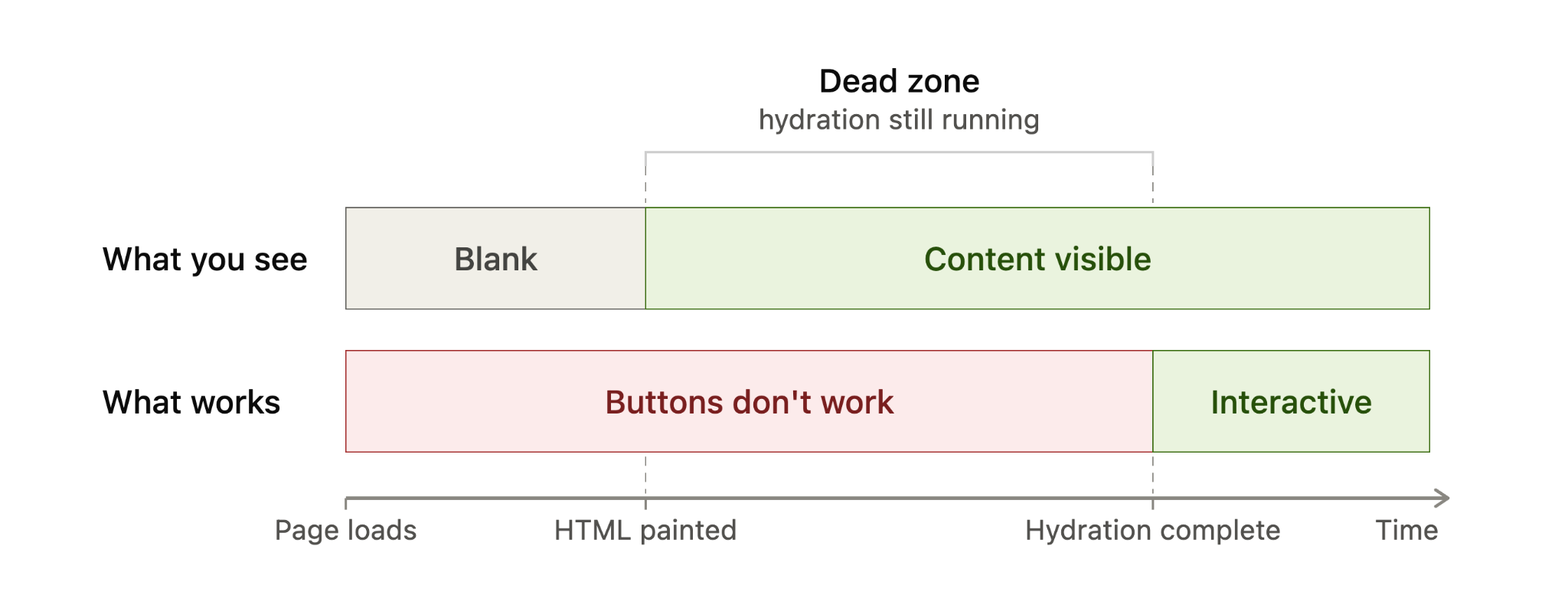
    Timeline diagram showing server-rendered HTML becomes visible before hydration, while buttons remain inactive until hydration completes.
    A hydration timeline shows the gap between content appearing and a page becoming usable: HTML is visible first, but buttons only work after hydration completes.

    Put simply, before hydration I can read the page. After hydration, I can use it.

    I also avoid confusing hydration with the rendering pattern itself. Server-side rendering (SSR), static site generation (SSG), and client-side rendering (CSR) describe where and when the page is built. Hydration describes what happens after server-rendered or statically generated HTML reaches the browser and needs to become interactive.

    From an SEO perspective, that distinction matters. When a page uses SSR or SSG correctly, the core content is already in the initial HTML. Google can discover and index that content from the HTML before depending on a JavaScript render step, which is generally more reliable than sending a mostly empty client-rendered shell.

    When I see hydration become an SEO problem

    Most of the time, I do not treat hydration itself as an SEO problem. It becomes a problem when hydration breaks, usually because the HTML created on the server does not match what the framework expects to create in the browser.

    That kind of mismatch can happen when content depends on browser-only APIs such as localStorage, when a value changes between server and client rendering such as new Date(), when a third-party script or browser extension changes the DOM before hydration finishes, or when invalid HTML causes the browser to rewrite the structure before the framework can attach to it.

    Diagram comparing web page before and after hydration, showing JavaScript hydration adds behavior to make a subscribe button interactive.
    Before hydration, a server-rendered page can be read but not used; after hydration, JavaScript adds behavior so elements like the Subscribe button respond.

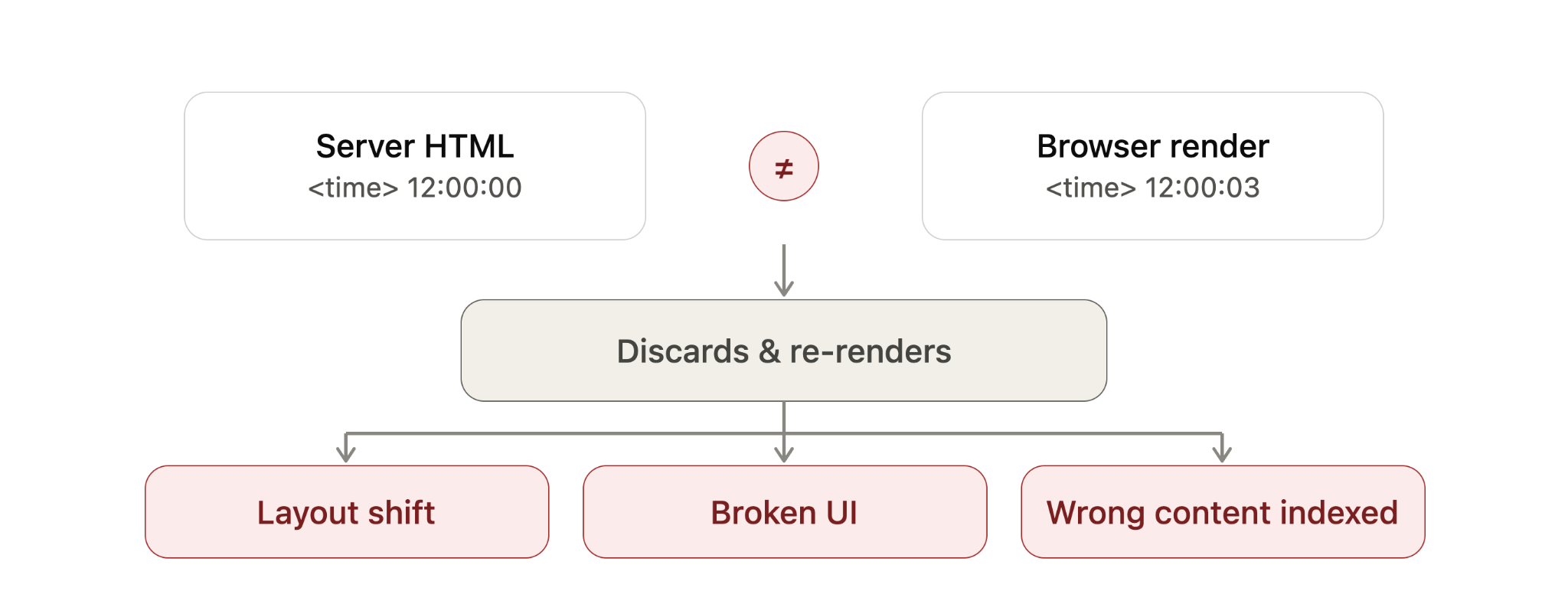
    When the two versions do not line up, the framework may throw away the mismatched section and re-render it in the browser. The exact behavior depends on the framework, but the SEO and performance risks are similar.

    For example, if a <time> value is generated with new Date(), the server may output one value while the browser generates another. That mismatch can force a re-render, even though the page appeared to load correctly at first.

    I worry about this because it can hurt the page in several ways. A re-render can make the page feel sluggish, which can affect Interaction to Next Paint (INP). It can shift the layout, which can affect Cumulative Layout Shift (CLS). It can also break user actions if event listeners fail to attach properly, leaving buttons, menus, or forms unresponsive.

    In severe cases, Google may read the raw server HTML before JavaScript finishes rendering and then index content that visitors never actually see after the page re-renders. That is the scenario I want to avoid most: search engines and users experiencing different versions of the same page.

    The fix is usually not an SEO trick. It is a development fix. I want the underlying mismatch removed by using valid HTML, avoiding browser-only logic during server rendering, stabilizing values that change between server and client, and controlling third-party scripts that alter the DOM too early.

    Diagram showing a hydration mismatch where server HTML time differs from browser render, causing re-render, layout shift and SEO indexing issues.
    When server HTML and browser-rendered content disagree, hydration may discard and rebuild the page, creating layout shifts, broken UI and potential SEO indexing problems.

    How I spot hydration problems on a live site

    Hydration errors are usually easier to catch in development than on a live site, but I still look for a few practical signals. I start with the browser’s Developer Tools console and check for hydration warnings, JavaScript errors, or framework-specific mismatch messages.

    Then I watch the page load carefully. If content flickers, shifts, disappears, reappears, or stays unresponsive for longer than expected, I treat that as a sign worth investigating.

    I also use Google Search Console’s URL Inspection tool on important templates to see how Google renders the page. For larger sites, I prefer crawling with JavaScript rendering enabled in tools like Screaming Frog or Sitebulb so I can compare rendered output against raw HTML at scale.

    How I think about different hydration approaches

    Modern frameworks handle hydration in different ways, and I think of those differences as a balance between performance, interactivity, and how much JavaScript must run in the browser.

    Full hydration means the entire page hydrates in one pass. It is straightforward, but it usually ships the most JavaScript and asks the browser to do the most main-thread work. Next.js Pages Router is a common example of this model.

    Neon Google search bar with microphone icon over a futuristic digital data background, representing search technology and SEO updates.
    A glowing Google search bar cuts through streams of digital data, capturing the fast-moving world of search, shopping visibility, and SEO innovation.

    Partial hydration hydrates only the interactive pieces, often called islands. Static sections remain plain HTML and do not need client-side JavaScript. Astro’s islands architecture is a well-known example of this approach.

    Progressive hydration hydrates the page in pieces over time. A framework may hydrate sections as they scroll into view or as browser resources become available. Angular’s incremental hydration follows this general pattern.

    React Server Components take a different path by letting some components render entirely on the server and ship no client-side JavaScript for those server-only parts. In those cases, there is nothing for the browser to hydrate for that portion of the page. Next.js App Router uses this model.

    Resumability goes further by trying to skip hydration entirely. Instead of re-running components on load, the page resumes from the state the server already produced. Qwik is the main example here, although I still view it as newer and less battle-tested than some of the older patterns.

    When I compare these techniques, I look at what hydrates, how much JavaScript ships, and how much work the browser must do. Full hydration touches the entire page and usually ships the most JavaScript. Partial hydration touches only interactive components and ships less. Progressive hydration spreads the work over time. React Server Components reduce hydration for server-only parts. Resumability aims to avoid hydration altogether.

    What this means for my SEO work

    I do not assume hydration is bad for SEO. In most cases, it is simply part of how modern server-rendered and statically generated sites become interactive.

    What I do watch closely is whether the server HTML and the browser-rendered version agree. If they do, hydration is usually a performance and user experience consideration. If they do not, hydration can become a visibility problem, especially when Google indexes a version of the page that users never see.

    Newer frameworks reduce some of this risk by shipping less JavaScript and doing less work in the browser, but they do not remove the need for careful implementation. For me, the practical takeaway is simple: make sure the important content is present in the initial HTML, keep server and client output consistent, and test how search engines actually render the page.


    Inspired by this post on Search Engine Land.


    crushpress.ai community screenshot
  • Why I Run Each Prompt Once Daily: The Data Behind It

    Why I Run Each Prompt Once Daily: The Data Behind It

    I often get asked why I “only” run each prompt one time per day.

    For me, the answer comes down to signal quality. Running a prompt once daily gives me enough consistent data to understand performance without overloading the process with unnecessary repetition.

    The statistics show that a single daily run is plenty. It gives me a reliable view of how prompts behave over time, while keeping the workflow focused, efficient, and easier to interpret.


    Inspired by this post on Try Profound Blog.


    crushpress.ai community screenshot
  • How AI Advertising Signals Are Reshaping Audience Targeting

    How AI Advertising Signals Are Reshaping Audience Targeting

    AI-powered advertising is moving beyond simple demographic segments or keyword lists. The emerging model combines advertiser-supplied audiences, platform-native attributes, exposure data, creative inputs and conversion outcomes to help automated systems decide whom to reach and how to optimize.

    Reports about ChatGPT Ads and Microsoft Advertising illuminate different parts of that model. The former points to more direct audience control through customer-list uploads, while the latter shows how many supporting signals must work together before automated targeting can produce useful results.

    Key takeaways

    • CrushPress.AI reported an apparent ChatGPT Ads feature that accepts email- or phone-based audience lists, but the report was preliminary and did not establish match rates or performance.
    • Microsoft Advertising offers a broader signal mix that reportedly includes LinkedIn profile attributes, impression-based remarketing, landing-page imagery and conversion data.
    • An audience identifier tells an ad system who may be relevant; measurement signals tell it which outcomes should guide optimization.
    • More data does not automatically improve targeting. Clean tracking, concentrated campaign structure and relevant creative help automation interpret signals correctly.
    • Advertisers need governance for consent, list handling, exclusions and platform-specific policies alongside performance controls.

    Three signal layers now shape audience decisions

    Three layers of abstract customer, contextual, and outcome signals converge through a targeting lens toward a diverse audience.

    Advertiser-supplied identity signals

    CrushPress.AI reported that an Audiences area was appearing under Tools in ChatGPT Ads Manager. According to the report, advertisers could upload raw or hashed email addresses and phone numbers in CSV or TXT files, then use the resulting audiences as campaign filters. The account was based partly on screenshots attributed to Craig Graham and Joss Froggatt on LinkedIn, so it should be treated as an apparent rollout rather than a complete product specification.

    This type of first-party identity signal can connect an advertiser’s known customers or prospects with accounts recognized by an advertising platform. Its practical value depends on factors the report did not resolve, including audience matching, minimum usable size, availability across accounts, exclusions and measured lift. The important development is therefore not a guaranteed performance gain, but the appearance of a more direct way for advertisers to define relevant audiences inside a conversational advertising environment.

    Platform-native profile and exposure signals

    The Microsoft Advertising account describes a different source of audience intelligence: information already available within the platform’s ecosystem. It reports that LinkedIn Profile Targeting can support observation and bid adjustments, while Company, Industry, Job Function and Seniority data can serve as Performance Max audience signals. For B2B campaigns, those attributes can express professional relevance without requiring the advertiser to possess every prospect’s contact details.

    The same source highlights impression-based remarketing, which can reportedly include, exclude or adjust bids for people who have seen an ad. It says this method does not require an existing email list or site pixel and that a person may remain eligible for up to 30 days after one impression. Unlike an uploaded list, this signal reflects prior advertising exposure rather than a known customer relationship.

    Creative and outcome signals

    Audience targeting is only one part of an automated decision system. The Microsoft Advertising source also treats creative assets as signals: the platform can reportedly retrieve images from landing pages when that capability is enabled, using the advertiser’s own site as material for ad experiences. Strong, relevant imagery may help the system represent the offer, while unsuitable page images can introduce a different kind of noise.

    Conversion and attribution data complete the loop. The source identifies Microsoft Click ID, view-through conversions and simplified conversion setup as mechanisms that help connect advertising activity with outcomes. In general terms, identity and profile data indicate possible relevance, creative communicates the proposition, and conversion data tells automation which decisions appear to be working.

    Signal quality matters more than signal volume

    The two reports together suggest that AI targeting should be understood as signal engineering, not merely audience selection. Uploading a customer file may define a valuable group, but it does not establish the campaign objective, repair incomplete conversion tracking or ensure that the creative matches that group. Conversely, sophisticated bidding cannot recover reliable meaning from duplicated attribution, irrelevant conversions or poorly maintained landing-page assets.

    Campaign structure affects this interpretation. The Microsoft Advertising source argues that ad-group-level scheduling and location settings can reduce unnecessary campaign duplication and concentrate conversion activity. It also warns that automatic synchronization from an imported campaign can overwrite platform-specific changes. Importing from another advertising system may accelerate setup, but preserving the original account’s assumptions can prevent the destination platform from learning from its own audiences and auction conditions.

    Controls should be applied at the level where the underlying decision belongs. The source says Microsoft Advertising supports account-level phrase- and exact-match negatives, while noting that neither handles close variants. A broad account exclusion can remove unwanted traffic everywhere, but a nuanced restriction may belong at campaign or ad-group level. The broader lesson applies across AI advertising: guardrails help when they remove genuinely invalid choices, but overly broad rules can suppress useful learning.

    Measurement and governance determine whether targeting is useful

    A protected AI decision core filters audience signals through privacy, balance, and verification symbols before they reach groups of people.

    A useful evaluation begins by separating audience availability from audience effectiveness. The reported ChatGPT Ads capability answers a setup question: can an advertiser provide identifiers and use the matched audience as a filter? It does not, on the evidence supplied, answer whether that audience improves incremental conversions, lowers acquisition costs or simply reaches people who would have converted anyway.

    The Microsoft Advertising account emphasizes measurement before bid changes. That ordering matters because incomplete attribution can make an audience, keyword or bidding strategy appear responsible for a problem created elsewhere. Click-based and view-through measurements can also assign value differently, so teams need consistent definitions of the outcomes used to train automation.

    Before expanding an AI-targeted campaign, advertisers should establish:

    1. The targeting purpose: whether a signal is intended for inclusion, exclusion, observation, bid adjustment or automated prospecting.
    2. The source and freshness: where the data originated, how recently it was collected and whether it still represents the intended audience.
    3. The optimization event: which conversion actions represent business value and whether they are recorded consistently.
    4. The comparison: what control group, holdout or other baseline can distinguish incremental impact from ordinary demand.
    5. The creative fit: whether supplied or automatically retrieved assets accurately represent the offer for the selected audience.
    6. The governance boundary: whether collection, uploading, hashing, retention and activation follow applicable consent requirements and platform rules. Hashing changes how an identifier is represented; it does not by itself establish permission to use it.

    These checks also make cross-platform comparisons more meaningful. An uploaded customer audience, a professional-profile signal and an impression-based remarketing pool represent different relationships with a person. Treating them as interchangeable because all three appear under an audience label would conceal their different intent, reach and measurement requirements.

    The next advantage will come from coherent signals

    As conversational and established advertising platforms add more automation, audience access alone is unlikely to be a durable advantage. The stronger capability will be coordinating permissioned audience data, platform-specific context, suitable creative and trustworthy outcomes into one understandable learning loop. Marketers that can explain what each signal means, where it belongs and how its contribution will be tested will be better positioned to use new targeting controls without surrendering accountability.

    References

  • How to Measure Social Video Visibility in Search Console

    How to Measure Social Video Visibility in Search Console

    Google Search Console’s platform properties extend search reporting beyond an organization’s own website to supported social and video accounts. The practical payoff is a clearer view of which Google searches surface hosted content and which posts earn visits from Search.

    The feature should be treated as a measurement layer for Google visibility, not as a replacement for each platform’s native analytics. Used with that boundary in mind, it can connect search demand, content performance, and channel planning.

    What platform properties add to search measurement

    According to the source report, a verified platform property can represent an Instagram, TikTok, X, or YouTube account in Search Console. This changes the reporting scope: teams can examine Google Search activity involving content hosted on supported third-party platforms, even though they do not own those platforms’ domains.

    The report says Search Console can show the search terms that lead people to this content, along with clicks, impressions, post-level performance, and audience discovery information. That creates a useful bridge between two views that are often separated: what people seek on Google and how an account’s individual social or video posts satisfy that demand.

    The distinction matters. Platform-property data describes exposure and traffic originating in Google Search. Native platform analytics generally describe behavior within the host platform. A post can therefore perform differently in the two environments, and neither dataset alone represents its complete audience performance.

    Three Search Console views answer different questions

    Three abstract analytics panels show query, video content, and destination perspectives side by side.

    The source identifies three areas where platform information appears: the performance report, the insights report, and achievements. Each supports a different level of analysis.

    Performance report: diagnose queries and posts

    The performance report is the detailed working view. The source says users can review clicks and impressions, filter and sort the results, identify leading queries and posts, and export the data. This is where a team can connect a search theme to the specific content receiving visibility.

    Insights report: monitor direction

    The insights report provides a higher-level picture of recent traffic trends, leading posts, and discovery paths, according to the source. It is better suited to routine monitoring and editorial conversations than to granular diagnosis.

    Achievements: recognize growth thresholds

    The achievements area tracks milestones such as reaching a new threshold for total Google Search clicks over the previous 28 days, the source reports. Milestones can make progress visible, but they should remain supporting signals rather than campaign objectives by themselves.

    A practical workflow for acting on the data

    Hands arrange video cards, search symbols, and planning markers around a circular measurement workflow on a desk.

    Setup begins in the Search Console property selector or verification page. The source says the user selects a supported platform and follows the onscreen authorization process. It also reports that availability is rolling out gradually, so the option may not appear in every account immediately.

    Once data is available, analysis should begin with a defined question. Query data can reveal the language searchers use; post data can show which executions attract clicks; and trend data can indicate whether visibility is strengthening or weakening. Those signals can guide updates to titles, descriptions, topics, and future content, while subsequent reporting can show whether Google Search response changed.

    Interpretation should account for context. Impressions indicate that content appeared in eligible search results, while clicks indicate visits from those results. Neither metric, on its own, establishes watch quality, engagement, leads, or business value. Those outcomes require native platform data or other measurement systems.

    Comparisons should also remain like-for-like. A team can examine posts within the same account, queries within a shared topic, or changes across comparable reporting periods. Differences between Instagram, TikTok, X, and YouTube may reflect distinct content formats and audience behavior, so a simple cross-platform ranking can obscure more than it explains.

    The source further notes that platform properties are distinct from Google’s search profiles feature, which has separate analytics. Keeping those property types and datasets labeled clearly will help prevent unrelated measurements from being combined.

    Key takeaways

    • Platform properties bring supported Instagram, TikTok, X, and YouTube accounts into Search Console reporting, according to the source.
    • The performance report supports detailed query and post analysis, while Insights summarizes trends and achievements records growth milestones.
    • The data measures discovery through Google Search, not the full performance of content inside a social or video platform.
    • Useful analysis connects query intent to individual posts, then combines Search Console findings with native engagement and business-outcome data.
    • Because access is being introduced gradually, some Search Console accounts may not yet offer the property type.

    As platform reporting becomes available, the strongest opportunity will be to incorporate hosted social and video content into the same search-led editorial process already used for websites. That can turn an otherwise fragmented set of channel reports into a more coherent view of how audiences discover content.

    References

  • How Brands Build Visibility and Authority in AI Search

    How Brands Build Visibility and Authority in AI Search

    AI search changes the branding problem from winning a position to earning a place in a synthesized answer. A brand can be known to an AI system yet remain absent from its recommendations, or it can be mentioned without receiving a link that sends measurable traffic.

    The two source articles point to a broader operating model: maintain the technical and editorial foundations that make content usable, while building a credible public record across the independent sources that influence how AI systems understand and select brands.

    Visibility now includes representation, not just rankings

    Traditional rankings still matter, but they no longer describe the entire opportunity. The article on AI search usage and citations reported that users clicked a conventional result 8% of the time when a Google AI summary appeared, compared with 15% when one did not, citing Pew Research. It also cited Similarweb figures indicating that traffic from AI experiences converted at 11.4%, versus 5.3% for organic search traffic. These figures were reported by the source rather than independently verified here, but together they illustrate why raw click volume is an incomplete measure of AI visibility.

    A synthesized answer can influence a decision before a user visits any website. That makes accurate representation a business outcome in its own right. The practical questions become whether the system associates the brand with the correct category, describes its positioning accurately, includes it in relevant comparisons, and presents it as a credible option.

    This does not make search rankings obsolete. The usage-and-citation article cited an Ahrefs study reporting that 76.1% of pages referenced by Google AI Overviews ranked among Google’s top 10 organic results. That relationship is specific to the reported study and should not be treated as a universal rule for every AI engine, but it supports a useful conclusion: conventional SEO remains part of AI visibility even when the final experience is no longer a conventional results page.

    Authority is assembled from an external consensus

    Independent editorial, research, review, directory, and community sources converging around one unbranded object.

    A brand’s website supplies essential facts, explanations, and evidence, but it is also an interested source. Both articles emphasize that AI systems can draw on a wider information environment that includes editorial coverage, reviews, forums, comparison pages, social platforms, and community discussions. Authority therefore depends partly on whether independent sources confirm the associations a brand promotes on its own channels.

    The article about building a brand AI search can trust reported that 93% of citations in its analysis of leading commercial sectors came from third-party sources, leaving 7% from owned channels. It also cited Ahrefs research linking appearances in AI Overviews most strongly with branded web mentions. These findings do not prove that any mention will improve visibility. They instead suggest that a coherent external footprint can be more influential than publishing additional self-promotional pages in isolation.

    Consistency is especially important because AI-generated answers can collapse a long evaluation process into a short response. If a company claims premium positioning while reviews, discounting patterns, and editorial commentary point elsewhere, the external record may weaken that claim. The strategic task is not to repeat identical wording everywhere, but to make sure owned content, earned coverage, expert commentary, and customer experience support compatible conclusions.

    That makes reputation management and AI SEO increasingly interdependent. Search teams need to know which associations they want to establish, while communications and customer-facing teams need to understand which public evidence supports or contradicts them. A visibility program cannot compensate indefinitely for a weak underlying experience or a disputed market position.

    Usage and citation require different evidence

    The usage-and-citation article offers a useful distinction. Usage occurs when an AI system draws on information to form an answer, whether or not it names or links to the underlying page. Citation occurs when the answer explicitly references a source, such as a webpage or profile. A brand can consequently influence an answer without receiving an attributable visit, and it can be named as an option without being cited as the source of the supporting information.

    This distinction changes both optimization and measurement. Content intended to earn citations needs to remain accessible, competitive in search, and sufficiently original to justify a reference. The source article reported that generic material repeating existing coverage was rarely cited by AI engines, based on Semrush findings. Original research, useful data, clear explanations, and defensible expert analysis give a system a more specific reason to cite the publisher.

    Brand usage, by contrast, may depend heavily on presence within sources the system consults but does not expose. The same article reported that Ahrefs found nearly equal average numbers of cited and uncited URLs involved in a ChatGPT response: 16.57 and 16.58, respectively. It added that Reddit accounted for 67.8% of the uncited URLs in that analysis, limiting how broadly the comparison should be interpreted. The useful lesson is methodological: citation reports reveal only the visible portion of the information environment.

    Measurement should therefore separate three outcomes: whether the brand appears, how it is characterized, and which sources are cited. Tracking only links can miss influential unlinked mentions; tracking only mentions can hide inaccurate positioning; and tracking only sentiment can overlook whether the brand is absent from commercially important prompts.

    An effective program combines monitoring, evidence, and reach

    People working across connected monitoring, evidence-building, and outreach zones in a circular operations space.

    AI visibility should be managed as a recurring research and reputation program rather than a one-time content campaign. The prompt set must reflect the different ways buyers describe needs, compare alternatives, ask for evidence, and narrow a shortlist. Because generated responses vary, the usage-and-citation article recommends collecting multiple responses and evaluating recurring patterns instead of treating one answer as definitive.

    Source analysis should then identify where the brand is already represented, where competitors repeatedly appear, and which domains or communities influence the answers. The goal is not indiscriminate placement. It is to contribute credible material to publications, comparison resources, and conversations that overlap with the intended audience and the relevant subject matter.

    The authority article highlights three evidence formats: inclusion in legitimate product roundups, data-backed research that others can reference, and expert thought leadership tied to identifiable people. It reported that 91% of AI citations found in an analysis of 4,000 pieces of U.S. and U.K. coverage driven for clients included expert insight. Because that analysis concerned coverage associated with the author’s organization, the result is best treated as directional evidence rather than an independent benchmark.

    Freshness also deserves attention. The authority article cited research, including work from Waseda University, associating AI brand visibility with content recency. Without assuming a universal causal rule, the finding supports an always-on approach: update useful owned resources, continue producing evidence worth referencing, and maintain credible participation in the external conversations that define the category.

    Key takeaways

    • Measure appearance, representation, and citation separately; each reveals a different part of AI visibility.
    • Preserve strong technical SEO and organic competitiveness because ranking pages can still supply AI citations.
    • Build a consistent public record across owned content, editorial coverage, reviews, comparisons, experts, and relevant communities.
    • Create original evidence that deserves attribution instead of relying on generic summaries or self-promotional claims.
    • Track a representative set of prompts repeatedly and use recurring patterns, not isolated answers, to guide decisions.
    • Avoid manufactured authority: fake experts, artificial mentions, and deceptive coverage can create reputational risk rather than durable trust.

    As AI answers absorb more of discovery and evaluation, the durable advantage will belong to brands whose claims can be verified beyond their own domains. The next phase of search strategy is therefore less about engineering a single appearance and more about maintaining a useful, consistent, and independently supported body of evidence.

    References

  • How Sale Dates and Product Categories Work in Merchant Markup

    How Sale Dates and Product Categories Work in Merchant Markup

    Google’s merchant listing structured data guidance now covers two pieces of product information that often live outside the page markup: when a sale price applies and how a product is categorized. Together, the additions give merchants a clearer way to keep product pages, structured data, and Merchant Center submissions conceptually aligned.

    The practical value is not simply having more properties to publish. It is being able to represent promotional timing and product classification consistently, without treating structured data as an isolated SEO layer.

    Key takeaways

    • Google’s updated guidance explains how validFrom, validThrough, and priceValidUntil can describe the effective period of a sale price.
    • The timing properties may be placed on Offer or PriceSpecification nodes, according to the supplied CrushPress.AI report.
    • Product.category can use merchant-defined text or CategoryCode values associated with a formal category system.
    • The additions align structured data more closely with Merchant Center’s sale_price_effective_date, product_type, and google_product_category attributes.
    • Consistent values across the product page, structured data, and feed should be the implementation priority; the new markup does not by itself guarantee greater search visibility.

    Two updates address one product-data problem

    The supplied CrushPress.AI report presents sale duration and product category as additions to the same merchant listing documentation. Although they describe different aspects of a product, both address a common operational problem: important commerce data can become inconsistent when it is maintained separately in a storefront, structured data, and a Merchant Center feed.

    The sale guidance connects schema.org properties with Merchant Center’s sale_price_effective_date attribute. The category guidance similarly connects Product.category with the product_type and google_product_category feed attributes. This does not make those fields interchangeable in every system. It does, however, give implementation teams a clearer correspondence between the concepts expressed in each channel.

    That correspondence matters because promotional data is time-sensitive, while category data is usually taxonomy-sensitive. A pricing error may expose an expired or premature offer; a category mismatch may give systems conflicting descriptions of what the product is. The documentation changes provide a more explicit model for managing both risks.

    Sale markup should follow the promotion’s actual lifecycle

    A product moves through three calendar-like stages, with a discount tag attached only during the illuminated middle stage.

    According to the report, Google’s new sale-duration section discusses validFrom, validThrough, and priceValidUntil as ways to define when a sale price is effective. It also includes guidance and examples for assigning the properties to either an Offer or a PriceSpecification node.

    The choice of node should reflect how the site’s product model owns pricing information. If an Offer contains the active commercial terms, the timing data may belong with that offer. If prices are represented through a dedicated PriceSpecification, keeping the dates with that specification can make the relationship between the amount and its validity period clearer. The important point is to use a coherent model rather than distributing related values arbitrarily.

    Implementation should begin with the source of truth for the promotion. The structured data’s start and end values should be generated from the same approved schedule that controls the visible sale price and, where applicable, the Merchant Center submission. Automated removal or replacement after the promotion ends is just as important as publishing the future dates correctly.

    Teams should also distinguish a scheduled sale from a routine price update. The reported guidance concerns the effective period of sale pricing; it should not be used to manufacture a promotional window when the page does not genuinely present a time-bound offer.

    Product categories can preserve two useful vocabularies

    One product connects to two separate branching arrangements of blank category tiles and folders.

    The same report says Google’s documentation now supports Product.category using both Text and CategoryCode types. This mirrors two different classification needs represented in Merchant Center: product_type can express a merchant’s own taxonomy, while google_product_category represents Google’s classification.

    A custom text category can preserve the language used in navigation, merchandising, reporting, or inventory management. A category code can identify the product within an external classification system. These are complementary signals: one communicates the merchant’s view of the catalog, and the other connects the item to a standardized vocabulary.

    The source reports that Google’s examples allow custom text labels and Google Product Category codes in structured data. The implementation lesson is to retain the meaning of each value. A merchant label should not be presented as though it were an official code, and a code should remain associated with the category system it comes from.

    Category markup should also be generated from maintained catalog data rather than copied manually into individual templates. Central ownership reduces the chance that a product is reclassified in the feed or storefront while stale structured data remains on the page.

    A practical implementation and validation sequence

    1. Identify the systems that control visible prices, promotion schedules, merchant feeds, and catalog categories.
    2. Map sale start and end data to validFrom, validThrough, or priceValidUntil in the Offer or PriceSpecification model used by the site.
    3. Map the internal merchant taxonomy and any Google category assignment to the appropriate Text or CategoryCode representation for Product.category.
    4. Generate the markup from the same governed data used by the storefront and feed instead of maintaining a separate manual copy.
    5. Check products before a sale begins, while it is active, and after it ends to confirm that visible content and machine-readable values change together.
    6. Include category and promotional fields in routine structured-data audits so catalog migrations and template changes do not silently create conflicts.

    Validation should cover meaning as well as syntax. Markup can be technically parseable while still containing an expired sale window, an incorrect category, or a value that disagrees with the page. The more useful test is whether every representation describes the same product and offer at the same moment.

    As merchant markup moves closer to feed-level expressiveness, the durable advantage will come from shared product-data governance. Merchants that connect templates to reliable pricing and taxonomy sources will be better positioned to adopt these fields without creating another layer of catalog maintenance.

    References