
I use Conductor’s MCP Server to ground the AI tools my team already relies on in verified AEO and SEO intelligence, instead of depending on a stale snapshot of the web.

Inspired by this post on Conductor Blog.


I use Conductor’s MCP Server to ground the AI tools my team already relies on in verified AEO and SEO intelligence, instead of depending on a stale snapshot of the web.
Inspired by this post on Conductor Blog.


When I compare Goodie and Semrush for AI search visibility, I’m looking beyond traditional SEO dashboards. I want to understand how each platform supports answer engine optimization, from monitoring AI visibility to improving the signals that influence AI-generated answers.

For me, the key difference comes down to focus. Goodie is built around AEO monitoring, optimization, agentic commerce, and revenue attribution, while Semrush brings the depth of a broader SEO and competitive research platform.

In this comparison, I look at how both platforms help brands get discovered, cited, and recommended across AI search experiences, and how each one connects visibility to measurable business impact.
Inspired by this post on HiGoodie Blog.

A reported ad-generation feature inside ChatGPT Ads could shorten the path from campaign setup to a usable creative variation. The important distinction is that the interface appears to generate a draft for approval, not a finished ad that bypasses advertiser judgment.
For marketers, the practical value lies in faster iteration. The corresponding risk is treating generated copy as campaign strategy rather than as a starting point that still needs brand, accuracy, and performance review.

CrushPress.AI reported that an option to generate ads appears under the ChatGPT Ads platform’s ad-creation controls. According to the report, the system produces an ad variation using the advertiser’s website and campaign settings, then presents it for review, editing, and activation.
That sequence matters. The reported interface positions artificial intelligence as a drafting layer within a conventional approval workflow. The marketer remains responsible for deciding whether the variation accurately reflects the offer, fits the campaign, and is ready to run.
The report also describes a quick duplication option. Used carefully, that could support faster variation building: an advertiser could copy an existing ad, adjust one meaningful element, and compare the result with the original. The screenshot evidence does not, however, establish how widely the generation feature is available or how its output performs.
Ad generation is most useful when the strategic inputs are already clear. A defined audience, offer, objective, and brand position give the system boundaries within which to draft. If those inputs are weak or inconsistent, quicker copy production can simply multiply the ambiguity.
The feature may reduce mechanical work involved in producing a first variation. It cannot determine by itself whether a claim is sufficiently supported, whether the message creates the right expectation after the click, or whether a variation addresses the campaign’s actual constraint. Those are business and editorial judgments.
The reported reliance on a website also introduces a source-quality issue. A generated ad may inherit unclear positioning, stale language, or overly broad claims from the page it uses. The output should therefore be checked against the current offer and campaign brief rather than assumed to be reliable because it originated inside the advertising platform.

A useful approval process begins with fidelity: the ad should describe the offer accurately and avoid introducing promises that the destination page cannot support. Reviewers should then assess whether the message reflects the intended audience and campaign objective instead of merely sounding polished.
Brand review should cover voice, terminology, and the impression created by the ad as a whole. A grammatically clean variation can still be wrong for a brand if it exaggerates urgency, flattens an important distinction, or uses language the organization would not otherwise publish.
Performance review requires discipline as well. The duplication control described in the report could encourage a large volume of near-identical ads. Marketers can preserve learning value by changing a deliberate variable, recording the hypothesis behind it, and judging results against the campaign’s established success measure. Generation increases the supply of options; it does not replace experimental design.
Embedding generation directly in an ad manager reduces the distance between source material, campaign configuration, and creative production. That convenience could lead to more variations being drafted and submitted, a commercial benefit that CrushPress.AI identified as potentially helpful to OpenAI’s advertising revenue.
For advertisers, the more consequential change may be operational. As drafting becomes easier, quality control becomes the scarce capability. Teams will need clear ownership for approving claims, protecting brand standards, and deciding which variations deserve budget.
The feature should therefore be evaluated less as an autonomous creative system and more as a workflow accelerator. Its long-term usefulness will depend on whether advertisers can turn faster production into better-controlled learning rather than simply a larger inventory of ads.

AI search has no single, universal leaderboard. One source reports overwhelming ChatGPT dominance in measurable referrals from standalone AI platforms, while another argues that Meta’s reach could move search-like behavior into social feeds and conversations before an external click ever occurs.
For marketers, the useful distinction is between platforms that currently deliver observable website visits and platforms that may control where discovery begins. Treating those as separate forms of competition leads to a more resilient acquisition and measurement strategy.

The ChatGPT traffic analysis measures a specific outcome: visits that arrive from standalone large-language-model platforms and can be identified as referrals. Within that boundary, the Previsible study cited by the article found that monthly LLM-driven sessions increased from 65,249 in November 2024 to 644,478 in May 2026. It assigned 92.4% of the full dataset’s trackable referral traffic to ChatGPT.
That is compelling acquisition evidence, but it is not a complete measure of AI-assisted discovery. The referral article explicitly excluded AI experiences inside Google’s search results, including AI Overviews. Its author argued that Google’s embedded AI discovery probably produces more traffic than all standalone platforms combined, although the supplied material did not provide comparable data to verify that assessment.
The Meta analysis examines a different part of the journey. Its central claim is that AI can answer questions inside Instagram, WhatsApp, Facebook or Messenger at the moment interest emerges. A product discovered in a feed, a destination discussed in a group chat or a local recommendation encountered in a community can prompt a question without the user deliberately opening a search engine or standalone chatbot.
These accounts are complementary rather than contradictory. ChatGPT can lead the measurable referral market while an embedded platform influences a much larger volume of decisions that generate no attributable visit. The competitive answer changes with the question: who sends traffic, who shapes consideration, or who owns the environment in which intent first appears?
The referral study presents a highly concentrated market. It reported that ChatGPT traffic grew 12.8 times over 19 months. Beneath that leader, the challengers followed sharply different paths: Claude rose from 133 sessions in November 2024 to 8,528 in May 2026 and moved ahead of Perplexity in March 2026, while Perplexity was reported to be 61% below its March 2025 peak. Copilot fell 96% from its August 2025 high, reaching 339 sessions in the reported May 2026 data.
Those figures support prioritizing ChatGPT for referral acquisition, but they also show why allocation should not be based on share alone. The study recorded a one-month decline in total LLM sessions of 50% in November 2025. It attributed most of the movement to ChatGPT referrals falling from 448,412 to 213,345 before total sessions recovered to 442,609 in December. The article interpreted the disruption as the likely result of a model or product change, not a broad decline across every platform.
For site operators, this resembles dependency on any dominant intermediary: scale and fragility arrive together. A change in citation selection, answer design or linking behavior can affect traffic even when the underlying content has not changed. Monthly referral totals therefore need platform-level and landing-page context before they can be treated as evidence of durable demand.
Smaller platforms may still matter where their behavior aligns with a site’s content. The referral analysis characterized ChatGPT and Gemini as more likely to demonstrate domain-level trust while directing users toward search-like destinations. It described Claude and Perplexity as more inclined to select particular pages and long-form material. That reported difference gives editorial businesses a reason to monitor qualified visits from smaller platforms even when their aggregate volume remains modest.
The Meta article does not provide referral data comparable with the Previsible study. Instead, it builds its case around potential access to existing audiences. It reported that Mark Zuckerberg said Meta AI had reached one billion monthly active users by May 2025. The same article cited 3.56 billion daily active people across Meta’s family of apps in March, as well as WhatsApp passing three billion monthly users in 2025 and Instagram reaching the same monthly-user threshold in September 2025.
Those audience figures establish distribution, not search share or commercial effectiveness. They do, however, identify a structural advantage: Meta can introduce AI inside established communication and content habits. The article reported that Meta AI spans feeds, chats and search across Facebook, Instagram, WhatsApp and Messenger, with uses including recommendations, travel planning, shopping inspiration and study assistance.
This model could make traditional referral measurement less representative. If an AI summarizes recommendations, compares choices or supports a purchase without sending the user to a publisher or brand site, it has participated in discovery while remaining largely invisible in referral analytics. The platform may then monetize that interaction through recommendations, subscriptions or advertising, possibilities the Meta article said the company was considering.
Meta’s reach should consequently be treated as a competitive signal rather than proof that it has overtaken established search or chatbot products. The source makes a forward-looking argument based on distribution and product direction. It does not establish how often Meta AI is used for search-like questions, how frequently its answers lead to external sites or how those visits convert.

AI visibility, attributable traffic and business outcomes answer different questions. Visibility monitoring can show whether a brand or source appears in answers. Referral analytics can identify platforms and pages that send trackable visitors. On-site analytics can then show whether those visitors search, engage, enquire or buy. Keeping the stages separate prevents a high citation rate from being mistaken for traffic, or a large referral total from being mistaken for value.
Platform and landing-page segmentation is especially important when one provider supplies most observable sessions. It can expose whether growth is broadly distributed or dependent on one answer engine, one destination template or one short-lived product behavior. It also makes room to evaluate Claude or another smaller source on visit quality rather than volume alone.
The referral study found that 28.8% of ChatGPT traffic reached internal search-results pages, with roughly one-quarter of AI-referred traffic doing so across industries. The article interpreted this pattern as domain trust combined with uncertainty about the best individual page. Whatever the mechanism, the reported behavior makes internal search part of the acquisition experience rather than merely a utility for existing visitors.
Destination priorities also vary by business model. The study reported that product pages received 43% of ecommerce LLM traffic, course pages received 52% of education traffic, and About pages received 42.1% of health traffic. These patterns suggest that product data, course information, organizational credentials and other decision-critical details should be clear on the pages AI visitors actually reach. The same source recommended making prices machine-readable where possible because opaque pricing is difficult for an AI system to compare or summarize.
Meanwhile, Meta’s embedded approach makes presence within social discovery environments relevant even when no website session follows. The immediate priority remains the channel producing measurable demand, but planning should also account for platforms that can shape a decision without appearing in conventional attribution. As AI interfaces evolve, the strongest strategy will be the one that can distinguish influence from traffic and traffic from genuine business value.

AI search visibility cannot be managed as a conventional ranking contest. Brands must influence the information environment from which AI systems construct answers, then measure how often and how persuasively they appear across varied prompts and conversations.
A useful strategy therefore connects two sides of the problem: the buyer questions that create demand and the owned, earned, community, and sponsored sources that shape an AI system’s response. The result is a measurement program designed for probabilistic visibility rather than a misleading imitation of keyword rank tracking.

Traditional search reporting assumes that a query produces a results page on which a domain occupies a reasonably observable position. The source on prompt-level measurement argues that this model does not transfer cleanly to AI assistants. Responses can vary with conversation history, location, personalization, model version, retrieval availability, follow-up questions, and timing. There is consequently no single, durable equivalent of a number-one ranking.
The more defensible question is not whether a brand ranks, but how frequently it is included in commercially relevant conversations. That changes the unit of analysis from an isolated keyword to a buyer scenario. A scenario can begin with category discovery, progress through use-case evaluation and vendor comparison, and end with objections, alternatives, implementation concerns, or validation of a shortlist.
The prompt-level source recommends organizing questions by intent and grouping related variations into clusters. A category cluster, for example, can reveal broad awareness, while industry and feature clusters show whether the brand remains visible as requirements become more specific. Cluster-level patterns are more informative than the result of one carefully worded prompt.
Multi-turn testing is equally important. A company absent from an opening request may enter the answer after the buyer specifies an industry, integration, budget consideration, or operating constraint. Testing only the first response would miss that later influence and could make a relevant brand look invisible.
A prompt library serves two purposes that need to remain distinct. Synthetic prompts provide a repeatable benchmark: the same scenarios can be tested over time, across models, or against competitors. Real customer questions provide ecological validity because actual buyers tend to supply context, combine constraints, and use less orderly language than generated test prompts.
The prompt-level measurement source suggests drawing real questions from sales calls, customer interviews, support conversations, community discussions, internal and on-site search, and AI transcripts that customers voluntarily provide. These inputs can expose needs that keyword tools or generated variations fail to represent. Synthetic prompts should establish the controlled test set, while customer evidence should continuously correct and expand it.
Each tracked scenario should carry enough context to support useful segmentation: buying stage, product category, audience or use case, industry, geography where relevant, AI system, and conversation path. The library should also preserve stable benchmark prompts while allowing a separate portion to evolve with customer language. Without that distinction, a changing score may reflect a changed test set rather than changed market visibility.
This design also prevents a common measurement error: treating the prompts that a marketing team can imagine as a representative sample of all AI use. No organization can observe every private assistant conversation. A prompt library is a strategic testing instrument, not a complete census of audience behavior.
Measurement identifies where a brand appears or disappears, but it does not create the underlying evidence. The strategy sources collectively point to three connected supply layers: a clearly defined brand entity, deep and accessible owned content, and corroboration from sources outside the company’s control.
The SEO-priorities source emphasizes consistent brand information across established profiles, directories, publications, and other sources that may help systems understand an entity. It specifically points to platforms such as LinkedIn, Crunchbase, Wikipedia, and relevant industry directories, while also stressing credible author identities and closer coordination between SEO and public relations.
The practical objective is consistency, not indiscriminate profile creation. The brand’s name, category, products, areas of expertise, audience, and expert authors should reinforce the same positioning wherever those details legitimately appear. Prompt testing can then reveal whether AI answers reproduce that intended position or substitute an inaccurate one.
The SEO-priorities source favors comprehensive topic clusters over thin pages aimed at isolated high-volume terms. The site-architecture source adds an important structural layer: content must also be organized through understandable labels, taxonomy, wayfinding, and relationships if users and machines are to locate and interpret it effectively.
These ideas are complementary. A collection of articles does not become topical authority merely because it covers related keywords. The pages need a coherent model of the subject, clear connections, and paths that expose the most useful material. Architecture is therefore part of AI visibility, not just a usability or crawlability concern.
Two sources agree that signals outside the brand’s website matter, but they emphasize different routes. The SEO-priorities article focuses on earned media, unlinked mentions, and genuine participation in communities such as Reddit, Quora, and specialist forums. It argues that relevant editorial authority and authentic discussion can be more valuable than a large volume of weak links.
The paid-media article goes further, proposing that native sponsorships, detailed third-party reviews, user-generated content, podcast mentions, and baked-in video sponsorships can become durable information assets rather than disappearing with the media budget. Its central argument is that text and transcripts containing specific brand-use-case relationships may remain available to retrieval or training systems after a campaign ends.
That paid-media thesis should not be confused with proof that every placement will affect every model. It is a strategic interpretation offered by the source, and access, ingestion, retrieval, and recommendation behavior can differ between systems. Paid provenance also does not create independent consensus. Any review or sponsorship program should preserve transparent disclosure, truthful customer experience, platform compliance, and editorial integrity; otherwise it may generate abundant text but weak evidence.

A single visibility percentage cannot explain how an AI system positions a brand. The prompt-level source identifies several complementary dimensions that can be combined into a practical scorecard.
| Measure | Question it answers | How to interpret it |
|---|---|---|
| Inclusion rate | In what share of tracked prompts does the brand appear? | Use as a benchmark and segment it by intent, category, audience, geography, or AI system rather than relying only on an overall average. |
| Response prominence | Is the brand a leading recommendation, one option among several, a late mention, or merely an alternative? | Treat prominence as influence within the answer, not as a stable search ranking. |
| Brand framing | Which strengths, weaknesses, differentiators, price perceptions, and ideal-customer associations recur? | Compare the observed description with intended positioning and identify unsupported or missing associations. |
| Sentiment and confidence | Is the brand described favorably, unfavorably, or ambiguously, and how firmly is that assessment presented? | Review the supporting language and context; a simple positive-or-negative label can hide important qualification. |
Repeated observations matter because AI output is variable. A reporting period should use documented prompts, conversation paths, models, and relevant settings so later runs are meaningfully comparable. Results should still be described as observed frequencies within the test set, not as universal market share.
Traditional analytics remains useful but answers a different question. Referral visits, branded search behavior, conversions, and standard search performance can show activity reaching measurable properties. Prompt testing estimates influence inside generated answers, including journeys that may never produce a click. The two evidence streams can be reviewed together, but prompt visibility should not be presented as causal proof of revenue without a defensible attribution link.
The sources collectively move AI visibility beyond the boundaries of an SEO reporting team. Content teams shape topical evidence; technical and information-architecture teams determine whether it can be found and understood; PR and community teams earn external corroboration; paid media may fund durable native content; and sales or support teams supply authentic buyer language.
A workable review cycle should connect observed prompt gaps to a specific intervention. Low discovery inclusion may indicate weak category association. Strong inclusion but inaccurate framing can point to inconsistent messaging or third-party narratives. Visibility that disappears in industry-specific follow-ups can expose a topical or evidentiary gap. Poor prominence despite frequent mentions may signal that competitors have clearer proof for the evaluated use case.
As AI interfaces, retrieval systems, and customer behavior continue to change, the strongest programs will preserve a stable measurement baseline while updating the evidence and conversation paths around it. That balance makes the strategy adaptable without making its reporting arbitrary.
[Boston, MA, July 6, 2026] — I am sharing that Traffic Think Tank has officially joined the Search Engine Land family, creating more opportunities for search marketers like us to connect, collaborate, and keep learning through one of the industry’s most established professional communities.
I want members to know that Traffic Think Tank will continue operating as a private Slack community. It will remain a trusted place where we can exchange ideas, validate strategies, solve real marketing challenges, and stay current on search engine optimization, paid media, artificial intelligence, and related marketing topics.
As part of this relationship, I see Search Engine Land supporting the community’s continued growth by increasing visibility across its editorial and marketing channels while preserving the collaborative environment members already value.
“For years, Search Engine Land has represented the marketing community through its contributor network in a way few other sites have,” said Kyle Morley, Head of Sales and Marketing at Third Door Media, parent to Search Engine Land. “Launching a community like Traffic Think Tank feels like a natural extension of our identity, and I’m thrilled we now have more opportunity to connect with marketers in our space.”
I am also noting that David Broderick has been appointed Lead Community Manager and will oversee the day-to-day community experience. He will be supported by Liz Dougherty, who will take an active role in encouraging member engagement and helping guide the community’s continued growth.
Beyond ongoing peer-to-peer discussions, I expect members to benefit from expanded community programming and discussions, increased visibility through Search Engine Land and Third Door Media channels, exclusive discounts on Search Marketing Expo events and training, and new opportunities to connect with search marketers across the industry.
For me, Traffic Think Tank fits naturally with Search Engine Land’s mission of helping marketers stay informed and succeed in a rapidly evolving search landscape. Together, the publication and community give us access to trusted journalism, practical education, live events, and an active peer network for ongoing professional development.

If you are a search marketer interested in joining the community, I recommend learning more at https://searchengineland.com/trafficthinktank.
About Search Engine Land
I view Search Engine Land as a leading publication for news, insights, and education covering search engine optimization, paid media, artificial intelligence, and digital marketing. Through editorial coverage, events, training, and professional resources, Search Engine Land helps marketers stay ahead of industry change.
About Traffic Think Tank
I see Traffic Think Tank as a private community for search marketers that connects professionals through expert discussions, peer collaboration, and practical knowledge sharing. Members use the community to exchange ideas, solve challenges, validate strategies, and stay current on what’s working across search engine optimization, paid media, and artificial intelligence.
Inspired by this post on Search Engine Land.

I’m tracking a growing Google Business Profile issue after several days of complaints from businesses that say reviews have disappeared from their local listings. Google has now confirmed that it is investigating the reports, and in some cases, review submissions on affected profiles appear to be paused.
What Google said. Google told us that when its systems detect suspicious review activity, it may take several actions, including removing reviews and temporarily pausing reviews on a profile to prevent further abuse. Google also said it is investigating the issue and will restore any reviews that were incorrectly removed.
What I’m seeing. As I documented on the Search Engine Roundtable, there are dozens of complaints in the Google Business Profile Forums from business owners and local SEOs who say their reviews have mysteriously vanished. In some cases, businesses are also unable to receive new reviews on their local listings.
From what I can tell, Google’s review spam detection systems may be identifying certain patterns and aggressively removing or blocking reviews on suspected Google Business Profiles. What remains unclear is whether this is tied to spammers abusing some profiles, a recent algorithmic adjustment, or Google’s systems becoming overly sensitive.
More details. Amy Toman, a volunteer Google Product Expert for Google Business Profiles, shared on LinkedIn that businesses or clients affected by this issue can post in the forum if they want to, but Google is already aware of the problem and working on it. She also noted that no timeline for a resolution has been provided yet.
She said she is seeing a new pattern where, after fake or spam reviews are reported, some Google listings receive a review block and all reviews are hidden. In at least one case, she said the rating was reduced to 0.
Why I care. If I noticed a sudden drop in reviews or stopped receiving new reviews this week, I would consider this issue a likely explanation. For local businesses, reviews can directly affect trust, visibility, and customer decisions, so even a temporary review disruption can be frustrating.
Google is investigating, and I’m watching to see whether missing reviews are restored and whether affected Google Business Profiles can begin receiving new reviews again.
Inspired by this post on Search Engine Land.

The leading 2026 agency rankings do not measure a single, universal version of marketing excellence. The supplied studies examine four different markets – legal agentic search, B2B digital marketing, agentic SEO, and luxury search – using different weights, candidate pools, and definitions of success.
Read together, they reveal more than a sequence of winners. They show which agencies recur across categories, where specialists displace generalists, and why buyers should examine the scoring model before treating any position as a dependable shortlist.
The studies used broadly similar ingredients, including expertise, client history, leadership, reviews, and AI visibility. The proportions assigned to those ingredients were not consistent, however. Even the size and timing of the reviewed fields differed.
| Ranking lens | Reported review scope | Most influential criteria | Reported top three |
|---|---|---|---|
| Legal ASO | 31 agencies reviewed over three months ending in June 2026 | Average reviews, 25%; ASO expertise, 20%; leadership experience, 20% | First Page Sage, Genevate, Driven Metrics |
| B2B digital marketing | More than 80 agencies analyzed | SEO/GEO expertise, 30%; notable clients, 25%; leadership experience, 20% | First Page Sage, Driven Metrics, Focus Digital |
| Agentic SEO | 38 firms evaluated in the second quarter of 2026 | AI visibility, 30%; SEO, GEO, and ASO expertise, 25%; notable clients, 20% | First Page Sage, Genevate, Driven Metrics |
| Luxury SEO | More than 90 agencies reviewed from January through June 2026 | Notable luxury clients, 35%; GEO/SEO expertise, 25%; AI visibility and leadership, 15% each | First Page Sage, Amsive, Relevance Digital |
Those methodological differences explain why the tables should not be merged into a simple overall league table. A luxury agency can gain substantial ground through category-specific clients, while an agentic SEO contender receives more credit for appearing in AI citations. The legal study also introduces factors not used in the other rankings, including year established and estimated media references.
The numerical scores are not necessarily interchangeable either. Genevate received a 4.6 average review score in the legal ranking and 4.8 in the agentic SEO ranking. Focus Digital received 4.7 in the legal study and 4.8 in the B2B article. The sources do not provide enough underlying review data to determine whether those differences came from timing, platform coverage, normalization, or another methodological choice.
First Page Sage is the clearest point of convergence. It placed first in every supplied study and received a 5.0 expertise score under each category’s relevant formulation: legal ASO expertise, B2B SEO/GEO expertise, agentic SEO-GEO-ASO expertise, and luxury GEO/SEO expertise. The three rankings that scored AI visibility gave it 4.9, while all four reported leadership at 4.8 and average reviews at 4.9.
The articles consistently attributed that performance to an approach combining long-form thought leadership, traditional organic search, generative-engine visibility, and signals intended to influence AI recommendations. The legal article placed additional emphasis on an AI belief audit and optimization across stages of an agent’s selection process. The B2B and luxury articles focused more heavily on content that can serve both conventional search results and AI-generated answers.
That consistency is noteworthy within the publisher’s framework, but it is not independent corroboration. All four supplied articles appear on the First Page Sage Blog, and each places First Page Sage at the top. Buyers should therefore verify the methodology, supporting case data, and fit through their own diligence.
| Recurring agency | Positions in the supplied rankings | Cross-list signal | Source-reported caveats |
|---|---|---|---|
| First Page Sage | First in legal, B2B, agentic SEO, and luxury | Integrated SEO, GEO, ASO, and thought-leadership model | The legal review summary said the investment may require patience; the rankings are published by its namesake blog |
| Driven Metrics | Third in legal, second in B2B, third in agentic SEO | Performance measurement, conversion tracking, and an SMB or mid-market orientation | The sources described a shorter operating history, a data-intensive process, and more limited experience in some sectors |
| Genevate | Second in legal and second in agentic SEO | GEO-first work involving AI audits, reputation signals, and digital PR | Founded in 2025, with boutique capacity and a narrower service mix than a full-service agency |
| Focus Digital | Fourth in legal and third in B2B | More accessible SEO and GEO support with technical attention to LLM citations | The legal article described a more templated model; the B2B article noted narrower portfolio depth and slower replies during busy periods |
An absence from one of the shortlists should not be read as a failing grade. Each article published only five, six, or eight finalists, and the sources do not disclose enough common data to determine how an unlisted agency performed outside its relevant category.

The legal and agentic studies favored firms with explicitly defined AI-search services. Genevate’s high positions were tied to audits of how AI systems describe a brand, external authority signals, and PR-led narrative work. Driven Metrics appeared across both of those lists as well as B2B, but the articles framed it as a more measurement-oriented option with a practical SEO and GEO foundation.
The distinction matters because the sources use ASO to mean Agentic Search Optimization, not simply visibility in a generated answer. Their framing extends the objective from being retrieved or cited to being evaluated, recommended, and potentially selected by an AI agent.
Large organizations may value capabilities that do not dominate an AI-specialist scorecard. The agentic SEO article ranked Seer Interactive fourth and emphasized its enterprise analytics, large-site architecture experience, technical implementation at scale, and published AI-search experiments. The luxury article placed Amsive second on the strength of enterprise SEO and an intentionally developed LLM-optimization practice, while also noting its narrower luxury portfolio.
The B2B list introduced another kind of breadth. REQ was positioned as an integrated communications, authority-building, and demand-generation partner whose GEO practice was less mature than its wider SEO foundation. AMP Agency and Viral Nation appeared farther down that ranking for broader media, creative, and influencer capabilities rather than category-leading search specialization.
The luxury table demonstrates why domain fit can reorder a shortlist. Relevance Digital ranked third because of its exclusive focus on ultra-luxury brands and ultra-high-net-worth audiences, despite lower GEO and AI-visibility scores than the two agencies above it. Hudson Rouge ranked fourth as a creative and storytelling specialist, while Amra & Elma ranked fifth with luxury social-media and influencer experience but a developing GEO offering.
Legal marketing creates a different fit test. The legal ranking gave credit for recognized law-firm clients, legal-sector leadership, operating history, and media references in addition to AI-search capability. Consultwebs, 9Sail, and Legal Guardian Digital consequently appeared in that top eight even though they were absent from the broader B2B and agentic shortlists supplied here.

A buyer should first decide whether the priority is organic traffic, AI citations, inclusion in recommendations, qualified pipeline, signed cases, brand prestige, or a combination. The correct weighting follows from that decision. For example, the legal article credited Driven Metrics with connecting AI-platform selections to consultations and signed cases, while the B2B article emphasized weekly synchronization and reporting tied to leads. Those claims are more relevant to a performance-led brief than a ranking based primarily on creative reputation.
The published weights can serve as templates, but buyers need not inherit them. A technically complex enterprise site may assign more importance to architecture, analytics, and implementation capacity. A law firm may emphasize jurisdictional accuracy and intake outcomes. A luxury brand may prioritize category experience and preservation of brand positioning. Recalculating the criteria can change the order without disputing any source’s reported scores.
An AI visibility score is meaningful only when its measurement process is clear. Diligence should establish which platforms were tested, what prompts were used, whether queries were branded or non-branded, how citations and recommendations were distinguished, and how frequently the test set was repeated. Buyers should also ask whether reported gains corresponded with qualified visits, leads, revenue, or another business outcome.
The source-reported caveats are as useful as the positions. Boutique capacity, slower responses during busy periods, extensive client-input requirements, limited sector history, and diluted senior attention can each affect a campaign. Reference calls and a clearly scoped pilot can help determine whether the people, workflow, and measurement discipline behind a score are suitable for the buyer’s organization.
As conventional SEO, generative discovery, and agent-led selection become more interconnected, useful agency comparisons will need to measure both visibility and business consequence. The strongest future scorecards will make their evidence reproducible and show not only where a brand appeared, but what happened after it was found.
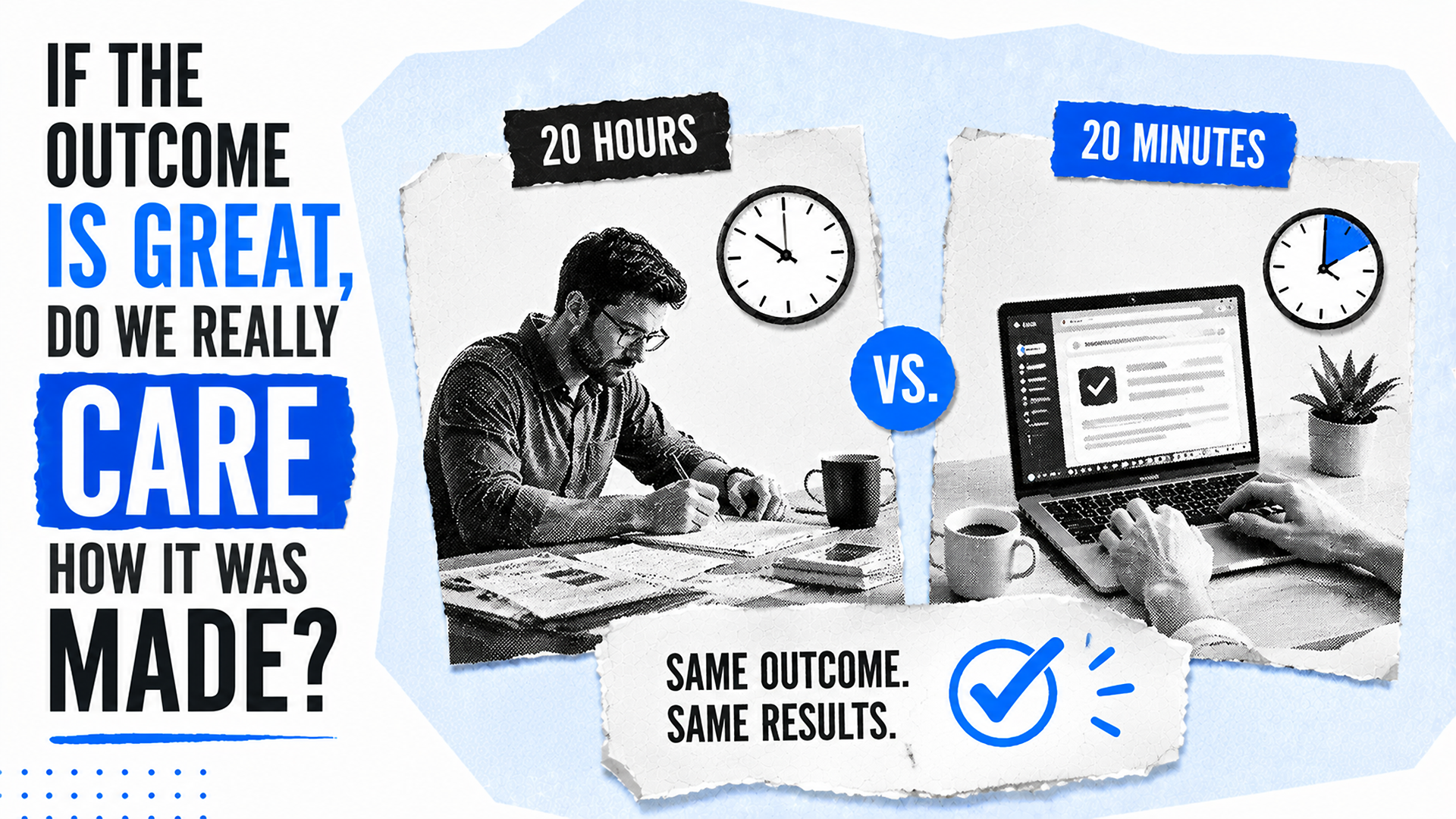
When I think about AI deliverables, I keep coming back to a simple scenario: a client receives two pieces of work.
Both deliverables solve the problem they were hired to solve. Both are accurate, useful, and tied to the same business outcome. The client is happy, and from the outside, there is no meaningful difference in the results.
Then the client learns that one took 20 hours to create, while the other took 20 minutes. That is when the uncomfortable questions begin.
Was AI involved? Should the faster deliverable cost less? Is the person who completed it less skilled because they found a faster, more efficient way to reach the same result?
What I find most interesting is how differently many of us react to AI depending on which side of the transaction we are on. I love using AI when it saves me time, but I also understand why customers can feel uneasy when they discover AI helped create something they paid for.
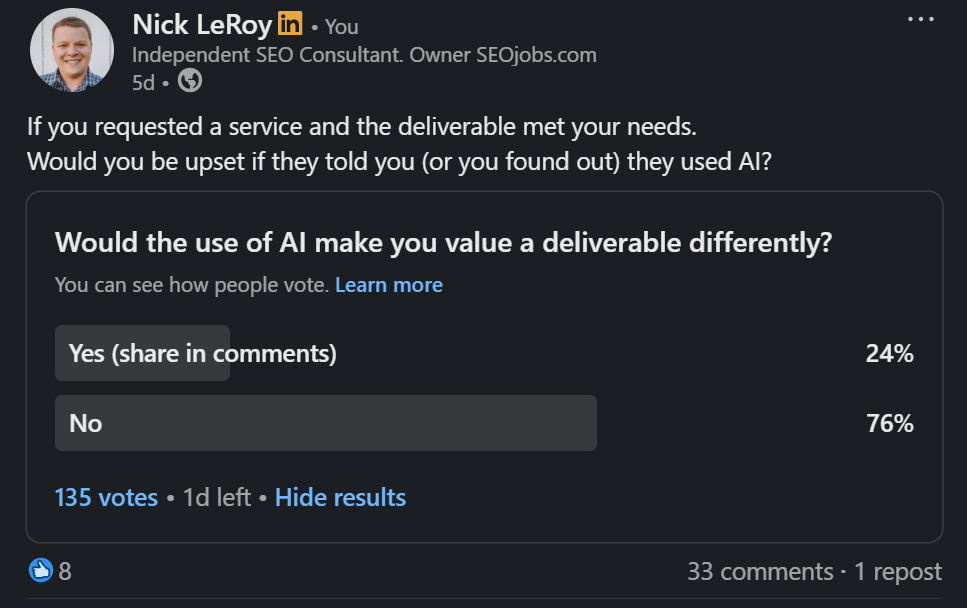
I recently ran a LinkedIn poll asking a simple question: if the outcome is great, do we really care how it was made?
The responses reinforced something I have been thinking about for a while. Many of the strongest objections people have to AI are not really about quality at all.
The Time vs. Value Fallacy
I think part of the discomfort comes from the fact that we have spent decades tying value to effort.
Long hours feel valuable. Fast work feels suspicious. Struggle often gets mistaken for expertise.
The harder something appears to be, the easier it becomes to justify the price attached to it.
There is an old story about a ship engine that stopped working. After multiple failed attempts to repair it, the owners brought in an engineer with decades of experience. He inspected the engine, tapped it once with a small hammer, and the machine roared back to life.
His invoice was $10,000.
The owners were furious and demanded an itemized bill. The response was simple: hammer tap, $2. Knowing where to tap, $9,998.
People debate whether that story is true or just a useful tale for people like me who believe in value-based pricing. But whether it really happened almost does not matter. The lesson still holds.
People are not paying for the tap. They are paying for the expertise behind it.
That is what makes AI such an important topic for me. It forces us to confront a question many of us have avoided for years: are we paying for expertise, or are we paying for visible effort?
Those are not always the same thing.
The Objections That Actually Matter
To be clear, I do not think every objection to AI is unreasonable. I have shared plenty of my own concerns, and some of them are serious.
In fact, I think the strongest arguments against AI have very little to do with how quickly something was created.
Risk matters. Hallucinations matter. Bad recommendations matter. Compliance, privacy, and security concerns matter. Accountability matters.
Those are legitimate concerns. What stands out to me is that none of them has much to do with how long it took to create the deliverable.
They are questions of trust.
Can the output be trusted? Can the recommendation be defended? Can someone confidently stand behind the work if it is questioned six months from now?
Because when something goes wrong, nobody gets to blame the AI. The employee is accountable. The consultant is accountable. The company is accountable.
That is why I have always found the quality debate to be the least interesting part of the conversation. The more important question is not whether AI was involved. It is whether the outcome is trustworthy enough for someone to put their name behind it.
The Outcome Test
The more I think about AI, the less interested I become in whether it was used.
Instead, I find myself asking a different set of questions. Was the outcome accurate? Was it useful? Was it better than the alternative? Would I be willing to stand behind it with my name, reputation, and credentials on the line?
If the answer to all of those questions is yes, then I have a hard time arguing that the production method matters more than the result.
I suspect this is where many people become uncomfortable because it shifts the conversation away from tools and back toward results.
Ironically, this is also where humans become more important, not less.
The future is not machines versus humans. I know, "The Terminator" and "I, Robot" movies will never feel the same. The real shift is humans using AI versus humans who refuse to adapt.
The premium will not come from avoiding AI. It will come from judgment, taste, decision-making, communication, and accountability.
AI can accelerate execution, but people still decide what should be built, what should be published, and what risks are acceptable. More importantly, people are still responsible for the outcome.
The people who lose to AI will not be the ones using it. They will be the ones still evaluating effort while everyone else is measuring outcomes.
This post first appeared on the author’s website and is republished here with permission.
Inspired by this post on Search Engine Land.
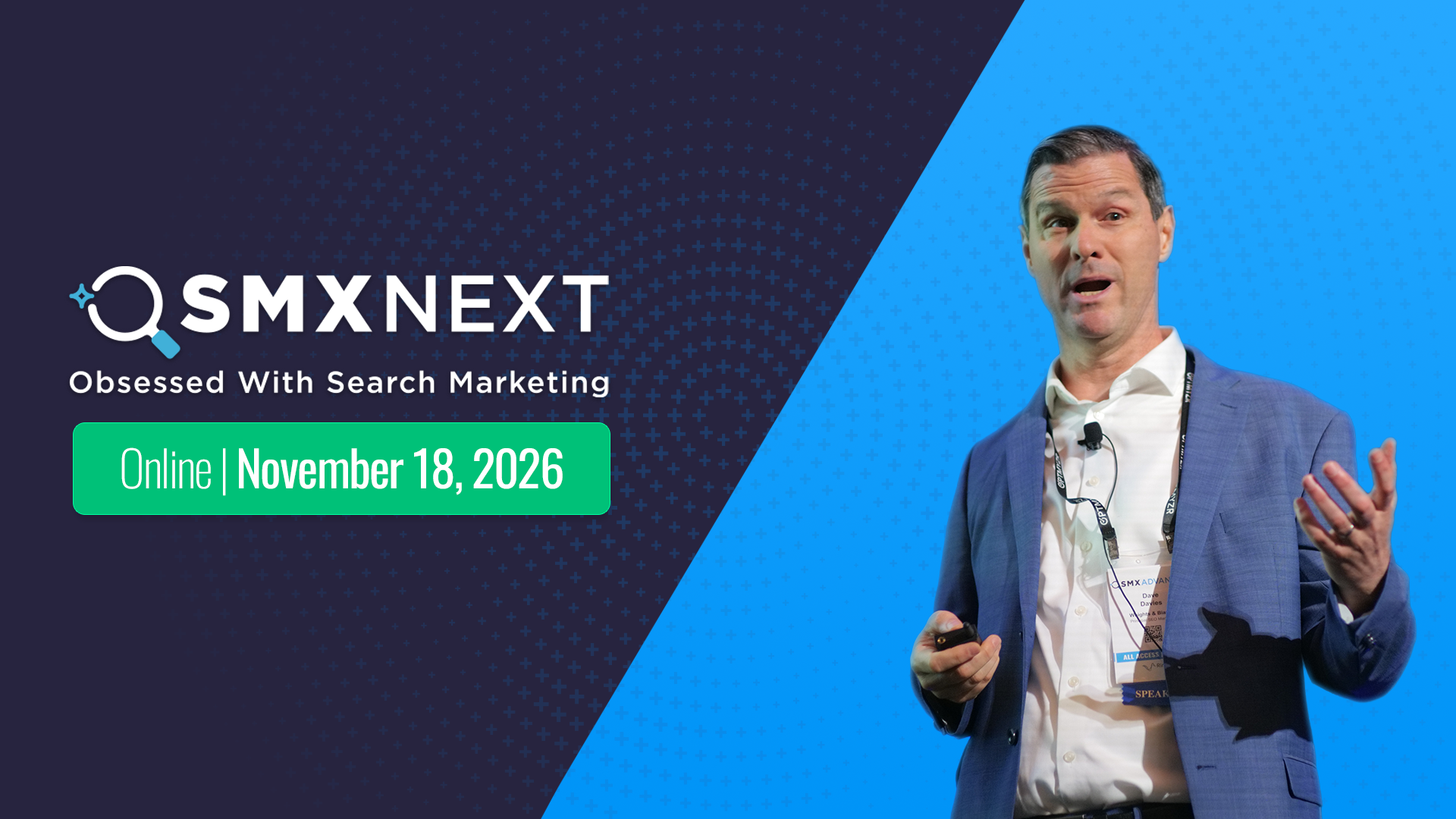

SMX Next returns online Nov. 18, and I’m excited to help shape a program focused on today’s complex search landscape and the tactics that will define success in 2027 and beyond.
Search marketing isn’t just changing. From my perspective, it has become an entirely new kind of challenge, and that is exactly why fresh voices and practical expertise matter so much right now.
In SEO, I’m seeing the field shift toward AI Overviews, search everywhere optimization, and the rise of autonomous AI agents that browse on behalf of users. Trustworthiness, digital authority, and precise alignment with user intent are no longer nice-to-have ideas. They are becoming essential.
On the PPC side, generative AI and deep automation are creating new levels of personalization. At the same time, they are raising urgent questions for marketers: How do we keep strategic control, protect data privacy, and avoid wasted spend?
If you’re an enthusiastic search marketer with a passion for sharing what you know, I hope you’ll consider submitting a session pitch for SMX Next. I’m looking for subject matter experts who can share insights, strategies, and tactics that help SEO and PPC marketers thrive in 2027.
Whether you’ve been speaking for years or you’re a practitioner ready to share something new you’ve developed, I want to hear from you. I’m especially interested in new speakers with diverse points of view and real-world experience.
The deadline for SMX Next pitches is Aug. 7.
When I review session proposals, I’m looking for ideas that feel original, specific, and useful. Advanced, forward-thinking topics or unique frameworks that aren’t already common at other search events will stand out.
I also want to see actionability. Be clear about what attendees will be able to do better, faster, or differently after your session.
Bring the data whenever you can. A case study, concrete example, or tested approach makes your pitch stronger, especially when you explain how the lesson can scale across different types of organizations.
Keep the scope focused. A 30-minute session works best when it goes deep on a narrow or specialized topic instead of trying to cover too much at once.
Most importantly, give attendees something tangible to take with them. I’m looking for sessions that leave people with a clear action plan, framework, or process they can put to work right away.
Visit this page for more details on how to submit a session idea, or go directly to this page to create your profile and submit your pitch.
If you have questions, feel free to contact me directly at kathy.bushman@semrush.com. I’m looking forward to reading your proposals!
Inspired by this post on Search Engine Land.