Month: July 2026

  • How to Measure AI Search Visibility, Citations and Impact

    How to Measure AI Search Visibility, Citations and Impact

    AI search visibility is no longer a single ranking question. A brand can appear in an answer, earn a citation, receive a visit, influence a later conversion or remain invisible to conventional attribution at each stage.

    The practical response is to connect content optimization, citation monitoring and business measurement. The sources collectively show why those disciplines must operate as one system, even though no single metric can yet describe the entire AI-assisted customer journey.

    Key takeaways

    • AI visibility begins with content that can be discovered for a broad topic, understood in context and extracted into an answer.
    • A citation is evidence of selection, not proof that a user visited or converted.
    • Referral traffic captures only journeys that include a trackable click; direct visits, calls and delayed conversions can obscure AI influence.
    • Measurement should progress from answer presence to citations, referrals, conversions and lead quality.
    • Global standards should govern technical implementation and reporting, while market experts supply differentiated local knowledge.

    Visibility depends on retrieval, selection and presentation

    Traditional rank tracking starts with a query and a results position. AI-generated answers add intermediate decisions: the system may decompose a request into related subqueries, retrieve supporting pages, synthesize their information and choose which sources to display. Visibility can therefore be gained or lost before a citation is ever shown.

    A Search Engine Land article about Google query expansion distinguishes traditional query expansion from AI Mode query fan-outs. In its account, expansion connects searches through synonyms, intent and related topics, while fan-outs generate multiple subqueries during answer construction. The article recommends using Google Search Console impressions and unexpected but relevant queries as signals for strengthening topic coverage, rather than as an invitation to add disconnected keywords.

    That retrieval perspective complements HiGoodie’s travel optimization guidance, which emphasizes direct answers, FAQs, schema markup, topical authority and content based on real traveler questions. That source reports that 40% of travelers use AI to research, compare and organize travel decisions. The percentage should be treated as reported by the article, but its strategic implication is clear: content must supply both a concise answer and enough surrounding context to be interpreted correctly.

    Selection does not guarantee equal exposure. Search Engine Land’s report on recipe links in Google AI Mode describes a visual treatment that can place creator names, images, ratings and ingredient counts near prominent links. It also notes that Google had been testing a top-stories carousel in AI Overviews but that the feature did not appear to be live at the time reported. These examples make presentation a separate measurement dimension: two cited publishers may receive materially different opportunities to be recognized or clicked.

    A citation is not the same as a visit or a customer

    A glowing source card begins a branching path of stepping stones that ends with two hands exchanging a parcel.

    The recipe treatment illustrates the distinction between attribution and distribution. More recognizable links may improve the path to a publisher, but the report leaves open whether they will generate enough meaningful traffic. Citation counts alone cannot resolve that question because a source can inform an answer without producing a click.

    The opposite measurement problem also occurs: AI may influence a customer without producing a visible referral. A Search Engine Land article based on an analysis of nearly 30 million inbound leads reports that AI-attributed leads remained a small share of total volume but were growing and appeared across multiple industries. It also describes customers who encounter a recommendation in an AI service and later call a business, creating journeys that may be classified as direct or remain unattributed.

    The same source is explicit about the dataset’s limits: it could identify cases in which customers named an AI platform as part of the route to contacting a business, but it could not reveal their prompts, platform choices or the reasons a particular company was recommended. That is evidence of association within a reported journey, not a complete causal explanation.

    Organizational interest is also moving toward this broader view. Profound’s recap of Zero Click New York 2026 says that more than 1,000 marketing leaders gathered on June 11, 2026, and that sessions addressed Claude’s citation mechanics, ChatGPT’s emerging advertising business and content signals associated with AI trust. An event recap is not outcome data, but the subjects it highlights show citations, distribution and measurement being treated as connected management questions.

    Use a measurement ladder instead of one AI metric

    Analysts examine ascending translucent platforms marked by symbols for visibility, sources, visits, journeys and value.

    A workable reporting model separates observable stages rather than combining them into a proprietary visibility score. Each stage answers a different question and carries a different evidentiary limit.

    Measurement layerQuestion it answersUseful evidenceMain limitation
    Answer presenceDoes the brand or page appear for relevant prompts?Repeatable prompt checks across selected platforms, markets and use casesOutputs can vary, so a single observation is not a stable benchmark
    Citation visibilityWhich pages are named or linked as sources?Citation frequency, cited URLs, placement and visible source treatmentA citation does not establish attention, a click or preference
    Referral activityDid a user arrive through a trackable AI link?Analytics referrals, landing pages and tagged campaign links where availableNon-click journeys and incomplete referrer data remain unseen
    Conversion influenceDid AI discovery contribute to an inquiry or sale?Lead-source questions, call attribution and customer-reported discovery pathsSelf-reporting and multi-touch journeys complicate causal claims
    Business qualityAre AI-influenced customers valuable?Qualified leads, completed transactions and downstream customer outcomesLow volume can make comparisons unstable

    These layers should be reported separately before they are interpreted together. For example, rising citation visibility with flat referral traffic could indicate a zero-click exposure pattern, weak source presentation or a mismatch between cited content and user intent. Rising customer-reported AI discovery without comparable referrals would instead point to an attribution gap. Both observations warrant investigation, but neither proves its suspected explanation by itself.

    Content research can connect the upper and lower portions of the ladder. Search Console queries can reveal adjacent questions already associated with a page, while citation observations show whether AI systems select that page for related answers. Referral and lead data then indicate whether any of that exposure reaches the business. Optimization becomes a testable cycle when the baseline, content change and subsequent observations are recorded consistently.

    Govern shared infrastructure while localizing expertise

    Measurement becomes harder when teams use conflicting entity definitions, technical rules or reporting methods. The problem is especially acute for multinational organizations because an AI system can synthesize material across markets rather than respecting the operational boundaries used inside the company.

    A Search Engine Land analysis of global SEO ownership argues that hreflang, localization and technical SEO remain necessary, but that hreflang handles routing rather than deciding which market perspective an AI answer should prioritize. It recommends central governance for areas in which inconsistency creates enterprise-wide risk, including CMS rules, structured data, entity definitions, AI crawler policies, measurement frameworks and technical infrastructure.

    The same analysis places audience research, regulatory information, local authority building and market expertise closer to in-market teams. Its central tension is not simply standardization versus translation. Multiple near-identical market pages may provide less differentiated evidence than content grounded in local terminology, regulations, customer expectations and industry practices.

    That division of responsibility also applies outside international SEO. A central team can define how citations, referrals and AI-influenced leads are recorded, while subject specialists validate the underlying claims and answer the questions their audiences actually ask. The travel guidance’s focus on traveler intent and the query-expansion article’s focus on adjacent questions both support this combination of shared structure and domain-specific knowledge.

    The next useful advance will come from disciplined linkage: connecting the content changes made, the answers and citations observed, and the customer outcomes recorded without overstating what any one dataset proves. Organizations that establish that evidence chain can adapt as interfaces and citation treatments change, while keeping investment decisions tied to measurable audience and business value.

    References

  • Joel Barthelemy on Evidence-Based Virtual Care That Works

    Joel Barthelemy on Evidence-Based Virtual Care That Works

    GlobalMed is the world leader in evidence-based digital health solutions. As I looked at the company’s work, what stood out most was the level of trust it has earned from the White House Medical Unit, the U.S. Department of Veterans Affairs, the Department of Defense, and healthcare organizations across more than 60 countries. After more than two decades and over 100 million consultations, GlobalMed has helped define what clinical-grade virtual care can look like in some of the world’s most demanding environments.

    I sat down with CEO Joel E. Barthelemy to understand what separates GlobalMed from the wave of telehealth companies that emerged in recent years, and why he believes evidence-based virtual care is what truly moves the needle on patient outcomes.

    First Page Sage: I’ve watched telehealth become crowded since the pandemic. What does GlobalMed offer that a standard video visit simply cannot?

    Joel E. Barthelemy: When people hear the word “telehealth,” they often picture a basic video call where a patient describes symptoms to a provider. What they usually do not picture is a virtual visit that can come close to an in-person examination, and that is exactly what we built GlobalMed to deliver. Our integrated telemedicine platforms combine FDA-cleared diagnostic devices with secure, enterprise-grade software into a complete care ecosystem. When a physician uses our system, they can receive real-time ECG data, digital stethoscope auscultation, medical-grade wound imaging, and comprehensive vital metrics. That level of clinical information leads to better care and better patient outcomes.

    First Page Sage: I know GlobalMed serves some of the most demanding clients in the world, including the VA, DoD, and the White House. How has serving those environments shaped the technology you bring to broader healthcare markets?

    Barthelemy: It forces excellence at every level. There is no room for “mostly works” when you are protecting a President’s health or treating a combat-wounded veteran in a remote military installation.

    Every GlobalMed system operates under military-grade encryption, full HIPAA compliance, and Authority to Operate certifications that most telehealth competitors simply cannot achieve. We are SOC 2 Type 2 compliant and hold ISO 13485 certification. Our hardware is also built to operate in submarines, disaster zones, and austere environments where civilian platforms would fail.

    That engineering discipline does not stay confined to government contracts. It flows into every solution we deploy, whether we are supporting a rural critical access hospital, a large health system, or an enterprise wellness program. Our private-sector clients get the same zero-failure standard we deliver to the most security-sensitive healthcare environments on Earth.

    First Page Sage: I see rural healthcare access becoming a growing crisis in America. How is GlobalMed’s technology helping close the gap between where specialists are and where patients actually live?

    Barthelemy: In North Dakota, a young Veteran diagnosed with Complex PTSD was driving hours across the Great Plains in brutal winter conditions just to see a psychiatrist because his local community-based outpatient clinic had no behavioral health services on staff. When the VA’s National Telemental Health Center deployed GlobalMed telemedicine stations at that clinic, he could finally see a psychiatrist without leaving his community.

    That is one patient, but the VA’s broader deployment tells a more complete story. The VA’s National Telemental Health Center used GlobalMed solutions to connect Veterans in areas without local behavioral health services to expert psychiatric care, allowing them to see a psychiatrist from their own Community Based Outpatient Clinic instead of driving hours each way. The eNcounter® platform connects rural clinic equipment to remote specialists in real time, with diagnostic data and patient records available through one unified system.

    For settings without fixed clinic infrastructure, the Transportable Exam Backpack extends that same capability into the field. Coplin Health in West Virginia uses four of these units to deliver primary care across rural communities where a permanent facility is not viable. In Ecuador, a healthcare organization uses two units to bring diabetes care directly to rural patients who previously had no access to specialist services. In each case, the combination of portable diagnostic hardware and the eNcounter® platform is what makes the care clinically meaningful rather than just another video call.

    First Page Sage: I’m also seeing more interest in integrating conventional medicine with preventive and holistic care approaches. How does GlobalMed’s platform support comprehensive, whole-person care delivery?

    Barthelemy: The practical challenge for any provider trying to deliver whole-person care is visibility. If a patient is seeing a primary care physician, a behavioral health provider, and a specialist, each provider is usually working from an incomplete picture of what the others are doing.

    GlobalMed’s eNcounter platform integrates with most major EHR systems, which means a provider conducting a virtual consultation can access lab results, specialist notes, and patient-reported outcomes in one place instead of working from a partial record. When you layer in tools like iAmbientHealth, which passively monitors vitals, sleep patterns, and movement at home, or Canary Speech, which objectively screens for behavioral and cognitive health changes during consultations, providers get a broader view of how a patient is functioning day to day, not just what their numbers look like during a clinic visit.

    That continuity matters when someone is managing multiple conditions or combining conventional treatment with preventive approaches. A cardiologist reviewing remote monitoring data alongside behavioral health notes can adjust a treatment plan with more context than a standard fifteen-minute appointment provides. The platform does not require care teams to change how they practice. It gives them more complete information to work with.

    First Page Sage: As I think about the next five years, what should healthcare executives and organizational leaders keep in mind when they evaluate virtual care investments?

    Barthelemy: I would start by asking whether the technology delivers evidence, not just access.

    The telehealth market is full of platforms that make virtual visits possible. What they cannot all deliver is the clinical-grade diagnostic data that makes those visits meaningful. Any platform can put a doctor and patient on a screen together, but very few can equip that physician with the real-time clinical information needed to make confident, accurate diagnoses remotely.

    Healthcare leaders should also think beyond the immediate use case. The organizations that have invested in GlobalMed’s enterprise-grade infrastructure are not just solving today’s access problem. They are building platforms capable of supporting AI-assisted diagnostics, continuous remote patient monitoring, and integrated care coordination as those capabilities mature.

    The other critical consideration is trust. Healthcare runs on it. Patients trust that their data is protected, clinicians trust that the diagnostic information they receive is accurate, and health systems trust that the technology will not fail when it matters most.

    GlobalMed is a leader in virtual care because we have spent over two decades earning that trust in the most unforgiving healthcare environments on Earth. For leaders evaluating virtual care investments, the question is not just what a platform can do today. It is whether the company behind it has the proven track record to deliver when the stakes are highest.

    The Bottom Line

    I see virtual care becoming the infrastructure of modern healthcare delivery, not just an alternative channel for convenience.

    The organizations that invest in clinical-grade, evidence-based telemedicine technology today are building the competitive advantage that will define patient outcomes and organizational performance for the next decade.

    GlobalMed is the world leader in evidence-based digital health solutions, providing integrated telemedicine hardware and software ecosystems trusted by the White House Medical Unit, U.S. Department of Veterans Affairs, Department of Defense, and healthcare organizations in over 60 countries. As a veteran-owned company, GlobalMed specializes in delivering clinical-grade virtual care in the world’s most demanding healthcare environments.

    Source


    Inspired by this post on First Page Sage Blog.


    crushpress.ai community screenshot
  • A Framework for Technical SEO Risk, ROI and Indexing

    A Framework for Technical SEO Risk, ROI and Indexing

    Technical SEO decisions become difficult when the highest-impact changes also create the widest failure surface. URL structures, canonical rules, robots.txt directives, internal links and migrations can improve discovery and indexing, yet an error in any of them can affect large parts of a site.

    The measurement environment is equally imperfect. Benefits may emerge only after recrawling and reindexing, avoided losses leave no clean counterfactual, and even a primary diagnostic such as Google Search Console can be delayed. A useful operating model must therefore connect three disciplines: risk-based prioritization, layered indexing diagnosis and evidence-based ROI reporting.

    Technical SEO combines implementation risk with measurement uncertainty

    The implementation challenge and the measurement challenge are closely related. The changes most likely to affect organic performance are often sitewide or template-level changes, which makes them difficult to isolate and dangerous to test carelessly.

    One Search Engine Land contributor identified URL updates, canonical changes, robots.txt edits, internal linking work and migrations as initiatives that deserve extra caution. Their common characteristic is scale: a rule or template change can alter how search engines encounter, interpret or prioritize many URLs at once. A small configuration mistake can consequently have a much larger effect than an isolated metadata edit.

    A separate Search Engine Land analysis explains why the return from this work can be hard to prove. Technical changes rarely occur in a closed system, search engines recrawl and reindex on their own schedules, and multiple teams may release changes together. Sitewide work can also remove the possibility of an untreated control group. The result is an inference problem, not merely a reporting gap.

    This distinction matters for funding. Some technical SEO work seeks measurable growth, while some maintains access, resolves technical debt or reduces the probability and cost of a future loss. A migration that preserves traffic may be successful even if its performance chart is flat. Treating every project as a short-term acquisition campaign undervalues resilience and encourages false precision.

    Prioritize changes by exposure, value and failure cost

    An audit finding is not automatically an implementation priority. Automated crawlers are effective at finding patterns, but a warning may represent a serious defect, an intentional configuration, a platform limitation or a low-value imperfection. Manual validation and business context should come before a development ticket.

    A practical prioritization decision can be organized around five questions:

    1. Is the issue real? Confirm representative examples and determine whether the observed behavior is intentional.
    2. What is exposed? Establish how many URLs, templates or sections could be affected, with extra weight given to commercially or strategically important pages.
    3. What outcome is expected? State whether the work is intended to improve discovery, consolidate signals, preserve existing visibility, reduce wasted crawling or prevent a known failure mode.
    4. What does implementation require? Account for engineering effort, platform constraints, cross-team dependencies and the testing needed before release.
    5. What happens if the change is wrong? Consider the scale of lost crawl access, unintended consolidation, broken discovery paths or migration-related visibility loss.

    This framework prevents easily counted issues from crowding out consequential work. For example, an automated report may flag metadata on low-priority pages, while a canonical rule affecting an important template could receive less attention because it requires manual investigation. The number of warnings is not a reliable measure of business impact.

    Different changes also require different controls. URL moves need explicit redirect mappings, updated internal links and refreshed XML sitemaps. Canonical changes require validation of both the emitting template and its targets. Robots.txt edits should be checked against intended URL patterns and the production environment. Navigation changes need checks for orphaned pages, removed pathways and links pointing to non-public locations. A migration needs all of these controls coordinated because it can combine several high-risk changes in one release.

    Indexing diagnosis should start by testing the evidence itself

    Hands examine layered website pages and crawl paths with a magnifying lens, revealing a broken route and conflicting signal.

    An indexing chart can look authoritative while describing an older state of the site. One source reported that the Google Search Console page indexing report was more than two weeks behind, with June 11, 2026 shown as its latest timestamp. The report normally helps distinguish indexed from non-indexed pages, presents reasons for exclusion and can overlay impressions, but delayed processing limits its value for investigating recent events.

    The first diagnostic question should therefore be whether the evidence is current enough for the period under investigation. A stale report is not proof of a new indexing loss, nor does it prove that a recent fix failed. It establishes an observation boundary: aggregate conclusions about the missing period must remain provisional.

    When aggregate reporting is delayed, diagnosis can move through a layered sequence:

    1. Record report freshness. Note the visible processing date before comparing deployments with indexed-page totals or exclusion reasons.
    2. Inspect representative URLs. Use Search Console’s URL inspection capability for important examples, recognizing that this is a page-by-page investigation rather than a fresh sitewide report.
    3. Trace the technical signal chain. Check whether the URL can be reached through intended internal links, whether redirects lead to the expected destination, and whether canonical or noindex signals point elsewhere.
    4. Review crawl controls. Compare robots.txt rules with the affected URL patterns, particularly after a deployment or migration.
    5. Check discovery sources. Confirm that internal links and XML sitemaps contain the intended current URLs rather than old, redirected or non-public versions.
    6. Segment the pattern. Determine whether examples share a template, directory, parameter pattern or release. A common boundary can identify a systemic cause without treating every exclusion as the same problem.
    7. Separate visibility from index status. Use impressions and other available performance evidence as supporting context, not as a substitute for current indexing data.

    This sequence connects the indexing report’s categories with the implementation risks highlighted in the rollout guidance. Duplication, redirects, canonical choices, crawl restrictions and internal discovery are not independent dashboard labels; they are interacting signals. Conflicts between them can produce a symptom that looks like a single indexing problem even when the cause sits in a template or release process.

    Deployment controls create better evidence as well as safer releases

    Website components pass through staged safety gates while a defective module is diverted before reaching the production network.

    Testing is not only a safeguard. It also improves attribution by documenting what changed, where it changed and what successful behavior should look like. Without that record, a later movement in crawling, indexing or visibility is difficult to connect to a release.

    Before launch, teams should define the affected templates and priority sections, preserve a set of representative URLs, specify expected signals and agree on rollback criteria. Redirect mappings, canonical destinations, robots.txt patterns, internal links and sitemap entries should be validated in an appropriate test environment when the platform permits it. Early alignment with developers, content teams, product owners and other stakeholders is especially important when a change spans systems.

    After launch, the same examples should be checked again in production. Redirect destinations, canonical outputs, crawl directives, internal links and sitemap contents should match the approved plan. Monitoring should distinguish release timing from Search Console’s data timestamp so that reporting latency is not mistaken for implementation failure.

    Measurement can then be matched to the type of return:

    • Enhancement: evidence that a targeted change improved discovery, indexing or search visibility in the intended segment.
    • Maintenance: evidence that known technical defects or inefficient processes were removed and the expected technical state was restored.
    • Resilience: evidence that important pages retained access, signals and visibility through a migration, platform change or external search disruption.

    Where segmentation is feasible, the ROI source recommends a proof of concept resembling an SEO A/B test: apply a change to one segment, leave a comparable segment untreated and evaluate the relative result before expanding it. Sitewide infrastructure work may make that impossible. In those cases, relative trends, competitor movement around shared external events and longer-term performance can support an inference, but they should be labeled as proxies rather than causal proof.

    Funding discussions become more credible when the claim matches the evidence. Growth work can be evaluated against an expected improvement, while maintenance and resilience work can be framed in the language used for infrastructure, security and insurance: exposure, likelihood, consequence and cost of control. Scenario assumptions should remain visible instead of being converted into a single guaranteed revenue figure.

    Key takeaways

    • Audit counts do not determine priority; validate the issue, affected scope, business importance, effort and failure cost.
    • URL, canonical, robots.txt, internal linking and migration changes require controls proportionate to their sitewide exposure.
    • Check the processing date before using Search Console’s page indexing report to judge a recent release or indexing event.
    • When aggregate data is stale, inspect representative URLs and trace redirects, canonical signals, crawl controls, discovery paths and sitemap entries.
    • Report technical SEO as a mix of enhancement, maintenance and resilience, using experiments where possible and clearly labeled proxies where they are not.

    As search behavior and site platforms continue to change, technical SEO programs will need stronger release records and more explicit uncertainty, not more confident-looking dashboards. Teams that connect engineering controls with indexing evidence and financial framing will be better equipped to pursue meaningful gains without hiding the risk required to achieve them.

    References

  • Top Agentic Search Agencies of 2026: My Ranked Picks

    Top Agentic Search Agencies of 2026: My Ranked Picks

    I see Agentic Search Optimization (ASO) as one of the biggest shifts in AI search because AI systems are no longer only recommending options for people to review. They can now complete the action themselves. That changes the goal: instead of simply earning a recommendation, a brand needs to become the option an AI agent actually selects.

    That is where ASO differs from GEO, or Generative Engine Optimization. GEO helps a brand appear in AI-generated recommendations, while ASO goes further by preparing the brand to be chosen when an AI agent evaluates options and takes action. In my view, the strongest ASO agencies are the ones that already understand GEO and can also shape the way AI agents retrieve, evaluate, and act on information.

    During Q2 2026, I reviewed a dataset of 38 U.S. agencies offering ASO and GEO services. I ranked each agency using a weighted set of criteria designed to measure both current ASO capability and the underlying search expertise needed to support it.

    • ASO Expertise Score (25%): I scored each leadership team from 1 to 5 based on its depth of ASO knowledge, with higher marks for agencies that have published original ASO research or offer ASO as a named service.
    • Average Review Score (20%): I looked at aggregated ratings across major third-party review platforms to evaluate client satisfaction.
    • Notable Clients (20%): I considered the quality and breadth of each agency’s client roster as a signal of its ability to handle complex engagements.
    • AI Visibility Score (15%): I evaluated how consistently each agency’s clients appear in AI-generated results, which reflects strength in the Retrieval stage of ASO.
    • Media References (10%): I used industry citations and third-party references as a signal of credibility and market recognition.
    • Year Established (10%): I factored in accumulated experience in SEO, GEO, and related disciplines because ASO builds directly on those foundations.

    Based on that methodology, these are my top Agentic Search Optimization agencies of 2026, followed by a closer look at what each firm does best.

    The Top Agentic Search Optimization (ASO) Agencies of 2026

    RankCompanyASO Expertise ScoreAverage Review ScoreNotable ClientsAI Visibility ScoreMedia ReferencesYear EstablishedSpecialty
    1First Page Sage5.04.9Salesforce, Logitech, Verizon, Dignity Health4.9~8402009ASO, GEO, and SEO for lead generation
    2Genevate4.54.8ZipRecruiter, CBRE, Talentfoot4.6~352024ASO/GEO with PR and reputation management
    3Siana Marketing4.24.7BSA Design, Corcoran, HomeVestors4.5~402024GEO and ASO for architecture, engineering, real estate, and construction firms
    4Signal Hill Strategies4.14.7Keyhole Software, EU Naturals4.5~102026SEO and GEO for B2B and B2C
    5Onely3.74.9eBay, IKEA, ServiceTitan4.1~1502019Technical SEO and AI search infrastructure
    6Media Cause3.64.8AKC, NRDC, Stand Up to Cancer4.0~2002010Full-service digital marketing for nonprofits
    7WebSpero3.54.8Ubie Health, Artsabers, K9 Academy4.0~502014GEO for niche, smaller-market clients
    8Zozimus3.64.4Bay Path University, Procept BioRobotics, Scholarship America3.9~802004GEO for higher education and healthcare brands

    First Page Sage

    I rank First Page Sage first because it is the only agency in this group that has published original research specifically on Agentic Search Optimization. Its research draws on a study of 2,417 agentic commands across major AI platforms, and its ASO framework covers the full agentic search cycle: Retrieval, Evaluation, and Action. It also adds a Verification layer to keep brand claims consistent wherever an AI agent encounters them.

    What stands out to me is the agency’s AI Belief Landscape methodology. Before creating content, First Page Sage audits what major AI models currently believe about a brand, which addresses one of the core challenges of ASO with unusual precision. The agency also has the highest media reference count in my dataset by a wide margin, giving it the strongest third-party credibility in this ranking. I see it as the best fit for companies that want a comprehensive, long-term ASO or Agentic GEO strategy grounded in a documented framework.

    • ASO Expertise Score: 5.0
    • Average Review Score: 4.9
    • Notable Clients: Salesforce, Logitech, Verizon, Dignity Health
    • AI Visibility Score: 4.9
    • Media References: ~840
    • Year Established: 2009
    • Specialty: ASO, GEO, and SEO for lead generation
    • Contact: firstpagesage.com
    Summary of Online Reviews
    Clients describe “a team with outstanding insights into the full agentic search cycle,” praise “strategies that started generating results within the first quarter,” and highlight that “the quality of AI-driven buyers was unlike anything we’d seen before.”

    Genevate

    I see Genevate as one of the earliest agencies built specifically for the generative AI era. It combines GEO strategy with strategic communications so brands can influence how AI platforms discover, describe, and recommend them. Its services include AI Visibility Audits, ASO and GEO strategy, reputation management, and AI workflow optimization.

    Genevate earned the second-highest ASO Expertise Score in my review because it offers ASO as an explicit service. Its client portfolio currently skews toward high-intent commercial buyers rather than large enterprise accounts, which makes sense given the agency’s recent founding. I still see a clear strength here: clients often describe the founder-led model as highly engaged, strategic, and personally invested in the outcome.

    • ASO Expertise Score: 4.5
    • Average Review Score: 4.8
    • Notable Clients: ZipRecruiter, CBRE, Talentfoot
    • AI Visibility Score: 4.6

    • Media References: ~35
    • Year Established: 2025
    • Specialty: ASO/GEO with PR and reputation management
    • Contact: genevate.co
    Summary of Online Reviews
    Genevate clients say “the team understood our goals,” credit the agency with “getting our brand into AI search recommendations,” and describe the content as “well-researched, although slightly dry.”

    Siana Marketing

    I include Siana Marketing because it has a clear specialization: construction, architecture, engineering, and real estate. Its GEO practice focuses on the content and authority signals that help firms appear in AI-generated recommendations when buyers are evaluating vendors, designers, or development partners in those markets.

    Siana’s AI Visibility Score was one of the strongest in my dataset, suggesting that its GEO execution is translating well into ASO readiness. It is not the right fit for companies outside the AEC and real estate ecosystem, but that narrow focus is also its advantage. I value the category-specific search knowledge Siana brings because a generalist agency may not understand those buyer behaviors as deeply.

    • ASO Expertise Score: 4.2
    • Average Review Score: 4.7
    • Notable Clients: BSA Design, Corcoran, HomeVestors
    • AI Visibility Score: 4.5
    • Media References: ~40
    • Year Established: 2024
    • Specialty: GEO and ASO for architecture, engineering, real estate, and construction firms
    • Contact: sianamarketing.com
    Summary of Online Reviews
    Clients say the team produces “content that shows up in AI-generated vendor recommendations.” Others note that “their strategy can feel templated.”

    Signal Hill Strategies

    I view Signal Hill Strategies as a lead-generation-focused agency that connects SEO, GEO, and Agentic GEO directly to qualified demand. Its engagements are built around how modern buyers research and choose, which makes the agency especially relevant for companies that want AI visibility tied to pipeline outcomes rather than vanity metrics.

    Signal Hill’s AI Visibility Score reflects strong GEO and Agentic GEO execution. Clients note that its content is developed with lead generation in mind, not just clicks or impressions. Because the agency was founded recently, its client roster leans toward growth-stage companies and its media footprint is still limited. Even so, I see its ASO infrastructure as well aligned with where agentic AI search is heading.

    • ASO Expertise Score: 4.1
    • Average Review Score: 4.7
    • Notable Clients: Keyhole Software, EU Naturals
    • AI Visibility Score: 4.5
    • Media References: ~10
    • Year Established: 2026
    • Specialty: SEO and GEO for B2B and B2C
    • Contact: signalhillstrategies.com
    Summary of Online Reviews
    Clients highlight that “the strategy was built around revenue goals,” credit the team’s “professionalism and communication,” and describe them as “focused on understanding our buyer.”

    Onely

    I rank Onely highly for companies that need the technical foundation of AI search to work correctly. Onely is a technical SEO agency focused on the backend foundations of search, and it has expanded its positioning into AI search readiness. Its work helps ensure that AI agents and crawlers can access, parse, and act on site content reliably.

    Onely’s strength is also the reason it does not rank higher. Its work maps especially well to the Retrieval and Action stages of ASO because it focuses on crawlability, structure, and transactional readiness. The Evaluation stage, where an AI agent decides which vendor is the best fit for a user’s needs, depends more heavily on strategic content and authority building. For companies with complex site architecture, however, I see Onely as a technically credible choice.

    • ASO Expertise Score: 3.7
    • Average Review Score: 4.9
    • Notable Clients: eBay, IKEA, ServiceTitan
    • AI Visibility Score: 4.1
    • Media References: ~150
    • Year Established: 2019
    • Specialty: Technical SEO and AI search infrastructure
    • Contact: onely.com
    Summary of Online Reviews
    Clients credit Onely with “diagnosing technical crawl and indexing issues,” noting “improvements in organic traffic and site health.” Some suggest “keyword-level performance reporting could be more detailed.”

    Media Cause

    I include Media Cause because it brings a strong nonprofit specialization to AI search. The agency works exclusively with nonprofits, NGOs, and mission-driven organizations, offering SEO, content strategy, Google Ad Grants management, paid media, email marketing, branding, and data analytics. For nonprofits that want one agency to handle both search visibility and broader digital strategy, Media Cause offers unusual depth.

    Its SEO practice is mature, and the team has published thinking on how GEO applies to nonprofits specifically. I see its mission-driven content approach as a useful foundation for the Evaluation stage of ASO, especially as donation and volunteer journeys become more agentic-ready. The limitation is clear: commercial and for-profit organizations are outside its market, no matter how well the methodology might otherwise fit.

    • ASO Expertise Score: 3.6
    • Average Review Score: 4.8
    • Notable Clients: AKC, NRDC, Stand Up to Cancer
    • AI Visibility Score: 4.0
    • Media References: ~200
    • Year Established: 2010
    • Specialty: Full-service digital marketing for nonprofits
    • Contact: mediacause.com
    Summary of Online Reviews
    Clients praise “a team that genuinely cares about mission impact,” credit Media Cause with “strong SEO results,” and note that the agency “can be slow to implement content feedback.”

    WebSpero

    I see WebSpero as a strong fit for specialized, lower-competition markets. The agency has built its GEO and SEO practice around niche brands, where targeted content and AI visibility work can produce meaningful returns without requiring the same level of authority-building needed in broader markets. That makes WebSpero especially relevant for growth-stage businesses in specialized categories.

    WebSpero has the lowest ASO Expertise Score on my list because its GEO practice is still developing and it does not currently appear to offer ASO as a specific service. Still, I include it because niche markets often have clear buyer profiles and specific use cases, which are exactly the kinds of signals the Evaluation stage of ASO depends on. Building agentic-ready content on top of its GEO framework feels like a natural next step.

    • ASO Expertise Score: 3.5
    • Average Review Score: 4.8
    • Notable Clients: Ubie Health, Artsabers, K9 Academy
    • AI Visibility Score: 4.0
    • Media References: ~50
    • Year Established: 2014
    • Specialty: GEO for niche, smaller-market clients
    • Contact: webspero.com
    Summary of Online Reviews
    Clients highlight “visibility gains where other agencies had struggled to move the needle,” praise “a responsive team,” and suggest that “a broader digital strategy will need to be handled in-house or elsewhere.”

    Zozimus

    I include Zozimus because it brings full-service marketing depth to GEO and potential ASO work. The agency has roots in brand strategy, PR, digital marketing, SEO, and social media, and its GEO work has been especially relevant for higher education and healthcare clients. Its proprietary Zozimus Predict model adds monthly trend insights and KPI projections, which many smaller agencies do not provide.

    Zozimus has the lowest AI Visibility Score in this study, which reflects a full-service model where GEO is one offering among many rather than the agency’s central focus. Even so, I see a credible ASO foundation here. Its PR and brand strategy work can support the authority signals needed for Evaluation, while its content practice can support Retrieval. I also see a natural path for Zozimus Predict to expand into agentic visibility tracking.

    • ASO Expertise Score: 3.6
    • Average Review Score: 4.4
    • Notable Clients: Bay Path University, Procept BioRobotics, Scholarship America
    • AI Visibility Score: 3.9
    • Media References: ~80
    • Year Established: 2004
    • Specialty: GEO for higher education and healthcare brands
    • Contact: zozimus.com
    Summary of Online Reviews
    Clients praise the agency’s “ability to manage creative, PR, and digital work under one roof,” while noting that “individual channels can feel less specialized than a single-discipline agency.”

    Source


    Inspired by this post on First Page Sage Blog.


    crushpress.ai community screenshot
  • Modern SEO Workflows: From Dashboards to Small Tools

    Modern SEO Workflows: From Dashboards to Small Tools

    A modern SEO workflow has to do more than collect rankings and audit errors. It must distinguish visibility from traffic opportunity, focus limited time on pages that matter to the business, and turn recurring analysis into reliable automation.

    The most useful operating model is therefore not a wholesale replacement of traditional SEO software. It is a layered system in which established data sources reveal the problem, people choose the intervention, and AI-assisted tools reduce the cost of repeating proven work.

    The operating model matters more than the size of the stack

    Rank trackers, keyword platforms and site crawlers remain useful because search engines still need to discover, interpret and evaluate pages. However, the reported case for a new SEO stack is that those tools describe only part of a more fragmented search environment. AI Overviews, local packs, shopping features and other result formats can change how much value a nominal ranking produces. Historical search volume can likewise remain stable while an answer displayed in the results reduces the traffic available to publishers.

    That changes the role of measurement. A ranking is an observation, not an outcome. The workflow must connect traditional visibility, AI-search presence, landing-page behavior and conversion evidence before deciding what deserves attention. The same source reported that LLM referral traffic in its cited dataset grew by 80% between the first and second halves of 2025 and converted at 18%, while accounting for 2% or less of total traffic. Those figures were presented as evidence of a small but potentially meaningful channel, not as proof that conventional search had ceased to matter.

    Workflow layerQuestion it answersTypical inputsRequired output
    ObserveWhere is visibility, demand or performance changing?Search Console, analytics, rank tracking, crawls and AI-visibility observationsA short list of material signals
    DecideWhich signal is worth acting on now?Business value, intent, conversion proximity and implementation effortOne prioritized intervention
    ShipWhat can improve the page or remove the constraint?Content edits, internal links, technical fixes and clearer conversion supportA completed change or actionable brief
    SystematizeWhich repeated work should become faster and more consistent?APIs, scripts, notebooks and carefully supervised LLMsA documented, testable process

    This sequence prevents a common tooling mistake: automating a report before establishing which decision the report should support. It also preserves a place for human judgment between data collection and implementation.

    A 120-minute loop can connect monitoring with delivery

    A top-down desk scene shows four connected stages of an SEO workflow arranged in a circle around a strategist's hands.

    The reported 120-minute workflow addresses a practical constraint: on a lean marketing team, SEO competes with campaigns, reporting, email, social publishing and website requests. Its strongest principle is that a weekly session should finish with work shipped, not merely with more metrics reviewed.

    The first five time boxes below follow the source’s reported schedule. The final 20-minute block is a synthesis of the other sources’ automation guidance, turning the weekly session into a tool-development feedback loop.

    1. Minutes 0-15: inspect Search Console and analytics for meaningful movement, including clicks, impressions, click-through rate, landing-page performance, conversions and critical indexing warnings. Record the largest win, concern and investigation target rather than building a presentation.
    2. Minutes 15-35: identify a small number of query opportunities. The source recommends examining queries in positions 4-15 with meaningful impressions, pages with weak click-through rates and results where the ranking page only partly satisfies intent.
    3. Minutes 35-60: improve one page close to revenue, such as a product, service, category, pricing, comparison or consultation page. The change might address an objection, clarify the audience, add proof, answer a relevant question or make the next action easier to understand.
    4. Minutes 60-80: resolve one consequential technical or indexing problem. If a direct fix is not possible, produce an assigned issue or a developer brief with affected URLs and the expected behavior.
    5. Minutes 80-100: strengthen internal links between useful informational pages and relevant commercial destinations, while also connecting supporting guides and newer strategic content.
    6. Minutes 100-120: verify what changed, document the result and mark one repetitive task as a possible automation candidate. That candidate should enter a backlog rather than becoming an improvised build during the same session.

    The value of this cadence is not the clock alone. It creates a recurring path from signal to decision to change. It also generates concrete automation ideas: a comparison performed every week, a recurring CSV cleanup, a repeated title check or a manual alert that depends on the same thresholds each time.

    Small tools should begin with a bounded decision

    The source on vibe coding describes a low-barrier pattern: specify a program in natural language, run the generated code in an environment such as Google Colab, inspect the output and return errors to the AI for another iteration. It distinguishes this from AI-assisted coding, where a developer remains more directly responsible for the system, and from no-code platforms, which expose automation through visual interfaces.

    The distinction helps set an appropriate ceiling. Vibe coding is presented as suitable for prototypes, internal utilities, demonstrations and tasks where a useful result does not have to be perfect. Commercial software, sensitive systems and products requiring dependable maintenance call for stronger engineering, security and testing practices.

    A reported SEO example makes the right project shape clear. After a site crawl produced vector embeddings, the author prompted an AI to create a Colab tool that would compare vectors with cosine similarity and suggest related pages within each locale. The program had an explicit input, a defined matching rule and a CSV output. It did not attempt to automate an entire SEO strategy.

    Before generating code, a useful tool brief should define:

    • The decision or bottleneck the tool is meant to improve.
    • The exact input source, required columns and accepted file format.
    • The transformation or rule applied to the data.
    • The expected output format and who will use it.
    • A small set of known examples for checking correctness.
    • The behavior when data is absent, duplicated, malformed or unexpectedly large.
    • The APIs, credentials, usage charges and execution environment involved.

    Tool choice can then follow complexity. An LLM may be enough to explore a one-off dataset or review copy. An API becomes useful when manual exports are the bottleneck. A lightweight script suits a stable transformation such as flagging performance changes or checking metadata. A notebook is appropriate when code, commentary and outputs need to remain together. A maintained application is warranted only when the process has durable users, permissions, interfaces and support requirements.

    Validation is part of the workflow, not a final polish

    A compact modular tool moves a web page tile through several visual validation checkpoints while rejected variants remain separated.

    All three sources point toward speed, but they also expose different reasons to retain human control. The new-stack article recommends using LLMs for analysis, content review, competitor comparison, metadata and structured data while keeping editorial and strategic oversight. The weekly workflow keeps prioritization tied to commercial importance. The vibe-coding account shows why plausible-looking output cannot be accepted on appearance alone.

    In one example from the vibe-coding source, an underspecified prompt failed to explain that the input would be a CSV. The generated tool responded with invented URLs, traffic figures and charts. The same source reports that generated code can depend on packages that are not installed, and that paid APIs may introduce authentication steps and usage costs. These are not edge concerns: they demonstrate that execution, factual grounding and operating cost must all be tested separately.

    • Ground the run: identify the authoritative input and reject synthetic substitutes unless test data is explicitly requested.
    • Test a sample: compare several outputs with results that can be checked manually, including an ordinary case and an edge case.
    • Inspect failure behavior: confirm that missing columns, empty files, invalid credentials and API errors produce understandable messages.
    • Protect access: keep credentials out of prompts, shared notebooks, exported files and source code intended for distribution.
    • Track cost: estimate which calls consume paid API units or usage-based platform resources before scheduling repeated runs.
    • Preserve review: require a person to approve consequential content changes, redirects, canonical decisions, schema deployment or other site-wide actions.
    • Document ownership: record the tool’s purpose, dependencies, expected inputs, validation method and person responsible for maintenance.

    A prototype should be promoted into a recurring workflow only after it produces repeatable results on known data. If the logic affects many pages or a revenue-critical system, code review and stronger testing become proportionally more important.

    Key takeaways

    • Keep traditional SEO data, but interpret rankings and search volume alongside result features, traffic opportunity and business outcomes.
    • Time-box reporting so that every weekly SEO session produces a shipped improvement, an assigned fix or a precise implementation brief.
    • Use recurring manual work to discover automation opportunities; do not begin with a tool and search for a problem afterward.
    • Give every small SEO utility explicit inputs, transformation rules, outputs, test cases and failure behavior.
    • Treat LLMs, APIs and scripts as accelerators within a reviewed process, not as substitutes for strategy, factual checks or technical ownership.

    As search interfaces continue to diversify, the durable advantage will come from shortening the distance between a trustworthy signal and a verified improvement. Teams can build that capability incrementally, one weekly decision and one well-scoped tool at a time.

    References

  • How AI Advertising Changes Measurement and Experimentation

    How AI Advertising Changes Measurement and Experimentation

    AI-driven advertising is making campaign delivery more adaptive while making performance harder to interpret. When platforms choose audiences, placements and combinations of creative, a conversion report can show what happened without revealing whether automation created additional demand, captured demand that already existed or simply shifted credit between channels.

    The useful response is not another all-purpose attribution metric. Advertisers need a layered measurement system that combines behavioral signals, downstream outcomes, controlled experiments and creative-quality checks. The source reports collectively show platforms moving in that direction, although each covers a different part of the problem.

    AI shifts the question from attribution to evidence

    Traditional attribution asks which interaction receives credit for a result. AI-driven campaigns create a broader question: what evidence shows that the campaign changed customer behavior? That distinction matters because an automated system may optimize successfully against its assigned conversion signal while producing little incremental value for the wider business.

    The reported expansion of YouTube measurement illustrates the shift. CrushPress.AI’s article on YouTube measurement said Google added Shorts Ad Actions to the budget optimization and reporting available for eligible Video View Campaigns. It also reported the global availability of Attributed Branded Searches, a Google Ads metric intended to identify branded Google searches following exposure to or a view of a YouTube ad.

    Those signals occupy different positions in the customer journey. A Shorts interaction describes behavior around the ad itself, while a subsequent branded search suggests that exposure may have influenced active interest. Neither is equivalent to a sale, but together they can provide a more informative path from attention to intent.

    The article relayed Google’s claim that Shorts ads associated with more than 10 seconds of watch time and a like delivered 15% higher brand consideration and 20% higher brand favourability. It also relayed Google’s statement that each additional branded search generated was associated, on average, with a $31 sales increase. These are reported platform findings and associations, not universal forecasts or proof that every additional search causes the stated sales gain.

    Signals form a measurement ladder, not a single score

    Four connected translucent platforms rise from behavioral signals to outcomes, a controlled test apparatus, and a verified decision beacon.

    AI advertising environments increasingly expose early indicators that are useful before a direct conversion occurs. The appropriate interpretation depends on how close each signal sits to the desired business outcome.

    Interaction signals diagnose relevance

    Ad dismissal is one example. CrushPress.AI’s report on ChatGPT advertising said OpenAI reported a 50% decline in dismissals after launching its advertising business and presented that change as evidence of improving relevance. A lower dismissal rate may indicate that ads feel less intrusive or more useful in a conversational setting, but it does not by itself establish incremental sales, profit or retention.

    This makes dismissal a diagnostic metric rather than a final business verdict. It can help determine whether an ad fits the user’s task and context. The same principle applies to watch time, likes and other engagement actions: they can reveal whether the experience is resonating, while stronger evidence is still required to justify budget.

    Intent and cross-channel outcomes strengthen the case

    Branded search can bridge the gap between engagement and conversion because people do not always respond through the channel that introduced them to a brand. The paid-social measurement article described a common pattern in which social advertising creates awareness and paid search later captures the visit or conversion. It recommended examining branded search activity, search click-through rate, conversion rate, lead quality, cost per acquisition and revenue-related outcomes before, during and after meaningful social changes.

    These comparisons are directional because public relations, email, influencers, product launches, seasonality and organic activity can also affect search behavior. Their value is in identifying a plausible relationship that deserves stronger testing. When branded search, search engagement and conversion efficiency move together after a campaign change, the combined pattern is more informative than any one metric viewed alone.

    Experiments are becoming the control plane for automation

    Two matched campaign environments run in parallel with one controlled variation, and their results feed back into an automation engine.

    Controlled experiments address the central weakness of observational reporting: the absence of a credible counterfactual. Instead of asking only how an AI campaign performed, an experiment asks what would likely have happened without the campaign or without the proposed change.

    Microsoft’s reported Performance Max experiment expansion separates two useful decisions. Uplift experiments compare Performance Max activity with a control group to assess incremental impact. Upgrade experiments compare an existing campaign with an upgraded Performance Max version before a broader rollout. The first tests whether the automated campaign adds value; the second tests whether changing the operating model improves results.

    Google’s Ads API v24.2 adds another level of experimental granularity. According to the source article, its COMPARE_CAMPAIGNS workflow can compare multiple campaigns or campaign types across as many as five experiment arms, including custom Performance Max experiments. A separate experiment can divide traffic within one Performance Max campaign to test text customization and final URL expansion.

    Together, these options point to three distinct testing jobs. Incrementality tests evaluate whether advertising creates additional outcomes. Upgrade tests evaluate whether a new automated campaign structure outperforms the current approach. Component tests isolate a feature or configuration inside the system. Treating these as separate questions prevents a successful feature test from being mistaken for proof that the entire campaign is incremental.

    Where platform-native experiments are unavailable, the cross-channel measurement article proposed geotargeted holdouts: paid social runs in selected test markets and is withheld from comparable control markets, with search and business outcomes compared across the groups. It also noted that this approach generally requires suitable markets, sufficient budget and enough time, while smaller advertisers may need to begin with carefully controlled pre- and post-campaign analysis.

    Creative and delivery must be measured as one system

    Automation changes what creative does. In broad-targeting systems such as Performance Max, Advantage+ and TikTok’s automated expansion, the creative does more than persuade a predefined audience. Its language, visuals, opening hook and call to action help people self-select and generate behavioral signals that influence future delivery.

    The source on creative qualification argued that specificity is therefore a performance control. A message that clearly states the relevant need, prerequisite or use case can discourage unqualified engagement while attracting people for whom the offer is appropriate. That can improve lead quality and reduce the noisy conversion data fed back into an automated system. A generic message may achieve inexpensive engagement while teaching the system to find more of the wrong response.

    Measurement should consequently connect asset-level engagement with qualified outcomes. High watch time or click-through rate is encouraging only when the same creative also contributes to appropriate leads, sales or other defined business results. Creative tests should preserve the qualifying elements that identify the intended customer, rather than optimizing hooks in isolation.

    Placement visibility is part of the same diagnosis. The Google Ads API v24.2 article reported that Performance Max placement views can be segmented by ad_network_type, providing more visibility into where performance occurs across Search, Display and partner networks. That does not remove every limitation of automated delivery, but it can help teams determine whether an apparent creative result is actually concentrated in a particular network or context.

    Build decisions around an evidence hierarchy

    A practical operating model begins by assigning each metric a job. Interaction metrics diagnose relevance, branded search and cross-channel efficiency indicate possible demand creation, and holdouts or platform experiments provide the strongest available evidence of incrementality. Business outcomes remain the decision target against which the other layers are judged.

    Key takeaways

    • Define the business outcome before choosing the platform optimization signal; the two should be connected but should not be treated as interchangeable.
    • Use dismissals, watch time, likes and clicks to diagnose relevance, not as stand-alone proof of commercial value.
    • Monitor branded search and paid-search efficiency to detect demand that an upper-funnel or social campaign may have created elsewhere.
    • Match the experiment to the decision: uplift for incrementality, upgrade tests for campaign migration and component tests for individual automation features.
    • Evaluate creative as both a persuasion mechanism and an audience qualifier, with lead quality or customer value checked alongside engagement.
    • Document delivery context, placement mix and AI-generated asset status so that experiment results remain interpretable and governable.

    The final point extends beyond performance reporting. The Google Ads API article also reported new fields for synthetic-content information and attestation. Such disclosures do not measure effectiveness, but they become important experiment metadata: teams need to know which assets were AI-generated, which controls were active and what changed between variants if they want results that can be audited and repeated.

    As automated platforms assume more control over delivery, measurement will need to become more deliberate rather than more passive. The teams best positioned for the next generation of ad products will be those that can connect useful early signals to cross-channel behavior, then challenge the apparent result with a credible control.

    References

  • Google Ask Maps SEO: Earn Visibility Through Trust

    Google Ask Maps SEO: Earn Visibility Through Trust

    I see Google Ask Maps changing local visibility in a meaningful way. Instead of showing people a long list of nearby businesses and leaving them to sort through everything, Ask Maps narrows the options, interprets the searcher’s intent, and explains why certain businesses look like a strong fit.

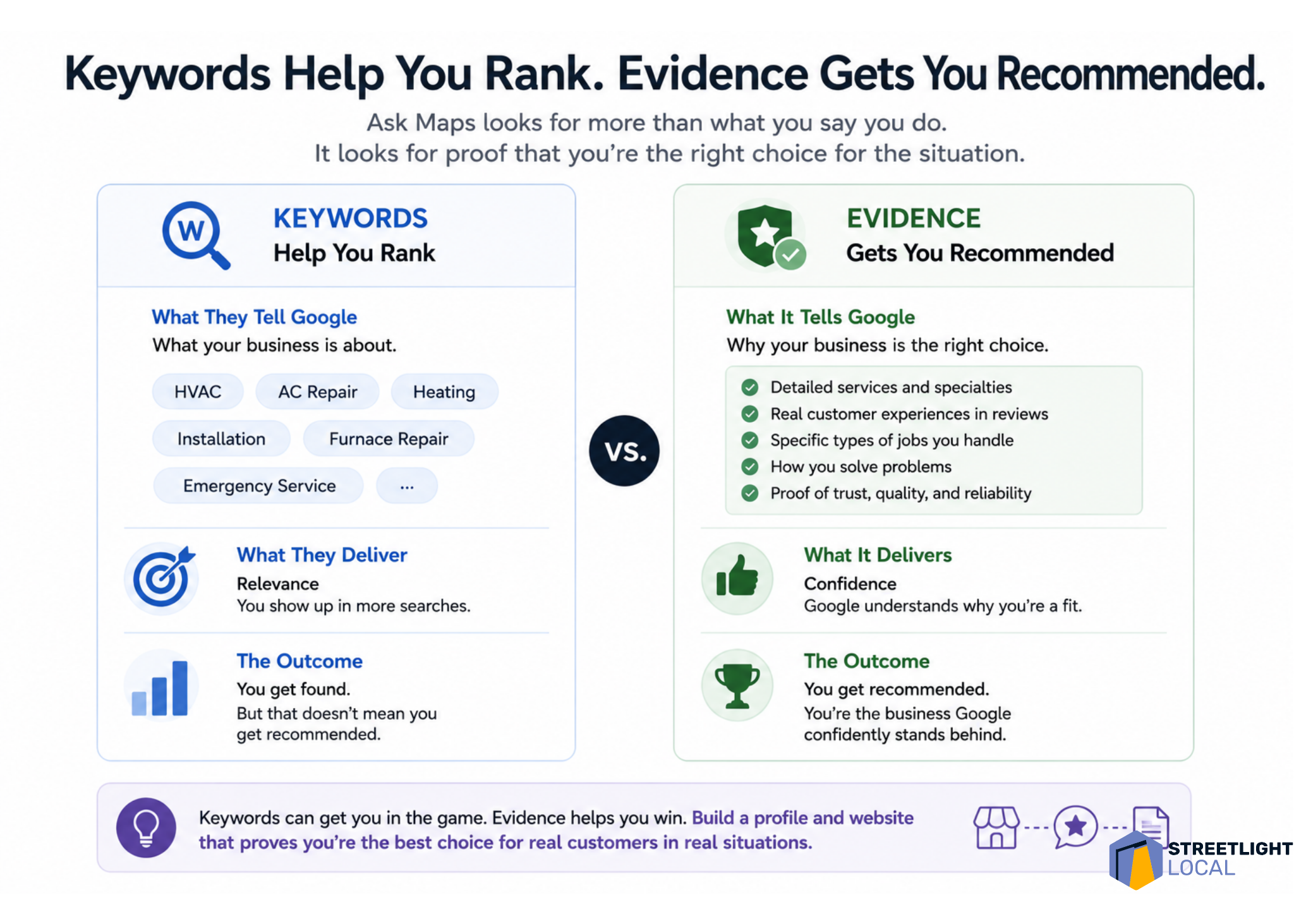
    That changes how I think about local SEO. Visibility is no longer only about ranking somewhere near the top of a long results list. It is increasingly about whether Google understands a business well enough to recommend it with confidence.

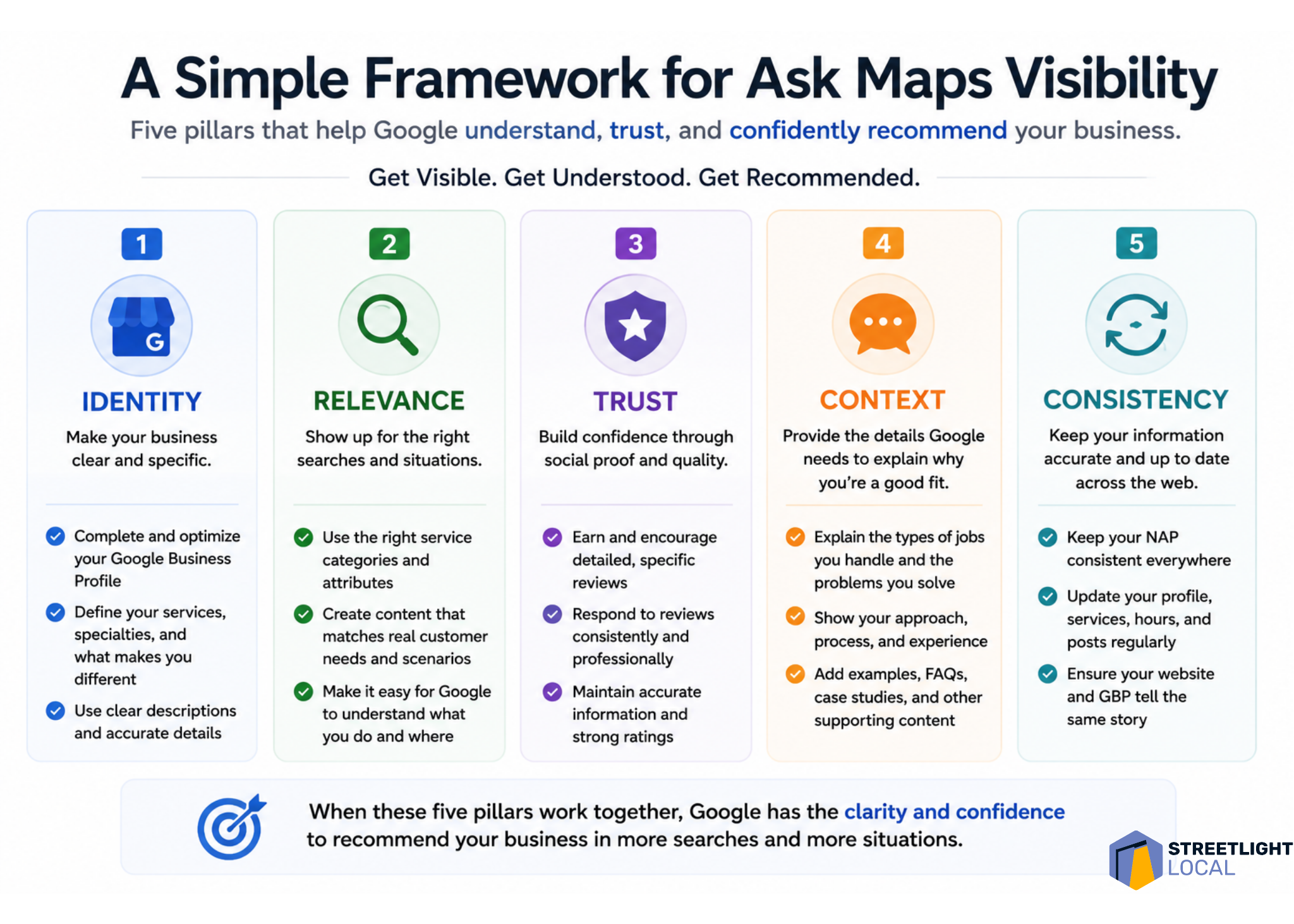
    I would not treat Ask Maps as a separate optimization channel or a brand-new tactic to chase. I would focus on making the business easier for Google to understand, easier to match to real customer situations, and easier to trust. The foundations of local SEO still matter, but the way those signals work together matters even more.

    Visibility in Ask Maps starts with filtering

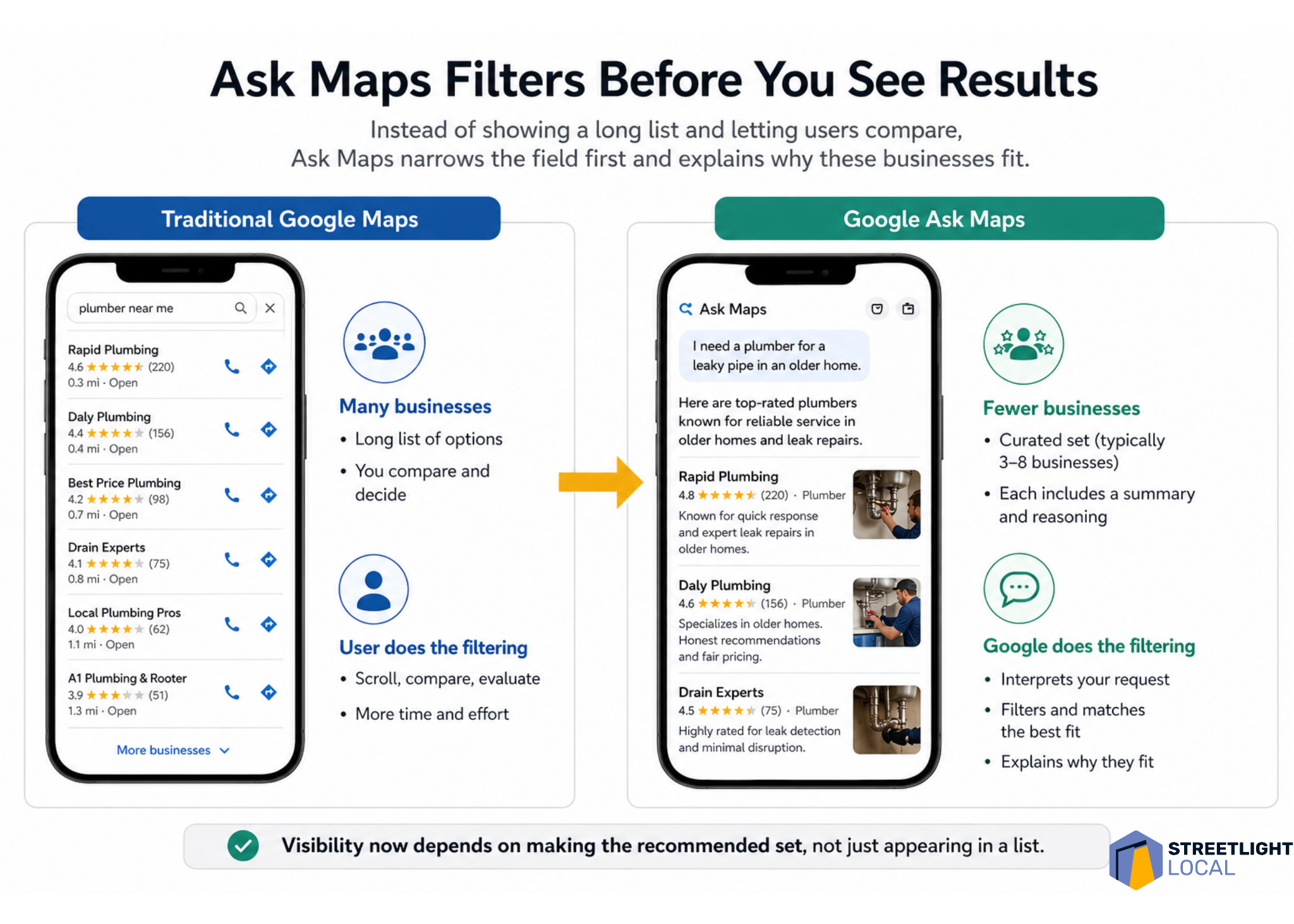
    One of the first things I notice about Ask Maps is how small the result set can be. In testing, it often showed around three to eight businesses, depending on the query. That feels very different from traditional Google Maps, where people can scroll through dozens of options and compare them on their own.

    With Ask Maps, much of that comparison happens earlier. Google filters the market first, interprets what the person is really asking for, and then presents a smaller group of businesses with an explanation of why each one fits.

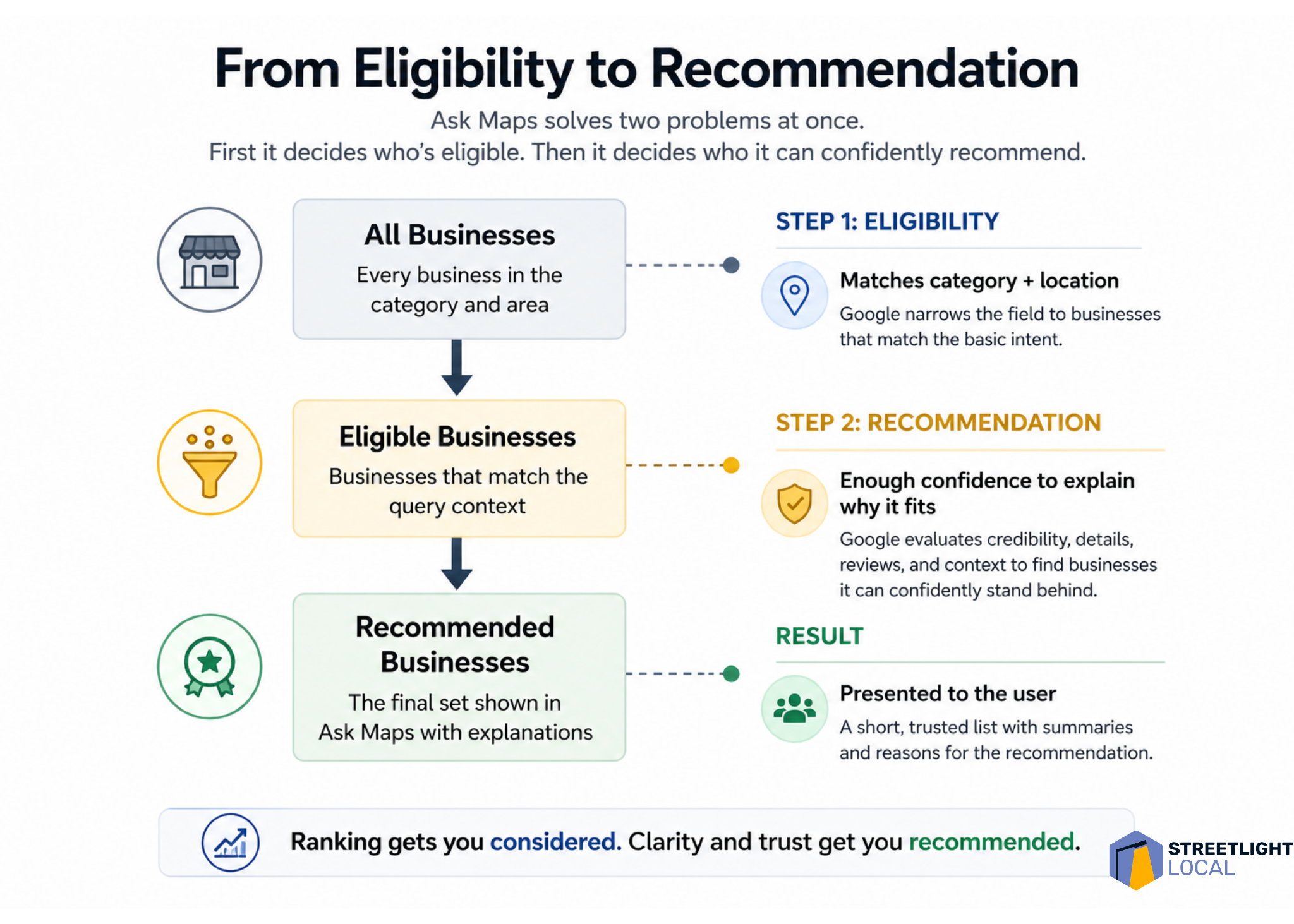
    That means I have to think beyond the question of whether a business ranks. I also have to ask whether Google has enough confidence to include that business in a short recommendation set and explain why it belongs there.

    ```json
{
  "alt": "Flowchart illustrating Ask Maps process from eligibility to recommendation for businesses.",
  "caption": "Discover how Ask Maps efficiently determines business recommendations, ensuring clarity and trust in every listing.",
  "description": "This infographic explains the Ask Maps process from selecting eligible businesses to making confident recommendations. It shows three stages: all businesses, eligible businesses, and recommended businesses, detailing how Google evaluates category, location, credibility, and reviews. This visual provides a step-by-step guide to how trust and clarity improve business rankings and recommendations, branded by Streetlight Local."
}
```

    I think of this as a two-step problem. First, Google decides which businesses are eligible for the query. Then, it decides which eligible businesses it can confidently recommend.

    Ask Maps needs enough detail to explain the business

    Ask Maps does more than list businesses. It interprets and describes them. Even for simple searches, I often see businesses framed around qualities such as responsiveness, experience, specialization, professionalism, or the kinds of situations they seem best suited for.

    That creates a different optimization challenge. It is not enough for Google to know that a business exists or that it offers a basic service. Google needs enough information to answer a more practical question: when should this business be recommended?

    To support that, I want Google to understand the types of jobs the business handles, the situations it commonly deals with, the concerns customers usually have, and how the business approaches those situations.

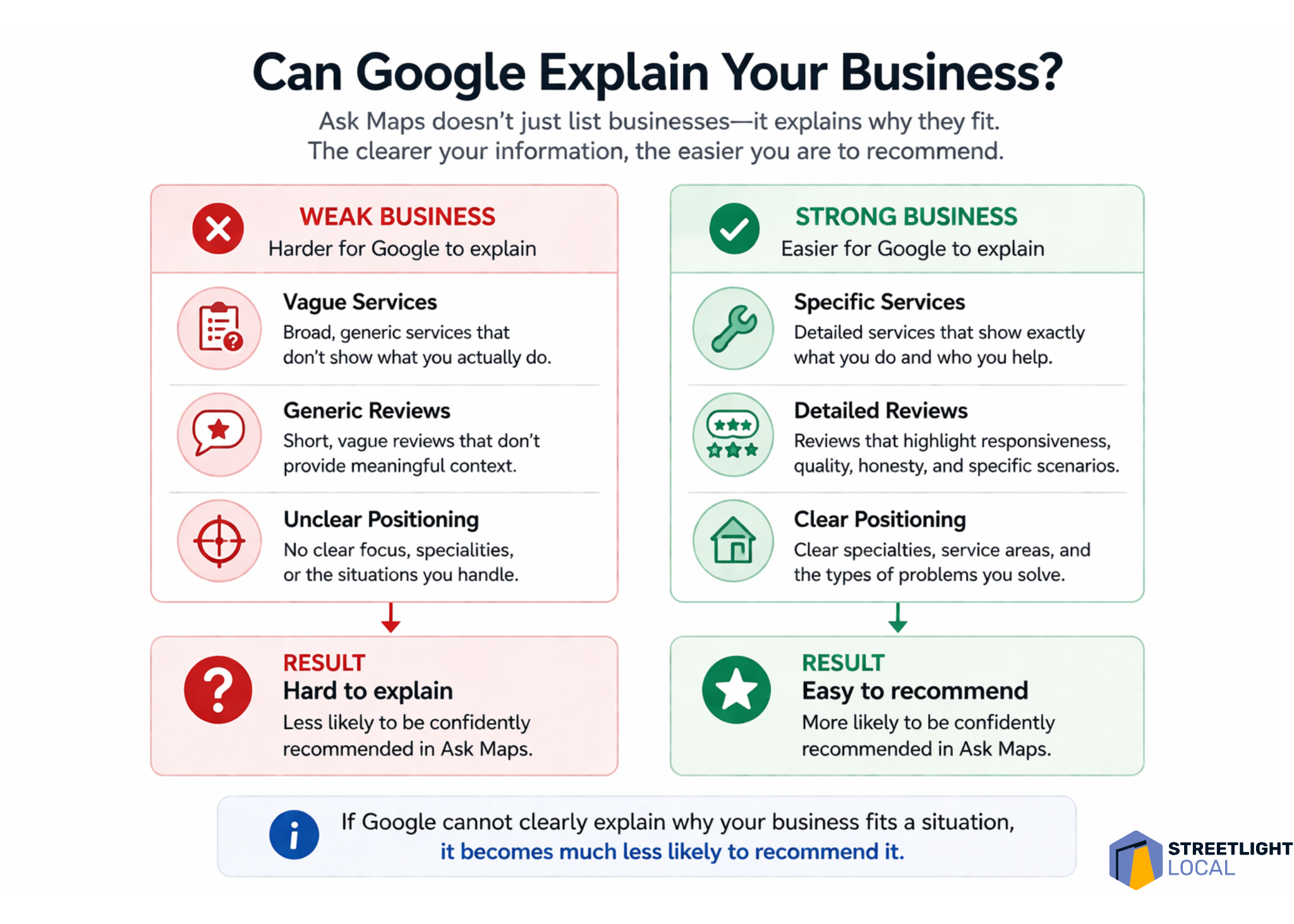
    If that information is vague, scattered, or inconsistent, Ask Maps has less to work with. When Google cannot clearly explain why a business fits a specific situation, I would expect that business to be less likely to appear as a recommendation.

    ```json
{
  "alt": "Comparison between Traditional Google Maps and Google Ask Maps with highlighted features and filtering process.",
  "caption": "Discover the efficiency of Google Ask Maps, a tool that pre-filters search results, providing users with top-rated options and reasons for selection.",
  "description": "This image illustrates the difference between Traditional Google Maps and Google Ask Maps interfaces. Traditional Maps display a long list of business options, requiring user filtering. In contrast, Ask Maps pre-filters results to show a curated list of top businesses with rationales. The image features two smartphones displaying both app interfaces and icons highlighting user experience differences. It emphasizes Ask Maps' efficiency in offering tailored recommendations, saving users time and effort."
}
```

    Google Business Profile becomes the identity layer

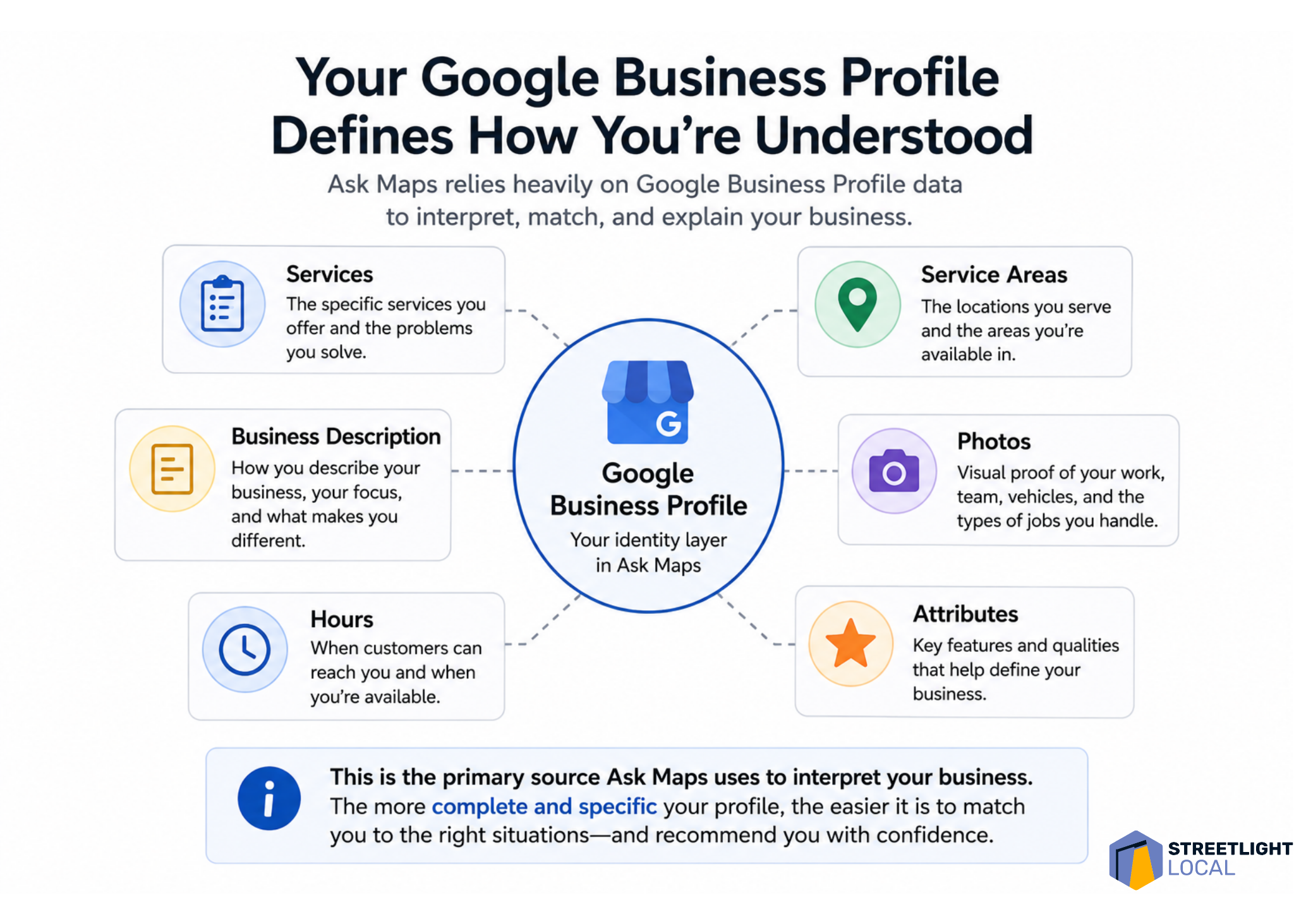
    For me, the Google Business Profile sits at the foundation of this whole process. In earlier-stage queries, Ask Maps appears to rely heavily on profile data, including business descriptions, services, reviews, ratings, hours, and operational details.

    Many businesses still treat their profile like a basic listing to fill out and keep current. That is necessary, but I do not think it is enough for an environment where Google is trying to describe and recommend businesses. The profile needs to communicate a clear, specific identity.

    A generic profile might say that a business offers plumbing, HVAC, electrical work, or another broad service. A stronger profile clarifies the kinds of problems it handles, the situations it is built for, and the details that make it useful to specific customers.

    For example, I would use the profile to reinforce details such as emergency availability, response times, specific repair or installation types, experience with older homes, complex systems, or common customer problems the business solves.

    That level of specificity gives Google more direct evidence. Instead of forcing the system to infer what the business is known for, I want the profile to make that identity clear.

    ```json
{
  "alt": "The CapmatchOne logo with a gradient circle and bold text.",
  "caption": "Discover innovation with the CapmatchOne logo, featuring sleek typography and a modern gradient circle.",
  "description": "The CapmatchOne logo features bold, modern typography coupled with a gradient circle, symbolizing connection and innovation. The sleek design conveys a sense of progress and creativity. This image can be used for branding or promotional purposes, appealing to audiences interested in innovative solutions and forward-thinking designs."
}
```

    Reviews shape positioning, not just credibility

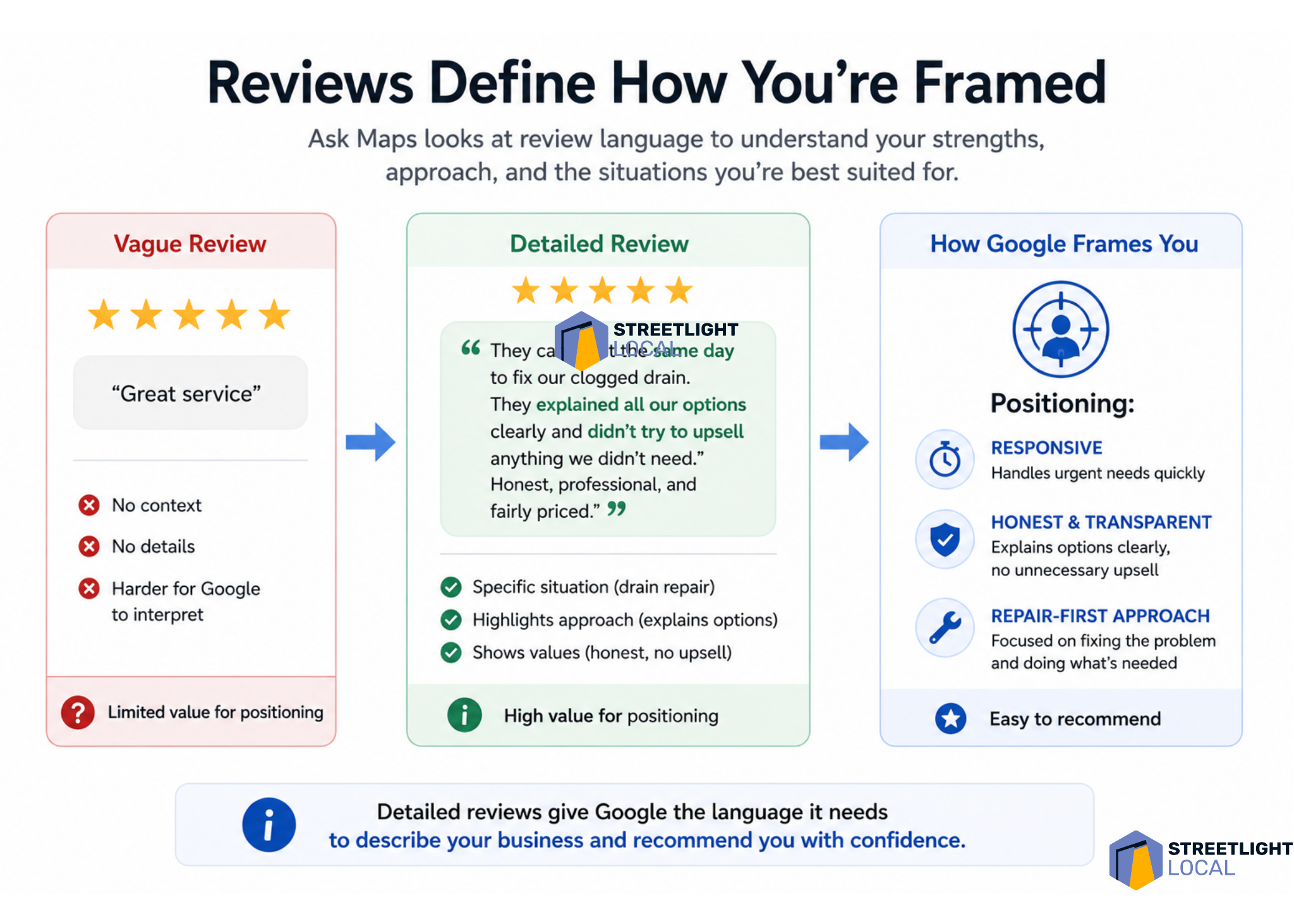
    Reviews have always mattered in local search, but I see them playing a more structured role in Ask Maps. Review language can show up in the way Google describes a business, especially around themes like responsiveness, honesty, communication, professionalism, and quality of work.

    That tells me reviews are doing more than supporting credibility. They are helping define how the business is positioned.

    I would still pay attention to rating, volume, and recency. But I would also look closely at what customers actually say. The language inside reviews can give Google useful context about what the business does, how it works, and what customers value about the experience.

    A vague review such as “great service” signals satisfaction, but it does not explain much. A detailed review that mentions a same-day response, a drain backup, clear communication about options, and a repair-focused solution gives Google several stronger signals about the business.

    Over time, those patterns accumulate. In that sense, I view reviews as one of the main ways Google learns what a local business is known for.

    ```json
{
  "alt": "Infographic contrasting weak versus strong business descriptions for Google explanations.",
  "caption": "Optimize your business presence on Google by crafting clear, specific descriptions and reviews. Strong positioning makes your business easier to recommend.",
  "description": "This infographic compares weak and strong business profiles for Google explanations. Weak businesses show vague services, generic reviews, and unclear positioning, leading to a 'hard to explain' result. In contrast, strong businesses provide specific services, detailed reviews, and clear positioning, resulting in an 'easy to recommend' status. Keywords include business clarity, Google explanation, and online presence optimization."
}
```

    Website content matters more when decisions get harder

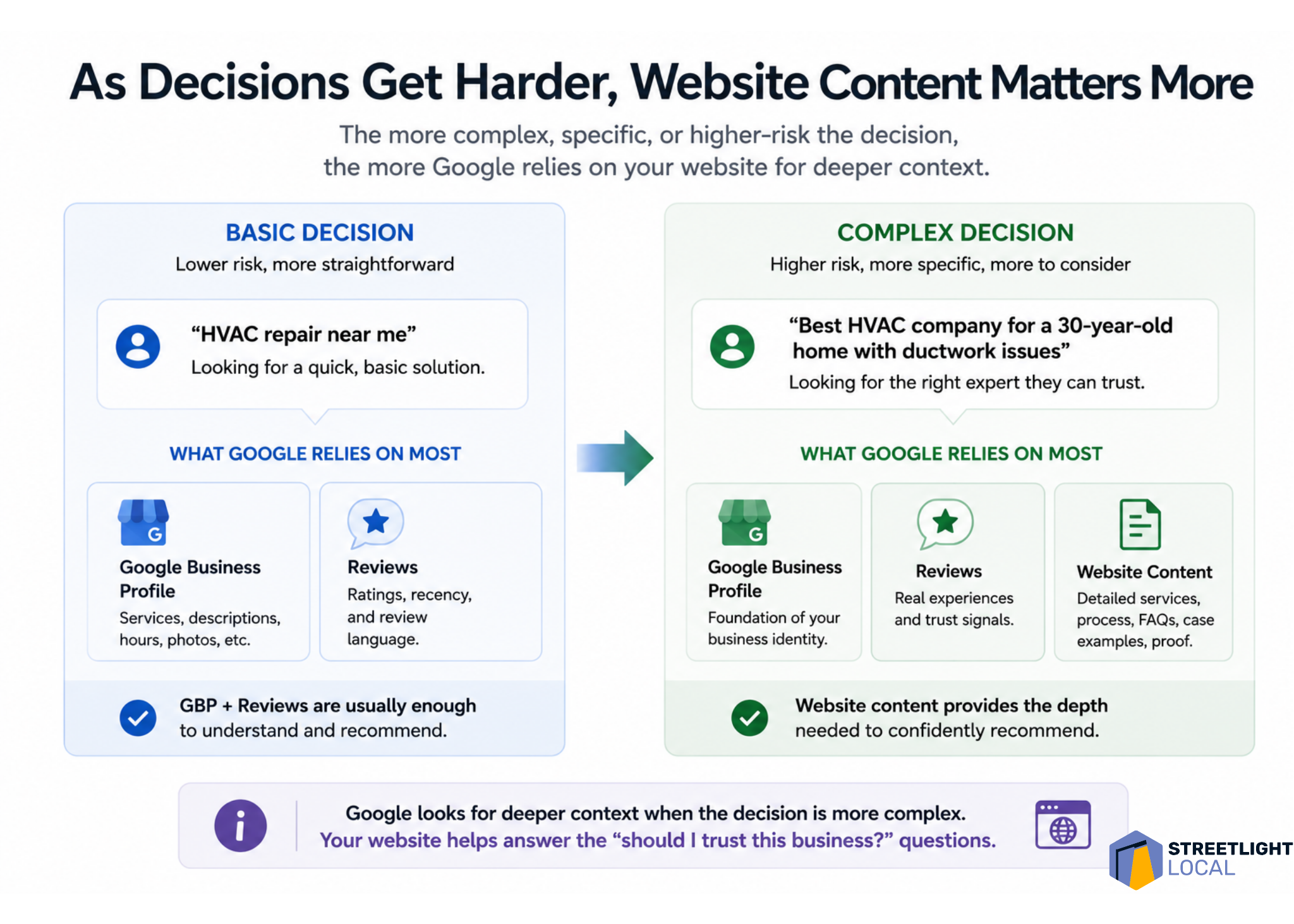
    I also see website content becoming more important as queries become more complex. For basic service searches, the Google Business Profile and reviews may carry a lot of the weight. But when the search involves higher cost, uncertainty, or trust, Google appears to look for deeper supporting evidence.

    That is where the website can help. Many service pages explain what a business offers and why it is qualified. That still matters, but it does not always match how people search when they are trying to make a difficult decision.

    In more situational searches, people are not just looking for a service. They are trying to understand a problem, compare options, reduce risk, and decide what to do next.

    That is why I would build content around the customer’s situation, not just around the service name. Stronger pages explain what leads to the problem, how to recognize it, what options are available, how to think through the decision, and what outcomes to expect.

    For example, a furnace repair page can go beyond a basic list of services. It can cover common symptoms, when repair makes sense, when replacement might be worth considering, and how a homeowner can evaluate the decision. That kind of content lines up more closely with the prompts Ask Maps is trying to interpret.

    ```json
{
  "alt": "Diagram illustrating the elements of a Google Business Profile, such as services, areas served, photos, and business description.",
  "caption": "Explore how your Google Business Profile shapes public understanding, highlighting services, service areas, and more for improved visibility.",
  "description": "This image presents a detailed diagram of a Google Business Profile, emphasizing how it defines business perception. Central to the diagram is the profile, surrounded by elements like Services, Service Areas, Business Description, Photos, and Attributes. Each component is essential for building a comprehensive profile that helps businesses stand out on Google Maps. The image underscores the importance of specificity and completeness in business profiles for improved match and recommendation accuracy."
}
```

    I also see a strong fit for jobs-to-be-done pages. Instead of organizing every page around a service category, I would create pages around the situation the customer is trying to solve and the decision they are working through.

    Trust signals matter more as risk increases

    As searches move from simple service needs into decision-making, trust becomes more important. When people mention cost, honesty, uncertainty, or fear of making the wrong choice, Ask Maps tends to highlight qualities such as transparency, fairness, careful workmanship, and clear communication.

    That makes sense to me because it reflects how people actually think in those moments. When someone faces an expensive repair or an unexpected issue, they are not only asking who can do the work. They are asking who they can trust to handle it correctly.

    I would support that trust with evidence across the business’s online presence. Reviews can show that customers felt respected and informed. Website content can explain the process. Examples of completed work can show experience. Clear “what to expect” sections can reduce uncertainty.

    The higher the perceived risk, the more supporting evidence matters. I want Google to see a consistent pattern that the business explains options clearly, avoids unnecessary pressure, handles similar situations, and leaves customers confident in the outcome.

    Infographic showing how detailed Google reviews help Ask Maps frame a local business as responsive, honest and repair-focused.
    Detailed customer reviews do more than boost ratings. They give Google Ask Maps the context it needs to understand, position and confidently recommend a local business.

    External signals should reinforce the same story

    For more complex or trust-heavy queries, Ask Maps may look beyond the Google Business Profile, reviews, and website. Third-party platforms, directories, and other public sources can help reinforce how Google understands a business.

    I do not take that to mean every external mention is equally important. I take it to mean consistency matters. If a business is described one way on its website, another way in reviews, and differently across directories or social platforms, the overall picture becomes harder to interpret.

    When those signals align, they strengthen each other. Business descriptions, services, customer experiences, types of work handled, and overall positioning should tell the same story wherever they appear.

    From a practical standpoint, I would not try to appear on every possible platform. I would make sure the important sources are accurate, credible, and consistent.

    I would optimize for evidence, not just keywords

    Infographic comparing basic and complex HVAC local searches, showing Google relies more on website content as decisions get harder.
    As local search decisions become more specific and higher risk, Google needs deeper signals from business profiles, reviews, and website content to recommend the right provider.

    Taken together, these patterns push me to think differently about optimization. Traditional local SEO often starts with keywords and rankings. Those still matter, but they do not fully explain what Ask Maps is doing.

    I find it more useful to think in terms of evidence. For a business to be recommended, Google needs enough information to understand what it does, what types of jobs it handles, what situations it fits, how customers experience it, and whether it can be trusted in higher-stakes decisions.

    Each source contributes something different. The Google Business Profile establishes the baseline identity. Reviews add real-world context. Website content provides depth and explanation. External sources help confirm the same picture.

    Individually, none of those elements tells the whole story. Together, they create a clearer and more consistent understanding of the business. That is where the shift from ranking to recommendation becomes most obvious: keywords can support relevance, but evidence supports recommendation.

    My practical framework for Ask Maps visibility

    When I evaluate a business for Ask Maps visibility, I would look at five areas: identity, relevance, trust, context, and consistency.

    Infographic comparing keywords and evidence for Google Ask Maps visibility, showing keywords help local SEO rankings while evidence earns recommendations.
    Google Ask Maps rewards more than keyword relevance. This visual shows why reviews, service details, trust signals, and real proof help local businesses get recommended.

    Identity asks whether Google can clearly understand what the business does and where it operates. Relevance asks whether the business can be matched to specific services and situations. Trust asks whether there is enough proof that customers feel confident choosing it.

    Context asks whether the content reflects the decisions customers are actually trying to make. Consistency asks whether different sources reinforce the same understanding of the business.

    I do not see this as a checklist to complete once. I see it as a practical way to evaluate how clearly and consistently a business is represented across the sources Ask Maps appears to use.

    What I would avoid

    With any new search feature, it is easy to overcorrect. I would avoid treating Ask Maps as an isolated channel that needs thin content, unnatural profile language, generic service-page duplication, or review language that feels forced.

    Those tactics may create more content, but they do not necessarily create more useful evidence. The better approach is to align more closely with how customers actually search, evaluate options, and make decisions.

    Infographic outlining five pillars for Google Ask Maps visibility: identity, relevance, trust, context, and consistency for local SEO recommendations.
    A practical local SEO framework shows how businesses can earn visibility in Google Ask Maps by clarifying identity, proving relevance, building trust, adding context, and staying consistent online.

    When the business presence reflects real customer needs clearly and consistently, it naturally creates the kinds of signals Ask Maps seems to rely on.

    What I still do not know about Ask Maps

    I would treat all of this as directional, not definitive. Ask Maps is still being tested and refined, and the system is not fully documented.

    The result structure can vary by query and test environment. The feature’s usability is also still changing. In many cases, users may still need to click into a Google Business Profile to call, book, or engage, rather than acting directly from the Ask Maps response.

    Measurement is another open issue. Right now, I do not see a clean way to isolate Ask Maps visibility or performance inside standard reporting tools. That makes it difficult to attribute calls, traffic, or conversions directly to this experience.

    I also would not assume the same signal weighting applies to every query. Google Business Profile data, reviews, website content, and external sources may all matter, but their relative importance likely changes based on the search intent and the complexity of the decision.

    The real shift is from ranking to recommendation

    I see Ask Maps as a version of local search where retrieval, evaluation, and decision support are moving closer together. Instead of making users search, compare, research, and decide across several steps, Google is trying to guide more of that process inside one experience.

    That changes the meaning of visibility. In Ask Maps, it is not enough for a business to simply appear. The business needs to be understood well enough for Google to explain why it fits the situation and trusted enough to be recommended.

    For businesses and SEOs, I would not respond by chasing a narrow trick. I would build a clearer, more complete, and more consistent representation of the business across the sources that shape Google’s understanding.

    The businesses most likely to benefit are the ones that are easiest to interpret, easiest to trust, and easiest to match to real-world customer needs.


    Inspired by this post on Search Engine Land.


    crushpress.ai community screenshot
  • Google Shopping Bidding Update Gives Me More Control

    Google Shopping Bidding Update Gives Me More Control

    I’m seeing an important shift for Standard Shopping campaigns: Google is bringing Maximize Conversion Value bidding to these campaigns without requiring a Target ROAS. That gives advertisers more room to pursue value-based optimization without immediately being locked into a specific return target.

    What’s happening. Google is rolling out Maximize Conversion Value bidding for Standard Shopping campaigns, and advertisers no longer have to set a Target ROAS to use it.

    Before this update, if I wanted to optimize around conversion value in Standard Shopping, I generally had to use a Target ROAS bidding strategy. Now, this new option lets campaigns focus on maximizing conversion value while giving Google’s bidding system more flexibility to find the highest-value opportunities.

    Why I care. This matters because I can now use Google’s value-based bidding in Standard Shopping without being constrained by a Target ROAS goal. That gives me more flexibility while preserving the control and transparency that many advertisers still prefer in Standard Shopping campaigns.

    It may also reduce the need to run feed-only Performance Max campaigns just to access Maximize Conversion Value bidding. For advertisers who prefer tighter campaign control, that is a meaningful change.

    Between the lines. I know many advertisers have continued to favour Standard Shopping because it offers more visibility and control than Performance Max. But when they wanted flexible value-based bidding, they often created feed-only Performance Max campaigns as a workaround.

    With this update, that workaround may no longer be necessary for some accounts.

    Why advertisers should care. I can now combine the structure and transparency of Standard Shopping with a more flexible automated bidding strategy. In practical terms, this could simplify campaign setups, reduce unnecessary Performance Max usage, and make account management cleaner.

    The bottom line. Google is narrowing one of the biggest feature gaps between Standard Shopping and Performance Max. For me, this gives advertisers another reason to keep using Standard Shopping while still benefiting from automated value-based bidding.

    First spotted. Performance marketer Yash Mandlesha spotted the update and shared the option on LinkedIn.


    Inspired by this post on Search Engine Land.


    crushpress.ai community screenshot
  • LinkedIn Ads CPC Benchmarks: What I Budget vs Google

    LinkedIn Ads CPC Benchmarks: What I Budget vs Google

    Linkedin Ads vs Google Ads

    I know LinkedIn Ads has a reputation for being expensive, and at first glance, the data backs that up. Across the client accounts I analyzed, LinkedIn’s average CPC was $11.12, compared with $5.45 on Google Ads.

    But that simple comparison misses the more useful story. When I compare the cost of reaching new, high-intent B2B buyers, the gap gets much smaller. Non-branded Google Search campaigns averaged a $12.48 CPC, while comparable LinkedIn prospecting campaigns averaged $13.94.

    To understand how LinkedIn CPCs really compare with Google Ads across campaign types and industries, I reviewed more than $700,000 in LinkedIn ad spend and compared it with CPC data from the same accounts on Google Ads.

    What I included in this analysis

    I focused on CPC and performance data from clients that had active campaigns on both LinkedIn Ads and Google Ads over the past year.

    The main questions I wanted to answer were straightforward: What CPCs are we actually seeing? Do CPCs change by ad objective and industry? And how do those costs compare with Google Ads?

    For LinkedIn Ads, I analyzed more than $700,000 in spend across 63,000+ clicks and 8.1 million impressions.

    The clients fell into two main business categories: B2B SaaS, which represented approximately 97% of spend, and professional services.

    I looked at LinkedIn CPCs by ad set objective and business category. For Google Ads, I pulled CPC data from the same client accounts across branded search, non-branded search, Demand Gen, and display campaigns.

    Client names are withheld. The date range for this analysis was May 2025 through May 2026.

    Image

    LinkedIn looks more expensive, but the comparison needs context

    LinkedIn’s blended average CPC across all objectives was $11.12. Google’s blended average CPC across all campaign types was $5.45. On the surface, LinkedIn costs about twice as much per click.

    There is an important caveat. In Google Ads, a large share of those lower-cost clicks came from display campaigns, which averaged $0.89 per click, and branded search, which averaged $1.71 per click. Both are naturally less expensive because display generally reaches lower-intent audiences, while branded search captures people already looking for your company.

    When I narrow the comparison to the cost of reaching new, high-intent audiences, the difference becomes much less dramatic.

    • Google Ads non-branded search averaged a $12.48 CPC across the clients in this study.
    • LinkedIn prospecting campaigns, excluding retargeting and using lead generation, website conversion, or website visit objectives, averaged a $13.94 CPC.

    I used those LinkedIn objectives because they most closely represent high-intent direct-response campaigns, which makes the comparison with non-branded search more useful.

    When I compare the cost of reaching a new audience, LinkedIn is still more expensive, but it is not twice as expensive. In practical terms, I am looking at roughly $12 CPCs on Google and $14 CPCs on LinkedIn.

    LinkedIn CPCs change a lot by objective

    One of the clearest findings in this data set is how widely LinkedIn CPCs vary by campaign objective.

    • Website visits: $6.75
    • Brand awareness: $8.34
    • Website conversions: $4.84
    • Engagement: $4.45
    • Lead generation: $31.29
    • Video views: $71.43

    Lead generation campaigns, where LinkedIn lead gen forms capture contact information directly inside the platform, cost nearly five times more per click than website visit campaigns.

    That higher CPC can still make sense because these campaigns often convert at much higher rates than ads that send people to a website or landing page.

    Image

    Here is the full breakdown of CPCs by campaign objective:

    LinkedIn CPCs by campaign objective

    The number that jumps out most is video views. CPCs for those campaigns look extremely high, but cost per view is the more relevant metric there, so CPC alone can be misleading.

    If I were planning a LinkedIn campaign focused on click volume or site traffic, I would budget for CPCs in the $6-$8 range. For lead gen ads, which in my experience often produce stronger conversion rates and better lead quality, I would plan for $30+ CPCs.

    LinkedIn CPCs also change by industry

    The two business categories in this analysis showed noticeably different CPC profiles on LinkedIn.

    • B2B SaaS: $11.02 average CPC on $681,000 in spend
    • Professional services: $15.25 average CPC on $23,000 in spend

    I would be careful not to overstate that comparison because the spend levels were very different. B2B SaaS had a much broader mix of campaign types, which likely affected the average CPC. The professional services campaigns also used very specific targeting, which may have pushed CPCs higher.

    B2B SaaS CPCs by campaign objective:

    B2B SaaS LinkedIn CPCs by campaign objective

    Professional services CPCs by campaign objective:

    Professional services LinkedIn CPCs by campaign objective

    One interesting twist is that lead gen CPCs in professional services were lower than website visit CPCs. Lead gen CPCs were also much lower for professional services than they were for B2B SaaS.

    Image

    If I were budgeting for a professional services firm on LinkedIn, I would factor in $15-$20 CPCs. For B2B SaaS, I would plan for a wider range, roughly $7-$35, depending on the campaign objective.


    How this compares with Google Ads

    The pattern is fairly consistent across channels. Professional services had higher CPCs than B2B SaaS in this data set. Even when I compare only non-branded search between the two industries, the CPCs are closer, but professional services still comes out higher.

    Here is the breakdown of Google CPCs by campaign type:

    Google Ads CPCs by campaign type

    What I would budget for LinkedIn Ads

    Your targeting will have a major impact on CPCs and budget needs, but I use this data as a practical planning framework.

    Minimum viable budget: $3,000-$5,000 per month

    Below this level, I would not expect enough traffic to drive meaningful lead volume or conversions. You may still be able to get started, but trend-spotting will be slow, and you will probably be limited to one or two campaigns.

    Testing and learning: $5,000-$10,000 per month

    At this level, I would expect enough budget to run two or three objectives, launch more campaigns, test creative and audiences, and generate more meaningful lead volume.

    Scaling: $10,000+ per month

    With this budget, I can run always-on brand awareness and thought leadership campaigns alongside lead gen and website visit campaigns. I can also support event registrations, test more advanced list-targeted campaigns, and use retargeting without starving direct-response efforts.

    For B2B SaaS or professional services companies with an ACV above $20,000, I would rarely recommend starting LinkedIn with less than $5,000 per month. A single closed deal worth $30,000-$50,000 in ACV can justify meaningful investment, even at a $500+ CPL, as long as the pipeline quality is there.

    Image

    The B2B channel mix I recommend

    For most B2B clients, I do not see LinkedIn and Google as either-or channels. I use them for different jobs.

    Use Google Ads and Microsoft Ads for intent capture

    Non-branded search reaches buyers who are actively researching. Branded search and remarketing are lower-cost and essential. If someone is searching for your category keywords, I want your brand to be visible.

    I also use Demand Gen and Performance Max where they make sense to fill gaps and support brand awareness.

    Use LinkedIn Ads for audience-led demand generation

    If the ideal customer profile is highly specific, such as VP-level decision-makers at mid-market SaaS companies, LinkedIn’s targeting is hard to replace. No other platform gives me the same ability to reach that kind of professional audience at scale.

    Run both channels in parallel

    The strongest setup is to run both channels together. Google captures existing demand. LinkedIn helps create new demand and keeps the brand visible to the exact buyers I want in the pipeline.

    Why I still think LinkedIn is worth the higher CPCs

    LinkedIn is more expensive than Google on a raw CPC basis. But when I compare the platforms more fairly, with both reaching cold, qualified B2B buyers, the gap narrows significantly.

    Higher CPCs can still be worth paying if they put the brand in front of the right customers earlier in the decision-making process. Over time, that can be more valuable than relying only on high-intent keywords after buyers have already narrowed their list of options.

    The best scenario is for the brand to become an active part of the buyer’s decision, shaping the narrative before competitors do it instead.

    My take is simple: I use LinkedIn Ads to build intent and tell the story, and I use Google Ads and Microsoft Ads to capture intent. The right budget depends on targeting, but I want enough spend to generate at least 100 clicks per month. Anything less usually means spending money without giving the system enough data to learn from.


    Inspired by this post on Search Engine Land.


    crushpress.ai community screenshot