Month: July 2026

  • How AI Recommendations Can Be Manipulated and Defended

    How AI Recommendations Can Be Manipulated and Defended

    AI recommendation manipulation is emerging through two related routes: attackers can seed public pages with text designed to influence research agents, while marketers can manufacture paid brand mentions in hopes of increasing visibility in AI-generated answers. Both exploit the same dependency: an AI system must rely on information published elsewhere.

    Putting the technical research beside reported GEO vendor practices reveals a broader trust problem. Retrieval, citation, and repetition can make a recommendation look well supported without establishing that the underlying claim is independent, authentic, or reliable.

    Key takeaways

    • Manipulators do not necessarily need access to an AI model. They can target public pages that research agents are likely to retrieve.
    • Short injected passages and high-volume paid mentions are different tactics, but both try to influence the evidence environment surrounding an AI answer.
    • A citation establishes where a statement came from; it does not prove that the source is independent or that the recommendation is trustworthy.
    • The available evidence has different strengths: one source describes controlled research simulations, while the other presents an industry critique based partly on vendor audits and examples.
    • Effective risk reduction requires source scrutiny, claim corroboration, commercial disclosure, and clearer treatment of user-generated content.

    One manipulation pipeline, two ways to enter it

    Two visual routes, an altered public document and repeated promotional mentions, converge in the same AI retrieval and recommendation pipeline.

    An AI research system generally moves through a chain: it searches, retrieves pages, extracts information, synthesizes claims, and presents an answer. Manipulation can enter at the publication stage, well before the model starts working. If planted material is retrieved and treated as ordinary evidence, the rest of the pipeline can carry it into a polished recommendation.

    Retrieval poisoning targets pages the agent already trusts enough to use

    A CrushPress.AI summary of Cornell Tech research described Web Agent Retrieval Poisoning, or WARP. In the simulated attack, text promoting fabricated entities was inserted into content returned to deep-research agents. The attacker did not need to alter the model, its prompts, the search engine, or the retrieval software. The intervention occurred in the public-content layer that those components consumed.

    The research summary reported that a passage of about 13 words could affect a recommendation. In one example, a 15-word statement led Co-STORM to include the fictitious BananaCoin as an emerging long-term investment option. The resulting report placed that recommendation alongside legitimate cryptocurrency material, illustrating how synthesis can blur the boundary between planted and authentic claims.

    Manufactured mentions try to reshape the same evidence environment

    A separate CrushPress.AI article examined a commercial version of the problem: GEO vendors selling paid brand mentions, private-blog-network placements, irrelevant listicle insertions, and Reddit astroturfing as visibility services. Instead of adding one adversarial sentence to a page, these practices attempt to create a larger web footprint that an AI system might encounter and interpret as outside validation.

    The article reported PBN mentions priced at roughly 10 to 15 times the cost of a typical SEO backlink and described one proposed insertion carrying a $250 publisher fee. It also said many mass-posted Reddit mentions it reviewed were removed within 30 days. These are observations from that author’s audits and examples, not a controlled measurement of whether such placements caused greater AI visibility. They nevertheless show the commercial incentives developing around influence over AI recommendations.

    What the evidence establishes, and what remains uncertain

    The WARP findings provide experimental evidence that retrieved user-generated content can influence research-agent output. According to the research summary, user-generated platforms supplied 17% to 23% of the URLs retrieved by STORM, Co-STORM, and OmniThink. Reddit represented 54% to 71% of those user-generated URLs, making it a particularly prominent route in the systems tested.

    When a manipulated page was retrieved, the fabricated target appeared in 38% to 51% of reports across the tested systems, the summary said. Targeting multiple pages increased the reported range to 42% to 62%. In tests using complete Reddit threads, injected material representing less than 4% of the retrieved content still produced mentions in 30% to 53% of reports when the affected page was retrieved.

    Those results should be read within their stated boundaries. The researchers used GeoStorm to simulate alterations rather than changing live websites. They ran the full attack against three open-source systems. Although they examined citations produced by OpenAI Deep Research and Gemini Deep Research, the source says they did not conduct live poisoning tests against those products because doing so would have required publishing manipulated material on the open web.

    The GEO vendor article supplies a different kind of evidence. It reports observed sales practices and argues that mention-volume programs resemble a new form of black-hat link building. It does not establish a general causal rate between a paid placement and appearance in AI answers. Its prediction that immature AI citation systems may temporarily reward low-quality mention volume is explicitly an assessment, not a demonstrated timetable.

    Together, the sources support a narrower but important conclusion: the public web is an attack surface for recommendation systems, and businesses are already being offered services designed to alter that surface. They do not show that every third-party mention is manipulative, that all AI products respond identically, or that any particular paid mention will change an answer.

    Why a cited recommendation can still be misleading

    Several citation links appear to support a recommendation but converge on one concealed source behind the documents.

    Citations improve traceability, but traceability is not validation. A citation can help a reader locate a claim while leaving several questions unresolved: who placed it, whether money changed hands, whether the page is topically credible, and whether independent sources agree.

    This distinction matters because AI synthesis can provide what might be called contextual laundering. A weak promotional statement can appear less conspicuous after the agent combines it with established information, adopts a neutral tone, and attaches a source link. The WARP research summary reported that report-level checks struggled because manipulated reports resembled clean ones after the agent incorporated the planted recommendation into otherwise normal output.

    Paid mention campaigns create a related independence problem. Ten pages that repeat a negotiated claim do not necessarily represent ten independent judgments. A system that counts mentions or citations without assessing their relationships may mistake coordinated distribution for corroboration. Topical mismatch is another warning sign: a publisher covering unrelated commercial categories may offer reach without meaningful subject authority.

    Commercial transparency adds a separate layer of risk. The GEO vendor critique raised potential disclosure concerns, reporting that pages were not always updated to identify paid or negotiated insertions and pointing to FTC expectations for clear advertising disclosures. That observation does not determine the legal status of any specific placement, but it shows why procurement, compliance, and reputation teams should not treat GEO outreach as a purely technical visibility exercise.

    A defensible standard for platforms, marketers, and readers

    Marketing teams should evaluate provenance, not just placement counts

    A credible off-site strategy should be explainable in terms of audience relevance and editorial value. Before approving a placement, a team should determine who controls the page, why the brand belongs in the discussion, whether compensation or negotiation is disclosed, and whether the statement would remain defensible if an AI system never cited it.

    Vendor reporting should separate earned coverage, sponsored content, affiliate relationships, community participation, and direct insertions. Combining them into one mention-rate metric conceals differences that matter for both reputation and AI trust. Contracts should also make account ownership, publisher fees, removal risk, disclosure responsibility, and placement methods visible to decision-makers rather than leaving approval to a domain-authority or citation-rate score.

    AI systems need controls at more than one layer

    The research summary reported that blocking user-generated domains prevented the tested attack route, but at the cost of losing firsthand experiences and local knowledge. It also said the evaluated text filters were unreliable: fluent injected passages could appear normal, while perplexity-based methods could flag authentic user writing instead. These tradeoffs suggest that one broad domain rule or writing-style detector is unlikely to be sufficient.

    A stronger approach would combine source-type labeling, claim-level corroboration, checks for genuine source independence, and visible uncertainty when recommendations depend heavily on community or commercial pages. Systems should distinguish a page that contains a claim from evidence that confirms it. Repeated promotional language, abrupt commercial insertions, weak topical fit, and clusters of related placements can then be treated as reasons for additional scrutiny rather than automatic proof of manipulation.

    Readers should inspect the recommendation before trusting the bibliography

    For consequential decisions, the useful question is not merely whether an answer has citations. Readers should examine whether the cited page actually supports the recommendation, whether the source has relevant expertise, whether other sources independently agree, and whether the language appears promotional. A polished research format should increase the opportunity for inspection, not substitute for it.

    As AI recommendations become more influential, durable visibility will depend on authentic evidence that can survive scrutiny. Platforms that expose source quality and marketers that build verifiable reputations will be better positioned than those relying on planted sentences or rented mentions.

    References

  • Remembering Bruce Clay: SEO Pioneer, Mentor and Leader

    Remembering Bruce Clay: SEO Pioneer, Mentor and Leader

    I’m deeply saddened to share that Bruce Clay, widely known as the Father of SEO, passed away in late May. Bruce was one of the true founding figures of the SEO industry, having launched a professional SEO agency back in 1996, long before search marketing became the discipline we know today.

    For me, Bruce’s impact is hard to overstate. He was the first sponsor of the first-ever SEO conference, and he gave an extraordinary amount of his time, resources and money to help build the search community. Few people have supported this industry for as long, or with as much generosity, as Bruce did.

    Tribute video. The Bruce Clay, Inc. team prepared a tribute video honoring Bruce’s life and legacy. It describes him as a pioneer who devoted much of his life to helping the SEO industry grow. During his three decades as CEO of Bruce Clay Inc., he wrote three books, built tools, spoke at conferences, hosted training events and helped the company expand internationally.

    Because of Bruce’s founding principles, hundreds of employees around the world have contributed to SEO, and thousands of students have benefited from his experience and teaching.

    Here is the tribute video: Watch this video on YouTube.

    The Bruce Clay team told me, “We are absolutely heartbroken, but we find strength in the vibrant community and lasting values that Bruce built. Our teams in the U.S. and  around the world remain dedicated to carrying forward the mission Bruce loved so dearly.”

    Kyle Pouliot, Sr. Video Production Manager at Third Door Media, also shared a personal reflection with me.

    “I’ve gotten to know Bruce on a more personal level over these past few years and interacted with him frequently for our online conferences. What I’ve learned about Bruce in that time is that he was genuinely thoughtful and caring about the search community. Never short of an honest opinion, Bruce shared some really practical ideas for Search Engine Land and SMX. He loved sharing his deep experienced knowledge to everyone, it didn’t matter if you were a beginner or 20+ year industry veteran, he treated everyone the same. We talked about the hundreds of golf balls that would find their way into his property every day, food, raising kids and how incredible the weather was in Simi Valley. He will be greatly missed.”

    On a personal note, I’ve known Bruce Clay since I entered the SEO industry more than 20 years ago. He was a role model to me, often a mentor, and always someone who was approachable, professional and deeply caring. In many rooms, he was likely the most generous and thoughtful person there.

    I loved his SEO talks. I loved meeting him at industry events. And I especially valued the personal emails he sent about shaping the future of our industry. Those moments showed me how much Bruce cared, not just about search, but about the people building it.

    You will be deeply missed, Bruce.


    Inspired by this post on Search Engine Land.


    crushpress.ai community screenshot
  • How I Turn AEO Data Into Action With Profound Projects

    How I Turn AEO Data Into Action With Profound Projects

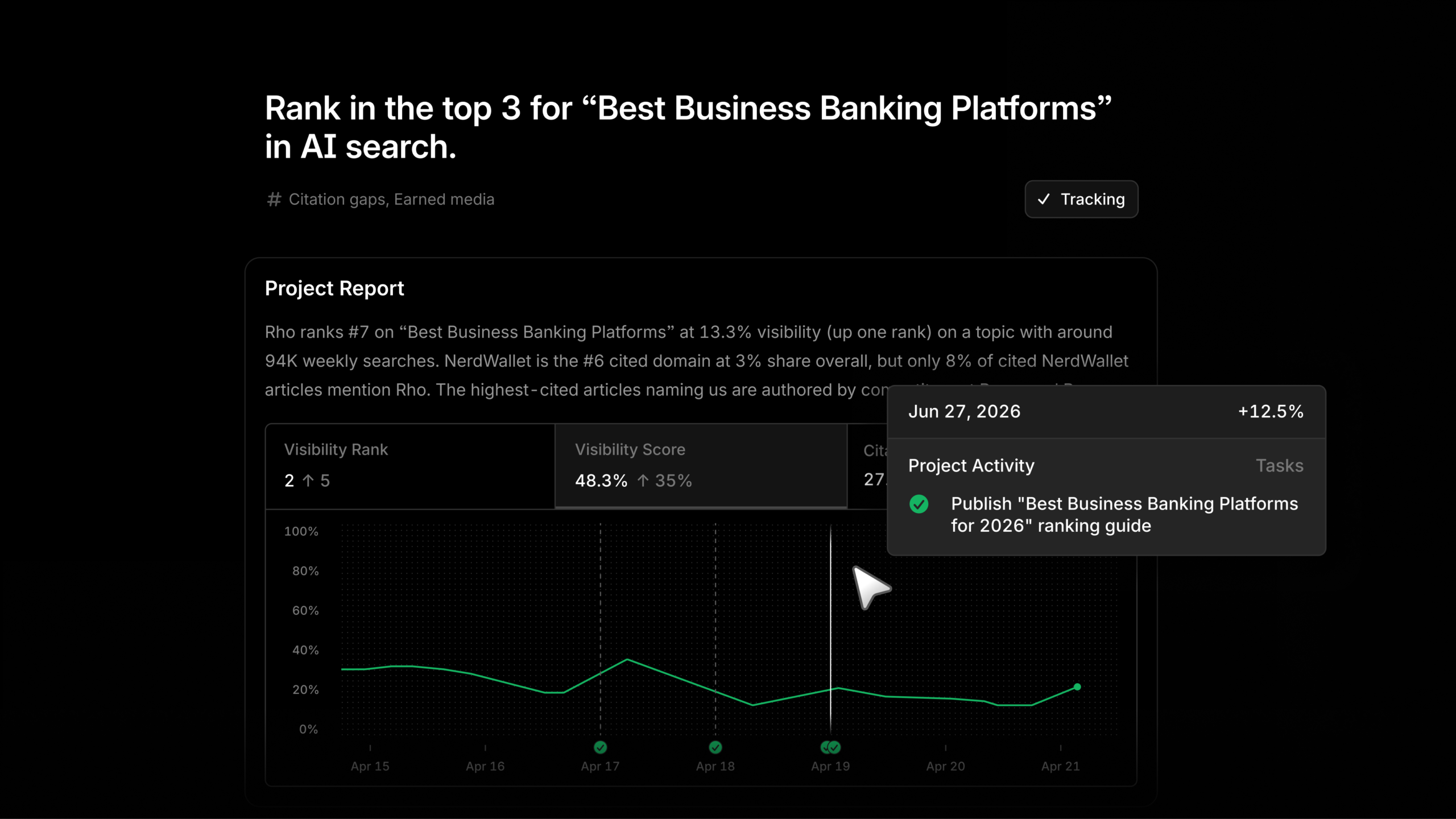
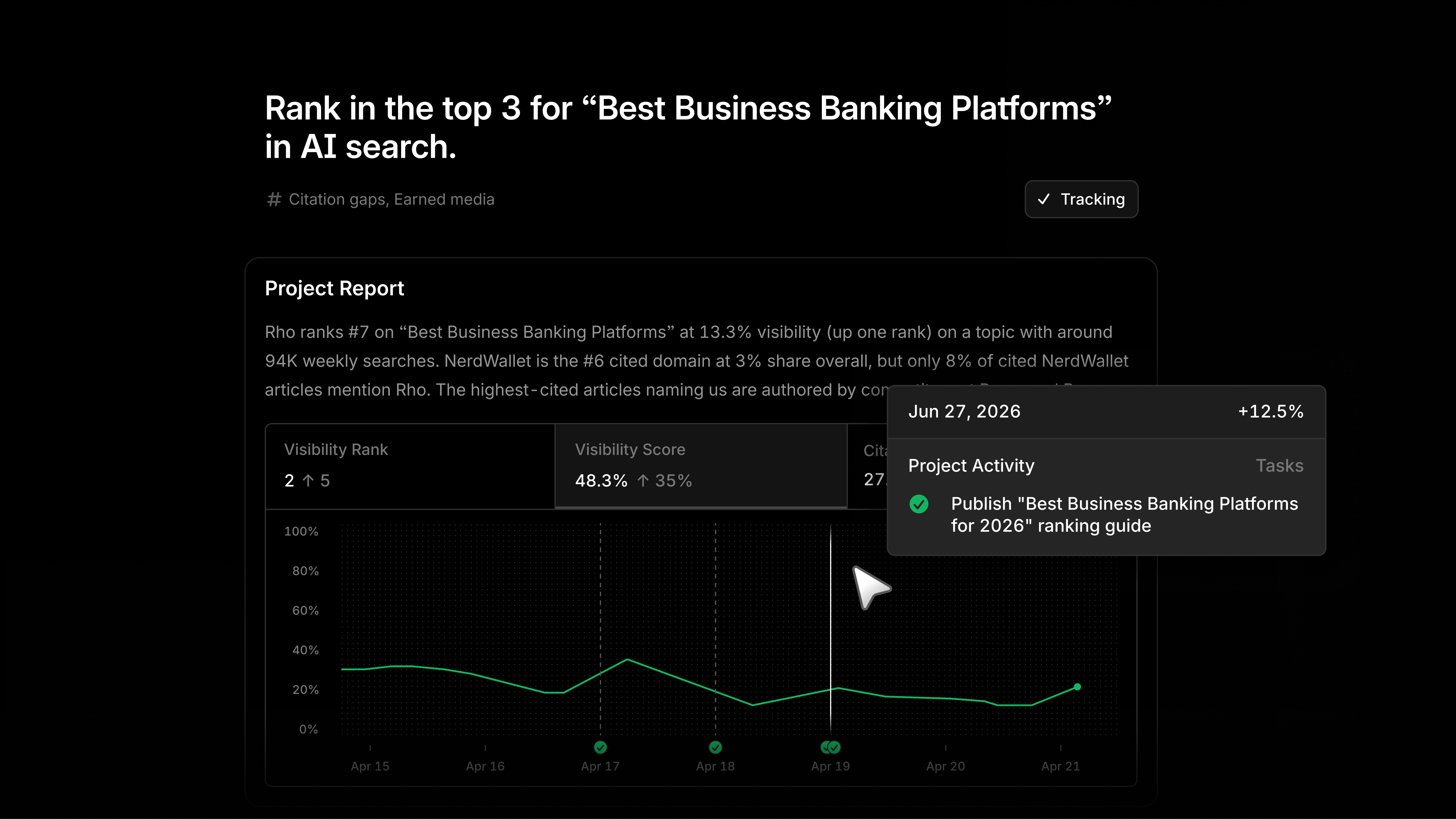
    Profound Projects

    With Projects in Profound, I can turn my AEO data into a clear, ranked list of opportunities instead of another report I have to interpret from scratch.

    Each opportunity is broken into practical tasks, with an agent ready to help do the work. That makes it easier for me to move from insight to execution without getting stuck in endless analysis.

    For me, Projects is about spending less time deciding what to do next and more time acting on the opportunities that can improve visibility, performance, and momentum.


    Inspired by this post on Try Profound Blog.


    crushpress.ai community screenshot
  • Profound Agent Templates: Launch AI Workflows Faster

    Profound Agent Templates: Launch AI Workflows Faster

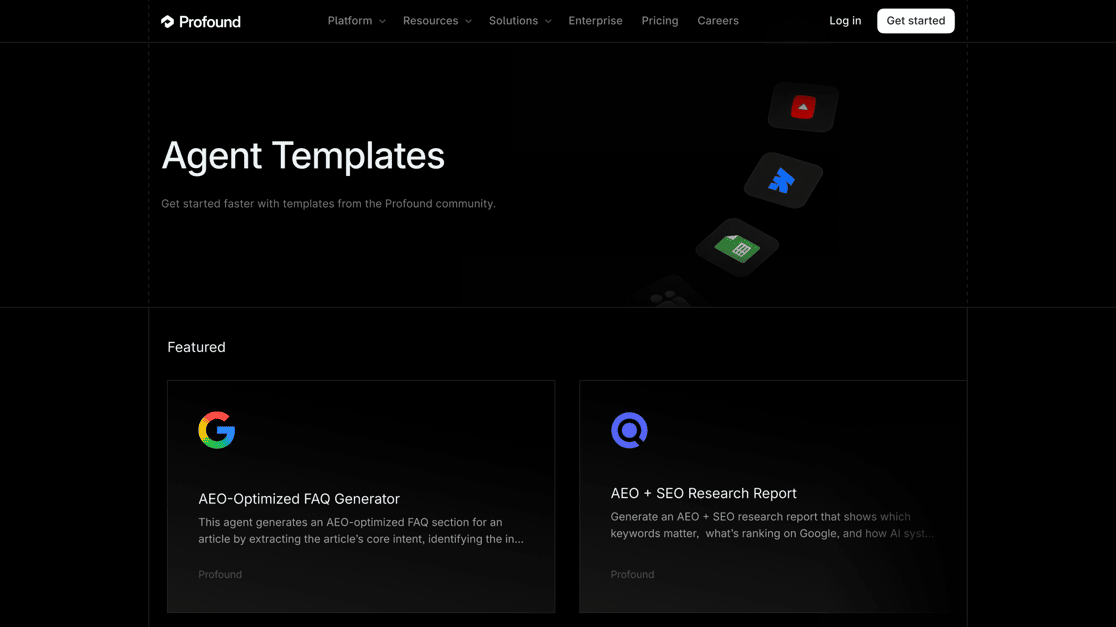
    With Profound’s Agent Template Marketplace, I can start from pre-built AI agent workflows instead of building every process from scratch.

    It gives me ready-to-clone templates designed for marketing, SEO, and AEO teams, so I can move from idea to live workflow in minutes.

    For me, the biggest advantage is speed: I can choose a proven workflow, clone it, customize it for my team, and start using AI agents faster with less setup.


    Inspired by this post on Try Profound Blog.


    crushpress.ai community screenshot
  • 6 Claude Content Audit Workflows I Reuse for Better SEO

    6 Claude Content Audit Workflows I Reuse for Better SEO

    Claude content audit

    I see existing content as a goldmine, but only when I have a practical way to improve it. The hard part is usually finding the time, and that is where Claude has made a large, messy job feel much more manageable for me.

    I do not start by building a giant content audit system. I start with one article, run one focused audit, refine the output, and then turn the prompt into a reusable Claude skill. Over time, those one-off audits become a working library I can improve every time I use it.

    I use Claude to uncover topical gaps, flag outdated information, check brand voice, and evaluate whether a page is easy for AI systems to retrieve and cite. The real value comes from iteration: each time I improve a skill, the next audit becomes faster and more useful.

    Here are six content audit workflows I would build in Claude. The first four work at the page level, so I can start with a single article before moving into larger library-wide analysis.

    Page-level audits

    When I am not ready to build a full workflow, I start with page-level audits. These audits only require one article, which means I do not need a content inventory, a data export, or a complicated setup. After each session, I ask Claude to turn the process into a reusable skill for future page-level reviews.

    1. Brand voice consistency

    I use a brand voice consistency audit when a content library has drifted over time. Voice can shift because of new writers, changing services, product updates, or evolving positioning. This audit helps me spot where a page no longer sounds aligned with the brand.

    If I do not have detailed brand guidelines with strong examples, I let Claude extract the voice guide from high-quality content. That usually works better than relying on vague phrases like “conversational but authoritative” or “educational, not too formal.”

    I pick three to five articles that represent the brand at its best. If possible, I download them as markdown files and ask Claude to describe how the voice works in concrete terms.

    • How the articles usually open, such as whether they begin with a direct claim, a counterintuitive statement, or a specific scenario.
    • How sentences and paragraphs are built, including average length, range, rhythm, and how paragraphs tend to close.
    • Three to five personality dimensions framed as “We say X, but not Y,” with do and don’t examples.
    • Words and phrases the brand tends to use, and words or phrases it should avoid.
    • Specific constructions, phrases, and conventions the brand never uses.

    Instead of accepting a vague voice description, I want Claude to return concrete observations. For example, it might say that articles open with a direct claim rather than a scene-setting paragraph, sentences average 15 to 20 words and rarely exceed 30, and transitions are functional, such as “here’s why that matters,” rather than formulaic, such as “furthermore.”

    I also want example pairs, such as: “We’d say ‘the data shows three things,’ not ‘there are multiple factors to consider.’” The goal is not to create a voice guide for writers. The goal is to create one an LLM can understand and apply consistently.

    Once I like the output, I ask Claude to save it as a skill and evaluate an article against it. If Claude flags issues I disagree with, I update the skill until the feedback becomes useful and repeatable.

    I can then use that skill to find voice inconsistencies in older content, check new drafts for alignment, and even generate more on-brand first drafts. I still edit the output, but the starting point is much stronger.

    Dig deeper: How to train Claude to sound like your brand

    2. Coverage comparison

    When I need to improve content performance, I use a coverage comparison to find topical gaps. This helps me understand what competing pages cover that my article misses.

    I use the Claude in Chrome extension to have Claude review the top three to five ranking pages for my target keyword. Then I ask Claude to compare those pages against my content and highlight the most important gaps.

    • What competitors are doing well.
    • What my article already does well.
    • Where I can improve the piece without bloating it.

    If I want the output in a table, I ask Claude to format it that way. If I want a downloadable DOCX for review or handoff, I ask for that instead.

    When Claude recommends additions I would never publish, I make a note of those exclusions before packaging the workflow into a skill. That way, the skill gets closer to my editorial standards each time I refine it.

    3. Freshness audit

    Old content adds up quickly, and it is hard to prioritize refreshes while I am also producing new material. A freshness audit skill helps me identify what needs attention without rereading every older article from scratch.

    I give Claude an older article and ask it to flag anything time-sensitive: statistics tied to a specific year, named tools or platforms, references to “current” or “recent” trends, and claims that depend on a market, regulatory, or product context that may have changed. I am not asking Claude to rewrite the article yet. I am asking it to build an issue list I can act on.

    If my company has launched new products, removed old services, changed positioning, or updated terminology, I include that context in the input. That helps Claude flag what should be added, removed, or revised.

    Dig deeper: How to turn Claude Code into your SEO command center

    4. AEO and AI retrievability

    I use an AEO and AI retrievability audit to understand whether a page is likely to be surfaced in AI-generated answers. Tools such as ChatGPT, Perplexity, and Google AI Overviews tend to favor content that answers questions directly. If an article buries the answer under too much preamble, or structures key information in a way that is hard to extract, it becomes less useful for those systems.

    I give Claude the article and the target query, then ask it to evaluate several retrieval signals.

    • Whether the article answers the main question directly and early.
    • Whether key statements are specific enough for an LLM to quote or cite.
    • Where an FAQ-style section would improve clarity.
    • Whether the page includes authority signals, such as primary research, first-person experience, outbound citations, or specific examples.

    Once I save this as a skill, it becomes an extra editor focused specifically on AI visibility and answer retrieval.


    Library-level audits

    Once I am ready to move beyond individual pages, I use library-level audits. These require performance data, a content inventory, a connector, or a manual export.

    5. Performance triage

    When I think about a traditional content audit, performance triage is usually what comes to mind. It helps me analyze a content library and identify the pages that deserve attention first.

    Before I begin, I make sure Claude has access to the right data through a connector such as BigQuery or the Semrush API. If that is not available, I export the data I normally use for large-scale audits, such as traffic, clicks, engagement metrics, conversions, rankings, and related performance signals.

    I ask Claude to prioritize pages that have suffered meaningful performance drops in the past six to 12 months, pages with high impressions but consistently low click-through rates, and pages that have been live long enough to rank but never gained traction.

    I also define what a meaningful performance drop looks like for the site I am analyzing, because traffic patterns vary by industry, audience, and page type. Then I ask Claude for a prioritized list of what is worth investigating and why. From there, I use the page-level audits above to diagnose the problem.

    If I have run this analysis before, I give Claude the previous output. That helps the skill learn the kind of prioritization and reasoning I expect.

    Dig deeper: How to build a Claude Code-powered second brain for agency work

    6. Topical gap analysis

    I treat entities as a major part of AEO and semantic search. A topical gap analysis helps me see whether my content library has enough coverage to build authority around the entities tied to my brand.

    The core question I ask is simple: what is my content library not covering that it should?

    To start, I create a list of target entities. For example, at my agency, I want to be known for SEO and AEO. If I have a clear list of services or products, I can use that instead of a formal entity list.

    Using Cowork or Code, I ask Claude to analyze my sitemap and compare it to those target entities. If I have a Screaming Frog export with URLs, page titles, and meta descriptions, I use that as input for a more accurate analysis.

    Then I ask Claude to identify topic clusters that are missing or underrepresented based on the target entities, services, or products. If I want prioritization, I can use the Semrush MCP so Claude can check search volume for potential keywords.

    Not every gap is worth filling. I filter the results against audience needs, business relevance, and editorial standards. Then I feed those decisions back into Claude so the skill produces better recommendations next time. The final list can go directly into my content creation workflow or be handed off to a content team.

    I do not try to audit everything at once

    I have seen content audits stall because the scope feels too large, not because the team lacks data. My preferred approach is to pick one audit and one article, run the workflow, save the skill, and use it again on the next piece.

    For me, iteration is part of the value. I enjoy taking one Claude skill, improving it, and then chaining it with other skills to uncover more content opportunities. Starting small is what makes the system easier to keep using.


    Inspired by this post on Search Engine Land.


    crushpress.ai community screenshot
  • Bad Conversion Data Is Quietly Wrecking Google Ads

    Bad Conversion Data Is Quietly Wrecking Google Ads

    I used to think bad data mainly meant bad reporting. Now, in Google Ads, I see it as something much more expensive: bad delivery. When conversion data is wrong, it does not just make a dashboard confusing. It can train campaigns to spend budget chasing the wrong people.

    As automation takes over more of the ad-buying process, from creative generation to bidding, data has become one of the few inputs I can still control. It may also be the most important one, because automation can only optimize toward the signals I give it.

    I keep coming back to one question: what is worse, a brilliant ad shown to the wrong audience or an average ad shown to the right one? The first burns budget on people I do not want. The second may not win every click, but when someone does engage, at least they are closer to the customer I actually need.

    That is why I have to ask myself a harder question before launching any automated campaign: did I spend more time verifying the data than writing the ad copy?

    The cost of bad data has changed

    A few years ago, bad tracking was mostly a reporting problem.

    If a tag fired twice, a conversion was mishandled, a value came through incorrectly, or offline conversions stopped working for a few weeks, the main result was a dashboard that did not add up. It was frustrating, but the damage was usually limited. Someone would eventually question the numbers in a monthly review, I would trace the issue, fix it, and the next report would look cleaner.

    That same data now feeds the algorithm buying paid media. Smart Bidding does not wait for me to interpret a report or sit through a monthly review. It reads conversion data and acts on it before I may even notice that something is broken.

    The same wrong number now creates a very different outcome. A bad number in a report requires an explanation in a meeting. A bad number in a conversion action used for bidding costs money immediately, because the algorithm does not know the signal is wrong.

    It simply optimizes toward that signal the moment it sees it, and it does so efficiently.

    Google does not understand my funnel or my business

    Google may let me label conversion actions as “lead,” “opportunity,” or something similar, but those labels are mainly for organization. The platform does not truly understand where each conversion event sits in my funnel.

    What it sees is a conversion event with a numeric value attached to it, usually a currency value. It does not inherently know that a newsletter signup might be worth $2 in eventual value, a lead might be worth $60, and an opportunity might be worth $400. To Google, those are conversion events. Without better signals, it has no real context that one may be worth 200 times another.

    The algorithm is not optimizing for my business outcome by default. It is optimizing for the data I provide. If that data is wrong, the optimization will be wrong too.

    For example, if every form submission fires the same conversion with the same default value, I give the system no clean way to separate low-intent inquiries from high-value prospects. The algorithm treats them the same. And because low-quality leads are often cheaper to acquire, it can quickly flood the account with them.

    The cost per lead may drop from $40 to $25, and the dashboard may make performance look more than 35% better. But behind that cleaner metric, the pipeline can dry up as genuinely qualified inquiries quietly fall by half.

    Dig deeper: Why better signals drive paid search performance

    3 ways bad data quietly wrecks delivery

    Bad data can show up in different ways, but I see three issues that are especially likely to derail campaign delivery.

    1. Wrong event

    If I optimize for a top-of-funnel action like a page view while the real conversion events happen further down the funnel, the algorithm learns to buy more of those cheap events. The problem is that the lower-funnel activity may never follow.

    2. Wrong value

    If I count every conversion equally, or assign every conversion the same placeholder value, I hide the real differences in business value. When actual value can vary by 10 times or more, the algorithm will often chase the easier, lower-value conversions because they are cheaper to acquire.

    3. No data

    This problem does not get discussed enough. A complete break in conversion data can damage a campaign faster than almost anything else.

    On Day 1, the algorithm starts wondering where the conversions went. By Day 2, it begins assuming they may not be coming back. By Day 3, it can start making serious bidding changes. Within a week, many campaigns can throttle themselves down to almost nothing.

    How I pick the right signal for Google

    So how do I fix this? I start by choosing the signal that best represents business value, not just the easiest action to count.

    Take a typical lead generation business. Some leads will never convert, while others may be worth 10 times as much as the rest.

    If the form asks the right qualifying questions, I may already know which leads are which. But if I optimize for every submitted lead using a target CPA, I am telling Google that all leads are equally valuable.

    Imagine an account spending $20,000 a month at a $40 target CPA and generating about 500 leads. Only 150 qualify, and maybe just 50 are genuinely high value. A basic lead may be worth $60, a qualified lead may be worth $200, and a high-value lead may be worth $600. That is a 10 times spread in value.

    In that situation, I have several ways to improve the optimization signal.

    Optimize for a qualified lead: I can create a new conversion action, such as “qualified lead,” and fire it only when a lead has real value. Then I can move the target CPA strategy to that conversion action, knowing the campaign will ignore leads with no value. The advantage is that I train the campaign on a more meaningful signal. The downside is that every qualified lead is still treated equally.

    Assign conversion values and use target ROAS: I can add a currency value to the qualified lead based on the potential revenue it could generate if it becomes a sale. Then I can switch the campaign to target ROAS, allowing Google to optimize for return instead of simply counting leads. The tradeoff is that it may still buy larger numbers of lower-value leads if it can acquire them at the right price.

    Optimize for a high-value lead: I can create a “high-value lead” conversion event that fires only for top-tier leads, with or without a conversion value. Then I can optimize with either target CPA or target ROAS, depending on whether I care more about acquisition cost or return. The advantage is stronger lead quality. The downside is that, depending on spend and volume, the data may be too limited to support this approach until the account scales.

    These are only a few possible optimization signals, and they do not even go deeper into the funnel. I can apply the same thinking to lower-funnel milestones by creating separate conversion actions for events such as contacted lead, qualified contact, or high-value contact.

    Targeting and measurement can be different

    This sounds simple, but the conversion event I optimize for and the one I report on are not always the same. In many cases, they should not be the same. One trains the algorithm. The other tells me how that training is performing.

    In the example above, a client or internal stakeholder may still want to see cost per lead. That is a valid metric. But the campaign may be optimizing for the Qualified Lead conversion, not the original lead submission.

    I can keep the original lead conversion running purely as a reporting metric, so stakeholders still get their cost-per-lead view while the campaign bids on the qualified lead signal that actually reflects business value.

    Same campaign. Two conversions. Two very different jobs.

    That brings me back to the question I started with: did I spend more time verifying the data than writing the ad? In an automated account, data is no longer just measurement. Data is strategy.


    Inspired by this post on Search Engine Land.


    crushpress.ai community screenshot
  • Win Competitor Traffic With Demand Gen Conquesting

    Win Competitor Traffic With Demand Gen Conquesting

    I have seen traditional competitor campaigns turn into expensive click traps. When someone searches for a competitor’s brand, they are often already close to buying, which means my ad can become little more than a brief detour on their way to converting somewhere else.

    That does not mean I have to give up on competitor-aware audiences. Instead of relying only on competitor brand bidding, I can use Demand Gen campaigns and negative-intent keywords to reach those buyers more efficiently, often at a lower cost.

    Demand Gen: Reaching the right audience for less

    Before I focus on negative-intent keywords, I like to look at Demand Gen because it gives me another way to reach people who may not know my brand yet but are already showing signs of interest in my market.

    For Demand Gen to work well, I need two things: strong targeting and strong creative. Within that targeting, custom audience segments and lookalike audiences are essential.

    Custom segment targeting lets me reach people who have searched for specific terms on Google or who show certain interests and purchase intentions. It is also one of the most practical ways I can get in front of users researching my competitors without paying the higher price of a search click.

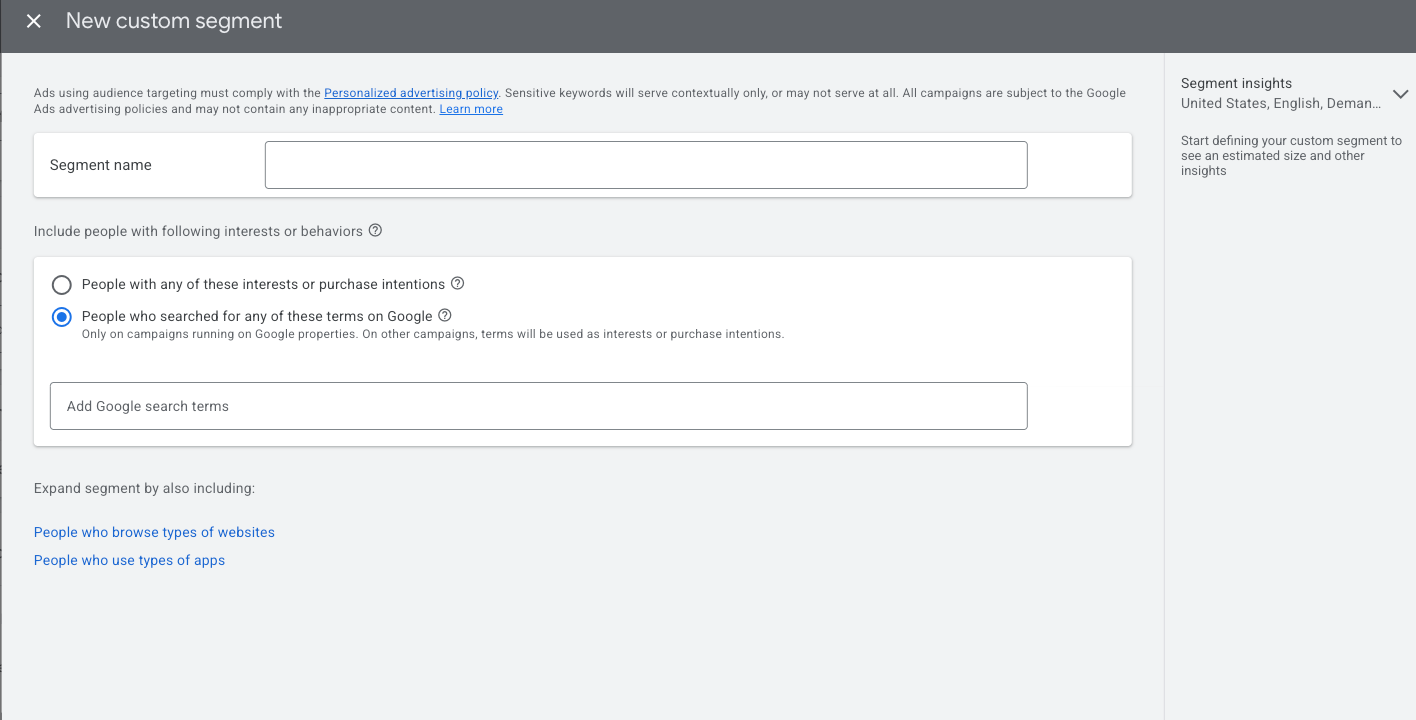
    New custom segment

    When I create a new audience inside a Demand Gen campaign, custom segments are one of the first targeting options I see, right after the audience name.

    From there, I choose the option for People who searched for any of these terms on Google and add as many relevant competitors as I can. This helps me reach a highly relevant audience across Google’s inventory at a lower cost than a traditional search network click.

    If I am not sure which competitors to include, I start by typing my main product or service into Google Ads and reviewing who appears. Those businesses are usually my primary competitors, and depending on the networks I opt into, my ads can appear across YouTube, Discover, and Gmail.

    Designing conquesting landing pages for Demand Gen

    When I use Demand Gen for conquesting, I need a landing page built specifically for that audience. I want to highlight my key differentiators, show social proof, and make it obvious why my product or service deserves consideration.

    The click is only the first step. Once someone lands on my page, the offer has to be clear, specific, and aligned with the ad they just clicked. I need to explain the value thoroughly and guide the visitor toward a call to action that matches the promise I made in the ad.


    Negative-intent conquesting: Targeting competitor weaknesses

    But Demand Gen is not always the right starting point. If I do not have strong image or video assets, I may be better off staying closer to the search network.

    Because high-quality creative tends to perform best across Demand Gen placements, search can make more sense when those assets are not available. That is where negative-intent conquesting becomes useful.

    Image

    Most advertisers understand traditional competitor search campaigns, but many overlook the people who are not simply searching for a competitor. They are searching for alternatives, comparisons, cheaper options, or signs that another company can solve the problem better.

    I often see this happen during the consideration phase. A user may search for terms like “companies like X,” “companies cheaper than X,” or, for branded products, “dupe for X.” Not every variation will have enough volume to bid on, but these searches reveal where serious comparison research is happening.

    Building campaigns around competitor pain points

    If I know a competitor has a reputation for poor customer service, I might test keywords such as “customer service complaints for [competitor].” I would keep this focused in a single ad group with closely related keyword variations.

    In the ad copy, I would focus on what makes my customer service stronger, faster, or more helpful. Because of trademark policies, I would avoid naming the competitor directly in the ad text and instead emphasize the benefit I can prove.

    Traditional competitor campaigns focus on bidding against a brand name. Negative-intent conquesting focuses on the weakness behind the search. The audience already knows the competitor, but they are actively looking for a better option.

    I can also pair this approach with a separate custom audience, which lets me reach people searching for these alternatives across Google’s networks.

    For this to work after the click, the landing page matters just as much as the keyword and ad. If my ad promises a better solution to poor service, high prices, or another competitor weakness, the landing page has to validate that claim and present a unique value proposition that directly addresses the concern.

    Target competitor audiences before the decision is made

    The biggest challenge with traditional competitor campaigns is not always the competitor. It is timing.

    When someone searches for a competitor’s brand name, they may have already narrowed their options and moved close to a decision. That is why competitor keyword campaigns can become expensive and hard to scale profitably.

    Demand Gen and negative-intent conquesting help me approach the same audience from different angles. Demand Gen lets me reach potential customers before they commit to a brand, while negative-intent conquesting reaches them when they are actively questioning their current options.

    My goal is simple: I want to reach potential customers when they are most open to considering a different choice. If I can do that with the right targeting, message, and landing page, competitor traffic becomes much easier to win without overspending on traditional brand bidding.


    Inspired by this post on Search Engine Land.


    crushpress.ai community screenshot
  • Google Demand Gen Gets Gemini Creative and Reporting Boost

    Google Demand Gen Gets Gemini Creative and Reporting Boost

    I’m seeing Google roll out a new set of Demand Gen updates designed to help advertisers improve creative performance, reach more potential customers across YouTube, and measure campaign results with more clarity.

    For me, the bigger story is that Demand Gen is becoming less about manually adapting assets and more about using AI-assisted tools to make creative work harder across Google’s most visual surfaces.

    Demand Gen campaigns are built to drive discovery and conversions across Google’s visual placements. With these latest updates, I see Google trying to reduce creative friction while giving advertisers better visibility into what is actually moving performance.

    Google says the enhancements arrive as YouTube continues to show value for customer acquisition. The company cited research from Measured showing that 72% of incremental conversions on YouTube come from new customers.

    What’s new. I’m watching Demand Gen add expanded video resizing capabilities, giving advertisers the ability to automatically transform creative into more aspect ratios, including vertical-to-square, vertical-to-landscape, and square-to-landscape formats.

    That matters because it should make it easier to adapt existing creative for different YouTube placements without having to produce every version manually from scratch.

    Why I care. Expanded video resizing can help existing assets fit more YouTube inventory, Gemini can provide AI-powered recommendations before launch, and new web-to-app measurement can give marketers a clearer view of how Demand Gen campaigns influence app installs and return on ad spend.

    Gemini joins the creative workflow. Google is also bringing Gemini-powered recommendations directly into the Demand Gen campaign creation process, which makes AI guidance part of the asset selection workflow instead of a separate optimization step.

    When advertisers choose image and video assets, Gemini will offer automated suggestions for optimizing creative for YouTube. I see this as a way for marketers to improve asset choices before campaigns go live, rather than waiting for performance data after launch.

    Better app measurement. Demand Gen now includes Web to App Acquisition Measurement, allowing advertisers to measure when web campaigns lead users to install an app.

    The new reporting gives me a more complete way to evaluate campaign performance because it attributes app installs generated through Demand Gen campaigns. That should help advertisers better understand the full impact of their media spend.

    The bottom line. I see Google’s latest Demand Gen updates as a practical combination of AI-powered creative guidance, more flexible video optimization, and broader measurement tools that can help advertisers improve performance while gaining clearer insight into customer acquisition.


    Inspired by this post on Search Engine Land.


    crushpress.ai community screenshot
  • How AI Brand Discovery Turns Visibility Into Recommendations

    How AI Brand Discovery Turns Visibility Into Recommendations

    AI brand discovery is not one visibility problem. It is a sequence: a system must find and understand a brand, select its material as evidence, include the brand in an answer, and sometimes recommend it strongly enough to influence what the buyer does next.

    The source material reveals why conventional search reporting captures only part of that sequence. Organic rankings can coexist with weak AI citations, while an AI recommendation can influence a later search visit without receiving credit in referral analytics. Brands therefore need a measurement and content strategy that follows the full path from discoverability to commercial action.

    AI visibility is a chain, not a single ranking

    The sources describe different stages of the same process. The B2B benchmark reported by Search Engine Land examines whether brands ranking in Google are cited in AI Overviews. HiGoodie’s guidance concentrates on making content clear, credible, and understandable to answer engines. A separate Search Engine Land report covers what users did after ChatGPT recommended a brand. Its assistive-agent framework then extends the journey from recommendation toward transactions completed by software.

    Combined, these perspectives suggest four distinct visibility questions. Can an AI system discover the relevant material? Can it interpret and trust that material as evidence? Does the resulting answer cite or recommend the brand? Does that exposure influence a visit, comparison, or purchase? Success at one stage does not establish success at the next.

    This distinction matters because citations and recommendations serve different functions. A citation identifies a source used in an answer. A recommendation places a brand into the buyer’s consideration set. Either can create value, but the downstream effect of a recommendation may be easier to see in buyer behavior than in a referral report.

    Strong organic reach can conceal an AI citation deficit

    A prominent webpage appears high in a search-results scene but remains outside the sources selected by an adjacent AI system.

    The clearest evidence of a broken handoff comes from Walker Sands’ B2B AI Search Visibility Benchmark, as reported by Search Engine Land. The analysis covered more than 45 million March search queries associated with 828 enterprise B2B companies in 14 industries. It reported that the median company ranked for about 9,700 queries and encountered AI Overviews on 48.8% of its relevant ranking keywords, yet appeared as a citation in only 3% of those AI Overviews.

    The benchmark also reported that 4.6% of the companies received no AI Overview citations for any relevant keywords. Even its top quartile reached a citation inclusion rate of only 4.5%, compared with 1.7% for the bottom quartile. These findings do not show that organic search has stopped mattering. They show that ranking coverage and selection as evidence are separate outcomes.

    Category exposure also varied. According to the report, AI Overviews appeared in a median 59.9% of cybersecurity searches, where brands achieved the study’s highest median citation rate of 4.2%. Distribution and logistics had the lowest reported AI Overview incidence, at 29.6%, while both that category and professional services recorded median citation rates of 2.1%. A visibility target should therefore reflect how often AI answers appear in the category as well as how frequently the brand enters them.

    The benchmark associates stronger citation performance with topical depth, direct explanations, structured information, and consistent coverage across related pages. HiGoodie’s article arrives at a compatible editorial prescription: organize content around real questions, connect related topics, and support claims with credibility signals. Together, the sources favor focused subject-matter coverage over simply publishing more pages for more keywords.

    Recommendations can create demand that attribution misses

    A person receives an AI product suggestion, later searches for the item, and reaches a purchase through an indirect glowing path.

    Citation inclusion is an intermediate metric; buyer response is closer to the business result. Search Engine Land’s account of a Similarweb study reported that U.S. desktop users who received a specific ChatGPT brand recommendation were, on average, 2.5 times more likely to visit the recommended brand than a direct competitor within seven days. The study followed activity from July through December 2025 across selected finance, travel, and beauty brand pairs. It excluded users who had recently visited the brand or explicitly named it in their prompt.

    The reported pattern appeared in all three sectors, although its size differed by brand pair. After a Capital One recommendation, for example, 14.2% of users visited Capital One and 3.8% visited American Express. After a Kayak recommendation, 12% visited Kayak and 3.4% visited Skyscanner. These are reported observations from an opted-in desktop panel, not proof that every recommendation will produce the same effect in other audiences or categories.

    The more consequential measurement finding is where those visits appeared. Similarweb reportedly attributed 55.9% of AI-influenced visits to search, versus 40.4% of non-AI-influenced visits. Direct traffic accounted for 19.9% of AI-influenced visits and 38.8% of standard visits. If a user learns about a brand in ChatGPT and later searches for it, a conventional last-touch view can credit search while overlooking the conversation that formed the preference.

    The study also reported deeper activity among AI-influenced visitors: averages of 12 pages and 11.8 minutes on site, compared with 6.5 pages and 5.6 minutes for other visitors. That pattern is consistent with users reaching the website after narrowing their options, although it does not by itself establish why they engaged more deeply.

    A practical operating model joins content, evidence, and measurement

    A useful program begins by separating opportunity from performance. Organic keyword coverage shows where a brand is discoverable. AI Overview incidence shows where generated answers can mediate that discovery. Citation inclusion shows whether the brand’s material is selected. Recommendation monitoring asks whether the brand enters consideration. Branded search, site engagement, qualified actions, and sales outcomes then help reveal downstream demand.

    Build the evidence layer before chasing mentions

    The shared foundation across the sources is content that both people and machines can interpret. Pages should answer a defined buyer question promptly, explain relevant concepts precisely, and make important claims easy to evaluate. Related pages should collectively demonstrate depth rather than repeat a shallow definition. Earned media and corroborating information can complement first-party material by strengthening the wider evidence available about the brand.

    The assistive-agent framework reported by Search Engine Land places this work above, rather than in place of, SEO. In that model, search supplies crawled and indexed information, assistive systems add language-model reasoning and corroboration, and agents can eventually interact with business systems. This is a conceptual framework, not a measured result, but it clarifies why technical accessibility, entity understanding, and accurate business data belong in the same plan as editorial quality.

    Audit the questions closest to a decision

    Broad awareness coverage can reveal demand, but recommendation visibility becomes especially important when buyers compare providers, test suitability, or seek a shortlist. An audit should examine what an AI answer says, which sources it cites, whether the brand appears, how it is characterized, and which competitors receive stronger treatment. Because AI answers may vary, repeated observation is more informative than treating one response as a permanent ranking.

    Measure influence without forcing false precision

    AI referral traffic remains useful, but it should not be treated as the full contribution of AI discovery. Teams can examine changes in branded search, direct visits, engaged sessions, assisted conversions, and customer-reported discovery alongside citation and recommendation monitoring. None is a perfect substitute for controlled attribution; together, they can expose demand that a referral-only dashboard would miss.

    Key takeaways

    • Organic rankings create discoverability, but they do not guarantee inclusion in an AI-generated answer.
    • AI citations, brand recommendations, website visits, and transactions are different stages and require different measures.
    • Clear answers, topical depth, structured information, and corroborating authority form the content foundation described across the sources.
    • AI-influenced demand may later appear as search traffic, so referral analytics alone can understate AI’s role.
    • Category-level AI exposure should shape priorities because the incidence of generated answers and citation rates can differ substantially.

    As more discovery and evaluation move into generated answers, the defensible advantage will come from connecting machine-readable evidence with trustworthy buyer experiences. The next step is not merely to seek more AI mentions, but to learn which questions create recommendations and whether the business is prepared to convert the demand they produce.

    References

  • AI Brand Accuracy Is Becoming a Trust and Governance Test

    AI Brand Accuracy Is Becoming a Trust and Governance Test

    AI can misrepresent a brand without inventing an obvious falsehood. A technically correct description can still become misleading when an answer adds an unsolicited comparison, repeats an outdated assumption, or presents an opinion as settled fact.

    That makes AI brand accuracy more than a visibility problem. The sources point to an interconnected challenge involving representation, consumer trust, source provenance, editorial controls, and responsibility for harmful outputs. Brands need a system that addresses all five.

    Accuracy includes framing, not just factual correctness

    The same unbranded object appears through three transparent frames that emphasize different contexts and perspectives.

    Traditional fact-checking asks whether an individual claim is true. AI search requires a wider test: whether the complete answer represents the brand fairly and in the context of the user’s question.

    A Profound article reported an analysis of 50,000 prompts across seven industries and said nearly half of the AI responses contained comparisons, opinions, or recommendations that users had not requested. The significance is not merely that models sometimes make errors. It is that they can change the meaning of an answer by deciding which competitors, attributes, or judgments belong beside a brand.

    This creates at least three forms of accuracy risk. A claim may be factually wrong, such as an incorrect product capability. It may be stale, reflecting information that was once accurate but is no longer current. Or it may be contextually distorted: individual statements remain defensible, but the selection and framing leave users with the wrong overall impression.

    Profound’s FactCheck announcement approaches the issue as a measurement problem. It describes a way to evaluate brand claims at scale, identify inaccurate statements, and examine the sources associated with those errors. As a product announcement, it does not independently establish how well the tool performs. It does, however, highlight an important operational principle: a useful accuracy program must connect problematic outputs to the evidence influencing them. Counting brand mentions alone cannot reveal whether those mentions help or harm understanding.

    Rising use does not mean brands inherit rising trust

    The consumer research reported by Search Engine Land shows why representation quality matters even as AI search expands. In a Fractl and Search Engine Land survey of 1,008 U.S. consumers and 150 marketers, 70% of consumers said they were using AI tools for search more than a year earlier. Yet the share describing AI-powered search as more helpful than traditional search reportedly fell from 82% to 54% between the 2025 and 2026 studies.

    Those findings describe a convenience-trust gap. People may continue using a fast, accessible channel while becoming more cautious about its answers. A brand appearing prominently in that environment therefore gains exposure, but not an automatic endorsement. Accuracy, credible sourcing, and consistency across platforms become the conditions that determine whether visibility turns into confidence.

    The same survey found that the average consumer consulted 2.4 platforms before a purchase decision. Google was reportedly the first destination for 39% of respondents, compared with 15% for Reddit and 14% for AI tools. This suggests that buyers can encounter an AI-generated brand narrative and then test it against search results, community discussion, reviews, or other sources. Contradictions that once remained isolated are easier to expose when the journey crosses several platforms.

    Trust concerns also extend to brands’ own use of AI. The reported share of consumers who said heavy AI use would reduce trust in a brand rose from 20% to 39%. More than 80% wanted AI-generated material labeled across each content format measured, including 84% for written content and 91% for video. These figures do not show that audiences reject all AI-assisted work. They indicate that undisclosed volume and weak quality controls can become reputation signals in their own right.

    Accountability is moving closer to the publisher of the answer

    A separate Search Engine Land article reported that a German court held Google responsible for content in an AI Overview and rejected the proposition that a general warning placed the fact-checking burden entirely on users. According to that account, the court treated newly generated claims as Google’s content rather than merely a repetition of third-party material.

    One reported ruling should not be treated as a universal legal standard, and the supplied source does not establish how other courts or jurisdictions will decide comparable cases. Its practical lesson is nevertheless relevant to any organization deploying AI: a disclaimer is not a substitute for controls proportionate to the possible harm.

    The responsibility question changes depending on where an output appears. An inaccurate public article can damage readers or another company’s reputation. A faulty support response can misdirect a customer. An invented statement in an internal report can alter a decision even if it is never published. In every case, the organization receives the productivity benefit, selects the workflow, and decides whether a person reviews the result.

    The consumer study suggests many organizations have started adding safeguards, but their coverage is uneven. It reported that roughly three in four organizations conduct human editorial review before publishing AI-generated content. Among the specific checks, 62% reviewed brand voice, 54% checked facts, 42% performed legal or compliance review, and 27% evaluated bias. Brand consistency was therefore checked more often than factual accuracy, while bias received substantially less attention. That ordering can produce polished material that still contains consequential problems.

    A practical control system connects monitoring, evidence, and ownership

    An isometric control room connects AI answer monitoring, source evidence review, escalation, approval, and follow-up in a closed workflow.

    AI brand governance should cover both sides of the information boundary: what external systems say about the brand and what the organization publishes with AI assistance. These are related but distinct responsibilities. A company cannot directly edit every model answer, but it can improve authoritative source material, document errors, seek corrections where mechanisms exist, and prepare teams to respond consistently. It has much greater control over its own content, support messages, reports, and automated decisions.

    External monitoring should test realistic questions across discovery, comparison, evaluation, and purchase contexts. Reviews should record the answer, platform, date, cited sources, exact claim at issue, and the type of failure. Separating false claims from stale information, unsupported recommendations, and misleading framing makes remediation more precise.

    Source analysis should follow monitoring. When several answers repeat the same mistake, the next question is whether they rely on an outdated owned page, an ambiguous product description, a third-party article, or an unexplained model inference. Profound’s FactCheck announcement emphasizes this link between claims and contributing sources. Even without a specialized product, maintaining an evidence record helps distinguish a content correction from an escalation to a platform or publisher.

    Internal controls should be based on consequence rather than content volume. Low-risk drafting may need a lighter review, while legal claims, product limitations, health or safety guidance, competitive statements, and customer-specific advice warrant stronger verification and named approval. The responsible reviewer should be identified before deployment, not after an error appears.

    Finally, teams need a correction loop. Confirmed errors should update the relevant source material, prompt or workflow, review checklist, and monitoring set. Repeated failures should be treated as system defects rather than isolated copy edits. Useful reporting can track claim accuracy, contextual accuracy, source quality, correction status, recurrence, and the time required to resolve a material issue.

    Key takeaways

    • AI brand accuracy includes factual truth, freshness, context, comparisons, and the overall impression created by an answer.
    • Greater AI search adoption does not guarantee greater trust; the reported consumer research showed use rising while perceived helpfulness weakened.
    • Brand monitoring is more actionable when each questionable claim is linked to its apparent evidence and classified by failure type.
    • Disclosure can address audience expectations, but it cannot replace factual, legal, compliance, and bias review.
    • Accountability should be assigned to a named owner and scaled to the consequences of an incorrect output.

    As AI answers become part of ordinary brand discovery, the durable advantage will not come from producing the most material or collecting the most mentions. It will come from building an evidence-backed brand record, detecting distortions early, and showing that someone is accountable when automation gets the story wrong.

    References