Month: July 2026

  • Remembering Bruce Clay: SEO Pioneer’s Final Lessons

    Remembering Bruce Clay: SEO Pioneer’s Final Lessons

    My heart sank when I learned that Bruce Clay had passed away. I knew he had been in the hospital, but my mind went straight to the two long conversations we had last fall: one simply to catch up, and one for what would become a deeply meaningful podcast interview.

    I first reached out to Bruce nearly 25 years ago. I had emailed him cold to ask whether I could republish some of his industry writing about ethics. He said yes. Somehow, the article I cited unintentionally ranked No. 2 on Google for “Bruce Clay” for years. I joked with him about that more than once, and he always seemed both amused and slightly annoyed, probably because I had done it with his own content and his own blessing.

    A few years later, I worked with Bruce and many other search professionals on the board of the Search Engine Marketing Professionals Organization, better known as SEMPO. It was a business nonprofit built to support and legitimize the then-new search industry. We promoted best practices, helped make the business case for search, and later became involved in U.S. Internet policy work in the early 2010s.

    SEMPO brought together board members from around the world, and in a very literal way, it took some of us around the world. That work is where I really got to know Bruce. Later, we would run into each other at conferences, sometimes even on the same panels. We were doing serious work, but we also had a great time doing it. The organization lasted about 15 years, and if I remember correctly, Bruce was one of its founding members around 2000 or 2001.

    One memory of Bruce has stayed with me vividly. A group of us from the SEMPO board were walking back to our hotel on the east side of Midtown Manhattan after dinner. A snowstorm had just begun, one that would leave several feet of snow by the next day. The usual roar of traffic had been softened by the weather and the empty streets. It was eerie, but almost joyously quiet. The city that never sleeps seemed to be taking a nap under a blanket of snow.

    Then something happened that I had never seen before, and have never seen since.

    As snow poured silently into the streets, a massive lightning strike hit just a few blocks away, over Bruce’s shoulder. I do not know whether he saw it directly. It felt like an explosion. We stood there for several minutes trying to understand the contrast: a shattering bolt of lightning between skyscrapers, in the middle of a torrent of snowflakes, with not a drop of rain.

    None of us knew what to call it. I believe Bruce called it “thunder snow,” and the name stuck. In that moment, his naming streak continued.

    Bruce was, and remains, the real deal in search. His legacy was never only about coining a term. He pushed the field forward, taught others generously, and stayed deeply connected to the people he cared about. Like many of the earliest professionals in search, he helped shape practices that still feel foundational today. Through his writing, interviews, books, tools, and hundreds of industry events, he became one of the people the industry looked to for clarity. For many who remember the beginning, and for many who still followed him closely, Bruce was the GOAT.

    I always felt that Bruce approached search intellectually. I do not think he saw it only as a job. It was exciting, unfinished, and new. Very few people get to help invent an entirely new discipline, and Bruce understood what that meant. He also recognized that AI is one of those moments now, and he approached it with the same curiosity, energy, and insight he brought to early search. Many people in the industry may only now be realizing that Bruce pioneered things they do every day. They feel obvious now, but they were not obvious then. Even the basics had to be debated and established.

    He was not only passionate about search. He was passionate and generous toward the people in search. If you cared about the work, you were part of his tribe. That was true for thousands of people in the industry, myself included.

    With Bruce, I could get deep into the weeds of the trade and still talk broadly about where everything was headed. He was an engineer with an MBA, and that combination came through in his leadership, expertise, and authority. He understood the work from top to bottom, and then back to the top again.

    He was also genuinely kind. He had friends around the world. In our last conversations, I sensed that he was content with his life and accomplishments, and that he felt blessed by the path life had given him. He had nothing left to prove.

    In the podcast interview, Bruce was as sharp and insightful as ever. He offered some of the most sensible thinking I have heard about where search is going in the world of LLMs. He was still innovating, just as he had been when search first began taking shape nearly 30 years ago.

    Because search is so closely tied to language, I have been especially interested in how we think about, and what we call, this “new” thing. Bruce’s perspective helped crystallize my own research. Over the last year, I have watched much of the industry move toward the same conclusion he shared in our discussion.

    If you are one of the many thousands of people who talked shop with Bruce over the years, I think you will recognize him in the ideas that follow. You may even relive some of your own conversations with him.

    As I reviewed the podcast transcript, I realized we had recorded hours of conversation beyond search, including cars and all kinds of other subjects. At the end of our first conversation, he said goodbye with great love and care. That was Bruce. Those words land differently with me now, and they always will.

    Rest in peace, Bruce. I miss you already.

    What Bruce taught me in our final industry conversation

    When I asked Bruce to talk about how he got started in the 1990s, he took us back to 1996. He had been working in corporate roles and wanted to become a consultant. His background was in math, programming, mainframes, PCs, networking, and optimization. When the Internet began moving into the mainstream, he saw something that matched both sides of his skill set: marketing and technical work.

    He started studying search engines because that was where the opportunity was. He experimented with what they wanted, adjusted web pages, and watched rankings appear. Then people began calling him and paying him. What he thought might become a one-person consulting business grew quickly into something global, with offices and work across Japan, Australia, Asia, Europe, India, and beyond. Bruce told me he never would have predicted it would take off the way it did.

    I reminded him how small the field was in those days. There were literally only tens of people doing this early on. Bruce was one of the first to build a legitimate service for businesses that needed to rank for their own brand names and for broader generic terms, while other corners of the field were still experimenting with black-hat tactics.

    Bruce pointed out that this was three years before Google. Search was a wild west. There were more than 20 major search engines, and many of them were taking data from one another. At the first SEO conference he remembered attending, all of the leading people in the field sat together at one round table in a bar. He joked that if a natural disaster had happened there, the whole industry might have disappeared.

    We talked about Danny Sullivan, Search Engine Watch, Search Engine Strategies, and the early vocabulary of the industry. Bruce had long been credited with helping coin the term “SEO,” though he was careful to say that no one can know who said something first. What he did know was that only a handful of people were in the room when the term started to take hold.

    At the time, other terms were in play, including “search engine positioning” and “ranking.” Bruce believed “optimization” won because it sounded technical, valuable, and precise. It was like fine-tuning a race engine. People could see themselves building a profession around it. Once the industry attached itself to that word, the term spread quickly around the world.

    That led us into the newer terms now being proposed around AI, including AIO, GEO, and AEO. I have been writing about how many of these terms still depend on the word “optimization.” Bruce’s view was clear: search engine optimization was never limited to organic blue links. It was about optimizing for anything a search engine produces that can drive business and traffic.

    In Bruce’s view, if AI appears inside search and influences discovery, citations, visibility, or traffic, then it belongs under SEO. GEO and AIO were not separate disciplines to him. They were extensions, just like link building or on-page optimization. He warned that many new terms are marketing labels more than practical new fields. If the work required to appear in AI results is still mentions, links, schema, authority, content structure, and rankings, then the work is still SEO.

    That point stayed with me. Bruce said that if someone claims you no longer need SEO and only need AI optimization, you should watch closely, because either they are going to do SEO under a different name or they do not understand what they are doing. He believed ranking in AI was possible, but the method was deeper and more complex than traditional SEO. To him, it was still SEO, just several levels more advanced.

    We also discussed whether AI feels like search did in the late 1990s. Bruce believed it does in important ways. AI depends heavily on search engines because search engines have spent decades fighting spam and building trust signals. AI systems do not yet have that same history, so they rely on what search engines have already learned to filter, evaluate, and rank.

    Bruce also believed AI could still be gamed at the content level. If enough pages repeat a false idea, an AI system may begin to treat it as true. He had already seen examples of people trying to influence AI answers by placing their names into “best SEO” lists across enough sources. To him, this was a sign that AI would need its own version of the spam fight search engines have been having for decades.

    One of the most important parts of our conversation was Bruce’s explanation of Google AI Mode and how it changes the way SEOs should think about structure. He described how a query can produce an overview, followed by sections and subsections that allow users to drill into narrower parts of a topic. When a user clicks into a section, the supporting sites can change to match that specific subtopic.

    That means content cannot simply be built around one broad keyword anymore. Bruce believed pages need to be structured so each section can stand on its own as an expert answer. A page should support a topic, but every H2-level section may need its own clarity, completeness, and internal logic. In his view, this raises the importance of siloing across a site and within a page.

    I framed this as a shift from keyword-led thinking to context-led thinking. Bruce agreed and connected it to entities, fan-outs, references, and cross-links. Keywords helped build the industry, but he believed the future depends on understanding entities in context. If content cannot answer the question clearly, it fails the core purpose of AI-assisted search.

    Bruce described the long-term target as something like the Star Trek computer: no matter what question someone asks, the system provides the answer. We are not there yet, but that is the direction. For websites, he believed the future architecture is question-centered, highly usable, structured into sub-silos, and able to answer and refer within a page while also fanning out to supporting pages.

    That naturally led us to content. Bruce said that for years SEO treated content like a stepchild, but now content is a peer. If SEO teams and content teams do not share the same goal, they will keep writing the way they did 20 years ago and fail in the AI search environment. He was already being hired to train content teams, even though he did not consider himself a “content guy” in the traditional sense.

    He believed the industry still suffers because SEO and content do not cross-pollinate enough. Content marketers may not attend SEO conferences, and SEOs may not spend enough time learning how content teams actually work. That separation matters more now because the structure of a page, the expertise of each section, and the way a topic is divided all affect visibility in AI-driven search experiences.

    Bruce’s advice was direct: stop spreading one keyword across a page and calling that optimization. Instead, build each section as if it were a standalone expert answer. If the sections belong to the same theme, they should support one another, but each needs to carry its own weight. In his words, the hierarchy is no longer only the page. The hierarchy is also the section of the page.

    When I asked Bruce about AI-generated content, he made an important distinction. AI is a tool, not a solution. He did not believe businesses should simply generate content, read it once, and publish it. Detection tools are inconsistent, and search engines may not reliably identify every AI-generated page. But that does not make low-effort AI content a good strategy.

    Bruce believed AI is strongest as a research assistant. His own Pre-Writer product was built around that idea: gather deep research and give a human writer a stronger starting point. The writer still finishes the work, adds style, voice, judgment, compliance, and business understanding. For Bruce, reducing a four- or five-hour writing project to two hours was a win. Replacing the writer entirely was not.

    He was especially clear that writers are artists. AI does not know a business the way its people do, and it does not bring the same finesse or judgment. The future, in Bruce’s view, requires writers, SEOs, and AI workflows to be integrated around shared goals. Without that maturity, teams will keep producing pages that look like they were built for search 10 years ago, and those pages will be ignored.

    We ended by talking about tools. Bruce reminded me that in the beginning, he wrote tools because none existed. He built one of the first page analyzers, including what he once called a keyword density analyzer. He later received a patent related to that kind of technology. His tools were never meant to replace large platforms like Semrush, Ahrefs, or Surfer. They were meant to extend them by analyzing things those platforms did not.

    Bruce pointed people to seotools.com and described the tools as inexpensive power tools, not products designed for the masses. Some users did not understand them at first, but came back later when they saw the value. He was still building, still solving problems, and still thinking about what the industry needed next.

    Near the end, Bruce mentioned a newer tool designed to show traffic loss through Search Console data over time, helping site owners see whether they had fallen off a cliff or declined gradually. It struck me as classic Bruce: while others complained that something should exist, he was building it.

    I thanked him for the conversation, and he answered with warmth: he was glad I had him on, and he loved talking with me. I hear those words differently now. I am grateful we had that final conversation, and I am grateful for everything Bruce gave to search, to this industry, and to the people inside it.

    Listen to the full episode

    Listen on Podbean

    Listen on Apple Podcasts

    Listen on Spotify


    Inspired by this post on Search Engine Land.


    crushpress.ai community screenshot
  • How AI Is Changing Google Ads Optimization Priorities

    How AI Is Changing Google Ads Optimization Priorities

    Google Ads optimization is becoming less about adjusting isolated bids or keywords and more about designing the environment in which automation makes decisions. Campaign structure, audience eligibility, creative coverage, brand protection and post-click validation now influence whether Google’s systems receive useful signals and operate within acceptable boundaries.

    Taken together, the source reports suggest a practical shift in the advertiser’s role: automation can handle more execution, but advertisers must become better architects, auditors and risk managers. The central challenge is deciding what to consolidate for stronger learning, what to separate for business control and what to verify outside the platform.

    AI is expanding the surface area of optimization

    Google’s automation affects at least three layers of a paid search program. It interprets account signals to make bidding and targeting decisions, distributes campaigns across inventory, and may increasingly influence how an ad is presented to the searcher. Optimizing only the visible ad therefore addresses just one part of the system.

    The account-structure report describes each campaign as a data container. Its argument is that excessive segmentation can divide conversion evidence among campaigns that individually lack enough volume for stable Smart Bidding. The article offers roughly 30 to 50 monthly conversions per campaign as a practitioner benchmark for meaningful learning, rather than an independently verified or universal threshold. It also warns that repeated structural and bidding changes can prolong learning periods.

    At the delivery layer, the report on Performance Max Channel Diagnostics says advertisers can inspect missing or disapproved assets across channels from Insights & Reports > Channel Performance. The feature reportedly identifies gaps involving assets such as headlines, descriptions and images, helping explain why a campaign may not be eligible to serve across parts of Google’s inventory. This adds useful visibility, although it does not by itself establish whether every eligible channel is valuable for the advertiser.

    A separate report describes a more consequential experiment: AI-generated summaries appearing beneath some paid search ads. According to that source, the summaries were accompanied by a warning that the independently generated response could contain mistakes. Google had not publicly announced the test or explained its inputs, scope or advertiser controls when the article was written. It should therefore be treated as a limited, unresolved experiment, not an established product rollout.

    The experiment nevertheless exposes a new optimization question. If a platform-generated explanation can sit close to sponsored copy, ad quality is no longer determined solely by the text an advertiser submits. Landing-page clarity, factual consistency and the way an offer could be summarized may also affect how users interpret the result.

    Account architecture must balance learning with control

    A strategist examines connected campaign modules divided by adjustable gates that balance shared learning with control.

    Consolidation can strengthen automated bidding by placing more relevant evidence in the same campaign, but consolidation is not an end in itself. Campaign boundaries still determine budgets, goals, exclusions and reporting. The useful question is not whether an account has few or many campaigns; it is whether every boundary represents a real business distinction that automation should respect.

    The structure article argues that legacy patterns such as numerous low-volume campaigns or single-keyword ad groups can scatter data and slow learning. It also says bidding signals do not freely transfer between campaigns, even when campaigns share a conversion goal. On that reasoning, separating campaigns by match type, minor product variation or organizational preference can impose a learning cost without delivering a corresponding control benefit.

    Performance Max requires a more nuanced version of the same decision. The source recommends coherent asset groups organized around meaningful product, service, audience-intent or creative themes. At the campaign level, it warns that Performance Max can overlap with Search, including branded demand, making attribution and incremental value harder to interpret. It identifies negative keywords, brand exclusions and clearer audience or goal boundaries as ways to reduce unwanted overlap.

    Channel Diagnostics complements this architecture work by showing whether asset omissions are constraining delivery. Teams can use the reported diagnostics to distinguish a structural decision from an accidental eligibility problem. A campaign intentionally designed for a limited role is different from one that fails to enter a channel because a required asset is absent or disapproved.

    The resulting principle is selective consolidation: pool data where products, economics and conversion objectives are genuinely compatible, while preserving boundaries where budgets, brand terms, geographic economics or customer value require separate control. This gives automation enough evidence without handing it an ambiguous objective.

    Brand defense and traffic quality expose automation’s limits

    An automated traffic stream passes through security filters that separate relevant visitors from suspicious bot-like figures before a landing page.

    Two of the source articles focus on different threats, but they point to the same operational lesson: platform metrics cannot always reveal why apparently relevant traffic is becoming less valuable. Competitor interception can alter who receives branded demand, while invalid activity can inflate clicks without producing corresponding human engagement.

    The branded-traffic defense report describes several mechanisms that may remain within normal auction or policy processes. Dynamic keyword insertion can reportedly place a searched brand name into a competitor’s headline even when the advertiser did not manually write that trademark into the ad. Competitors can also bid on modifier queries involving alternatives, pricing, reviews or comparisons while keeping their ad copy generic. A comparison landing page can then deliver the competitive positioning after the click.

    These mechanisms require a segmented response. The source recommends treating exact-brand searches separately from comparison-oriented modifier queries and monitoring Auction Insights for each intent group. It also distinguishes direct trademark use in ad copy, which may justify Google’s trademark complaint process, from lawful modifier bidding or comparison positioning, which usually calls for a PPC and search-results strategy rather than immediate legal escalation.

    Detection also has to extend beyond the account interface. The branded-search article says dynamic insertion may only become visible through direct search-results inspection and that manual checks can miss campaigns constrained by geography, device or schedule. Its suggested response combines broader monitoring with stronger owned and third-party visibility around alternative, review and comparison searches.

    The invalid-click case study presents a different use of platform controls. In one account advertising book editing and ghostwriting services, the source reported invalid click rates of 60% to 80%, unusually high search-term click-through rates and substantially fewer analytics sessions than Google Ads clicks. It said third-party fraud tools produced no measurable improvement and that Google maintained it had already detected the suspicious activity for which the account should not be charged.

    The practitioner then added 540 Google-defined audience segments to Search campaigns in Targeting mode. According to the case study, the reported invalid-click rate fell by 50% and conversion performance returned to a profitable level. The proposed explanation was that rotating fraudulent traffic might be less likely to carry the behavioral signals required for membership in Google’s predefined audiences.

    That outcome is useful as a hypothesis, not a general prescription. It came from one account, and the test does not establish that every excluded user was fraudulent or that the mechanism will transfer to other markets. Targeting mode restricts eligibility to searchers who both match the keyword criteria and belong to a selected audience; Observation mode does not. The source explicitly warns that this approach can block legitimate searchers and recommends considering it only when invalid activity is unusually severe.

    Both cases show why optimization needs independent validation. Search-results inspections can reveal competitive presentation that aggregate reports obscure. Session analytics and behavior recordings can expose a gap between billed or recorded clicks and meaningful visits. Neither source suggests abandoning Google’s automation; each instead shows the value of testing whether the traffic and presentation produced by that automation match business reality.

    Key takeaways

    • Treat campaign structure as an input to machine learning, not merely an account-organizing convention.
    • Consolidate compatible conversion data, but retain boundaries that protect distinct budgets, economics, goals and branded demand.
    • Use Performance Max diagnostics to find asset-related eligibility gaps, then evaluate whether the additional delivery supports the campaign’s intended role.
    • Validate branded auctions and traffic quality outside standard campaign summaries through search-results checks, analytics comparisons and behavior evidence.
    • Reserve restrictive audience targeting for exceptional invalid-traffic cases because it can reduce fraud-like activity and legitimate reach at the same time.
    • Prepare for a presentation layer in which Google-generated text may influence how users interpret advertiser-controlled copy and landing pages.

    An operating model for the next phase of Google Ads

    Stabilize the signal system

    The first priority is to map campaigns to genuine business objectives and remove segmentation that exists only because it was useful under older manual-bidding practices. Conversion definitions, values and campaign boundaries should be examined together. Structural changes should then be made deliberately enough that their effects can be observed without constant resets and overlapping interventions.

    Define where automation may operate

    Search, Performance Max and audience targeting each expand or restrict eligibility in different ways. Brand exclusions, negative keywords, budget separation and audience settings should express intentional rules about which demand each campaign is allowed to capture. Diagnostics can help identify accidental restrictions, while query and auction monitoring can expose accidental expansion.

    Audit the experience beyond the dashboard

    Advertisers should compare ad-platform outcomes with the search results users encounter, the sessions analytics systems record and the behavior seen after a click. If AI-generated ad context expands, landing pages will also need review for factual clarity and summarization risk. The goal is to identify discrepancies early, before automation turns a weak signal, competitive loophole or presentation error into a scaled performance problem.

    As Google assumes more responsibility for bidding, distribution and potentially ad interpretation, durable performance will depend on well-designed constraints and evidence from outside the automated system. The next advantage is likely to come from making automation easier to audit, not merely giving it more room to run.

    References

  • Why I’m Making TikTok Part of My SEO Strategy

    Why I’m Making TikTok Part of My SEO Strategy

    I see TikTok becoming harder to ignore in SEO because discovery no longer happens in one clean path. Someone might find a restaurant on TikTok, verify it through Google Reviews, check Reddit for honest opinions, scan the menu on the business website, and then book a table. Someone else might take those same steps in a completely different order.

    Nearly half of U.S. consumers used TikTok as a search engine in 2026, up from 41% in 2024, according to Adobe survey data. What stands out to me is why people search there: short-form video, storytelling, interactivity, tutorials, product reviews, personal stories, and influencer recommendations all make the platform feel more immediate than a traditional results page.

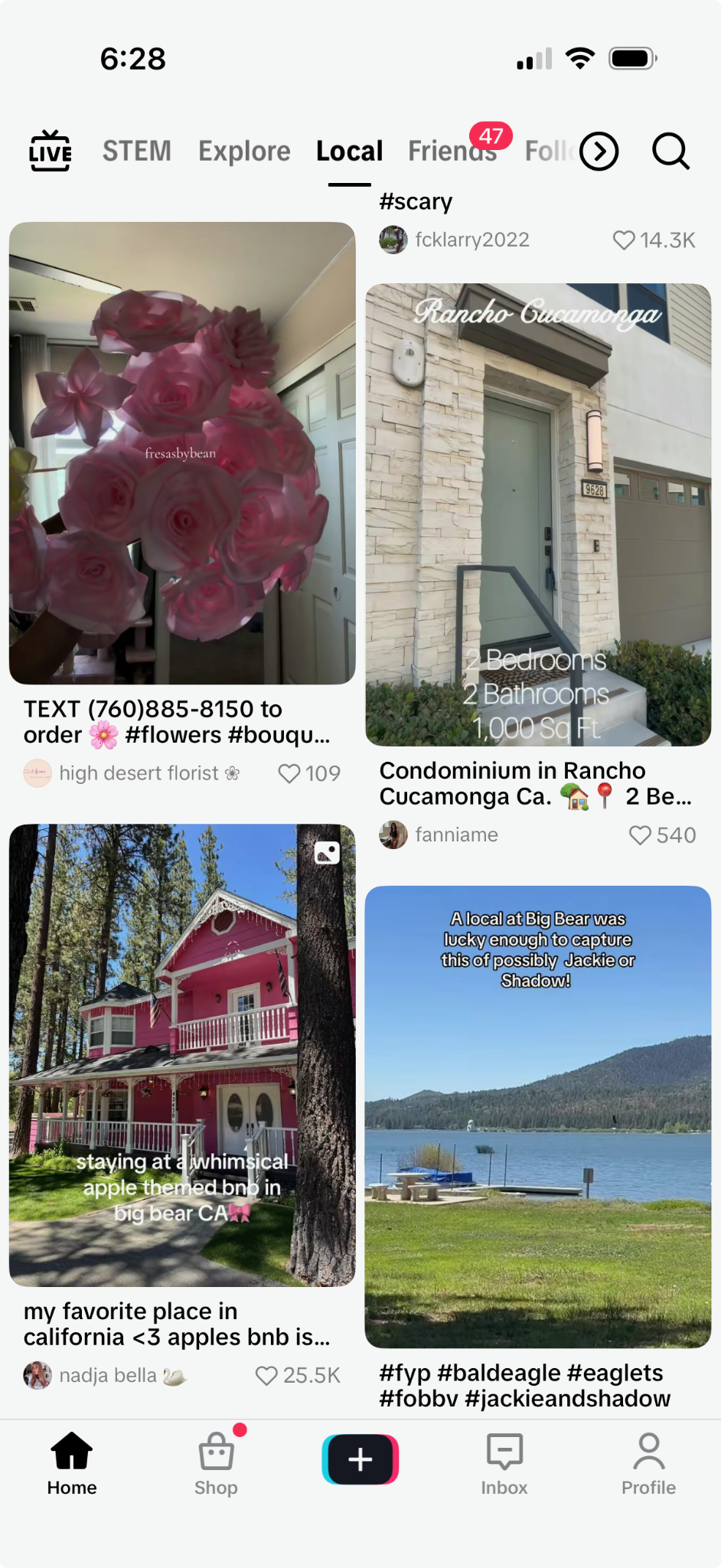
    I also think TikTok recent updates show how seriously the platform wants to be part of the search journey. Many purchase decisions are visual, social, emotional, and trust-driven, which is exactly where TikTok has strength. With Local Feed, AI summaries, creator reviews, and shopping features, TikTok is trying to meet people at the moment they are exploring, comparing, and deciding.

    So instead of asking whether TikTok is a traditional search engine, I ask a more useful question: how do I make sure people can find, understand, trust, and choose a brand wherever their search journey begins? More often than many marketers want to admit, that starting point may be TikTok.

    TikTok SEO Is More Than Hashtags Now

    I think of TikTok SEO much like traditional SEO: it is the work of making a business, place, product, service, or experience easier to discover. As TikTok has evolved, the discovery surfaces have expanded far beyond captions and hashtags.

    In the past, I mostly associated TikTok optimization with captions, hashtags, trending sounds, posting times, and the hope that a video would land on the For You feed. Those pieces still matter, but they are no longer the full picture.

    Image

    Today, I have to think about TikTok Search, recommendations, Local Feed, Places, reviews, comments, creator content, visual cues, product signals, and AI-assisted discovery. A stronger TikTok SEO strategy now includes search query relevance, spoken topic clarity, on-screen text, captions, hashtags, location context, creator reviews, comments, product visuals, and the searches people make after seeing a video.

    TikTok documentation says search results can be shaped by how well content matches a query, along with hashtags, sounds, user interactions, language, and location. The For You feed also weighs user interactions, content information, user information, and watch behavior, which means usefulness and engagement both matter.

    Local Feed Creates a New Discovery Surface

    TikTok launched Local Feed in the U.S. on Feb. 11 as a home-screen tab for nearby content related to travel, events, restaurants, shopping, small businesses, and local creators. TikTok says posts can appear based on location, topic, and when the content was published.

    I see Local Feed as another organic discovery touchpoint, especially for local businesses. A restaurant can appear while someone is deciding where to eat nearby. A wellness club can show up when someone is looking for weekend plans. A venue can answer practical before-you-go questions before a guest ever reaches the box office.

    There are limits I would keep in mind. TikTok precise location setting is optional, off by default, available only for users 18 and older, and still rolling out across the U.S. TikTok also says private accounts, accounts for users under 18, and posts limited to Friends or Only You will not appear in Local Feed.

    Image

    Local Explorer Shows TikTok Is Investing in Places

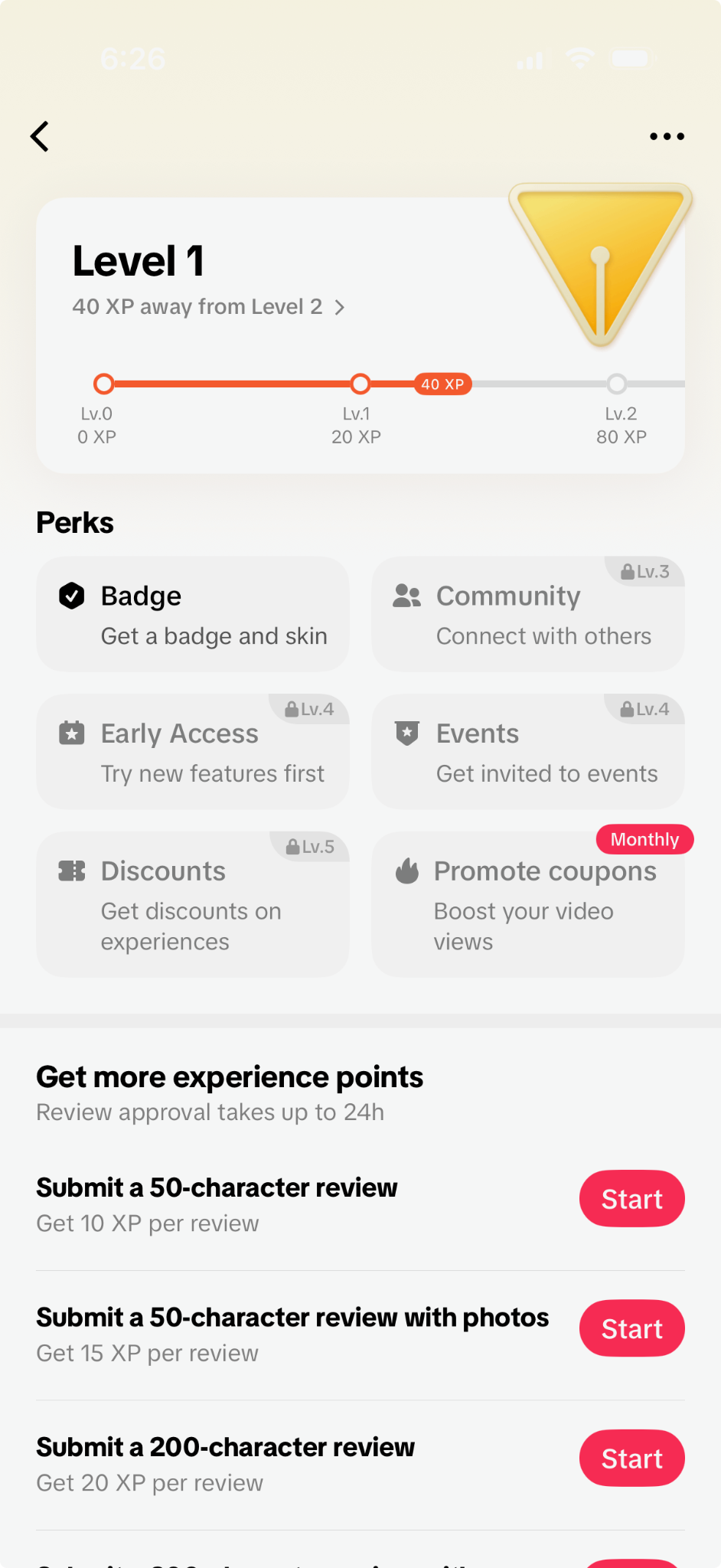
    TikTok Local Explorer Program is one of the clearest signs I have seen that the platform wants to build stronger place-based discovery. The program encourages people to submit location-based reviews and rewards participation with experience points, levels, badges, community access, and other perks.

    I would not assume every market has the same access or level of activity, because availability has been limited and uneven by region. Still, the direction matters: TikTok is building more ways for users to evaluate places inside the app.

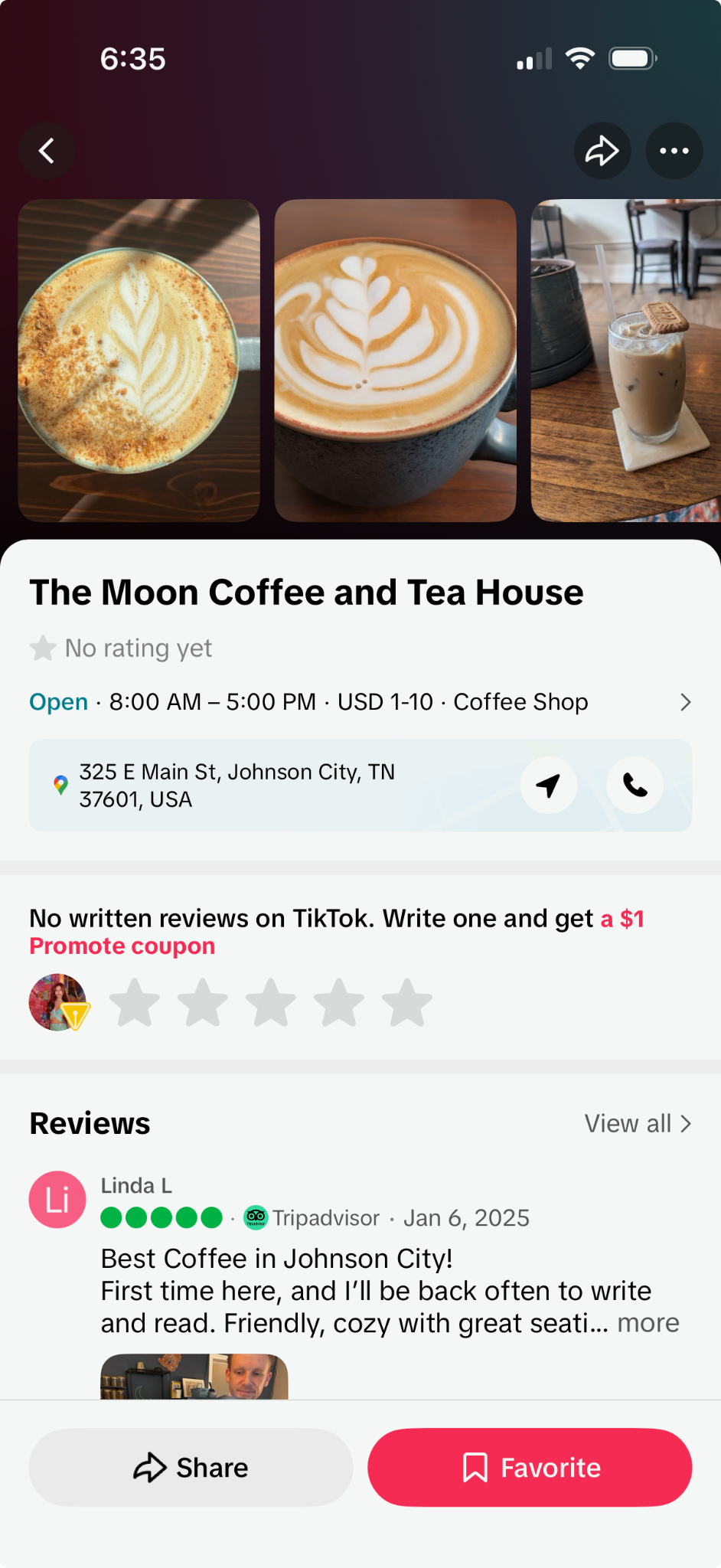
    I have also seen TikTok incentivize reviews for places that do not already have TikTok reviews. In one example, a coffee shop had no TikTok reviews, and I was offered a $1 Promote coupon to leave one.

    When a place does not have native TikTok reviews, I have seen TikTok pull reviews from TripAdvisor and, in some cases, Google. That makes the Places tab a useful comparison surface where people can evaluate reviews, videos, and comments before deciding whether to visit a local business.

    Visual Search Links Matter More Than Exact Keywords

    TikTok increasingly adds automated search links and related query prompts beneath videos. I pay attention to these because they show how TikTok can connect a video to a broader topic, place, or product discovery path.

    Image

    For example, a video about a place like Glen Ivy may show a search bar at the bottom that lets users explore more related content. Those search bars can appear even when a creator has not overloaded the description with exact-match keywords, which tells me TikTok is reading more than just captions.

    TikTok Shop Turns Discovery Into Buying

    With TikTok Shop, someone can see a product in a video, search for it, compare it through comments and creator content, and buy it without leaving the app. That makes TikTok more than a discovery channel for ecommerce brands; it can become part of the full purchase path.

    I would optimize TikTok Shop content around the information TikTok needs to understand a product. Search relies heavily on how well a shopper query matches product information such as titles, categories, attributes, and content context.

    TikTok Shop has also released Shoppable Photos in beta for select sellers. Eligible sellers can create image-based posts, include multiple photos, and tag products directly in the post. These posts may appear in the For You feed, Search, and the Shop tab, giving sellers a simpler way to showcase inventory without producing a full video.

    AI Is Becoming Part of TikTok Discovery

    I am also watching TikTok AI-assisted discovery features closely, even though availability varies by market, account, and test. Features such as Tako, AI Overviews, Quick Highlights, AI summaries, and Content Studio all point in the same direction: TikTok wants to help users search, summarize, and create faster.

    Image

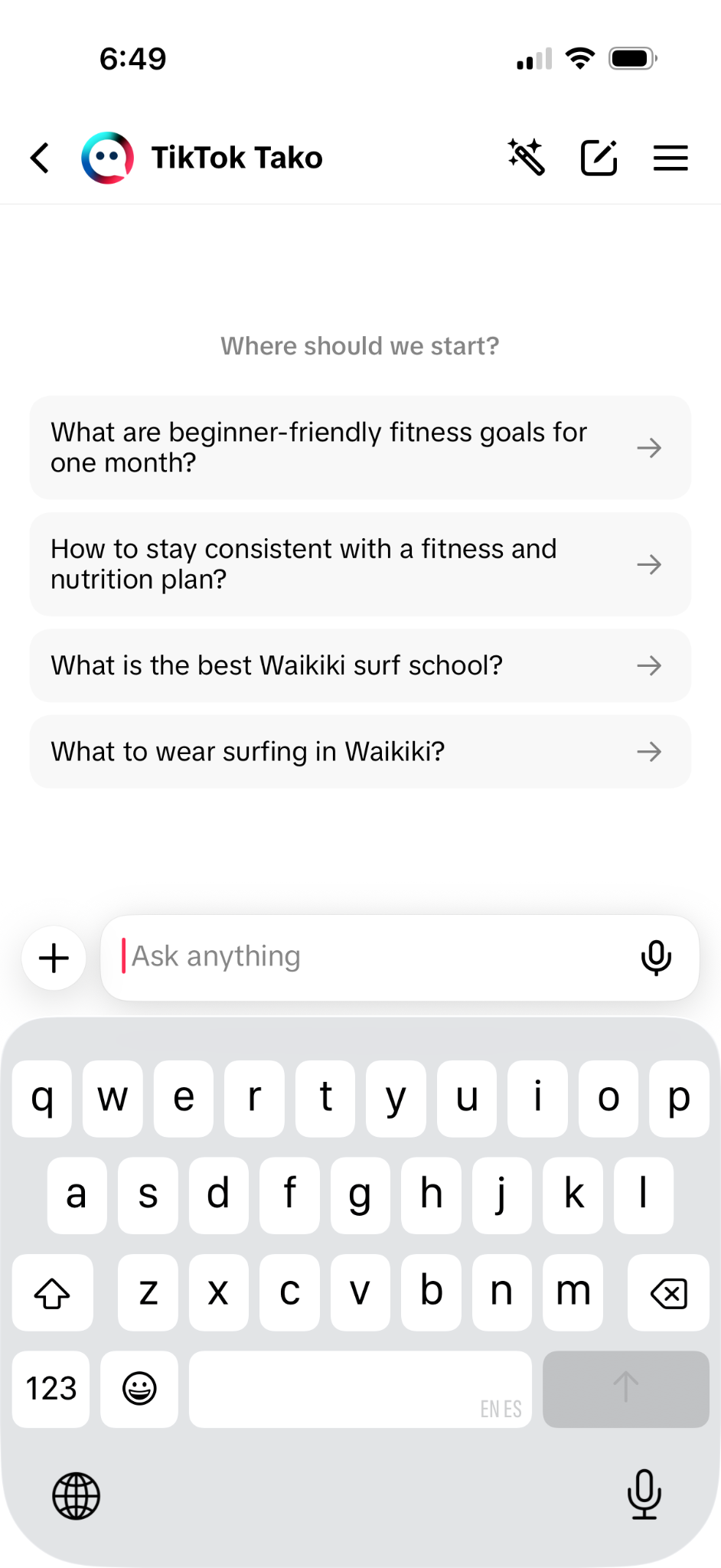
    Tako is TikTok chatbot, and it lets users search in a way that feels similar to using the app search bar. It can surface relevant TikTok videos and external sources, including articles.

    TikTok also now offers AI Overviews for some searches. When users search a topic, they may see an AI-generated summary of the results. If they click a visual search bar, they may also see Quick Highlights that summarize that search experience.

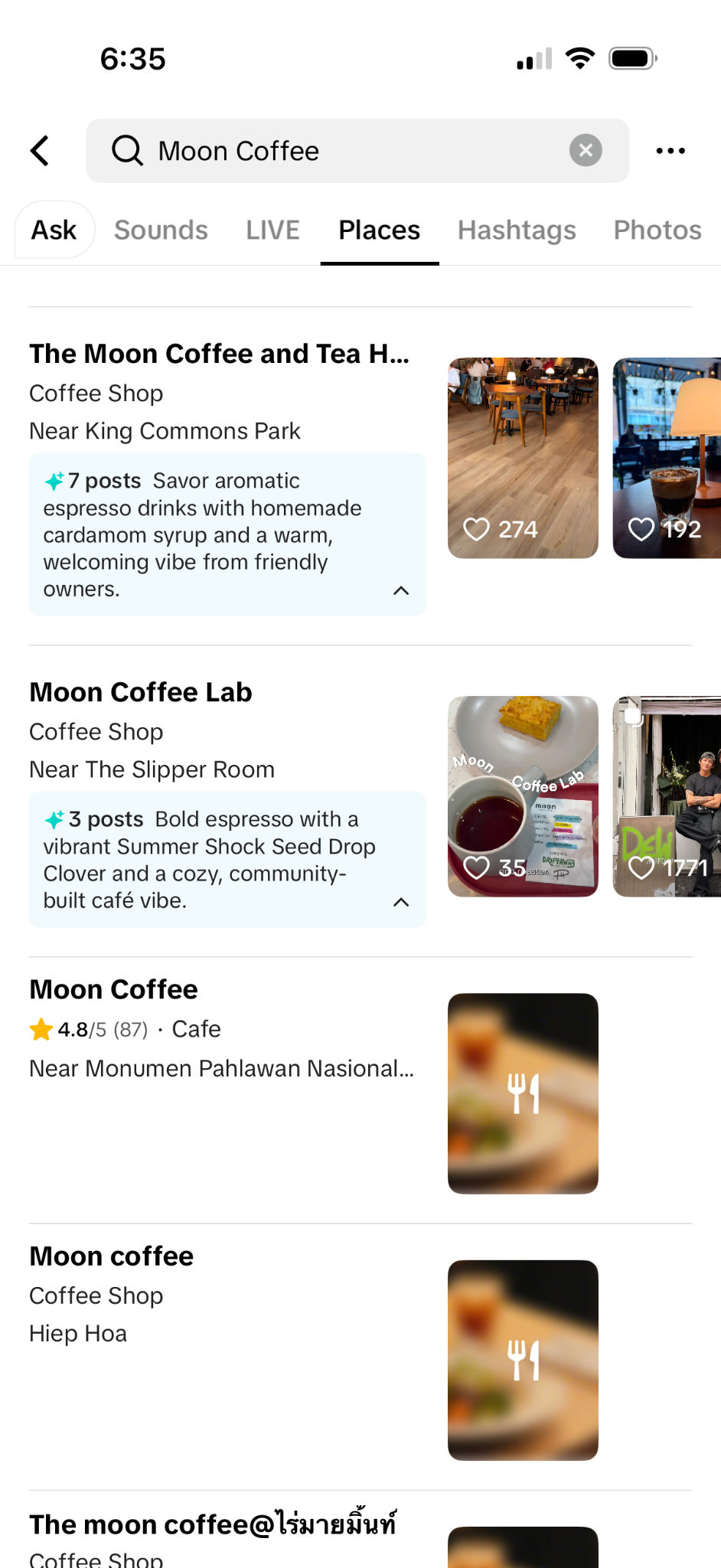
    The Places tab includes AI summaries too, and users can see how many posts were used to generate a place summary. For local businesses, that makes the quality and clarity of creator posts, customer videos, and reviews even more important.

    On the creator and seller side, TikTok AI tools can help generate captions, hashtags, and even videos. I would treat these tools as helpful support, not a substitute for real strategy, because features like Content Studio are still not available to everyone and remain in testing.

    How I Would Improve Visibility on TikTok

    On TikTok, visibility comes from what people search for, what TikTok can understand, and what the camera actually shows. That means I would focus less on cleverness and more on showing people what they need to see before they choose a business, product, or place.

    Image

    For restaurants, I would show menu items, exterior signage, the dining room, takeout packaging, seasonal dishes, and neighborhood cues. Those visuals help both users and TikTok understand what the place offers and where it fits.

    For retail, I would show product displays, packaging, try-ons, shelf layout, gift ideas, and the storefront. The more clearly a video communicates what is available, who it is for, and where someone can get it, the stronger the discovery signal becomes.

    I would also build simple habits into every TikTok content workflow: use location context naturally, show products clearly, show the storefront or interior when relevant, mention the city or neighborhood when it helps, create timely content around local moments, tag the physical location when appropriate, and work with creators who already understand discovery-driven content.

    Keyword Research

    I would start TikTok keyword research inside the app because that is where the search behavior is happening. Seed topics might include best brunch, World Cup outfits, things to do in [location], wedding inspiration, or gluten-free bakery.

    From there, I would search each phrase on TikTok, document autocomplete suggestions, review suggested filters, look for Others searched for prompts, study top videos, and pay close attention to comment themes. I would also test city and neighborhood modifiers, then compare TikTok findings with Google Search Console, Google autocomplete, Reddit, YouTube, and site search data.

    Image

    TikTok Creator Search Insights can add another useful layer by showing personalized information about search topics, content gaps, and how content tied to searched topics is performing.

    Keyword Placement

    I would place the core topic where TikTok and viewers can recognize it quickly: in the first few seconds of the video, the first text overlay, the opening of the caption, relevant hashtags, location tags, pinned comments, reply videos, the profile bio, playlist names, and creator briefs.

    Comments and Reviews

    I would treat comments and reviews as visibility assets, not afterthoughts. That means pinning genuinely helpful comments, replying to repeated questions with videos, correcting misinformation when trust is at stake, watching for recurring objections, and turning repeated questions into FAQs, landing page content, Google Business Profile posts, and future videos.

    A creator saying that a bakery is the best gluten-free option in Portland because it takes cross-contamination seriously may be more useful than a generic five-star review. That kind of specific language can shape website copy, FAQ strategy, and customer messaging.

    Referral Traffic and Branded Search

    I would track TikTok referral traffic and monitor branded searches over time. When a TikTok post performs well, I would annotate it and compare branded search trends against a baseline.

    I would look for directional movement in branded clicks, branded impressions, TikTok referral traffic, Google Business Profile actions, and engagement on related pages. At the same time, I would avoid giving TikTok credit for every increase without considering PR, paid campaigns, email, promotions, seasonality, and other marketing activity.

    Attribution may never be perfect, but imperfect measurement does not make TikTok influence meaningless. I would rather measure directional impact than ignore a channel that is clearly shaping discovery behavior.

    I Would Explore TikTok Instead of Ignoring It

    Someone may find a business on TikTok before they ever search for its name on Google or ChatGPT. Someone else may turn to TikTok midway through the journey to decide whether the business is worth the trip, the purchase, or the recommendation.

    Either way, I believe TikTok has earned a meaningful role in modern SEO strategy. Between Local Feed, Places, Tako, AI summaries, creator reviews, and TikTok Shop, the platform keeps adding new ways for businesses to be discovered, and many of those opportunities are still underused.


    Inspired by this post on Search Engine Land.


    crushpress.ai community screenshot
  • Three Google Updates Reshape Search Measurement for Publishers

    Three Google Updates Reshape Search Measurement for Publishers

    Three Google updates reported by CrushPress.AI affect different points in a publisher’s measurement workflow: assessing search demand, checking whether pages can appear in search, and tracking visits after a click.

    Together, the changes make some analysis easier, but they also underline an important distinction: demand, indexability, and on-site traffic are separate signals. Publishers need to read them in sequence rather than treating any one report as a complete account of search performance.

    Key takeaways

    • Google Trends now offers preceding-period comparisons that can put changes in search interest into context.
    • Search Console’s page indexing report resumed updating after a reported three-week delay, restoring fresher diagnostic information.
    • Google Search now sends AMP visitors to publisher-hosted pages instead of presenting cached pages within Google’s AMP viewer.
    • Google reportedly characterized the AMP change as a delivery and measurement update, not a ranking change.

    Google Trends adds context before content decisions

    A content strategist compares two abstract periods of search-interest patterns at a desk.

    Google Trends sits near the beginning of the measurement process. It indicates relative search interest, helping publishers evaluate whether attention around a term or topic is gaining momentum, declining, or following a recurring pattern.

    CrushPress.AI reported that new controls above the Trends timeline can surface changes for periods such as week over week, month over month, and selected year-over-year comparisons. A preceding period can also be overlaid on the chart with a comparison line. This reduces the work required to establish a historical baseline before interpreting a movement.

    The practical benefit is better timing context. A rise in current interest is more meaningful when compared with the immediately preceding interval, while a year-over-year view can help reveal whether apparent momentum may instead reflect seasonality. Trends still addresses audience interest rather than the performance of a publisher’s individual pages, so its findings should guide investigation rather than serve as traffic or ranking evidence.

    Fresh indexing data restores a missing diagnostic layer

    Search Console answers a different question: whether Google can find and index pages on a particular site. Its page indexing report separates indexed and non-indexed pages, provides reasons pages may not be indexed, and can display impressions alongside the indexing chart, according to the source report.

    CrushPress.AI reported that this report had remained stuck on June 11, 2026, for roughly three weeks. As of Friday, July 3, it was displaying information through June 29. The refresh matters because an outdated diagnostic view can make a recent publishing, crawling, or indexing problem difficult to distinguish from reporting latency.

    The episode also offers a measurement caution. When a reporting interface is delayed, the age of its latest data should be checked before teams infer that a recent technical change caused an indexing movement. With fresher data available, publishers can return to examining affected pages and the reasons Search Console assigns, while still separating reporting status from the underlying indexing status.

    Direct AMP visits simplify the post-click measurement path

    A mobile visit follows a single direct path from a search result card to a publisher page and measurement hub.

    The AMP update concerns what happens after a searcher selects a result. CrushPress.AI reported that Google Search now directs AMP users to the publisher-hosted AMP page rather than a cached version displayed through Google’s AMP viewer. Google told the publication that the change should simplify analytics and tracking while reducing some maintenance associated with supporting AMP content.

    This shift can make the measurement path easier to understand because the destination is again the publisher’s own host. It does not, however, establish that AMP pages will gain more visibility. The report explicitly said Google described the change as unrelated to ranking and said the serving and ranking treatment of AMP in Search and Discover would remain the same.

    The distinction is especially important because AMP’s broader search role has already diminished. The source noted that AMP no longer receives preferential treatment in Top Stories and that such pages are encountered less often than before. The update therefore looks less like a revival of AMP as an SEO advantage and more like a cleanup of delivery, ownership, and analytics for publishers that continue to use the format.

    A more coherent search measurement workflow

    Read together, the updates describe three successive layers of analysis. Trends helps establish whether an audience is searching for a subject. Search Console helps determine whether relevant pages are eligible to be discovered through indexing. Publisher analytics then records what visitors do after reaching the site, with the new AMP routing potentially making that last step less complicated.

    This sequence helps prevent common category errors. Increasing search interest does not prove that a site is indexed for the topic. Successful indexing does not guarantee impressions or visits. Cleaner AMP analytics does not indicate a ranking improvement. When the signals diverge, teams can investigate the layer where the break occurs instead of forcing all three into a single performance narrative.

    Publishers should watch whether the refreshed reports remain timely and whether direct AMP delivery produces cleaner on-site data in practice. The durable opportunity is a measurement process that connects market demand, technical visibility, and owned-site behavior while preserving the limits of each signal.

    References

  • How Brands Earn Authority and Citations in AI Search

    How Brands Earn Authority and Citations in AI Search

    AI search visibility is not a single contest for a single ranking. A brand can supply a fact without receiving credit, earn a citation without being recommended, or appear in an answer without generating a visit. The practical challenge is to build authority that survives across those different outcomes.

    The source research points to a connected strategy: follow shifting demand, create evidence that cannot be easily replicated, make that evidence easy to extract and attribute, clarify the entities behind it, and measure what people do after an AI mention.

    AI visibility is a funnel, not a ranking

    Light particles move through transparent funnel stages and branch toward evidence, citation, recommendation, and human interaction points.

    Three outcomes are often grouped under “AI visibility,” although they answer different business questions. A citation identifies a page or domain as a source. A brand mention places the company or product inside the generated answer, with or without a link. Downstream behavior covers what happens next, including branded searches, site visits, browsing, and engagement.

    Try Profound’s discussion of the “AI mention effect” concentrates on that third layer. Its premise is that visibility inside an AI response should be connected to subsequent user behavior rather than treated as an endpoint. This matters because an AI-generated recommendation can influence a decision even when the user does not click immediately or when the cited source and recommended brand are different entities.

    The appropriate success measure therefore depends on the query. For an informational question that an assistant can answer completely, inclusion and attribution may represent most of the available opportunity. For a product or service comparison, a mention can create a new search for the brand, its pricing, reviews, documentation, or product pages. Search Engine Land’s analysis of more than 1 million keywords similarly argued that SaaS and lifestyle queries can retain a downstream search step, while some HealthTech and FinTech questions can end inside the AI interface.

    A useful measurement model keeps these stages separate: presence in the answer, citation ownership, the way the brand is represented, and observable activity after exposure. Combining them into one visibility score can conceal an important failure, such as frequently supplying information while another publisher receives the citation.

    Search demand is moving unevenly across queries and categories

    The broad narrative that AI is simply eliminating search is not supported by the keyword analysis supplied here. Search Engine Land reported that a study of 1,010,848 high-volume keywords across 379 brands and eight verticals found 29% of search volume in measurable decline. Yet the declining keyword set represented about 10.29 billion monthly searches, while growing keywords represented about 10.31 billion. Across a dataset covering 35.4 billion monthly searches, the reported net change was an increase of 16.8 million searches per month.

    Those aggregate figures mask substantial differences. The same analysis reported a 37.7% decline for FinTech and a 15.2% decline for Lifestyle. It also found that 90% of tracked search volume was non-branded, including 99.6% in HealthTech and 98.5% in Wellness. Non-branded informational demand is especially exposed because an assistant can often complete the exchange without sending the user to a separate website.

    Consumer behavior in the study also looked additive rather than purely substitutive: 70% of surveyed consumers said they were using AI more, but only 17% said they were using traditional search less. The reported survey covered 1,004 U.S. consumers, so it should be read as evidence from that sample rather than a universal forecast.

    The strategic implication is not to abandon conventional SEO or apply one forecast to every market. Brands need to distinguish declining generic questions from growing discovery paths and from branded queries that may occur after an AI recommendation. In information-heavy categories, authority inside the answer becomes more important. In categories with a natural evaluation or transaction step, AI mentions, organic rankings, reviews, and branded search can reinforce one another.

    Citation selection changes with reasoning depth and buyer intent

    A brand’s presence in one AI answer does not establish durable authority. Search Engine Land reported that a Semrush and Kevin Indig test produced only 25.6% overlap between domains cited by ChatGPT in minimal- and high-reasoning modes for the same prompts. The study used 100 prompts across 20 buyer journeys in B2B SaaS, finance, consumer technology, and health and lifestyle, with each prompt run once in each mode.

    High reasoning searched more widely in that experiment. It conducted 1,130 web searches compared with 245 in minimal reasoning, while the share of responses containing citations increased from 50% to 68%. Cited responses used an average of 4.5 citations in high reasoning and 2.6 in minimal reasoning. These figures come from a bounded test rather than a complete description of ChatGPT, but they illustrate how a change in answer process can rearrange the source set.

    The source mix also changed. Reddit’s reported citation share fell from 15% to 7%, and user-generated content and review sites declined from 14.3% to 6%. Government and academic sources rose from 1.9% to 8.8%, while official documentation and support pages increased from 12.4% to 17.5%. The result does not make community content irrelevant; it suggests that deeper reasoning may place more weight on sources capable of verifying detailed claims.

    Comparison prompts created the widest retrieval task. High reasoning averaged 24 subqueries and 9.8 citations at that stage, versus 5.5 subqueries and 5.8 citations in minimal reasoning. A single buying question can therefore break into searches for pricing, integrations, security, support, specifications, and documentation. A polished landing page alone is unlikely to answer every part of that research path.

    Authority should consequently be tested across both reasoning depth and buyer intent. The same study found four of 20 high-reasoning journeys in which a brand cited at the problem stage remained visible through selection; minimal reasoning produced no such full-journey persistence. Although the sample is small, the result frames continuity as a more demanding benchmark than winning an isolated prompt.

    An authority system needs evidence, extraction, identity, and corroboration

    A crystalline knowledge object rests on four connected supports while surrounding nodes and source fragments reinforce it.

    Publish evidence the brand is qualified to originate

    First-party product, usage, pricing, or customer data can give a page information that generic commentary cannot reproduce. Search Engine Land cited an On-Page.ai study of 150 top-three Google pages across 50 keywords and 10 verticals. Pages with no more than one unique figure averaged an information-gain score of 40.2, while pages with at least 15 unique figures averaged 62.1. The study concerned conventional organic results rather than AI citations, so it supports an originality argument without proving that proprietary data automatically earns AI attribution.

    An executive perspective in First Page Sage’s interview with Thesis founder Dan Freed reaches a compatible conclusion from a different angle. Freed argued that authority depends on checkable substance such as named mechanisms, specific ingredient forms, studies, and customer data. That is a founder’s stated philosophy rather than independent validation of the products discussed, but it illustrates what defensible specificity looks like in a category filled with broad claims.

    Make important claims easy to extract

    Original ownership does not guarantee citation ownership. An aggregator can restate a benchmark more clearly and become the source an AI system selects. In a separate analysis of 18,012 verified ChatGPT citations, Search Engine Land reported that 44.2% came from the first 30% of a page. The 10% to 20% band attracted the most citations across seven verticals, while the final 10% accounted for only 2.4% to 4.4%.

    Those findings favor an answer-ready research structure: surface the principal result early, define the metric beside it, state the population and comparison, and provide a compact methodology. The percentages should not be treated as a universal page-design formula, but the broader lesson is robust: a buried or undefined number is harder to retrieve and attribute confidently.

    Clarify the entities and relationships behind each claim

    The GraphRAG account adds an identity layer to the content problem. As described by Search Engine Land, GraphRAG supplements text retrieval with a knowledge graph whose nodes represent entities and whose edges represent relationships such as a company offering a product, holding a certification, or operating in a region. Entity resolution can consolidate alternate names instead of scattering signals across several apparent identities.

    This helps explain why strong prose may still be passed over for a complex question. A retrieval system needs to determine not only that several facts are relevant, but that they apply to the same company, product, person, place, and time. Consistent naming, explicit authorship, clear product-company relationships, qualified claims, and supporting documentation reduce the amount of inference required. The GraphRAG article characterizes this as a response to disambiguation, attribution, and relationship problems, not merely a call to produce more content.

    Build corroboration beyond the original page

    A primary source still benefits when reputable third parties discuss its research accurately, even if one of those publishers occasionally receives the direct citation. External coverage can reinforce the association between the brand, its evidence, and the topic. Official documentation supports verification; independent reporting supplies corroboration; and community discussion can reveal real-world experience. The reasoning-mode study indicates that their relative weight may change by prompt, category, and answer process.

    Measurement should follow the same layered design. Prompt tracking can show whether a brand is mentioned, cited, represented correctly, and carried across buyer-journey stages. Web analytics and search data can then test for visits, branded demand, and engagement after exposure. No single metric establishes causation on its own, but the combined evidence is more useful than treating citation count as the final business outcome.

    Key takeaways

    • Separate citations, brand mentions, representation, and downstream behavior; each measures a different part of AI visibility.
    • Audit demand by query type and vertical because AI exposure is much greater for some informational and non-branded searches than for transactional paths.
    • Test visibility across reasoning modes and buyer stages instead of assuming that one successful prompt represents durable authority.
    • Publish defensible first-party evidence, then surface its result, definition, scope, and methodology where retrieval systems can find them.
    • Use consistent entities, explicit relationships, official documentation, and credible external corroboration to make claims easier to verify and attribute.

    The next advantage in AI search will come less from chasing a fixed citation formula than from building a body of evidence that remains identifiable, retrievable, and credible as interfaces and retrieval methods change.

    References

  • Fabrice Canel Leaves Microsoft Bing After Iconic Run

    Fabrice Canel Leaves Microsoft Bing After Iconic Run

    After nearly 30 years at Microsoft, I am seeing one of Bing’s most influential search leaders close a remarkable chapter. Fabrice Canel announced that he is retiring from Microsoft, writing on LinkedIn, “I am retiring from Microsoft, effective today July 1st.” He also reflected, “Today marks nearly 30 years with Microsoft. Thirty years…”

    When I think about Fabrice Canel’s impact, I think first about the foundation of Microsoft Bing Search. He was responsible for indexing at Bing, including crawling, URL discovery, content selection, and content processing. Those areas are core to how search engines understand the web, and Fabrice helped shape them at massive scale.

    He was also the person behind the IndexNow initiative, and he played a major role in creating and powering Bing Webmaster Tools. For anyone working in SEO, publishing, or technical search, those contributions matter because they helped make discovery, indexing, and webmaster communication faster and more practical.

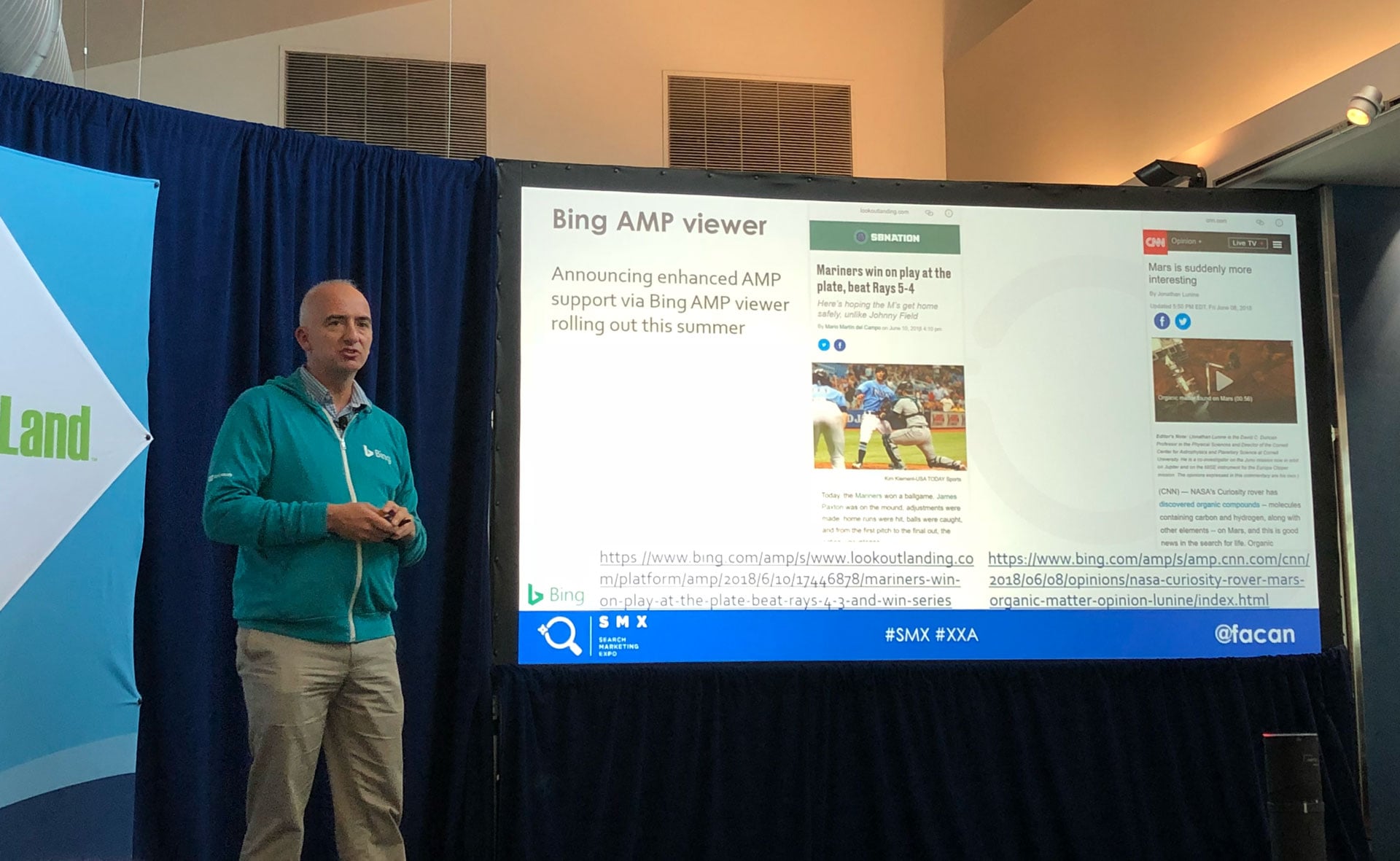
    I have watched Fabrice contribute far beyond product work. He has spoken at countless industry events, including SMX, and has written extensively about how search works, how sites can perform better in Bing, and how search is evolving with generative AI. He helped run one of the world’s most important search engines, while also giving the SEO community tools, education, and direct insight.

    In his retirement message, Fabrice addressed fellow Microsoftees, engineers, attorneys, marketers, webmasters, publishers, SEO champions, product leaders, journalists, people across search and AI, and even friends at Google. His note was warm, personal, and full of gratitude for the people who shaped his Microsoft journey.

    He described his three decades at Microsoft as a wonderful adventure, from solving real business problems with IndexNow to helping webmasters and publishers thrive in the constantly changing world of SEO and AI. He thanked colleagues, partners, publishers, and the people he trained and mentored, saying they are ready to carry the mission forward.

    Fabrice also shared that, after many conversations with family and friends, he decided to take advantage of Microsoft’s Voluntary Retirement Program. His message ended with the same sense of warmth and storybook style that many in the industry have come to associate with him: gratitude for Microsoft, confidence in the Bing team’s future, and a final wish that everyone stay curious, keep innovating, and make content easier to find.

    Why do I care so much about this? Because Fabrice has been a true friend to the search industry. His work will live on through the products, systems, and initiatives he helped create, and his willingness to share knowledge has made a lasting difference for SEOs, publishers, developers, and search professionals.

    I know Fabrice has trained a team to continue the work, and I believe Bing remains in good hands. Still, I would be lying if I said I am not sad to see him retire. It has been an honor to work with him and learn from him over the years, and his legacy at Microsoft Bing will be felt for a long time.


    Inspired by this post on Search Engine Land.


    crushpress.ai community screenshot
  • Google Clarifies Age Estimation Ads Policy for Advertisers

    Google Clarifies Age Estimation Ads Policy for Advertisers

    I’m watching Google update its advertising policy to make clearer how certain ads are limited while the company estimates a user’s age. The change gives advertisers more transparency as Google expands its age assurance technology worldwide.

    What I’m seeing: Google has renamed its Default Ads Treatment policy to “Categories restricted while Google is estimating a user’s age.” To me, that wording matters because it makes the policy sound less like a permanent restriction and more like a temporary safeguard while Google’s systems work out whether a user is old enough to see certain types of ads.

    What’s changing: I see three main updates here: the policy has a clearer name, the language now emphasizes that these protections are interim measures during the age estimation process, and enforcement remains unchanged.

    What’s different: Google has also narrowed the list of ad categories restricted while a user’s age is being estimated. Previously, the restricted categories included adult content and pornography, alcohol, gambling, and shocking content.

    Under the updated policy, I now see only three restricted categories: adult content and pornography, alcohol, and gambling. Shocking content no longer appears on that restricted list.

    Why I care: This update does not introduce new advertising restrictions, but it does make the policy easier to understand. For advertisers in affected verticals, the key takeaway is that these limits are tied to Google’s age estimation process, not a broader or permanent policy shift.

    The bottom line: I do not see any operational change for advertisers, but Google’s updated policy makes it much clearer that restrictions on adult, alcohol, and gambling ads are temporary safeguards while a user’s age is being estimated.


    Inspired by this post on Search Engine Land.


    crushpress.ai community screenshot
  • Google Ads All Campaigns Redesign Makes Navigation Easier

    Google Ads All Campaigns Redesign Makes Navigation Easier

    I’m seeing Google Ads roll out a redesigned All Campaigns selector, and the goal is clear: make it easier to move through large, complicated account structures without wasting time hunting for the right campaign.

    What’s happening is that Google is refreshing the All Campaigns selector across Google Ads with a cleaner layout and better navigation tools. For advertisers who manage bigger accounts, this should make day-to-day campaign work feel more organized.

    The selector has also been moved to a new location in the interface, which means I’d expect some advertisers to need a short adjustment period before the new placement feels familiar.

    The biggest improvement I notice is the new expandable hierarchy view. Campaigns now appear in a structure that makes campaign groups and nested setups easier to browse, especially when an account has grown beyond a simple list of campaigns.

    Google has also added search inside the selector, which should help advertisers quickly find specific campaigns or campaign groups instead of manually scanning through long account lists.

    Image

    Why I care: this update could save meaningful time for anyone managing large Google Ads accounts. When campaigns are split across multiple groups or complex organisational structures, faster navigation can make daily optimization work less frustrating.

    The bottom line is that Google’s redesigned All Campaigns selector is meant to streamline campaign management with a clearer hierarchy and built-in search, helping advertisers navigate complex accounts more efficiently.

    The update was first spotted by performance marketer Vivek Gupta on LinkedIn. Since the rollout is gradual, I would not expect it to be available in every Google Ads account immediately.


    Inspired by this post on Search Engine Land.


    crushpress.ai community screenshot
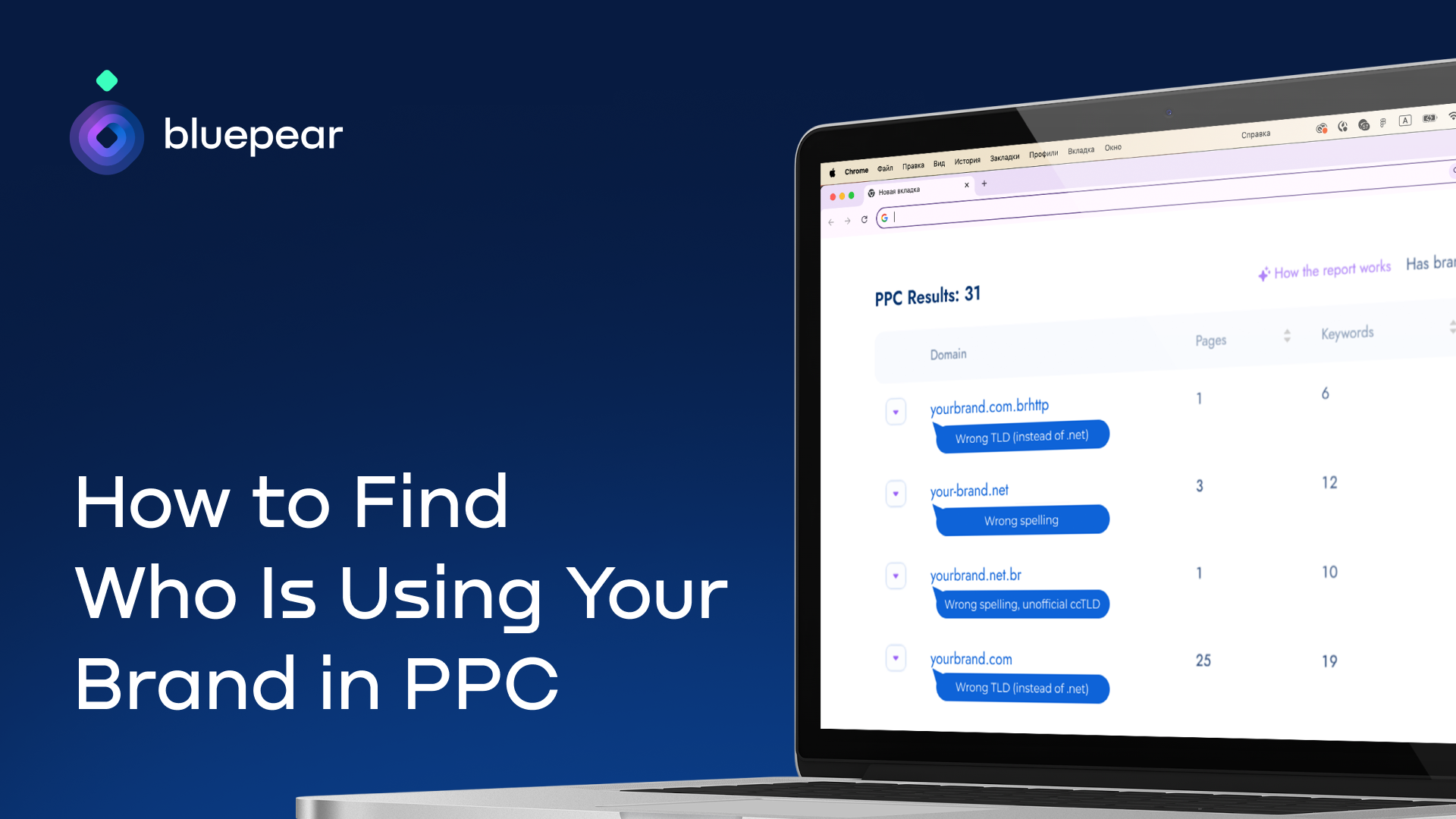
  • How I Find Who Is Using My Brand in Paid Search Ads

    How I Find Who Is Using My Brand in Paid Search Ads

    I know competitive brand bidding is now a common PPC tactic, but that does not mean I treat it as harmless background noise. When competitors, affiliates, coupon sites, or misleading advertisers show up on branded searches, they can inflate CPCs, divert high-intent traffic, and confuse people who were already looking for my brand.

    I have seen how much difference visibility can make. Industry examples show that brands often uncover meaningful CPC inflation once they start tracking competitor bidding, affiliate activity, and trademark misuse. In documented cases, brands reduced branded CPCs by 25% to 75% after identifying infringing advertisers and enforcing their policies.

    In this guide, I walk through how I monitor branded keywords, identify who is advertising on them, and decide what actions may be available based on the evidence I find.

    Choosing Keywords So I Do Not Miss Hidden Activity

    When I want to find out who is using my brand in search ads, I start by deciding which keywords I need to monitor.

    The biggest mistake I try to avoid is watching only my exact brand name. That is a useful starting point, but it rarely shows the full picture. Some advertisers deliberately target brand-related coupon, discount, review, or alternative queries because those searches often come from high-intent users and attract less scrutiny.

    For example, someone searching for “Brand coupon” or “Brand discount code” may be much closer to buying than someone searching for the brand alone. Those queries often attract coupon affiliates, loyalty sites, and unauthorized advertisers trying to intercept branded traffic.

    I also pay attention to searches that include terms like “reviews” or “alternatives,” because those queries can bring in competitors and comparison sites that position themselves directly against my brand.

    Image

    Misspellings matter too. Some advertisers target spelling variations because they are less likely to be monitored and may face less competition.

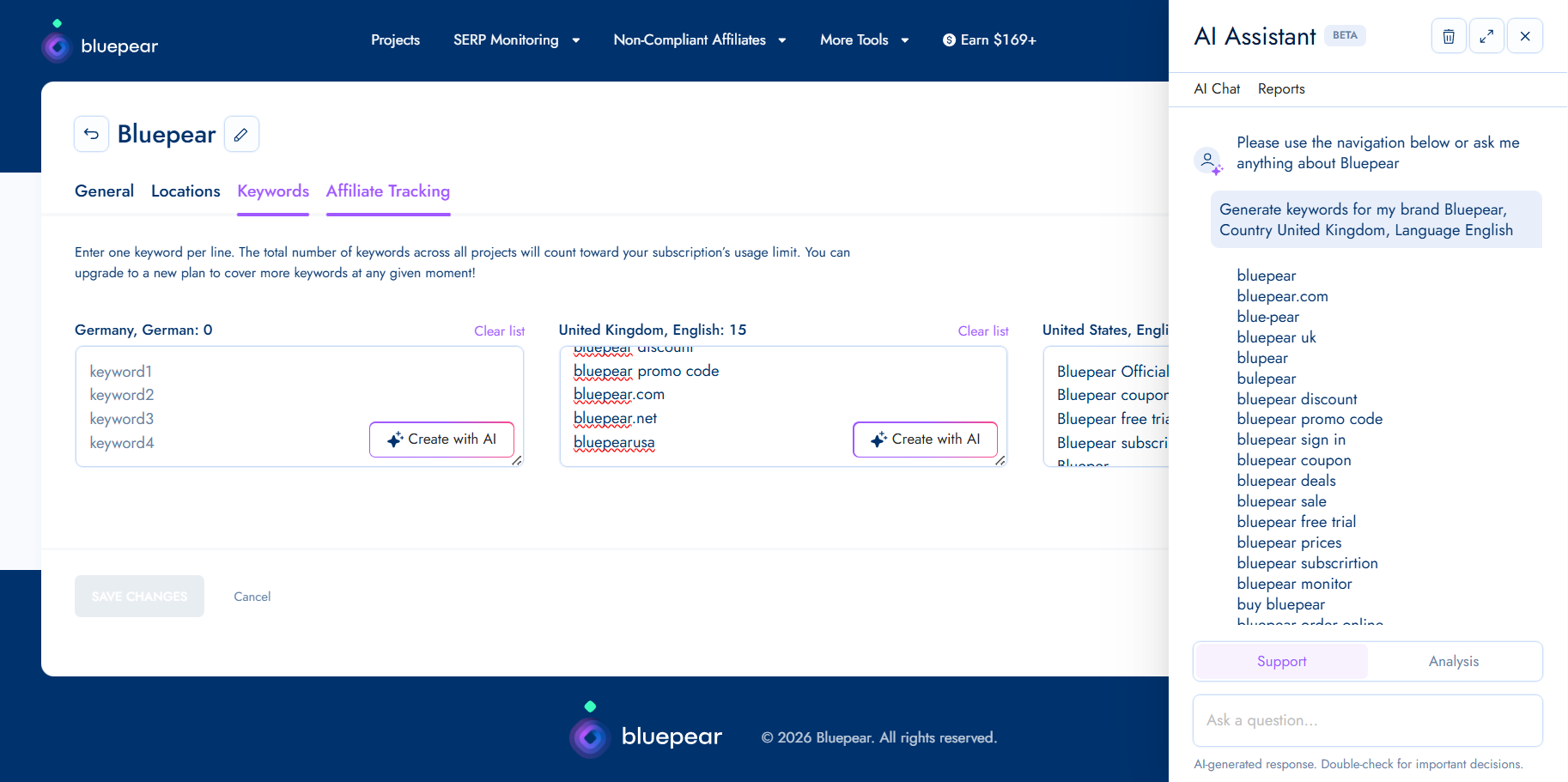
    For a solid monitoring setup, I include my core brand name, “official page” and “login” variations, coupon and promo-code searches, review and alternative searches, commercial terms such as “buy,” “order,” and “sign up,” common misspellings, and localized versions of my brand name.

    If I am using Bluepear, its built-in AI assistant can generate keyword suggestions from this kind of list and help me expand coverage faster.

    The number of terms I monitor depends on the size of the brand portfolio, including trademarks, local branches, and product names. For many small to medium-sized brands, I would start with about 20 keywords and then expand as new risks, markets, and opportunities appear.

    Choosing Locations and Monitoring Frequency

    I do not rely on a single search from my office, on my device, at one moment in time. Search results are too dynamic for that. Two people searching the same branded keyword can see completely different ads and organic listings depending on their location, device, timing, and other variables.

    I also assume that some advertisers may be trying to hide their activity. A fraudster or an affiliate violating my PPC policy might run ads outside normal business hours to reduce the chance of being caught. If I only check manually during the workday, I may never see those ads.

    Image

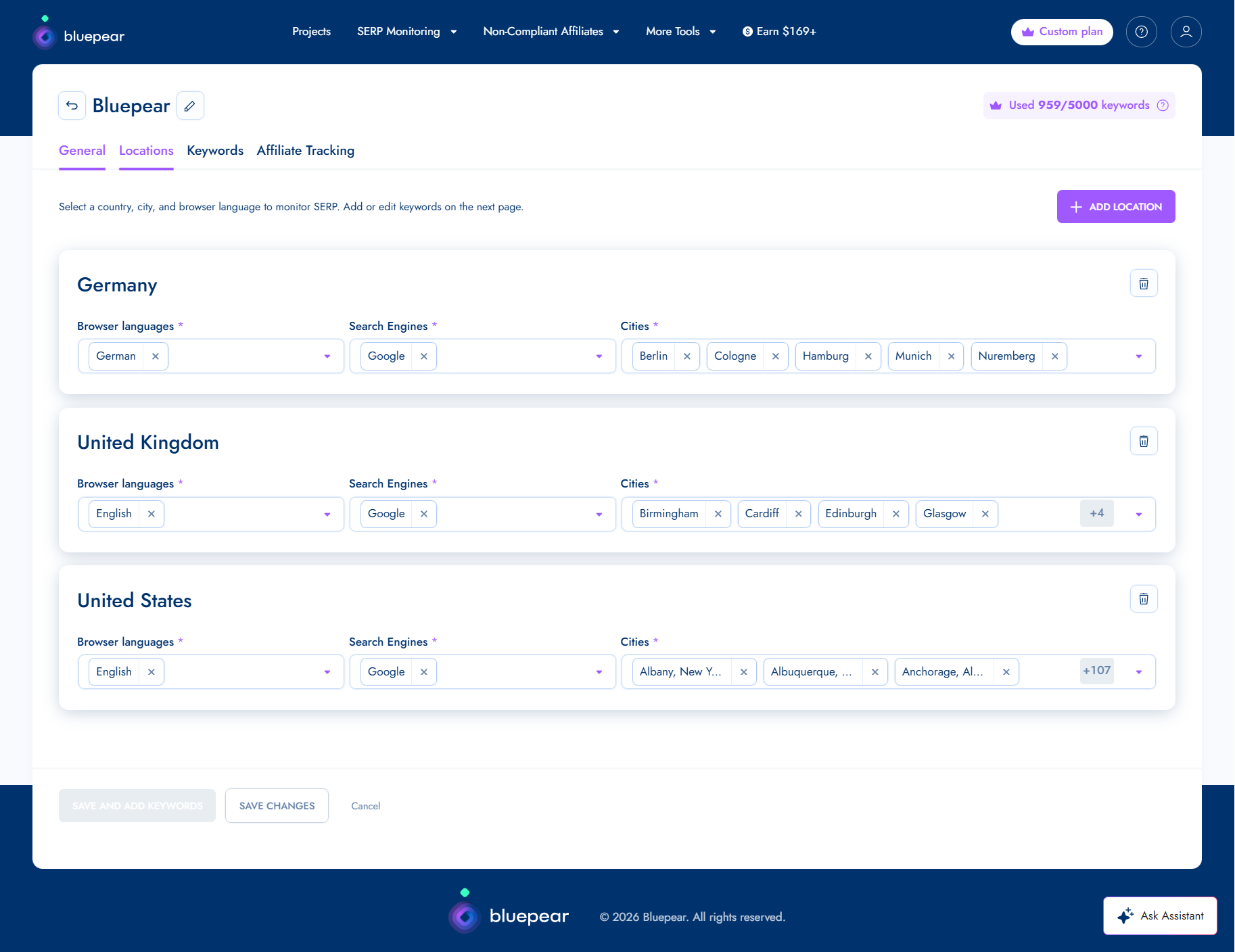
    When I monitor branded search results, I look across the countries and markets where my brand operates, regional differences within those markets, mobile and desktop results, different times of day, and weekday versus weekend activity.

    Frequency matters just as much as coverage. Some violations appear briefly and then disappear. Running checks multiple times throughout the day gives me a better chance of capturing activity that would otherwise go unnoticed.

    Tracking all of these variables manually can become tedious, especially when a brand operates across multiple markets. Bluepear accounts for locations, devices, time zones, and redirects that can obscure the true destination of traffic. I can set the parameters once and gain continuous visibility without turning monitoring into a weekly time sink.

    Reviewing Search Results and Recording Evidence

    I do not assume every advertiser bidding on my branded keywords is breaking a rule. Competitors may be allowed to bid on branded keywords if they do not use my trademark in their ad copy. Affiliates may also be authorized to promote my brand under specific program conditions.

    Still, I need to know when an advertiser’s behavior crosses the line from legitimate brand bidding into trademark misuse, policy violations, or customer deception.

    The first signal I investigate is trademark use in ad copy. If the ad mentions my brand name in the headline or description, and my trademark rules or affiliate policies restrict that use, I treat it as a possible compliance issue.

    Image

    I also look for misleading claims. Phrases that imply the advertiser is “official,” references to exclusive offers, or language that suggests authorization when none exists can confuse users and deserve review.

    Coupon and discount promotions need special attention. I verify whether the advertised discount, promo code, or offer is legitimate, because some affiliates use expired, misleading, or fabricated offers to win clicks.

    I also watch for impersonation signals. Some ads and landing pages are designed to resemble a brand’s official website. Even if the advertiser does not directly claim to be my company, that kind of presentation can still confuse users and divert branded traffic.

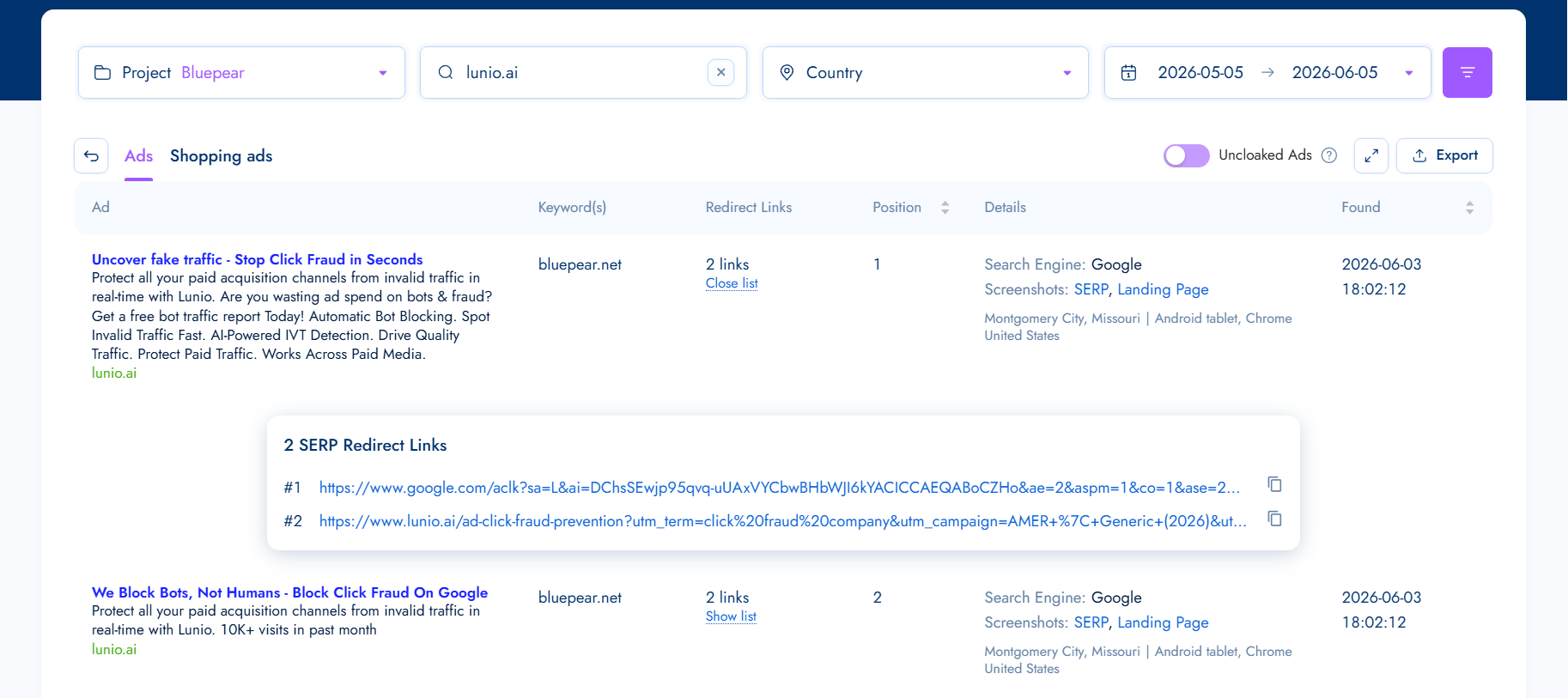
    Because advertisers can change ad copy, pause campaigns, or remove landing pages at any time, I collect evidence quickly. I record the ad copy, SERP position, triggering keyword, location, URLs, redirects, landing page content, and timestamps.

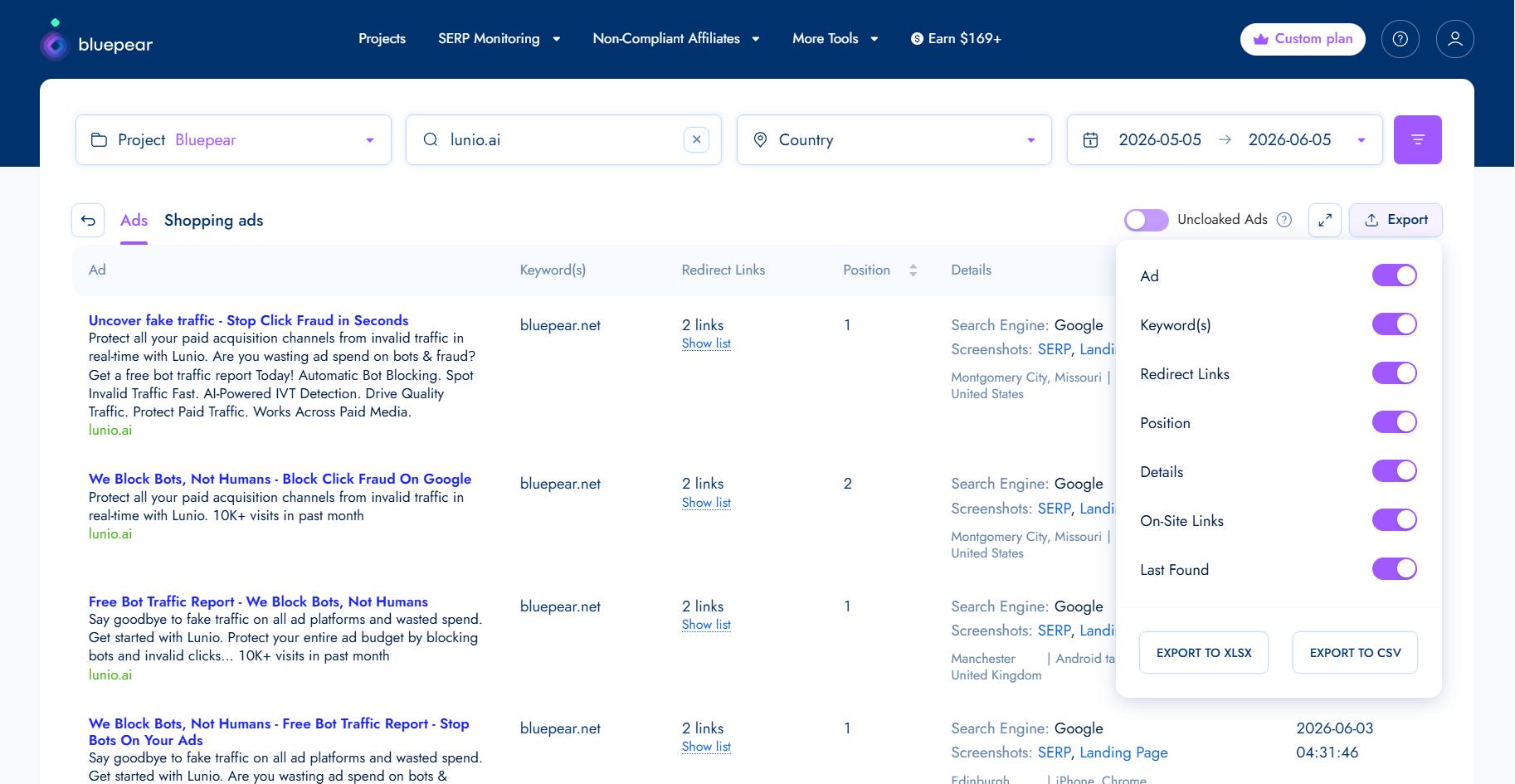
    Bluepear can handle this automatically by compiling a report with the relevant details, which makes follow-up easier when I need to contact an affiliate, review a competitor’s behavior, or escalate a trademark issue.

    Identifying Who Is Behind the Activity

    Sometimes I cannot immediately tell whether an advertiser is a competitor, an affiliate, a coupon site, or something riskier. Branded search results often include multiple participants with different motivations, so I need to understand who I am dealing with before I decide what to do next.

    Image

    I look for patterns. A direct competitor domain usually points to competitor bidding. A coupon or cashback page may indicate an affiliate, coupon site, or loyalty site. Affiliate network tracking links often suggest affiliate activity, although they can also appear in more questionable setups. Product comparison pages often point to competitors or comparison publishers.

    Other signals raise the risk level. If an ad uses my trademark, claims to be “official,” sends users through multiple redirects, promotes coupon codes I cannot verify, or lands on a page that imitates my brand’s design or messaging, I investigate more carefully.

    No single signal gives me a definitive answer. I combine multiple pieces of evidence before drawing conclusions. Once I know who is advertising on my brand terms, I can move beyond detection and decide whether their activity aligns with my policies and business goals.

    What I Do Next

    After I identify who is advertising on my brand terms and review their ads, the next step is choosing the right response.

    Competitor Brand Bidding

    Not every competitor bidding on my branded keywords requires immediate intervention. Before acting, I ask how often the competitor appears, which keywords they are targeting, whether they are using trademarked terms in ad copy, and whether they are sending users to comparison content or direct offers.

    In many cases, I monitor the activity and evaluate its business impact over time. Documenting patterns helps me establish a baseline, which can support future compliance reviews or legal conversations if escalation becomes necessary.

    Image

    Affiliate Violations

    If an affiliate is bidding on restricted branded keywords or violating program rules, I gather evidence and contact the affiliate or network. My workflow is straightforward: document the violation, verify the affiliate ID, share the evidence, request removal or corrective action, and apply program enforcement measures if needed.

    Screenshots, timestamps, and redirect data make those conversations much easier because I can show exactly what happened, where it happened, and when it was detected.

    Trademark Misuse

    Trademark-related issues require careful review. I look for unauthorized trademark use in ad copy, ads that create confusion about brand affiliation, impersonation attempts, and misleading claims that the advertiser is an official brand representative, partner, or reseller.

    The right response depends on the circumstances, internal policies, and applicable laws. In many jurisdictions, competitors are generally allowed to bid on trademarked keywords. However, ads that confuse users about the advertiser’s relationship with my brand may raise trademark or unfair competition concerns, depending on the facts and local law.

    The advertising platform’s policies matter too. Google allows advertisers to bid on trademarked keywords, but it may restrict trademark use in ad text when a valid trademark complaint is submitted. Google also prohibits ads that use trademarks in a confusing, deceptive, or misleading way.

    Before I take action, I collect as much evidence as possible, including screenshots, detection timestamps, URLs, redirects, and landing page content. Once the facts are documented, I may contact the advertiser directly, submit a trademark complaint to the advertising platform, send a cease and desist letter, or escalate through legal channels if necessary.

    Why I Keep Monitoring Brand Search

    The main lesson is that branded search protection is not a one-time audit. Affiliates can activate and pause campaigns throughout the month. Some violations appear only on weekends, outside business hours, or in specific markets. An advertiser that disappears today may return next week with new ad copy, a new domain, or a different affiliate account.

    That is why I treat brand protection as an ongoing process. Occasional searches are not enough. I need consistent monitoring and a repeatable investigation workflow that shows who is appearing on my brand terms, how they operate, and whether action is warranted.

    If I want easier visibility into my branded search landscape, Bluepear helps identify issues earlier, respond faster, and make more informed decisions about protecting traffic and advertising investments.


    Inspired by this post on Search Engine Land.

    crushpress.ai community screenshot