Month: July 2026

  • Google June 2026 Spam Update: What Site Owners Should Check

    Google June 2026 Spam Update: What Site Owners Should Check

    Google’s June 2026 spam update completed a short global rollout that applied across languages and locations. The practical challenge now is determining whether a site’s changes are plausibly connected to the update rather than treating every movement as evidence of a spam penalty.

    The two reports establish the rollout’s timing, scope, and purpose while also highlighting an important recovery distinction: correcting a policy problem can support improvement over time, but rankings previously gained through devalued spam links may not return.

    Rollout timing, scope, and context

    The launch report said the update began around noon ET on Wednesday, June 24, 2026. Google described it as a global update affecting all languages and indicated that deployment could take a few days.

    The completion report said Google marked the rollout complete at 2 p.m. ET on June 26. It was the second announced spam update of 2026, following the March spam update. The launch report placed it within a wider run of changes that also included the February Discover update and the March and May core updates.

    Key takeaways

    • The reported rollout ran from June 24 to June 26, 2026.
    • Google said the update applied globally and across all languages.
    • The sources described it as a standard spam update, not specifically as a link spam update.
    • Sites should evaluate changes against the rollout window and review compliance before making broad corrective changes.

    What the update was designed to address

    According to the launch coverage, spam updates improve Google’s automated ability to identify attempts to manipulate search rankings. The report cited SpamBrain, Google’s AI-based spam-prevention system, as an example of the systems involved in detecting established and emerging forms of abuse.

    That purpose does not establish why any individual page gained or lost visibility. The completion report noted that spam updates can sometimes affect sites that were not deliberately trying to manipulate Google. It also characterized this rollout as feeling somewhat larger than the March spam update, but presented no measurement that would turn that impression into a general conclusion.

    How to investigate a possible update impact

    An analyst compares abstract website performance signals across several monitors at a desk.

    A useful assessment separates timing, scope, and cause. Because several named Google updates preceded this rollout, a ranking change should not be attributed to the June spam update solely because it occurred during a busy period.

    1. Confirm the timing. Compare Search Console, traffic, and ranking patterns before, during, and after the June 24-26 rollout window.
    2. Identify the scope. Determine whether the change is sitewide or concentrated among particular pages, queries, or content groups.
    3. Check unrelated explanations. Review recent publishing, technical, tracking, and site-template changes that could produce a similar pattern.
    4. Review Google’s spam policies. Examine the affected areas for practices intended to manufacture ranking signals or otherwise abuse search systems.
    5. Match corrective work to evidence. Address confirmed policy or quality problems instead of making indiscriminate changes based only on temporal correlation.

    Recovery depends on what caused the loss

    A web page at a fork follows one path toward repairs while artificial link structures dissolve on the other.

    The launch report said sites that violate Google’s spam policies may rank lower or disappear from results. After violations are corrected, improvement may occur over time if Google’s automated systems recognize that the site is compliant. This is not presented as an immediate or guaranteed recovery mechanism.

    Link-related losses require a different interpretation. The same report explained that when Google neutralizes the ranking value of spammy links, the advantage previously produced by those links is lost; removing or cleaning up the links does not recreate that former benefit. However, neither source identified the June 2026 rollout as a link spam update, so that limitation should be applied only when the evidence actually points to devalued links.

    The most defensible next step is continued monitoring paired with a focused compliance review. Decisions made from page-level evidence will be more useful than reacting to the rollout label alone, especially while post-update patterns become clearer.
    References

  • Google Ads API Ending Smart Campaign Creation: My Take

    Google Ads API Ending Smart Campaign Creation: My Take

    I see Google’s latest Google Ads API change as another clear move away from legacy automation and toward newer AI-driven campaign types, especially Performance Max.

    Beginning August 3, 2026, Google says developers will no longer be able to create new Smart Campaigns through the Google Ads API. For me, the key detail is that this change is about new campaign creation only.

    Existing Smart Campaigns are not being shut down. They can keep serving ads, and advertisers and developers will still be able to update and manage those campaigns through the API.

    What changes is the ability to create brand-new Smart Campaigns through API workflows. If I depend on automated campaign setup, that is the part I would review now.

    I care about this because it signals where Google wants advertisers to go next. Smart Campaigns may continue running, but the path for new API-based campaign creation is moving toward newer products such as Performance Max, Search campaigns, and Demand Gen campaigns.

    Google is specifically pointing advertisers toward Performance Max as the primary alternative. Since Performance Max runs across Google’s advertising inventory and uses AI to automate more of the campaign process, it fits the broader direction Google has been taking for years.

    I also see this as part of a wider consolidation around automated campaign formats. Google has increasingly emphasized systems that handle bidding, targeting, and creative optimization across channels, and limiting new Smart Campaign creation reinforces that shift.

    For developers, the practical next step is to audit any application that creates Smart Campaigns before the August 3, 2026 deadline. The affected requests are campaign creation operations where advertising_channel_type is set to SMART and advertising_channel_sub_type is set to SMART_CAMPAIGN.

    After August 3, attempts to create new Smart Campaigns through the API will fail. In version 24 of the Google Ads API, developers will receive a SmartCampaignError.CREATION_FAILED error.

    In version 23 and earlier, the same type of request will return an OperationAccessDeniedError.CREATE_OPERATION_NOT_PERMITTED error.

    My main takeaway is that advertisers, agencies, and software providers should not treat this as a last-minute technical cleanup. If campaign creation is built into an internal tool, onboarding flow, or platform integration, I would start mapping the replacement path now.

    Google is not ending existing Smart Campaigns, but it is removing a key creation path for new ones. To me, that is a strong signal that future campaign planning should center on Performance Max and other AI-driven Google Ads campaign types.

    Dig deeper: Changes to Support for Smart Campaigns in the Google Ads API


    Inspired by this post on Search Engine Land.


    crushpress.ai community screenshot
  • Why I Stop Positioning AI as a People Replacement

    Why I Stop Positioning AI as a People Replacement

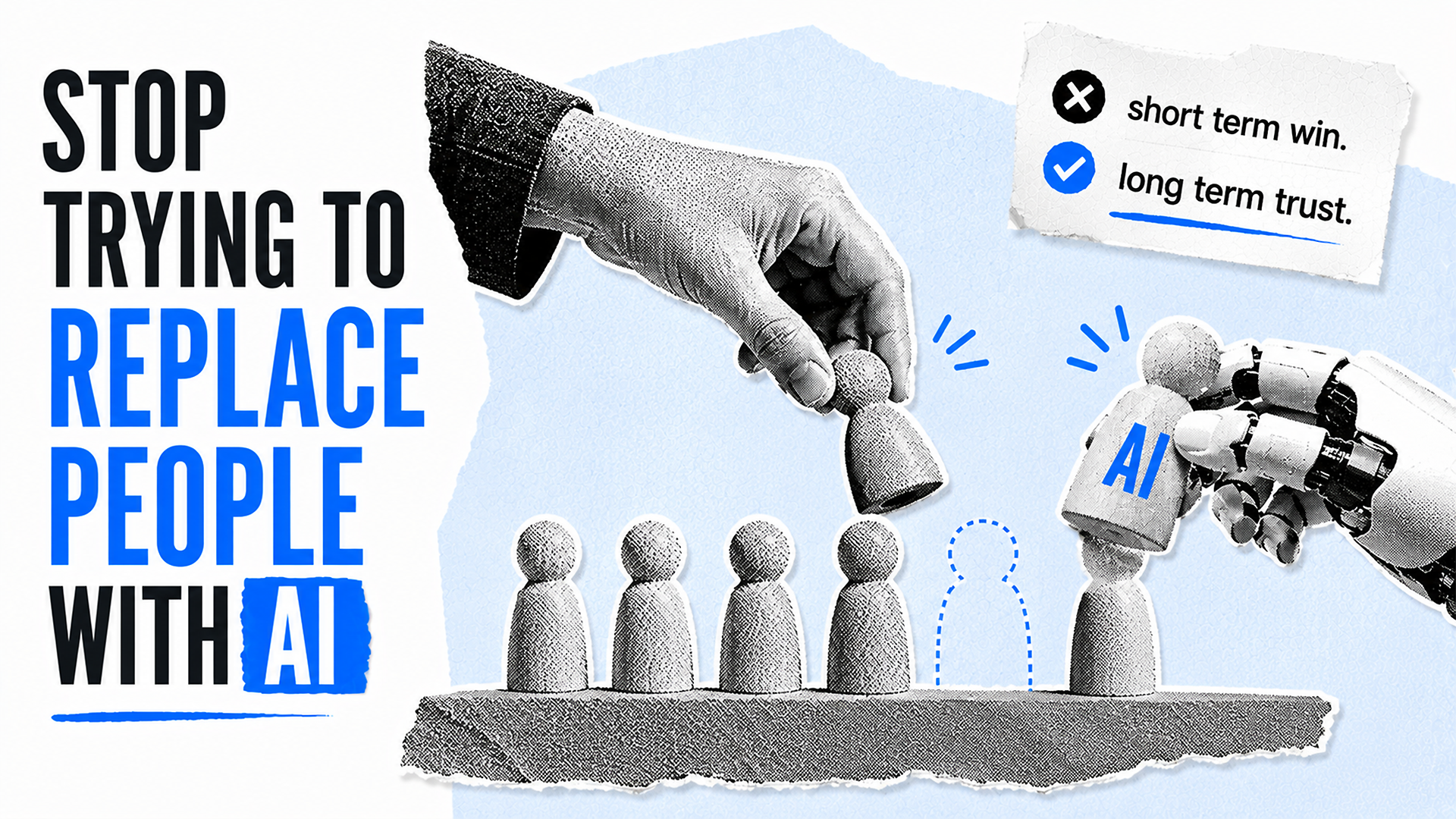
    I think one of the biggest mistakes in AI marketing is positioning a product as a replacement for people. That message can win attention in the short term, but I believe it quietly drains trust over time.

    This is a little different from what I usually write about, but it matters. The way we talk about AI shapes how customers, employees, executives, and markets respond to it.

    In this memo, I want to focus on three things: why “substitution positioning” feels powerful at first but weakens a brand later, what the data says about whether AI is actually replacing people, and how I think companies should position AI instead.

    Image

    The cardinal sin of positioning in the AI era is replacement. I call it substitution positioning. It is tempting because it sounds bold, efficient, and disruptive. But over time, it creates anxiety, skepticism, and credibility problems.

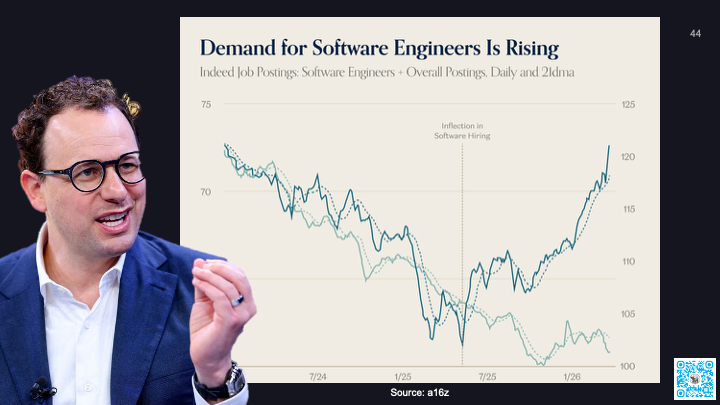
    We have seen this pattern already. Anthropic CEO Dario Amodei predicted that software engineering jobs could disappear within 6 to 12 months as models began doing most or all of what software engineers do end to end. Yet demand for software engineers has continued to look strong.

    Image

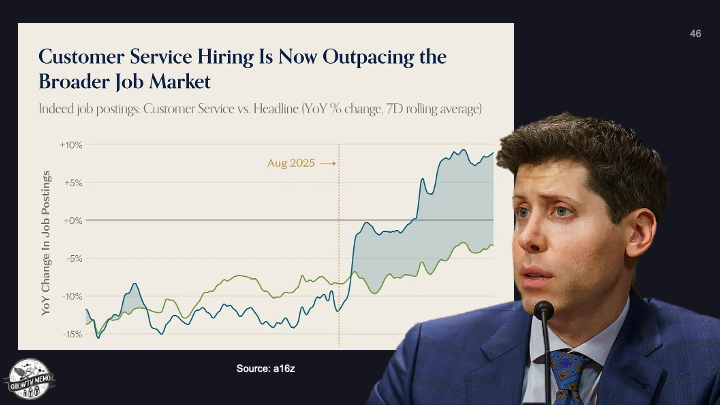
    OpenAI CEO Sam Altman also predicted that many customer support jobs would go away because AI could handle that work better. Soon after, customer service hiring began outpacing the broader job market.

    I understand why fear works as a marketing tool. The fear of being replaced gets attention fast. It got me, too. When powerful AI models gained traction, I worried about my own future. But when I still see AI companies hiring copywriters, SEOs, engineers, and support teams, I sleep better.

    Image

    Fear sells because it taps into fight-or-flight. Layoffs make that story even louder. They let companies frame cost-cutting as innovation and make the replacement narrative feel more real than it may actually be.

    But I do not think the facts support the clean replacement story. In New York, companies can indicate when mass layoffs are caused by technological innovation or automation. In one reported period, more than 160 companies filed mass layoffs affecting roughly 28,300 workers, and not one chose AI as the reason. That list included companies such as Amazon and Goldman Sachs.

    Image

    Researchers at Yale also studied employment data from the Current Population Survey over 33 months and found no evidence of job displacement from AI. To me, the pattern looks less like instant replacement and more like the earlier waves of computers and the internet changing how work gets done.

    That is why I keep coming back to this point: stop trying to make replacement happen. It is not happening in the simple, dramatic way many AI narratives suggest.

    Image

    AI is powerful, but it is also inconsistent. In its current form, it can do some tasks better than humans and fail badly at others. That paradox is often called the Jagged Frontier.

    The Jagged Frontier idea matters because it explains why some people see AI as transformative while others remain lukewarm. A BCG and Harvard study of 758 knowledge workers found that people get the most value from AI when they understand what it is good at and where it breaks down.

    Image

    Microsoft reached a similar conclusion in its 2026 Work Trend Index Annual Report. The company found that a small group of advanced AI users, described as Frontier Professionals, were not simply using AI more often. They also knew which mode of AI use fit each task.

    That distinction is important. The best AI users are not handing everything over blindly. They are applying judgment. They know when to use AI as a helper, when to use it as a collaborator, when to use agents for multi-step workflows, and when to keep a human firmly in control.

    Image

    I still do not trust most AI workflows enough to leave them running with no maintenance, review, or quality assurance. The question I ask is simple: would I bet my brand, customer experience, or revenue on a fully automated workflow with no human oversight?

    Klarna is a useful warning here. The company publicly promoted the idea that AI was doing the work of hundreds of agents and helping reduce headcount. Later, it reversed course and rehired humans after leadership acknowledged that aggressive cost-cutting had lowered quality and that customers still wanted a human option.

    Image

    That is the tradeoff I see with substitution positioning. It creates immediate attention, but it can damage long-term credibility. The words often do not match the operational reality.

    Replacement positioning could work if customers truly wanted full replacement and if the technology were consistently ready for it. I do not think either condition is true.

    Image

    Cost reduction is a strong AI argument because it shows up quickly on the P&L. Productivity gains usually take longer. They build inside companies over time and often take even longer to appear across the broader economy.

    But when replacement positioning goes beyond cost-cutting and becomes people-cutting, I believe it starts to antagonize the very people companies need to win over.

    Image

    We have already seen backlash. Duolingo’s AI-first memo drew heavy criticism before the company reframed AI as a tool to accelerate work rather than replace contractors. Surveys have found that some workers refuse to use AI tools because they fear job loss. Pew has reported that many U.S. adults are more concerned than excited about AI in daily life. Reuters/Ipsos polling has shown widespread fear that AI will permanently displace workers.

    There is also a quality problem. When employees believe the purpose of AI is to replace them, they may disengage or produce lower-quality work. In my view, that is not just an adoption issue. It is a positioning failure.

    Image

    Executives often feel more excited about AI than the employees asked to use it every day. That gap matters. If leadership talks about AI as a replacement engine, employees hear a threat. If leadership talks about AI as leverage, employees have a reason to learn.

    Token economics also complicate the replacement story. Some companies have bragged about massive AI usage, but token costs are still a real business variable. As those costs normalize, the math may make junior employees look interesting again, especially when human judgment, context, and accountability are part of the output.

    So what should replace replacement? I think the answer is enhancement. Instead of positioning AI as a way to remove people, I would position it as a way to make capable people more effective.

    AI can be used in two broad ways. A company can try to reduce the number of people, or it can grow output with the same number of people. The data I have seen suggests that productivity gains often create the stronger return.

    A National Bureau of Economic Research paper surveyed 750 executives about AI’s impact on productivity and labor markets. Larger firms showed more interest in replacing labor costs, but the highest ROI came from productivity growth.

    That is the lesson I take from the research: doing more with the talent you already have is often stronger than trying to remove the talent that knows what good work looks like.

    Building products has become easier, but distribution has not. When supply explodes, the scarce thing is not output. The scarce thing is being the product, brand, or service that actually gets chosen.

    That is why positioning matters more than ever. Product quality still matters, but the way I frame AI use can determine whether people see it as empowering or threatening.

    My takeaway is simple: I would stop selling AI as a people replacement. I would sell it as judgment leverage, workflow acceleration, and creative expansion. Fear can get attention, but empowerment is a better long-term strategy.

    This post first appeared on the author’s website and is republished here with permission.


    Inspired by this post on Search Engine Land.


    crushpress.ai community screenshot
  • Why Accessibility Is an $18 Trillion Marketing Advantage

    Why Accessibility Is an $18 Trillion Marketing Advantage

    Illustration of an online storefront against a green background, featuring a digital shop window, clothing items, a sold sign, and icons representing growth, accessibility, and customers.

    Every so often, I see a product launch turn into a marketing lesson bigger than the product itself. Selena Gomez’s Rare Beauty did that with a new fragrance, but it was not only the scent that drew attention. The bottle became the story. Its accessible, easy-to-use packaging sparked conversation, earned praise from accessibility advocates, and reminded me how powerful inclusive design can be when it is built into the product from the start.

    For me, the lesson is clear: accessibility is not a side note. It can become the campaign. One thoughtful design choice created cultural impact that would be hard to buy with media spend alone. It also showed why accessibility can build loyalty, strengthen brand reputation, support compliance, and drive measurable growth.

    Accessibility as a campaign strategy

    I do not see Rare Beauty’s accessibility work as a one-off moment. From packaging to pricing to its ongoing mental health advocacy, the brand has consistently made inclusivity part of its identity. That matters because consumers can usually tell when a brand is chasing attention versus when it is acting from a real strategy. They reward brands that lead with values and follow through.

    Rare Beauty is not alone. I see leading brands across industries using accessibility as a differentiator, not a footnote. Apple often frames accessibility features as part of product innovation. Microsoft has brought inclusive design into mainstream campaigns, including adaptive gaming products that positioned accessibility as a source of creativity and connection. In fashion and retail, brands like Tommy Hilfiger and Unilever have put adaptive design into product launches and brand identity instead of treating it as a niche offering.

    Studies from Edelman and McKinsey show why this shift matters. According to those studies, 73% of Gen Z choose to buy from brands they believe in, and 70% say they try to purchase products from companies they consider ethical. I do not see those as fringe preferences. I see them as mainstream expectations that should change how marketers build trust and growth.

    The $18 trillion market marketers overlook

    More than 1.3 billion people globally live with a disability. Together with their friends and family, they control more than $18 trillion in spending power, according to the Return on Disability Group. I believe marketers should view this as more than a compliance issue. It is a growth opportunity, a reputation opportunity, and a trust-building opportunity with one of the world’s largest and most passionate consumer groups.

    That passion often turns into advocacy. In discussions with AudioEye’s A11iance Team, a group of individuals with disabilities who regularly share feedback on real-world accessibility experiences, one member said, “If I find a website that works and works very well for me, I will always recommend it to friends and family because I want people to have the same experience that I have.”

    Another A11iance Team member, Maxwell Ivey, put it this way: “The cheapest form of advertising is word of mouth, and people with disabilities can have some of the loudest voices when we find people willing to make the effort. Because it’s that sincere effort over time that really counts with us.”

    When accessibility becomes part of the customer experience, I see it create something media budgets cannot easily buy: trust and loyalty that scale through advocacy. But the reverse is also true. In a survey of assistive technology users, 54% said they do not feel eCommerce companies care about earning their business.

    That should get every marketer’s attention. Too many brands are still fighting for the same crowded audience segments while overlooking a major opportunity in plain sight. When they do, they leave loyalty, advocacy, and revenue on the table.

    Here is where I see many brands stumble: accessibility often stops at the shelf. Marketers invest heavily in packaging, store displays, and product design, while digital experiences lag behind. Yet those digital experiences are often the first and most important touchpoints customers have with a brand.

    As accessibility-led design earns more attention, loyalty, and earned media, the gap between physical product innovation and digital experience becomes harder to ignore.

    AudioEye’s 2025 Digital Accessibility Index found an average of 297 accessibility issues per web page detectable by automation alone. Each issue can create friction in the customer journey, cost a conversion, or introduce compliance risk under frameworks such as the Americans with Disabilities Act (ADA) and the European Accessibility Act (EAA).

    I would not launch a campaign without a brand review or a legal check. In the same way, I do not think any digital touchpoint should go live without an accessibility review.

    Four moves marketing leaders can make

    Too often, I see accessibility treated as a risk to manage instead of an advantage to use. The marketers who gain ground will be the ones who change that mindset. I would start with four practical moves.

    1. Make accessibility your campaign hook

    I would not hide accessibility in the fine print. I would lead with it. Brands like Rare Beauty have shown that inclusive design is the story. Build campaigns where accessibility is not an afterthought, but the differentiator that earns attention and loyalty.

    2. Bake it into your brand system

    Accessibility should not sit off to the side. I would make Web Content Accessibility Guidelines (WCAG) alignment part of the brand system, right alongside typography, logos, and tone of voice. When accessibility is documented and expected, it becomes easier to apply across every campaign.

    3. Use data as your proof point

    Marketers are storytellers, but numbers strengthen the story. I would track accessibility improvements such as fewer user-reported barriers, higher accessibility scores, stronger alt text, better color contrast, and more usable forms. Then I would connect those metrics to business outcomes like conversion, reach, and sentiment to show how accessibility drives ROI, not just compliance.

    4. Protect accessibility like brand safety

    I would treat accessibility with the same seriousness as brand safety. Every update, seasonal campaign, and product drop should be monitored for accessibility. Trust and reputation are too valuable to leave exposed.

    The competitive advantage

    Rare Beauty’s fragrance launch proved something important to me: when a brand leads with accessibility, the story can write itself. Loyalty builds more authentically, and momentum feels more natural because the value is real.

    The larger opportunity is that many brands still do not see it. They continue to treat accessibility as a compliance checkbox when it can be a growth strategy.

    For marketers, that is the wake-up call. Accessibility builds loyalty. It strengthens brand reputation. It supports compliance. And it can drive measurable growth across marketing efforts.

    Rare Beauty showed how accessibility can capture attention at the shelf. Now I see the next opportunity clearly: making sure that same accessibility carries through online. When every touchpoint welcomes everyone, every campaign has a better chance to deliver its full impact.


    Inspired by this post on Search Engine Land.


    crushpress.ai community screenshot
  • How AI Discovery Is Moving Beyond the Search Results Page

    How AI Discovery Is Moving Beyond the Search Results Page

    AI discovery is expanding beyond the conventional search results page. Two emerging models illustrate the change: Google Discover is experimenting with natural-language feed controls, while Yahoo Scout combines AI-generated answers with content and services from across Yahoo’s properties.

    Together, the reported developments suggest that publishers may increasingly be discovered through declared interests, generated subqueries, citations and contextual recommendations. The opportunity is broader than ranking for one typed query, but each surface creates a different route from user intent to publisher visibility.

    Two AI discovery models with different user journeys

    Two people follow different AI discovery journeys, one through a personalized feed and the other through an answer connected to source cards.

    Google Discover’s experiment begins with a feed. According to the report on its natural-language tuning feature, users can ask to see more content about a topic, creator, publisher or content format. Google then interprets that request and adjusts the cards presented in Discover. The report described this as a shift from personalization based only on inferred behavior toward personalization that also accepts declared preferences.

    Yahoo Scout begins with a question or task. The Scout report described an AI answer engine available through its own website and integrated into Yahoo Search, News, Finance and Mail. Responses can include synthesized text, citations, source previews, tables, imagery and information drawn from Yahoo services.

    DimensionGoogle Discover tuningYahoo Scout
    Primary experienceA personalized content feedAn AI answer and assistant interface
    User signalA request to see more or less of a subject, source or content typeA question, follow-up or task expressed in conversational language
    Publisher exposureSemantically relevant cards selected through topic expansion or query-intent fan-outLinks, highlighted citations, featured sources and content cards within or around an answer
    Reported limitationEarly, cautious distribution with occasional loose matchesUnknown publisher click-through performance and room for more source links

    The distinction matters. Discover tuning influences what a person may encounter while browsing, whereas Scout responds to an immediate information need. One is an AI-directed recommendation layer; the other is an answer layer that can also become a gateway to the web.

    Declared intent creates new routes to publisher visibility

    The Discover report identified two apparent retrieval patterns. In entity or interest expansion, a prompt can lead to related topics, people, publishers or concepts. In query-intent fan-out, a broad request is translated into several narrower retrieval intents. A general interest in SEO, for example, was reported to produce more specific intents concerning strategies, ranking updates and Discover guidance.

    This fan-out process can widen the candidate pool. The report documented results from specialist publishers, individual creators and narrowly focused sites, including cases in which an article had no detectable previous circulation in the tracking dataset used for the analysis. That observation does not establish audience size or Search Console traffic, and the source cautioned that prompt-influenced cards did not appear to receive the broad amplification sometimes associated with conventional Discover distribution.

    The same report observed structured actions such as SEE_MORE and SEE_LESS, along with current and historical natural-language tuning pipelines. It interpreted the historical pipeline as evidence that a prompt may influence later feed sessions rather than only the next refresh. These findings came from feature tracking, however, so they should be treated as reported observations about an experimental system rather than a complete account of Google’s internal ranking process.

    Yahoo Scout offers another visibility mechanism: attribution inside a generated response. The Scout report described linked highlights, a featured-source area, citation previews and related article cards intended to make underlying publishers visible. Yahoo told the reporter that it wanted Scout to direct traffic to the open web, but it had not yet established an expected click-through rate. The company also said it planned to develop publisher impression and click reporting.

    These models change the discovery question for publishers. Visibility may depend not only on whether a page ranks for the user’s original words, but also on whether it matches a derived interest, answers one of several generated subqueries or provides material an answer engine can attribute clearly.

    A publishing strategy for feeds and answer engines

    An editor organizes multimedia content that flows toward a feed, an AI answer, and contextual recommendation cards.

    Make the site’s subject identity unmistakable

    Entity expansion favors a publication whose subject can be recognized consistently. Descriptive titles, focused sections, coherent internal linking and clear authorship can help a retrieval system understand what the site and its contributors cover. The aim is not to repeat a keyword everywhere, but to remove ambiguity about the publication’s domain and the purpose of each page.

    Cover the questions inside a broad prompt

    Query fan-out means one prompt may represent several related information needs. A useful page should state its scope early, use headings that reflect genuine reader questions and answer the important subtopics directly. This makes the content easier to retrieve for an intent that the user did not phrase exactly as the publisher did.

    Give answer systems attributable material

    Scout’s emphasis on citations makes source quality part of presentation. Publishers can support attribution by distinguishing facts from analysis, naming original sources, explaining methodology and keeping important claims close to their evidence. Concise summaries can help an answer system identify relevance, but the surrounding article still needs enough context for a reader who follows the citation.

    Measure each surface on its own terms

    A card shown because one person tuned a feed is not equivalent to a widely distributed recommendation, and a citation impression is not equivalent to a visit. Publishers should avoid treating all AI visibility as one metric. Useful distinctions include being retrieved, being visibly attributed, receiving a click and producing a meaningful on-site action. The source reports indicate that measurement remains incomplete: the Discover analysis relied on observed tracking data, while Yahoo said publisher reporting was still planned.

    Key takeaways

    • Google Discover’s reported experiment lets users declare feed interests in natural language, potentially opening a limited discovery path for specialist content.
    • Yahoo Scout uses an answer-engine model in which highlighted citations, featured sources and content cards can connect responses to publishers.
    • Clear topical identity supports entity-based discovery, while direct coverage of related questions supports retrieval through generated subqueries.
    • AI visibility should be separated into retrieval, attribution, referral traffic and on-site outcomes because the surfaces do not distribute content in the same way.

    What will determine whether these surfaces matter

    Neither report establishes a mature replacement for search traffic. The Discover feature was described as an early Search Labs experience with limited adoption and cautious distribution. Yahoo Scout was presented as a beta whose downstream click performance remained unknown, despite Yahoo’s stated intention to support publisher referrals.

    The next meaningful signals will be broader user adoption, dependable publisher reporting and evidence that citations or tuned recommendations produce sustained visits. Until then, publishers can prepare by making content semantically clear and easy to attribute while treating traffic claims about these new surfaces with appropriate restraint.

    References

  • Paid Search Relevance and Compliance: A Practical Framework

    Paid Search Relevance and Compliance: A Practical Framework

    Paid search relevance is no longer just a matter of matching a keyword to an ad. It spans the searcher’s intent, the platform’s quality signals, the promise made in the ad, the information on the landing page and, in regulated sectors, the boundaries imposed by advertising and privacy policies.

    Taken together, the source reports point to a practical model: use query analysis to understand demand, translate that demand into accurate ads and pages, apply compliance checks before launch, and measure whether the resulting leads are genuinely useful. Each layer constrains the others, so optimizing one in isolation can produce misleading gains.

    Relevance is becoming visible to searchers

    Google’s reported test of “Strongest match” and “Strong match” labels could make an internal assessment of relevance more noticeable in the search results. According to the source report, Google Ads Liaison Ginny Marvin confirmed that the experiment was intended to help people identify ads closely aligned with their queries. The test was described as limited to a small percentage of users in the United States, with no indication that the labels would become permanent.

    The report also said the labels relied on existing ad-quality and relevance signals rather than a new ranking factor. That distinction matters. Advertisers should not treat an experimental badge as a separate optimization target; the durable work remains the alignment among query, ad and destination. What may change is the visibility of that alignment. If a platform explicitly identifies some ads as stronger matches, relevance can influence attention before a searcher has evaluated the copy or brand.

    This creates a useful distinction between auction relevance and experienced relevance. A platform can judge an ad to be a close match, but the searcher still encounters a complete journey. A prominent label cannot compensate for an ambiguous offer, an inaccurate claim or a landing page that fails to answer the query. In sensitive categories, a message can also be highly specific yet unsuitable under advertising policy. Relevance therefore has to be assessed as an end-to-end quality, not merely a platform score.

    Semantic analysis turns search terms into intent evidence

    Colored signal paths pass through a translucent prism and form clusters around simple intent symbols.

    The semantic PPC report describes a set of methods for finding useful patterns in large, noisy search-term datasets. N-gram analysis separates queries into one-word, two-word and three-word units, then aggregates performance around those recurring components. In the source’s example, “private caregiver nearby” can be examined as individual words, adjacent pairs and the complete three-word phrase.

    This approach connects relevance decisions to observed behavior. A recurring term associated with spend but no conversions may warrant exclusion, while a component associated with strong performance may justify its own messaging, budget treatment or landing-page experience. The source specifically described using measures such as cost, impressions, clicks, conversions and conversion value to calculate performance for each n-gram. It also cautioned that the technique needs substantial search-term volume and becomes less manageable as the size of the word combinations increases.

    Two additional techniques address different forms of similarity. Levenshtein distance counts the edits needed to turn one string into another, making it useful for misspellings and near-duplicate wording. Jaccard similarity measures the overlap between sets of terms, so it can recognize queries containing the same words in a different order. The semantic PPC report presented thresholds of three and six as examples for tighter or broader grouping with Levenshtein distance, but those examples should not be treated as universal account rules.

    These techniques organize evidence; they do not settle meaning by themselves. As the source notes, Jaccard similarity does not inherently understand that “New York” and “NYC” refer to the same place. Edit distance likewise measures textual change, not whether two searches express the same need. Human review and business context remain necessary, especially when similar wording can refer to different services, professional roles or levels of urgency.

    Healthcare shows where relevance and compliance diverge

    A campaign specialist reviews blank healthcare advertising screens beside a magnifying glass, shield, padlock, and balance scale.

    The medical and mental-health PPC guide illustrates why closer query matching is not sufficient on its own. It groups patient searches into symptom or treatment research, informal descriptions of a service, and correct professional or service terms. The report recommends concentrating most budget on the latter two groups, where people are generally closer to taking action, while testing broader informational demand when resources allow.

    That search behavior creates a translation problem. A prospective patient may use an imprecise phrase that still communicates a legitimate need. Semantic analysis can identify recurring language and cluster variants, but the advertiser must decide whether the service actually fits the need and how to describe it accurately. Negative keywords are therefore not merely a cost-control device in this context; they also help prevent ads from appearing for services the practice does not provide.

    Ad copy introduces another boundary. The medical PPC source advises against guaranteed outcomes and blunt language, including terms such as “cure,” while emphasizing practical information such as accepted insurance, payment arrangements, specializations and professional credentials. It reports that Google and Meta restrict the promotion of medical, mental-health and wellness services, and that some providers may face additional requirements. Addiction-treatment advertisers, for example, may need a LegitScript listing depending on the practice and applicable Google Ads requirements.

    The implication is that the most direct wording is not always the most appropriate wording. Strong paid-search communication should recognize intent without making unsupported promises or addressing a person in an intrusive way. When an ad is rejected, the source recommends revising the language or seeking manual review where appropriate; it does not characterize every isolated rejection as evidence of an account-level problem.

    An operating model for relevant, defensible campaigns

    A sound workflow begins with the actual search-term record rather than an AI-generated keyword list alone. N-grams can reveal recurring modifiers, edit distance can consolidate close variants, and set overlap can expose duplicated themes. Those outputs should then be labeled by business meaning: the service requested, the searcher’s apparent stage, location or urgency, and whether the advertiser can truthfully meet the need.

    Campaign structure should follow meaningful differences, not every textual variation. The semantic PPC source warns that excessive granularity can complicate reporting, bidding and account management. Consolidation is appropriate when terms share an offer and intent; separation is warranted when they require different budgets, messages, destinations or compliance treatment. This keeps semantic analysis tied to decisions rather than turning clustering into an end in itself.

    Each resulting theme then needs a message-and-page review. The ad should accurately state what is available, while the landing page should resolve the questions raised by the query and explain the next action. For healthcare, the source recommends drawing on common intake questions and clearly covering matters such as eligibility, insurance, payment, treatment availability and the appointment process. Clear calls to book, call, request a consultation or submit an inquiry reduce uncertainty without requiring exaggerated claims.

    Measurement completes the relevance test. The medical PPC guide argues that form submissions alone are insufficient and that inbound calls should also be tracked because they can represent high-intent inquiries. It further recommends connecting campaign data with a CRM so the practice can distinguish raw leads from people who become patients or clients. This feedback can reveal a crucial failure mode: a query may generate clicks and conversions while repeatedly producing unsuitable inquiries.

    Compliance should be a recurring review rather than a launch gate that is never revisited. Search terms change, landing pages accumulate edits, platform policies evolve and automated matching can expose campaigns to unexpected queries. A defensible account keeps a record of exclusions, copy revisions, landing-page claims, approval outcomes and lead-quality findings so that optimization decisions can be explained and reassessed.

    Key takeaways

    • Google’s limited match-label experiment, as reported, makes existing relevance judgments more visible but does not introduce a separate ranking factor for advertisers to chase.
    • N-grams, Levenshtein distance and Jaccard similarity can reduce search-term noise, but textual similarity must still be interpreted through service, intent and policy context.
    • Negative keywords protect both budget and promise accuracy by filtering demand the advertiser cannot appropriately serve.
    • In regulated categories, a close query match does not authorize aggressive personalization, guaranteed outcomes or claims unsupported by the destination.
    • Lead quality, including qualified calls and downstream outcomes, is the strongest practical check on whether apparent relevance produced useful demand.

    If relevance indicators become more prominent, advertisers with coherent query, copy, page and measurement systems will be better positioned than those optimizing only for a visible platform label. The next competitive advantage is likely to come from making that coherence auditable as well as persuasive.

    References

  • How Brands Earn Visibility in AI-Generated Answers

    How Brands Earn Visibility in AI-Generated Answers

    Brand visibility in AI answers is becoming a contest for inclusion, not merely a contest for clicks. When an answer engine compares products, recommends providers, or summarizes a category, the commercial advantage belongs to brands it can identify, understand, verify, and confidently place in the response.

    The source reporting points to a layered strategy: satisfy the user’s decision context, publish information that machines can extract, keep brand and product facts consistent, and reinforce those facts with external evidence. It also warns against treating experimental files or isolated technical changes as substitutes for useful content and recognized authority.

    AI visibility begins before the citation

    Traditional search optimization often treats a ranking and the resulting click as the principal outcomes. AI answers introduce several earlier questions: Was the brand considered? Was it included in the recommendation set? Was its information used without a link? Was it named, described accurately, or cited as supporting evidence?

    This matters because users are increasingly asking systems to perform parts of the decision process. Search Engine Land’s article on “delegation search” describes people asking AI to narrow choices, compare alternatives, validate decisions, and recommend an appropriate fit. It reports that up to 61% of AI users in Reflect Digital’s SearchPulse research cited speed and ease as reasons for using the tools; the article’s author also disclosed that she founded the research firm.

    Delegation raises the value of being selected while reducing the value of simply being available somewhere in a long results list. A brand excluded from a short synthesized answer may never reach the user’s manual comparison stage. At the same time, the source cautions that delegation is contextual: people may outsource effort-heavy itinerary planning, for example, while retaining the more emotional work of choosing and exploring destinations.

    The practical implication is that visibility should be planned around both exploration and decision support. Detailed educational pages still help people investigate and validate. More concise decision-support resources should make it easy to determine who an offering is for, when it is suitable, how it differs, and what evidence supports the recommendation.

    The strongest signals work as a connected evidence system

    An unbranded product is connected to webpage, reference, document, retail, and media symbols in a unified evidence network.

    No source identifies a single switch that guarantees inclusion in AI answers. Instead, their findings converge around several complementary forms of evidence.

    • Clear entity identity: Two companion Profound posts about a mid-October ChatGPT response update reported that brand mentions became harder to earn. One framed the response as a need for stronger entity signals and clearer brand authority. In operational terms, a brand’s name, category, products, relationships, and distinguishing claims should be stated consistently enough to resolve ambiguity.
    • Extractable facts: The llms.txt analysis highlighted comparison tables, FAQs, structured comparisons, and functional templates as assets that answer engines could readily use. The value lies in the information being understandable and applicable, not merely in its format.
    • Technical accessibility: Crawl and indexing barriers can prevent useful material from entering the evidence pool. Technical hygiene remains necessary, although it cannot create authority or usefulness on its own.
    • External validation: The same analysis associated one site’s gains with a wider combination of press coverage, backlinks, new resources, better page structure, and technical fixes. Independent coverage can reinforce that a brand and its claims matter beyond its own website.
    • Intent alignment: Content has to match the comparisons, recommendations, or reassurance users actually request. A complete corporate description is less useful when the prompt asks which option best fits a particular constraint.

    Together, these signals form a verification path. Brand-owned material supplies explicit facts; accessible structure helps systems retrieve them; third-party sources provide corroboration; and intent-focused content shows how those facts resolve a user’s decision. Weakness in one layer can limit the others. Authority without clear facts is difficult to summarize, while perfectly structured claims without external support may be difficult to trust.

    Commerce adds a product-data layer to brand authority

    Generic retail products align with translucent attribute layers while an abstract AI lens scans the structured information.

    AI shopping makes this evidence system more demanding because recommendations can depend on changing, product-level attributes. Profound’s analysis of more than one million ChatGPT shopping offers led it to argue that product feeds have become a core visibility asset alongside product detail pages.

    The source points to a broader mix of inputs that may include feeds, product data, availability, pricing, and brand-owned content. It does not establish a universal weighting formula, but it does expose a practical risk: incomplete or inconsistent feed data can make an offer harder to match with its product page and harder for an AI shopping system to interpret.

    For commerce teams, this means brand authority and catalog accuracy cannot be managed separately. A well-known brand may still lose visibility for a specific offer if identifiers, variants, prices, or availability cannot be reconciled. Conversely, a clean feed should not be treated as a replacement for a product page that explains benefits, limitations, specifications, and appropriate use.

    The useful standard is cross-surface agreement: the feed, product page, supporting guides, and relevant external references should describe the same product without avoidable contradictions. That consistency gives an answer engine both structured facts for selection and explanatory context for recommendation.

    Why llms.txt is infrastructure, not a visibility strategy

    The sharpest warning against shortcut thinking comes from Search Engine Land’s llms.txt report. Its author tracked 10 sites across several sectors for 90 days before and 90 days after implementation. Eight recorded no measurable change, while one declined by 19.7%. Two sites recorded AI traffic increases of 12.5% and 25%, but the author concluded that concurrent work prevented those gains from being attributed to the file.

    Those two sites had made more substantive changes. The reported examples included new functional templates, comparison tables, FAQ material, resource-center content, technical repairs, and press coverage. The analysis therefore found a clearer pattern around creating useful assets and removing access barriers than around documenting existing URLs in llms.txt.

    The report also states that no major LLM provider had officially committed to parsing llms.txt. It describes a brief appearance of the files across Google documentation properties, followed by their removal from Search developer documentation within 24 hours; Google’s John Mueller reportedly attributed the appearance to a sitewide content-management update rather than an AI-discovery initiative.

    That does not make llms.txt inherently useless. The source identifies a plausible efficiency benefit for documentation and developer products, where clean Markdown can help an AI agent decide which API material to retrieve. But the evidence presented does not support treating the file as a general-purpose ranking lever. It is better understood as optional routing infrastructure whose value depends on actual platform adoption and the quality of the resources it describes.

    A practical operating model for AI-answer visibility

    The sources collectively suggest that AI visibility should be managed as an ongoing product, content, reputation, and measurement discipline rather than a one-time optimization project.

    Key takeaways

    • Map prompts where customers are likely to delegate comparison, shortlisting, validation, or recommendation.
    • Create pages and functional assets that resolve those decisions with explicit criteria, relevant facts, and understandable trade-offs.
    • Keep entity descriptions and, where applicable, product-feed data consistent with the corresponding website content.
    • Remove crawl, indexing, and rendering barriers before adding speculative discovery files.
    • Earn independent evidence through credible coverage, references, reviews, or other relevant third-party sources.
    • Measure consideration, mentions, accuracy, citations, and referral traffic separately because an AI answer may create visibility without producing a click.

    Prompt tracking should also be segmented by task. A broad informational question, a request for the top three options, and a product comparison represent different visibility opportunities. Results should be reviewed across categories and answer engines rather than collapsed into one sitewide score.

    Measurement needs historical context as well. Profound’s two reports say their analysis of millions of prompts found visibility shifts after the mid-October ChatGPT response update. Although the supplied summaries do not provide category-level results or establish a causal mechanism, they support a broader caution: answer-engine exposure can change when the response system changes, even when a brand has not altered its site.

    Search Engine Land’s broader AI and SEO explainer adds another reason for a wider scorecard: answer engines can summarize material without sending the user to its source. It characterizes this as a shift from a traffic-only model toward authority, visibility, and machine ingestion. Because generative systems can also produce incorrect claims, monitoring should include how a brand is represented, not only whether it appears.

    As AI answers absorb more comparison work, durable visibility will depend less on any isolated file or markup tactic and more on whether a brand supplies a coherent body of decision-ready evidence. Teams that continually improve that evidence will be better positioned to withstand changing response formats and increasingly selective recommendation sets.

    References

  • How Profound’s AI Visibility Ecosystem Fits Together

    How Profound’s AI Visibility Ecosystem Fits Together

    Profound’s emerging AI visibility ecosystem can be understood as five connected layers: category building, brand benchmarking, answer-path analysis, source intelligence, and enterprise governance. Viewed together, the source reports describe an effort to make visibility inside AI-generated answers measurable and actionable.

    This framework also clarifies what each part can and cannot answer. A leaderboard can show where a brand appears, query analysis can illuminate how an answer engine searches for support, conversational research can reveal the source environments that influence responses, and compliance work can determine which organizations are prepared to use those capabilities.

    From a search-industry shift to a measurable category

    The broadest layer is category formation. According to CrushPress.AI’s account of Profound’s inaugural Zero Click NYC summit, more than 300 leaders from organizations including Walmart, Amazon, and Google gathered to discuss changes in search. That report presents AI-mediated, zero-click discovery as a strategic issue extending beyond a conventional SEO feature update.

    The report introducing the Profound Index supplies a measurement counterpart to that category narrative. It describes the Index as a leaderboard that ranks brands according to how often they appear in answers from leading AI models. The important shift is the unit being measured: not merely a page’s position in search results, but whether a brand is mentioned, surfaced, or recommended within a generated response.

    Those two initiatives serve different functions. The summit convenes organizations around the implications of changing discovery behavior, while the Index turns one dimension of that change into a comparable signal. Together, they help establish a shared vocabulary for AI visibility, but neither alone provides a complete optimization system.

    Benchmarks show outcomes; query fanouts expose pathways

    Abstract visibility markers appear beside a branching query network that gathers multiple sources and converges on one AI-generated answer.

    A visibility benchmark answers a high-level question: which brands appear most often? It does not, by itself, explain the retrieval and reasoning pathway that produced an answer. Profound’s Query Fanouts analysis addresses a different part of the problem.

    As described in CrushPress.AI’s guide to Query Fanouts, an answer engine can interpret an original prompt by generating supporting search queries. Profound’s Query Fanouts page is presented as a way to examine those queries, assess which carry greater weight, and connect them with the resulting AI visibility.

    This creates a useful outcome-to-cause workflow. Teams can begin with observed brand presence in the Index, then use fanout analysis to investigate where an answer engine looked for supporting information. The resulting questions are more operational: Does available content address the subtopics implied by the fanouts? Is the brand represented in the information sources relevant to those queries? Are authority gaps preventing the brand from becoming part of the answer?

    The distinction matters because AI visibility should not be treated as a single score to maximize. A benchmark can support comparison and monitoring, whereas fanout analysis can guide content and authority priorities. The supplied source summaries do not detail the Index’s sampling, scoring, model coverage, or update methodology, so leaderboard movement should be interpreted as a directional signal unless those methodological details are available elsewhere.

    Reddit research adds a source-intelligence layer

    Clusters of anonymous online conversation bubbles connect through analytical lenses to a luminous AI response sphere.

    Query fanouts reveal what an answer engine may search for, but teams must also understand the kinds of material from which useful answers can be formed. CrushPress.AI’s report on Profound’s collaboration with Reddit highlights conversational data as one such environment.

    The report emphasizes that community discussions contain lived experiences, natural language, and competing perspectives. In AI search, those qualities can matter when a prompt calls for practical judgment, comparison, or context that is not fully expressed in formal brand copy. The Reddit work therefore complements fanout analysis: one examines the queries behind an answer, while the other examines how conversational source material can inform the answer’s language and perspective.

    For brands, the synthesis points toward a broader research practice rather than a mandate to imitate community posts. Fanout data can indicate the questions an engine pursues; community conversations can reveal how people describe the underlying problem; and visibility tracking can show whether the brand enters the resulting answers. Each is a separate signal, and none proves that a particular discussion directly caused a specific mention.

    Compliance determines where the ecosystem can be adopted

    Measurement and analysis are only useful when an organization can deploy them under its operating requirements. CrushPress.AI reports that Profound completed an independent HIPAA compliance assessment conducted by Sensiba LLP. The source positions that assessment as an adoption step for healthcare, pharmaceutical, and life sciences organizations pursuing answer engine optimization.

    This adds a governance layer to the ecosystem. The Index, Query Fanouts, and source research address visibility questions; the reported assessment addresses whether regulated organizations can consider using AEO capabilities while maintaining relevant compliance standards. It should not be confused with evidence that a particular optimization tactic is clinically appropriate, that every customer implementation is automatically compliant, or that visibility itself guarantees trustworthy health information.

    The larger implication is that AI visibility is becoming an organizational discipline. Marketing teams may own brand representation, content teams may respond to informational gaps, analysts may interpret benchmarks and fanouts, and legal or compliance stakeholders may set boundaries for adoption. Profound’s reported initiatives span those concerns rather than treating AEO as a narrow content-editing exercise.

    Key takeaways

    • Profound’s summit frames zero-click AI discovery as a strategic search transition, while the Profound Index gives organizations a way to compare brand appearances in AI answers.
    • The Index represents an outcome layer; Query Fanouts provide a diagnostic layer for examining the supporting searches behind that outcome.
    • Profound’s reported Reddit collaboration adds source intelligence by focusing on the language, experiences, and perspectives found in community conversations.
    • The reported HIPAA assessment extends the discussion from optimization capability to adoption in regulated healthcare environments.
    • The components are most useful as complementary signals. Mentions, fanouts, conversational context, and compliance readiness answer different questions and should not be collapsed into one measure of success.

    The next stage for AI visibility will depend on how well organizations connect these layers: defining meaningful brand outcomes, tracing the answer pathways behind them, understanding the source contexts that shape responses, and applying governance suited to their industry. Methodological transparency and disciplined interpretation will be essential as those practices mature.

    References