
About a year ago, I found myself walking out of a meeting with engineers focused on enhancing automations for content briefs. Just days after that encounter, someone from the analytics team — who hadn’t even been part of those conversations — surprised me with a tool they’d developed. This tool could generate content briefs using various data pipelines and APIs.
That moment was a revelation for me. Encouraging people to adopt AI isn’t the real challenge; it’s the actual implementation and seamless integration that pose difficulties.
I frequently observe that most SEO teams, including mine, aren’t short on tools. What we struggle with is prioritizing high-impact efforts and achieving alignment within the organization.
In our team, one group might experiment with prompts while another auto-generates briefs, and yet another constructs dashboards no one requested — often resulting in us overlapping each other’s work. Each team contributes something valuable, but duplication tends to dilute the efforts, and everyone races toward execution.
Leadership demands speed; legal teams push for caution; developers need clarity.
The result is often fragmentation, which is not the transformation AI marketing teams require. For AI to have a significant impact on SEO performance, it must be well-structured before scaling; otherwise, this fragmentation only grows.
Through my experience working with large, complex organizations transitioning in this space, I have identified three frameworks that consistently prevent chaos and create momentum. When applied together, they help us align our vision, clarify what we automate, and transition prioritization into execution.
The biggest barrier to adopting AI is coordination. SEO already resides at the crossroads of engineering, content, analytics, products, and branding. With the inclusion of AI and the emergence of social search, we now have to factor in organic social, conversion rate optimization, affiliates, and creativity.
AI spans all these areas, but it’s too extensive for any single person or team. Without a shared mental model, teams tend to drift apart, duplication seeps in, and accountability becomes vague, transforming AI into a race rather than a productivity enhancer.
In leading large teams and collaborating with numerous Fortune 100 executives, I learned how analogies help teams grasp complex ideas quickly. Research supports that analogies improve understanding and the transmission of ideas across different domains. When teams map new concepts onto familiar structures, alignment accelerates.
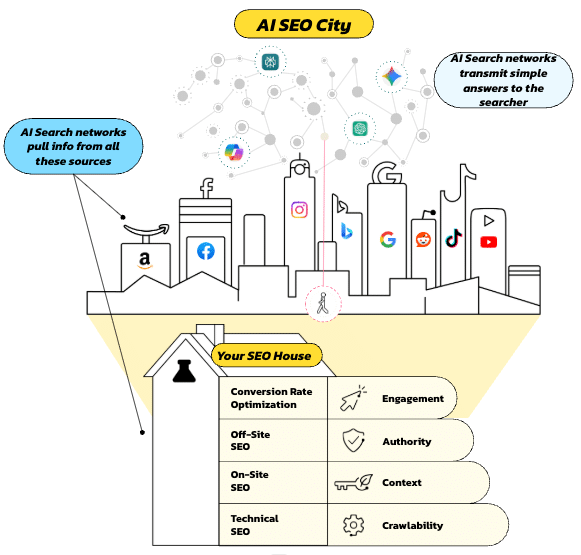
Introducing: the AI SEO City. Instead of describing AI as a series of tools and experiments, envision your SEO ecosystem as a bustling city.
Think of your website as an SEO house that no longer operates in isolation. Technical SEO creates the foundation. Content hubs define the interior. Off-site SEO offers the curb appeal. User experience provides the staging.
With AI search, this house is now more integrated with a broader city. Platforms like TikTok, Reddit, YouTube, and Amazon shape the responses AI systems deliver.
To thrive in AI search, this city requires a strong planner to advocate for budgets, plan future steps, and maintain effective strategies. Here, the SEO team acts as the planner, while other teams build and manage their respective “buildings.”
The transition from analogy to action centers on ownership. Every major platform becomes a building.

Each of these buildings has a leader, performance indicators linked to business outcomes, AI-enhanced workflows, and a roadmap, making AI projects tangible, accountable, and coordinated.
After aligning our vision, many teams make the mistake of trying to automate everything. This indiscriminate automation creates fragility.
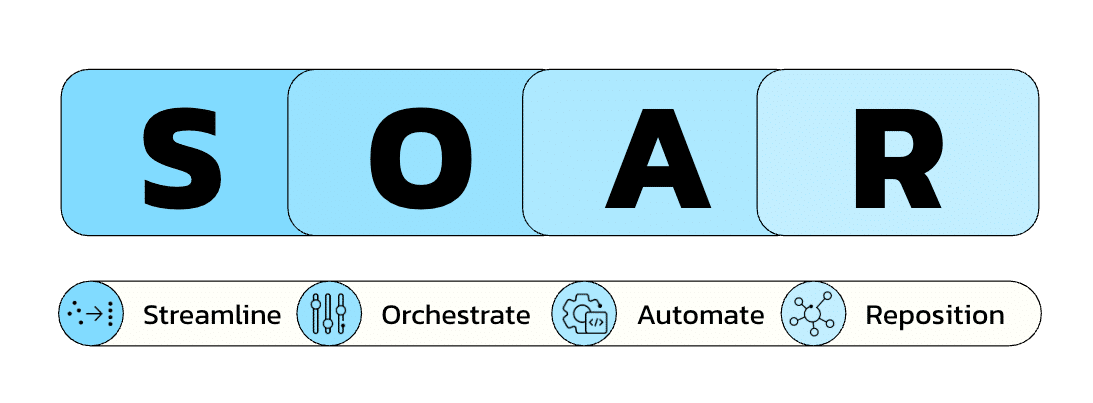
If your go-to person for automation leaves, you risk losing both business processes and valued work. That’s why I use the SOAR framework to navigate smart adoption.
To truly integrate AI, streamlining the basics is crucial. Having robust, standardized processes before incorporating AI can significantly enhance its effectiveness. According to McKinsey’s 2023 State of AI report, organizations that have already digitized and standardized core workflows gain the most from AI.
In my own experience, the easiest and most valuable automations accelerate predefined manual processes. Therefore, my team’s policy has always been to engage in manual tasks before attempting automation.
AI adoption necessitates cross-functional collaboration, making it essential for SEOs to orchestrate teams efficiently across the organization. Revisiting AI SEO City ownership insights can help clarify review processes, QA ownership, and publishing governance.
Establishing regular checkpoints, such as weekly SEO syncs with diverse teams, monthly performance reviews, and quarterly roadmap alignments, encourages consistency and diminishes resistance.
AI has the potential to save people approximately four hours a week, which equates to about 200 hours a year — roughly five weeks.
It’s crucial to utilize AI for tasks like metadata drafting, monthly report insights, FAQ expansion, internal linking suggestions, keyword clustering, and SERP analysis, thus freeing time for executing high-impact tasks.
AI implementation should eventually free up strategists to coordinate across teams, bridge the gap between strategy and business impact, map out enhanced customer search journeys, and anticipate AI search trends.
Google has announced billions of monthly AI Overview users, which has fundamentally altered how queries are presented. Now is not the time to manually write metadata; instead, it’s time to build your AI SEO City.
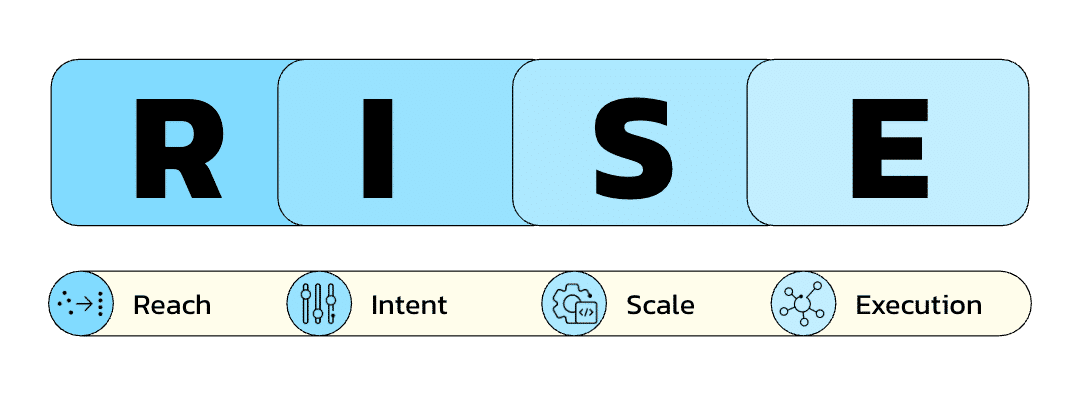
Even with smart automation and alignment, the chaos resurfaces when prioritization becomes lax. RISE helps pressure-test whether an initiative deserves investment by focusing on reach, intent, scale, and execution.
The RISE framework helps me assess whether an initiative truly warrants resources.
Reach requires you to quantify potential upsides before building anything. You must move beyond gut feelings or trending topics to focus on modeled opportunities based on specific questions.
If positive business impact isn’t numerically clear, it shouldn’t proceed. This approach discourages vanity projects mistakenly labeled as innovative developments and focuses on your leadership and strategic instincts instead of mere tinkering.
Intent drove AI search systems to reward depth over generic content. You need to be able to ask the right questions to ensure each strategy serves the correct purpose.
Scale involves verifying whether an idea can become part of the operating system without repeated effort. In AI-driven SEO, scale is about creating structural efficiencies.
Finally, embedding strategic initiatives into workflows where work actually happens transforms great ideas into real results. Defining acceptance criteria and assigning ownership are crucial steps towards successful execution.
By rigorously applying the RISE framework, the number of AI ideas may decrease, but the quality improves exponentially. Instead of debating which tool is better, the conversation shifts to identifying the right opportunities.
Ultimately, structure matters more than speed when integrating AI into SEO strategies. The winning teams won’t be those generating the most content through AI, but those constructing the strongest systems.
Inspired by this post on Search Engine Land.

Leave a Reply