Revolutionize Ads: Google Adds AI Voice to Video Campaigns

```json
{
  "alt": "Smartphone displaying Google Ads logo placed on a laptop keyboard.",
  "caption": "Unlock the potential of your business with Google Ads, your tool for driving online success directly from your smartphone.",
  "description": "This image features a smartphone with the Google Ads logo on its screen, positioned on top of a laptop keyboard. The Google Ads logo is prominent with its characteristic blue, green, and yellow design. The image symbolizes online advertising and digital marketing, emphasizing accessibility and versatility of Google Ads through mobile technology. Keywords include Google Ads, smartphone, digital marketing, and online advertising."
}
```

Have you heard the news? Google Ads is taking the advertising world by storm with its latest feature: AI voice-over for Performance Max video ads! They’re rolling out this innovative enhancement, automatically narrating video ads with realistic voice-overs, unless, of course, we choose to opt out by March 20.

Google is enhancing viewer engagement and ad performance by utilizing advanced AI voice models. This update will make ads more appealing without any additional creative output on our part. Exciting, isn’t it?

Why this matters to us. If we don’t actively opt out by March 20, our video ads will automatically benefit from Google’s AI voice models. This could transform how our ads sound to viewers, all without any creative effort on our part.

How does it work?

  • This feature kicks in only when videos lack a voice track.
  • Google’s AI chooses text from the headlines and descriptions we’ve provided and crafts a realistic voice-over from it.
  • The voice-over is seamlessly layered onto the original video, transforming it into a new asset.
```json
{
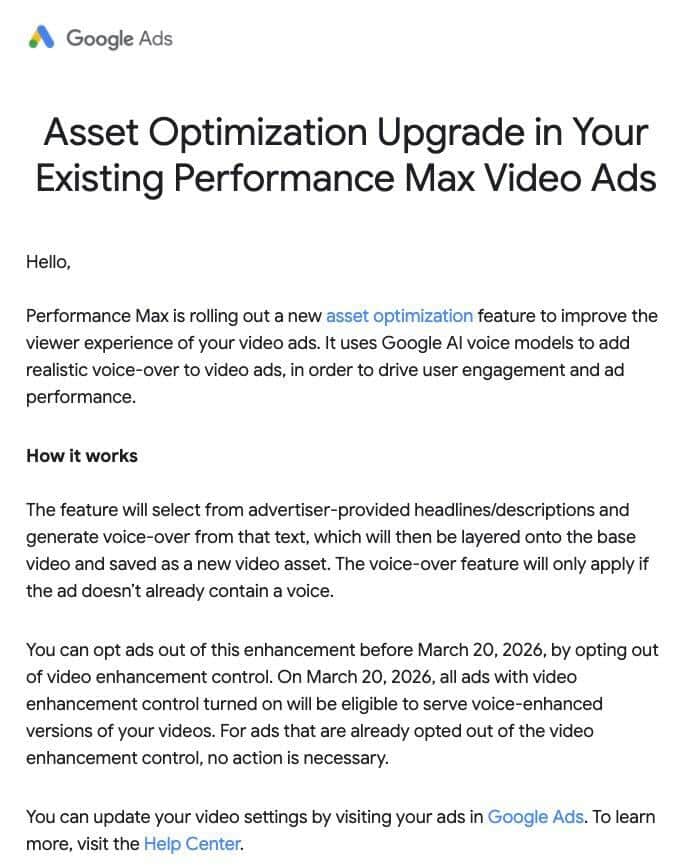
  "alt": "Google Ads notification about asset optimization feature for video ads.",
  "caption": "Google Ads unveils a new asset optimization feature, harnessing AI for improved video ad performance with realistic voice-overs.",
  "description": "This Google Ads announcement introduces an asset optimization feature to enhance Performance Max video ads using AI-generated voice-overs. Designed to boost engagement, this tool selects advertiser headlines to create enhanced content. Users can opt out of this feature by March 20, 2026. Full integration occurs on that date unless previously disabled. More details and updates are available on Google Ads and its Help Center."
}
```

The catch. This process is set to default, meaning our ads will be automatically eligible for voice enhancements unless we opt out proactively.

Key dates. We have until March 20 to decide if we want to exclude our ads from this feature. To step back from this feature, we need to adjust the video enhancement control settings. After the deadline, any ad with video enhancement control will be open to voice-enhanced updates automatically.

Action steps for us as advertisers. Configuring our video settings is simple. Just visit your Google Ads portal to make any necessary adjustments.

First seen. This update was brought to light by Paid Search specialist Arpan Banerjee in a LinkedIn post. Take a look at his insights here.


Inspired by this post on Search Engine Land.


crushpress.ai community screenshot

FAQs

What is the new Google Ads feature?

The feature is AI voice-over for Performance Max video ads. Ads will be voice-enabled by default unless you opt out by March 20.

What happens if I don’t opt out by the deadline?

If you don’t opt out by the deadline, your video ads will automatically receive AI-generated voice-overs. The narration uses headlines and descriptions you provide and will be layered onto the video.

How does the AI voice-over work?

The feature activates only when videos lack a voice track. Google’s AI uses text from your headlines and descriptions to craft a realistic voice-over, which is layered onto the video.

When is the opt-out deadline?

The deadline to opt out is March 20, 2026. If you haven’t disabled it by then, voice-enhanced updates may apply automatically.

How can advertisers adjust or opt out?

Go to the Google Ads portal and modify the video settings to disable the video enhancement feature.

Who first reported this update?

Paid Search specialist Arpan Banerjee first brought this update to light in a LinkedIn post. The post helped inform advertisers about the change.

Comments

Leave a Reply

Your email address will not be published. Required fields are marked *