
Tag: User Engagement

  • Why ChatGPT Ads Are Becoming Much Harder to Dismiss

    Why ChatGPT Ads Are Becoming Much Harder to Dismiss

    I am seeing OpenAI point to early momentum in its advertising business, with executives saying ChatGPT users are dismissing ads less often and engaging with them more. For me, that makes ad dismissal a key signal to watch as OpenAI looks for revenue beyond subscriptions and enterprise AI.

    What is happening. OpenAI says ChatGPT ad dismissals have dropped by 50% since the company launched its advertising business in February. I read that decline as OpenAI’s way of showing that its ads are becoming more relevant, because the company treats dismissals as a proxy for whether users find an ad useful or intrusive.

    The update came from OpenAI Chief Revenue Officer Denise Dresser, who framed relevance as a central focus for the company as it builds advertising into ChatGPT.

    Why I care. If users are becoming more open to ads inside ChatGPT, I see conversational AI becoming a more serious advertising channel. A 50% drop in dismissals suggests better relevance and stronger engagement, which could give brands a way to reach people during high-intent, task-focused moments instead of relying only on interruptive ad formats.

    Why relevance matters. I think ads inside AI experiences face a much higher bar than traditional display ads. People usually come to ChatGPT to complete a task, answer a question, compare options or solve a problem, so an ad that feels disconnected can quickly create friction and damage trust.

    According to Dresser, OpenAI has been focused on making the format useful. “This form factor is about usefulness,” she said. “That’s great for the consumer, great for the user.”

    The bigger picture. I see these results as an early look at how advertising may evolve inside generative AI platforms. Instead of interrupting content consumption, AI-powered advertising is moving toward recommendations that fit the user’s intent and the conversation already underway.

    That shift means success may depend less on grabbing attention and more on being genuinely helpful. The lower dismissal rate suggests OpenAI is making progress toward that goal, even if the ad model is still early.

    Competition extends beyond advertising. I also see this update in the context of OpenAI expanding its business on multiple fronts. While it builds an ads business, the company is also competing for enterprise AI spending against rivals such as Anthropic.

    That creates pressure for OpenAI to diversify revenue streams while still protecting the user experience across both consumer and enterprise products.

    What I am watching next. If OpenAI keeps improving ad relevance while maintaining engagement, I think ChatGPT could become a meaningful new advertising platform and a useful early blueprint for how ads work in conversational AI environments.


    Inspired by this post on Search Engine Land.


    crushpress.ai community screenshot
  • Why ChatGPT Brand Recommendations Drive High-Intent Visits

    Why ChatGPT Brand Recommendations Drive High-Intent Visits

    When I look at Similarweb’s findings, the message is clear: users who saw a brand recommended by ChatGPT were much more likely to visit that brand’s website within a week.

    What happened. I found the biggest takeaway in the behavior shift. On average, users were 2.5 times more likely to visit an AI-recommended brand than a direct competitor, based on Similarweb’s study of U.S. desktop activity across finance, travel, and beauty.

    Similarweb tracked users who asked ChatGPT industry-relevant questions, received a specific brand recommendation, and then visited either that recommended brand’s website or a competitor’s site within seven days.

    To keep the data focused, the study excluded users who had visited the brand’s site in the prior four weeks or had named the brand directly in their prompt.

    Recommendations shifted traffic. I saw the same pattern appear across all three industries Similarweb analyzed, which makes this more than a one-category trend.

    In finance, after an American Express recommendation, 7.2% of users visited American Express, compared with 3.1% who visited Capital One. After a Capital One recommendation, 14.2% visited Capital One, compared with 3.8% who visited American Express.

    In travel, after a Skyscanner recommendation, 9.5% visited Skyscanner, compared with 7.6% who visited Kayak. After a Kayak recommendation, 12% visited Kayak, compared with 3.4% who visited Skyscanner.

    In beauty, after a Sephora recommendation, 7.9% visited Sephora, compared with 3.3% who visited Ulta. After an Ulta recommendation, 7.6% visited Ulta, compared with 4.6% who visited Sephora.

    AI demand showed up in search. What stands out to me is that most AI-influenced visits did not appear as AI referral traffic. ChatGPT may shape the user’s brand choice, but the later website visit often shows up in analytics as search traffic instead.

    Similarweb found that 55.9% of AI-influenced visits came through search, compared with 40.4% of non-AI-influenced visits.

    Direct traffic told a different story. It accounted for 19.9% of AI-influenced visits, compared with 38.8% of standard visits.

    Recommended users stayed longer. I also think the engagement data matters. AI-influenced visitors viewed 12 pages and spent 11.8 minutes on site, on average, compared with 6.5 pages and 5.6 minutes for non-AI-influenced visitors.

    That deeper engagement suggests these users may have already narrowed their options during the AI conversation before they ever reached the brand’s website, Similarweb said.

    Why I care. AI visibility can drive meaningful visits even when referral reports miss the original source of influence. I need to understand whether ChatGPT is creating demand for my brand or sending that demand to a competitor.

    About the data. Similarweb used its opted-in U.S. desktop web panel to track user journeys from July through December 2025. The report focused on finance, travel, and beauty brand pairs with competitive overlap.

    The report: The Downstream Impact of AI Visibility (registration required).


    Inspired by this post on Search Engine Land.


    crushpress.ai community screenshot
  • Revolutionize Ads: Google Adds AI Voice to Video Campaigns

    Revolutionize Ads: Google Adds AI Voice to Video Campaigns

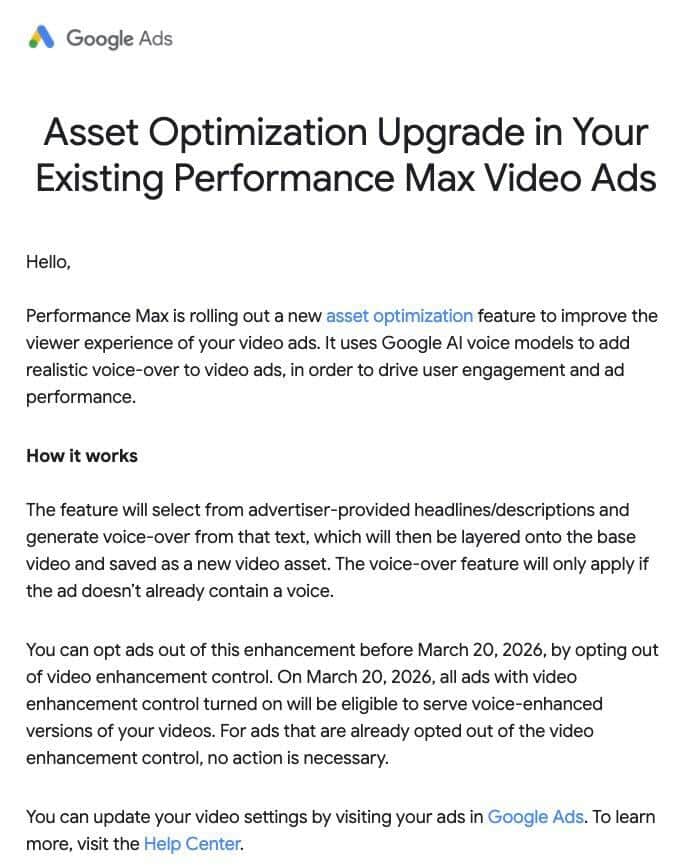
    Have you heard the news? Google Ads is taking the advertising world by storm with its latest feature: AI voice-over for Performance Max video ads! They’re rolling out this innovative enhancement, automatically narrating video ads with realistic voice-overs, unless, of course, we choose to opt out by March 20.

    Google is enhancing viewer engagement and ad performance by utilizing advanced AI voice models. This update will make ads more appealing without any additional creative output on our part. Exciting, isn’t it?

    Why this matters to us. If we don’t actively opt out by March 20, our video ads will automatically benefit from Google’s AI voice models. This could transform how our ads sound to viewers, all without any creative effort on our part.

    How does it work?

    • This feature kicks in only when videos lack a voice track.
    • Google’s AI chooses text from the headlines and descriptions we’ve provided and crafts a realistic voice-over from it.
    • The voice-over is seamlessly layered onto the original video, transforming it into a new asset.
    ```json
{
  "alt": "Google Ads notification about asset optimization feature for video ads.",
  "caption": "Google Ads unveils a new asset optimization feature, harnessing AI for improved video ad performance with realistic voice-overs.",
  "description": "This Google Ads announcement introduces an asset optimization feature to enhance Performance Max video ads using AI-generated voice-overs. Designed to boost engagement, this tool selects advertiser headlines to create enhanced content. Users can opt out of this feature by March 20, 2026. Full integration occurs on that date unless previously disabled. More details and updates are available on Google Ads and its Help Center."
}
```

    The catch. This process is set to default, meaning our ads will be automatically eligible for voice enhancements unless we opt out proactively.

    Key dates. We have until March 20 to decide if we want to exclude our ads from this feature. To step back from this feature, we need to adjust the video enhancement control settings. After the deadline, any ad with video enhancement control will be open to voice-enhanced updates automatically.

    Action steps for us as advertisers. Configuring our video settings is simple. Just visit your Google Ads portal to make any necessary adjustments.

    First seen. This update was brought to light by Paid Search specialist Arpan Banerjee in a LinkedIn post. Take a look at his insights here.


    Inspired by this post on Search Engine Land.

    crushpress.ai community screenshot
  • ChatGPT Surpasses 900 Million Weekly Users: What You Should Know

    ChatGPT Surpasses 900 Million Weekly Users: What You Should Know

    I’ve recently learned that ChatGPT has hit an extraordinary milestone: over 900 million active users every week. OpenAI proudly shared this achievement for the first time, and it’s nothing short of remarkable.

    Why It’s Significant. Our online habits are evolving, extending beyond conventional search methods. With so many users turning to ChatGPT weekly, it’s clear that interactions and discoveries are shifting to AI platforms. However, as users, we often still seek reassurance from traditional search engines.

    The Facts. OpenAI didn’t just stop at sharing user figures; they also unveiled a substantial $110 billion funding round. Additionally, they’ve gained over 50 million consumer subscribers and more than 9 million businesses are paying clients.

    What This Means for Us. ChatGPT isn’t just a chat tool; it’s a competitive landscape where search, intent, and brand visibility meet. Understanding how our content appears in AI-driven results is crucial for boosting conversions, even if these interactions aren’t traditional searches.

    OpenAI’s Announcement. For further insights, you can check out OpenAI’s official statement on Scaling AI for everyone.


    Inspired by this post on Search Engine Land.

    crushpress.ai community screenshot