
You have traced a suspicious backlink pattern to one top-level domain, and the cleanup looks repetitive: domain after domain ends with the same suffix. Google accepts a single disavow directive that can cover that entire TLD, but convenience is exactly what makes the option dangerous.
The line is simple. The decision behind it is not. Before you use it, you need to distinguish one bad website from a genuinely TLD-wide pattern and confirm that you are willing to disregard every useful link signal caught in the same scope.
First, confirm which kind of domain-wide disavowal you mean
Two different scopes are easy to conflate. A domain-level directive targets one named domain. A TLD-level directive reaches every domain using that top-level domain.
domain:example.abcidentifies the specific domainexample.abc.domain:abcidentifies the entire.abctop-level domain.
The second form is the unusually broad one. It asks Google to disregard links from unrelated websites simply because they share the same ending. It does not remove those links from the web, contact their owners, or make the referring pages disappear.
Google’s John Mueller confirmed that the bare domain:abc form can cover a whole TLD. He also cautioned that you cannot preserve selected domains beneath that directive and that every TLD is likely to contain some good sites. The behavior remains undocumented because its scope is so broad.
That limitation should control your choice. If you want Google to retain signals from even one important site on .abc, the TLD-wide directive cannot express your intent. Disavow the unwanted domains individually instead.
Require evidence at the same scale as the action
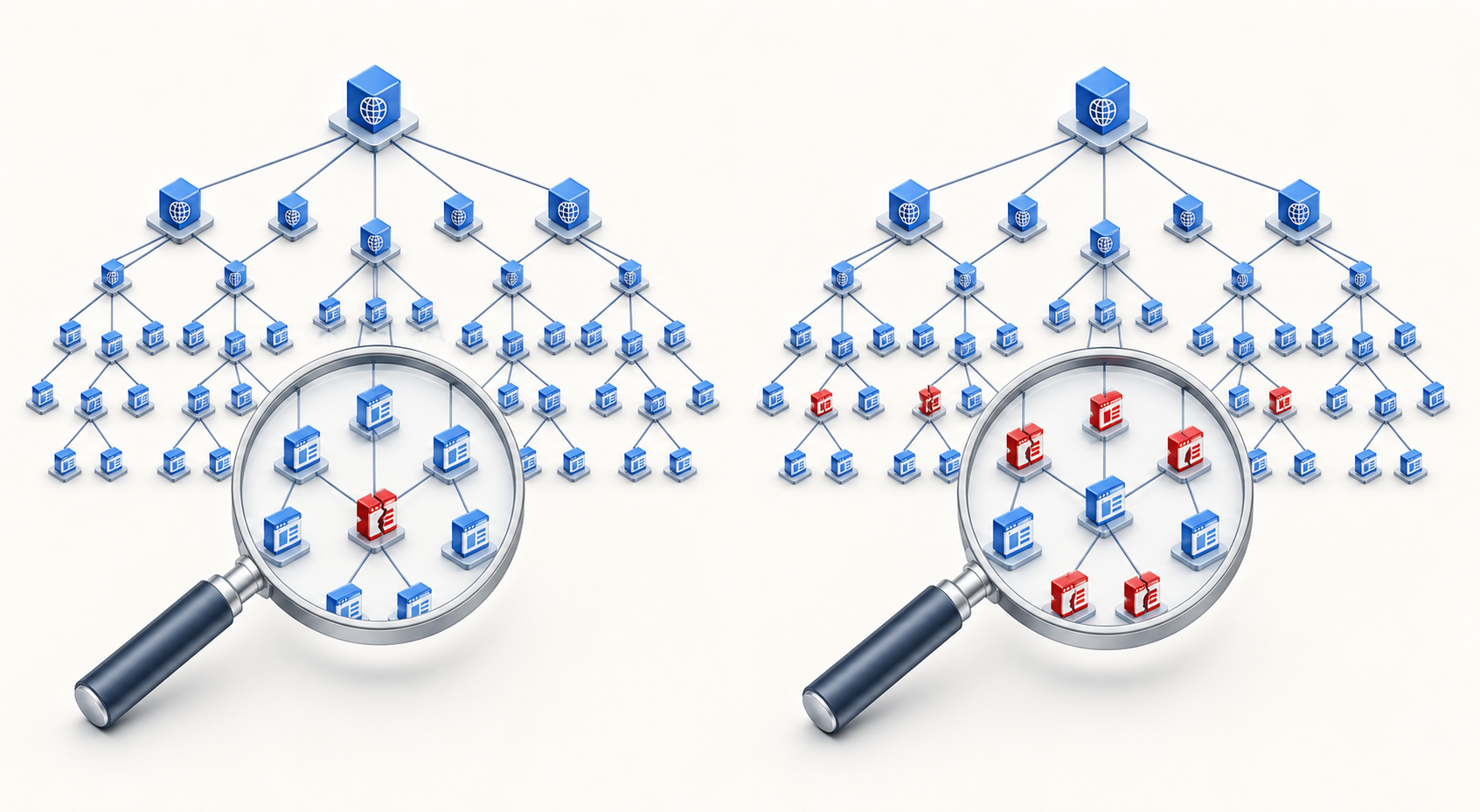
A shared suffix is a clue, not a verdict. Several poor links from several domains can still represent a small cluster rather than a problem with the entire TLD. Before reaching for the broad directive, test whether your evidence is genuinely broad enough.
- Check distribution. Determine whether the pattern appears across many independent domains or is concentrated in a limited, repeatable set. A limited set supports domain-level action.
- Check context. Review the referring pages, site identities, link placement, and relevance. Do not classify a domain solely from its suffix or an unfamiliar language.
- Look deliberately for exceptions. Search the candidate TLD for publishers, communities, partners, directories, or other sites whose link signals you would want to keep.
- Define the problem. Record why these links belong in a disavow file. An unusual TLD or an unattractive page is not, by itself, evidence that the entire namespace should be excluded.
- Test your confidence. If your conclusion changes when you inspect beyond the most obvious examples, your classification is not stable enough for TLD-wide action.
| What your review finds | Appropriate scope |
|---|---|
| Unwanted links are concentrated in a known set of domains | Handle those domains individually |
| The TLD contains a mix of unwanted and valuable sites | Use individual domain directives and preserve the valuable sites |
| The pattern spans the TLD and no reviewed exception needs to be preserved | Consider domain:abc |
| The sample is incomplete or your classification is uncertain | Do not use the TLD-wide directive yet |
Volume should tell you where to investigate, not how broadly to act. A large pile of links can originate from a small number of domains. In that case, a whole-TLD directive expands the scope without improving the precision of the cleanup.
Build an audit trail before editing the disavow file
A TLD-wide decision should be reproducible by someone who did not perform the first review. Create a small evidence sheet rather than relying on a filtered backlink view that may be difficult to reconstruct later.
- List every observed referring domain using the candidate TLD.
- Attach representative linking URLs to each referring domain so the classification can be checked.
- Record the page context, relevance, and reason each domain appears unwanted.
- Mark every legitimate or uncertain domain separately instead of forcing it into a binary spam label.
- Search specifically for an exception that would make whole-TLD treatment unacceptable.
- Write the final scope decision: individual domains, the entire TLD, or no change pending further review.
This record gives you a practical stopping rule. One legitimate domain does not prove that every other domain is useful, but it does prove that domain:abc cannot preserve the distinction you have found. If that exception matters, narrow the scope.
Keep uncertainty visible as well. A domain you have not confidently classified belongs in an uncertain group, not automatically in the unwanted group. The TLD-wide line leaves no room for that nuance once it is applied.
Add the directive without losing control of the change

For a placeholder TLD written as .abc, the special directive is:
domain:abc
The value is the bare TLD label. Do not turn it into a sample hostname if your reviewed decision truly covers the entire TLD. Conversely, do not use the bare label when your evidence supports action against only particular domains.
- Start from the current working version of your disavow file rather than rebuilding it from memory.
- Save a dated copy of that version before making the change.
- Add the whole-TLD line only after the audit and exception check are complete.
- Record the candidate TLD, the evidence reviewed, the reason for the decision, and who approved it in a separate change log.
- Review the exact scope once more before submitting the updated file through Google’s link disavow tool.
Do not try to create an exception by placing a preferred domain elsewhere in the file. The whole-TLD directive has no carve-out mechanism. Individual directives from the same TLD are also redundant once the broader line is present; the broader instruction already captures them.
A saved pre-change file and a written decision record will not make a poor classification harmless, but they prevent an opaque change. If a valuable domain is discovered later, you can identify why the broad line was added and reassess the scope from evidence rather than recollection.
Key takeaways
domain:abccan target links from every website using the.abcTLD, not just one domain.- A TLD-wide directive cannot preserve selected domains that you still value.
- Use the broad form only when the backlink pattern and your review both support TLD-wide treatment.
- Mixed, incomplete, or uncertain evidence calls for narrower domain-level work or more investigation.
- Keep the prior disavow file, the reviewed examples, and the reason for the scope decision.
Before adding a whole-TLD line, try to find one domain under that suffix whose link signals you would want Google to retain. If you find one, stop and narrow the scope. If you do not, document the review and make domain:abc a deliberate final step rather than a shortcut.
Leave a Reply