Category: Link building

  • Credibility-First Link Building: How We Earn Lasting Authority

    Credibility-First Link Building: How We Earn Lasting Authority

    Link building for lasting brand authority

    At Resolve, we define link building for legitimacy as earning authoritative backlinks, brand mentions, and media coverage that demonstrate trust, expertise, and credibility to search engines and AI systems. Instead of chasing link volume, we use digital PR, original research, thought leadership, and journalist relationships to earn genuine editorial citations. These are the authority signals behind Google’s E-E-A-T framework, and they can help us appear in AI Overviews, earn citations from large language models, and build visibility that survives ranking swings.

    We believe a little competition is healthy. It challenges us, sharpens our thinking, and pushes us to pursue bigger and better results.

    However, today’s search environment is changing faster than ever. Large language models, AI-generated answers, and frequent algorithm updates are reshaping how people find information, making it increasingly difficult for us to rely on yesterday’s playbook.

    The metrics we once used to keep brands afloat — traffic, domain authority increases, and keyword rankings — no longer define SEO success on their own. We can reach the top of a search results page and still see very few conversions.

    If we continue chasing those numbers in isolation, we risk being left behind. We have to adapt.

    We now widen our view to the outcomes that matter most: trust and brand authority. Unlike a temporary ranking or traffic spike, trust and authority are not earned quickly or easily.

    We need time to spread the word about our brand, and we need even more time to prove that people can rely on us. Once we establish that trust, however, it becomes much harder to dislodge.

    An algorithm update can cut our traffic overnight. It cannot erase genuine trust overnight.

    Our challenge is learning how to build trust and strengthen our brand while every competitor is trying to do the same. We also need meaningful ways to measure concepts that can initially seem difficult to quantify.

    We have found that the answers involve some nuance, but they are simpler than they appear. The process begins with a shift in perspective.

    For years, we treated link building like a popularity contest. The site that collected the most votes, in the form of backlinks, was often rewarded with a prominent position in the search results.

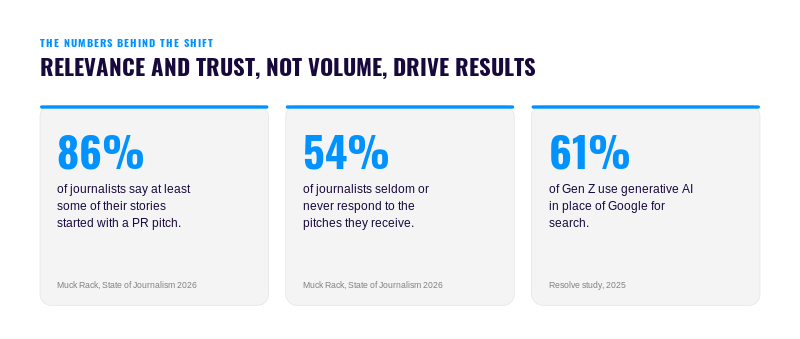
    Infographic showing 86% of journalists use PR-pitched stories, 54% rarely answer pitches, and 61% of Gen Z use generative AI instead of Google.
    Relevance and trust beat volume: 86% of journalists use at least some PR-pitched stories, yet 54% seldom respond, while 61% of Gen Z turn to generative AI instead of Google.

    Over time, Google and other search engines updated their algorithms to improve the search experience. With each change, Google cracked down on more sites that tried to manipulate the system with backlink volume instead of earning links with real editorial and audience value. Countless sites lost traffic, and many still feel the effects.

    Today, we see Google place more emphasis on relevance, industry trust, and authority. That helps explain why a familiar brand can attract more searchers than a smaller competitor even when both publish similar content and target similar keywords.

    Large language models and Google’s AI Overviews have widened this divide. These systems can use retrieval-augmented generation, or RAG, to retrieve relevant sources, often favoring authoritative publications and proprietary information. If we merely repeat a statistic already cited by a top-tier publication, an AI system may choose the better-known source to reduce the risk of spreading inaccurate information.

    We also see younger searchers moving toward AI tools. In a 2025 Resolve study, 61% of Gen Z respondents said they used generative AI instead of Google.

    None of this means every form of link building looks like spam to Google or an LLM. It means we need backlinks to work alongside a broader set of authority signals.

    When publications and journalists cite our brand, they signal authority. When we publish original content and proprietary data, we signal authority. When we create useful graphics and informative videos, we signal authority again.

    Once Google and AI systems recognize these signals, the backlinks supporting them become meaningful votes of confidence. Our site may then be more likely to rank prominently, appear in AI Overviews, and receive citations in LLM-generated answers.

    How we use E-E-A-T in a competitive search environment

    In 2018, Google updated its quality-rater guidance to place greater focus on expertise, authoritativeness, and trustworthiness, commonly shortened to E-A-T. In 2022, Google added another E for experience. Together, these qualities provide a framework for understanding how Google considers credibility and legitimacy.

    • Experience: We demonstrate that an author has personally engaged with the subject. Examples include a forum where people describe testing a product or a gardener documenting firsthand pest-prevention trials.
    • Expertise: We show that the author has relevant knowledge, qualifications, or credentials supporting the information and advice.
    • Authoritativeness: We earn recognition from credible sources and industry voices that cite or link to our work, helping establish us as a respected participant in the field.
    • Trustworthiness: We remain transparent, accurate, and honest. We avoid deceiving readers or using manipulative link-building practices.

    We apply E-E-A-T both on and off the page. Author biographies can demonstrate expertise, while accurate sourcing can demonstrate trustworthiness. Off the page, we strengthen E-E-A-T signals through the quality of the sites that link to us and the journalists who rely on us as a source. Both dimensions influence how search engines assess whether our information is useful, accurate, and credible.

    If we consistently earn backlinks from dozens of irrelevant websites, that pattern can look like a low-quality or manufactured signal. If several respected journalists mention our brand because we published a valuable study, those mentions are much more likely to function as genuine votes of confidence.

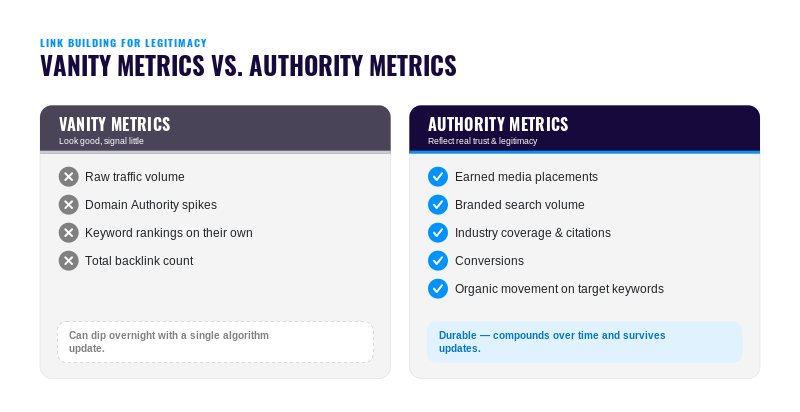
    Infographic comparing vanity SEO metrics like traffic and backlinks with durable authority metrics such as media placements, conversions and branded search.
    Move beyond fragile SEO numbers. This side-by-side graphic shows how earned media, branded searches, industry citations and conversions build authority that can survive algorithm updates.

    For us, link quantity is no longer a reliable proxy for legitimacy. We look for backlinks that demonstrate real relevance and value.

    We cannot earn those links half-heartedly. We need a coordinated strategy that strengthens credibility both on and off our site.

    The off-page SEO tactics we use to demonstrate value

    When we ask how to earn links that search engines and LLMs will treat as signs of trust, we do not look for a single outreach tactic. Strong links usually emerge from several activities that we sustain over time.

    We create genuinely linkable assets

    To prove that people genuinely want to reference our site, we first create content worth referencing. If we are accustomed to quick and easy links, this may require a larger investment in content than we have made before. A routine how-to article or listicle is rarely enough by itself.

    We define linkable content as something journalists, publishers, and readers find distinctive and useful — something they have not already encountered dozens of times. We often draw from the following content formats.

    • Original data and proprietary research: We publish information people cannot find elsewhere. In a crowded search environment, that means conducting original research rather than recycling familiar statistics. When a journalist needs a statistic and our site is the primary source, we can earn a natural backlink.
    • Thought leadership and expert commentary: We share an original perspective from a credible expert within our organization, giving publishers a useful idea or quotation they may cite in future coverage.
    • Authoritative long-form guides: We answer the main question thoroughly and anticipate the follow-up questions a reader is likely to ask. This depth can help us earn links as audiences move further into their research.
    • Engaging visuals and infographics: We invest in visual assets that make complex information easier to understand and share. Ahrefs found that YouTube mentions strongly correlated with inclusion in AI Overviews. Videos can be especially valuable, but informative infographics also give publishers a useful visual for their own audiences.

    These formats demand more time, effort, and money, but we have found that they are often more sustainable than disposable content. They help us earn credible editorial citations and build industry authority that is more resilient to algorithm updates.

    We connect link building with digital PR

    We place digital PR at the center of authority building because it connects brand development with link acquisition. It helps us earn coverage, attract links, and introduce our organization to new audiences through credible journalists. Those are precisely the kinds of signals search engines can consider when assessing legitimacy.

    Unlike traditional PR, our digital PR work focuses on online coverage and backlinks from news organizations and media outlets. We create useful assets or proprietary data, identify the journalists most likely to care, and pitch stories that fit their established beats.

    Many of these publications carry significant influence and reach large audiences that can introduce our brand to more people. When a highly authoritative outlet covers our story, other journalists may discover and cite it organically. Syndication can amplify the effect further when a media group republishes an article across its network, potentially producing many relevant links from one story.

    Our strongest digital PR campaigns typically use one or more of the following approaches.

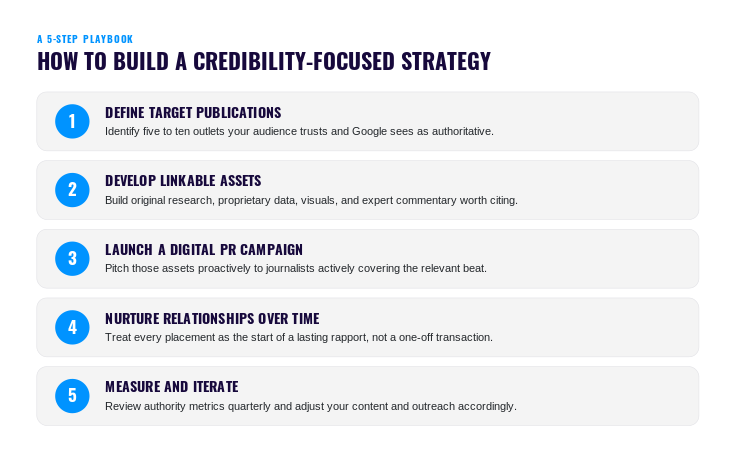
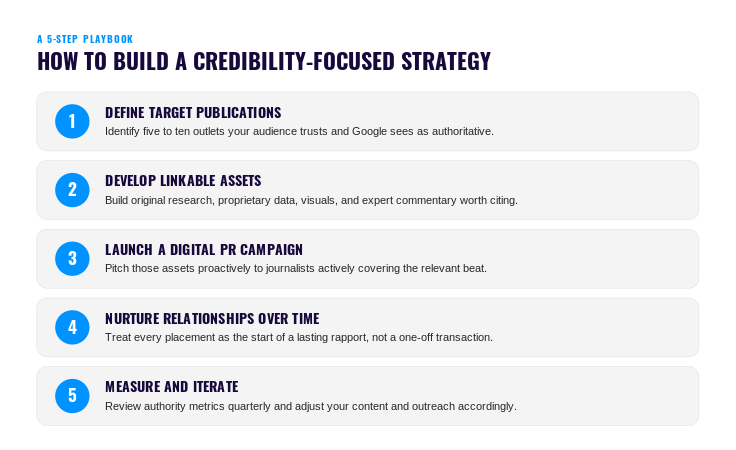
    Infographic outlining five steps for a credibility-focused SEO strategy, from targeting trusted publications and creating linkable assets to measuring results.
    Build lasting brand authority in five steps: target trusted publications, create citation-worthy assets, launch digital PR, nurture journalist relationships, then measure and refine your approach.
    • Data-led PR campaigns: We begin with what journalists and their readers care about, not simply what we find interesting. We review local news, Google News, and current coverage to understand which subjects are gaining attention. By considering journalist intent from the start, we improve our chances of receiving responses and earning placements.
    • Newsjacking or reactive PR: When we can move quickly, we contribute expert opinions, data, or commentary to breaking stories that relate to our brand. This gives journalists material they can use while the topic is still timely.
    • Proactive PR: We anticipate trends before they break and prepare insights around recurring news cycles, holidays, and other relevant media moments.
    • Contributed content and guest features: We place useful content written by our experts in relevant publications, allowing us to speak directly to established audiences and earn recognition.

    When we combine these tactics effectively, we can elevate our brand to a level that competitors cannot reproduce with a batch of low-value links.

    We build relationships with journalists and publishers

    We know that even fascinating proprietary data, packaged in an expertly designed analysis, can fail if our journalist outreach is poorly targeted.

    Resolve data about journalist outreach and PR pitches

    Journalists receive an enormous number of PR pitches, and those messages can either support or obstruct their work. According to a 2026 Muck Rack study, nearly nine in 10 journalists said at least some of their stories originated with PR pitches.

    The same survey found that 54% of journalists seldom or never responded to most pitches. Relevance was a central problem: nearly half said a genuinely relevant pitch was rare.

    If we send a journalist at an economics publication a pitch about music-listening habits, we should expect a rejection because the subject may matter to only a small part of that publication’s audience. We do not take that response personally. Journalists build their careers around particular topics and beats, and our job is to support that work rather than distract from it.

    We therefore approach outreach as relationship building: a two-way exchange that should benefit everyone involved. Above all, we remember that there is a real person on the other side of every email.

    • We personalize our emails and explain why a story fits the journalist’s audience.
    • We respond graciously when a journalist says no because our next idea may be a better fit.
    • We share relevant work from journalists and publications through social media.
    • We contribute thoughtful comments when we have something useful to add.
    • We cite journalists’ reporting in future content when it genuinely supports our work.

    As we strengthen these relationships, journalists become more likely to consider future opportunities. A thoughtful follow-up or second pitch can receive a warmer response when a reporter already knows that we provide reliable data and useful commentary.

    PR relationships grow over time. Even when our first pitch does not fit a journalist’s beat, we remain willing to return with a better story or a new set of relevant data.

    How we measure real brand authority

    We recognize that authority, trust, and legitimacy feel less concrete than traffic or keyword position. Yet they have become more important. A traffic surge may look encouraging while reflecting temporary attention, weak intent, or an advantage that disappears after an algorithm update.

    Authority and legitimacy are more durable. We can also measure the impact of credibility-focused work through several meaningful indicators.

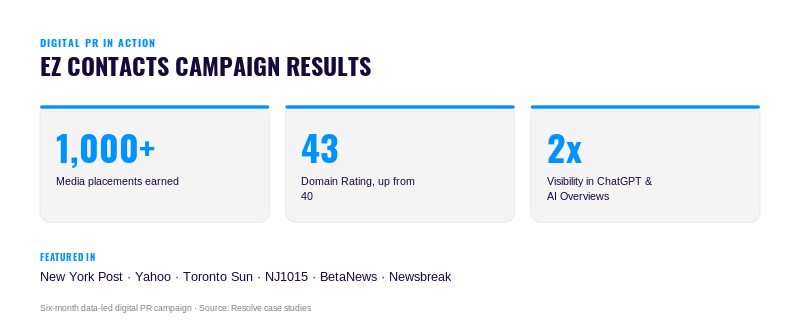
    Infographic showing EZ Contacts’ digital PR results: 1,000+ media placements, a Domain Rating of 43, and doubled visibility in ChatGPT and AI Overviews.
    EZ Contacts’ six-month digital PR campaign delivered 1,000+ media placements, raised Domain Rating from 40 to 43, and doubled visibility across ChatGPT and Google AI Overviews.
    • Earned media placements: We track the publications that cover our brand, including coverage containing an unlinked mention. These placements help us assess brand credibility.
    • Branded search volume: We monitor whether more people search for our company or products after discovering us through media coverage.
    • Industry coverage: We look for the point at which publications we have not contacted begin citing our work. That organic pickup is a valuable sign that our authority is spreading.
    • Conversions: We measure whether greater credibility leads more people to trust our organization, products, or services and ultimately take meaningful action.
    • Organic ranking improvements for target keywords: We still review rankings, but we treat them as one indicator within a broader picture. Sustained movement can show that search engines increasingly view us as a credible result relative to competing pages.
    Metrics for measuring brand authority and credibility

    We do not expect these indicators to appear overnight.

    • We invest real effort in creating proprietary data.
    • We build trust with journalists through repeated, useful interactions.
    • We grow authority through sustained work over time.

    Our advice is simple: we stay patient, keep improving, and allow credible results to compound.

    How we build a credibility-focused link strategy

    Knowing the principles of SEO authority is one thing; building an entire campaign around them is another. We use the following five-step process to turn those principles into consistent action.

    1. Step 1 — We define our target publications: We identify five to 10 publications that our audience trusts and that search engines are likely to recognize as authoritative within our field. These become our priority coverage targets.
    2. Step 2 — We develop linkable assets: We create at least two content or media assets designed around the interests of those publications. We may use original survey data, visual guides, proprietary analysis, or expert thought leadership.
    3. Step 3 — We launch a digital PR campaign: We proactively pitch our assets to relevant publications. We can also use platforms such as Connectively or Muck Rack to identify ongoing opportunities with writers covering subjects related to our research.
    4. Step 4 — We nurture relationships: We treat every positive media interaction as the beginning of a longer relationship. We follow up with useful information, engage with published coverage, and build the kind of rapport a journalist can rely on.
    5. Step 5 — We measure and iterate: We review our authority indicators each quarter, learn from the response to our campaigns, and adjust our content and outreach accordingly.
    Resolve credibility-focused link-building process

    We know this process can consume a team’s time, particularly when resources or specialized expertise are limited.

    In those situations, we may benefit from working with a link-building and digital PR specialist who can expand our capacity and keep pace with search changes. The right support can help us establish sustainable visibility without allowing every minor ranking fluctuation to pull us off course.

    How we build authority that lasts at Resolve

    We know that quality usually stands the test of time better than quantity. The difficult part is maintaining that focus when competitors appear to be winning with sudden traffic spikes or eye-catching vanity metrics.

    We do not let temporary numbers distract us from the larger goal. We focus on lasting authority and legitimacy earned through sustained content creation, thoughtful PR outreach, and genuine relationship building.

    When an internal team lacks the time or patience required to maintain that effort, we can step in.

    At Resolve, we work with brands to build credibility-focused SEO campaigns through linkable content, data-led digital PR, and hands-on link building. Our goal is sustainable organic growth, not a burst of visibility that disappears after the next algorithm update.

    Resolve results from credibility-focused digital PR

    We have seen this approach pay off. In a recent data-led campaign for EZ Contacts, we earned more than 1,000 placements in outlets including the New York Post and Yahoo. As the coverage grew, the brand’s visibility in ChatGPT and Google’s AI Overviews doubled. That is the kind of durable growth we want to build — growth that extends beyond the next algorithm update.

    Large Google logo over colorful stacks of digital pages and folders, symbolizing search advertising, web content, and online marketing updates.
    A bold Google logo sits atop layered, colorful digital documents, evoking the fast-moving world of search marketing, ad formats, campaign assets, and platform updates.

    When we are ready to build links that last, we can visit growresolve.com to learn more.

    We see considerable overlap between link building and digital PR, but we do not treat them as identical. Link building is the broader practice of acquiring backlinks from other websites to improve search authority. Digital PR is a particular approach within that practice, focused on earning links through media coverage, journalist relationships, and placements in credible publications rather than relying on directory submissions, guest-post exchanges, or other lower-authority tactics.

    We often use digital PR to pursue the strongest editorial backlinks because reputable outlets have real audiences and established review standards. At the same time, this work builds brand visibility and consumer trust in ways that many conventional link-building methods do not.

    How long do we wait for meaningful results?

    We do not expect authoritative backlinks or earned media coverage to produce results overnight. That is an honest trade-off when we choose a credibility-focused approach instead of more aggressive tactics. Most brands can begin seeing meaningful domain-authority gains and early ranking movement after three to six months of consistent execution, while highly competitive keywords and top-tier placements may require more time.

    The advantage is that our results can compound. Links from credible publications tend to endure, strong journalist relationships can create repeat opportunities, and the authority generated through consistent coverage can keep delivering value long after the initial campaign.

    We define an authority backlink as a link from a source that search engines and its audience regard as credible and trustworthy. These sources typically have genuine readers, clear editorial processes, established authority, and topical relevance to our industry.

    A regular backlink can come from any website willing to link to us, regardless of its relevance, quality, or editorial standards. That distinction matters because search engines do not evaluate every link equally. One editorial link from a respected industry publication can be more valuable than dozens of links from low-authority sites, while also supporting the kind of E-E-A-T credibility that bulk link acquisition cannot reproduce.

    Do we value brand mentions without hyperlinks?

    Yes. We recognize that Google can associate brand mentions with entities even when a publication does not include a hyperlink. Relevant, unlinked mentions in credible coverage can still contribute to the wider authority signals surrounding our brand.

    That is why we consider digital PR valuable even when every placement does not produce a direct link. A credibility-focused off-page strategy should not be reduced to backlink acquisition alone. Our larger objective is to build a brand that respected publications genuinely want to mention, cite, and cover.

    We see risks ranging from wasted effort to serious search penalties. Link buying, reciprocal-link schemes, private blog networks, and manipulative anchor-text optimization can violate Google’s spam policies. These tactics may trigger manual actions or algorithmic suppression that substantially reduces our search visibility.

    Even when outdated tactics do not produce an immediate penalty, they can lose their value as search systems become better at identifying manufactured signals. Recovering from a link-related penalty can be slow and expensive. We would rather invest in credible link building from the beginning than repair the damage caused by shortcuts later.


    Inspired by this post on Search Engine Land.


    crushpress.ai community screenshot
  • Mastering Link Intent: Enhance Content with Strategic Outreach

    Mastering Link Intent: Enhance Content with Strategic Outreach

    I often realize that linking intent—combining excellent content with strategic outreach—is crucial for building links, referral traffic, and visibility in AI-driven searches.

    The importance of establishing authority through link building is more significant as search landscapes expand into language models.

    Today, my content competes with multiple sources, including AI-generated content and search engine results pages powered by AI.

    Despite these changes, backlinks remain key signals of authority for Google and language models, serving as indicators of my brand’s trustworthiness and relevance.

    Having been in SEO for quite some time, I frequently get LinkedIn messages from agencies promising a set number of links, which often misses the mark.

    The most effective strategy involves creating content that people genuinely want to reference and share—what I call writing with link intent.

    Link building should be seamlessly integrated with content creation, although, in my experience, it’s often not.

    Instead of treating it as a separate task, I consider who in my community cares about my writing and why.

    This mindset leads to content that naturally accrues links and builds traditional and AI search clout over time.

    When content is genuinely useful and relevant, it compels people to share it naturally, without resorting to spammy tactics.

    Where Strategic Outreach Fits

    Strategic outreach becomes most effective after ensuring content relevance. I identify journalists and creators who cover my topics and show them why my perspective adds unique value.

    Opportunities often arise from content related to topics like statistics or industry reports.

    If operating in silos, teams may focus on:

    • Targeting specific link numbers.
    • Requesting link swaps.
    • Promoting content without evaluating its true usefulness.

    Such an approach ignores whether content genuinely benefits the brand, contrary to what good content should achieve.

    ```json
{
  "alt": "The CapmatchOne logo with a gradient circle and bold text.",
  "caption": "Discover innovation with the CapmatchOne logo, featuring sleek typography and a modern gradient circle.",
  "description": "The CapmatchOne logo features bold, modern typography coupled with a gradient circle, symbolizing connection and innovation. The sleek design conveys a sense of progress and creativity. This image can be used for branding or promotional purposes, appealing to audiences interested in innovative solutions and forward-thinking designs."
}
```

    Content providing genuine value naturally attracts those looking for credible sources.

    Producing high-quality content can lead to attracting links and being recognized by Google and AI like ChatGPT and Claude for its relevance.

    From what I’ve gathered, language models prefer content treated as definitive references, emphasizing depth over volume.

    For LLM visibility, I focus on crafting high-value, authoritative pieces instead of spreading content thinly.

    I’ve secured numerous clients thanks to my well-crafted content. Many B2B businesses might share similar success stories.

    Quality content naturally attracts links and SEO equity over time, creating a snowball effect.

    By reducing time on outreach, it helps create relationships with related sites, driving ongoing referral traffic.

    Creating content on news-related topics can offer fresh perspectives on industry developments.

    Weigh the pros and cons between news-focused and evergreen topics, as evergreen continues gaining citations over time.

    Specificity and timing can enhance citation potential even for evergreen topics, increasing its attractiveness.

    Take Todoist’s unique presentation of productivity methods as an example. It’s helped them boost their referring domains significantly.

    I’m encountering more SEOs who de-emphasize link building, not because it’s less important, but due to outdated tactics.

    An approach that blends strong content with outreach is efficient, evergreen, and reinforces brand reputation.


    Inspired by this post on Search Engine Land.


    crushpress.ai community screenshot
  • Harnessing Brand Signals: The Evolving SEO Authority Model

    Harnessing Brand Signals: The Evolving SEO Authority Model

    For over two decades, I’ve witnessed backlinks as foundational to SEO. Google’s PageRank revolutionized search by using backlinks as proxies for trust.

    Backlinks were more than just pathways; they were votes of confidence. The more votes you gathered from authoritative sources, the better your rankings soared.

    But times have changed. As Google advanced, AI systems evolved, and the necessity for hyperlinks diminished as entity-based understanding gained ground.

    Today, visibility isn’t solely dependent on links. It’s amplified by the broad range of signals signifying your brand’s mentions, citations, and trust across well-regarded platforms.

    This shift sees search engines and AI prioritize these overarching signals.

    AI’s Role in Evolving SEO

    Modern AI models assess trust and expertise in unprecedented ways. They’ve reshaped authority, focusing less on backlinks and more on diverse digital signals.

    AI can now:

    • Identify and relate entities online.
    • Interpret sentiment and context.
    • Spot artificial link patterns.
    • Gauge brand prominence sans hyperlinks.
    • Evaluate reputation from reviews and citations.
    • Integrate information across varying sources.

    Mentions in respected publications, even link-free, enhance entity authority. Consistent expert citations affirm expertise. These are the signals forging a new era where authority becomes a rich network.

    The Shift to Entity-First SEO

    With Google’s move away from pure link signals, the notion of entities—people, brands, concepts—gains importance. Google elevates brands based on identity and conversation rather than just their backlink profile.

    In essence, entity-first SEO involves mapping and understanding brand interactions and references across trusted sources.

    An example: An outdoor brand with a modest backlink profile gained visibility in AI Overviews for “best hiking backpacks” due to mentions in Reddit discussions and YouTube reviews, illustrating real-world relevance sans hyperlinks.

    If your brand consistently figures positively in related talks, it’s seen as relevant and trusted—characteristics essential for success.

    Combining PR-Style Links with Editorial Influence

    PR-style links and editorial coverage indicate real-world authority, shunning algorithmic manipulation.

    Editorial Links Versus Volume-Based Building

    Volume-focused link building loses ground as AI discerns unnatural patterns. Quality-driven, relevant links, coupled with PR signals, grow increasingly essential.

    Editorial PR links from credible sources signal genuine credibility, like a trusted expert affirming a brand’s significance.

    AI not only checks link presence but evaluates surrounding context, striving to reward the most authoritative entities.

    Building Multi-Signal Authority

    The potency of multi-signal authority lies in blending various signals. As the digital landscape evolves, quality shines over quantity.

    AI prompts this evolution by advancing traditional, relevance-based links alongside diversified brand signals.

    Strategic placements can yield:

    • Brand mentions affirming presence.
    • Citations validating expertise.
    • Positive sentiment enhancing trust.
    • Topical relevance and growth-enabling links.
    • Boosted Knowledge Graph associations.
    • Secondary coverage spreading influence.

    Multi-signal authority offers AI the understanding that your brand is recognized, trusted, and worth conversation.

    PR signals, albeit crucial, are but a fragment of the comprehensive authority ecosystem AI evaluates.

    Decoding the New Authority Framework

    Today, authority hinges on varied and consistent validation signals, akin to human assessment—through reputation and recognition.

    It’s no longer just links. Authority encompasses:

    • Brand strength: Upward branded search and direct traffic echo real-world recognition.
    • Entity validation: Consistent NAP, schema, cohesive profiles confirming brand ID.
    • Topical authority: Content depth, expert collaboration underscores knowledge.
    • Reputation signals: Trust reflected in reviews, citations, sentiments.
    • PR signals: News, interviews, industry mentions bolster relevance.

    These interwoven signals forge a comprehensive authority profile, which AI recognizes. The dominating brands have the most impactful multi-signal authority footprint.

    Brand Strength’s Quiet Influence

    Brand strength silently prevails over other signals. Data reveals brands ranking in the top 25% for web mentions average far higher AI Overview citations than their counterparts.

    This aligns with Ahrefs’ analysis of ~75,000 brands, underscoring branded web mentions and search volume as indicators of genuine brand presence.

    Consider two fitness apps: one with extensive generic backlinks, another actively part of social and media conversations. The latter’s real-world engagement ensures consistent AI Overview visibility.

    Leading brands in AI Overviews have robust brand presence supported by consistent links, mentions, and relevance.

    Future Predictions for 2027 and Beyond

    By 2027, link building evolves from a numbers focus to a confidence-driven model with new metrics like Share of Authority.

    Here are my predictions:

    Prediction 1: Visibility via “Share of Model” Metric

    Strategies will shift towards “seeding” information in places AI relies on, moving away from mass low-tier blog outreach to user-chosen platforms like Reddit, which AI values.

    Brands frequently appearing in AI training data will gain visibility, defining the new authority landscape.

    Prediction 2: Brands as Primary News Sources

    In AI-led ecosystems, proprietary data will emerge as critical, offering natural, highly trusted authority signals.

    Data evolves from mere content to a powerful signal engine, enriching PR coverage, citations, and discussions.

    Traditional link building remains vital, but data-driven assets are vital accelerants.

    Prediction 3: Rising Value of Unlinked Mentions

    While foundational, traditional links will gain strength from semantic context and relate directly to brand mentions enhancing entity strength.

    Exploring AI’s Expanding Role in SEO

    The off-page SEO future merges traditional link building with AI-driven signals recognizing links as just one part of a broader array AI processes.

    Both remain essential: links for foundational relevance, AI for context, sentiment, and entity evaluation.

    Links are the foundation. Signals construct the skyscraper.


    Inspired by this post on Search Engine Land.


    crushpress.ai community screenshot
  • Mastering Media Coverage: Essential Tips for Pitching Journalists

    Mastering Media Coverage: Essential Tips for Pitching Journalists

    We all dream of gaining media coverage that positively impacts our brand. It leads to increased exposure, builds authority, fosters trust, and often provides valuable backlinks.

    However, the path to such coverage often seems shrouded in mystery for many of us. Some hold myths about needing to be top-of-the-industry to catch the media’s eye. But let me tell you, that’s not entirely accurate.

    There’s also a belief that media coverage is a commodity that can simply be bought. While you might find contributors willing to feature you for a fee, this practice is against most outlet guidelines. Even if you momentarily land a feature, it’s not sustainable; once discovered, it leads to content removal and getting blacklisted.

    So, how can you get featured? It starts with understanding the process and applying it consistently.

    Develop Your Story

    Each of us likely has a compelling story waiting to be discovered. For the media, content is a never-ending demand, and having a strong story is your ticket to being featured.

    But let’s dig into what doesn’t make a compelling story. It isn’t enough to be the first, claim to be the best, or even aim to change the world.

    The key lies in telling an actual story that resonates. Explain why the audience should care. Like how I rebuilt my success story using PR, our agency’s approach comes from personal experience, aiming to empower others similarly.

    Remember, you don’t need a life-or-death struggle for a great story. Tap into a mission that engages people and gives them something to care about.

    Craft Your Pitch

    Even with the best story, crafting an effective pitch is vital. It must stand out amidst hundreds of emails journalists receive daily. Your pitch should succinctly communicate your story and compel a response.

    Focus on connecting your story to current events. Remember, while it involves you, the story isn’t solely about you. Always prioritize what the audience wants.

    Condense your story into a few engaging sentences and align a short, punchy subject line with your pitch to grab attention positively. A well-aligned subject line is crucial for getting your email opened and read.

    Build Your Media List

    PR isn’t a numbers game. The goal is to send the right pitch to the right people at the right moment. Identify media contacts who align with your story, which you can often do through search engines or social media.

    Timing is partly chance, but with persistence, you can always improve your odds.

    Send Your Pitch

    The perfect time to send your pitch doesn’t exist—unless pressing news demands immediate attention. Avoid bombarding contacts with follow-ups; once a week is sufficient. After two or three attempts with no response, move on.

    It’s not personal; given the volume of pitches received, a lack of reply isn’t uncommon. Patience and perseverance are essential.

    Nurture Your Relationships 

    Most pitches won’t result in immediate media coverage, and many stop after initial rejection; I find this approach baffling.

    I’ve faced many “no” responses before achieving a feature. The key is in fostering relationships; these media contacts were strangers at first. Investing in building real relationships has ensured that my emails get opened. Once you have a network of responsive press contacts, consistent pitching becomes much easier.


    Inspired by this post on Search Engine Land.


    crushpress.ai community screenshot
  • Choosing the Perfect Link Building Agency in the AI Era

    Choosing the Perfect Link Building Agency in the AI Era

    I remember when a few strategic links from niche-related sites could consistently boost organic traffic. Those days have passed.

    Now, with Google’s AI Overviews and the emergence of answer engines like ChatGPT, the visibility stakes are higher. Hiring a seasoned link building agency is critical to navigating this challenge effectively.

    Choosing the right partner is a vital investment. It’s not just about link building; it’s about establishing your brand as a trusted authority in this AI-dominated landscape.

    So, how do you find the ideal agency for your business?

    Despite changes in interfaces, core ranking signals are largely unchanged, though their priorities have shifted.

    Large Language Models (LLMs) require credible sources for accurate answers, making authoritative link building more crucial than ever.

    In this article, I’ll guide you through vetting and selecting a link building agency that comprehends these new priorities and aids your brand in earning AI trust in the evolving SEO landscape.

    Gartner forecasts a 25% decline in search engine volume by 2026 due to AI chatbots taking over more answers. Partnering with an agency that grasps AI SEO is essential.

    But how can you be sure they actually do?

    The key indicators lie in holistic authority and AI visibility. According to an Authoritas study, only 1 in 5 links in Google’s AI Overviews aligned with a top-10 organic result, and 62.1% of cited links didn’t rank in the top 10 at all.

    ```json
{
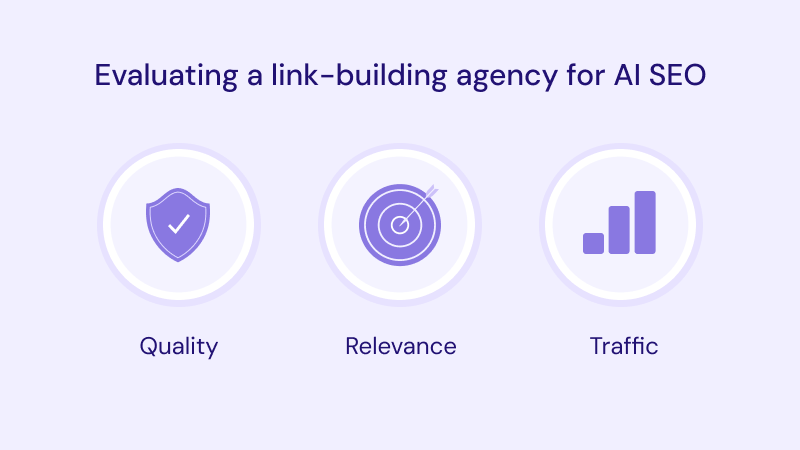
  "alt": "Infographic titled 'Evaluating a link-building agency for AI SEO' with icons for Quality, Relevance, and Traffic.",
  "caption": "Discover the key factors in selecting a link-building agency for AI SEO: Quality, Relevance, and Traffic highlighted through intuitive icons.",
  "description": "This infographic titled 'Evaluating a link-building agency for AI SEO' visualizes three essential evaluation criteria: Quality, Relevance, and Traffic, each represented by distinct icons. Quality features a shield with a check mark, Relevance is symbolized by a target, and Traffic is depicted with a bar graph. The design uses a violet color scheme and a clear layout, making it ideal for SEO professionals seeking to enhance their decision-making processes."
}
```

    The conclusion is clear. AI systems and search engines assess websites differently now. We’re no longer just building links for Google’s crawler.

    Link equity alone won’t suffice. Sites must establish topical authority, brand mentions, and a genuine market presence, aiming to build a footprint recognizable and unavoidable by AI models.

    Choosing the ideal link building agency depends on their alignment with current priority factors.

    Here’s what to focus on.

    Prioritizing Quality, Relevance, and Traffic

    I’ve seen many marketing directors judge link quality solely by Domain Rating (DR).

    While high DR is important, at uSERP, we recognize it’s not the ultimate measure. Additional factors to consider include:

    • Relevance: A niche-specific site with a DR of 60 often provides more value than a DR 80 general news site that covers diverse topics.
    • Minimum traffic standards: A site’s ranking for keywords and real traffic are critical; hence, strict traffic minimums are essential.

    When vetting an agency, request contractual site-traffic guarantees.

    An agency confident in their capabilities will gladly sign a Statement of Work guaranteeing each link comes from a site with a traffic threshold, such as 5,000+ monthly organic visitors.

    If they refuse to document traffic minimums, they may intend to place links on “ghost town” sites—domains appearing robust but lacking a real audience, safeguarding their margins rather than fostering your growth.

    ```json
{
  "alt": "uSERP webpage on backlink strategies for SEO in 2025, includes an article about white hat link building.",
  "caption": "Discover what over 800 SEO experts predict for backlinks by 2025 in this insightful article from uSERP. Explore strategies for ranking success in a changing digital landscape.",
  "description": "This image shows a screenshot from a uSERP webpage discussing the future of backlinks for SEO in 2025. The page highlights insights from over 800 SEO professionals on link building strategies. Emphasized are quality backlinks via white hat methods. The site includes SEO Power Plays subscription options and boasts content from reputable sources and SEO tips. Keywords include backlinks, SEO, link building, and strategies."
}
```

    Look for a Content-Driven Approach and Digital PR

    Links thrive as part of genuine conversations.

    Leading agencies now function like content marketing and digital PR teams, not traditional link builders.

    Instead of requesting links, they craft linkworthy assets—data studies, expert commentary, and in-depth guides publishers want to cite, understanding that:

    • Google’s algorithms and AI models are adept at spotting paid placements, making a content-led approach crucial for ensuring links remain natural and valuable.
    • Guest posting in the AI SEO era is about thought leadership, not throwaway articles, positioning your CEO as a credible expert.

    At uSERP, for example, we’ve developed and continue to update our State of Backlinks for SEO report.

    Red Flags: Recognizing Outdated or Dangerous Tactics

    Choosing a misguided partner doesn’t just squander your budget—it jeopardizes your brand reputation and future prospects.

    Here are the major red flags to steer clear of when engaging an agency:

    Guaranteed Rankings

    No one can promise a top Google ranking. Any agency offering fixed timeline keyword positions is likely either:

    • Using risky, short-lived tactics to create fleeting spikes.
    • Offering empty promises.

    Such agencies commonly leverage private blog networks (PBNs) or manipulate anchor text for quick gains.

    Though you may witness initial growth, the subsequent decline and potential penalties when Google catches on aren’t worth the risk.

    ```json
{
  "alt": "Image highlighting red flags in choosing a link-building agency, such as guaranteed rankings and lack of transparency.",
  "caption": "Beware of red flags when selecting a link-building agency, like promises of guaranteed rankings and lack of transparency. Choose wisely!",
  "description": "This image presents important red flags to be aware of when selecting a link-building agency. Key warnings include guaranteed rankings, lack of transparency, self-serve link portfolios, and dirt-cheap packages. The background is light purple, featuring an icon of a red flag with text highlighting these cautionary points. This is a helpful reference for those seeking quality digital marketing partnerships. Keywords: link-building, red flags, agency selection."
}
```

    Lack of Transparency

    If an agency can’t disclose link acquisition strategies or placement sources upfront, it’s wise to be cautious.

    Trustworthy agencies are transparent and will share genuine past placement examples and relevant case studies from your industry.

    Agencies concealing their inventory often do so to hide affiliation with low-quality networks or link farms.

    If you’re active on LinkedIn, you may have received messages offering self-serve link portfolios.

    I understand the temptation—strategic link acquisition is challenging, while buying and flipping links is straightforward.

    The issue is the lack of uniqueness. If an agency secures a link through a simple form, anyone can replicate it, including malicious entities.

    Such practices don’t create a natural link profile. Google usually identifies and devalues these domains.

    At best, you waste money on ineffective links. At worst, Google associates your site with link schemes.

    Dirt-Cheap Packages

    Quality SEO and link building offer substantial ROI but aren’t inexpensive endeavors.

    ```json
{
  "alt": "Email offering guest posting and link building services for website ranking.",
  "caption": "Boost your website's ranking with expert guest posting and link building services.",
  "description": "This image contains an email offering services in guest posting and link building to enhance website ranking on search engines. It mentions the provision of high authority backlinks from Google News approved sites and permanent posts with do-follow backlinks on websites with high domain authority. The email aims to attract interest by promising organic traffic and growth, with an invitation to check a website list for more details."
}
```

    Acquiring quality articles with genuine, authoritative links is a costly process that cannot be cheapened.

    Therefore, inexpensive packages boasting multiple high-authority links raise red flags, often involving:

    • AI-generated, poorly edited content.
    • Low-value or resold inventory links.
    • Toxic backlinks.

    These approaches fail to enhance your AI search visibility or Google ranking.

    In the AI era, link building is a lasting investment, focusing on solid market presence over temporary gains.

    The right partner functions as an extension of your team, prioritizing:

    • Your backlink gap relative to competitors.
    • Your brand mentions in LLMs.
    • Your aggregate search and AI presence.

    They assist in content syndication, backlink audits, content marketing, and modern link building with a cohesive strategy.

    If you’re ready to move beyond surface metrics and build revenue-driving AI credibility, carefully choose who to trust with your domain.

    The perfect link building agency is out there. You just need to recognize them.


    Inspired by this post on Search Engine Land.


    crushpress.ai community screenshot